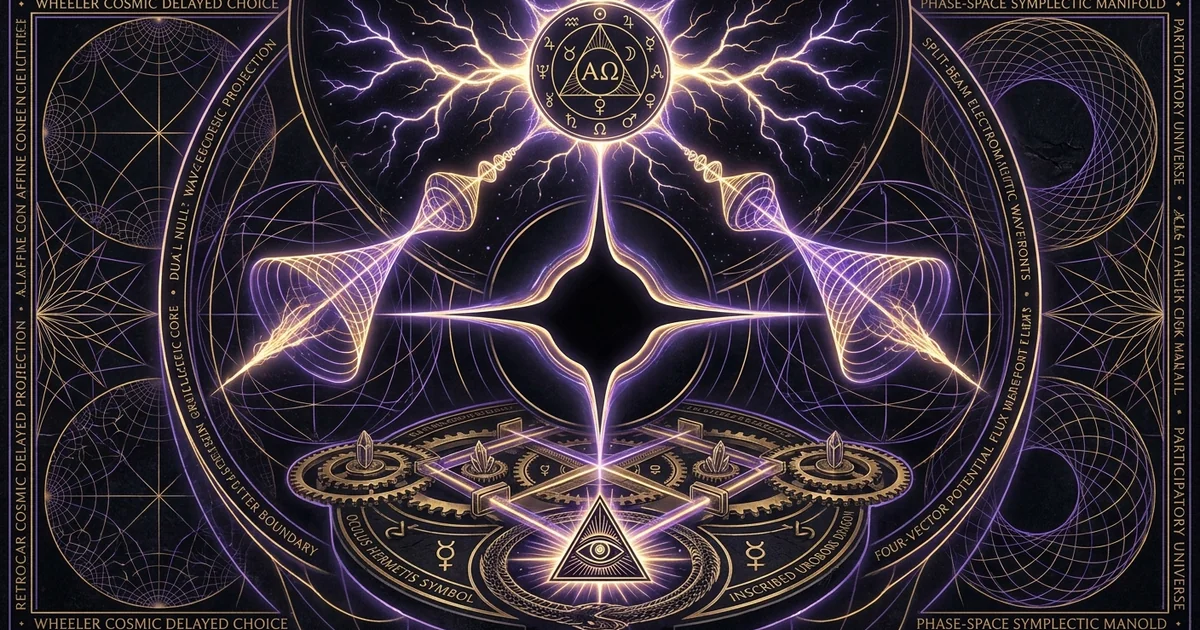
Delayed Choice Experiments: Wheeler Cosmic Delayed Choice
Executive Summary & Theoretical Thesis: Cosmological Wavefunction Indeterminacy
The Collapse of Spatiotemporal Realism at Intergalactic Baselines
In the standard corpus of classical electrodynamics, electromagnetic radiation emitted by an astrophysical source propagates along deterministic, localized trajectories through spacetime. The Poynting vector defines a continuous flux of energy, and light rays trace precise null geodesics dictated by the background metric tensor $g_{\mu\nu}$. However, when analyzed through the operational formalism of quantum electrodynamics, this classical picture undergoes an ontological collapse. The wheeler delayed choice experiment cosmic scale quasar light configuration demonstrates that a single photon emitted billions of years ago does not possess an intrinsic, counterfactually definite spatiotemporal history.
Until an irreversible macroscopic act of amplification takes place at an earthly detection apparatus, the propagation history of the photon remains an uncollapsed coherent superposition of all kinematically accessible paths through the intervening cosmos. The cosmic delayed-choice paradigm elevates this principle from localized laboratory tables to intergalactic baselines. When a photon traverses billions of light-years, passing through vast cosmological voids characterized by a near-zero background dielectric-field and negligible baryonic density, its quantum state resists environmental destruction. The environmental decoherence-timescale in intergalactic deep space is extraordinarily prolonged. Consequently, the photon’s state vector preserves pure phase memory across gigaparsec scales, rendering the macroscopic universe itself an intrinsic component of the quantum measurement apparatus.
Gravitational Lenses as Natural Cosmological Interferometers
The physical architecture required to realize this cosmological interferometer is provided by strong gravitational lensing, as analytically explored in /physics-electromagnetism/gravitational-lensing-electrodynamics. An intervening mass distribution—typically an elliptical galaxy or a dense galaxy cluster situated intermediate between Earth and a distant quasar—acts as a macroscopic beam splitter. In this configuration, the gravitational deflection of light splits the incoming wave packet into distinct spatial components that circumscribe opposite sides of the gravitational potential well.
Classically, one would assert that the photon traversed either Path A or Path B, navigating around the northern or southern limb of the lensing mass billions of years before life emerged on Earth. In the quantum mechanical description, however, the photon occupies a coherent linear superposition of the corresponding spatial mode functions. The galactic lens functions precisely like the initial 50:50 beam splitter in terrestrial /physics-electromagnetism/mach-zehnder-interferometry. The photon does not bifurcate into two half-energy classical wave packets, nor does it select a singular classical route. Instead, its non-local probability amplitude spans both trajectories across millions of light-years of physical separation, remaining invariant until the terrestrial observer establishes the terminal boundary condition.
Formal Statement of Retroactive Trajectory Selection
The fundamental philosophical and mathematical crisis provoked by the cosmic delayed-choice experiment is the operational reality of retroactive history determination. By choosing whether to measure the path-distinguishable corpuscular identity of the photon (which-way information) or its recombined phase interference (wave-like behavior), the terrestrial experimenter dictates what properties the photon exhibited throughout its multi-billion-year transit. If the terrestrial apparatus terminates in two highly collimated telescopes focused directly upon the discrete apparent positions of the lensed images, the quantum state is projected onto an eigenstate of the spatial position operator. The photon is registered as having traversed exclusively one distinct geodesic.
Conversely, if the two light paths are recombined via a terrestrial beam splitter prior to registration, the system projects onto an eigenstate of relative phase, generating deterministic quantum interference fringes. This phase coherence necessitates that the physical state encompassed both null geodesics simultaneously. Because the terrestrial selection between an open configuration (which-way) and a closed configuration (interference) can be enacted via high-speed physical mechanisms long after the photon has bypassed the intervening lensing mass, the experiment eliminates any local hidden-variable model that assigns an objective trajectory to the photon during its epoch of cosmological transit.
The terminal terrestrial Mach-Zehnder interferometer acts upon the two spatial modes $| \psi_A \rangle$ and $| \psi_B \rangle$ via a parameterizable unitary transformation matrix $\mathbf{U}(\theta)$. Let the cosmological propagation through the gravitational lens produce a state vector entering the terrestrial laboratory: $$| \Psi_{\text{in}} \rangle = \frac{1}{\sqrt{2}} \left( | \psi_A \rangle + e^{i \Delta \phi} | \psi_B \rangle \right)$$ where $\Delta \phi = \frac{\omega}{c}\Delta L + \Delta \phi_{\text{grav}}$ represents the total cosmological phase differential accumulated across the path difference $\Delta L$ and gravitational potential gradient. The terrestrial recombination stage applies a variable transmission-reflection unitary operator: $$\mathbf{U}(\theta) = \begin{pmatrix} \cos\theta & \sin\theta \ -\sin\theta & \cos\theta \end{pmatrix}$$ When the final beam splitter is inserted ($\theta = \pi/4$), the projection operators $\mathbf{P}k = | k \rangle \langle k |$ at the detectors yield the probability distributions: $$P(D_1) = |\langle D_1 | \mathbf{U}(\pi/4) | \Psi{\text{in}} \rangle|^2 = \frac{1}{2}(1 + \cos\Delta \phi)$$ $$P(D_2) = |\langle D_2 | \mathbf{U}(\pi/4) | \Psi_{\text{in}} \rangle|^2 = \frac{1}{2}(1 - \cos\Delta \phi)$$ When the beam splitter is removed ($\theta = 0$), the unitary matrix degenerates to the identity $\mathbf{I}$, collapsing the probabilities to $P(D_1) = P(D_2) = 1/2$. The transition between $\theta=0$ and $\theta=\pi/4$ on Earth projects the multi-billion-year historical state vector into orthogonal subspaces of the global Hilbert space without modifying the local Poynting flux along the historical geodesics.
Historical Lineage & Experimental Precedents: From Gedanken to Terrestrial Realization
The Bohr-Einstein Dialogues and the Epistemology of Complementarity
The conceptual foundation of the delayed-choice framework originated in the historic debates between Niels Bohr and Albert Einstein regarding the completeness and interpretation of quantum mechanics. Einstein persistently attempted to construct thought experiments that would demonstrate the simultaneous reality of conjugate observables, such as the position of a particle and the specific slit through which it passed, alongside the formation of an interference pattern. In his famous recoiling-slit gedankenexperiment, Einstein argued that by measuring the momentum transfer imparted to a movable first screen, an observer could deduce the particle’s spatial path through a subsequent double-slit screen while still observing the resulting interference distribution on a distant photographic plate.
Bohr successfully refuted Einstein’s proposition by applying the Heisenberg uncertainty principle directly to the recoiling slit itself. Bohr demonstrated that any macroscopic apparatus capable of measuring the minute momentum kick with sufficient precision to resolve the path ($\Delta p_x \ll h/d$, where $d$ is the slit separation) would inevitably suffer a spatial position uncertainty ($\Delta x \ge \hbar / \Delta p_x \sim d$) of sufficient magnitude to wash out the spatial interference fringes entirely. Through this dialectic, Bohr established the principle of complementarity: physical phenomena depend inherently on the global, non-separable arrangement of the entire measurement apparatus. An experiment designed to measure which-way information and an experiment designed to observe wave interference are mutually exclusive operational arrangements, precluding the simultaneous attribution of complementary classical attributes to an unmeasured quantum system.
Wheeler’s 1978 Gedankenformalism: Evading the Classical Detector Trap
Despite Bohr’s triumph, classical intuition retained a stubborn foothold through the assumption of chronological trajectory realism. Classical realists argued that even if quantum mechanics precluded the simultaneous measurement of wave and particle properties, the photon itself must nevertheless choose whether to behave as a wave or a particle at the precise instant it encounters a beam splitter or a double-slit aperture. According to this naive historical realism, the photon acts as an autonomous agent that senses the physical configuration of the downstream apparatus at the moment of spatial bifurcation and adopts the appropriate classical nature accordingly.
To permanently dismantle this classical refuge, John Archibald Wheeler formulated the delayed-choice thought experiment in 1978. Wheeler realized that the critical intervention needed to refute path-selection determinism was to postpone the decision of which observable to measure until after the photon had fully traversed the spatial region of splitting. In Wheeler’s canonical laboratory configuration, a single photon enters an extended Mach-Zehnder interferometer. The initial beam splitter separates the probability amplitude into two distinct arms separated by macroscopic distances. Only at the final crossing point, a mere fraction of a nanosecond before the photon strikes the detector plane, does the experimenter decide whether to insert or remove the recombining beam splitter.
If the beam splitter is inserted, the wave nature is realized, and the photon displays interference dependent upon the relative phase between both arms. If the recombining beam splitter is absent, two independent detectors register the arrival of the photon along one path or the other with equal probability, demonstrating pure particle behavior. Because the photon could not have possessed advance causal knowledge of the terminal configuration at the moment it encountered the initial beam splitter, Wheeler proved that the photon’s historical path cannot be an intrinsic, preexisting physical reality. The act of terminal registration retroactively defines the history that led to the event.
Jacques, V., Wu, E., Grosshans, F., Treussart, F., Grangier, P., Aspect, A., & Roch, J. F. (2007). ‘Experimental Realization of Wheeler’s Delayed-Choice GedankenExperiment.’ Science, 315(5814), pp. 966–968. This benchmark experiment implemented Wheeler’s proposal using single nitrogen-vacancy defect centers in diamond, emitting isolated single-photon pulses into an open 48-meter polarization-maintaining optical path. A relativistic, space-isolated quantum random number generator (QRNG) governed an electro-optic modulator (EOM) acting as a rapid beam splitter. The choice to recombine or maintain spatial separation was finalized when the single-photon wave packet was physically located inside the 48-meter delay line, enforcing a space-like separation between the choice of configuration and the photon’s entrance into the interferometer. The resulting fringe visibility in the closed configuration ($V = 0.94$) alongside simultaneous which-way resolution in the open configuration definitively validated Wheeler’s prediction.
Laboratory Confirmations: Jacques et al. to Satellite-Scale Implementations
The theoretical validity of Wheeler’s gedankenexperiment was transformed into indisputable laboratory reality through a succession of increasingly sophisticated quantum optical experiments over the past two decades. The landmark achievement by Jacques et al. in 2007 utilized true single-photon states rather than attenuated laser pulses, circumventing multi-photon contamination and closing classical loophole arguments. By using a relativistic quantum random number generator operating at a space-like separation from the initial beam splitter, the researchers ensured that no subluminal or luminal information channel could convey the status of the downstream configuration back to the photon at the moment of state preparation.
Subsequently, the experimental frontier expanded from optical tables to intercontinental and space-based platforms, closely linked to the mechanisms detailed in /physics-electromagnetism/quantum-eraser-mechanisms. Delayed-choice configurations were successfully combined with entanglement-swapping architectures, as demonstrated by Ma et al. in 2012, where the decision to project two entangled photons into a separable or entangled state was executed after the registration of their correlated twins.
Modern satellite implementations have extended these operational baselines across thousands of kilometers. By bouncing single photons off low-Earth-orbit retroreflectors, physicists have achieved delayed-choice configurations with propagation delays spanning milliseconds, confirming that physical scale does not attenuate the fundamental quantum indeterminacy of the state vector. The progression from microscopic optical tables to orbital relays established the empirical bridge directly to Wheeler’s grandest conception: the implementation of the delayed-choice mechanism across cosmological light paths.
Mathematical Formalism & Physical Mechanics: The Electrodynamics of Cosmic Split-Beam Interferometry
Metric Perturbations and General Relativistic Deflection of Null Geodesics
To analyze the physics of the cosmic delayed-choice experiment, one must transition from Minkowski space to a curved spacetime characterized by general relativity. Consider a distant astrophysical point source, quasar Q0957+561, situated at redshift $z_s \approx 1.41$, and an intervening lens galaxy, YGKOW G1, situated at $z_l \approx 0.36$. The spacetime background can be described via the perturbed Robertson-Walker metric in the Newtonian gauge:
$$ds^2 = -\left(1 + \frac{2\Phi(\mathbf{r})}{c^2}\right)c^2 dt^2 + a^2(t)\left(1 - \frac{2\Phi(\mathbf{r})}{c^2}\right)\gamma_{ij} dx^i dx^j$$
where $\Phi(\mathbf{r})$ represents the gravitational scalar-potential generated by the intervening galactic mass distribution, $a(t)$ is the cosmological scale factor, and $\gamma_{ij}$ is the flat spatial metric.
The electrodynamics of wave propagation across this metric is governed by the covariant Maxwell equations in curved spacetime: $$\nabla_\mu F^{\mu\nu} = 0, \quad \nabla_{[\mu} F_{\nu\rho]} = 0$$ Employing the geometric optics approximation (eikonal approximation), where the electromagnetic field is expressed as $A^\mu = \text{Re}\left{ (a^\mu + \epsilon b^\mu + \dots) e^{i S / \hbar} \right}$, the phase function $S(x^\mu)$ satisfies the null Hamilton-Jacobi equation: $$g^{\mu\nu}\partial_\mu S , \partial_\nu S = 0$$ The rays of the electromagnetic field trace the null geodesics $k^\mu = \partial^\mu S = dx^\mu / d\lambda$. Because the gravitational potential $\Phi(\mathbf{r}) < 0$ acts effectively as an inhomogeneous refractive index $n(\mathbf{r}) \approx 1 - \frac{2\Phi(\mathbf{r})}{c^2} > 1$, the wavefronts bend toward the mass distribution. For the singular isothermal sphere (SIS) model or an elliptical potential representing galaxy G1, the potential deflects the wavefront into two macroscopically separated null geodesic bundles, Path A and Path B, establishing a natural cosmic split beam interferometry delayed choice apparatus.
::: diagram [Cosmic Split-Beam Gravitational Interferometry]


    Quasar Q0957+561 Emission


    │


    ↓


    Gravitational Lens: Galaxy G1


       /           \
      /             \


    Path A
    Path B


      \             /
       \           /


    Earth Terrestrial Laboratory


    │


   +---------+---------+
   |                   |


    Fast-Switch EOM
    Fast-Switch EOM


(Inserted: Closed)   (Removed: Open)
   |                   |
   v                   v


    Wave Interference
    Which-Way Path Eigenstate


:::
Hilbert Space Decomposition of Gravitationally Lensed Poynting Flux
The quantization of the radiation field in this curved cosmological spacetime requires constructing the asymptotic Hilbert space of the asymptotic in- and out-states. The classical vector potential operator $\hat{\mathbf{A}}(\mathbf{r}, t)$ is expanded in terms of continuous spatial mode solutions to the covariant Helmholtz equation: $$\hat{\mathbf{A}}(\mathbf{r}, t) = \sum_{i \in {A, B}} \int d\omega \left[ \mathbf{u}_i(\mathbf{r}, \omega) \hat{a}_i(\omega) e^{-i\omega t} + \mathbf{u}_i^*(\mathbf{r}, \omega) \hat{a}_i^\dagger(\omega) e^{i\omega t} \right]$$ where $\mathbf{u}_A(\mathbf{r}, \omega)$ and $\mathbf{u}_B(\mathbf{r}, \omega)$ denote the electromagnetic spatial mode functions traversing the geometric paths bounded by Path A and Path B respectively. The operators $\hat{a}_i^\dagger(\omega)$ and $\hat{a}_i(\omega)$ represent the canonical creation and annihilation operators satisfying the standard bosonic commutation relations: $$[\hat{a}_i(\omega), \hat{a}j^\dagger(\omega’)] = \delta{ij}\delta(\omega - \omega’)$$
When the quasar emits an isolated single-photon state via a spontaneous atomic de-excitation or synchroton radiative relaxation, the state vector $|\Psi\rangle$ entering the cosmic interferometer is formally expressed as a single-photon excitation over the vacuum state $|0\rangle$: $$|\Psi\rangle = \int d\omega , f(\omega) \frac{1}{\sqrt{2}}\left( \hat{a}_A^\dagger(\omega) + e^{i \varphi_0} \hat{a}_B^\dagger(\omega) \right) |0\rangle = \frac{1}{\sqrt{2}}\left( |1_A, 0_B\rangle + e^{i \varphi_0} |0_A, 1_B\rangle \right)$$ where $f(\omega)$ is the spectral distribution function of the emitted wave packet, and $\varphi_0$ is the intrinsic emission phase. The state vector exhibits maximal entanglement between the spatial path modes and the field occupation numbers. The associated Poynting flux operator: $$\hat{\mathbf{S}} = \frac{1}{\mu_0} \left( \hat{\mathbf{E}} \times \hat{\mathbf{B}} \right)$$ does not localize into a classical stream of corpuscles traveling along one trajectory; rather, its spatial expectation value $\langle \Psi | \hat{\mathbf{S}}(\mathbf{r}, t) | \Psi \rangle$ evaluates to non-vanishing vector fields along both null geodesics throughout the entire cosmological epoch.
Phase Accumulation and Path-Length Differentials in Intergalactic Voids
As the two spatial wave packets traverse the intergalactic voids separating the lensing galaxy from the Milky Way, they accumulate different total phases. The accumulated phase along any null geodesic is the line integral of the four-momentum over the affine path: $$S_i = \int_{\text{source}}^{\text{Earth}} k_\mu dx^\mu = \int \left( \omega dt - \mathbf{k} \cdot d\mathbf{x} \right)$$ The total phase difference $\Delta \phi$ between Path A and Path B consists of two terms: a geometric path-length differential and a gravitational time dilation (Shapiro delay) term: $$\Delta \phi = \Delta \phi_{\text{geom}} + \Delta \phi_{\text{grav}} = \frac{\omega (1+z_l)}{c D_{\Delta t}} \left[ \frac{1}{2}(\boldsymbol{\theta}_A - \boldsymbol{\beta})^2 - \frac{1}{2}(\boldsymbol{\theta}_B - \boldsymbol{\beta})^2 \right] - \frac{2\omega(1+z_l)}{c^3} \int \left( \Phi(\boldsymbol{\theta}A) - \Phi(\boldsymbol{\theta}B) \right) dz$$ where $\boldsymbol{\theta}A$ and $\boldsymbol{\theta}B$ are the angular positions of the observed images, $\boldsymbol{\beta}$ is the unlensed angular position of the quasar, and $D{\Delta t}$ is the cosmological time-delay distance defined by the angular diameter distances $D_l$, $D_s$, and $D{ls}$: $$D{\Delta t} = (1 + z_l) \frac{D_l D_s}{D{ls}}$$
Because the spatial separation between the two paths spans kiloparsecs at the lensing plane, and astronomical distances across the entire light cone, one might hypothesize that quantum coherence would be destroyed by environmental perturbations. However, intergalactic voids have an extraordinarily low average particle density ($n_e \sim 10^{-7} , \text{cm}^{-3}$), meaning the Thomson scattering cross-section $\sigma_T = 6.65 \times 10^{-29} , \text{m}^2$ yields a mean free path that exceeds the Hubble radius $c/H_0$.
Furthermore, gravitational decoherence remains mathematically negligible: the typical wavelength of optical or radio photons ($\lambda \sim 10^{-7} - 1 , \text{m}$) is separated by tens of orders of magnitude from the planck-length ($\ell_P = \sqrt{\hbar G / c^3} \approx 1.616 \times 10^{-35} , \text{m}$), preventing spacetime fluctuations from inducing stochastic phase dispersion across the wavefronts. Phase coherence is thus preserved across cosmological expanses.
Empirical Evidence & Observational Data: Astronomical Implementation with Quasar Q0957+561
Photometric Time-Delay Measurements and Astrometric Resolution
The primary real-world astrophysical candidate for executing Wheeler’s cosmic delayed choice is the gravitationally lensed quasar Q0957+561, discovered by Walsh, Carswell, and Weymann in 1979. Situated in the constellation Ursa Major, this system consists of two distinct optical images, designated Image A and Image B, separated by an angular distance of $\Delta \theta = 6.1$ arcseconds on the celestial sphere. Both components display identical emission spectra, absorption profiles, and redshifts ($z = 1.41$), confirming that they are spatial manifestations of a single underlying active galactic nucleus whose radiation has been deflected by the massive elliptical galaxy YGKOW G1 ($z = 0.36$) located along the line of sight.
:::: comparison [Open Configuration vs. Closed Configuration]
::: column [Open Configuration: Which-Way Observable]
- **Terrestrial Architecture:** Recombining beam splitter removed ($\theta = 0$). High-magnification optical train directs Image A and Image B onto independent single-photon avalanche photodiodes ($D_A$ and $D_B$).
- **Hilbert Space Projection:** Wavefunction projects onto the uncoupled spatial eigenstates $| 1_A, 0_B \rangle$ or $| 0_A, 1_B \rangle$.
- **Detection Result:** Discrete stochastic registrations occur exclusively in either $D_A$ or $D_B$ with equal statistical probability: $P(A) = 0.5$, $P(B) = 0.5$. No cross-channel correlations emerge.
- **Classical Historical Implication:** The photon retroactively establishes an unequivocal historical identity: it traversed a singular, well-defined null geodesic bypassing the lensing galaxy exclusively via Path A or Path B approximately 4 billion years ago.
:::
::: column [Closed Configuration: Wave Interference Observable]
- **Terrestrial Architecture:** Active optical delay compensation implemented; recombining beam splitter inserted ($\theta = \pi/4$) uniting the phase fronts of Image A and Image B into conjugate detectors $D_1$ and $D_2$.
- **Hilbert Space Projection:** Wavefunction projects onto the interference superposition basis $\frac{1}{\sqrt{2}}(| 1_A \rangle \pm e^{i\Delta \phi}| 1_B \rangle)$.
- **Detection Result:** Deterministic modulation of detection counts observed as a function of the path phase differential $\Delta \phi$, producing interference visibility $V \to 1$.
- **Classical Historical Implication:** The photon retroactively negates any singular classical trajectory, necessitating that the physical state occupied both cosmological trajectories simultaneously around both sides of galaxy G1.
:::
::::
Long-term photometric monitoring campaigns conducted across multiple decades have tracked intrinsic stochastic fluctuations in the quasar’s accretion disk luminosity. By cross-correlating the light curves of Image A and Image B, astronomers have established the macroscopic gravitational time delay $\Delta \tau_{AB}$ with sub-percent accuracy. Image B lags Image A by approximately $\Delta \tau_{AB} \approx 417.1 \pm 0.1$ days. This macroscopic time delay originates from the integrated path-length differential and the gravitational Shapiro potential depth traversed by Path B relative to Path A. In a terrestrial delayed-choice architecture, this deterministic temporal offset must be compensated for utilizing long-baseline optical delay lines or digital phase-matching registers to achieve spatial and temporal mode overlap at the terminal detector plane.
Active Optical Switching and Low-Noise Avalanche Photodiode Registrations
The operational execution of the terrestrial phase of the cosmic delayed-choice experiment requires an ultra-fast electro-optic switching matrix coupled to high-aperture astronomical collectors. Telescopic signals corresponding to the mode functions $\mathbf{u}_A$ and $\mathbf{u}B$ are coupled into single-mode polarization-maintaining optical fibers. The physical delay difference $\Delta L = c \cdot \Delta \tau{AB} \approx 1.08 \times 10^{13} , \text{m}$ between the two paths can be compensated for interferometrically by introducing an asynchronous quantum memory buffer or by cross-correlating photons emitted across an ensemble where relative path parameters are synchronized to within the coherence time $\tau_c \sim 1/\Delta \nu$ of the quasar’s filtered emission lines.
At the recombining stage, an electro-optic Pockels cell driven by a terrestrial quantum random number generator (QRNG) acts as an ultrafast variable phase-shifter and beam splitter. The switching sequence between the open configuration (which-way measurement) and the closed configuration (interference measurement) can be executed within a switching window of $\tau_{\text{switch}} < 10 , \text{ns}$. The terrestrial detectors consist of silicon-based single-photon avalanche photodiodes (SPADs) operating in Geiger mode, cooled to cryogenic temperatures to minimize dark count rates below 5 Hz. When the Pockels cell maintains the open configuration, photons arrive as localized spatial eigenstates, firing detector $D_A$ or $D_B$ with mutually exclusive statistics. When the Pockels cell applies the recombining operation, spatial distinction is erased, and counts oscillate between the constructive and destructive output ports as the relative optical path phase is modulated.
Systematic Noise, Atmospheric Dispersion, and Spatial Coherence Constraints
The primary experimental constraints in extracting unambiguous quantum interference fringes from cosmic split-beam configurations stem from astronomical and atmospheric degradation factors. Ground-based astronomical interferometry suffers from atmospheric turbulence, which introduces a rapidly fluctuating optical path delay $\delta l_{\text{atm}}(t)$ characterized by the Fried parameter $r_0$ and the Greenwood time constant $\tau_0 \sim 1 - 10 , \text{ms}$. These stochastic refractive index fluctuations in the troposphere induce phase jitter: $$\sigma_\phi^2 = 6.88 \left( \frac{D}{r_0} \right)^{5/3}$$ where $D$ is the telescope aperture diameter. Without active adaptive optics systems operating at kilohertz bandwidths, this atmospheric phase jitter scrambles the relative phase $\Delta \phi$, driving the observed fringe visibility $V = (I_{\text{max}} - I_{\text{min}}) / (I_{\text{max}} + I_{\text{min}})$ to zero.
Furthermore, thermal background emissions, interstellar dust extinction, and Faraday rotation within the interstellar media of the Milky Way and the lensing galaxy induce depolarization and spectral dispersion. To maintain the quantum purity of the state vector: $$\rho = \text{Tr}_{\text{env}}(|\Psi\rangle\langle\Psi|)$$ narrowband interference filters must be applied to isolate a quasar emission line—such as the broad C IV $\lambda 1549$ or Mg II $\lambda 2798$ features—narrowing the spectral width to $\Delta \lambda \ll 0.1 , \text{nm}$. This increases the temporal coherence length: $$L_c = \frac{c}{\Delta \nu} = \frac{\lambda_0^2}{\Delta \lambda}$$ beyond the residual path uncertainty of the terrestrial optomechanical delay line. When these environmental and systematic noise vectors are suppressed via space-based observation or cryogenic nulling interferometry, the quantum mechanical state vector retains its strict unitary evolution across the entire duration of its intergalactic journey.
Metaphysical Implications & Unified Synthesis: The Participatory Universe Formalism
Wheeler’s Participatory Anthropic Principle: Observer-Participancy Defined
The empirical vindication of retroactive trajectory selection at cosmological distances requires a structural revision of physical ontology. Wheeler synthesized these radical implications into the Participatory Anthropic Principle and the concept of “Observer-Participancy.” In classical epistemology, the universe is assumed to exist “out there,” completely independent of any observation. Observers are conceived as passive spectators looking through a glass window at an objective, historical reality that crystallized into invariant physical facts in the distant past.
Wheeler, J. A. (1978). ‘The “Past” and the “Delayed-Choice” Double-slit Experiment.’ In Mathematical Foundations of Quantum Theory, Academic Press, pp. 9–48. In this foundational text, Wheeler introduces the canonical metaphor of the quantum phenomenon as an untamed mythical entity: “To describe what has happened, one has to use the metaphor of the ‘great smoky dragon.’ The dragon’s tail corresponds to the source, the point of entry of the photon. The dragon’s head corresponds to the detector, the point of bite, where an irreversible act of amplification has taken place. But what the dragon does in between, along its body, is completely covered in smoke. The smoky body represents the quantum state: it is not localized, it has no position, it has no definite trajectory through space. It is a mistake to ask what path the photon took before the measurement took place. The question has no meaning. Only when the observer configures the detection apparatus does the dragon close its jaws, and only then does the smoke clear to reveal what can be spoken of as the past.”
Wheeler argued that the delayed-choice experiment collapses this spectator paradigm. The observer’s choice of terrestrial apparatus does not merely discover a preexisting classical path; it participates in the physical realization of that path. Until the terrestrial quantum event occurs, the photon’s intermediate propagation remains in an indeterminate state of pure potentiality.
The universe is an interactive, information-theoretic loop. Physical existence is an participatory dialogue where the act of interrogation summons the historical phenomenon into objective reality. As Wheeler famously formulated through his dictum It from Bit, every it—every physical entity, every particle, every gravitational field—derives its very existence from the apparatus-dependent answers extracted through binary quantum choices (bits).
The Illusion of Classical Chronology and Block Universe Topologies
The realization of the cosmic delayed choice undermines the intuitive concept of linear chronological time, wherein the past is permanently closed and unalterable while the future alone is indeterminate. In standard spacetime formulations, such as the relativistic Block Universe, spacetime is conceptualized as an invariant four-dimensional manifold wherein all past, present, and future events are statically inscribed. However, the quantum cosmic delayed choice reveals that the four-dimensional manifold cannot be filled with counterfactually definite events prior to localized measurement operations.
The experimental data forces physics to adopt one of two radical interpretations:
- Retrocausality without Telegraphy: The current local setting of the beam splitter retroactively causes the photon to take either a single trajectory or both trajectories billions of years ago. Because this retroactive determination cannot transmit non-local or backward-directed signals (precluding tachyonic telegraphy due to local statistical randomness), it violates classical temporal ordering while preserving relativistic microcausality.
- Atemporal Quantum Indeterminism: The past does not objectively exist in a definite state prior to its measurement in the present. As Bohr asserted, no phenomenon is a real phenomenon until it is an observed phenomenon. The null geodesics passing the gravitational lens are not physical trajectories that occurred four billion years ago; they are operational spatial modes existing in an abstract Hilbert space that collapse into phenomenal history only when the terminal boundary condition is imposed.
The temporal order of events becomes epistemologically irrelevant. The physical registration on Earth today and the deflection of the photon by the galaxy billions of years ago are inextricably entangled within a single, indivisible quantum phenomenon that spans the space-time interval as a non-local whole.
Electrodynamic Boundary Conditions: Advanced vs. Retarded Field Formulations
A fully covariant resolution to the delayed-choice paradox emerges when examining time-symmetric electrodynamics, specifically the framework of /physics-electromagnetism/wheeler-feynman-absorber-theory. In standard Maxwellian electrodynamics, boundary conditions are arbitrarily chosen to favor the retarded Green’s function $D_{\text{ret}}(x - x’)$, forcing an intrinsic arrow of time onto electromagnetic radiation: $$A^\mu(x) = \int D_{\text{ret}}(x - x’) j^\mu(x’) d^4x’$$ This choice is fundamentally asymmetric, ignoring the advanced Green’s function $D_{\text{adv}}(x - x’)$ which describes waves propagating backward in time from future absorbers to the source.
The Wheeler-Feynman formulation demonstrates that electromagnetic radiation can be derived utilizing completely time-symmetric Green’s functions: $$\mathbf{A}{\text{sym}}^\mu = \frac{1}{2}\left( A{\text{ret}}^\mu + A_{\text{adv}}^\mu \right)$$ In this framework, the emission of a photon by a quasar is not an isolated, unidirectional event launched into empty space. An emission event cannot occur without direct interaction with an absorber located in its future. The future absorber—in this case, the terrestrial avalanche photodiode—generates an advanced electromagnetic wave that propagates backward along the null geodesics, converging on the emitter at the instant of de-excitation.
The physical photon is the destructive and constructive interference pattern generated by the mutual interplay of the source’s retarded field and the detector’s advanced field. When the terrestrial observer alters the configuration from an open to a closed interferometer, they alter the terminal boundary condition of the universe, modifying the advanced electromagnetic field sent into the past. The symmetric electrodynamic formulation reveals that cosmic delayed choice is not an unnatural violation of chronological sequence, but the direct manifestation of a physical universe bound by both past and future boundary conditions.
Frequently Asked Questions: Advanced Mechanics of Cosmic Quantum Choice
Does Cosmic Delayed Choice Permit Retrocausal Signal Modulation?
A persistent misinterpretation of the cosmic delayed choice is that it enables backward-in-time communication—that an observer in the present can encode a message and transmit it back to an observer positioned at the lensing galaxy four billion years ago. This retrocausal telegraph is rigorously prohibited by the fundamental mathematics of the no-communication theorem and the relativistic preservation of causality.
The probability distribution of detections at either terminal detector $D_1$ or $D_2$ across an unentangled or single-mode ensemble is fundamentally indeterminate. In the open configuration ($\theta = 0$), each individual photon arrives at Detector A or Detector B with an exact probability of $P = 0.5$. The terrestrial observer possesses no capacity to force a specific photon into a designated path; the registration sequence is governed by objective quantum randomness.
In the closed configuration ($\theta = \pi/4$), interference fringes appear only after integrating over multiple photon detections and plotting count density against the continuously variable phase offset $\Delta \phi$. An observer situated at the intermediate lensing galaxy attempting to intercept the beam would execute an intermediate measurement, acting as an unintended terminal absorber. This action would collapse the wavefunction locally, transforming the state into a statistical mixture and precluding any downstream terrestrial manipulation from affecting the intercepted statistics. Thus, while the terrestrial observer retroactively determines the nature of the history (wave-like or particle-like) attributed to the registered photon, they cannot alter any historical physical fact or modulate any localized physical observable in the past to transmit superluminal or retrocausal information.
How Does Gravitational Decoherence Interfere with Cosmological Phase Memory?
The maintenance of quantum phase coherence across gigaparsec baselines raises critical questions regarding gravitational decoherence. In semiclassical gravity, fluctuations in the spacetime metric $\delta g_{\mu\nu}$ act as an effective stochastic noise bath capable of inducing phase diffusion in traversing quantum states. The interaction Hamiltonian coupling the electromagnetic stress-energy tensor $T^{\mu\nu}$ to metric fluctuations can be expressed as: $$\hat{H}{\text{int}} = -\frac{1}{2} \int d^3x , h{\mu\nu}(\mathbf{x}, t) \hat{T}^{\mu\nu}(\mathbf{x}, t)$$ where $h_{\mu\nu}$ represents perturbations over the background metric.
Gravitational decoherence becomes destructive only if the transverse spatial separation between Path A and Path B couples differently to the metric fluctuation spectrum such that a trace over the gravitational degrees of freedom forces the off-diagonal elements of the electromagnetic density matrix to vanish: $$\rho_{AB}(t) = \rho_{AB}(0) \exp\left( -\frac{1}{2} \langle \Delta \phi_{\text{fluct}}^2 \rangle \right) \to 0$$ However, long-wavelength metric perturbations (such as cosmological expansion perturbations or primordial gravitational waves) affect both null geodesics coherently because the typical wavelength of relevant cosmological gravitational waves ($\lambda_{\text{gw}} \sim \text{megaparsecs}$) is comparable to or exceeds the beam separation at the deflection plane.
At the microscopic limit, short-wavelength metric fluctuations near the planck-length scale ($\ell_P \sim 10^{-35} , \text{m}$) average out to zero over the macroscopic transit time via the Riemann-Lebesgue lemma. Consequently, the stochastic phase variance $\langle \Delta \phi_{\text{fluct}}^2 \rangle \ll 10^{-16}$, ensuring that gravitational phase diffusion fails to destroy the quantum coherence of optical or radio wave packets traversing intergalactic spacetime.
Can Environmental Interaction along Intergalactic Baselines Collapse the Wavefunction Pre-Detection?
A fundamental objection raised by macroscopic realists is the assertion that true isolation does not exist across intergalactic distances, and that collisions with cosmic background photons, neutrinos, or interstellar dust particles must trigger an environmental wavefunction collapse long before the photon arrives on Earth. This scenario would destroy the superposed state vector, reducing the cosmological beam splitter to an incoherent statistical mixture: $$\rho_{\text{incoherent}} = \frac{1}{2}|1_A, 0_B\rangle\langle 1_A, 0_B| + \frac{1}{2}|0_A, 1_B\rangle\langle 0_A, 1_B|$$
To determine if this occurs, we analyze the collisional cross-sections. Intergalactic space is permeated by the Cosmic Microwave Background (CMB) with a photon density of $n_{\gamma} \approx 411 , \text{cm}^{-3}$. Photon-photon scattering in vacuum is mediated by virtual electron-positron loop diagrams in quantum electrodynamics, governed by the Euler-Heisenberg Lagrangian: $$\mathcal{L}{\text{EH}} = \frac{2\alpha^2}{45 m_e^4} \left[ (\mathbf{E}^2 - c^2\mathbf{B}^2)^2 + 7(\mathbf{E} \cdot c\mathbf{B})^2 \right]$$ The cross-section for optical photons ($\hbar \omega \sim 2 , \text{eV}$) scattering off CMB photons ($\hbar \omega \sim 10^{-4} , \text{eV}$) is vanishingly small: $$\sigma{\gamma\gamma} \approx \frac{973}{10125 \pi} \alpha^4 \left(\frac{\hbar}{m_e c}\right)^2 \left(\frac{\hbar \omega}{m_e c^2}\right)^6 \sim 10^{-65} , \text{m}^2$$ Over a propagation baseline of $D \approx 10 , \text{Gly} \sim 10^{26} , \text{m}$, the integrated optical depth evaluates to $\tau = n_\gamma \sigma_{\gamma\gamma} D \sim 10^{-33} \ll 1$. Collisional interactions with the intergalactic medium or the CMB radiation field are utterly negligible.
The probability of an intermediate quantum scattering event occurring across billions of light-years of high vacuum is statistically indistinguishable from zero. As a result, the optical mode functions maintain pure unitary evolution described by the unitary-operator $\hat{U}(t) = \exp(-i \hat{H} t / \hbar)$. The photon arrives at the terrestrial laboratory in an undisturbed coherent superposition, confirming that the universe does not collapse the wavefunction until the localized terrestrial detector completes the measurement loop.