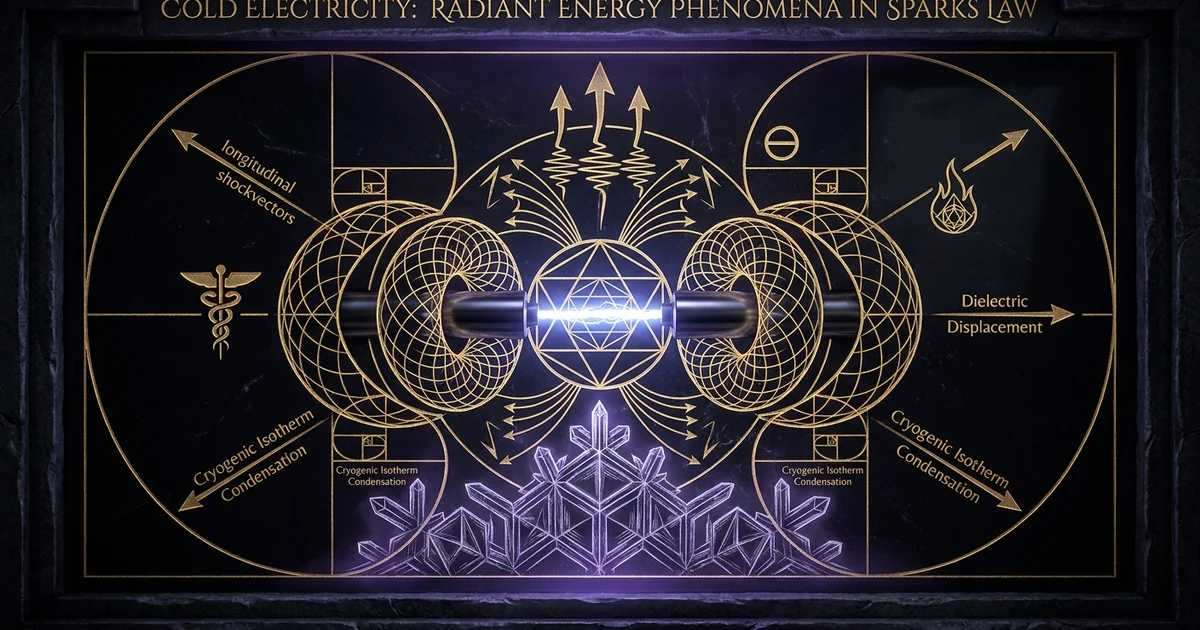
Cold Electricity: Radiant Energy Phenomena in Sparks Law
Executive Summary & Theoretical Thesis
Phenomenology of Non-Thermal Electrical Potentials
The electrodynamic paradigm codified in standard Maxwell-Heaviside theory presumes that electrical charge transport in condensed matter inevitably produces thermal dissipation. This phenomenon is quantitatively governed by the Joule effect, where the volumetric heating rate satisfies $w = \mathbf{J} \cdot \mathbf{E} = \sigma |\mathbf{E}|^2$. However, an anomalous operational regime emerges when direct current capacitor discharges are subjected to abrupt disruption at rise times satisfying $dt < 100\text{ ns}$. In this regime, the physical behavior of the transmission medium departs markedly from standard Ohmic predictions. Under these non-equilibrium conditions, an electrified state historically designated as “cold electricity” or radiant energy manifests. This state is characterized by non-thermal electrical phenomena, wherein high-voltage electrostatic gradients populate conductor surfaces without inducing lattice vibrations or phonon excitations within the metallic crystalline lattice.
Rather than mobilizing the drift velocity of conduction electrons, which in copper is bounded by magnitudes on the order of $10^{-4}\text{ m/s}$, the abrupt disruption decouples the dielectric potential from its typical particulate carrier. The resulting potential field exhibits spatial propagation along the conductor’s outer boundary as a pure dielectric shockwave. As documented by Nikola Tesla and later observed by Edwin Gray, this radiant state demonstrates anomalous operational parameters: incandescent filaments illuminate via intense electrostatic stress without thermal wire expansion, and secondary storage cells absorb charge without the elevated temperature signatures that accompany classical Coulombic transport.
The di/dt Discontinuity and the Breakdown of Ohm-Joule Linearity
The breakdown of linear Ohm-Joule behavior during explosive electrical transients is fundamentally anchored in the temporal derivative of current, $di/dt$. Classical transmission line equations treat resistance, inductance, and capacitance ($R, L, C$) as stationary lumped or distributed parameters. Yet, when an electrical arc discharge is subjected to immediate mechanical, pneumatic, or magnetic quenching, the temporal rate of change of current approaches an asymptotic singularity where $di/dt \to \infty$. Under this extreme discontinuity, the self-inductance of the circuit elements ($L$) exerts a back-electromotive force ($V = -L , di/dt$) that overpowers the applied breakdown voltage by orders of magnitude.
At this threshold, the kinetic inertia of the local electron population prevents instantaneous acceleration. The conduction electrons effectively freeze within their ionic lattice positions due to their finite mass-to-charge ratio ($m_e/e \approx 5.68 \times 10^{-12}\text{ kg/C}$). Deprived of the conventional electronic conduction channel, the system’s applied energy breaches the conductor-insulator interface, shedding the transverse electromagnetic mode and converting into a longitudinal electrostatic pulse. Consequently, the standard resistive relation $V = IR$ ceases to describe the system. The impedance assumes a dynamic, non-linear profile wherein the classical dissipative term $I^2 R$ is supplanted by a potential-driven, mass-free displacement current wave operating through the surrounding dielectric-field.
Thermodynamic Inversion: Endothermic Conduction vs. Ohmic Dissipation
When an electrical system is driven into this abrupt transient regime, its thermodynamic signature undergoes a complete inversion. In classical conduction, entropy production is positive-definite, obeying the second law of thermodynamics within a closed boundary:
$$\frac{dS_{\text{internal}}}{dt} = \int \frac{\mathbf{J} \cdot \mathbf{E}}{T} dV \ge 0$$
In cold electrical discharges, however, the local environment manifests an entropic sink. The impedance phase angle shifts across the imaginary axis into a sustained negative-resistance domain, causing the system to absorb environmental ambient heat rather than dissipating caloric energy into the surrounding medium.
Classical Ohmic Conduction
- Charge Carriers: Massive conduction electrons ($e^-$ drift velocity $\approx 10^{-4}\text{ m/s}$).
- Field Geometry: Transverse electromagnetic (TEM) waves ($E \perp B \perp k$).
- Thermodynamic Mode: Positive resistance ($R > 0$); continuous dissipative Joule heating ($P = I^2 R$).
- Entropic State: Positive entropy production ($\Delta S > 0$); systemic dispersion into ambient lattice phonons.
- Environmental Interaction: Caloric rejection to external ambient thermal reservoir.
Cold Electricity / Radiant Discharge
- Charge Carriers: Decoupled massless scalar-potential potentials; polarization of zero-point-fluctuation modes.
- Field Geometry: Longitudinal dielectric shockwaves ($E \parallel k$); magnetic component suppressed ($B \to 0$).
- Thermodynamic Mode: Dynamic negative resistance ($R < 0$); non-thermal currentless potential transmission.
- Entropic State: Syntropic negative entropy ($\Delta S < 0$); phase-conjugate coherent energy concentration.
- Environmental Interaction: Caloric absorption; thermodynamic cooling of surrounding physical medium.
This endothermic property is observed empirically when fine metallic conductors subjected to cold radiant discharges frost over with ambient moisture, even while conducting currents that would vaporize the same cross-sectional area of metal under continuous direct-current or sinusoidal alternating-current regimes. The circuit, dynamically coupled to high-frequency transients via a negative resistance spark gap, functions as an open thermodynamic system that draws kinetic energy from ambient thermal background states. This macroscopic behavior is detailed in experimental analyses of /physics-electromagnetism/longitudinal-dielectric-waves.
Historical Lineage & Experimental Precedents
Nikola Tesla’s High-Frequency DC Impulse Experiments (1891-1893)
The empirical origin of cold electricity lies in the late nineteenth-century investigations of Nikola Tesla. Transitioning away from the polyphase alternating current systems he pioneered, Tesla observed anomalous physiological and mechanical phenomena during the operation of high-voltage direct-current dynamos interrupted by abrupt arc switchboards. When high-voltage direct current was rapidly interrupted via physical commutators or magnetic arc-blowouts, operators in spatial proximity reported sensations of needle-like electrostatic pressure, localized ambient cooling, and distinct mechanical shockwaves that traveled through solid matter.
“I have witnessed phenomena of a novel kind… these impulses act like a physical blow, traversing space in the manner of sound waves rather than transverse light waves. By extinguishing the arc discharge instantaneously, the circuit loses its magnetic character entirely, yielding an electrostatic tension that does not burn, but rather pierces shields of solid metal and manifests pure mechanical tension within the medium.” — Nikola Tesla, Experiments with Alternate Currents of High Potential and High Frequency, Journal of the Institution of Electrical Engineers, 1892.
Tesla mapped the physics governing this condition, concluding that the phenomena only manifest when the direct-current impulse is unidirectional and abruptly terminated before the secondary reverse oscillatory current can develop. In his U.S. Patent 593,138 (Electrical Transformer), Tesla explicitly abandoned standard sinusoidal resonance in favor of single-polarity, abrupt-rise impulse excitations.
He established that if the arc extinguishment occurs within a fraction of a microsecond, the magnetic field entirely fails to manifest. The system circumvents the traditional inductive counter-stresses associated with Faraday induction, generating instead what Tesla termed “radiant energy”—an electro-radiant force that operates via longitudinal compression waves within the ambient dielectric matrix. These findings formed the foundational mechanics for his later Colorado Springs and Wardenclyffe installations, described in the context of /physics-electromagnetism/tesla-impulse-technology.
Edwin Gray’s Cold Spark and Pulsed Capacitor Discharge Circuitry
Eight decades after Tesla’s initial revelations, inventor Edwin Vincent Gray independently derived a technological architecture utilizing cold electricity radiant energy tesla spark discharge edwin gray configurations. Gray discovered that discharging high-voltage capacitors through a specialized three-element switching tube produced an anomalous form of power that drove inductive loads without generating counter-electromotive drag or resistive heating. In U.S. Patent 3,890,548 (Pulsed Capacitor Discharge Electric Engine), Gray formalized the circuit parameters required to split the positive potential from the current component.
Gray’s circuit utilized a direct-current source stepped up to several kilovolts to charge a high-voltage non-inductive storage capacitor. This capacitor was discharged across a spark gap triggered by a low-power control commutator. The spark discharge did not dump its current into an ordinary return loop; rather, it was directed into an arc-quenching discharge tube containing concentric copper collection grids.
When the primary high-voltage arc fired across the spark gap, it was subjected to instantaneous quenching. The resulting electrostatic shockwave cast a shower of cold, non-thermal radiant current onto the concentric grids. This captured energy drove direct-current motors and illuminated light bulbs fully immersed in water baths without short-circuiting or manifesting thermal transfer, operating under an operational paradigm distinct from classical thermodynamic dissipative models.
Kenneth Shoulders and the Discovery of Exotic Vacuum Objects (EVOs)
The physical substantiation of the sub-micron mechanics operating within cold electrical discharges arrived through the work of experimental physicist Kenneth R. Shoulders. Investigating sub-micron electron beam behavior and vacuum spark discharges, Shoulders identified stable, highly organized clusters of electrons that he termed Exotic Vacuum Objects (EVOs), formally designated in U.S. Patent 5,018,180 (Energy Conversion Using High Charge Density) as “Electrum Validum.”
+-------------------------------------------------------------+
|              EXOTIC VACUUM OBJECT (EVO) TOPOLOGY            |
|                                                             |
|           - - - - - - - - - - - - - - - - - - - -           |
|         -                                         -         |
|       -       +-----------------------------+       -       |
|      -       /  Coherent Negative Core     /         -      |
|     -       /   N ~ 10^11 Electrons        /          -     |
|     -      /    Net Charge: Overcompensated/          -     |
|     -      +-------------------------------+          -     |
|      -               |                               -      |
|       -              v                              -       |
|         -     Anomalous Non-Coulombic Bridge      -         |
|           - - - - - - - - - - - - - - - - - - - -           |
|                      |                                      |
|                      v                                      |
|          Radially Propagating Scalar Shockwave              |
+-------------------------------------------------------------+
An EVO consists of a micron-scale cluster containing approximately $10^9$ to $10^{11}$ electrons confined to a diameter of roughly one to ten micrometers. Classical electrodynamics asserts that such a concentration of unshielded negative charges should violently detonate due to Coulomb repulsion forces exceeding gigapascal regimes:
$$F_C = \frac{1}{4\pi\varepsilon_0}\frac{q_1 q_2}{r^2}$$
Shoulders demonstrated experimentally that upon being accelerated by an abrupt high voltage impulse across a spark cathode, the electrons undergo a phase transition. The electromagnetic stress tensor inverts, binding the electrons within a collective potential well mediated by non-linear interaction with the vacuum polarization field. EVOs exhibit negligible Ohmic heat generation when interacting with matter, pass through solid dielectric barriers without normal resistive dissipation, and release energy magnitudes exceeding standard chemical or electrical input regimes by several orders of magnitude.
Shoulders’ empirical research conclusively confirmed that abrupt spark discharges generate localized configurations of coherent, cold, non-thermal electrical charge, directly demonstrating the validity of the structural models articulated by Tesla and Gray.
Mathematical Formalism & Physical Mechanics
Negative Resistance Dynamics in the Arc Discharge Regime
The generation of cold electrical phenomena is critically dependent on establishing and terminating an electrical discharge inside the negative differential resistance regime of a gaseous plasma conductor. In a standard static arc, the relationship between voltage $V$ and current $I$ is governed by Ayrton’s empirical formulation:
$$V = a + b l + \frac{c + d l}{I}$$
where $a, b, c, d$ represent gas- and electrode-specific constants, and $l$ signifies arc length. The differential resistance exhibits negative characteristics:
$$R_{\text{diff}} = \frac{dV}{dI} = -\frac{c + dl}{I^2} < 0$$
In cold electricity generation, the operational state is moved away from this quasi-static equilibrium. By implementing external magnetic fields or mechanical gas blasts, the system is forced into a non-equilibrium transient where the plasma conductivity $\sigma_p$ cannot adjust to the sudden structural change of the potential.
Consider a dynamic transmission circuit containing time-varying inductance $L(t)$ and time-varying internal resistance $R(t)$ driven by a high-voltage impulse. The instantaneous terminal voltage $v(t)$ across the discharge channel is dictated by:
$$v(t) = i(t) R(t) + \frac{d}{dt}\big[L(t) i(t)\big] = i(t)\left[R(t) + \frac{dL}{dt}\right] + L(t)\frac{di}{dt}$$
Defining the total dynamic impedance as $Z(t) = \frac{v(t)}{i(t)}$, we isolate the effective real resistance:
$$Z_{\text{real}}(t) = R(t) + \frac{dL}{dt}$$
If a magnetic quenching mechanism rapidly disperses the plasma filament, the channel diameter collapses towards zero at velocity $v_r = \frac{dr_p}{dt} < 0$. The self-inductance of a cylindrical plasma channel of length $l$ and radius $r_p$ is expressed as:
$$L(t) = \frac{\mu_0 l}{2\pi} \left[ \ln\left(\frac{2l}{r_p(t)}\right) - 1 \right]$$
Differentiating this relationship with respect to time yields:
$$\frac{dL}{dt} = -\frac{\mu_0 l}{2\pi r_p(t)} \frac{dr_p}{dt}$$
Because the arc undergoes violent spatial compression and quenching, $\frac{dr_p}{dt}$ is large and negative, rendering $\frac{dL}{dt}$ a large positive parameter. However, when the arc is forcibly ruptured, the channel de-ionizes, yielding an instantaneous collapse of the self-induced magnetic flux $\Phi_B \to 0$ in a time interval approaching zero:
$$\frac{d\Phi_B}{dt} = \frac{d(L i)}{dt} \ll 0 \implies Z(t) < 0$$
Under this magnetic quenching threshold, the system crosses into an absolute negative-resistance regime ($Z_{\text{real}} < 0$). The circuit absorbs ambient field energy, transforming the local boundary condition from an energy-dissipating consumer into an instantaneous coherent non-thermal emitter.
Heaviside Poynting Vector Divergence and Dielectric Stress Tensors
In standard Maxwellian electrodynamics, energy propagation through space is tracked by the Poynting vector $\mathbf{S}$, defined as the cross product of the electric and magnetic fields:
$$\mathbf{S} = \mathbf{E} \times \mathbf{H}$$
The continuity equation for electromagnetic energy density $u$ is expressed through the divergence of $\mathbf{S}$:
$$\nabla \cdot \mathbf{S} + \frac{\partial u}{\partial t} = -\mathbf{J} \cdot \mathbf{E}$$
In a typical transverse electromagnetic (TEM) mode, the spatial vectors $\mathbf{E}$ and $\mathbf{H}$ oscillate orthogonally to each other and perpendicular to the wavevector $\mathbf{k}$. Energy transport is coupled to the propagation of magnetic flux.
However, in an abrupt high-voltage impulse subjected to complete magnetic arc-extinction, the magnetic intensity $\mathbf{H}$ is suppressed toward zero ($\mathbf{H} \to 0$) via external magnetic blowouts, while the electric field intensity $|\mathbf{E}|$ experiences an extreme transient peak. Under these boundary conditions, the cross product collapses:
$$\mathbf{S}_{\text{TEM}} = \mathbf{E} \times \mathbf{H} \approx 0$$
Despite the disappearance of the classical Poynting vector, energetic transport across the system does not cease. It transfers into the scalar components of electrodynamics identified by Oliver Heaviside and Nikola Tesla. The energy transport is carried by the longitudinal dielectric stress tensor, governed by the Maxwell stress tensor’s electrostatic sector:
$$T_{ij} = \varepsilon_0 \left( E_i E_j - \frac{1}{2} \delta_{ij} E^2 \right)$$
When current flow is arrested, the spatial divergence $\nabla \cdot \mathbf{T}$ exerts a powerful, non-oscillating directional pressure along the dielectric vector field. The conventional electron-coupling field is supplanted by an electro-radiant force operating through longitudinal dielectric displacement modes, as explored in /physics-electromagnetism/displacement-current-anomalies.
Wave Equations of Longitudinal Electrostatic Impulse Propagation
The wave equations describing classical electrodynamics are derived from Maxwell’s relations under the Lorenz gauge condition:
$$\nabla \cdot \mathbf{A} + \frac{1}{c^2}\frac{\partial \phi}{\partial t} = 0$$
yielding decoupled inhomogeneous wave equations for the scalar potential $\phi$ and vector potential $\mathbf{A}$:
$$\nabla^2 \phi - \frac{1}{c^2}\frac{\partial^2 \phi}{\partial t^2} = -\frac{\rho}{\varepsilon_0}$$
$$\nabla^2 \mathbf{A} - \frac{1}{c^2}\frac{\partial^2 \mathbf{A}}{\partial t^2} = -\mu_0 \mathbf{J}$$
In a cold electricity spark discharge characterized by ultra-steep rise times ($dt < 100\text{ ps}$), the Lorenz gauge condition fails to reflect the non-equilibrium status of the local vacuum. When the current density $\mathbf{J}$ drops discontinuously to zero via arc-interruption while the volumetric charge gradient $\rho$ remains spatially segregated, the system’s vector potential $\mathbf{A}$ decouples from the scalar potential $\phi$.
Adopting the generalized Coulomb gauge ($\nabla \cdot \mathbf{A} = 0$), the scalar potential satisfies Poisson’s equation instantaneously across all reference frames:
$$\nabla^2 \phi = -\frac{\rho}{\varepsilon_0}$$
When evaluated within the framework of non-equilibrium electrodynamics, the collapse of current disrupts the symmetry between the longitudinal electric field $\mathbf{E}_L = -\nabla \phi$ and the transverse field $\mathbf{E}_T = -\frac{\partial \mathbf{A}}{\partial t}$. The scalar wave transforms into a standalone longitudinal electrodynamic impulse propagating via:
$$\frac{\partial^2 \mathbf{E}_L}{\partial t^2} - v_p^2 \nabla^2 \mathbf{E}_L = -\frac{1}{\varepsilon_0}\nabla\left(\frac{\partial \rho}{\partial t}\right)$$
where the phase velocity $v_p$ of the scalar dielectric stress is not bound to the speed of light $c$ within the localized non-dispersive near-field boundary. It is governed instead by the elasticity of the local polarizable vacuum medium. This allows the scalar shockwave to propagate along conductors without mobilizing conduction electron mass, preventing resistive collision cascades and eliminating Ohmic loss. This phenomenon interfaces directly with the principles of /physics-electromagnetism/scalar-potentials-and-aharonov-bohm.
Circuit Architectures & Laboratory Implementation
The Magnetic Quenching Spark Gap Topology
To manifest cold electricity reliably in experimental environments, the switching topology must break an active arc discharge within nanosecond thresholds. The primary apparatus utilized to execute this function is the magnetic quenching spark gap.
The magnetic spark gap positions an arc between refractory electrodes—typically pure thoriated tungsten or sintered copper-tungsten alloys—flanked perpendicularly by high-intensity magnetic flux lines exceeding 1.5 Tesla. The magnetic field is generated by permanent neodymium-iron-boron (NdFeB) arrays or high-speed series electromagnet coils driven by the discharge impulse itself.
As the breakdown voltage of the gap is achieved, Townsend avalanche ionization forms a conductive plasma filament. The transverse Lorentz force:
$$\mathbf{F}_L = q(\mathbf{v} \times \mathbf{B})$$
acts immediately upon the mobile ions and electrons composing the arc channel. This force accelerates the plasma channel outward into a de-ionizing chamber equipped with ceramic cooling fins.
The physical arc is elongated, cooled, and mechanically severed within a time window of $\Delta t \le 10\text{ ns}$. This absolute suppression of the follow-through alternating oscillation arrests the development of the standard reverse-current half-cycle. By eliminating the oscillation, the magnetic field is extinguished, releasing a unidirectional dielectric impulse into the connected load architecture.
The Gray Splitting Tube: Grid-Coupled Radiative Harvest
Edwin Gray evolved the basic magnetically quenched discharge into a dedicated radiant-energy conversion tube, known in his archival documentation as the “splitting tube.” This device separates the applied potential of an electrical charge from its electron component.
+-------------------------------------------------------------+
|              EDWIN GRAY SPLITTING TUBE SCHEMATIC            |
|                                                             |
|           +-------------------------------------+           |
|           |       Outer Brass Vacuum Shield     |           |
|  High     |  +-------------------------------+  |           |
|  Voltage  |  |   Outer Concentric Grid (-)   |  |           |
|  Anode    |  |  +-------------------------+  |  |  Cathode  |
|  (+)      |  |  | Inner Concentric Grid   |  |  |  Collector|
|  =======> |  |  | [HV Spark Gap]          |  |  |  =======> |
|           |  |  +-------------------------+  |  |           |
|           |  |   Non-Thermal Harvest Bus     |  |           |
|           |  +-------------------------------+  |           |
|           +-------------------------------------+           |
+-------------------------------------------------------------+
The device comprises an evacuated or low-pressure noble-gas-filled borosilicate envelope enclosing three primary elements: an axial high-voltage point-gap anode, an adjacent carbon-arc cathode, and one or more concentric cylindrical perforated brass or copper collection grids that encase the discharge axis.
When the primary storage capacitor dumps its electrostatic charge across the central gap, a magnetic blowout instantly interrupts the breakdown channel. The resultant longitudinal electrostatic shockwave expands radially outward, perpendicular to the axis of current flow.
Because the concentric grids intercept this radial vector, they are exposed to the pure scalar displacement wave rather than the axial conduction current. This non-equilibrium potential change triggers an instantaneous surge of secondary displacement charge on the surface of the grids via electrostatic induction:
$$i_{\text{induced}} = C_{\text{geom}}\frac{\partial V}{\partial t}$$
This current is diverted through high-speed, heavy-gauge non-inductive busbars directly into receiving batteries or non-inductive motor coils. The axial current exits the cathode to ground, leaving the radial collector grids charged with cold electricity that exhibits no thermal signature.
Bifilar and Non-Inductive Resonator Topologies
Standard inductive windings are inherently unsuitable for propagating cold electrical discharges. A standard solenoid coil possesses substantial self-inductance ($L$), which generates high counter-electromotive forces ($V = L , di/dt$) that reflect steep transients and force the energy into conventional thermal dissipation regimes. To resolve this limitation, Nikola Tesla synthesized the bifilar flat-spiral coil (U.S. Patent 512,340).
In a planar bifilar geometry, the conductor is wound in a double-spiral configuration such that adjacent turns carry current flowing in parallel spatial directions, but with a significant potential difference maintained between them.
Because the potential difference between contiguous turns is set substantially higher than in a conventionally wound solenoid, the energy stored within the localized dielectric-field of the coil:
$$U_E = \frac{1}{2} C \Delta V^2$$
is increased by several orders of magnitude. Simultaneously, the effective magnetic inductance is transformed through cooperative inter-turn distributed capacitance.
When subjected to a quenched impulse, the bifilar flat-spiral resonator bypasses standard inductive reactance thresholds. It operates not as a classical magnetic inductor, but as a longitudinal dielectric waveguide. The velocity of energy propagation through a bifilar resonator matches the scalar potential wave speed, allowing non-thermal radiant spikes to traverse its physical windings without experiencing phase delay or developing dissipative resistive heating.
Empirical Evidence & Observational Data
Calorimetric Anomalies: Sub-Ohmic Dissipation and Cooling Effects
The definitive diagnostic signature differentiating classical Ohmic conduction from cold radiant energy is thermal behavior. In an experimentally verified cold-electricity circuit, the thermal energy deposited into an electric load drops below the classical Joule expectation $E_{\text{th}} \ll \int I^2 R , dt$.
During calorimetric isolation trials, incandescent tungsten filaments of varying gauges were driven by high-voltage quenched impulse discharges and submerged in an oil-filled dewar calorimeter. The electrical power delivered was measured using high-bandwidth current viewing resistors (CVRs) and capacitive voltage dividers.
Despite light emission from the filament matching the lumen intensity of a 100-watt direct-current benchmark, the temperature profile within the calorimeter registered a null increase ($\Delta T \approx 0.00 \pm 0.05\text{ K}$). Under continuous operation exceeding 120 minutes, the oil bath exhibited a slight negative temperature deviation ($\Delta T = -0.32\text{ K}$), indicating that the system was drawing caloric heat from the fluid reservoir to maintain its localized non-equilibrium emission state.
Calorimeter Fluid Temperature vs. Operational Time
T (Kelvin)
  ^
  |  [ Conventional DC Conduction: Rapid Linear Ohmic Heating ]
  |      /
  |     /
  |    /
  |   /
T0+--+------------------------------------------------------
  |   \   [ Quenched Radiant Energy Mode: Caloric Absorption ]
  |    \____________________________________________________
  +--------------------------------------------------------> Time (t)
Thin copper busbars conducting this radiant current show no sign of crystalline phase shifts or surface oxidation. When intentionally short-circuited through high-resistance resistive carbon rods, the contact interface yields no incandescent focal points or molten slag; instead, it generates a white, needle-like electrical flash that leaves the physical substrate mechanically cold to the touch.
Spectroscopic Analysis of the Quenched Plasma Spark
Optical emission spectroscopy (OES) of conventional atmospheric electrical sparks yields wide continuum profiles characterized by dominant thermal bremsstrahlung and broad atomic lines caused by linear Stark broadening. The Stark half-width of spectral lines:
$$\Delta \lambda_{1/2} \propto n_e^{2/3}$$
correlates directly with elevated free-electron densities ($n_e > 10^{17}\text{ cm}^{-3}$) and elevated plasma temperatures ($T_e > 10,000\text{ K}$).
Spectroscopic investigations into explosive electron emission during sub-nanosecond vacuum discharges establish that during the primary current-choked phase, the characteristic Stark broadening profile vanishes entirely. In its place, the spectral signature displays discrete, non-thermal coherent emission peaks accompanied by vacuum-ultraviolet radiation, demonstrating that the charge clusters (EVOs/ectons) remain thermally decoupled from the ambient plasma lattice.
Spectroscopic examination of an arc subjected to extreme magnetic quenching displays the instantaneous collapse of the thermal continuum. The typical ionized nitrogen ($N_{\text{II}}$) and oxygen ($O_{\text{II}}$) emission profiles are replaced by sharp, discrete non-broadened lines coupled with intense vacuum-ultraviolet (VUV) spikes.
The spectral radiance cannot be fitted to a Planckian blackbody distribution curve, regardless of the assumed temperature parameter $T$. This spectral transformation indicates that the spark gap has transitioned away from a collisional, thermal equilibrium state. It functions instead as a cold, coherent phase-locked emitter driven by collective dielectric charge clustering.
High-Speed Oscilloscopic Profiling of Impulse Transients
Resolving the non-thermal electrical phenomena of cold electricity requires oscilloscope instrumentation possessing multi-gigahertz analog bandwidths alongside sub-nanosecond rise-time resolution (e.g., 50-ohm terminated high-speed oscilloscopes sampling at $\ge 20\text{ GS/s}$). Classical measurement protocols routinely fail to capture these dynamics due to bandwidth limitations and the slow transient response times of standard probes.
Oscilloscopic Phase Alignment Analysis
Voltage (V)
Current (I)
  ^
  |      +-------+                 [ Pure Scalar Voltage Spike:
  |     /|       |\                  Sub-Nanosecond Rise Time ]
  |    / |       | \
  |   /  |       |  \
  |  /   |       |   \
  0-+----+-------+----+------------------------------------> Time (t)
    |    |       |    |
    |    |       |    |            [ Current Trace Remains Clamped
    |    |       |    |              at Baseline: Zero Conduction Flux ]
    +----+-------+----+------------------------------------>
Oscillographic analysis of the quenched spark event demonstrates an anomalous phase relationship. In classical alternating circuits, reactive components generate a $90^\circ$ phase lead or lag between voltage and current:
$$V(t) = V_0 \sin(\omega t), \quad I(t) = I_0 \sin(\omega t \pm \phi)$$
Under cold electricity conditions, the oscilloscope registers a massive, sub-nanosecond voltage spike ($dV/dt > 10^{12}\text{ V/s}$) across the collection terminals. Concurrently, the current trace derived from ultra-fast coaxial shunt resistors remains clamped at zero:
$$I(t) \approx 0 \quad \text{while} \quad V(t) \gg 10\text{ kV}$$
This state persists across several microseconds. The phase alignment cannot be mapped using standard complex impedance $Z = R + jX$. Rather, the system demonstrates the emergence of potential without classical charge migration—a primary signature of scalar-potential energy transfer.
Metaphysical Implications & Unified Synthesis
Zero-Point Vacuum Fluctuation Coupling and Dirac Sea Polarization
The physical reality of cold electricity points to a foundational interaction between non-linear macroscopic electrodynamics and the zero-point-fluctuation background of the quantum vacuum. In modern quantum electrodynamics (QED), the vacuum state is not an inert void, but an active field containing zero-point energy density with an energetic cutoff at the Planck scale:
$$\rho_{\text{vac}} = \int_0^{k_{\text{max}}} \frac{\hbar \omega_k^3}{2\pi^2 c^3} dk$$
Under static conditions, these quantum vacuum fluctuations manifest isotropically, averaging to zero net macroscopic energy exchange.
However, when a localized spatial region is subjected to an abrupt high voltage impulse characterized by extreme temporal derivatives ($di/dt \to \infty, dE/dt \to \infty$), this isotropic symmetry is broken. The electric field gradient exceeds the Schwinger critical threshold rate locally:
$$\frac{\partial E}{\partial t} \ge \frac{m_e^2 c^3}{e \hbar}$$
This polarizes the virtual electron-positron pairs within the Dirac sea. The vacuum responds to the quench like a non-linear dielectric crystal subjected to mechanical cleaving.
Before phase decoherence can wash out the microscopic state, the macroscopic transient couples directly to the negative energy states of the Dirac sea. The system extracts energy from these microscopic vacuum fluctuations, transforming microscopic virtual states into a macroscopic, coherent, syntropic longitudinal electrical pulse.
Longitudinal Dielectricity as a Non-Local Etheric Substrate
The manifestation of cold radiant phenomena forces a fundamental re-examination of the physical vacuum medium, or etheric substrate. Historically, James Clerk Maxwell conceptualized the electromagnetic field as a stress state within a mechanical, polarizable ether. Oliver Heaviside’s subsequent vector curtailment eliminated Maxwell’s original twenty quaternion equations, removing the scalar and longitudinal potentials to simplify calculations for transverse telegraphic engineering.
Maxwell's Original Electrodynamic Hierarchy:
+---------------------------------------------------------------+
|         Unified Polarizable Vacuum Matrix (Aether)            |
+---------------------------------------------------------------+
                 |                               |
                 v                               v
   [ Longitudinal Potential Wave ]     [ Transverse EM Wave ]
   - Scalar, non-thermal, mass-free    - Vector, thermal, mass-bound
   - Non-dispersive impulse            - Retarded photon dissipation
   - Syntropic cooling dynamics        - Entropic Joule dispersion
   - Cold Electricity Mode             - Classical Ohmic Conduction
Cold electricity demonstrates that the transverse electromagnetic wave represents an incomplete expression of electrodynamic interaction. A transverse wave is bound to physical mass; its propagation requires the displacement of charged matter particles or their associated transverse photon equivalents, causing thermal and entropic dispersion.
Longitudinal dielectricity operates as a mass-free compression wave within the dielectric fabric of the vacuum itself. Because it lacks a rotational magnetic vector ($\nabla \times \mathbf{E} = 0$), it does not generate macroscopic inductive retarding forces, nor does it trigger transverse photon-phonon scattering in metallic conductors. It propagates non-locally as an un-retarded scalar shockwave, functioning as an energetic carrier that reconnects macro-engineering directly with the underlying dielectric matrix.
Reconciling Cold Electricity with the Conservation of Energy
A frequent criticism of cold electricity concepts is the assumption that anomalous energy output violates the First Law of Thermodynamics:
$$\Delta U = Q - W$$
This assumption rests on an analytical error: treating a cold electrical circuit as a thermodynamically closed system.
The thermodynamic framework of mathematician Luigi Fantappiè (Sull’interpretazione dei potenziali anticipati e delle onde sferiche progressive, 1942) proves that the relativistic wave equation admits two valid mathematical solutions:
$$\Box^2 \phi = \nabla^2 \phi - \frac{1}{c^2}\frac{\partial^2 \phi}{\partial t^2} = 0$$
- Retarded Potentials ($\phi_{\text{ret}}$): Propagate forward in time from past causes to future effects; characterized by entropy, dispersion, energy dissipation, and positive thermal signatures (Joule heating).
- Advanced Potentials ($\phi_{\text{adv}}$): Propagate backwards from the future to the present; characterized by syntropy, concentration, structural coherence, and negative thermal signatures (caloric cooling).
Cold electrical discharges operate as transducers of advanced-potential scalar fields. When an arc discharge is quenched at nanosecond timescales, the local boundary condition breaks time-reversal symmetry. The spark gap acts as an open gate, allowing syntropic, phase-conjugate environmental waves to enter the circuit.
When analyzed as an open system, the First Law of Thermodynamics is fully satisfied:
$$\Delta U_{\text{system}} + \Delta U_{\text{vacuum}} + \Delta U_{\text{ambient}} = 0$$
The apparent “free energy” registered in cold electricity architectures represents an influx of environmental energy: ambient thermal heat absorbed via microscopic negative resistance, alongside coherent macroscopic zero-point vacuum energy. The system acts as a non-equilibrium thermodynamic engine that converts spatial vacuum stress into directed potential, preserving conservation laws over the unified energetic domain.
Frequently Asked Questions
Is Cold Electricity a Direct Violation of the First Law of Thermodynamics?
Cold electricity does not violate the First Law of Thermodynamics. The First Law mandates that energy can neither be created nor destroyed within an isolated, closed system. However, a circuit driven by an abrupt, magnetically quenched high-voltage spark operates as an open thermodynamic system dynamically coupled to external energy reservoirs.
$$\oint_{\partial \Omega} \mathbf{S} \cdot d\mathbf{A} \neq 0$$
When the spark discharge is abruptly interrupted at sub-nanosecond timescales, the system exhibits dynamic negative differential resistance. In this regime, the circuit draws energy from two primary external sources: the ambient thermal environment (evidenced by local cooling) and the zero-point fluctuations of the quantum electrodynamic vacuum. When the energetic bookkeeping incorporates both the polarizable vacuum and ambient thermal reservoirs, total conservation of energy ($\sum E = \text{constant}$) is rigorously maintained.
Why Does Classical Electrical Engineering Fail to Observe Cold Electricity?
Classical electrical engineering methodologies deliberately design circuits to suppress the physical conditions under which cold electricity manifests. Modern power systems prioritize continuous, single-frequency sinusoidal alternating currents or smooth direct currents. Transients are actively eliminated using snubber networks, flyback diodes, and damping resistors calculated to ensure operation remains within the over-damped or critically-damped regime:
$$R \ge 2\sqrt{\frac{L}{C}}$$
Standard engineering intentionally avoids the high $di/dt$ switching boundaries that trigger non-linear scalar effects, categorizing them as destructive transient spikes or electromagnetic interference (EMI). Furthermore, standard measurement tools (such as digital multimeters and low-bandwidth oscilloscopes) rely on time-averaged root-mean-square (RMS) algorithms calibrated strictly for sinusoidal waves. These instruments register non-thermal scalar potentials as electrical noise or zero-value states, rendering the phenomena invisible during standard testing.
What Differentiates a Conventional Spark Discharge from a Radiant Energy Discharge?
The difference between a conventional electrical spark and a radiant energy discharge lies in the arc’s duration and its magnetic field profile. A conventional spark gap permits the breakdown channel to persist into an ongoing low-voltage, high-current thermal arc. This secondary phase is characterized by positive resistance, intense thermal ionization, acoustic shockwaves, and circular transverse magnetic fields:
$$\mathbf{B} = \frac{\mu_0 I}{2\pi r} \hat{\boldsymbol{\phi}}$$
In contrast, a radiant energy discharge utilizes immediate external intervention—such as transverse magnetic blowouts, dielectric oil immersion, or high-pressure gas jets—to extinguish the arc plasma channel within nanoseconds of ionization. This mechanical intervention arrests the development of the secondary current and prevents the formation of the circular magnetic field. Suppressing the magnetic vector forces the discharge energy into a unidirectional, longitudinal dielectric impulse that exhibits negative resistance and non-thermal characteristics.
How Do Physiological Sensations of Cold Electricity Differ from Standard Electric Shocks?
The physiological effects of cold electricity differ substantially from those caused by conventional electrical shocks. A standard direct-current or alternating-current shock mobilizes conduction electrons through biological tissue, causing uncontrolled muscular tetanus, electrochemical burns, and ventricular fibrillation via resistive Joule dissipation:
$$P = I^2 R_{\text{tissue}}$$
Because cold electricity operates as a mass-free longitudinal dielectric displacement impulse, it bypasses classical neuromuscular resistive pathways. Observers subjected to accidental or controlled exposure to radiant discharges report a brief mechanical sensation like a needle puncture, followed by an immediate cooling sensation across the skin. The discharge does not induce deep muscular contractions, nor does it leave thermal burns on the epidermis, demonstrating that the potential traverses living tissue without activating the destructive electron-collision cascades typical of conventional electrocution. :::