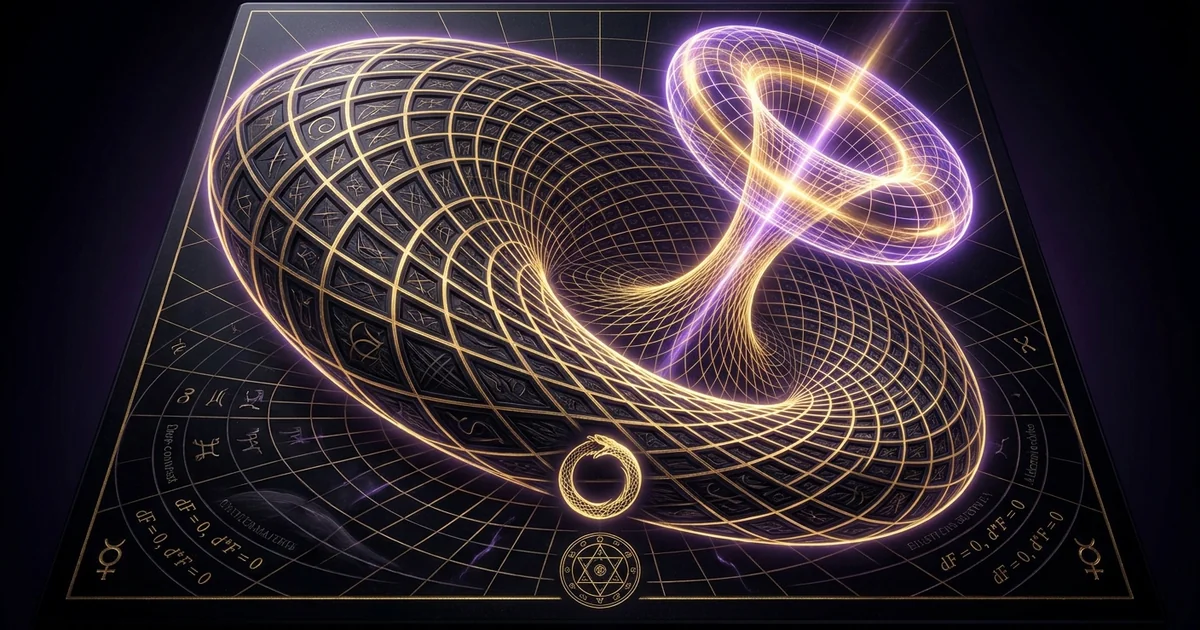
Wheeler Geometrodynamics: Physics as Curved Topologies
Executive Summary & Theoretical Thesis: Spacetime Geometry as the Only Physical Substance
The Elimination of the Source-Field Duality
Classical field theories since Isaac Newton, James Clerk Maxwell, and Hendrik Lorentz have operated upon an unexamined metaphysical bifurcation: the ontological division between continuous, mediating fields and discrete, localized material sources. Within Maxwellian electrodynamics, the electromagnetic field tensor $F_{\mu\nu}$ propagates across a passive, flat Minkowski background, anchored exclusively to extrinsic current densities $J^\mu$. This formulation posits that fields are secondary emanations produced by point-like corpuscles whose intrinsic mass, charge, and trajectory reside fundamentally outside the field equations themselves. Albert Einstein partially dissolved this dualism by identifying gravitation with the Riemannian metric tensor $g_{\mu\nu}$, yet the right-hand side of the field equations—the stress-energy tensor $T_{\mu\nu}$—remained an ad-hoc phenomenology of non-geometric matter, prompting Einstein to famously lament that his equation was composed of fine marble (the geometric Einstein tensor $G_{\mu\nu}$) and base timber (the matter tensor $T_{\mu\nu}$).
Standard Field Theory
- Ontological Dualism: Rigid separation between continuous fields and localized material particulate sources ($J^\mu, \rho$).
- Background Geometry: Passive Minkowski or static semi-Riemannian manifold serving as a neutral coordinate arena.
- Mass & Charge: Intrinsic, irreducible parameters externally ascribed to discrete point particles.
- Field Equations: Driven by non-geometric matter terms ($G_{\mu\nu} = 8\pi G c^{-4} T_{\mu\nu}^{\text{matter}}$).
Wheeler Geometrodynamics
- Ontological Monism: Complete elimination of particulate sources; geometry is the sole underlying physical substance.
- Dynamic Manifold: Actively evolving, multiply-connected Riemannian 3-manifolds ($\Sigma, \gamma_{ij}$) forming spacetime histories.
- Mass & Charge: Topological features; non-contractible 2-cycles trap source-free flux (“charge without charge”; “mass without mass”).
- Field Equations: Purely geometric Einstein-Maxwell vacuum configurations where $T_{\mu\nu}$ is reconstructed via Ricci curvatures.
John Archibald Wheeler’s program of classical geometrodynamics fundamentally eradicates this dualism. Developing the foundational insights of William Kingdon Clifford and George Yuri Rainich, Wheeler posited that spacetime geometry as the only physical substance forms the sole ontological substrate of the physical cosmos. The apparent dichotomy between force and matter, continuous medium and particulate point, is an artifact of treating spatial topology as simply connected and globally Euclidean. By lifting this topological restriction and admitting dynamic, multiply-connected Riemannian 3-manifolds, physical phenomena such as electric charge, electromagnetic radiation, and gravitational mass are revealed to be nothing more than pure, sourceless configurations of curved empty spacetime.
Topological Matter vs. Substantialist Particulates
In the geometrodynamic paradigm, particulate matter does not possess an ontological standing independent of the manifold. Particulates are not substantive, foreign bodies inserted into a geometric void; rather, they are localized, non-trivial topologies of space itself. Where conventional quantum and classical mechanics presuppose point charges that act as delta-function divergences in Poisson-type equations, geometrodynamics treats these singularities as optical illusions born of an impoverished topology.
When spatial regions are permitted to possess topological handles or “wormholes” connecting distant domains of a manifold, the field lines of a sourceless vector field can enter one throat and emerge from another without terminating on an actual particulate source. The apparent divergence measured by an asymptotic observer integrating the Gauss flux integral over an enclosing two-sphere is mathematically identical to the presence of a localized charge, yet nowhere within the manifold does the divergence of the field diverge from zero. Matter, in this realization, is transmuted into the topological connectivity of space itself.
The Core Postulates of Pure Differential Curvature
The mechanical apparatus of john archibald wheeler geometrodynamics mass without mass charge rests upon three interdependent postulates of classical differential geometry:
- The Postulate of Pure Geometry: The universe is a four-dimensional semi-Riemannian manifold $(\mathcal{M}, g)$ whose signature is $(-,+,+,+)$, evolving dynamically according to the Einstein vacuum field equations or source-free Einstein-Maxwell equations. No non-geometric mechanical entities, fluids, or corpuscles exist.
- The Postulate of Topological Non-Triviality: The spatial hypersurfaces $\Sigma_t$ of spacetime possess non-trivial homology and cohomology groups. Specifically, the second Betti number $b_2(\Sigma) \neq 0$, admitting non-contractible two-dimensional cycles that alter the global properties of differential forms.
- The Postulate of Already Unified Dynamics: The electromagnetic field is algebraically and differentially encoded within the geometry of Ricci curvature. There is no independent “matter-energy” tensor; rather, spacetime curves in response to its own intrinsic topological twists, electromagnetic stress-energy, and nonlinear metric perturbations.
Through these postulates, geometrodynamics articulates a universe composed exclusively of curved, empty space, where all dynamical forces, from electrostatic attractions to inertial resistances, are recognized as manifestations of Riemannian curvature evolving across coordinate time.
Historical Lineage & Experimental Precedents: From Clifford and Einstein to Wheeler’s Geon Program
William Kingdon Clifford’s Space-Theory of Matter (1870)
The philosophical and mathematical lineage of geometrodynamics traces directly to the visionary address delivered by William Kingdon Clifford to the Cambridge Philosophical Society in 1870, titled On the Space-Theory of Matter. Operating decades prior to the development of tensor calculus and general relativity, Clifford unified the non-Euclidean geometries of Bernhard Riemann with physical ontology, proposing:
“That small portions of space are in fact of a nature analogous to little hills on a surface which is on the average flat; namely, that the ordinary laws of geometry are not there true… That this variation of the curvature of space is what really happens in that phenomenon which we call the motion of matter, whether ponderable or etherial… That in the physical world nothing else takes place but this variation.”
Clifford accurately identified that if the axiomatic structure of Euclidean space were relaxed, mechanical motion, inertia, and particulate matter could be wholly reformulated as continuous local variations in spatial curvature. His work was historically premature, lacking the pseudo-Riemannian metric formulation, the connection formalisms of Elwin Bruno Christoffel, and the Ricci tensor mechanics necessary to translate spatial curvature variations into relativistic field laws. Nonetheless, Clifford established the axiomatic premise that Wheeler would formalize eighty-five years later: matter is not an occupant of space; matter is a dynamic wrinkle in the spatial fabric itself.
The Rainich-Misner-Wheeler Already Unified Field Theory
Following the establishment of General Relativity in 1915, Albert Einstein, Arthur Eddington, and Hermann Weyl pursued unified field theories that sought to absorb electromagnetism into geometry by modifying the metric or introducing affine torsions and higher dimensions. In 1925, George Yuri Rainich published a seminal paper demonstrating that unification did not require modifying Riemannian geometry or introducing non-symmetric connections. Rainich proved that the standard Einstein-Maxwell equations for sourceless fields contain an implicit, exact algebraic and differential correspondence between the electromagnetic field and the Ricci curvature tensor of spacetime.
Misner, C. W., & Wheeler, J. A. (1957). “Classical Physics as Geometry: Gravitation, Electromagnetism, Unquantized Charge, and Mass.” Annals of Physics, 2(6), 525–603.
- Core Contribution: Formalized the Rainich-Misner-Wheeler (RMW) “Already Unified Field Theory,” proving that classical physics is fully isomorphic to source-free differential geometry.
- Key Achievements:
- Developed the topological derivation of electric charge via de Rham cohomology periods over spatial wormhole throats.
- Integrated the algebraic Rainich conditions to reconstruct Maxwell’s field tensor $F_{\mu\nu}$ up to an arbitrary duality rotation.
- Established the foundational physics of geons—metastable configurations of pure electromagnetic-gravitational field energy.
Wheeler and his collaborator Charles Misner recognized the profound implications of Rainich’s discovery, formalizing it as the Rainich-Misner-Wheeler (RMW) “Already Unified Field Theory” in their landmark 1957 monograph. Misner and Wheeler demonstrated that when a source-free electromagnetic field traverses spacetime, its presence leaves an indelible, unambiguous “footprint” upon the Ricci curvature $R_{\mu\nu}$. Because the electromagnetic stress tensor is trace-free and satisfies precise quadratic identities, the local spacetime curvature inherently retains all information regarding the magnitude and direction of the electromagnetic field lines, up to an arbitrary constant duality rotation. Consequently, electromagnetism requires no independent geometric dimensional augmentations (such as the fifth dimension of Kaluza-Klein theory); it is already completely integrated within standard four-dimensional general relativity.
The Genesis and Instability of Classical Geons
In 1955, Wheeler took the operational logic of geometrodynamics to its physical extreme by publishing his theory of “Geons” (gravitational-electromagnetic entities). Wheeler asked whether electromagnetic radiation—which possesses zero rest mass but definite stress-energy—could be concentrated with such intensity that its own self-generated gravitational field would bend the path of the radiation into a closed, self-sustaining toroidal or spherical configuration.
[ Electromagnetic Flux Loop ]
                                              │
                      ┌───────────────────────┴───────────────────────┐
                      ▼                                               ▼
         [ Poynting Energy Density ]                     [ Maxwell Stress-Tensor ]
                      │                                               │
                      └───────────────────────┬───────────────────────┘
                                              ▼
                                 [ Local Spacetime Curvature ]
                                              │
                                              ▼
                             [ Gravitational Self-Confinement ]
                                              │
                                              ▼
                         [ Macroscopic ADM Mass: "Mass Without Mass" ]
Wheeler solved the coupled Einstein-Maxwell field equations for a high-frequency, circulating electromagnetic wave packet. His calculations proved that such an entity could indeed possess a self-consistent equilibrium: the outward radiative pressure of the high-frequency photons is precisely counterbalanced by the inward gravitational pull of the energy density itself, as mapped via the /physics-electromagnetism/maxwell-stress-tensor. To a distant observer, this localized, circulating knot of light displays an effective gravitational mass (measured via Arnowitt-Deser-Misner [ADM] mass formulas), an inertial resistance to acceleration, and a classical trajectory governed by the geodesic equation. Wheeler termed this construct “mass without mass.”
Subsequent numerical analysis and dynamical simulations revealed, however, that classical geons are fundamentally unstable. They are prone to two critical decay channels:
- Gravitational Collapse: Perturbations that slightly compress the geon drive it past its photon sphere, initiating catastrophic gravitational collapse into a Schwarzschild or Kerr-Newman black hole.
- Radiative Dispersion: Photons at the outer periphery of the geon undergo quantum-mechanical tunneling and classical wave leakage through the gravitational barrier, dispersing the mass-energy into asymptotic spatial infinity over time scales governed by the geon’s initial radius.
While the classical geon could not serve as a stable model for fundamental fermions, it established the mathematical proof-of-concept: mass is not an irreducible intrinsic property of particulate matter, but a dynamic manifestation of self-trapped, curved field energy.
Mathematical Formalism & Physical Mechanics: Charge Without Charge and Mass Without Mass
De Rham Cohomology and Wormhole Charge Lines of Force
The most striking conceptual triumph of Wheeler’s geometrodynamics is the phenomenon of “charge without charge.” In standard electrodynamics, Maxwell’s inhomogeneous equations dictate that non-zero divergence of the electric displacement field requires a localized electric charge density $\rho$:
$$\nabla \cdot \mathbf{E} = \frac{\rho}{\varepsilon_0}$$
If space is homeomorphic to $\mathbb{R}^3$, any compact, orientable Gaussian surface $S^2$ containing a non-zero flux integral $\oint_{S^2} \mathbf{E} \cdot d\mathbf{A} = q$ necessarily encloses a point-singularity where the field diverges.
Wheeler and Misner bypassed this requirement by generalizing the topology of the spatial 3-manifold $\Sigma$. Consider a spatial hypersurface containing a handle or throat—topologically equivalent to an Einstein-Rosen bridge—connecting two distinct asymptotic regions, or two widely separated locations within the same region. The topology of such a manifold $\Sigma$ is non-simply connected, characterized by a non-trivial second de Rham cohomology group:
$$H_{\text{dR}}^2(\Sigma) \neq 0, \quad b_2(\Sigma) = \dim H_{\text{dR}}^2(\Sigma) \ge 1$$
On this manifold, the electromagnetic field is governed exclusively by the sourceless Maxwell equations expressed in the exterior calculus of differential forms:
$$dF = 0, \quad d{\star F} = 0$$
where $F = \frac{1}{2} F_{\mu\nu} dx^\mu \wedge dx^\nu$ is the closed 2-form of the electromagnetic field, and ${\star F}$ is its Hodge dual.
Because $d{\star F} = 0$ everywhere on the manifold, the differential form ${\star F}$ is closed. However, on a manifold with $b_2(\Sigma) > 0$, a closed differential form is not necessarily exact; it cannot be written as ${\star F} = dA$ globally.
Let $S^2_A$ and $S^2_B$ be two distinct, non-contractible 2-spheres enclosing the opposite mouths of a wormhole throat $W$. By Stokes’ theorem, the difference between the surface integrals over these boundaries equals the integral of the exterior derivative across the 3-dimensional volume $V$ of the throat connecting them: $$\oint_{S^2_A} {\star F} - \oint_{S^2_B} {\star F} = \int_{V} d{\star F} = 0$$
Thus, the topological electric charge $q$ is defined as the period integral of the dual field over any non-contractible cycle $\gamma_2 \in H_2(\Sigma, \mathbb{Z})$: $$q = \frac{1}{4\pi} \oint_{\gamma_2} {\star F} = \frac{1}{4\pi} \oint_{S^2_A} \mathbf{E} \cdot d\mathbf{A} = -\frac{1}{4\pi} \oint_{S^2_B} \mathbf{E} \cdot d\mathbf{A}$$ The asymptotic observer at mouth $A$ measures an outward-pointing electric field flux corresponding to a positive point charge $+q$. An observer at mouth $B$ measures an inward-pointing flux corresponding to a negative charge $-q$. Yet nowhere on the manifold does a charge density exist: $\nabla \cdot \mathbf{E} \equiv 0$ universally.
The wormhole charge lines of force simply channel continuous, sourceless flux through the throat, traversing the non-contractible handle. The lines of force do not end; they circulate endlessly through the spatial topology, translating global connectivity into the phenomenological illusion of localized electrostatic charge.
Rainich-Misner-Wheeler Field Inversion Formalism
The mathematical foundation of the Already Unified Field Theory resides in the inversion of the Einstein field equations. In a region containing only an electromagnetic field, the Einstein tensor equals the Maxwell stress-energy tensor (setting $8\pi G = c = 1$):
$$G_{\mu\nu} = R_{\mu\nu} - \frac{1}{2}g_{\mu\nu}R = T_{\mu\nu}^{\text{EM}}$$
The electromagnetic stress-energy tensor is given by:
$$T_{\mu\nu}^{\text{EM}} = F_{\mu\alpha}F_{\nu}^{\ \alpha} - \frac{1}{4}g_{\mu\nu}F_{\alpha\beta}F^{\alpha\beta}$$
Because $T_{\mu\nu}^{\text{EM}}$ is traceless ($T^\mu_{\ \mu} = 0$), taking the trace of the Einstein equations yields $R = 0$, reducing the field equation to:
$$R_{\mu\nu} = T_{\mu\nu}^{\text{EM}}$$
Rainich proved that a semi-Riemannian metric can represent a pure electromagnetic field if and only if the Ricci tensor satisfies three fundamental algebraic and differential conditions:
- Algebraic Trace Condition: $$R = 0$$
- Algebraic Energy-Dominance Identity: $$R_{\mu\alpha} R^{\alpha}{\ \nu} = \frac{1}{4} g{\mu\nu} (R_{\alpha\beta} R^{\alpha\beta})$$ accompanied by the temporal requirement that the energy density is non-negative: $R_{00} \ge 0$.
- Differential Differential-Form Closure: Construct the 1-form vector $\alpha_\mu$ defined by the covariant curl of the Ricci curvature: $$\alpha_\mu \equiv \frac{\epsilon_{\mu\nu\rho\sigma} R^{\nu\lambda} \nabla^\rho R_\lambda^{\ \sigma}}{R_{\alpha\beta} R^{\alpha\beta}}$$ The differential condition states that this 1-form must be closed: $$d\alpha = 0 \quad \implies \quad \nabla_\mu \alpha_\nu - \nabla_\nu \alpha_\mu = 0$$
When these conditions hold, the Maxwell field tensor $F_{\mu\nu}$ can be directly extracted from the metric curvature tensors up to an arbitrary, constant duality transformation angle $\theta$:
$$F_{\mu\nu} = [ \cos\theta , \delta_\mu^\alpha \delta_\nu^\beta + \sin\theta , \epsilon_{\mu\nu}^{\ \ \alpha\beta} ] , f_{\alpha\beta}(R_{\rho\sigma})$$
This formulation proves that the Maxwell field is not an independent entity inhabiting spacetime; it is an intrinsic geometric feature of the curvature itself. If one knows the metric tensor $g_{\mu\nu}$ and its derivatives, one knows the full state of the classical electromagnetic field.
Gravitational-Electromagnetic Self-Confinement and the Geon Metric
To construct a classical geon, Wheeler analyzed a metric characterized by spherical or toroidal symmetry, parameterized by the line element:
$$ds^2 = -e^{2\nu(r,t)} dt^2 + e^{2\lambda(r,t)} dr^2 + r^2 (d\theta^2 + \sin^2\theta d\phi^2)$$
Within this spatial domain, an electromagnetic field of characteristic frequency $\omega$ is introduced, whose local wavelength $\lambda_\gamma$ is much smaller than the overall radius of the system $R_g$ ($\lambda_\gamma \ll R_g$), justifying the geometric optics approximation. The electromagnetic field acts as a high-density /physics-electromagnetism/scalar-potentials-and-aether-drift oscillation possessing radial and transverse components.
The effective energy-momentum components derived from time-averaging the high-frequency Poynting vector yield:
$$\langle T^0_{\ 0} \rangle = -\rho_{\text{eff}}, \quad \langle T^1_{\ 1} \rangle = p_r, \quad \langle T^2_{\ 2} \rangle = \langle T^3_{\ 3} \rangle = p_\perp$$
Integrating the time-averaged Einstein equations across the active interior region of radius $R_g$ produces the total mass of the system via the Arnowitt-Deser-Misner (ADM) mass integral:
$$M_{\text{geon}} = \int_0^{R_g} 4\pi r^2 \rho_{\text{eff}}® , dr = \frac{c^2}{2G} \lim_{r \to \infty} r \left( 1 - e^{-2\lambda®} \right)$$
At distances $r \gg R_g$, the metric exterior to the circulating pulse of light transitions smoothly into the standard Schwarzschild vacuum metric:
$$ds^2 = -\left( 1 - \frac{2GM_{\text{geon}}}{c^2 r} \right) c^2 dt^2 + \left( 1 - \frac{2GM_{\text{geon}}}{c^2 r} \right)^{-1} dr^2 + r^2 d\Omega^2$$
The exterior observer detects a localized body of mass $M_{\text{geon}}$ executing gravitational pull according to Newton’s law, generating orbital Keplerian paths for test particles. Yet inside this boundary, there is zero material mass density ($\rho_{\text{matter}} = 0$). Mass emerges entirely through the self-gravitating energy of massless photons confined by the geometry they collectively curve.
Empirical Evidence & Observational Data: Quantum Foam Topology Change and Metric Fluctuations
Planck-Scale Vacuum Metric Fluctuations ($10^{-35}\text{ m}$)
While classical geometrodynamics operates on smooth, continuous semi-Riemannian manifolds, Wheeler understood that the classical regime is merely a macroscopic thermodynamic average. When quantum mechanics is synthesized with general relativity, Heisenberg’s uncertainty principle dictates unavoidable fluctuations in the components of the metric tensor:
$$\Delta g \sim \frac{\ell_{\text{P}}}{L}$$
where $\ell_{\text{P}} = \sqrt{\frac{\hbar G}{c^3}} \approx 1.616 \times 10^{-35} \text{ m}$ is the Planck length, and $L$ is the linear dimension of the spatial region under observation.
+-----------------------------------------------------------------------------+
| Classical Scale (L >> l_P): Smooth, Flat Euclidean Spacetime                 |
|   g_μν ≈ η_μν = diag(-1, 1, 1, 1)                                            |
+-----------------------------------------------------------------------------+
                                       │
                                       ▼ (Decreasing Observation Scale L)
+-----------------------------------------------------------------------------+
| Mesoscopic Scale (L -> l_P): Metric Perturbations & Curvature Stress         |
|   Δg_μν ~ l_P / L; Local Stress-Energy Fluctuations Intensify                |
+-----------------------------------------------------------------------------+
                                       │
                                       ▼ (Reaching Planck Domain L <= l_P)
+-----------------------------------------------------------------------------+
| Trans-Planckian Scale: Quantum Foam Topology Change                          |
|   Non-Trivial 2-Cycles; Spontaneous Wormhole Genesis; Δg_μν ~ 1              |
+-----------------------------------------------------------------------------+
When the scale of measurement approaches the Planck length ($L \to \ell_{\text{P}}$), the metric uncertainty $\Delta g$ approaches unity ($\Delta g \sim 1$). In this trans-Planckian domain, the geometric structure ceases to resemble a static, smooth manifold. The curvature diverges wildly, and space dissolves into a dynamic, turbulent substrate characterized by Wheeler as “quantum foam.”
Topological Transitions and the Breakdown of Classical Manifolds
Within the quantum foam regime, the manifold’s global topological invariants can no longer be assumed fixed. The classical constraint of diffeomorphism invariance gives way to quantum fluctuations of the topology itself—a process termed quantum foam topology change.
In this trans-Planckian environment, spatial sections undergo continuous pinching, tearing, and spontaneous reconnective surgery. The topological metric undergoes virtual changes characterized by the instantaneous generation of:
- Virtual Wormhole Throats: Spontaneous generation of microscopic Einstein-Rosen bridges spanning characteristic lengths of $10^{-35}\text{ m}$.
- Euler Characteristic Jumps: Rapid variations in the global topology governed by metric path integrals over the Euler characteristic $\chi(\mathcal{M})$ and signature $\tau(\mathcal{M})$: $$Z = \int \mathcal{D}[g] \exp\left( \frac{i}{\hbar} S_{\text{EH}}[g] \right)$$
- Trapped Zero-Point Flux: The chaotic fluctuations of virtual wormholes perpetually trap and re-channel zero-point electromagnetic energy, giving rise to virtual “charge without charge” pairs that manifest phenomenologically in quantum electrodynamics as the vacuum polarization tensor.
The smooth classical spacetime assumed by general relativity and quantum field theory is therefore merely an infrared effective field limit. At the ultraviolet boundary, classical differential calculus fails entirely, replaced by pregeometric, discrete topological transitions.
Modern Laboratory Analogues: Casimir Boundary Constraints and Microscopic Entanglement
Direct experimental observation of metric fluctuations at $10^{-35}\text{ m}$ remains beyond current instrumental reach, as the required probing energy corresponds to the Planck energy $E_{\text{P}} \approx 1.22 \times 10^{19}\text{ GeV}$. However, high-precision laboratory experiments testing vacuum stress-energy constraints provide rigorous empirical bounds on the vacuum dielectric field and energy density shifts predicted by Wheelerian topologies.
The dynamical Casimir effect, verified experimentally via superconducting circuits with rapidly moving boundary conditions, validates the foundational geometrodynamic premise that the physical vacuum possesses a non-zero, alterable stress-energy capable of exerting macroscopic mechanical forces. In these experiments, the modification of boundary conditions shifts the mode density of the dielectric vacuum:
$$\langle T_{00}^{\text{Casimir}} \rangle = -\frac{\pi^2 \hbar c}{720 , d^4}$$
This negative energy density mirrors the precise metric stress-energy configurations required to stabilize the throat of a classical Wheelerian wormhole.
Furthermore, modern research in quantum gravity and the holographic principle—exemplified by the ER=EPR conjecture formulated by Juan Maldacena and Leonard Susskind—directly realizes Wheeler’s geometrodynamic vision. ER=EPR establishes a mathematical equivalence between quantum entanglement (Einstein-Podolsky-Rosen pairs) and topological wormholes (Einstein-Rosen bridges). The nonlocal correlations between entangled particles are shown to be structurally identical to non-traversable Wheeler wormholes threading through the quantum foam, vindicating Wheeler’s proposition that connectivity in quantum mechanics is governed by geometry.
Metaphysical Implications & Unified Synthesis: Ontological Monism and the Pregeometric Void
Superspace and the Geometric Wave Function of the Universe
To formalize the quantum evolution of geometrodynamics, Wheeler introduced the construct of “Superspace”—the infinite-dimensional configuration space whose points represent entire three-dimensional Riemannian geometries $[\mathcal{G}^{(3)}]$ up to coordinate transformations (diffeomorphisms):
$$\mathcal{S}(\Sigma) = \text{Riem}(\Sigma) / \text{Diff}(\Sigma)$$
In this formulation, the cosmos does not evolve as a function of time within a static space. Instead, time itself is an internal coordinate dynamically parameterized by the geometric degrees of freedom of the 3-metric $\gamma_{ij}$.
Wheeler, J. A. (1968). “Superspace and the Nature of Quantum Geometrodynamics.” In C. DeWitt & J. A. Wheeler (Eds.), Battelle Rencontres: 1967 Lectures in Mathematics and Physics (pp. 242–307). W. A. Benjamin, New York.
- Key Theoretical Achievement: Formulated the configuration space of all 3-metrics, casting quantum cosmology into the Wheeler-DeWitt functional differential equation.
- Core Equation: $$\hat{\mathcal{H}} \Psi[\gamma_{ij}] = \left( -16\pi G c^{-4} G_{ijkl} \frac{\delta^2}{\delta \gamma_{ij} \delta \gamma_{kl}} - \frac{c^4}{16\pi G} \sqrt{\gamma} , (^{(3)}R - 2\Lambda) \right) \Psi[\gamma_{ij}] = 0$$
- Philosophical Import: The wave functional of the universe $\Psi[\gamma_{ij}]$ contains no explicit time parameter $t$. The universe does not exist inside spacetime; spacetime exists as a distribution of probabilities across the configuration space of pure geometry.
The Wheeler-DeWitt equation captures the ultimate consequence of ontological monism: the universe possesses a stationary, timeless wave functional $\Psi[\gamma_{ij}]$. Dynamics, causality, and particulate interaction are holographic projections emerging from the constructive and destructive interference of geometric wave packets traversing the topological landscape of Superspace.
The Dissolution of Dualism: Geometry as Substratum
Wheeler’s geometrodynamics achieves the philosophical objective of absolute physical reductionism: the dissolution of the Cartesian cut between the container and the contained. In standard materialist ontologies, space is an empty stage upon which material actors perform dynamical interactions governed by arbitrary force laws. In geometrodynamics, the stage itself becomes the sole actor.
       Dualist Paradigm                             Wheelerian Monism
┌──────────────────────────────┐              ┌──────────────────────────────┐
│  Continuous Vacuum Metric    │              │                              │
│       (The Container)        │              │  Dynamic Multiply-Connected  │
├──────────────────────────────┤  ════════>   │       Spacetime Metric       │
│  Discrete Material Particles │              │ (The Sole Physical Substance)│
│       (The Contained)        │              │                              │
└──────────────────────────────┘              └──────────────────────────────┘
The implications for unified field theories are profound. By demonstrating that the Maxwell stress-energy tensor is isomorphic to Ricci curvature via the Rainich conditions, and that inertial mass corresponds to self-gravitating scalar and electromagnetic field configurations, geometrodynamics shows that all fundamental fields are different modal excitations of the Riemannian metric:
$$\text{Matter} \equiv \text{Curvature} \equiv \text{Topology}$$
The substance of the physical world is non-material. Mass is spatial curvature; charge is spatial connectivity; inertia is the geometric resistance of the manifold to coordinate deformation. The cosmos is an autonomous, self-referential geometric engine.
Convergence with Esoteric Topologies: Hermetic Principles and Cymatic Modal Geometries
This absolute geometric monism aligns precisely with historical metaphysical paradigms that posited the emergence of the physical world from the vibrational differentiation of an underlying void. Wheeler’s famous late-career aphorisms—“Everything is Fields,” “Everything is Particles,” and ultimately “It from Bit”—culminated in his radical realization that geometry itself emerges from pregeometric information dynamics.
This mechanics finds an exact formal analogue in wave dispersion physics and non-linear acoustics. In the study of acoustic fields, such as those governing cymatic-modal-nodes or planetary-scale resonances like the schumann-resonance, apparent material boundaries and particulate concentrations do not exist as independent objects. Instead, they are nodes of phase cancellation and amplification in a single underlying oscillating medium.
When acoustic frequencies are driven through a resonant boundary, macroscopic particles naturally aggregate exclusively along nodal lines—regions of zero displacement—creating intricate geometric symmetries without any direct mechanical handling of the particles themselves.
Similarly, geometrodynamics treats physical particles as the nodal lines of curved spacetime. Just as complex astronomical cycles like the precession-of-equinoxes reflect the rhythmic geometric orientations of rotating coordinate frames over cosmic epochs, the stable fundamental particles of modern physics reflect the natural harmonic eigenvalues of non-linear Einstein-Maxwell field equations. Wheeler’s wormhole charge lines of force mirror the continuous self-returning geometries seen in /sacred-geometry/toroidal-flux-dynamics, revealing that ancient intuitions of the universe as an undivided, self-resonant unity are rigorously expressed through the modern language of differential topology and non-Euclidean manifolds.
Frequently Asked Questions
How can an electric charge exist without an actual charged particle?
In standard field theory, an electric charge is modeled as a localized point-source characterized by a non-vanishing divergence in the electric displacement vector field ($\nabla \cdot \mathbf{D} = \rho$). Wheeler geometrodynamics eliminates this requirement by replacing simply connected spatial geometry ($\mathbb{R}^3$) with a multiply-connected manifold containing non-contractible topological handles, or wormholes.
Because the second de Rham cohomology group of such a space is non-trivial ($H^2_{\text{dR}}(\Sigma) \neq 0$), source-free electric flux ($d{\star F} = 0$) can circulate through a wormhole throat indefinitely. To an asymptotic observer measuring the electric field flux through a standard two-sphere enclosing one mouth of the wormhole, the integral yields a non-zero Gauss flux value $\oint_{S^2} \mathbf{E} \cdot d\mathbf{A} = q$, identically mimicking a point charge. However, the field remains entirely source-free; the flux lines simply thread the throat and re-emerge elsewhere, generating “charge without charge.”
Why did the classical geon program fail to replace standard particle physics?
The classical geon program, initiated by Wheeler in 1955, sought to model elementary particles such as electrons and protons as localized, self-gravitating concentrations of electromagnetic or neutrino radiation. While theoretically brilliant, the classical approach failed to serve as a complete particle model due to three major limitations:
- Dynamical Instabilities: Rigorous perturbation analyses demonstrated that classical geons are intrinsically unstable against both catastrophic gravitational collapse into black holes and radiative dispersion via classical tunneling through the gravitational potential barrier.
- Absence of Half-Integer Spin: Classical Riemannian geometry and sourceless Einstein-Maxwell fields do not naturally accommodate the spinorial $SU(2)$ representations required to generate half-integer fermion spins without externally adding spinorial matter fields.
- Mass Scale Discrepancies: Classical geons capable of self-confinement require macroscopic amounts of circulating electromagnetic energy, yielding minimum ADM masses on the order of planetary or asteroidal magnitudes ($10^{11}\text{ kg}$ to $10^{15}\text{ kg}$), vastly exceeding the microscopic mass-scales of actual fundamental leptons and quarks ($10^{-30}\text{ kg}$).
Does quantum foam imply that smooth spacetime is an illusion?
Yes. In Wheeler’s quantum geometrodynamics, the classical semi-Riemannian manifold $(\mathcal{M}, g_{\mu\nu})$ with a smooth, continuous metric is strictly an emergent, low-energy macroscopic approximation. At scales significantly larger than the Planck length ($\ell \gg \ell_{\text{P}} \approx 1.616 \times 10^{-35}\text{ m}$), the quantum fluctuations of the metric average out, yielding the apparently flat or smoothly curved spacetimes described by special and general relativity.
At the Planck scale, however, metric fluctuations become of order unity ($\Delta g \sim 1$). Under these conditions, the notion of a differentiable distance between points breaks down completely. Spacetime dissolves into quantum foam, an intensely turbulent, stochastic regime characterized by topological transitions, dynamic wormhole creation, micro-singularities, and fluctuating Betti numbers, rendering conventional continuous differential geometry fundamentally non-viable.
What is the mathematical relationship between the Rainich conditions and Maxwell’s equations?
The Rainich conditions establish the exact mathematical criteria under which a four-dimensional semi-Riemannian metric can be identified as a self-consistent solution to the source-free, coupled Einstein-Maxwell field equations. When a metric curvature satisfies:
- Vanishing Ricci scalar curvature: $R = 0$,
- The quadratic Ricci algebraic tensor condition: $R_{\mu\alpha} R^{\alpha}{\ \nu} = \frac{1}{4} g{\mu\nu} (R_{\alpha\beta} R^{\alpha\beta})$, with energy condition $R_{00} \ge 0$,
- The differential closure of the associated Ricci-derived 1-form: $d\alpha = 0$,
the metric inherently contains all necessary mathematical degrees of freedom to reconstruct the complete Maxwell field tensor $F_{\mu\nu}$ up to an arbitrary constant duality rotation angle $\theta$. This proves that the electromagnetic field does not need to be appended externally to gravitation; within an Einstein-Maxwell framework, electromagnetism is completely encoded within the Ricci curvature of spacetime itself, validating the principles of /physics-electromagnetism/unified-field-theories. :::