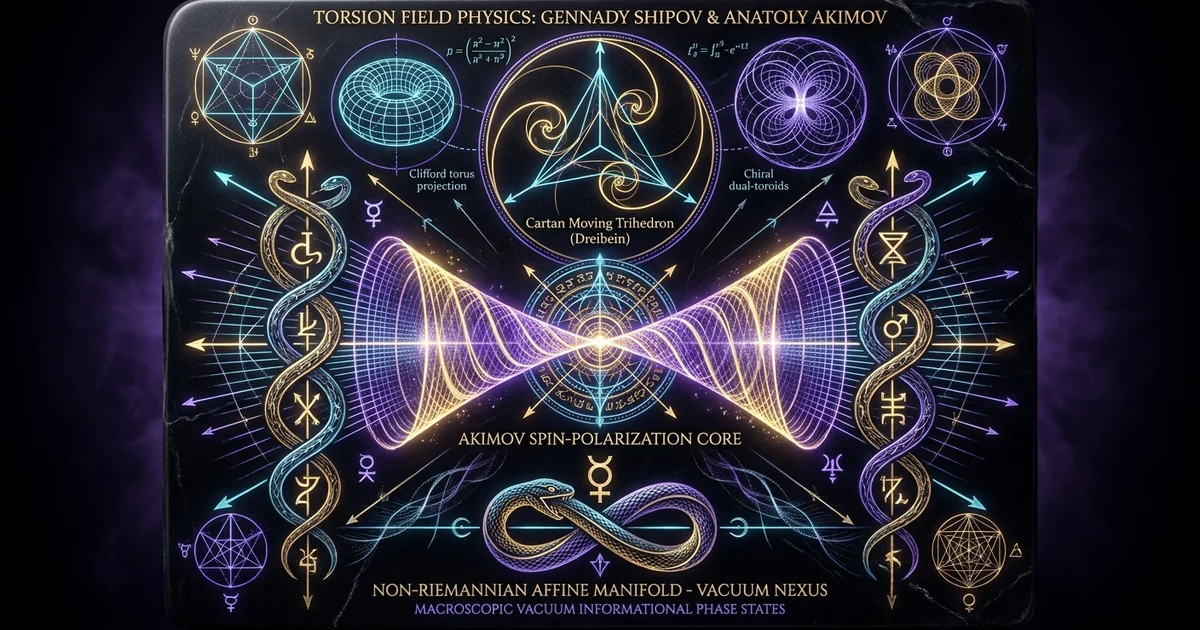
Torsion Field Physics: Gennady Shipov & Anatoly Akimov
Executive Summary & Theoretical Thesis
The Cartan Geometrical Extension of General Relativity
In canonical general relativity, Albert Einstein formulated gravitation upon the mathematical foundation of pseudo-Riemannian geometry. This manifold is strictly characterized by a symmetric, metric-compatible Levi-Civita connection $\Gamma^\lambda_{\mu\nu} = \Gamma^\lambda_{\nu\mu}$. In this metric framework, the Christoffel symbols describe how parallel transport alters the orientation of vectors along geodesics purely as a function of the metric tensor $g_{\mu\nu}$ and its partial derivatives. Consequently, the affine connection possesses zero anti-symmetric components. The geometric structure of spacetime is thus coupled exclusively to the translational energy-momentum tensor $T_{\mu\nu}$ of matter and radiation, completely ignoring any fundamental role for intrinsic quantum mechanical angular momentum or spin density.
In 1922, the French mathematician Élie Cartan demonstrated that this mathematical constraint is an arbitrary restriction upon differential geometry. By relaxing the condition of symmetry in the affine connection, Cartan introduced the concept of an asymmetric connection $\tilde{\Gamma}^\lambda_{\mu\nu} \neq \tilde{\Gamma}^\lambda_{\nu\mu}$, whose anti-symmetric component constitutes a third-rank tensor known as the torsion tensor:
$$T^\lambda_{\mu\nu} = \tilde{\Gamma}^\lambda_{\mu\nu} - \tilde{\Gamma}^\lambda_{\nu\mu}$$
Through this formulation, known modernly within metric-affine gravity as the Einstein-Cartan geometry and spin-gravity framework, spacetime possesses two distinct, independent geometric properties: curvature, which is mathematically governed by the Riemann curvature tensor $R^\rho_{\sigma\mu\nu}$ and dynamically coupled to translational mass-energy distributions, and torsion $T^\lambda_{\mu\nu}$, which couples directly to the intrinsic canonical spin density tensor $S^\lambda_{\mu\nu}$ of localized matter fields. In this mathematically rigorous setting, torsion represents the rotational twisting of the spacetime frame along affine autoparallel trajectories, describing how infinitesimal parallelograms fail to close when traversed via parallel transport.
The Phenomenological Claim of Vacuum Spin-Spin Coupling
While mainstream theoretical physics eventually codified Cartan’s geometry into the Einstein-Cartan-Sciama-Kibble (ECSK) theory of gravity, the physical manifestations of torsion were constrained to microphysical regimes. Because ECSK field equations yield an algebraic, non-propagating constraint between torsion and spin, torsion vanishes identically outside the spatial support of spinning matter. Gennady Ivanovich Shipov and Anatoly Evgenevich Akimov departed radically from this localized paradigm during the late Soviet and post-Soviet eras. Shipov asserted that the vacuum itself is not merely an empty geometric backdrop, but a dynamic, polarizable medium described by a fully geometrized set of vacuum equations where non-Riemannian torsion fields exist independently of localized mass-energy densities.
Akimov and Shipov proposed that just as electric charges polarize the electrostatic dielectric field and masses distort the metric tensor to induce gravitational acceleration, physical spinning masses or configurations of intrinsic quantum spins induce a long-range polarization of the vacuum. This purported interaction, termed by Akimov as “spin-spin interactions in vacuum” or macroscopic “torsion fields,” was claimed to facilitate non-electromagnetic, non-gravitational phase interactions. Within their heterodox formulation, these fields purportedly propagate at phase velocities vastly exceeding the speed of light ($c$), exhibit zero conventional attenuation through high-density physical shielding, and transmit information without direct thermodynamic energy dissipation. These assertions elevated torsion field physics from an esoteric geometric nuance of cosmological spin-density evolution to an all-encompassing vacuum mechanics theory.
Delineating Standard Metric-Affine Theory from Shipov-Akimov Heterodoxy
A rigorous scientific appraisal demands unambiguous demarcation between mainstream metric-affine gauge theories of gravity and the speculative vacuum mechanics promulgated by Shipov and Akimov. In established relativistic physics, as formalized by Friedrich W. Hehl and colleagues in 1976, torsion does not propagate as a radiative, long-range dynamic field in physical spacetime without the speculative introduction of explicit kinetic terms (such as quadratic curvature and torsion invariants $\sim R^2$ or $\sim T^2$) into the gravitational action. Even within propagating Poincaré gauge theories, the effective coupling constant mediating spin-spin contact interactions remains suppressed by the factor $G\hbar/c^3 \approx 10^{-65}\text{ cm}^2$, rendering macroscopic torsion signals imperceptible within several orders of magnitude of Planck-scale physics.
Conversely, Shipov’s “Theory of Physical Vacuum” and Akimov’s experimental programs operated upon an unshielded phenomenological coupling regime. Akimov posited that macroscopic objects possessing coherent rotational motion—ranging from mechanical gyroscopes to rotating electromagnetic fields and magnetic solenoids—could generate macroscopic torsion fields of macroscopic strength. These claimed fields were argued to perturb the fine-structure of the quantum vacuum, interacting directly with quantum vacuum zero-point fluctuations to alter local thermodynamic, crystallographic, and biological states. Mainstream theoretical and experimental physicists, led by the Russian Academy of Sciences, disputed these assertions, pointing out mathematical inconsistencies in Shipov’s tetrad equations and attributing Akimov’s reported experimental observations to uncalibrated systematic artifacts, classical electromagnetic coupling, and flawed statistical methodologies.
Einstein-Cartan-Sciama-Kibble (ECSK) Theory
- Underlying Geometry: Riemann-Cartan $U_4$ spacetime manifold featuring independent metric $g_{\mu\nu}$ and asymmetric affine connection $\Gamma^\lambda_{\mu\nu}$.
- Coupling Constants: Minimal spin-torsion coupling mediated directly by Newton’s gravitational constant: $\kappa = 8\pi G/c^4 \approx 2.07 \times 10^{-48}\text{ s}^2\text{cm}^{-1}\text{g}^{-1}$.
- Field Dynamics: Algebraic, non-propagating field equation ($T^\lambda_{\mu\nu} \sim S^\lambda_{\mu\nu}$). Torsion is strictly non-zero only within localized regions containing microphysical fermion spin density.
- Information & Energy Conservation: Adheres strictly to canonical relativistic conservation laws ($\nabla_\mu T^{\mu\nu} \neq 0$ balanced by spin conservation); signals obey the luminal speed limit $c$.
Shipov-Akimov Physical Vacuum Model
- Underlying Geometry: Absolute Parallelism / Weitzenböck $A_4$ spacetime possessing vanishing Riemannian curvature ($R^\rho_{\sigma\mu\nu} = 0$) and globally unconstrained torsion.
- Coupling Constants: Introduction of an arbitrary, unshielded phenomenological vacuum polarization parameter independent of Planck-scale gravitational suppression.
- Field Dynamics: Propagating wave-like and static polarization states generated by macroscopic rotational angular momentum and electromagnetic vortex systems.
- Information & Energy Conservation: Asserts non-energetic informational transmission; claims phase velocities exceeding $c$ ($v_{phase} \sim 10^9 c$) without standard thermodynamic attenuation.
Historical Lineage & Experimental Precedents
Élie Cartan’s 1922 Geometry and the ECSK Framework
The theoretical genealogy of non-Riemannian geometry originated with Élie Cartan’s 1922 communications to the French Academy of Sciences (Comptes Rendus), titled Sur une généralisation de la notion de courbure de Riemann et les espaces à torsion. Cartan recognized that the structural equations of a manifold could be elegantly dissected using differential forms and moving orthonormal frames (the Cartan tetrad or vielbein $e^a = e^a_\mu dx^\mu$). Cartan augmented the first structural equation, which traditionally defines the vanishing torsion of a Levi-Civita connection, with an anti-symmetric two-form of torsion:
$$\Theta^a = de^a + \omega^a_{\ b} \wedge e^b$$
where $\omega^a_{\ b}$ denotes the spin connection one-form.
For nearly four decades, Cartan’s geometric innovation remained largely an abstract mathematical curiosity, as general relativity’s experimental validation was anchored securely to mass distributions without macroscopic spin alignment. In the early 1960s, Dennis Sciama and Thomas Kibble re-examined Cartan’s construct through the lens of modern gauge theory. They demonstrated that just as translational invariance under the Poincaré group yields conservation of energy-momentum and generates the gravitational metric field, local Lorentz rotational invariance requires an independent gauge field: the spin connection, whose dynamic source is the canonical spin angular momentum of matter fields. This framework, systematically synthesized by Friedrich Hehl et al. in their 1976 Reviews of Modern Physics treatise, firmly positioned metric-affine geometry within the core canon of fundamental theoretical physics, while emphasizing that torsion’s physical effects become dynamically consequential only at catastrophic densities, such as the initial cosmological singularity or black hole collapse regimes.
Soviet Vacuum Physics and the Intersectoral Center ‘VENT’
In the late 1970s and throughout the 1980s, the closed scientific ecosystem of the Soviet Union provided an environment where unorthodox theoretical programs could secure state patronage if they promised breakthroughs in energy generation, non-line-of-sight telecommunications, or military defense applications. Anatoly Evgenevich Akimov, a researcher affiliated with the Institute of Radio Engineering, Electronics, and Automation (MIREA) and subsequently the Institute of Materials Science Problems in Kyiv, synthesized Cartan’s theoretical geometry with fringe interpretations of quantum electrodynamic vacuum states.
Akimov established the Intersectoral Scientific and Technical Center for Non-Traditional Technologies, designated as “VENT” (VNT-Center), under the auspices of the USSR State Committee on Science and Technology (GKNT) and with covert financial allocations directed through the Ministry of Defense and the Soviet State Security Committee (KGB). Between 1986 and 1991, VENT received millions of Soviet rubles to pioneer the application of “torsion field physics Gennady Shipov Cartan torsion spin fields” to non-electromagnetic telecommunications, novel metallurgical phase modifications, and strategic military sensor arrays. Operating under high levels of state secrecy, Akimov and his collaborators developed an idiosyncratic lexicon, conflating the mathematical torsion of Cartan-Sciama-Kibble spaces with wave-like vacuum perturbations produced by macroscopic apparatuses.
- Archival Origin: Declassified records of the USSR State Committee on Science and Technology (GKNT), Moscow; files of the Intersectoral Center for Non-Traditional Technologies (VENT).
- Reference Dossier: GKNT Directive No. 58 on “Program of Fundamental Research into Non-Traditional Physical Fields and Vacuum Effects” (Approved December 1988).
- Core Investigation: Documentation of project funding channeled to Anatoly Akimov’s group for testing non-electromagnetic information transmission across shielded underground enclosures using spin-polarized emitters.
- Institutional Outcome: Formal repudiation in July 1991 by the Committee on Science and Technologies of the Supreme Soviet of the USSR, which dissolved public funding following an audit exposing methodological failures and uncalibrated instrumentation.
Anatoly Akimov’s Mechanical and Spinor Field Generators
Akimov and his technical cadre engineered an array of physical devices that they categorized as macroscopic torsion field generators. These apparatuses were classified into three architectural paradigms: mechanical, electromagnetic, and geometric-topological. Mechanical generators comprised high-speed rotors, unbalanced asymmetric gyroscopes, and centrifuge systems operating at angular velocities exceeding $10^4\text{ RPM}$. Akimov asserted that coherent angular momentum vectors generated by rotating dense masses could shear the physical vacuum, producing macroscopic spin-polarization fields that persisted even after the mechanical drives were de-energized.
Electromagnetic generators integrated cross-field geometries where orthogonal magnetic and electrostatic vectors were introduced into non-linear dielectric media, closely mimicking earlier exploratory work in longitudinal dielectric waves and scalar potentials. Akimov utilized rotating magnetic fields, pulsed conical solenoids, and high-frequency discharge coils configured to nullify standard transverse electromagnetic radiation via destructive interference of transverse components. The residual emission, he argued, was a longitudinal, non-electromagnetic torsional wave.
Geometric or topological generators utilized cone, pyramid, or logarithmic spiral geometries, postulating that geometric boundary conditions alter the local zero-point energy density of the vacuum. Akimov asserted that these stationary shapes passively focused vacuum torsion, altering the local dielectric field and generating measurable changes in the physical properties of matter placed within their cymatic modal nodes.
Mathematical Formalism & Physical Mechanics
Metric-Affine Connections and the Asymmetric Cartan Torsion Tensor
To comprehend the departure of Shipov’s mechanics from standard relativistic field theory, one must inspect the fundamental affine transformation properties of modern differential geometry. Let $\mathcal{M}$ be a four-dimensional differentiable manifold equipped with a metric tensor $g_{\mu\nu}$ of Lorentzian signature $(+,-,-,-)$ and a general affine connection $\Gamma^\lambda_{\mu\nu}$. The covariant derivative of an arbitrary contravariant vector $V^\lambda$ is defined as:
$$\nabla_\mu V^\lambda = \partial_\mu V^\lambda + \Gamma^\lambda_{\nu\mu} V^\nu$$
In a standard pseudo-Riemannian manifold, the connection is assumed to be symmetric with respect to its lower indices ($\Gamma^\lambda_{\mu\nu} = \Gamma^\lambda_{\nu\mu}$), identically matching the Christoffel symbols ${^\lambda_{\mu\nu}}$:
$${^\lambda_{\mu\nu}} = \frac{1}{2} g^{\lambda\rho} \left( \partial_\mu g_{\nu\rho} + \partial_\nu g_{\mu\rho} - \partial_\rho g_{\mu\nu} \right)$$
In a Riemann-Cartan manifold ($U_4$), metric-compatibility ($\nabla_\lambda g_{\mu\nu} = 0$) is maintained, but the symmetry condition is dropped. The general connection decomposes uniquely into the symmetric Levi-Civita connection and the contortion tensor $K^\lambda_{\ \mu\nu}$:
$$\Gamma^\lambda_{\mu\nu} = {^\lambda_{\mu\nu}} + K^\lambda_{\ \mu\nu}$$
The contortion tensor is algebraically related to the Cartan torsion tensor $T^\lambda_{\ \mu\nu}$ via the linear combination:
$$K^\lambda_{\ \mu\nu} = \frac{1}{2} \left( T^\lambda_{\ \mu\nu} + T_{\mu\ \nu}^{\ \lambda} + T_{\nu\ \mu}^{\ \lambda} \right)$$
where $T^\lambda_{\ \mu\nu} \equiv \Gamma^\lambda_{\mu\nu} - \Gamma^\lambda_{\nu\mu}$. The torsion tensor satisfies total anti-symmetry in its lower indices: $T^\lambda_{\ \mu\nu} = -T^\lambda_{\ \nu\mu}$.
In the standard Einstein-Cartan-Sciama-Kibble theory, the gravitational action is derived from the modified Einstein-Hilbert variational principle: $$\mathcal{S} = \int d^4x \sqrt{-g} \left[ \frac{1}{2\kappa} R(\Gamma) + \mathcal{L}m(g{\mu\nu}, \Gamma^\lambda_{\mu\nu}, \psi) \right]$$ where $R(\Gamma) = g^{\mu\nu} R^\rho_{\ \mu\rho\nu}(\Gamma)$ is the curvature scalar constructed purely from the asymmetric affine connection $\Gamma$, $\kappa = 8\pi G/c^4$, and $\mathcal{L}_m$ is the matter Lagrangian.
Varying the action independently with respect to the metric $g_{\mu\nu}$ yields the modified Einstein field equations: $$G^{\mu\nu}(\Gamma) = \kappa \Sigma^{\mu\nu}$$ where $\Sigma^{\mu\nu}$ is the canonical, generally asymmetric, energy-momentum tensor.
Varying independently with respect to the contortion tensor $K^{\lambda\mu\nu}$ yields the Cartan field equation: $$T^\lambda_{\ \mu\nu} + \delta^\lambda_\mu T^\rho_{\ \nu\rho} - \delta^\lambda_\nu T^\rho_{\ \mu\rho} = \kappa S^\lambda_{\ \mu\nu}$$ where $S^\lambda_{\ \mu\nu} \equiv \frac{\delta \mathcal{L}m}{\delta K{\lambda}^{\ \mu\nu}}$ is the canonical spin angular momentum density tensor of matter.
By contracting indices to isolate the torsion trace vector $T_\mu = T^\nu_{\ \mu\nu}$, the explicit algebraic solution expresses torsion strictly as a local function of spin density: $$T_{\lambda\mu\nu} = \kappa \left( S_{\lambda\mu\nu} + \frac{1}{2} g_{\lambda\nu} S^\rho_{\ \mu\rho} - \frac{1}{2} g_{\lambda\mu} S^\rho_{\ \nu\rho} \right)$$ Crucially, because no spacetime derivatives ($\partial_\rho T_{\lambda\mu\nu}$) appear in this relation, the ECSK torsion tensor is non-propagating: it vanishes identically in any domain of spacetime where the local spin density $S_{\lambda\mu\nu} = 0$.
Shipov’s Universal Vacuum Equations and Geometric Rotational Inertia
Gennady Shipov recognized that the non-propagating character of ECSK torsion precluded any macroscopic transmission of forces or information across an empty vacuum. To overcome this limitation, Shipov advanced what he termed the Theory of Physical Vacuum: A New Paradigm (Shipov, 1998). Rather than utilizing the Riemann-Cartan space $U_4$, Shipov formulated his theory within a space of Absolute Parallelism (often designated as Weitzenböck space $A_4$ or $T_4$). In this space, the total Riemannian curvature is postulated to vanish identically throughout the manifold:
$$R^\rho_{\ \sigma\mu\nu}(\Gamma) = 0$$
Under this mathematical condition, the standard gravitational curvature is completely translated into torsion. To accomplish this, Shipov employed the Ricci rotation coefficients of an orthogonal tetrad basis $e^a_\mu$. The connection is defined such that parallel transport is path-independent in terms of the tetrad field, establishing an absolute teleparallelism:
$$\Gamma^\lambda_{\mu\nu} = e_a^\lambda \partial_\nu e^a_\mu$$
Shipov posited a unified set of nonlinear vacuum field equations. He argued that the true fundamental physical vacuum satisfies an overdetermined system of geometric conditions linking the torsion field directly to anholonomy coefficients and rotational inertia:
$$\nabla_{[\mu} T^\lambda_{\ \nu\rho]} + T^\sigma_{\ [\mu\nu} T^\lambda_{\ \rho]\sigma} = 0$$
Shipov asserted that the rotational inertia of accelerating, spinning mechanical systems generates a secondary geometric torsion field that modifies the local trajectory of center-of-mass vectors. He asserted that inertial mass is not an intrinsic, invariant property of matter, but a dynamic feedback effect arising from the interaction between macroscopic angular momentum and the absolute teleparallel connection of the vacuum manifold. By manipulating tetrad rotations, Shipov claimed to geometrize both translational and rotational mechanics, purporting to derive unified equations that encompass gravitation, electromagnetism, and rotational inertial fields without requiring matter stress-energy sources on the right-hand side of Einstein’s field equations.
[ Local Non-Inertial Acceleration ]
                       │
                       ▼
       [ Asymmetry of Affine Connection ]
     ( Γ^λ_μν ≠ Γ^λ_νμ  ==>  T^λ_μν ≠ 0 )
                       │
                       ▼
     [ Shipov Vacuum Teleparallel Equations ]
          ( R^ρ_σμν = 0 ,  T^λ_μν = e_a^λ ∂_[ν e^a_μ] )
                       │
                       ▼
     [ Macroscopic Vacuum Spin-Polarization ]
   ( Modification of Center-of-Mass Geodesics )
Spin-Spin Interactions in Polarized Vacuum Manifolds
The physical divergence between the ECSK framework and the Shipov-Akimov model becomes pronounced when analyzing spin-spin coupling. In established quantum field theory set within curved spacetime, two localized spinning particles (such as polarized electrons or neutrons) interact gravitationally through an effective four-fermion contact potential:
$$\mathcal{H}{spin-spin} = \frac{3}{16} \kappa \left( \bar{\psi} \gamma_5 \gamma\mu \psi \right) \left( \bar{\psi} \gamma_5 \gamma^\mu \psi \right)$$
Because $\kappa = 8\pi G/c^4$, this interaction is modulated by a coupling cross-section proportional to $G\hbar/c^3 \approx 10^{-65}\text{ cm}^2$. Such contact interactions are completely undetectable at macroscopic atomic distances, remaining roughly 35 orders of magnitude weaker than standard magnetic dipole-dipole interactions:
$$U_{magnetic} = \frac{\mu_0}{4\pi r^3} \left[ \mathbf{m}_1 \cdot \mathbf{m}_2 - 3(\mathbf{m}_1 \cdot \hat{\mathbf{r}})(\mathbf{m}_2 \cdot \hat{\mathbf{r}}) \right]$$
Akimov and Tarasenko (1992) bypassed this fundamental constraint by hypothesizing that the physical vacuum constitutes an ordered degenerate quantum fluid composed of electron-positron pairs with compensated charges and spins, designated conceptually as “phytons.” When exposed to a rotating macroscopic mass or an aligned magnetic domain, Akimov asserted that the phyton matrix undergoes transverse and longitudinal spin-polarization. This hypothesized polarization state was said to establish an unshielded, long-range potential:
$$V_{torsion}® \sim \frac{g_{spin} C_{vac}}{r} \left( \mathbf{S}_1 \cdot \mathbf{S}_2 \right)$$
where $C_{vac}$ is a phenomenological vacuum coupling constant arbitrarily set orders of magnitude above the gravitational scale, and $\mathbf{S}_1, \mathbf{S}_2$ represent macroscopic spin angular momentum vectors. This theoretical postulation enabled Akimov to assert that macroscopic rotating gyroscopes could exert mutual forces through classical electromagnetic shields, bypassing canonical quantum mechanical selection rules.
Empirical Evidence & Observational Data
Anomalous Gravimetric and Precessional Deviations in High-RPM Gyroscopes
The primary empirical cornerstone of the Soviet and post-Soviet torsion field claims was the observation of gravimetric anomalies in high-velocity spinning systems. In 1989, Japanese researchers Hideo Hayasaka and Sakae Takeuchi published an article in Physical Review Letters reporting an anomalous, asymmetric weight reduction in right-spinning mechanical gyroscopes dropped under vacuum conditions. The reported weight loss was minuscule—on the order of a few milligrams-force, proportional to the gyroscope’s angular velocity between 3,000 and 13,000 RPM—yet it matched predictions made by Shipov regarding non-compensated vertical components of dynamic geometric torsion fields.
Shipov seized upon these empirical reports, declaring that an asymmetric mechanical rotor undergoing 3D precession generates a non-zero net translational force: an effect he designated as a “4D gyroscopic thruster” or “inertial propulsion unit.” In these devices, internal motor-driven masses navigated elliptical and cardiodal trajectories designed to leverage the anti-symmetric Christoffel coefficients of non-Riemannian geometry. Shipov and his collaborators claimed that these laboratory rigs achieved anomalous acceleration on frictionless air-bearing tables without expelling propellant mass, asserting that the devices were exchanging momentum with the physical vacuum’s metric-affine torsion background.
Biological and Crystallization Effects under Purported Torsion Fields
Beyond purely gravimetric experiments, Anatoly Akimov and his network asserted extensive empirical validations within the domains of metallurgy and biological systems. In metallurgical tests conducted in collaboration with research institutes across Ukraine and Russia, Akimov claimed that exposing molten metals (such as tin, copper, and structural steels) to the radiation of electromagnetic torsion emitters altered their subsequent solid-state properties.
Reports circulated through VENT publications indicated that metals solidified within the focus of a torsion generator exhibited:
- Dramatically altered dendritic grain sizes;
- Significant non-thermal increases in tensile strength;
- Modified electrical conductivity profiles that could not be achieved through conventional annealing or electromagnetic induction techniques.
In biological domains, Akimov and Tarasenko reported altered metabolic rates in cellular cultures, shifts in the germination velocity of seeds, and reproducible modifications in human electroencephalographic (EEG) alpha-rhythm coherence during exposure to shielded emitters. These physiological perturbations were framed as resonant coupling between cellular microtubules, DNA helical geometries, and the cymatics and vortex mechanics of the vacuum. Crucially, Akimov maintained that these biological shifts remained invariant regardless of whether the target was shielded by multi-layered Faraday cages, thick lead plates, or large physical distances, thereby asserting the completely non-electromagnetic character of the transmitted signal.
Methodological Critiques, Null Replications, and Russian Academy of Sciences Scrutiny
The sensational empirical claims advanced by VENT and Shipov’s research circle encountered immediate, fatal resistance from the mainstream physics community once subjected to rigorous external replication protocols. In 1990, James E. Faller and his team at the Joint Institute for Laboratory Astrophysics (JILA) repeated the Hayasaka-Takeuchi gyroscope experiments using high-precision optical interferometry and null-balance systems. Faller’s group observed no anomalous weight shifts down to the microgram level, demonstrating that the anomalies initially reported by Hayasaka were systematic artifacts stemming from uncorrected thermal gradients, rotor precessional vibrations coupling to the balance suspensions, and magnetic interactions with surrounding chassis materials. Subsequent ultra-precise measurements by Quinn and Picard (1990) reinforced these null results.
- Faller, J. E., Hollander, W. J., Nelson, P. G., & McHugh, M. P. (1990). ‘Gyroscope test of the equivalence principle.’ Physical Review Letters, 64(8), 825–827.
- Quinn, T. J., & Picard, A. (1990). ‘The weight of a spinning gyroscope: a test of non-Newtonian gravity.’ Nature, 343(6260), 732–735.
- Aleksandrov, Evgeny B. (1991). ‘Torsion fields and Soviet funding: A post-mortem of state-sponsored pseudoscience.’ Vestnik Rossiiskoi Akademii Nauk, 61(7), 45–53.
- Kruglyakov, Edward P. (1998). Pseudoscience: How Does It Threaten Science and Society? Russian Academy of Sciences Commission on Pseudoscience and Research Fraud.
Simultaneously, the collapse of the Soviet Union exposed the operations of the VENT center to administrative and scientific evaluation. In 1991, Academicians Evgeny Aleksandrov, Edward Kruglyakov, and Vitaly Ginzburg—under the authority of the Russian Academy of Sciences (RAS)—conducted an exhaustive methodological audit of Akimov’s experimental protocols. The RAS commission determined that:
- Akimov’s torsion generators emitted standard, highly attenuated leakage of classical high-frequency electromagnetic radiation and magnetic flux through imperfectly engineered chassis seams;
- Biological and metallurgical anomalies were within standard statistical variance and could not be reproduced under double-blind laboratory conditions;
- Shipov’s mathematical formulations contained elementary boundary condition violations, arbitrary gauge modifications, and unjustified divisions by invariant differential quantities.
The Commission on Pseudoscience and Research Fraud formally declared the macroscopic torsion field claims of Shipov and Akimov to be scientifically unfounded, concluding that state funding had been obtained through the misrepresentation of established differential geometry.
Metaphysical Implications & Unified Synthesis
Information Transmission versus Energy Exchange in Quantum Vacuum States
Despite rigorous academic repudiation, the conceptual architecture engineered by Shipov and Akimov exerted profound influence across fringe physics, speculative philosophy, and modern esoteric metaphysics. The foundational principle of Akimov’s doctrine was the radical decoupling of information from thermodynamic energy. In canonical physics, Brillouin’s principle and Landauer’s erasure principle firmly tether informational entropy to thermodynamic states ($dE = kT \ln 2$). The transmission of an informational bit through physical spacetime necessitates the propagation of an energy-momentum wavefront ($\Delta E \geq \hbar / \Delta t$) governed by the relativistic dispersion relation $E^2 = p^2c^2 + m^2c^4$.
Akimov contended that torsion fields do not transport classical dynamic momentum or kinetic energy. Instead, he framed the torsion field as an informational modulation of the vacuum’s metric phase, akin to David Bohm’s quantum informational potential ($Q \sim \nabla^2 R / R$). In this paradigm, a torsion emitter does not perform mechanical work upon a distant detector; rather, it introduces a subtle topological rotation into the local vacuum phase angle. This modification alters the probabilistic outcome of quantum measurements—such as radioactive decay rates, liquid crystal optical polarization, or phase shifts in bio-molecular reactions. This conceptual framework bridged the gap between differential geometry and non-local metaphysical ideas, leading to assertions that human consciousness, intentionality, and brainwave coherence directly interface with macroscopic spacetime torsion.
+──────────────────────────────────────────────────────────+
│             PHENOMENOLOGICAL TAXONOMY                    │
+──────────────────────────────────────────────────────────+
│ CANONICAL ECSK GRAVITY   │ SHIPOV-AKIMOV PHYSICAL VACUUM │
+──────────────────────────+───────────────────────────────+
│ • Non-propagating contact│ • Propagating vacuum phase    │
│   interaction            │   polarization                │
│ • Strictly microphysical │ • Macroscopic manifestation   │
│   fermion spin density   │   via rotating mass / EM      │
│ • Suppressed by Planck   │ • Arbitrary long-range        │
│   scale (10^-65 cm^2)    │   coupling parameter          │
│ • Bound by speed of      │ • Asserted superluminal phase │
│   light (c)              │   velocities (v >> c)         │
+──────────────────────────────────────────────────────────+
The Geometrical Vacuum as an Informational Matrix
Within theoretical physics lineages that critique purely reductionist material models, Shipov’s “Physical Vacuum” provided a mathematical language for concepts historically designated as the luminiferous aether, prana, or subtle energy bodies. If the vacuum possesses internal degrees of rotational freedom governed by a dynamic teleparallel connection, the universe is no longer an empty void populated by isolated matter distributions. Instead, space becomes a continuous, interconnected geometric matrix.
In this metaphysical synthesis, macroscopic structures exhibit self-similar organizational patterns echoing non-linear wave dispersion. Ancient architectural frameworks, the geometric harmonics of planetary motions, and the slow, rhythmic cycles of the precession of the equinoxes were viewed by fringe theorists through the lens of torsional resonance. It was hypothesized that massive spinning celestial bodies—such as planets and stars—generate vast geometric torsion fields that structure solar systems into discrete, harmonically quantized orbits. The Earth itself, with its rotational angular momentum coupled to its core dynamo, was envisioned as a global torsion resonator, interfacing with the Schumann resonance to establish an environmental informational field regulating terrestrial biological homeostasis.
Reconciling Torsion Physics with Longitudinal Scalar Wave Models
To place the Shipov-Akimov framework into context with other heterodox physics traditions, one must examine its intersection with Nikola Tesla’s late-nineteenth-century assertions regarding non-Hertzian radiation and modern formulations of scalar electromagnetism. Standard Maxwellian electrodynamics, formulated via differential forms, asserts that electromagnetic energy propagates exclusively via transverse vector waves where electric and magnetic field vectors oscillate orthogonal to the direction of propagation ($\mathbf{E} \perp \mathbf{B} \perp \mathbf{k}$). The divergence equations $\nabla \cdot \mathbf{B} = 0$ and $\nabla \cdot \mathbf{D} = \rho$ preclude dynamic, longitudinal electromagnetic modes in free space.
Heterodox investigators, however, noted that if one couples electrodynamics to an asymmetric affine connection where torsion is non-zero, the electromagnetic field tensor $F_{\mu\nu} = \partial_\mu A_\nu - \partial_\nu A_\mu$ acquires an additional geometric component:
$$F_{\mu\nu}^* = \nabla_\mu A_\nu - \nabla_\nu A_\mu = \partial_\mu A_\nu - \partial_\nu A_\mu - T^\lambda_{\ \mu\nu} A_\lambda$$
This mathematical coupling permits the excitation of dynamic, longitudinal dielectric waves and dynamic longitudinal magnetic potentials. These modes oscillate parallel to the wavevector $\mathbf{k}$, matching the mathematical structure of acoustic waves propagating through an elastic fluid medium. Consequently, Shipov’s torsion fields were conceptually synthesized with Whittaker-type scalar potential electrodynamics. Mainstream physics maintains that these longitudinal electrodynamic and torsion waves represent gauge artifacts or mathematical fictions stemming from broken gauge-invariance assumptions. Yet, within the subculture of borderland science, this unified construct remains a persistent model used to explain purported non-local energy harvesting, anomalous gravitational shielding, and superluminal communication systems.
Frequently Asked Questions
Distinction Between Spacetime Curvature and Spacetime Torsion
In differential geometry, spacetime curvature and spacetime torsion represent two fundamentally distinct, mathematically independent tensor operations applied to an affine manifold. Curvature, quantified by the fourth-rank Riemann tensor $R^\rho_{\ \sigma\mu\nu}$, measures the rotation and tidal deformation that an arbitrary vector undergoes when it is parallel-transported around a closed, infinitesimal loop. Curvature is dynamically sourced by the distribution of mass, momentum, and energy within spacetime, dictating the convergence or divergence of adjacent geodesics.
CURVATURE TENSOR (Riemann):
Parallel transport of a vector along a closed loop rotates its orientation.
               v_final
                ▲
               /   \
  v_initial   /     \
      ▲      ┌───────┐
      │  ──> │ Loop  │
             └───────┘

TORSION TENSOR (Cartan):
Infinitesimal displacement vectors along coordinate axes fail to form a closed parallelogram.
      x + dx
      ┌───────> •
      │        /
      │       /
   dy │      / dy'  ===> Closure Failure: ∮ dx^μ = ∮ T^μ_νρ dx^ν ∧ dx^ρ ≠ 0
      │     /
      ▼    ▼
      • ───> •
        dx'
Torsion, quantified by the third-rank Cartan tensor $T^\lambda_{\ \mu\nu}$, measures the failure of infinitesimal displacement vectors to close into a planar parallelogram when traversed along the connection’s autoparallel trajectories. Physically, while curvature bends trajectories into orbits, torsion imparts an intrinsic chiral “twist” or helicity to the local reference frames. In physical terms, curvature governs orbital angular momentum and translational gravitation, whereas torsion interacts exclusively with rotational spin angular momentum, twisting the coordinate axes along the trajectory of moving particles.
The Magnitude Problem of Torsion Coupling Constants
Mainstream general relativity accepts the mathematical consistency of the Einstein-Cartan-Sciama-Kibble (ECSK) theory of gravity, yet categorically rejects Shipov’s and Akimov’s claims regarding macroscopic torsion phenomena. The fundamental divergence centers entirely upon the magnitude of the gravitational spin-coupling constant. In the standard ECSK framework, the field equations are derived strictly from a minimal-coupling variational principle, establishing that the magnitude of local torsion is governed by the gravitational constant:
$$\kappa = \frac{8\pi G}{c^4} \approx 2.07 \times 10^{-43}\text{ N}^{-1}$$
To produce a torsion field of sufficient magnitude to alter the trajectory of macroscopic objects, induce measurable weight changes, or alter the crystallization lattice of an alloy, the canonical spin density $S_{\lambda\mu\nu}$ of the source matter must reach astronomically high values. Theoretical calculations demonstrate that measurable torsion manifestations require matter densities on the order of:
$$\rho_{crit} \sim 10^{54}\text{ g/cm}^3$$
Such extreme conditions occur exclusively in the hyper-dense core regimes of collapsing black holes prior to event horizon formation, or during the pre-inflationary epoch of the early universe ($t < 10^{-43}\text{ s}$). Within normal terrestrial matter—where the atomic nuclei and electrons possess polarized spins at laboratory densities ($\sim 1\text{ to }20\text{ g/cm}^3$)—the resulting torsion field is suppressed by a factor of roughly $10^{-30}$ relative to the already weak Newtonian gravitational field. Therefore, generating macroscopic, long-range dynamic torsion forces within laboratory-scale apparatuses using conventional matter is fundamentally precluded by canonical metric-affine gravitational physics.
The inability of canonical metric-affine torsion to mediate long-range vacuum communications or macroscopic propulsion is demonstrated through its algebraic field equations. Consider the standard Einstein-Cartan field action in four dimensions: $$S = \frac{1}{2\kappa} \int d^4x \sqrt{-g} R(\Gamma) + \int d^4x \sqrt{-g} \mathcal{L}m(\psi, \nabla \psi)$$ In this action, the asymmetric connection $\Gamma^\lambda{\mu\nu}$ appears algebraically within the curvature scalar $R(\Gamma)$ without kinetic derivative terms of the form $(\nabla_\rho T^\lambda_{\ \mu\nu})(\nabla^\rho T_\lambda^{\ \mu\nu})$ or $(T^\lambda_{\ \mu\nu} T_\lambda^{\ \mu\nu})^2$.
When computing the Euler-Lagrange equations via independent variation of the contortion tensor $K_{\lambda\mu\nu}$: $$\frac{\partial (\sqrt{-g} R)}{\partial K_{\lambda\mu\nu}} - \partial_\rho \left( \frac{\partial (\sqrt{-g} R)}{\partial (\partial_\rho K_{\lambda\mu\nu})} \right) = -2\kappa \frac{\partial (\sqrt{-g} \mathcal{L}m)}{\partial K{\lambda\mu\nu}}$$ Because the derivative term $\frac{\partial (\sqrt{-g} R)}{\partial (\partial_\rho K_{\lambda\mu\nu})} = 0$, the resulting differential equation degenerates completely into a purely algebraic, local relation: $$T^\lambda_{\ \mu\nu} + \delta^\lambda_\mu T^\rho_{\ \nu\rho} - \delta^\lambda_\nu T^\rho_{\ \mu\rho} = \kappa S^\lambda_{\ \mu\nu}$$ Now, consider any region of spacetime situated strictly outside the boundary of the generating apparatus (the vacuum domain, where matter wavefunctions $\psi = 0$): $$\mathcal{L}m = 0 \implies S^\lambda{\ \mu\nu} = 0$$ Substituting this into the algebraic field equation yields: $$T^\lambda_{\ \mu\nu} = 0 \quad (\text{identically for all } x \in \text{Vacuum})$$ Consequently, unlike Maxwellian electromagnetic radiation where accelerating charges radiate transverse waves ($A_\mu \sim e^{ikx}$) that propagate infinitely through the matter-free vacuum via dynamic kinetic field equations ($\Box A_\mu = 0$), canonical spacetime torsion cannot propagate. It is mathematically chained to the localized spatial coordinate footprint occupied by non-zero spin density matter, vanishing the instant one retreats into the surrounding vacuum.
Status of Non-Electromagnetic Torsion Communication Systems
During the operational peak of the VENT center, Anatoly Akimov asserted that his team had constructed functional non-electromagnetic telecommunication links that transmitted data over distances exceeding twenty kilometers across Moscow. Akimov claimed that the signal penetrated through multi-story concrete structures, terrestrial geological formations, and specialized radio-frequency (RF) Faraday shielding without registering measurable signal loss. He maintained that this demonstrated the realization of an entirely novel telecommunication infrastructure that avoided the electromagnetic spectrum.
Subsequent investigations and historical post-mortems conducted by independent communication specialists and the Russian Academy of Sciences dismantled these claims:
- When the supposed torsion transmitters were enclosed within hermetically sealed, double-walled radio-frequency shielding cabinets, all detected signals at the receiver dropped below the ambient noise floor.
- The previously observed “signals” were traced to conventional electromagnetic crosstalk: the high-voltage pulsing electronics, spark gaps, and unshielded inductor leads within Akimov’s transmitters radiated broad-spectrum RF and low-frequency magnetic spikes. These emissions coupled to the electrical power grid and municipal ground lines, propagating along standard copper conduits rather than through the vacuum via non-Riemannian geometry.
To date, no independent laboratory has successfully demonstrated the transmission of a single bit of information using a purely torsional or non-electromagnetic spinor emitter operating under verified, RF-isolated conditions. The assertion that torsion field physics provides a functional, superluminal telecommunications medium remains an unproven technological hypothesis unsupported by peer-reviewed experimental literature.
Scholarly Synthesis & Methodological Conclusions
The trajectory of torsion field physics—from Élie Cartan’s rigorous 1922 geometric insights to the heterodox vacuum models of Gennady Shipov and Anatoly Akimov—illustrates the fragile boundary separating non-standard mathematical physics from speculative science. Within the strict boundaries of differential geometry and metric-affine gravity, Cartan’s torsion tensor remains an elegant mathematical apparatus: it naturally accommodates microphysical fermionic spin within curved spacetimes, providing an avenue for resolving singular geometries in high-energy cosmological models.
However, the post-Soviet extrapolation of this geometry into an unshielded, macroscopic informational field capable of superluminal propagation, propulsive thrust without reaction mass, and metallurgical transmutations represents an unverified theoretical overreach. The failure of independent teams to replicate these empirical claims, combined with the absence of propagating kinetic terms in well-founded metric-affine field actions, preserves the mainstream consensus: macroscopic torsion fields remain unobserved theoretical constructs. Legitimate investigations into spin-gravity coupling continue to progress, not through unverified vacuum devices, but through the rigorous empirical channels of quantum gravimetry, high-energy particle accelerators, and astrophysical observations of extreme compact stellar objects. :::