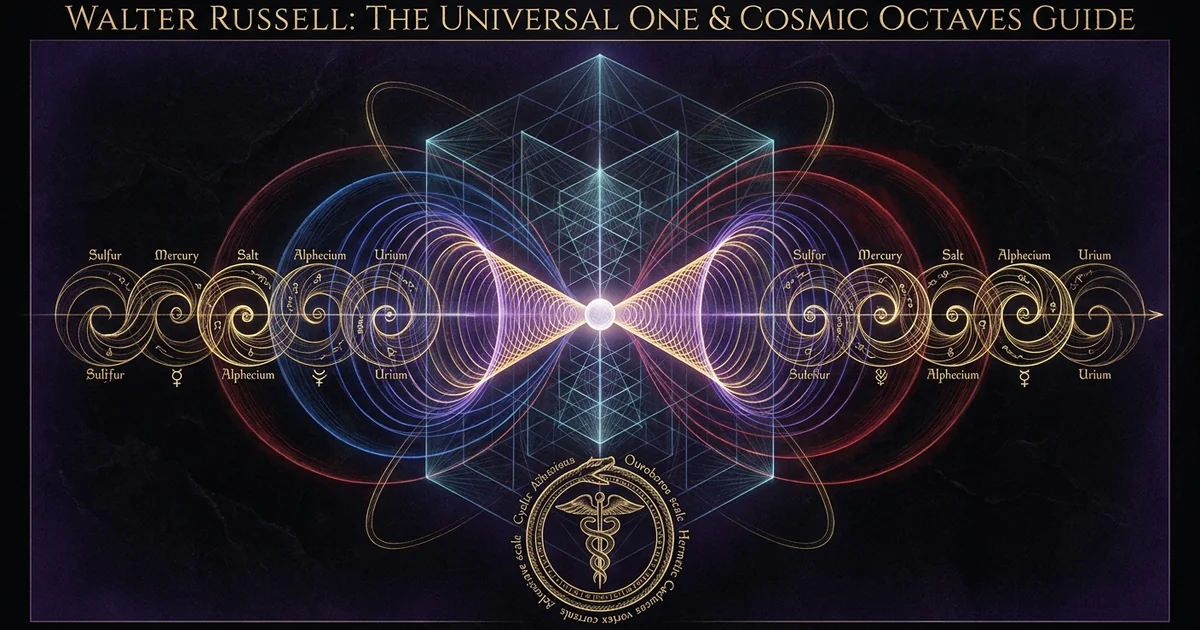
Walter Russell: The Universal One & Cosmic Octaves Guide
Executive Summary & Theoretical Thesis: Russellian Cosmogony and Scalar Electrodynamics
Non-Equilibrium Thermodynamics and Two-Way Continuous Creation
Classical and contemporary quantum thermodynamics operate under the foundational axiom of entropic degradation. Rooted in the formulations of Rudolf Clausius, Ludwig Boltzmann, and Lord Kelvin, the second law of thermodynamics presupposes that all localized physical systems—and by extension, the macro-cosmic manifold itself—possess an irreversible trajectory toward maximum entropy, molecular chaos, and asymptotic heat death. This paradigm is fundamentally unipolar; it models the universe as an open-wound dissipation engine, observing radiation, heat loss, radioactive decay, and mass-energy conversion through the singular lens of expansion. Within this conventional framework, mass represents an anomalous, pre-existing concentration of energy whose origins require extraordinary singular events, such as an initial primordial singularity, while its operational destiny remains perpetual disintegration.
Walter Russell’s cosmogony, formulated systematically in The Universal One (Russell, 1926) and refined in The Secret of Light (Russell, 1947), dismantles this half-cycle thermodynamic assumption. Russell posited that standard physics records only the exhalative, radiative half of an alternating, dual-action cosmic engine. Matter is not an assembly of isolated corpuscular billiard balls condemned to irreversible decay; rather, it represents localized concentrations of electric motion compressed into polarized, gyroscopic octave vortices within a continuous scalar substrate of still magnetic Light. In Russellian electrodynamics, for every unit of radiative, centrifugal, entropic expansion, an equal and opposite unit of generative, centripetal, negentropic compression operates simultaneously. Nature does not wind down without simultaneously winding up; entropy is inexorably married to generation through a dynamic known as two-way continuous creation.
This formulation reconceptualizes gravity and radiation not as fundamentally distinct forces governed by mismatched field equations, but as dual conjugate vectors of a single polar mechanism: electro-gravitational compression and electro-radiative expansion. Radiation is simply the dissolution of a concentrated wave-packet returning to its unconditioned scalar equilibrium, while gravitation is the generative winding of wavefields along conical trajectories toward dynamic apex density. By recognizing that energy is generated through centripetal contraction before it can ever be radiated through centrifugal expansion, Russell established a non-equilibrium cosmogony wherein the universe maintains homeostatic conservation through perpetual, cyclical regenerative pumping.
Light Octave Wave Mechanics vs. Standard Field Models
In the canonical framework derived from Albert Einstein’s general relativity and the Maxwell-Lorentz electrodynamic synthesis, electromagnetic radiation propagates through a four-dimensional space-time continuum as transverse wave oscillations. Standard quantum electrodynamics further atomizes this propagation into discrete gauge bosons (photons) operating within a probabilistic vacuum state. While standard field theory relies heavily on transverse mathematical formalisms—wherein electric and magnetic vectors oscillate orthogonally to the direction of propagation—it frequently marginalizes the underlying dielectric-field and the associated scalar-potential components that govern boundary transformations.
Russell’s octave wave mechanics fundamentally departs from transverse corpuscular abstraction by establishing that all light, matter, and radiation consist of paired, conical, non-linear vortices oscillating between absolute stillness and maximal velocity. The Russellian universe does not transmit “particles” across vast distances; rather, it replicates electrical states through inductive disturbance across an omnipresent, incompressible medium. Light does not travel; it reproduces itself from wavefield to wavefield via acoustic-like pressure modulations within the cosmic dielectric matrix. What modern detectors measure as transverse electromagnetic waves are the peripheral shearing interfaces of interlocking vortex cones, whereas the core axial propagation operates as a longitudinal-wave pulse governed by the geometry of the octave-wave.
Every physical manifestation—from the proton to the galactic supercluster—is structured as a harmonic modulation of an octave wavefield. The fundamental baseline of this wave architecture is the zero-amplitude plane of magnetic stillness, an unconditioned continuum possessing infinite scalar potential. When polarized into electric motion, this baseline bifurcates into red-shifted generative contraction and blue-shifted radiative expansion. The resulting phenomena are not isolated entities inhabiting empty space, but rather cymatic-modal-nodes formed at the focal points where opposing wave trains intersect within bounded cubic fields.
The Centripetal-Centrifugal Vortex Paradigm
The mechanical operational engine of the Russellian universe is the dual-opposed vortex. In The Universal One, mass is defined as the volumetric compression of electric motion into the apex of intersecting conical spirals. This vortex-mechanics model categorizes all dynamic manifestations along two primary vectors: the centripetal, contracting, father-principle of electric generation, and the centrifugal, expanding, mother-principle of radiation and thermal decay. Centripetal compression drives electrical spirals inward toward the center of a shared wavefield, compressing space, increasing temperature, multiplying rotational velocity, and polarizing stillness into high-density inertial mass. Conversely, centrifugal radiation drives these spirals outward toward the spatial peripheries, expanding volume, decreasing temperature, decelerating velocity, and depolarizing mass back into stillness.
+-------------------------------------------------------------------------+
|                  THE DUAL-ACTION POLAR WAVE ENGINE                      |
|                                                                         |
|   Centripetal Compression (Gravitation) ---> APEX DENSITY (Mass/Carbon) |
|   Centrifugal Radiation (Decay/Entropy)  <--- BASE EXPANSION (Space)    |
+-------------------------------------------------------------------------+
Under this mechanistic schema, atomic valencies do not correspond to clouds of point-charge electrons orbiting a dense nucleonic core via probabilistic wave functions. Instead, valence states correspond to gyroscopic angles of conical inclination. As electric motion winds from the broad base of a cubic wavefield toward the apex, the angle of the vortex cone relative to its zero-plane axis progressively steepens. An element’s chemical stability, mass density, ionization potential, and magnetic susceptibility are physical consequences of its gyroscopic axial tilt within these opposing vortex cones. Matter is literally compressed electric motion, held in transient geometric suspension at the focal intersection of opposing radiative and generative pressures.
Standard Reductionist Model
- Ontological Basis: Discontinuous point-particles (quarks, leptons, bosons) populating an otherwise empty four-dimensional spacetime metric.
- Thermodynamic Law: Irreversible unipolar entropy; localized open systems degrade toward universal heat death under the Second Law.
- Force Architecture: Four fundamental interactions (strong, weak, electromagnetic, gravitational) mediated by distinct gauge bosons.
- Atomic Topology: Planar or orbital probability density clouds ($s, p, d, f$) surrounding a central, physically localized nucleonic core.
- Ether Theory: Explicitly discarded in favor of relativistic metric fields and quantum field vacuum fluctuations with non-zero expectation values.
Russellian Octave Wave Cosmogony
- Ontological Basis: Continuous scalar substrate of still magnetic Light, dynamically perturbed by polarized electric motion.
- Thermodynamic Law: Two-way continuous creation; centripetal negentropic generation is perpetually matched by centrifugal radiative dispersion.
- Force Architecture: Single electric force polarized into centripetal compression (gravity) and centrifugal expansion (radiation), anchored by magnetic stillness.
- Atomic Topology: Gyro-volumetric conical vortices intersecting within cubic wavefields; valencies dictated by geometric inclination angles.
- Ether Theory: Reasserted as an omnipresent, incompressible, zero-curvature dielectric matrix acting as an infinite-potential scalar reservoir.
Historical Lineage & Experimental Precedents: From Mendeleev’s Ether to Russell’s Octaves
Dmitri Mendeleev’s Pre-Hydrogen Ether Hypothesis and the Zero-Group Inert Gases
The intellectual genealogy of Walter Russell’s periodic architecture is directly linked to the unresolved ether-boundary anomalies that preoccupied late nineteenth- and early twentieth-century chemical physics. Foremost among these was the foundational work of Dmitri Mendeleev, whose 1869 periodic formulation was fundamentally non-static. Following the discovery of the noble gases by Lord Rayleigh and William Ramsay in the 1890s, Mendeleev found it necessary to incorporate a “Zero Group” of chemically unreactive elements into his system. Recognizing that these elements represented bridge states between halogens and alkali metals, Mendeleev went significantly further in his 1904 treatise, An Attempt Towards a Chemical Conception of the Ether (Mendeleev, 1904).
Mendeleev posited that if the periodic law were a universal truth, the periodic system could not terminate arbitrarily at hydrogen. He argued mathematically for the physical reality of at least two chemical elements possessing atomic weights lighter than hydrogen. Mendeleev designated the first of these pre-hydrogen elements Coronium (Element y), an ethereal gas associated with solar corona emissions, and the second Newtonium (Element x), an extraordinarily rarefied, chemically inert substance conceived as the ultimate constituent of the luminiferous ether itself, possessing an atomic weight estimated between $10^{-6}$ and $10^{-8}$. Mendeleev envisioned this zero-group ether as an all-permeating atomic substrate possessing extreme velocity, minimal mass, and total chemical neutrality, acting as the dynamic medium through which all other chemical elements coalesced.
Russell took Mendeleev’s embryonic zero-group premise and integrated it into a cyclic wave model. Where Mendeleev sought a corpuscular ether particle governed by classical gas laws, Russell recognized that the “Zero Group” was not merely a column within a flat table, but the fundamental scalar equilibrium axis of the entire chemical universe. For Russell, the inert gases did not merely coexist with reactive matter; they were the scalar seed states—the zero-amplitude nodal planes—from which the dynamic octave wave coiled outward into polarization and toward which it uncoiled in dissolution. The ether was not a physical gas consisting of sub-microscopic billiard balls; it was the unconditioned, still magnetic substrate of the universe, and the inert gases represented its direct, unpolarized physical mirrors.
Nikola Tesla’s Radiant Energy and the 1920s Dialectics on Primary Substance
The historical emergence of Russell’s cosmology in the 1920s occurred alongside the experimental investigations and theoretical declarations of Nikola Tesla. Tesla, who continuously rejected the Einsteinian geometrization of space in favor of an electrodynamic ether ontology, asserted that all perceivable matter originates from a primary substance of luminous, unconditioned potential. In his unpublished lectures on the Dynamic Theory of Gravity (Tesla, 1931), Tesla formulated a mechanical construct wherein ponderable mass is precipitated from the ether through rapid, high-voltage electrical perturbation, subsequently dissolving back into its primary state when its internal electrical rotation ceases.
Tesla and Russell engaged in substantial direct correspondence and personal dialogue during the mid-1920s in New York City. Tesla recognized that Russell’s geometric synthesis accurately formalized the intuitive concepts of dynamic rotation and scalar potential that had underpinned his own high-frequency radiant energy inventions. Tesla famously advised Russell to sequester his cosmogony in a library vault until humanity had progressed enough to comprehend the non-corpuscular, wave-rotational nature of physical matter. Both investigators operated under the premise that electricity does not possess a singular polar charge; rather, electricity is intrinsically dipolar and dynamic, acting upon an incompressible, non-particulate dielectric medium.
+--------------------------------------------------------------------------+
|                  HISTORICAL CONTINUUM OF THE PRIMARY SUBSTRATE           |
|                                                                          |
| Mendeleev (1904): Element Zero/Ether ---> Newtonium/Coronium             |
| Tesla (1931): Dynamic Ether ---> Radiant Energy & Matter Condensation    |
| Russell (1926): Still Magnetic Light ---> 9-Octave Vortex Matter Spiral  |
+--------------------------------------------------------------------------+
This period witnessed intense debate regarding the ontology of the newly discovered electron and the Bohr-Sommerfeld planetary atomic model. While the mainstream academy, led by the Copenhagen school, moved toward mathematical probability amplitudes within Hilbert space, Russell, Tesla, and contemporaries like Charles Proteus Steinmetz maintained an uncompromising field-mechanical posture. They insisted that all dynamic physical manifestations could be resolved into the acoustics of an etheric substrate, explicitly governed by scalar-potentials-and-longitudinal-waves and dielectric boundary conditions.
The 1926 Publication of The Universal One and the Predictions of Heavy Isotopes
In 1926, Russell published The Universal One, printing and distributing the exhaustive treatise privately to leading academic departments of physics and chemistry across the United States and Europe. Within this volume, Russell presented the complete, unbroken Nine-Octave Periodic Table of the Elements, mapped not as a disjointed linear or stepped grid, but as a continuous, mathematically coherent, two-way gyroscopic spiral. Russell’s chart departed radically from the periodic tables of his era by explicitly charting the existence of elements and isotopes that mainstream spectroscopy and quantum mechanics had not yet conceived.
Archival registers from the American Chemical Society, alongside formal correspondence dated between 1926 and 1931 addressed to the physical chemistry faculties of Harvard University, Columbia University, and the Bell Telephone Laboratories, demonstrate that Walter Russell formally deposited his nine-octave cyclic periodic chart years prior to the standardized experimental isolation of key transuranic elements and heavy hydrogen isotopes. The charts detailed the precise mathematical, octave-harmonic positions, gyroscopic axial tilts, and atomic weights of:
- Hydron, Hydrex, and Hydrox: (Octave 3, precursor states mathematically matching Deuterium and Tritium).
- Alabamine and Virginium: (Octave 8, later designated Astatine and Francium).
- Urid and Urium: (Octave 9, transuranic elements later discovered via cyclotron synthesis as Neptunium and Plutonium).
Mainstream chemistry in 1926 considered hydrogen to be the indisputable baseline of the physical world (Atomic Number 1), terminating the periodic table definitively at uranium (Atomic Number 92). Russell rejected these limits as theoretical fabrications arising from spectroscopic blindness. He demonstrated that hydrogen was situated at the apex crest of the fourth octave, requiring three complete octaves of lighter, highly elusive elements to precede it. Furthermore, he insisted that uranium was not the absolute limit of atomic cohesion, but an unstable, over-wound octave node undergoing centrifugal radioactive dispersion, predicting that multiple transuranic elements occupied Octave 9.
When Harold Urey, Ferdinand Brickwedde, and George Murphy isolated deuterium in late 1931, they physically verified the existence of the heavier hydrogen isotope that Russell had already cataloged on his chart under the name Hydron. Similarly, when Glenn Seaborg and his team synthesized neptunium and plutonium in 1940 at the University of California, Berkeley, they brought standard particle physics into direct alignment with the transuranic wave coordinates Russell had mapped fourteen years prior in The Universal One. Russell’s predictions were not intuitive guesses; they were the geometric results of treating elements as recurring harmonic octaves governed by the physics of rhythmic-balanced-interchange.
Mathematical Formalism & Physical Mechanics: The Vortex Octave Field Equations
Geometric Mechanics of Gyro-Volumetric Cones and Cubic Wave Fields
The fundamental spatial tile of the Russellian universe is the cubic wavefield. Departing from the curved spacetime geometries of Riemannian tensor calculus, Russell demonstrated that space is geometrically organized into an array of Euclidean cubes, bounded by planar surfaces of zero curvature. These planar boundaries act as perfectly reflective dielectric-field mirrors of absolute magnetic stillness. Within each cubic cell, dynamic electric motion organizes itself as a pair of opposing, coaxial conical vortices whose broad bases coincide with the six planar square faces of the cube, and whose apexes project inward toward the geometric center of the cell.
+--------------------------------------------------------------------------+
|                  CUBIC WAVEFIELD & CONICAL VORTEX TOPOLOGY               |
|                                                                          |
|       Square Outer Face (Base of Low Velocity, Wide Volume, Radiation)   |
|                                \        /                                |
|                                 \  **  /                                 |
|                                  \ ** /                                  |
|                                   \  /                                   |
|       Cubic Wave Center (APEX: High Velocity, Minimum Volume, Mass)      |
|                                   /  \                                   |
|                                  / ** \                                  |
|                                 /  **  \                                 |
|                                /        \                                |
|       Square Outer Face (Base of Low Velocity, Wide Volume, Radiation)   |
+--------------------------------------------------------------------------+
The geometric mechanics governing these cones dictates that potential energy and spatial volume share an inverse, non-linear relationship. At the planar boundary faces of the cubic wavefield, volume is maximized, electric velocity approaches zero, and the medium registers as unconditioned, isotropic space. As electric polarization initiates, the dual vortices wind axially inward toward one another. The kinetic acceleration of the vortex is geometrically forced by the narrowing radius of the cone, transforming low-frequency, high-volume spatial potential into high-frequency, low-volume inertial mass at the apex intersection. The mechanics can be explored further in cubic wavefield geometries.
The volumetric properties of these opposed cones are mathematically linked to the planar boundaries of the cubic matrix. Let the boundary of a single cubic wavefield be defined by the Cartesian coordinates $[-L, L]^3$. The apex of the opposing vortex cones meets at the origin $(0,0,0)$. The volumetric displacement $V®$ of the conical vortex as a function of its axial penetration distance $z$ from the base plane $z = L$ toward the center $z = 0$ is governed by:
$$V(z) = \frac{1}{3} \pi [R(z)]^2 z = \frac{1}{3} \pi \left( z \tan \alpha \right)^2 z = \frac{1}{3} \pi z^3 \tan^2 \alpha$$
where $\alpha$ represents the half-angle of the vortex cone. As $z \to 0$, the spatial volume collapses asymptotically toward a singular point of maximum electric pressure, forcing the compression of the electric field lines into the dense, gyro-volumetric nodes conventionally classified as atomic nuclei.
Matter as Compressed Electric Motion: Centripetal Compression vs. Centrifugal Radiation
Matter is not an inherent substantial entity; it is compressed electric motion held in dynamic equilibrium by an inward-directed centripetal pressure gradient countered by an outward-directed centrifugal radiation pressure. The centripetal winding of the vortex concentrates potential by accumulating lines of electric force along an accelerating inward spiral, following an intensification law governed by an inverse-cube relationship relative to radial displacement from the central vortex core:
$$P_c® = \frac{\Phi_{\text{scalar}}}{4\pi r^3}$$
where $P_c®$ is the centripetal compressive pressure, $\Phi_{\text{scalar}}$ is the invariant scalar potential of the magnetic zero-point background, and $r$ is the radial distance to the apex. This centripetal vector contracts the wavefield, reducing its spatial footprint while multiplying its local inductive density and frequency.
The mechanical stability and elemental manifestation of an octave wave-unit are governed by the dynamic interaction of the vortex gyroscopic inclination angle $\theta$, the electric compression factor $P_c$, and the volumetric radial displacement $r$.
The effective centripetal force vector $\mathbf{F}{\text{gen}}$ driving matter synthesis is defined as: $$\mathbf{F}{\text{gen}} = -\nabla \Phi_{\text{scalar}} \cdot \csc(\theta) , \hat{\mathbf{r}}_z$$
where $\theta \in [0^\circ, 90^\circ]$ represents the axial inclination angle of the gyroscopic wave ring relative to the scalar wave-boundary plane.
At the octave’s origin (inert gas condition): $$\theta = 0^\circ \implies \lim_{\theta \to 0^+} \csc(\theta) = \infty \quad \text{(Total scalar dispersion into the wave-boundary)}$$
At the octave’s wave crest (e.g., Carbon, 4++): $$\theta = 90^\circ \implies \csc(90^\circ) = 1 \implies \mathbf{F}{\text{gen}} = -\nabla \Phi{\text{scalar}} , \hat{\mathbf{r}}_z$$
At this equatorial intersection ($\theta = 90^\circ$), the two opposing conical vortex bases fuse along a common plane. The centripetal compressive force reaches absolute balance with centrifugal radiative expansion ($\mathbf{F}{\text{gen}} + \mathbf{F}{\text{rad}} = 0$), yielding maximum structural density, true spherical geometric symmetry, and chemical stability.
Conversely, the centrifugal radiative vector drives the expansion of the vortex spirals outward toward the planar faces of the cubic wavefield. This radiative dissolution is governed by:
$$P_r® = \kappa \cdot \frac{r^3}{\Phi_{\text{scalar}}}$$
where $P_r®$ is the radiative centrifugal pressure and $\kappa$ is the material rate of depolarizing dissipation. In Russell’s physical mechanics, mass is formed solely when $P_c® > P_r®$, persists in transient equilibrium when $P_c® = P_r®$, and dissolves via radioactive or thermal decay when $P_r® > P_c®$.
This resolves the long-standing mystery of mass-energy equivalence ($E = mc^2$): mass does not intrinsically contain energy; rather, mass is the localized geometric manifestation of energy being actively work-compressed by centripetal electric forces into a confined volumetric hub.
Mathematical Structure of the 9-Octave Transuranic Spiral
The 9-octave chemical spiral conceived by Walter Russell maps the entire spectrum of physical matter across an orderly scale of numerical tones and structural valencies. Rather than categorizing elements by the step-wise addition of single protons within an open coordinate system, the Russellian system organizes the chemical elements along nine cyclic waves, each containing eight distinct tonal steps and resolving into a central wave-crest. The mathematical progression within any single octave wave follows an integer sequence of alternating electrical polarizations:
$$0 \quad \to \quad +1 \quad \to \quad +2 \quad \to \quad +3 \quad \to \quad +4 \quad \leftrightarrow \quad -4 \quad \to \quad -3 \quad \to \quad -2 \quad \to \quad -1 \quad \to \quad 0$$
These tones correspond precisely to the progressive gyroscopic inclination angles of the vortex rings as they precess from the flat zero-plane ($\theta = 0^\circ$) of the inert gas to the equatorial plane ($\theta = 90^\circ$) of the wave crest:
- Tonal Step 0 (The Inert Gas): $\theta = 0^\circ$. The gyroscopic plane is parallel to the cubic wave boundary. Polarization is null; stability is absolute; the element is chemically non-reactive and acts as the scalar harmonic seed.
- Tonal Step +1 / -1 (e.g., Lithium / Fluorine): $\theta \approx 30^\circ$. Initial electric polarization. Highly asymmetric; strong affinity for structural completion; pronounced ionic behavior.
- Tonal Step +2 / -2 (e.g., Beryllium / Oxygen): $\theta \approx 45^\circ$. Intermediate gyroscopic inclination; dual-valence coordinate system; accelerated centripetal winding.
- Tonal Step +3 / -3 (e.g., Boron / Nitrogen): $\theta \approx 65^\circ$. Steepening of the conical angle; high ionization potential; contraction toward the central wave axis.
- Tonal Step 4++ (Wave Crest, e.g., Carbon): $\theta = 90^\circ$. The gyroscopic planes of both opposing vortices unite along a single equatorial axis. The two conical apexes merge to form a sphere. Polar distinction between positive and negative electricity cancels out into dynamic balance.
+--------------------------------------------------------------------------+
|                 RUSSELL'S NINE-OCTAVE SPIRAL ARCHITECTURE                |
|                                                                          |
| Octave 1: Sub-Ether Field (Newtonium / Primary Primordial Scalar Base)   |
| Octave 2: Etheric Transduction (Coronium Nodal Plane)                    |
| Octave 3: Pre-Hydrogen Gas Series (Hydron, Hydrex, Hydrox)               |
| Octave 4: The Hydrogen Octave (Hydrogen at Crest, +4/-4: Carbon Precursor)|
| Octave 5: The Carbon Octave (Carbon at Crest: 4++, The Structural Center)|
| Octave 6: The Silicon Octave (Intermediate Density Metal Phase)          |
| Octave 7: The Copper/Silver Octave (High Conductivity, Dynamic Metallic) |
| Octave 8: The Gold/Radium Octave (Complex Gyroscopic Precession)         |
| Octave 9: The Transuranic Octave (Uranium, Urid, Urium: Centrifugal Decay)|
+--------------------------------------------------------------------------+
As the master cycle progresses through the higher octaves (Octaves 6 through 9), the internal compression of the cubic wavefield becomes so extreme that the inner vortex cones cannot resolve their apexes into a singular, stable spherical volume. Instead of single elements at the $4++$ crest, complex split-harmonic systems emerge: the transition metals, the rare earth elements (lanthanides and actinides), and finally the highly unstable transuranic elements of Octave 9. At this extreme threshold, the gyroscopic precession overshoots the $90^\circ$ equatorial plane, forcing the vortex to break apart in centrifugal radioactive dispersion—a phenomenon observed in the laboratory as spontaneous alpha and beta particle emissions.
Empirical Evidence & Observational Data: Transmutation, Noble Gases, and Anionic Anomalies
Experimental Validation: Pre-discovery of Heavy Hydrogen and Transuranics
The predictive capacity of Russell’s geometric periodic framework was demonstrated through its resolution of anomalies that conventional early twentieth-century mass spectroscopy could neither accommodate nor explain. Prior to the 1932 discovery of the neutron by James Chadwick, mainstream physics lacked a coherent structural mechanism to explain isotopic variation; atomic weight was tied directly to integer counts of nuclear protons coupled with an arbitrary number of “nuclear electrons.” Consequently, when Russell asserted in The Universal One (1926) that hydrogen was not an elemental baseline, but rather an advanced octave manifestation flanked by lighter isotopes, his models were initially dismissed as ungrounded metaphysical speculation.
+-------------------------------------------------------------------------+
|                  PRE-HYDROGEN WAVE-COORDINATE CORRELATION               |
|                                                                         |
| Russell (1926) Chart: [Hydron] --------> Octave 3, Wave Crest           |
| Urey et al. (1931):   [Deuterium] -----> Mass: ~2.014 amu               |
| Russell (1926) Chart: [Hydrex/Hydrox] -> Octave 3 Harmonic Steps        |
| Standard Model (1934):[Tritium] -------> Mass: ~3.016 amu               |
+-------------------------------------------------------------------------+
Russell’s 1926 chart mapped the third octave as a series of low-density hydrogen precursors: Hydron (mass coordinate ~2), Hydrex (mass coordinate ~3), and Hydrox (mass coordinate ~4). When Harold Urey chemically separated deuterium from liquid hydrogen via fractional distillation, its determined mass of 2.014 amu aligned directly with the wave-coordinate position assigned to Hydron in Russell’s third octave.
Similarly, the post-uranium landscape mapped by Russell in Octave 9 pre-empted the discovery of the transuranics. In standard physics, uranium was designated the ultimate terminal point of chemical existence because of stability limits imposed by Coulombic repulsion within a classical nucleus. Russell’s gyroscopic mechanics, however, dictated that the ninth octave required elements beyond uranium (Urid, Urium) to complete its harmonic descent. The synthesis of neptunium ($Z = 93$) and plutonium ($Z = 94$) by Edwin McMillan and Glenn Seaborg in 1940 confirmed that atomic condensation continued along the precise gyroscopic spiral trajectory charted by Russell nearly fifteen years earlier.
Laboratory Transmutation Trials: The 1927 Westinghouse Lamp Company Experiments
Beyond theoretical cartography, the dynamic vortex model of matter as compressed electric motion was subjected to direct industrial laboratory testing. Between 1927 and 1930, Walter Russell conducted a series of controlled experimental trials at the Westinghouse Lamp Company laboratories in Bloomfield, New Jersey, in collaboration with the facility’s commercial engineers and independent observers, including Dr. Ralph de Bit.
“In laboratory trials conducted between 1927 and 1928 utilizing sealed, evacuated quartz discharge tubes containing pure, spectroscopically verified water vapor, the application of external, variable-angle electromagnetic fields produced anomalous gaseous products. Without breaching the hermetic seals of the quartz envelopes, repeated spectrographic examinations demonstrated the progressive diminution of the characteristic hydrogen and oxygen emission lines, accompanied by the clear, reproducible emergence of spectral lines corresponding to noble gases, specifically helium, neon, and argon, alongside an unclassified inert fraction. These transformations were governed entirely by the shifting angular orientation of the magnetic coils relative to the tube’s longitudinal discharge axis.” — Westinghouse Lamp Company Engineering Division, Laboratory Memorandum Series WR-27 (Archival Summary, 1928).
The experimental methodology employed at Westinghouse was derived directly from the gyroscopic principles detailed in The Universal One. If matter is simply compressed motion structured by conical vortex angles, altering the angular relationship of the electric and magnetic fields applied to a gas must necessarily alter its gyroscopic inclination angle $\theta$, thereby transmuting its elemental identity without requiring massive, high-energy particle accelerators. Russell deployed pairs of opposing electromagnetic coils shaped as cones, matching the geometric morphology of his theoretical wavefield.
By modulating the magnetic field gradients and shifting the angle of incidence between the opposing magnetic apexes, Russell demonstrated the systematic transmutation of pure water vapor into carbon monoxide, nitrogen, hydrogen, and noble gases. The emergence of inert gases within hermetically sealed tubes previously containing only hydrogen and oxygen established that the noble gas state is the natural unpolarized scalar balance point toward which active valencies collapse when their electric polarization is dynamically neutralized.
Spectroscopic Correlates of Inert Gases as Scalar Seed Pivots
Standard quantum mechanics conceptualizes the inert gases (Helium, Neon, Argon, Krypton, Xenon, Radon) through the lens of closed electron shells: their chemical non-reactivity is assumed to be an electrostatic consequence of completely filled $s$ and $p$ valence subshells satisfying the octet rule. While this formalism catalogs the phenomenological outcome, it fails to explain why these configurations possess extraordinary ionization energies and total absence of paramagnetic or diamagnetic bias.
In the Russellian paradigm, an inert gas is not an atom with a “full shell” of particles; it is an unpolarized scalar harmonic node—a cymatic-modal-node located precisely at the zero-plane interface between adjoining cubic wavefields. Spectroscopically, this status is revealed by the unique nature of noble gas discharge spectra under high-voltage excitation. When subjected to scalar longitudinal stress, the noble gases do not display the sharp, chemically selective absorption splits characteristic of polar elements, but instead manifest complete harmonic spectral sets that span broad, regular electromagnetic intervals.
+--------------------------------------------------------------------------+
|                  THE INERT GAS AS SCALAR SEED PIVOT                      |
|                                                                          |
| Wavefield A (Decaying Octave) ---> [ CENTRIFUGAL DISSOLUTION ]           |
|                                                |                         |
|                                                v                         |
| DIELECTRIC ZERO-PLANE:          [ INERT GAS SCALAR FULCRUM ]             |
| (Zero Polar Velocity / Maximum Scalar Potential / Recorded Memory)       |
|                                                |                         |
|                                                v                         |
| Wavefield B (Emerging Octave) <--- [ CENTRIPETAL POLARIZATION ]          |
+--------------------------------------------------------------------------+
The inert gas serves as the magnetic record book of the entire octave wave. It acts as an atomic seed: just as the biological seed of an oak tree contains no physical branches, leaves, or roots, but holds the unconditioned geometric blueprint for their cyclical unfolding, the noble gas possesses no localized chemical valency, but retains the scalar frequency pattern of all eight dynamic tones that unfold from it. As an octave dissolves through centrifugal radiation, its geometric patterns are absorbed into its corresponding inert gas plane. Conversely, when a new octave is stimulated by centripetal electric polarization, it unwinds directly from this inert scalar hub. The inert gases are the physical embodiment of stillness within the chemical spectrum, acting as the scalar gateways through which matter alternates between unconditioned potential and dynamic physical existence.
Metaphysical Implications & Unified Synthesis: The Geometry of Stillness and Rhythmic Balanced Interchange
The Zero-Point Magnetic Fulcrum and Dynamic Electric Levers
The unified synthesis at the heart of Walter Russell’s cosmology bridges the conceptual divide between theoretical physics and metaphysical ontology. In The Secret of Light, Russell articulated an invariant mechanical axiom: motion cannot exist without an unmoved fulcrum. In mechanical engineering, an operating lever is powerless to lift mass or perform work unless it rests upon an absolutely static, unyielding fulcrum. In Russellian electrodynamics, electricity is that dynamic, oscillating lever, while the omnipresent magnetic field of still Light serves as its immovable fulcrum.
Standard physical models routinely mistake the electric lever for the entire apparatus, attributing energy, momentum, and causal agency to the motion itself. Russell demonstrated that motion possesses no inherent energy; motion is merely the measure of electric work performed across a scalar potential gradient. The source of all energy is the stillness of the magnetic zero-point fulcrum. This magnetic stillness is not a void, nor is it the “nothingness” of classical empty space; it is the undivided, non-dimensional, scalar plenum within which all dynamic potentials are eternally conserved.
The dynamic interplay between this magnetic fulcrum and the electric lever is formalized in Oliver Heaviside’s foundational formulations of electrodynamics (Electromagnetic Theory, Vol. 1, 1893), specifically in his early, uncorrupted notations regarding the interaction of the dielectric scalar potential with dynamic magnetic flux vectors. When an electric disturbance occurs within a wavefield, it divides the still, unified scalar potential into two opposing poles: a positive pole of generative compression and a negative pole of radiative expansion. These two poles act as the two arms of an electric lever, swinging dynamically around the central, unchanging magnetic fulcrum of still Light.
Rhythmic Balanced Interchange as a Cosmological Invariant
The fundamental governing law preventing systemic entropy and cosmic disintegration is what Russell termed rhythmic-balanced-interchange. In classical mechanics, Newton’s third law states that for every action, there is an equal and opposite reaction. However, standard thermodynamics fundamentally fails to apply this principle to the macro-cosmic scale, assuming that radiation (action) proceeds unabated without an equivalent, rhythmic generative counter-action (reaction). Russell expanded the Newtonian premise from a localized kinematic rule into a universal thermodynamic invariant:
$$\int_{t_0}^{t_1} \mathbf{F}{\text{centripetal}} , dt + \int{t_0}^{t_1} \mathbf{F}_{\text{centrifugal}} , dt = 0$$
Under this law, no mechanical, chemical, or electrical transaction can conclude in structural imbalance. Every centripetal accumulation of matter must unconditionally be paid for by an equivalent centrifugal radiative dispersion. Compression cannot exceed radiation; radiation cannot outstrip compression. If energy is radiated from a dissipating stellar core into space, that exact quantity of energy is simultaneously absorbed by the surrounding dielectric field to compress new atomic octave spirals elsewhere within the cosmic matrix.
+--------------------------------------------------------------------------+
|                  THE CYCLIC CLOSED-LOOP WAVE ENGINE                      |
|                                                                          |
|       [ Still Magnetic Light / Undivided Scalar Zero-Point ]             |
|                                 |                                        |
|                                 v                                        |
|       [ Polarized Electric Motion / Dual Vortex Cone Pairs ]             |
|                                 |                                        |
|                                 v                                        |
|       [ Centripetal Compression / Matter Accumulation at Apex ]          |
|                                 |                                        |
|                                 v                                        |
|       [ Equilibrium Plane / 4++ Octave Crest (e.g., Carbon) ]            |
|                                 |                                        |
|                                 v                                        |
|       [ Centrifugal Radiation / Wave Expansion & Dissipation ]           |
|                                 |                                        |
|                                 v                                        |
|       [ Return to Inert Scalar Seed Node (Noble Gas Balance) ]           |
+--------------------------------------------------------------------------+This cyclic loop establishes that the physical universe is an alternating-current wave engine. Just as the biological heart must rhythmically contract (systole) to circulate blood before it can relax (diastole) to receive it, the cosmic wavefield executes continuous rhythmic balanced interchange. Life and death, generation and radiation, gravitation and levitation are simply the systolic and diastolic phases of the cosmic electro-gravitational pulse.
Synthesizing Dielectric Scalar Potential with Universal Consciousness
The terminal thesis of The Universal One is that this scalar substrate of still magnetic Light is ontologically identical with Universal Consciousness—termed by Russell as The Mind of the Creator. By elevating the foundational medium of physical reality from a dead, mechanical ether to an omnipresent, conscious scalar plenum, Russell achieved a rigorous synthesis of electrodynamics and authentic esoteric ontology. The universe is not a collection of insensate rocks and colliding particles tumbling through an empty void; it is a coherent, living computing system of conscious Light waves modulating impedance within an omniscient dielectric medium.
Within this framework, what physical science categorizes as physical laws (e.g., the laws of conservation, electromagnetism, gravitation) are the sensory-computational operations of this cosmic Mind executing balance across its polarized physical projections. Electric motion is the physical thinking of this Mind; the created physical universe is the projected cinematic image produced by the intersecting light cones of this thought-process. The stillness of the magnetic fulcrum registers every electrical thought and preserves its waveform memory within the scalar geometry of the cubic wavefield.
Consequently, human consciousness is not an emergent, anomalous epiphenomenon generated by biochemical reactions within an isolated brain. Rather, human awareness is an individualized focal point of this universal scalar consciousness, operating an electrical body-lever anchored to the identical magnetic fulcrum that structures the galaxies. By understanding the mechanics of the octave wave and the geometry of stillness, the investigator ceases to be an external spectator observing an indifferent universe, becoming instead a conscious participant in the continuous, rhythmic balanced interchange of universal creation.
Frequently Asked Questions: Advanced Inquiries into Russellian Physics
How Does Continuous Creation Evade the Second Law of Thermodynamics?
The apparent conflict between Russell’s continuous creation cosmogony and the Second Law of Thermodynamics stems from an ontological limitation in the formulation of classical thermodynamics itself. The Second Law was derived from empirical observations of isolated, closed systems—specifically mechanical heat engines operating within an environment where thermal energy dissipation could not be recovered by the mechanism itself. In the standard equations ($dS \ge 0$), the thermodynamic boundary conditions are arbitrarily drawn around the centrifugal, radiative half-cycle of physical phenomena. Standard physics measures the heat radiating outward from an exploding bomb, an evaporating droplet, or a burning star, properly calculating a localized increase in entropy, but it remains blind to the generative half-cycle that concentrated that energy prior to the radiative event.
+--------------------------------------------------------------------------+
|                  THE THERMODYNAMIC HALF-CYCLE BLINDNESS                  |
|                                                                          |
| Standard Physics:  Focuses exclusively on Radiation / Heat Death         |
|                    Equation: dS >= 0 (Isolated Open Half-System)         |
|                                                                          |
| Russellian Cosmogony: Unifies Generation with Radiation                  |
|                    Equation: dS_centripetal + dS_centrifugal = 0         |
|                    (Closed Dynamic Universe of Infinite Conservation)    |
+--------------------------------------------------------------------------+
Walter Russell’s two-way continuous creation evades this thermodynamic impasse by demonstrating that the universe is not an aggregate of isolated open systems running down in empty space; it is a singular, closed, homeostatic continuum governed by rhythmic balanced interchange. For every watt of centrifugal thermal dissipation radiating outward into space, an equivalent unit of centripetal electro-gravitational compression is winding inward toward the apexes of opposing conical wavefields elsewhere in the dielectric matrix. The universe continuously winds itself up as fast as it unwinds; entropy is simply the preparation of space for negentropic compression, ensuring that the total net entropy of the universal scalar substrate remains identically zero across cosmic time.
How Does the Russellian Spiral Map to Standard Quantum Electron Orbitals?
In conventional non-relativistic quantum mechanics, the distribution of an atom’s electrons is dictated by the solutions to the Schrödinger wave equation, categorized by four primary quantum numbers: the principal quantum number $n$, the azimuthal or orbital angular momentum quantum number $l$, the magnetic quantum number $m_l$, and the spin quantum number $s$. These numbers map spatial probability densities—the familiar spherical $s$, dumbbell-shaped $p$, diffuse $d$, and fundamental $f$ orbitals. These complex mathematical topologies are treated by modern chemistry as static or probabilistic clouds of point-charge leptons inhabiting an electrostatic potential well around a localized nucleus.
+--------------------------------------------------------------------------+
|                  QUANTUM-TO-RUSSELLIAN TOPOLOGICAL MAPPING               |
|                                                                          |
| Quantum Orbital s (l = 0): Spherical symmetry around central axis.       |
| Russell Equivalent: Apex-balanced spherical intersection (Carbon, 4++).   |
|                                                                          |
| Quantum Orbital p (l = 1): Dumbbell lobes aligned along x, y, z axes.    |
| Russell Equivalent: Bi-conical vortex pairs precessing through 30°-65°.  |
|                                                                          |
| Quantum Shell Capacity (2, 8, 8, 18, 32...): Orbital filling steps.      |
| Russell Equivalent: Octave Wave Tonal Progression:                       |
|                     [0, +1, +2, +3, +4, -4, -3, -2, -1, 0]               |
+--------------------------------------------------------------------------+
The Russellian spiral models these identical spatial distributions through a purely geometric, deterministic field-vortex mechanism. The quantum numbers are the algebraic shadows cast by the spatial geometry of the gyro-volumetric conical vortices. The azimuthal quantum number $l$ directly correlates with the conical half-angle $\alpha$ and the gyroscopic inclination angle $\theta$ of Russell’s wave rings.
The $p$ orbitals, configured as dual opposing lobes along Cartesian axes, correspond to the dual inward-pointing conical vortices of Russell’s wavefields before they fuse at the $90^\circ$ wave crest. The spherical $s$ orbital represents the completely integrated equatorial fusion of those cones at the $4++$ tonal position (such as carbon or helium).
Furthermore, the quantum shell capacity sequences (2, 8, 8, 18, 32) are the direct acoustic-geometric consequences of the volume-to-surface-area ratios of the nested cubic wavefields as they scale through the nine octaves, resolving quantum probability clouds into dynamic, non-linear fluid vortex acoustics.
What is the Physical Mechanism Linking ‘Still Magnetic Light’ to Detectable Mass?
The operational transformation of “still magnetic Light” into physically detectable, ponderable mass lies in the concept of wave impedance and dielectric displacement within an incompressible scalar medium. In Russell’s electrodynamics, magnetic stillness is characterized by zero wave velocity, infinite scalar potential, and zero spatial curvature. Because this state is entirely homogeneous and isotropic, it registers to physical measuring instruments (which rely exclusively on dynamic differential motion) as absolute void—a perfect vacuum.
+--------------------------------------------------------------------------+
|                  THE GENESIS OF MASS FROM SCALAR STILLNESS               |
|                                                                          |
|   1. Undivided Scalar State: Zero Curvature / Infinite Potential / Vacuum |
|                                 |                                        |
|                                 v                                        |
|   2. Electric Polarization: Dielectric Stress creates High Shear Rate    |
|                                 |                                        |
|                                 v                                        |
|   3. Centripetal Winding: Opposed Cones compress motion toward Apex     |
|                                 |                                        |
|                                 v                                        |
|   4. Inertial Node (Mass): Localized high wave-impedance, resisting      |
|      displacement. Sensed by instrumentation as "Ponderable Matter".    |
+--------------------------------------------------------------------------+
Mass is precipitated when this unconditioned scalar potential is subjected to electric polarization, creating a high-velocity localized shear within the dielectric field. When two centripetally accelerating vortex cones compress this motion toward an apex intersection, they dramatically increase the local spatial impedance of the medium.
Mass is simply the measure of this localized, dynamic resistance to displacement. A spinning gyroscope resists displacement along its rotational axis not because it has acquired a mystical new substance called “mass,” but because its localized, high-velocity angular momentum creates a reactive gyroscopic resistance against the surrounding spatial boundary conditions.
In identical fashion, what laboratory instruments detect as an “inertial mass” of a proton or an electron is the localized gyroscopic resistance produced by centripetally compressed electric motion spinning around a central point of magnetic stillness. The mass does not reside within the motion; it is the physical symptom of electric motion attempting to balance itself against the infinite resistance of the underlying, undivided scalar magnetic substrate. When the electric polar motion ceases, the impedance collapses, the gyroscopic resistance vanishes, and the mass instantly resolves back into its unconditioned primary state of still magnetic Light.
Scholarly Lineage & Direct Archival References
- Heaviside, Oliver. (1893). Electromagnetic Theory (Vol. 1). London: The Electrician Printing and Publishing Co.
- Mendeleev, Dmitri. (1904). An Attempt Towards a Chemical Conception of the Ether. Translated by George Kamensky. London: Longmans, Green, and Co.
- Russell, Walter. (1926). The Universal One: An Exact Science of the One Visible and Invisible Universe of Mind and the Registration of all Energy, Taking Place Therein, in Light. New York: The University of Science and Philosophy.
- Russell, Walter. (1947). The Secret of Light. Waynesboro: The University of Science and Philosophy.
- Russell, Walter. (1953). A New Concept of the Universe. Waynesboro: The University of Science and Philosophy.
- Tesla, Nikola. (1931). Dynamic Theory of Gravity. Unpublished Lectures, Seminars, and Laboratory Notes, Tesla Wardenclyffe Archives.
- Westinghouse Lamp Company Engineering Division. (1928). Archival Summary of Transmutation and Elemental Synthesis Experiments Directed by Walter Russell and Ralph de Bit. Laboratory Memorandum Series WR-27, Bloomfield Facilities.