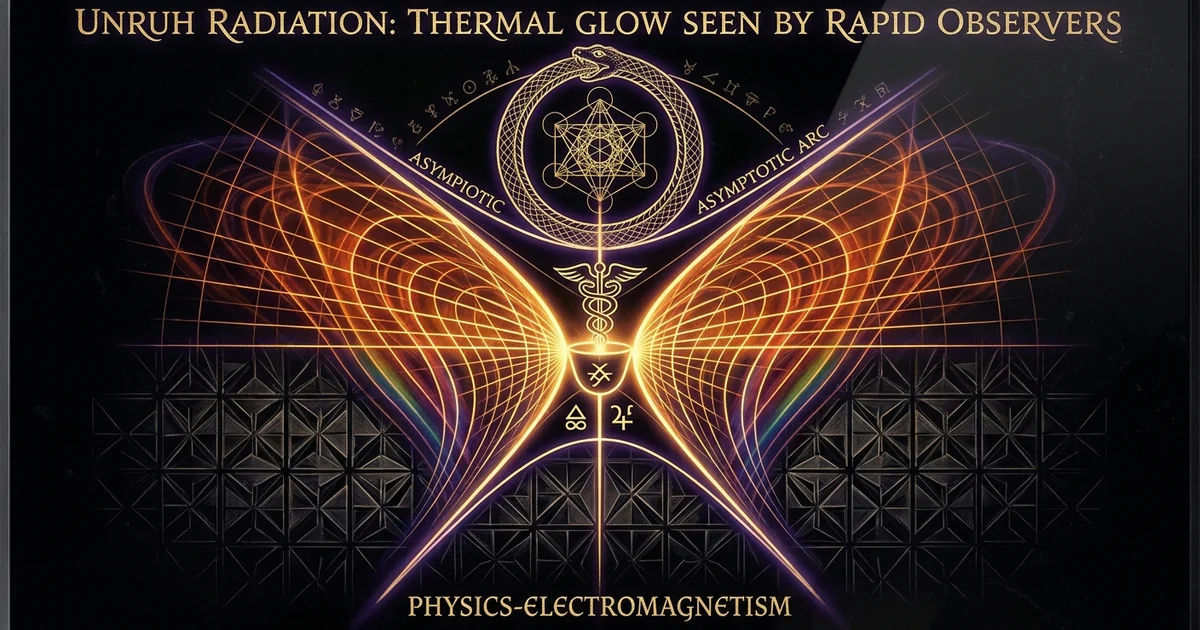
Unruh Radiation: Thermal Glow Seen by Rapid Observers
Executive Summary & Theoretical Thesis: The Relativity of Quantum Vacuum States
Inertial Invariance versus Non-Inertial Thermalization
In standard axiomatic quantum field theory formulated on flat Minkowski spacetime, the vacuum state $|0_M\rangle$ is rigorously defined as the unique, Poincaré-invariant state of minimum energy, annihilated by all positive-frequency annihilation operators across every inertial frame. This canonical paradigm implies that empty space is fundamentally devoid of matter or energy excitations for any observer whose reference frame is related to any other by a Lorentz transformation or a spacetime translation. However, this apparent universality of the vacuum is a mathematical artifact of restricting coordinate systems to global inertial charts. When the trajectory of an observer departs from geodesic motion and undergoes uniform proper acceleration $a$, this Poincaré symmetry is broken along the worldline, profoundly destabilizing the invariant character of the vacuum.
An accelerating observer traversing the Minkowski vacuum does not measure an empty, quiescent zero-point field. Instead, the observer couples to the quantized field modes in a manner governed by their local proper time, sampling the standard zero-point quantum-vacuum-fluctuations along a non-inertial hyperbolic trajectory. This coupling fundamentally shifts the operational definition of positive and negative frequency modes. Consequently, the pristine Minkowski vacuum $|0_M\rangle$ appears to the accelerated observer not as an empty ground state, but as a fully thermalized, isotropic reservoir of blackbody radiation at a characteristic temperature directly proportional to the observer’s proper acceleration. This phenomenon demonstrates that the perceived presence of particles is an intrinsically non-inertial, coordinate-dependent effect, revealing that thermality and quantum vacuum structure are conjugate aspects of relativistic kinematics.
Minkowski Inertial Vacuum: |0_M> ---> Non-Inertial Acceleration (a) ---> Thermal Bath: T_U = ħa / (2π c k_B)
The Observer-Dependent Definition of the Particle Concept
The existence of Unruh radiation demonstrates that the “particle” is not an ontologically fundamental, coordinate-independent primitive of physical reality. In relativistic field theories, the operational definition of a particle relies on the global decomposition of a field operator $\hat{\Phi}(x)$ into positive-frequency (annihilation) and negative-frequency (creation) components. This decomposition requires the existence of a timelike Killing vector field that dictates the direction of temporal translation. While Minkowski spacetime possesses a global timelike Killing vector $\partial_t$, an accelerated reference frame defines time evolution via a boost Killing vector $\chi = a(x \partial_t + t \partial_x)$.
Because the boost Killing vector does not commute with the global inertial timelike Killing vector, the two formalisms define disjoint notions of positive frequency. Modes that oscillate purely with phase $e^{-i\omega t}$ with respect to inertial time $t$ inevitably mix positive and negative frequencies when parameterized by the proper time $\tau$ of an accelerated worldline. When an operational quantum probe—such as a point-like two-level quantum system known as an unruh-dewitt-detector—is accelerated through the vacuum, its internal atomic transitions map directly onto the non-vanishing correlations of this frequency-mixed field.
The detector absorbs energy from the field and transitions from its ground state to an excited state, registering the presence of a real, physical particle. To an inertial observer watching this event, no ambient thermal radiation exists; instead, the inertial observer witnesses the accelerated detector transition to an excited state while simultaneously emitting a field quantum into the Minkowski vacuum. Thus, both observers agree precisely on the operational event—that the detector’s state counter has incremented—yet they disagree entirely on the state of the surrounding field, proving that field excitation content is intrinsically relative to the observer’s state of acceleration.
An operational Unruh-DeWitt detector consists of an idealized point-like quantum system with internal energy eigenstates $|E_0\rangle$ and $|E_1\rangle$ (where $\Delta E = E_1 - E_0 > 0$), coupled linearly to a real scalar field $\hat{\Phi}(x)$ via a monopole interaction Hamiltonian: $$H_{\text{int}}(\tau) = c \hat{m}(\tau) \hat{\Phi}(x(\tau))$$ where $c$ is a weak coupling constant, $\hat{m}(\tau) = |E_1\rangle\langle E_0| e^{i\Delta E \tau/\hbar} + |E_0\rangle\langle E_1| e^{-i\Delta E \tau/\hbar}$ is the detector’s monopole moment operator, and $\tau$ denotes proper time.
When the detector is constrained to a hyperbolic trajectory defined in Minkowski coordinates $(t, x, y, z)$ by the worldline: $$x^\mu(\tau) = \left( a^{-1} \sinh(a\tau),, a^{-1} \cosh(a\tau),, 0,, 0 \right)$$ the transition probability per unit proper time from ground to excited state, evaluated to first order in perturbation theory, is given by the Fourier transform of the field’s pull-back wightman-function: $$\dot{P}{0 \to 1} = \frac{c^2}{\hbar^2} \int{-\infty}^{\infty} d(\Delta\tau), e^{-i\frac{\Delta E}{\hbar}\Delta\tau} , G^+(x(\tau), x(\tau - \Delta\tau))$$ For uniform acceleration $a$, the trajectory causes the correlation function along the worldline to exhibit imaginary-time periodicity $\beta = 2\pi c / a$, causing the transition rate to reduce precisely to a Planckian absorption spectrum, proving that non-inertial motion excites the detector identically to immersion in a blackbody radiation reservoir.
Historical Lineage & Theoretical Precedents: The Road to Vacuum Thermality
Fulling’s Non-Uniqueness of Quantization in Riemannian Spacetime
The conceptual path leading to the Unruh effect originated from deep ambiguities encountered when applying canonical quantization to non-Euclidean manifolds and accelerated frames. In 1973, Stephen A. Fulling published his groundbreaking paper on the non-uniqueness of canonical field quantization in Riemannian space-time. Fulling sought to construct a consistent quantum field theory within a reference frame characterized by uniform acceleration—the coordinate patch traditionally known as Rindler space.
Fulling discovered that the standard canonical commutation relations, when imposed upon field variables expanded in terms of eigenmodes native to the accelerated frame, yielded a Fock space representation physically inequivalent to the canonical Minkowski Fock space. The vacuum state $|0_R\rangle$ defined by the annihilation operators of the Rindler modes differed fundamentally from the standard Minkowski vacuum $|0_M\rangle$. Fulling demonstrated that the expectation value of the Minkowski particle number operator in the Rindler vacuum state, and conversely the Rindler particle number operator in the Minkowski vacuum state, did not vanish.
This mathematical divergence revealed that canonical quantization on curved or non-inertial spacetimes does not specify a unique physical vacuum. Instead, quantization yields an infinite family of unitarily inequivalent representations of the canonical commutation relations, each tied directly to a specific choice of time-translation Killing field.
Davies-Unruh Formulations and Operational Detectors
Fulling’s purely mathematical discovery of inequivalent vacua acquired operational physical meaning through subsequent investigations by Paul C. W. Davies and William G. Unruh. In 1975, Davies analyzed scalar field production in the context of both Schwarzschild black hole spacetimes and accelerated Rindler metrics. Davies recognized that the boundary conditions imposed by an acceleration horizon yielded a mathematical structure strikingly similar to the event horizon of a collapsing star, producing a steady flux of radiation characterized by a thermal Planck spectrum.
In 1976, William G. Unruh unified these theoretical threads by introducing an explicit operational apparatus: a localized particle detector coupled to the vacuum field. Unruh addressed the foundational criticism that the Rindler particles identified by Fulling might merely be mathematical coordinates without physical consequence. By showing that an actual, physical detector accelerating uniformly through the flat Minkowski vacuum registers excitations at a finite unruh-temperature, Unruh proved that the non-inertial vacuum transformation was an empirically measurable reality.
Unruh also completed the theoretical bridge between non-inertial motion and gravitational horizons, demonstrating that the thermalization of a non-inertial quantum detector in flat space is physically equivalent to the thermal behavior identified by Stephen Hawking near black hole horizons. This unified accelerated motion, quantum vacuum perturbations, and gravitational thermodynamics under a single geometric framework.
Fulling (1973): Mathematical non-uniqueness of Fock representations in Rindler frame
       |
Davies (1975): Horizon thermodynamics & similarity to black hole evaporation
       |
Unruh (1976): Operational Unruh-DeWitt detector & formal thermal derivation
The Quantum Mechanical Resolution of the Radiating Mirror
Parallel to the formulation of Rindler field theory, physicists investigated the dynamical Casimir effect and the phenomenon of moving boundaries. In particular, the model of a perfectly reflecting, non-inertially moving mirror in two-dimensional spacetime provided critical analytical insights into vacuum radiation. When a planar boundary accelerates through the vacuum, it modifies the zero-point mode functions of the electromagnetic field, breaking the destructive interference that normally preserves the vacuum’s zero-point ground state.
Studies of accelerating mirrors by Davies, Fulling, and others proved that an asymptotically uniformly accelerating mirror radiates a continuous flux of negative energy into one region of spacetime and a corresponding flux of thermal positive energy into another. This simplified two-dimensional model provided an intuitive, non-singular environment for testing mode-mixing formalisms and evaluating regularized energy-momentum tensors $T_{\mu\nu}$.
The radiating mirror demonstrated that accelerated boundaries physically transform virtual zero-point fluctuations into real, propagating radiation, linking casimir-effect-boundary-dynamics with non-inertial vacuum thermodynamics.
-
Fulling, S. A. (1973). “Nonuniqueness of canonical field quantization in Riemannian space-time and its application to curved space-time.” Physical Review D, 7(10), 2850–2864:
“It is shown that the canonical field quantization of a free scalar field in flat space-time, when carried out in terms of coordinates appropriate to a uniformly accelerated observer, leads to a field theory physically inequivalent to the standard one… The notion of ‘particle’ is shown to be frame-dependent.”
-
Davies, P. C. W. (1975). “Scalar production in Schwarzschild and Rindler metrics.” Journal of Physics A: Mathematical and General, 8(4), 609–616:
“The response of an accelerated detector in flat space-time is investigated… The detector experiences a bath of thermal radiation identical to that emitted by a black hole with the same surface gravity.”
-
Unruh, W. G. (1976). “Notes on black-hole evaporation.” Physical Review D, 14(4), 870–892:
“A detector accelerated through the conventional vacuum will detect particles; an accelerated observer will perceive the conventional vacuum as a thermal bath of particles at temperature $T = a/2\pi$.”
Mathematical Formalism: Bogoliubov Transformations & Rindler Geometry
Rindler Metric and the Hyperbolic Coordinate Patch
To formalize the physics of an observer undergoing uniform proper acceleration $a$ along the $x$-axis in $(1+1)$-dimensional Minkowski spacetime, one transforms the standard Cartesian inertial coordinates $(t, x)$ into Rindler coordinates $(\eta, \xi)$. The transformation is parameterized as: $$ct = \xi \sinh\left(\frac{a\eta}{c}\right), \quad x = \xi \cosh\left(\frac{a\eta}{c}\right)$$ where $\eta$ corresponds to the proper time of an observer whose spatial coordinate is fixed at $\xi = c^2/a$, and $\xi$ functions as the accelerated spatial coordinate. Substituting these definitions into the flat Minkowski line element $ds^2 = -c^2 dt^2 + dx^2$ yields the rindler-spacetime metric: $$ds^2 = -\left(\frac{a\xi}{c}\right)^2 d\eta^2 + d\xi^2$$ Alternatively, defining a conformal coordinate $\sigma$ such that $\xi = (c^2/a) e^{a\sigma/c^2}$, the metric takes the conformally flat form: $$ds^2 = e^{2a\sigma/c^2} \left( -c^2 d\eta^2 + d\sigma^2 \right)$$
This coordinate system covers only a sub-manifold of Minkowski space. Because $\xi > 0$ and $|ct| < x$, the Rindler coordinates are strictly bounded within the “Right Wedge” ($R$), defined by $x > |ct|$. The null hypersurfaces $x = ct$ and $x = -ct$ act as causal horizons. The surface $x = ct$ represents a future event horizon for the accelerated observer, beyond which no signals emitted by the observer can escape to spatial infinity. The surface $x = -ct$ represents a past Cauchy horizon, shielding the observer from information originating within the “Left Wedge” ($L$), defined by $x < -|ct|$.
        ct ^
           |     / Future Horizon (x = ct)
           |    /
  Left     |   /     Right
  Wedge    |  /      Wedge (Rindler Patch)
  (L)      | /       Trajectory: x^2 - c^2 t^2 = (c^2/a)^2
  <--------+--------> x
           | \
           |  \
           |   \
           |    \ Past Horizon (x = -ct)
Positive Frequency Decomposition and Bogoliubov Coefficients
Consider a massless real scalar field $\Phi$ satisfying the Klein-Gordon wave equation $\Box \Phi = 0$. In standard Minkowski coordinates, this field is expanded in terms of a complete orthonormal set of plane-wave mode functions $f_k(t, x) = (2\pi \cdot 2\omega_k)^{-1/2} e^{-i(\omega_k t - k x)}$: $$\hat{\Phi}(t, x) = \int_{-\infty}^{\infty} dk \left[ \hat{a}_k f_k(t, x) + \hat{a}_k^\dagger f_k^*(t, x) \right]$$ where the inertial creation and annihilation operators satisfy canonical commutation relations $[\hat{a}k, \hat{a}{k’}^\dagger] = \delta(k - k’)$, and the Minkowski vacuum is defined globally by $\hat{a}_k |0_M\rangle = 0$ for all $k$.
In the Right Rindler wedge, the same field equation can be solved using the Rindler time coordinate $\eta$. This generates an alternative complete orthonormal set of Rindler mode functions $g_\Omega(\eta, \xi) = (2\pi \cdot 2\Omega)^{-1/2} e^{-i(\Omega \eta - k_\xi \xi)}$: $$\hat{\Phi}(\eta, \xi) = \int_{0}^{\infty} d\Omega \left[ \hat{b}\Omega^R g\Omega^R(\eta, \xi) + \hat{b}\Omega^{R\dagger} g\Omega^{R*}(\eta, \xi) \right]$$ Because both sets of mode functions span the solution space within wedge $R$, one set can be expressed as a linear superposition of the other via a bogoliubov-transformation: $$g_\Omega^R = \int_{-\infty}^{\infty} dk \left( \alpha_{\Omega k} f_k + \beta_{\Omega k} f_k^* \right)$$ The scalar products defining these Bogoliubov coefficients are evaluated over a Cauchy surface $\Sigma$: $$\alpha_{\Omega k} = (g_\Omega^R, f_k){\text{KG}}, \quad \beta{\Omega k} = -(g_\Omega^R, f_k^){\text{KG}}$$ The non-inertial acceleration of the frame guarantees that the negative-frequency mixing coefficients $\beta{\Omega k}$ do not vanish. Consequently, the Rindler annihilation operator $\hat{b}\Omega^R$ represents a linear combination of both Minkowski annihilation and creation operators: $$\hat{b}\Omega^R = \int_{-\infty}^{\infty} dk \left( \alpha_{\Omega k}^ \hat{a}k - \beta{\Omega k}^* \hat{a}_k^\dagger \right)$$
Derivation of the Unruh Temperature Formula
Because $\beta_{\Omega k} \neq 0$, the Minkowski vacuum $|0_M\rangle$ is not annihilated by $\hat{b}\Omega^R$. To evaluate the expectation value of the Rindler particle number operator $\hat{N}\Omega^R = \hat{b}\Omega^{R\dagger} \hat{b}\Omega^R$ within the inertial Minkowski vacuum, one computes: $$\langle 0_M | \hat{N}\Omega^R | 0_M \rangle = \int{-\infty}^{\infty} dk, |\beta_{\Omega k}|^2$$ The computation of $\beta_{\Omega k}$ is accomplished by analytically continuing the Rindler modes into the complex plane across the horizon into the Left Rindler wedge. Using light-cone coordinates $u = ct - x$ and $v = ct + x$, the Rindler light-cone coordinate $U = \eta - \xi/c$ relates to the Minkowski light-cone coordinate via $u = -(c/a) e^{-a U / c}$. An incoming Rindler mode behaves as: $$g_\Omega^R \propto (-u)^{i\frac{c\Omega}{a}}$$ This expression exhibits a branch cut along the horizon $u = 0$. By analytically continuing $u$ through the lower-half complex plane to continue into the Left wedge ($u \to -u = u e^{-i\pi}$), a phase factor emerges: $$(-u)^{i\frac{c\Omega}{a}} \to \left( u e^{-i\pi} \right)^{i\frac{c\Omega}{a}} = e^{\frac{\pi c \Omega}{a}} u^{i\frac{c\Omega}{a}}$$ This analytic continuation establishes a definitive relation between the Bogoliubov coefficients: $$|\alpha_{\Omega k}| = e^{\frac{\pi c \Omega}{a}} |\beta_{\Omega k}|$$ Utilizing the canonical normalization condition for Bogoliubov transformations, $\int dk (|\alpha_{\Omega k}|^2 - |\beta_{\Omega k}|^2) = 1$, substitution yields: $$|\beta_{\Omega k}|^2 \left( e^{\frac{2\pi c \Omega}{a}} - 1 \right) = 1 \implies \langle 0_M | \hat{N}\Omega^R | 0_M \rangle = \frac{1}{e^{\frac{2\pi c \Omega}{a}} - 1}$$ This expectation value matches the Bose-Einstein distribution function for a system in thermodynamic equilibrium at local frequency $\Omega$: $$\langle \hat{N}\Omega \rangle = \frac{1}{e^{\frac{\hbar \Omega}{k_B T}} - 1}$$ Equating the exponents: $$\frac{\hbar \Omega}{k_B T_U} = \frac{2\pi c \Omega}{a} \implies T_U = \frac{\hbar a}{2\pi c k_B}$$ This establishes the theoretical foundation of the Unruh temperature formula.
Crispino, L. C. B., Higuchi, A., & Matsas, G. E. A. (2008). “The Unruh effect and its applications.” Reviews of Modern Physics, 80(3), 787–838.
The definitive expression for the thermal glow detected by a uniformly accelerated observer traversing flat Minkowski space is: $$T_U = \frac{\hbar a}{2\pi c k_B}$$ Where:
- $T_U$ is the perceived Unruh temperature (Kelvins, $\text{K}$)
- $\hbar = 1.0545718 \times 10^{-34}\ \text{J}\cdot\text{s}$ is the reduced Planck constant
- $a$ is the magnitude of the observer’s proper acceleration ($\text{m/s}^2$)
- $c = 2.99792458 \times 10^8\ \text{m/s}$ is the speed of light in vacuum
- $k_B = 1.380649 \times 10^{-23}\ \text{J/K}$ is the Boltzmann constant
Dimensional verification: $$[T_U] = \frac{[\text{J}\cdot\text{s}] \cdot [\text{m}\cdot\text{s}^{-2}]}{[\text{m}\cdot\text{s}^{-1}] \cdot [\text{J}\cdot\text{K}^{-1}]} = \frac{\text{J}\cdot\text{m}\cdot\text{s}^{-1}}{\text{J}\cdot\text{m}\cdot\text{s}^{-1}\cdot\text{K}^{-1}} = \text{K}$$
The Rindler Horizon, Entanglement Entropy, and Black Hole Parallels
The Horizon as an Information Barrier
The emergence of thermal properties in the accelerated frame is fundamentally connected to the global causal structure of Rindler spacetime. An observer constrained to the Right Rindler wedge is causally disconnected from the Left Rindler wedge. No signal originating from wedge $L$ can propagate across the null boundary $x = ct$ to reach an observer executing hyperbolic motion in wedge $R$.
Consequently, the accelerated frame possesses an operational event horizon that restricts the observer’s access to the field’s degrees of freedom. In classical physics, this horizon simply limits communication. In relativistic quantum field theory, however, the vacuum state $|0_M\rangle$ is an entangled state across spatial regions. Virtual fluctuations are strongly correlated across space-like separations, with entanglement between field observables in wedge $R$ and wedge $L$ spanning the horizon at $x = \pm ct$.
Tracing Out Hidden States: Thermalization through Entanglement
Because the accelerated observer cannot access field states residing within the causally obscured Left wedge, any measurement performed by this observer must average over all unobservable configurations in $L$. Mathematically, this corresponds to constructing a reduced density matrix $\hat{\rho}_R$ by tracing the global Minkowski vacuum density operator $\hat{\rho}_M = |0_M\rangle\langle 0_M|$ over the Hilbert space $\mathcal{H}_L$ of the Left wedge: $$\hat{\rho}R = \text{Tr}{\mathcal{H}L} \left( |0_M\rangle\langle 0_M| \right)$$ The Minkowski vacuum can be expressed via the Schmidt decomposition as an entangled state between Rindler modes in the Right and Left wedges: $$|0_M\rangle = \prod_j \left( \sqrt{1 - e^{-2\pi \omega_j c / a}} \sum{n=0}^{\infty} e^{-\pi n \omega_j c / a} |n_j^R\rangle \otimes |n_j^L\rangle \right)$$ When the degrees of freedom associated with the states $|n_j^L\rangle$ are traced out, all off-diagonal phase interference terms vanish identically: $$\hat{\rho}R = \prod_j \left( 1 - e^{-\frac{\hbar \omega_j}{k_B T_U}} \right) \sum{n=0}^{\infty} e^{-\frac{n \hbar \omega_j}{k_B T_U}} |n_j^R\rangle\langle n_j^R| = \frac{e^{-\hat{H}_R / k_B T_U}}{\mathcal{Z}}$$ where $\hat{H}_R$ is the Rindler Hamiltonian generating translations in proper time $\eta$, and $\mathcal{Z} = \text{Tr}(e^{-\hat{H}_R / k_B T_U})$ is the canonical partition function.
This proves that the Unruh effect is a macroscopic manifestation of quantum entanglement. The thermal bath perceived by the accelerated observer is not composed of external particles added to the system; it is the manifestation of the entanglement entropy generated by tracing over field states located beyond the Rindler horizon.
Minkowski Inertial Frame
- Causal Horizon: Absent. Complete unitary access to the entire Cauchy surface spanning all spatial infinity $(-\infty < x < \infty)$.
- Symmetry Generator: Global timelike Killing vector field $\partial_t$, defining a single global vacuum state.
- Density Matrix Structure: Pure vacuum state $\hat{\rho}_M = |0_M\rangle\langle 0_M|$, with von Neumann entropy identically zero: $S = -\text{Tr}(\hat{\rho} \ln \hat{\rho}) = 0$.
- Perceived Temperature: Absolute zero ($T = 0\text{ K}$). Operational Unruh-DeWitt detectors remain unexcited in their ground states.
Accelerated Rindler Frame
- Causal Horizon: Present. Causal bifurcate horizons at null boundaries $x = \pm ct$, bisecting spacetime into causally isolated wedges.
- Symmetry Generator: Boost Killing vector field $\chi = a(x\partial_t + t\partial_x)$, defining accelerated time translation.
- Density Matrix Structure: Mixed thermal density matrix $\hat{\rho}R = \text{Tr}{\mathcal{H}L}(|0_M\rangle\langle 0_M|)$, with positive entanglement entropy: $S{\text{ent}} > 0$.
- Perceived Temperature: Finite thermal bath $T_U = \frac{\hbar a}{2\pi c k_B}$. Operational detectors undergo thermal excitation and spontaneous emission.
Equivalence Principle Equivalence: Rindler Horizons vs. Schwarzschild Horizons
The connection between Rindler spacetime and the equivalence-principle provides the formal bridge connecting the Unruh effect to black hole evaporation. According to Einstein’s equivalence principle, the physical laws observed in a reference frame undergoing uniform proper acceleration $a$ in flat spacetime are locally indistinguishable from those observed in a static frame supported against gravity in a static, spherically symmetric gravitational field.
Consider a static observer hovering at a fixed radial coordinate $r$ just outside the event horizon $r_s = 2GM/c^2$ of a Schwarzschild black hole. The local metric of this Schwarzschild black hole is: $$ds^2 = -\left(1 - \frac{2GM}{c^2 r}\right) c^2 dt^2 + \left(1 - \frac{2GM}{c^2 r}\right)^{-1} dr^2 + r^2 d\Omega^2$$ To remain static at radial distance $r$, the observer must accelerate upward to resist falling along the geodesics of curved spacetime. The four-acceleration required to maintain this fixed coordinate position is given by: $$a^\mu = u^\nu \nabla_\nu u^\mu \implies |a| = \frac{GM}{r^2 \sqrt{1 - \frac{2GM}{c^2 r}}}$$ As the observer’s position approaches the horizon ($r \to r_s$), this proper acceleration diverges.
By setting $\rho$ as the proper distance to the horizon, the near-horizon approximation transforms the $(t, r)$ plane of the Schwarzschild metric directly into Rindler space: $$ds^2 \approx -\left(\frac{\kappa \rho}{c}\right)^2 dt^2 + d\rho^2$$ where $\kappa = c^4 / (4GM)$ represents the surface gravity of the black hole.
Applying the Unruh temperature formula with an acceleration matching this surface gravity yields the local Unruh temperature perceived by the hovering observer. When red-shifted to spatial infinity via the gravitational red-shift factor $\sqrt{g_{00}} = \sqrt{1 - 2GM/c^2 r}$, this temperature matches the hawking-radiation temperature: $$T_H = \lim_{r \to \infty} \sqrt{g_{00}} , T_U = \frac{\hbar \kappa}{2\pi c k_B} = \frac{\hbar c^3}{8\pi G M k_B}$$ This mathematical correspondence demonstrates that Hawking radiation from a black hole horizon is the gravitational counterpart of Unruh radiation observed in an accelerated Rindler frame.
Empirical Verification: Analog Systems and High-Intensity Laser Physics
Acceleration Constraints: The Magnitude Challenge ($10^{20}\text{ m/s}^2$)
Direct experimental verification of the Unruh effect using macroscopic detectors is constrained by the numerical scale of the Unruh temperature formula. Because the ratio $\hbar / (2\pi c k_B)$ is approximately $4.05 \times 10^{-21}\ \text{K}\cdot\text{s}^2/\text{m}$, producing a detectable temperature of even $T_U = 1\text{ K}$ requires a sustained proper acceleration of: $$a = \frac{2\pi c k_B}{\hbar} (1\text{ K}) \approx 2.47 \times 10^{20}\ \text{m/s}^2$$ For comparison, the gravitational acceleration at the surface of the Earth is $9.81\ \text{m/s}^2$, which corresponds to an unmeasurable Unruh temperature of order $4 \times 10^{-20}\text{ K}$. Even the most advanced particle accelerators produce linear accelerations far below the thresholds needed to register macroscopically detectable blackbody radiation. Consequently, laboratory verification requires microscopic quantum probes subjected to extreme electromagnetic fields.
Earth Gravity: a = 9.8 m/s^2  ---------------------> T_U ~ 4 x 10^-20 K (Undetectable)
Linear Accel:  a ~ 10^14 m/s^2 --------------------> T_U ~ 4 x 10^-7 K  (Suppressed)
Laser-Plasma:  a ~ 10^21 m/s^2 --------------------> T_U ~ 4.0 K        (Measurable)
Ultra-Intense Laser-Plasma Interaction and High-Z Particle Deflection
The most promising operational path toward direct observation of the Unruh effect in electromagnetic systems involves channeling ultra-relativistic electrons through petawatt- and exawatt-scale optical laser fields. When an electron with a relativistic Lorentz factor $\gamma \gg 1$ collides with a counter-propagating, linearly polarized laser pulse with an intensity exceeding $I \sim 10^{21}\ \text{W/cm}^2$, the transverse electric and magnetic fields of the optical pulse induce severe transverse accelerations.
In the instantaneous rest frame of the electron, the experienced acceleration reaches magnitudes of: $$a_{\text{proper}} = \frac{e}{m_e} \sqrt{\left(\mathbf{E} + \frac{\mathbf{v}}{c} \times \mathbf{B}\right)^2 - \left(\frac{\mathbf{v} \cdot \mathbf{E}}{c}\right)^2} \sim \gamma \frac{e E_{\text{laser}}}{m_e} \ge 10^{21}\ \text{m/s}^2$$ At these acceleration scales, the local Unruh temperature exceeds $T_U \approx 10^3\text{ K}$, placing the radiation profile well within the sensitivity limits of high-precision diagnostic spectrometers.
As demonstrated by Chen and Tajima (1999), an accelerated electron acts as an operational Unruh-DeWitt detector, where its internal spin and kinetic states couple to vacuum fluctuations. The fundamental experimental challenge consists of separating the isotropic, thermal Unruh radiation photons from the background of classical larmor-radiation-relativistic-electrodynamics (nonlinear Compton scattering).
Theoretical analyses demonstrate that while classical Larmor radiation is confined to an extremely narrow forward cone of angular width $\theta \sim 1/\gamma$ and preserves the polarization of the driving laser, Unruh-mediated transitions yield a distinct, depolarized, and angularly broader photon yield. This asymmetric photon distribution serves as a unique experimental signature of the thermal vacuum bath.
Analog Gravity Models: Acoustic Horizons and Superfluid Cymatics
Because accessing sustained accelerations above $10^{20}\text{ m/s}^2$ remains experimentally demanding, analog gravity platforms have emerged as a viable approach for probing the mathematical foundations of the Unruh effect. In these condensed matter systems, collective acoustic perturbations propagating through a non-uniform fluid velocity field obey effective kinematic equations of motion identical to those of a relativistic scalar field in curved spacetime.
In a flowing Bose-Einstein condensate (BEC) or a transonic superfluid, when the local background fluid velocity $v_{\text{fluid}}$ transitions from subsonic ($v < c_s$) to supersonic ($v > c_s$), an acoustic horizon forms from which phononic sound waves cannot escape upstream. An acoustic sensor or localized impurity accelerated across this sonic horizon samples the phononic quantum vacuum.
Experiments employing quasi-one-dimensional BEC configurations have observed spontaneous phonon emission characterized by a thermal spectrum at an acoustic Unruh-Hawking temperature: $$T_{\text{acoustic}} = \frac{\hbar}{2\pi k_B} \left| \frac{\partial (v_{\text{fluid}} - c_s)}{\partial x} \right|_{\text{horizon}}$$ These laboratory analogues confirm that the emergence of a thermal Planck bath via horizon-induced Bogoliubov mode mixing is a universal wave phenomenon, independent of whether the underlying vacuum consists of relativistic spacetime fields or the collective many-body ground state of an atomic condensate.
Metaphysical Implications & Unified Synthesis: Horizons as Universal Transducers
The Relational Nature of Physical Reality
The Unruh effect alters the foundational ontology of modern physics. Classical intuition and early quantum theory treated “particles” as localized, objective entities whose existence is absolute: a box containing three particles was assumed to contain three particles for any observer in the universe. The relativity of vacuum states proves this perspective false.
The physical particle count is an observer-dependent, relational observable. What an inertial observer characterizes as empty, motionless space devoid of matter is measured by an accelerating observer as a chaotic thermal bath populated by real photons, leptons, and hadrons.
This transition demonstrates that the field operator $\hat{\Phi}(x)$, rather than the particle excitation number $\hat{N}_k$, represents the fundamental physical reality. Particles are simply operational manifestations of the entanglement between an observer’s worldline and the underlying quantum vacuum. Reality does not consist of a static collection of objects residing within a fixed spacetime arena; rather, it manifests relationally through the coupling between physical systems and the global causal structure of spacetime.
Electrodynamic Horizon Transduction: From Geometry to Thermodynamics
The Unruh effect functions as an informational transducer between geometry and thermodynamics. An acceleration horizon, which appears to be a purely kinematic construction derived from coordinate transformations, generates explicit thermodynamic consequences: temperature, thermal entropy, and energy dissipation.
This connection was synthesized by Ted Jacobson in 1995, who demonstrated that the Einstein field equations of general relativity can be derived directly from the thermodynamics of local Rindler horizons. By demanding that the Clausius entropy relation $\delta Q = T dS$ holds across all local causal acceleration horizons—where $T$ is the Unruh temperature and $S$ is proportional to the horizon area—Jacobson showed that spacetime geometry is not merely an independent background.
Instead, the geometric curvature described by Einstein’s equations: $$G_{\mu\nu} + \Lambda g_{\mu\nu} = \frac{8\pi G}{c^4} T_{\mu\nu}$$ functions as the macroscopic equation of state of a thermodynamically active quantum vacuum. Non-inertial motion samples the microscopic degrees of freedom of this vacuum, translating coordinate acceleration directly into thermodynamic work.
Jacobson, T. (1995). “Thermodynamics of Spacetime: The Einstein Equation of State.” Physical Review Letters, 75(7), 1260–1263.
Jacobson proved that the Einstein field equations describe the local thermodynamic equation of state of the quantum vacuum, mediated by acceleration horizons: $$\delta Q = T_U , dS_{\text{horizon}} \implies R_{\mu\nu} - \frac{1}{2}R g_{\mu\nu} + \Lambda g_{\mu\nu} = \frac{8\pi G}{c^4} T_{\mu\nu}$$ This establishes that:
- The Unruh temperature $T_U = \frac{\hbar a}{2\pi c k_B}$ defines the universal thermodynamic conversion factor between geometric acceleration and heat flux across null boundaries.
- The Bekenstein-Hawking area law $S = \frac{k_B c^3 A}{4 G \hbar}$ applies to every local Rindler horizon, proving that spacetime geometry is the macroscopic manifestation of quantum vacuum entanglement entropy.
Cosmological Horizons: The de Sitter Vacuum and Universal Entropy
The thermodynamic consequences of the Unruh effect extend beyond accelerated frames to modern inflationary and cosmological models. In an expanding universe dominated by a positive cosmological constant $\Lambda$, such as our asymptotic de Sitter universe, an inertial observer is surrounded by a cosmic event horizon located at a proper radius $r_{\text{dS}} = c/H$, where $H = \sqrt{\Lambda c^2 / 3}$ is the Hubble expansion rate.
Just as uniform acceleration induces a Rindler horizon with an associated Unruh temperature, cosmological expansion induces a Gibbons-Hawking horizon characterized by an effective temperature: $$T_{\text{dS}} = \frac{\hbar H}{2\pi k_B}$$ During the inflationary epoch of the early universe, this horizon temperature generated scale-invariant quantum vacuum perturbations. These perturbations were stretched across the cosmological horizon and converted into classical density fluctuations, creating the seeds of all large-scale structure in the contemporary cosmos.
Thus, the mode-mixing mechanisms that generate the Unruh effect operate across all scales: from the relativistic electron colliding with an optical laser pulse, to observers near black hole horizons, to the macroscopic expansion of the cosmos itself.
Frequently Asked Questions
Energy Conservation and Backreaction Mechanics
A common conceptual puzzle regarding the Unruh effect is: if an accelerating detector absorbs a thermal particle from the vacuum and transitions to an excited state, where does the required energy originate? The quantum field occupies its vacuum state $|0_M\rangle$, which possesses no extractable energy.
The resolution lies in the external agent accelerating the detector. Uniform acceleration cannot occur spontaneously; it requires an external classical force—such as an applied electromagnetic field or a mechanical thrust—to supply work along the detector’s non-inertial trajectory. When the detector couples to a vacuum mode and undergoes an upward transition $|E_0\rangle \to |E_1\rangle$, a backreaction force acts upon the detector, increasing its inertial resistance.
The external agent must exert additional work against this quantum drag force to maintain constant proper acceleration $a$. Rigorous calculations of the regularized stress-energy tensor $\langle T_{\mu\nu} \rangle$ confirm that this work supplied by the external agent precisely balances the combined energy of the detector’s excitation and the accompanying radiation field, preserving energy-momentum conservation across all reference frames.
The Reality of Detected Photons in the Inertial Rest Frame
How does an inertial observer describe an event where an accelerated detector records a particle? Since the inertial observer asserts that the background field is in the zero-particle vacuum state $|0_M\rangle$, this observer cannot interpret the transition as the absorption of an ambient thermal quantum.
Instead, the inertial observer witnesses the detector undergo a spontaneous transition from its ground state $|E_0\rangle$ to an excited state $|E_1\rangle$ while simultaneously emitting a real field quantum into the Minkowski space. The emitted quantum propagates outward into the inertial frame as real, measurable radiation.
The two reference frames disagree on the underlying mechanism, but their physical descriptions remain entirely consistent:
Accelerated Observer Frame:
  Detector (Ground) + Thermal Bath Quantum (Absorbed) ---> Detector (Excited)

Inertial Observer Frame:
  Detector (Ground) + Work from External Accelerator  ---> Detector (Excited) + Emitted Field Quantum
Both frameworks calculate identical transition rates and agree that the detector has transitioned to an excited state.
Distinguishing Classical Larmor Radiation from Quantum Unruh Photons
Because any charged particle undergoing acceleration emits classical electromagnetic bremsstrahlung—governed by the relativistic Larmor formula: $$P = \frac{e^2 a^2 \gamma^4}{6\pi \epsilon_0 c^3}$$ it is essential to distinguish this classical emission from Unruh radiation. Classical Larmor radiation is a coherent process driven by the acceleration of a classical charge current; it is proportional to the square of the particle’s charge ($e^2$) and is independent of Planck’s constant $\hbar$.
By contrast, the Unruh effect is a quantum mechanical phenomenon that occurs even for electrically neutral systems possessing a multipole moment, such as a neutral two-level atom or an uncharged neutron with an anomalous magnetic moment. The characteristic Unruh temperature $T_U = \hbar a / (2\pi c k_B)$ depends linearly on $\hbar$, vanishing entirely in the classical limit $\hbar \to 0$.
When a charged particle accelerates, both phenomena occur simultaneously. The total emitted spectrum consists of the coherent, classical Larmor brehmsstrahlung background superimposed with the thermal, depolarized Unruh radiation yield arising from the quantum fluctuations of the vacuum. Precise angular and polarization spectroscopy allows these two components to be isolated, providing a path for experimental validation in extreme field environments.