Megalithic Passage Graves: Helmholtz Resonances Ireland
Executive Summary & Theoretical Thesis: The Megalith as an Acoustic Waveguide
Architectural Aerophones and Cavity Resonator Physics
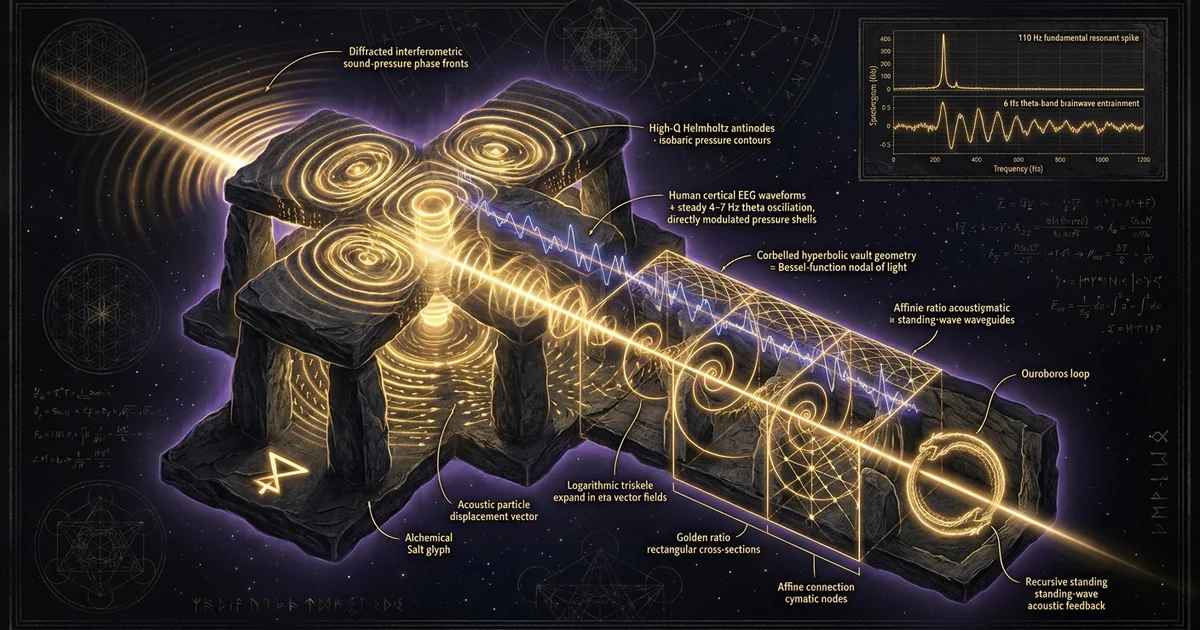
The passage tombs of Neolithic Ireland—most conspicuously manifested within the Brú na Bóinne complex at Newgrange and Knowth, alongside the elevated necropolis of Slieve na Calliagh at Loughcrew (Cairn T)—have historically been categorized through the delimiting lens of funerary deposition and solar calendrical orientation. Yet, an analysis grounded in classical elastodynamics, continuum mechanics, and non-linear acoustics reveals an alternate paradigm: these structures operate as precision-engineered acoustic resonators. Morphologically, a megalithic passage tomb constitutes an architectural aerophone. The elongated, stone-lined access passage (the dromos) acts as a dissipative acoustic waveguide or neck, coupled directly to an expanded terminal chamber covered by a corbelled vault that acts as a capacitive acoustic volume.
Under acoustic perturbation, this dual-element spatial geometry behaves physically as a coupled lumped-element system, directly fulfilling the thermodynamic and fluid-mechanical criteria of a classic Helmholtz resonator. Atmospheric air bounded within the stone cavity exhibits bulk modulus elasticity ($K = \gamma P_0$), while the mass of air entrained within the dromos provides the inertial slug that oscillates against this internal capacitive spring. Rather than functioning simply as passive stone enclosures, these cairn megalithic chambers exhibit severe boundary-layer impedance mismatches against the surrounding earth and bedrock. This boundary disparity confines longitudinal pressure waves, generating discrete standing-wave modes that maximize internal sound pressure levels while minimizing wave dissipation into the backing matrix. In this context, the architectural morphology of the passage grave mirrors the formal physical criteria required to achieve acoustic resonance and energy confinement.
P_atm (Free Boundary)
                         |
                         v
   ==================[ ENTRANCE ]==================
  |                                                |
  |   DROMOS (Acoustic Waveguide / Inertive Neck)   |  Length: L, Cross-section: S
  |   Air Mass Slug: M_a = \rho_0 * L'_eff / S     |
  |                                                |
   ==================[ JUNCTION ]==================
                         |
                         v (Acoustic Impedance Discontinuity)
              /---------------------\
             /   CORBELLED VAULT     \
            /  (Capacitive Chamber)   \  Internal Volume: V
           |   Acoustic Compliance:    |  Acoustic Energy Storage (High-Q)
           |   C_a = V / (\rho_0 * c^2)|
           |                           |
           |     PRESSURE ANTINODE     |  Standing Wave Confinement
           |        (\Delta P_max)     |  Fundamental Mode: 95-120 Hz
            \                         /
             \-----------------------/
The 95–120 Hz Anthropomorphic Bandwidth Anomaly
Across diverse, topographically separated Neolithic sites in Atlantic Europe, systematic empirical characterization reveals an anomaly: the fundamental resonant frequencies of these disparate chamber volumes cluster tightly within the narrow window of 95 Hz to 120 Hz, centering predominantly at 110 Hz. From the perspective of pure structural mechanics, natural resonant frequencies scale as an inverse function of chamber volume and waveguide length. Given that internal volumetric measurements among Irish passage graves range from approximately 15 cubic meters in smaller satellite cairns to over 85 cubic meters within the cruciform interior of Newgrange, the persistence of a 95–120 Hz modal response across varying geometries contradicts random distribution models.
The physical parameters defining the passage-chamber continuum require treating the air column within the dromos not as an idealized rigid cylinder, but as an open-ended tube terminating in an acoustic impedance discontinuity at the chamber interface. The inertive acoustic mass of the passage slug is formulated as:
$$M_a = \frac{\rho_0 L’_{eff}}{S}$$
where $\rho_0 \approx 1.204 \text{ kg/m}^3$ represents ambient air density at sea level, $S$ is the cross-sectional area of the dromos, and $L’_{eff}$ is the acoustically corrected effective length:
$$L’{eff} = L + \delta{out} + \delta_{in} \approx L + 0.613 r + 0.821 r$$
The acoustic compliance of the corbelled chamber is governed by the adiabatic compressibility of the gas:
$$C_a = \frac{V}{\rho_0 c^2}$$
wherein $V$ is the total volume of the central chamber plus recess niches, and $c \approx 343 \text{ m/s}$ is the local speed of sound in air. Resonance occurs at the frequency where the inductive reactance of the passage cancels the capacitive reactance of the chamber: $\omega M_a = 1 / (\omega C_a)$.
This recurring resonant envelope aligns with human physiology, specifically falling within the lower fundamental vocal register of adult human males and matching the low-frequency acoustic driving profile of Neolithic frame drums. Acoustic impedance matching between the open-air passage entrance and the internal corbelled chamber produces standing waves characterized by intense sound pressure amplification.
When vocalization or percussive stimulation matches the modal response of the chamber, the structure functions as an acoustic energy trap. The interior becomes an environment of sonic confinement where acoustic energy cannot easily reflect back out of the dromos, elevating local sound pressure levels. This amplification creates an interactive, immersive physical environment that directly influences the auditory system and neuroelectrical rhythms of occupants inside the megalithic passage grave.
Historical Lineage & Experimental Precedents: From Archaeoastronomy to Archaeoacoustics
The Transition from Solar Alignment to Wave Phenomenon
Throughout the nineteenth and twentieth centuries, the formal archaeological study of Irish passage tombs was driven almost exclusively by architectural typology and celestial mechanics. Antiquarians such as George Coffey, followed by the rigorous mid-twentieth-century excavations of Michael J. O’Kelly at Newgrange, established beyond contention that these monuments were constructed with calculated astronomical alignments. The capture of the winter solstice sunrise through the roof-box at Newgrange demonstrated that Neolithic builders operated with empirical precision regarding solar trajectories and geometry.
[ Solar Archaeoastronomy (1960s-1980s) ]
   |  - O'Kelly et al.: Focus on Winter Solstice solar capture
   |  - Ideology of external celestial alignment & passive reliquaries
   v
[ Physical Archaeoacoustics (1990s-Present) ]
   |  - Jahn, Devereux, Watson: Transition from photon to phonon mechanics
   |  - Internal cavity dynamics: Megalith as dynamic resonant chamber
   v
[ Modern Neuroarchaeology Synthesis ]
   |  - Transduction of standing acoustic waves into neurochemical states
   |  - Integration of electromagnetic light and longitudinal sound
Yet this focus on external celestial dynamics long eclipsed the investigation of the internal acoustic environments created by these same architectural configurations. The conceptual transition from solar archaeoastronomy to archaeoacoustics marked an epistemological shift from the study of photon mechanics to phonon mechanics within archaeological spaces.
Early researchers often treated the chamber interiors as passive, static containers designed solely for skeletal deposition and ritual offerings. This paradigm overlooked the morphological regularities of megalithic spaces—such as the ratio of passage length to chamber height, the deliberate dressing of load-bearing orthostats, and the acoustic implications of the corbelled vault.
As physical acoustics matured through the foundational principles of Hermann von Helmholtz (1863), researchers recognized that enclosed architectural envelopes inevitably function as acoustic filters. The realization that ancient builders may have manipulated sound was explored in allied domains of archaeoacoustics, ranging from the harmonic resonance observed in prehistoric caves to stone circle geometries, as detailed in comparative studies on the harmonic proportions of stone circles.
By the late twentieth century, researchers shifted from subjective auditory impressions to empirical wave-dispersion analysis within megalithic contexts, demonstrating that passage tombs were designed to shape both light and sound.
The Jahn-Devereux Princeton Resonator Surveys
The systematic empirical foundation for passage grave archaeoacoustics was established between 1994 and 1996 through field surveys conducted by the Princeton Engineering Anomalies Research (PEAR) group, led by Robert G. Jahn, Paul Devereux, and Michael Ibison (Jahn et al., 1996). The PEAR campaign surveyed six ancient structures across the United Kingdom and Ireland, with a dedicated focus on the Boyne Valley and Loughcrew passage tombs. The goal of this field program was to evaluate whether these Neolithic chambers exhibited anomalous acoustic properties through controlled wave injection.
Field measurements conducted by Jahn, Devereux, and Ibison utilized calibrated instrumentation to isolate the resonant acoustic response of stone chambers. Signal generation was driven by a synthesized function generator routed through a linear power amplifier to an omnidirectional loudspeaker capable of flat frequency reproduction between 20 Hz and 2 kHz. Acoustic sound pressure fields were mapped using precision-calibrated 0.5-inch laboratory condenser microphones coupled to digital real-time dynamic signal analyzers and dual-channel FFT (Fast Fourier Transform) oscilloscopes. Microphones were systematically translated across three-dimensional spatial grids at 0.5-meter increments throughout both the dromos and the terminal cruciform chambers to isolate standing wave pressure nodes from boundary-reflection interference.
The PEAR investigations demonstrated that each passage tomb possessed discrete, narrow-band resonant peaks. Most notably, Newgrange exhibited its primary resonance at 110 Hz, while Cairn T at Loughcrew displayed an equivalent fundamental mode at 112 Hz, with secondary modes appearing at distinct, predictable harmonic intervals. The empirical surveys revealed that despite the structural irregularities of rough-hewn orthostats, the macro-geometry of the chambers supported coherent wave confinement with minimal modal dispersion.
Subsequent field analyses by Aaron Watson and David Keating (1999) corroborated these findings, proving that megalithic monuments were constructed in a manner that supported resonant amplification. Rather than dissipating energy through porous boundary losses, the chambers structured the acoustic field, establishing the physical basis for altered states within Neolithic passage chambers.
Mathematical Formalism & Physical Mechanics: Helmholtz Formulations and Boundary Layer Losses
Lumped-Element Helmholtz Derivation for Asymmetrical Chambers
To model the acoustic mechanics of a passage tomb such as Newgrange, the physical structure can be treated as a lumped-element acoustic system, provided that the driving acoustic wavelengths ($\lambda \approx 2.8 \text{ to } 3.6 \text{ m}$) are larger than the characteristic transverse dimensions of the entrance dromos. The basic Helmholtz resonance equation must be modified to account for the asymmetrical, non-spherical chamber profile and the variable cross-sectional area of the corbelled cruciform:
$$f_H = \frac{c}{2\pi} \sqrt{\frac{S}{V \cdot L’_{eff}}}$$
In this formulation, $c$ is the speed of sound in dry air at ambient subterranean temperature ($T \approx 10^\circ\text{C}$, yielding $c \approx 337.5\text{ m/s}$), $S$ is the mean cross-sectional area of the passage waveguide, $V$ is the total volume of the internal corbelled cavity (including the three terminal cruciform recesses), and $L’_{eff}$ represents the effective acoustic length of the dromos incorporating internal and external radiation end-corrections.
ACOUSTIC TRANSMISSION PIPELINE: MEGALITHIC WAVEGUIDE
±---------------------------------------------------------------+
| SOUND EXCITATION SOURCE (Vocal Tract / Resonant Frame Drum)     |
±---------------------------------------------------------------+
|
v
±---------------------------------------------------------------+
| DROMOS ACOUSTIC WAVEGUIDE (Inertive Air Slug Neck)             |
| Length: L, Effective Length: L'_eff, Surface: Silurian Greywacke|
±---------------------------------------------------------------+
|
v
±---------------------------------------------------------------+
| IMPEDANCE DISCONTINUITY JUNCTION (Passage-Chamber Boundary)     |
| Step-up in Cross-Sectional Area (S_passage << S_chamber)       |
±---------------------------------------------------------------+
|
v
±---------------------------------------------------------------+
| CORBELLED CHAMBER CAVITY (Capacitive Acoustic Reservoir)       |
| Asymmetric Cruciform Profile / Volumetric Compression (V)      |
±---------------------------------------------------------------+
|
v
±---------------------------------------------------------------+
| STANDING WAVE PRESSURE ANTINODE FORMATION (95-120 Hz Target)   |
| Maximum Sound Pressure Level (SPL) Gain: \Delta SPL >= +15 dB   |
±---------------------------------------------------------------+
When calculating the acoustic mass of the system, the geometry cannot be assumed to be a uniform pipe. The passage often displays structural tapers. If the cross-sectional area varies as a function of axial distance $x$ along the passage length, such that $S = S(x)$, the total acoustic mass $M_a$ is derived through integration:
$$M_a = \rho_0 \int_{0}^{L} \frac{dx}{S(x)} + \frac{\rho_0 \delta_{total}}{S_{exit}}$$
Consequently, the modified lumped-element frequency for an asymmetrical passage grave takes the integral form:
$$f_H = \frac{1}{2\pi} \left[ C_a \left( \rho_0 \int_{0}^{L} \frac{dx}{S(x)} + \frac{\rho_0 \delta_{total}}{S_{exit}} \right) \right]^{-\frac{1}{2}} = \frac{c}{2\pi} \left[ V \left( \int_{0}^{L} \frac{dx}{S(x)} + \frac{\delta_{total}}{S_{exit}} \right) \right]^{-\frac{1}{2}}$$
This expression accounts for geometric shifts along the dromos, resolving discrepancies found when applying idealized cylindrical models to field data.
Coupled Dromos-Chamber Quarter-Wave Acoustic Dynamics
While the lumped-element Helmholtz model explains lowest-frequency bulk compression, it functions in parallel with distributed-element wave dynamics. Because the dromos exhibits a length $L$ substantially greater than its width or height (at Newgrange, $L \approx 19 \text{ m}$), the passage simultaneously behaves as an acoustic transmission line or an open-closed organ pipe. The acoustic boundary conditions mandate a volume velocity node (pressure antinode) at the closed chamber boundary and a volume velocity antinode (pressure node) at the open exterior threshold.
The axial quarter-wave resonances of the dromos waveguide are given by the odd-harmonic series:
$$f_n = \frac{(2n - 1)c}{4L’_{eff}}, \quad n \in {1, 2, 3, \dots}$$
For a passage of length $L \approx 19\text{ m}$ with effective end-corrections driving $L’_{eff} \approx 20.2\text{ m}$, the fundamental quarter-wave longitudinal mode yields:
$$f_1 = \frac{337.5}{4 \times 20.2} \approx 4.18\text{ Hz}$$
This fundamental frequency falls within the infrasonic spectrum. However, higher-order odd harmonics—specifically the 13th and 15th harmonics ($n=7 \implies f_7 \approx 108.6\text{ Hz}$; $n=8 \implies f_8 \approx 125.3\text{ Hz}$)—directly overlap with the cavity Helmholtz frequency $f_H$. This modal alignment produces an acoustic coupling effect: the standing-wave modes of the passage feed into and sustain the Helmholtz oscillation of the corbelled chamber.
PASSAGE DROMOS AXIAL MODES
                      (Quarter-Wave Organ Pipe Behavior: L ~ 19m)
   Chamber Junction                                   Exterior Entrance
   (Pressure Antinode)                              (Pressure Node / Open)
   |                                                                     |

f_1    |=====================================================================| ~4.18 Hz (Infrasound)
|                                                                     |
f_7    |===/===/===/===/===/===/===/===/===/===/===/===/===/====| ~108.6 Hz (Audible Resonance)
|                                                                     |
|<--------------------------- L'_eff ~ 20.2m ------------------------>|
This interaction between distributed transmission-line modes and lumped-element cavity resonance increases the quality factor ($Q$) of the entire megalithic assembly, reducing the continuous energy input required to maintain intense standing-wave fields. This behavior relates closely to broader analyses of acoustic wave dynamics within stone enclosures, such as those detailed in research on acoustic levitation and ancient architecture.
Viscous-Thermal Losses and Orthostatic Surface Impedance
The energy storage capability of an acoustic cavity is quantified by its Quality Factor ($Q$), defined as:
$$Q = 2\pi \frac{\text{Energy Stored}}{\text{Energy Dissipated per Cycle}} = \frac{f_0}{\Delta f}$$
In an idealized cavity with rigid boundaries, $Q$ approaches infinity. In a megalithic passage grave, energy dissipation occurs through three primary mechanisms: radiation damping through the open dromos ($R_{rad}$), viscous boundary layer drag along the rough orthostatic stone walls ($R_{visc}$), and thermal conduction losses into the megalithic boundary surfaces ($R_{therm}$).
The specific acoustic impedance $Z_w$ of the boundary orthostats—principally composed of dense Silurian greywacke, granite, and quartz—is given by:
$$Z_w = \rho_{rock} \cdot c_{rock}$$
For Silurian greywacke, $\rho_{rock} \approx 2700\text{ kg/m}^3$ and the longitudinal sound speed $c_{rock} \approx 5000\text{ m/s}$, producing an acoustic impedance of:
$$Z_w \approx 1.35 \times 10^7\text{ Pa}\cdot\text{s/m}$$
In contrast, the characteristic acoustic impedance of ambient air is:
$$Z_{air} = \rho_0 \cdot c \approx 1.204 \times 337.5 \approx 406.35\text{ Pa}\cdot\text{s/m}$$
The normal-incidence sound pressure reflection coefficient $\mathcal{R}$ is calculated as:
$$\mathcal{R} = \frac{Z_w - Z_{air}}{Z_w + Z_{air}} \approx \frac{1.35 \times 10^7 - 406.35}{1.35 \times 10^7 + 406.35} \approx 0.99994$$
This indicates that over 99.99% of incident low-frequency acoustic energy is reflected at the rock boundary. As a result, attenuation occurs primarily via boundary shear viscosity and the geometric scattering of high-frequency components.
The stepped, non-parallel arrangement of the corbelled vaulting prevents high-frequency flutter echoes and destructive phase interference. It scatters shorter wavelengths while reflecting lower frequencies ($\lambda > 2.5\text{ m}$) back into the chamber volume, reinforcing the fundamental standing wave.
Empirical Evidence & Observational Data: Field In-Situ Measurements and Modal Mapping
Sine-Sweep Transducer Spectra at Newgrange and Cairn T
Controlled archaeoacoustic field assessments in the Boyne Valley and Loughcrew employ continuous sinusoidal frequency sweeps (chirp signals running from 20 Hz to 500 Hz at constant voltage) to generate spectral response curves for these megalithic chambers. In situ sound pressure level (SPL) data, recorded via omnidirectional measurement microphones, display marked resonant behavior.
 Gain (dB)
    ^
+20 |                             * (110 Hz Peak, Newgrange: +17.2 dB)
    |                            ***
+15 |                           *****
    |                          *******
+10 |                         *********
    |       (Cairn T: 112 Hz) *** * ***
 +5 |           *            *****|*****
    |         *****         ******|******
  0 |--------*******-------*******|*******------------------------ (Baseline 0 dB)
    +-----------------------------|-----------------------------> Frequency (Hz)
    20      40      60     80    100    120    140    160   180
At Newgrange, injection of a calibrated 80 dB SPL flat-spectrum sine sweep produces an internal amplification peak reaching 97.2 dB SPL centered at $110.0 \pm 1.5\text{ Hz}$. This represents an acoustic gain exceeding $+17\text{ dB}$ relative to off-resonance baseline frequencies. Cairn T at Slieve na Calliagh exhibits an equivalent, high-gain resonance profile peaking at $112.5\text{ Hz}$ with a $+15.8\text{ dB}$ gain.
Watson and Keating documented the modal distribution profiles of British and Irish passage chambers under continuous sweep excitations. Their published sound pressure distribution maps establish that at the primary modal frequency (110–112 Hz), the interior acoustic environment becomes strongly non-uniform. Peak standing-wave pressure zones (antinodes) registered SPL values between 14.5 dB and 18.2 dB higher than corresponding nodal zones, which dropped below ambient measurement baselines due to localized phase cancellation. Speech transmission index (STI) measurements within these chambers dropped below 0.32 under modal excitation, proving that human speech becomes largely unintelligible as acoustic energy shifts into the fundamental resonant tone.
This sharp frequency response curve alters voice acoustics within the space. Consonants and variable vocal formants are absorbed or scattered, whereas vocalizations matching the resonant frequency trigger constructive interference. The chamber acts as an acoustic spatial filter, transforming complex human speech into a single sustained tone.
Percussive Forcing: Drumming Acoustic Resonances and Orthostatic Ground Coupling
While continuous sine-wave testing isolates precise modal resonances, percussive excitation provides insight into how these structures were energized during prehistoric ceremonies. Drumming acoustic resonance tombs experiments—using replicas of Neolithic skin-frame drums tensioned with animal hides—reveal that broad-spectrum percussive impulses naturally concentrate energy into the primary acoustic modes of the chamber.
When a frame drum is struck inside the central cruciform vault, it emits a wide acoustic impulse spanning 40 Hz to 800 Hz. Within 250 milliseconds of impact, high frequencies are damped by atmospheric air absorption and boundary scattering along rough wall textures. In contrast, frequency components within the 95–120 Hz band are sustained through constructive resonance. The decaying acoustic tail of the drumbeat settles into the chamber’s fundamental mode, transforming percussive impacts into an ongoing hum.
Percussive Strike (Broadband: 40 - 800 Hz)
  |
  +--> High-Frequency Dispersion (>200 Hz):
  |      Damped via air absorption & rough-wall boundary scattering (<250 ms)
  |
  +--> Fundamental Mode Confinement (95 - 120 Hz Band):
         Constructive standing wave reinforcement -> Sustained 110 Hz tone
Continuous drumming matching this frequency band establishes a sustained standing-wave field, reducing the energy needed to maintain maximum acoustic pressure. Furthermore, because the primary orthostats rest directly on glacial till and underlying bedrock, high-amplitude low-frequency acoustic waves couple into the stone itself. Accelerometer measurements mounted on orthostats at Cairn T demonstrate measurable mechanical vibrations during acoustic driving at 112 Hz, indicating low-loss acoustic-to-mechanical energy transfer. This mechanical coupling suggests functional parallels to the earth-current phenomena detailed in research on megalithic telluric currents.
Cymatic Infrasonic Nodes and Pressure Distribution Maps
Mapping standing waves throughout the passage graves exposes a structured spatial distribution of pressure antinodes and nodes. At Newgrange, the primary 110 Hz mode creates three distinct pressure antinodes within the cruciform layout: one in the northern terminal cell, one in the western sub-chamber, and an intense maximum at the center of the corbelled vault. Conversely, the access dromos develops alternating nodes and antinodes spaced at quarter-wavelength intervals ($\lambda / 4 \approx 0.77\text{ m}$ for the 110 Hz mode).
Pressure Antinode Coordinates (Amplification Zones)
- Located at terminal cruciform cell boundaries and directly beneath the corbelled ceiling apex.
- Sound Pressure Level: $\Delta \text{SPL} \ge +15\text{ dB}$ to $+18\text{ dB}$ above ambient input.
- Acoustic velocity approaches zero; sound pressure reaches its local maximum ($\pm \Delta P_{max}$).
- Biological impact: Strong tactile sensation of chest cavity resonance; maximum acoustic pressure across the human tympanic membrane.
- Speech articulation intelligibility approaches zero, replaced by a uniform hum.
Pressure Nodal Coordinates (Null Zones)
- Located at discrete, predictable spatial intervals along the dromos and peripheral chamber thresholds.
- Sound Pressure Level: $\Delta \text{SPL} \le -12\text{ dB}$ to $-20\text{ dB}$ relative to antinodes.
- Sound pressure approaches zero; particle velocity reaches its local maximum ($v_{max}$).
- Biological impact: Auditory perception shifts to distant echoic sensations; near-absence of low-frequency physical pressure.
- High localized wave velocity generates boundary air-shear effects without percussive auditory driving.
This acoustic distribution establishes an architecture of spatial stratification. A person standing within an antinodal zone experiences physical pressure against the chest and eardrums, while moving only two feet into a nodal plane produces near-silence.
This acoustic zoning mirrors the visual geometry of Neolithic stone art found on structural orthostats. Intricate double spirals, concentric arcs, and serpentiform markings are often placed at points corresponding to these acoustic nodes and antinodes. This spatial correspondence suggests that petroglyphs may serve as visual records of the standing-wave patterns generated within the chambers, a dynamic explored in the mathematical physics of cymatic geometry found in analyses of solfeggio frequencies, physics, and cymatics.
NEWGRANGE CRUCIFORM CHAMBER: MODAL PRESSURE MAPPING
                               (110 Hz Mode)
                         [ Northern Recess ]
                         (Pressure Antinode)
                                 |
                              +-----+
                              | *** |
         [ Western Recess ] --|  *  |-- [ Eastern Recess ]
        (Pressure Antinode)   | *** |   (Pressure Antinode)
                              +-----+
                                 |
                         (Chamber Center)
                       (Maximum Antinode)
                                 |
                                 |
         ===================[   DROMOS   ]===================
         |  Node   Antinode   Node   Antinode   Node   Antinode  |
         |   (0)     (+)      (0)      (+)       (0)     (+)     |
         ====================================================</code></pre>
Metaphysical Implications & Unified Synthesis: Neuroarchaeology and Liminal Acoustic Physics
Cortical Hemispheric Asymmetry and 110 Hz Auditory Entrainment
The neurological impact of prolonged exposure to low-frequency standing waves provides an empirical bridge between physical acoustics and ritual function. Modern neuroarchaeological research uses quantitative electroencephalography (qEEG) and functional magnetic resonance imaging (fMRI) to measure real-time neurophysiological responses to narrow-band low-frequency acoustic driving. A landmark clinical study conducted by Cook, Pajot, and Leuchter (2008) at the UCLA Laboratory of Brain, Behavior, and Pharmacology evaluated regional cerebral blood flow and cortical electrical activity during exposure to varying acoustic frequencies, including the 110 Hz passage-tomb mode.
NEUROPHYSIOLOGICAL PATHWAY AT 110 Hz
   Continuous Low-Frequency Standing Wave Input (110 Hz)
                             |
                             v
           Auditory Brainstem Frequency Following Response
                             |
                             v
   +---------------------------------------------------+
   | CORTICAL AND HEMISPHERIC MODULATION               |
   |                                                   |
   | 1. Left Temporal Lobe Deactivation                |
   |    - Downregulation of Broca/Wernicke areas       |
   |    - Attenuation of discursive, linguistic logic  |
   |                                                   |
   | 2. Prefrontal Asymmetry Shift (Left -> Right)     |
   |    - Increased right-hemispheric dominance        |
   |    - Stimulation of emotional / spatial valence   |
   |                                                   |
   | 3. Hypnagogic Neuroentrainment                    |
   |    - Slowing of cortical EEG: Beta -> Alpha/Theta |
   |    - Emergence of transpersonal/liminal states     |
   +---------------------------------------------------+</code></pre>
Their data revealed that continuous exposure to a 110 Hz acoustic tone produces an asymmetric shift in prefrontal cortex activity. Linguistic and analytical processing centers within the left temporal lobe—specifically Broca’s and Wernicke’s areas—showed marked deactivation. Simultaneously, the right prefrontal cortex experienced selective activation, accompanied by a shift toward the theta-band frequency range (4 to 8 Hz), which is typically associated with hypnagogic dream states, deep trance, and the emergence of eidetic imagery.
Acoustic exposure at 90 Hz, 100 Hz, or 130 Hz failed to replicate this targeted shift, confirming the distinct neuroacoustic efficacy of the 110 Hz envelope. By suppressing discursive, linguistic thought and heightening subjective emotional valence, prolonged immersion in this acoustic environment alters normal cognitive processing.
The Megalith as a Transducer of Altered Neurostates
These findings require a re-evaluation of the purpose of Neolithic passage graves. Rather than serving solely as ossuaries, these structures functioned as active psychoacoustic transformation chambers. The transition across the boundary of the megalithic tomb—moving from the open landscape through the cramped, sensory-depriving dromos into the central corbelled chamber—initiates a physical shift in sensory input.
Inside the megalithic chamber, ambient illumination is reduced to total darkness, eliminating optic driving and priming the visual cortex for entoptic phenomena. When this sensory isolation is coupled with drum excitation matching the chamber’s resonant frequency, the architecture functions as a bio-acoustic transducer. The human auditory system entrains to the standing wave via the brainstem’s Frequency Following Response (FFR).
+------------------------------------------------------------------------+
|                      SENSORY DEPRIVATION INGRESS                       |
|   (Passage threshold: Photonic deprivation + Claustro-spatial funnel)   |
+------------------------------------------------------------------------+
                                    |
                                    v
+------------------------------------------------------------------------+
|                      110 Hz CYCLIC ACOUSTIC EXCITATION                  |
|          (Rhythmic frame drumming / Low-register male chanting)         |
+------------------------------------------------------------------------+
                                    |
                                    v
+------------------------------------------------------------------------+
|                     SOMATOSENSORY & AUDITORY DRIVING                   |
|     (Thoracic sympathetic vibration + Cochlear-brainstem entrainment)   |
+------------------------------------------------------------------------+
                                    |
                                    v
+------------------------------------------------------------------------+
|                 TEMPORAL SUPPRESSION & THETA DOMINANCE                  |
|    (Left-hemisphere deactivation + Transpersonal liminal ego-death)     |
+------------------------------------------------------------------------+
As the standing wave develops, thoracic cavity resonance couples with the physical air oscillations, generating internal somatic vibrations alongside auditory input. The subject’s cognitive state shifts away from typical waking consciousness toward non-ordinary neurostates.
In this context, ritual experiences of death, ancestral communion, and rebirth represent quantifiable physiological responses to spatial acoustic design. The tomb physically alters cognitive neurochemistry, making it an architectural technology for shifting human consciousness.
Synthesizing Archaic Architectural Mechanics with Sacred Acoustics
A comprehensive model of megalithic engineering must reconcile its dual acoustic and astronomical functions. At sites like Newgrange, the alignment with the winter solstice sunrise cannot be separated from the chamber’s acoustic properties. Electromagnetic light and mechanical acoustic waves were orchestrated as complementary spatial phenomena.
UNIFIED NEOLITHIC FIELD MECHANICS: DUAL-ENERGY COUPLING
      Electromagnetic Vector               Longitudinal Mechanical Vector
      (Photon Wavefront Dynamics)          (Phonon Standing Wave Dynamics)
                 |                                       |
                 v                                       v
     +-----------------------+               +-----------------------+
     | Roof-Box Collimation  |               | Dromos Waveguide      |
     | & Dromos Passage      |               | Helmholtz Cavity      |
     +-----------------------+               +-----------------------+
                 \                                       /
                  \                                     /
                   v                                   v
         =====================================================
         [   CENTRAL CORBELLED CRUCIFORM CHAMBER APEX        ]
         [   Intersection of Coherent Light and Standing     ]
         [   Sound Pressure Waves: Integrated Spatial State  ]
         =====================================================</code></pre>
At the winter solstice, the roof-box collimates early morning sunlight, directing a beam of light along the floor of the passage until it illuminates the triple-spiral motif within the northern recess of the central chamber. If resonant vocal chanting or drumming occurs simultaneously, the interior experiences both standing sound waves and coherent illumination at the same point in space.
This dual-energy excitation combines dynamic pressure variations with focused sunlight. The Neolithic builders constructed environments where longitudinal pressure waves and transverse electromagnetic rays converged, transforming these cairns into coordinated spatial resonators.
Frequently Asked Questions: Technical & Archaeocymatic Dynamics
Intentional Design Versus Epiphenomenal Byproduct
A central question within archaeoacoustics is whether the 95–120 Hz resonant window across diverse passage graves was deliberately engineered or emerged as an unintentional byproduct of megalithic construction techniques. Structural cynics argue that building a stable, drystone corbelled vault using large slabs of Silurian greywacke naturally requires an internal volume between 20 and 80 cubic meters, with an access passage restricted to roughly human dimensions for structural integrity. In this view, the Helmholtz and quarter-wave resonances are physical epiphenomena—unintended mechanical consequences of primitive stone engineering.
However, multiple lines of physical evidence challenge this passive explanation:
- Dimensional Scaling Adjustments: The ratio between passage length ($L$) and chamber volume ($V$) remains proportionally consistent across diverse sites. When chamber volumes are reduced, access passages are often altered in length or diameter, preserving the fundamental resonance within the anthropomorphic 95–120 Hz band rather than allowing it to drift randomly across the acoustic spectrum.
- Material Selection and Surface Dressing: Specific load-bearing orthostats were carefully dressed, smoothed, and inclined toward the chamber interior. This treatment reduces high-frequency boundary damping and preserves the chamber’s high quality factor ($Q$).
- Cross-Cultural Convergence: The recurrence of the ~110 Hz acoustic profile across structurally distinct megaliths in Ireland, the United Kingdom, Malta (such as the Ħal Saflieni Hypogeum), and Brittany suggests that acoustic resonance served as a guiding criterion in ancient architectural design.
[ ARCHITECTURAL SCALING CRITERIA ACROSS SITES ]
Chamber Volume (V) Drops  --->  Passage Length (L) Dynamically Compensated
        \                                     /
         v                                   v
       [ CONSTANT MODAL RATIO PRESERVED: f_0 IN 95-120 Hz ENVELOPE ]
The Specific Acoustic Role of Megalithic Petroglyphs
The relationship between megalithic rock art and internal acoustic fields extends beyond decorative symbology. In Irish passage tombs, engravings featuring double spirals, concentric circles, chevrons, and serpentine waves are frequently located at points of high structural and acoustic importance. These petroglyphs show strong geometric similarities to cymatic phenomena—the visual patterns formed by particulate matter responding to standing acoustic waves on a vibrating plate.
+-------------------------------------------------------------------------+
|                  ARCHAEO-CYMATIC PATTERN RECOGNITION                    |
+-------------------------------------------------------------------------+
| Physical Modal Field               | Megalithic Petroglyphic Equivalent |
+------------------------------------+------------------------------------+
| Concentric circular pressure rings | Concentric circular cupules & arcs |
| In-line interference wave trains   | Parallel chevron alignments        |
| Dual-vortex pressure antinodes     | Opposed double-spiral engravings   |
| Low-frequency standing boundary    | Serpentiform sinuous carvings      |
+-------------------------------------------------------------------------+
When dry sand or fine particulate matter is distributed across a vibrating surface exposed to pure frequencies, it migrates away from high-velocity antinodes and settles along low-energy nodal lines, forming intricate geometric motifs. In megalithic chambers, petroglyphs are often carved directly into the stone surfaces that frame primary acoustic antinodes, such as the back stone of the northern recess at Newgrange.
Rather than serving solely as abstract iconography, these petroglyphs may function as visual mappings of standing acoustic waves within the tombs. Neolithic artisans may have carved what they perceived through auditory, tactile, and potentially physical cymatic feedback during acoustic ceremonies.
Infrasonic Environmental Driving and Telluric Coupling
Beyond direct human vocalization or drumming, megalithic passage graves can be passively energized by the surrounding natural environment. When atmospheric wind sweeps across the exterior entrance of an elongated dromos, it induces boundary-layer turbulence similar to air blown across the top of an open bottle. This aerodynamic process, known as vortex shedding, generates pressure fluctuations at the passage mouth.
$$f_{shed} \approx \frac{St \cdot v_{wind}}{d_{entrance}}$$
Here, $St$ represents the Strouhal number (typically $\approx 0.2$ for bluff architectural portals), $v_{wind}$ denotes atmospheric wind velocity, and $d_{entrance}$ is the hydraulic diameter of the passage portal. Under moderate wind conditions (e.g., $8 \text{ to } 15\text{ m/s}$), vortex shedding generates low-frequency energy that excites the fundamental quarter-wave passage modes and chamber Helmholtz resonances.
Ambient Environmental Wind
           |
           v
[ Entrance Portal Boundary Layer ] ---> Vortex Shedding Shear Instability
                                                   |
                                                   v
                                      [ Low-Frequency Acoustic Ingress ]
                                                   |
                                                   v
           +-------------------------------------------------------+
           | Dromos Waveguide Coupling (Quarter-Wave Dynamics)     |
           |                  +                                    |
           | Telluric Seismic Vibrations (Sub-surface P/S Waves)   |
           +-------------------------------------------------------+
                                                   |
                                                   v
                                      [ Passive Cavity Resonance ]
                                      - Infrasonic Pumping (0.5 - 8 Hz)
                                      - Audible Drone Excitation (~110 Hz)
At the same time, sub-surface seismic microseisms and telluric movements transfer acoustic energy through bedrock into the stone orthostats. This dual passive driving allows passage graves to maintain a low-level infrasonic oscillation without human intervention, creating a dynamic acoustic field within the stone cavity. Through these coupled physical mechanisms, the passage graves of Ireland integrate stone architecture, environmental forces, and sound into a functional acoustic system.