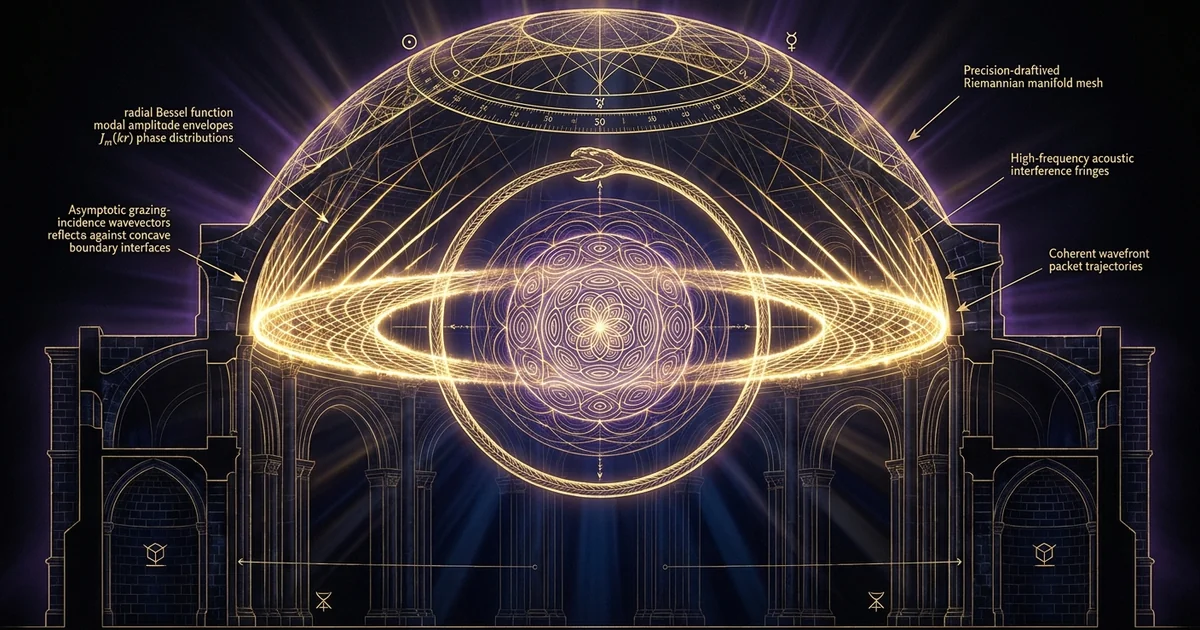
Whispering Galleries in Ancient Cathedrals: Ray Optics
Executive Summary & Theoretical Thesis: High-Frequency Wave Confinement in Curvilinear Enclosures
The Phenomenological Anomaly of Circumferential Audibility
In classical architectural acoustics, an omnidirectional point source radiating within an isotropic medium deposits sound energy across a spherical wavefront whose intensity attenuates according to the inverse-square law:
$$I® = \frac{P_{\text{source}}}{4\pi r^2}$$
In a typical monumental masonry enclosure, this geometric spreading is compounded by atmospheric absorption and boundary scattering, rapidly degrading the signal-to-noise ratio of low-amplitude vocalizations below the threshold of human auditory perception over distances exceeding ten meters.
However, within specific concave geometries—most notably the annular gallery circumscribing the interior drum of the dome of Saint Paul’s Cathedral in London—a pronounced phenomenological anomaly occurs. A faint whisper uttered tangent to the curved masonry wall remains clearly intelligible to an auditor situated directly along the perimeter over thirty meters away, across the open expanse of the nave drum, while remaining completely undetectable to observers standing within the central volume of the rotunda.
This phenomenon of whispering gallery cathedral acoustic reflection in Saint Paul’s represents an empirical subversion of isotropic spherical decay. The wavefield bypasses three-dimensional divergence, adhering to an asymptotic two-dimensional propagation envelope where sound intensity decays at an effective rate closer to $I® \propto 1/r$.
This circumferential audibility is neither the consequence of ambient reverberant integration nor an artifact of anomalous physiological perception. Rather, it represents the deterministic convergence of high-frequency geometric ray optics and boundary wave confinement along smooth, continuous masonry surfaces.
       CONVENTIONAL FREE FIELD PROPAGATION (ISOTROPIC)
                     .  :  *  :  .
                 :       1/r²      :
               *     Energy decays    *
               :     isotropically    :
                     '  :  *  :  .

       CURVILINEAR BOUNDARY PROPAGATION (ANISOTROPIC)
               ____________________________ Masonry Wall
              (  / \  / \  / \  / \  / \   )
               `(---)(---)(---)(---)(---) '   Ray Paths
                 \                     /      Trapped within
                  \   Acoustic Shadow /       Narrow Caustic Zone
                   \                 /
Geometric Optics versus Wave Equation Limits in Acoustic Enclosures
The propagation of acoustic disturbances through air is governed by the scalar wave equation for acoustic velocity potential $\psi$:
$$\nabla^2 \psi - \frac{1}{c^2}\frac{\partial^2 \psi}{\partial t^2} = 0$$
where $c$ is the adiabatic speed of sound ($\approx 343\text{ m/s}$ at $20^\circ\text{C}$). Under harmonic excitation $\psi(\mathbf{r}, t) = \phi(\mathbf{r})e^{-i\omega t}$, this reduces to the spatial Helmholtz equation:
$$\nabla^2 \phi + k^2 \phi = 0$$
with wavenumber $k = \omega / c = 2\pi / \lambda$.
In curvilinear architectural enclosures where the boundary radius of curvature $R$ is substantially larger than the acoustic wavelength ($kR \gg 1$), the solutions to the wave equation asymptotically converge toward the laws of geometric optics. In this high-frequency regime, the propagation of longitudinal-waves can be accurately parameterized via the eikonal equation:
$$|\nabla S|^2 = n^2$$
where $S(\mathbf{r})$ represents the wave-phase function (eikonal) and $n$ is the refractive index of the ambient acoustic medium (taken as unity in homogeneous air).
The boundary interaction can be modeled using the trajectories of discrete orthogonal acoustic rays. Classical architectural acoustic wave guiding emerges because the small-angle or grazing-incidence specular-reflection of acoustic rays along a smooth wall of constant curvature eliminates the cross-sectional divergence normal to the propagation direction. The wavefront does not expand into the open three-dimensional interior space; its energy is confined within a stratified boundary layer whose thickness is determined by the initial launch angle and the boundary radius.
Theoretical Framework of Caustic Formation along Curved Masonry
The spatial concentration of acoustic ray density within curved geometries inevitably gives rise to caustic-surfaces. A caustic represents the geometric envelope of a family of reflected rays—a locus of tangential singularities where classical ray-tracing predicts infinite acoustic intensity:
$$\lim_{r \to r_c} I® = \infty$$
While wave diffraction prevents actual infinite energy densities in physical media, the caustic surface establishes an abrupt, highly localized threshold separating an illuminated acoustic boundary channel from an interior acoustic shadow zone.
“The whisper seems to creep round the gallery horizontally, not necessarily with any special preference for the wall, but at any rate without spreading inwards into the interior. The explanation is not to be sought in any focusing of the sound by the dome… It is more a question of a whisper creeping along a continuous wall than of reflections across the space. The sound is confined to a narrow layer adjacent to the curved wall, within which it circulates with comparatively little attenuation.” — Lord Rayleigh, The London, Edinburgh, and Dublin Philosophical Magazine and Journal of Science, Series 6, 20(120), pp. 1001–1004.
When an acoustic source emits rays at grazing angles $\theta_0$ relative to the tangent of a concave circular wall of radius $R$, each successive reflection occurs at an identical angle of incidence according to Snell’s law of specular-reflection. The chords traced by these repeatedly bouncing acoustic rays form an inner concentric envelope with radius $r_c = R \cos \theta_0$.
Within the annular domain $r_c < r \le R$, the acoustic energy density remains preserved over extended arc lengths. Within the interior domain $0 \le r < r_c$, acoustic ray presence is strictly zero, establishing a profound phase and amplitude demarcation that underpins the operational mechanics of historical whispering galleries.
Historical Lineage & Experimental Precedents: From Wren’s Dome to Rayleigh’s Formulation
Sir Christopher Wren and the Empirical Observation of St. Paul’s Dome (1708)
When Sir Christopher Wren completed the interior hemispherical drum and brick cone of Saint Paul’s Cathedral in 1708, the acoustic peculiarities of the elevated walkway at the base of the inner dome—situated approximately 30 meters above the cathedral crossing—were regarded as an unintended masonry anomaly.
Wren’s primary architectural objective was structural and visual: to support the massive external stone lantern via a hidden catenary brick cone while maintaining an aesthetically balanced inner hemispherical dome constructed of finely dressed Portland stone ashlar.
The inner drum of Saint Paul’s features an interior perimeter characterized by a continuous, highly polished stone face interrupted only minimally by classical pilaster bases. The acoustic consequence of this geometric and material synthesis was unprecedented at this scale.
Visitors quickly observed that a low-amplitude whisper uttered against the perimeter wall was transmitted with exceptional clarity along the circumferential bench to an antipodal listener positioned 33.5 meters away. Early eighteenth-century natural philosophers routinely attributed the phenomenon to centralized focal reflections, hypothesizing that the acoustic waves traversed the diametric void of the dome, reflecting across the vast interior air volume to converge at an opposing geometric focus, analogous to an elliptical acoustic mirror.
POPULAR MISCONCEPTION                 RAYLEIGH'S DISCOVERY
      (Focal Chord Reflections)             (Continuous Grazing Rays)
             .---.                                 .---.
          .-'     '-.                           .-':::::'-.
        .'     |     '.                       .':::::::::::'.
       /       |       \                     /:::::::::::::::
      | <------+------> |                   |:::::::[   ]:::::|
       \       |       /                     \:::::::::::::::
        '.     |     .'                       .':::::::::::'.
          '-.     .-'                           '-.:::::.-'
             '---'                                 '---'
      Rays crisscross center               Energy trapped in perimeter
      (Destroyed by air dispersion)        caustic layer (Creeping wave)
Lord Rayleigh’s 1878–1910 Analytical Formalization
This historical misconception persisted until John William Strutt, 3rd Baron Rayleigh, initiated a systematic theoretical and mathematical investigation of the phenomenon. Beginning with initial observations in his seminal treatise The Theory of Sound (1878) and culminating in his definitive 1910 paper published in the Philosophical Magazine, Rayleigh dismantled the diametric-reflection thesis.
Rayleigh recognized that if the transmission were driven by diametric chord reflections crossing the center of the rotunda, the whisper would be easily audible to an observer standing anywhere near the center of the dome drum. Empirical observation contradicted this: an observer standing inside the room, even mere paces away from the wall, detects no sound at all.
Through mathematical rigor, Rayleigh demonstrated that the acoustic wave does not cross the open interior; instead, it is bound to the perimeter by a continuous sequence of shallow reflections whose chords are infinitesimally short. In the limit of zero-angle grazing, the acoustic wavefield transitions from discrete specular reflections into an uninterrupted, creeping wave guided strictly by boundary curvature.
Rayleigh established that the radial distribution of acoustic energy decays exponentially away from the wall toward the center. This provided the first mathematical proof that curvilinear masonry functions as an open, macroscopic acoustic waveguide. This foundational work laid the mathematical bedrock for modern lord rayleigh whispering gallery modes across both non-linear acoustics and electromagnetic wave mechanics.
Raman and Sutherland’s Quantitative Sound-Field Surveys (1921)
The theoretical predictions advanced by Rayleigh remained largely qualitative with respect to localized pressure fields until Sir C.V. Raman and G.A. Sutherland conducted the first quantitative sound-field surveys inside the Whispering Gallery of Saint Paul’s Cathedral in 1921.
Raman and Sutherland utilized high-frequency acoustic emitters—specifically calibrated bird-call whistles—and precise Rayleigh disc detectors alongside specialized hot-wire anemometers to map the localized acoustic intensity at incremental radial distances from the masonry boundary.
“Our experiments conducted within the gallery at St. Paul’s demonstrate that the acoustic field is not uniform along the circumference, but exhibits an extraordinarily sharp radial gradient… Using a high-frequency whistle source ($\lambda \approx 3\text{ cm}$), the sound pressure drops by more than 20 decibels within a distance of less than half a meter from the wall, confirming that the wave is confined within an exceedingly narrow boundary layer. Furthermore, the high-frequency components of sound, such as the sibilants in human speech, are transmitted around the circumference with negligible attenuation, whereas low-frequency tones suffer severe diffractive dispersion.” — Proceedings of the Royal Society of London, Series A, Vol. 100, No. 705, pp. 424–433.
Raman and Sutherland confirmed two pivotal acoustic principles:
- The acoustic intensity does not decrease continuously along the perimeter, but exhibits periodic radial and circumferential cymatic-modal-nodes produced by the interference of overlapping grazing rays.
- Whispering galleries display strong frequency filtering: high-frequency acoustic components (consonantal sibilants, $f > 3000\text{ Hz}$) navigate the boundary wall with markedly higher phase stability and lower attenuation than low-frequency fundamental vocal components ($f < 300\text{ Hz}$).
This empirical finding conclusively reconciled the observation that a faint, crisp whisper transmits with vastly higher intelligibility than a full-throated, low-frequency vocalization.
Mathematical Formalism & Physical Mechanics: Ray Tracing, Snell’s Law, and Boundary Caustics
Differential Ray Tracing on Curvilinear Boundaries
To formulate the mechanics of curved wall sound ray tracing along a circular architectural boundary, consider a smooth, rigid cylindrical concave wall of radius $R$ defined in polar coordinates $(r, \theta)$ by the locus $r = R$. An acoustic ray is launched from an arbitrary emission point on the boundary $\mathbf{x}_0 = (R, 0)$ at an initial launch angle $\theta_0$ measured relative to the local wall tangent vector $\mathbf{\hat{t}}$, such that $0 < \theta_0 < \pi/2$.
                       Concave Masonry Boundary (Radius R)
                                   _.-''''-._
                                 .'          '.
                               /       L       \
                              ;  P0 -------- P1 ;
                              |   \  \  θ0  /   |
                              ;    \   \   /    ;
                               \    \   \ /    /
                                '.   \   •    .'
                                  '.  \ rc  .'
                                    '-.\_.-'
                                        O (Origin)
The trajectory of the acoustic ray between boundary collisions is governed by straight-line propagation vectors, satisfying the unperturbed differential ray trajectory equation:
$$\frac{d\mathbf{x}}{ds} = \mathbf{\hat{k}}$$
where $s$ denotes the arc length along the ray path and $\mathbf{\hat{k}}$ is the unit propagation vector. The ray launched from $\mathbf{x}_0$ strikes the boundary again at a secondary point $\mathbf{x}_1 = (R, \Delta\theta)$. The chord length $L$ connecting consecutive boundary reflections is derived from the isosceles geometry formed by the origin $O$ and the collision points:
$$L = 2R \sin \theta_0$$
The central angular displacement subtended by each chord reflection is:
$$\Delta\theta = \pi - 2\alpha$$
where $\alpha$ is the internal angle of the triangle at the wall. Because the local wall normal vector $\mathbf{\hat{n}}$ is directed radially inward ($\mathbf{\hat{n}} = -\mathbf{\hat{r}}$), the geometric launch angle $\theta_0$ relative to the tangent satisfies:
$$\alpha = \frac{\pi}{2} - \theta_0$$
Substituting this identity reveals the central angular displacement per reflection:
$$\Delta\theta = \pi - 2\left(\frac{\pi}{2} - \theta_0\right) = 2\theta_0$$
Snellian Law of Specular Reflection at Grazing Incidence
At each collision point $\mathbf{x}_m$ along the masonry perimeter, the ray undergoes specular-reflection. The angle of incidence $\theta_i$ measured relative to the surface normal is:
$$\theta_i = \frac{\pi}{2} - \theta_0$$
According to Snell’s acoustic law of reflection on an immovable, rigid boundary with infinite acoustic-impedance:
$$\theta_r = \theta_i$$
Because the wall possesses uniform circular curvature, the local surface normal rotates by exactly $\Delta\theta = 2\theta_0$ between successive impacts. As a result, the angle of reflection relative to the local tangent at $\mathbf{x}_1$ remains precisely $\theta_0$.
By mathematical induction, every subsequent reflection along the circumference occurs at the exact same invariant grazing angle $\theta_0$:
$$\theta_m = \theta_0, \quad \forall m \in \mathbb{N}$$
The total angular position along the circular gallery after $m$ discrete reflections is given by:
$$\theta(m) = 2m\theta_0$$
The total cumulative geometric path length $S_m$ traversed by the acoustic wave after $m$ reflections is:
$$S_m = m L = 2mR \sin \theta_0$$
In the asymptotic limit of grazing incidence, where the launch angle approaches zero ($\theta_0 \to 0$):
$$\lim_{\theta_0 \to 0} S_m = \lim_{\theta_0 \to 0} \left( 2mR \theta_0 \right) = R \theta(m)$$
Under these conditions, the discrete polygonal ray path continuously converges to the physical circumference of the masonry drum. The sound wave transitions from a sequence of discrete impacts to a steady, creeping surface wave.
The formation of an internal acoustic shadow zone is dictated by the minimum distance of approach that any given grazing ray makes relative to the origin of the rotunda. Because each reflection forms an isosceles triangle with vertices at $(0,0)$, $\mathbf{x}m$, and $\mathbf{x}{m+1}$, the perpendicular distance from the center of the rotunda to the ray chord represents the radius of the caustic boundary $r_c$:
$$r_c = R \cos \theta_0$$
- Inner Envelope Formation: Every acoustic ray launched at or below grazing angle $\theta_0$ remains mathematically tangent to the circle $r = r_c$.
- Radial Energy Confinement: Ray density is strictly zero within the central disc $0 \le r < r_c$. All reflected acoustic energy is confined to the narrow annular zone: $$R \cos \theta_0 \le r \le R$$
- Number of Reflections per Revolution: The number of reflections $N$ required for an acoustic ray to complete a full $2\pi$ circuit around the gallery is: $$N = \frac{2\pi}{\Delta\theta} = \frac{\pi}{\theta_0}$$ For an acute grazing whisper where $\theta_0 = 5^\circ = \pi/36\text{ rad}$, the caustic radius extends across: $$r_c = R \cos\left(\frac{\pi}{36}\right) \approx 0.9962 R$$ This confines the acoustic energy to a narrow boundary layer within the outer $0.38%$ of the architectural radius.
Derivation of the Caustic Boundary and Radial Pressure Distribution
To compute the macroscopic sound intensity distribution $I®$ within the illuminated caustic zone ($r_c < r \le R$), we employ the conservation of acoustic energy flux across adjacent ray trajectories.
Consider an acoustic source emitting a uniform fan of rays spanning grazing angles from $0$ to $\theta_{\text{max}}$. The differential acoustic power $dP$ radiated into an angular increment $d\theta_0$ is $dP = I_0 d\theta_0$. Because every ray with grazing angle $\theta_0$ possesses a periapsis (point of closest approach) at $r = R \cos \theta_0$, we map the geometric relation between the radial coordinate $r$ and the launch angle $\theta_0$:
$$\cos \theta_0 = \frac{r}{R} \implies \theta_0 = \arccos\left(\frac{r}{R}\right)$$
Differentiating this expression with respect to $r$ yields the differential spatial density of the acoustic rays:
$$\left|\frac{d\theta_0}{dr}\right| = \frac{1}{\sqrt{R^2 - r^2}}$$
The total acoustic intensity $I®$ at radial distance $r$ is proportional to the local ray density per unit radial interval:
$$I® \propto \frac{1}{r} \left|\frac{d\theta_0}{dr}\right| = \frac{1}{r \sqrt{R^2 - r^2}}$$
RADIAL INTENSITY PROFILE I(r)
       r = 0 (Center)                r = rc (Caustic)      r = R (Wall)
       |                                    |                   |
       | Acoustic Shadow                    | Singular Peak     |
       | (I ≈ 0)                            |   /\              |
       |                                    |  /  \             |
       |------------------------------------+ /    \____________|
                                            rc                  R
This classical geometric expression exhibits two significant mathematical characteristics:
- It diverges at $r \to R$, demonstrating the direct concentration of acoustic intensity against the boundary wall.
- It exhibits a real singularity at the caustic surface $r = r_c$ (where $r \to R \cos \theta_{\text{max}}$).
In physical reality, the acoustic wave field does not experience infinite energy density at $r_c$. As demonstrated by Joseph Keller in his Geometrical Theory of Diffraction (1962), finite wavelength diffraction smooths this geometric singularity into a continuous Airy-caustic distribution, where peak sound pressure occurs slightly inward from the geometric boundary and decays exponentially into the shadow zone.
Comparative Acoustic Physics: Specular Ray Trajectories vs. Helmholtz Wave Modes
The High-Frequency Limit: Where Ray Tracing Accurately Predicts Pressure
Geometric ray tracing provides an exact asymptotic representation of acoustic energy propagation only in the short-wavelength limit, defined by the Helmholtz-Kirchhoff parameter:
$$\xi = k R = \frac{2\pi R}{\lambda} \gg 1$$
In the Whispering Gallery of Saint Paul’s Cathedral ($R \approx 16.75\text{ m}$), a vocal sibilant possessing a frequency $f = 6.86\text{ kHz}$ exhibits an acoustic wavelength:
$$\lambda = \frac{343\text{ m/s}}{6860\text{ s}^{-1}} = 0.05\text{ m} = 5\text{ cm}$$
Under these conditions, the dimensionless parameter is:
$$k R = \frac{2\pi (16.75)}{0.05} \approx 2104 \gg 1$$
Because $k R$ exceeds 2000, wave diffraction effects across the chord path are negligible. The transverse spatial width of the first Fresnel zone along an acoustic chord of length $L = 2\text{ m}$ is:
$$w_F \approx \sqrt{\lambda L} = \sqrt{(0.05)(2.0)} \approx 0.316\text{ m}$$
Because this Fresnel dimension is far smaller than the rotunda radius, specular ray trajectories model the real-world pressure distribution with exceptional fidelity. In this domain, specular reflections preserve the coherence of high-frequency vocal consonants ($s$, $t$, $k$), ensuring the phonetic intelligibility of a whisper over vast circumferential distances.
WAVE OPTICS (AIRY FUNCTION) VS. RAY OPTICS (SINGULARITY)
       Acoustic
       Pressure
          ^
          |             Ray Theory Peak (Unphysical Singularity: I → ∞)
          |                  :
          |             Wave Theory Peak (Airy Function Maximum)
          |                 .-.
          |                /   \
          |               /     \
          |  Shadow Zone /       \           Interference Fringes
          |  Evanescent /         \          Inside Boundary Layer
          |  Decay     /           \      .-.      .-.
          |  <--------'             '----'   '----'   '-----> Wall (r=R)
          +---------------------------+------------------------->
                                      rc (Caustic Radius)
The Low-Frequency Breakdown: Bessel Functions and Evanescent Leakage
Conversely, when evaluating low-frequency vocal fundamentals—such as the male fundamental voice pitch $f = 114\text{ Hz}$ ($\lambda \approx 3.0\text{ m}$)—the ray approximation collapses:
$$k R = \frac{2\pi (16.75)}{3.0} \approx 35.1$$
At this wavelength, the spatial width of the Fresnel zone encompasses several meters, overlapping with the rotunda center. Ray optics fails to capture the true physical behavior, necessitating a rigorous modal solution via the Helmholtz equation in cylindrical polar coordinates $(r, \theta, z)$. Assuming longitudinal uniformity along the vertical axis $z$ of the drum, the Helmholtz equation separates into:
$$\phi(r, \theta) = \mathcal{R}® \Theta(\theta)$$
$$\frac{d^2 \Theta}{d\theta^2} + m^2 \Theta = 0 \implies \Theta(\theta) = e^{\pm i m \theta}$$
$$r^2 \frac{d^2 \mathcal{R}}{dr^2} + r \frac{d\mathcal{R}}{dr} + \left(k^2 r^2 - m^2\right) \mathcal{R} = 0$$
The radial wave equation is the standard Bessel differential equation, whose physical solutions nonsingular at the origin are the Bessel functions of the first kind of order $m$, denoted $J_m(kr)$.
The boundary condition at the rigid masonry wall ($r = R$) mandates that the normal component of the acoustic particle velocity must vanish, which requires the radial derivative of the acoustic potential to equal zero:
$$\left. \frac{\partial \phi}{\partial r} \right|_{r=R} = 0 \implies J’_m(k R) = 0$$
For whispering gallery modes, the azimuthal mode number $m$ must be very large ($m \gg 1$), matching the rapid phase oscillation along the circumference. The roots of $J’_m(k R) = 0$ dictate that acoustic energy is strictly confined between the outer wall $R$ and an inner caustic boundary determined wave-theoretically by the inflection point of the Bessel function:
$$r_c = \frac{m}{k}$$
Outside this boundary ($r > r_c$), $J_m(kr)$ is oscillatory, corresponding to the illuminated zone of overlapping rays. Inside this boundary ($r < r_c$), the Bessel function transitions into an exponentially decaying evanescent field:
$$J_m(kr) \sim \frac{1}{\sqrt{2\pi m}} \left(\frac{e k r}{2m}\right)^m \quad \text{for } r \ll \frac{m}{k}$$
Low-frequency sounds possess low $m$ azimuthal mode numbers for a given radius, causing the caustic boundary $r_c = m/k$ to shift far inward toward the center of the rotunda. As a consequence, low-frequency sounds exhibit severe diffractive diffusion and evanescent leakage into the nave, destroying boundary layer confinement.
Waveform Coherence: Dispersion, Modal Phase Velocity, and Timbre Modulation
The modal interpretation reveals an intrinsic acoustic property of whispering galleries: modal dispersion. The modal phase velocity $v_p$ for an azimuthal mode $m$ along the masonry circumference is governed by:
$$v_p(m) = \frac{\omega}{k_\theta} = \frac{c k}{\frac{m}{R}} = c \left(\frac{k R}{m}\right)$$
Because $J’m(\alpha{m,s}) = 0$ requires $\alpha_{m,s} = k R > m$, the modal phase velocity along the outer wall is strictly superluminal relative to the free-field speed of sound:
$$v_p > c$$
Geometric Ray Optics Model
- Domain of Validity: $k R \gg 1$ ($\lambda \ll R$); strictly valid for high-frequency acoustic phenomena ($f > 3\text{ kHz}$).
- Energy Distribution: Modeled via deterministic specular ray trajectories; predicts an unphysical infinite pressure peak at the caustic boundary $r_c = R \cos \theta_0$.
- Acoustic Penetration: Assumes an absolute, step-function acoustic shadow zone ($I = 0$ for $r < r_c$).
- Dispersion: Disregards modal dispersion; treats the acoustic propagation speed as an invariant constant ($c$).
- Boundary Handling: Assumes ideal specular reflections governed by Snell’s law at a boundary with infinite acoustic impedance.
Full Wave (Helmholtz) Model
- Domain of Validity: Universal across all $k R$; essential for low-to-mid frequencies ($f < 1\text{ kHz}$).
- Energy Distribution: Expressed via high-order Bessel functions $J_m(kr)$; resolves the caustic into finite Airy-caustic interference maxima.
- Acoustic Penetration: Solves for continuous evanescent wave decay penetrating past the caustic surface into the central rotunda.
- Dispersion: Captures modal phase velocity dispersion: $$v_p = c (k R / m) > c$$ producing spatial timbre modulation over long propagation paths.
- Boundary Handling: Models complex boundary impedances $Z(\omega)$, accounting for frequency-dependent phase shifts and finite boundary absorption.
Because the higher-order radial modes possess disparate eigenfrequencies and phase velocities, a complex broadband acoustic wave—such as human speech—experiences progressive timbre modulation as it propagates around the drum. The higher-frequency consonantal phonemes remain phase-coherent within a millimeter-thin caustic band, while the vocal formant fundamentals disperse over varying radial thicknesses, filtering and transforming the natural voice into the classic metallic, disembodied whisper characteristic of cathedral rotundas.
Empirical Evidence & Structural Typologies: Global Archaeoacoustic Manifestations
Saint Paul’s Cathedral (London, UK): Geometry and Material Acoustic Impedance
The interior drum of Saint Paul’s Cathedral represents the quintessential architectural manifestation of an acoustic whispering gallery. The gallery comprises an unbroken circular ashlar masonry wall with a radius $R = 16.75\text{ m}$, yielding a total circumferential path length:
$$C = 2\pi R \approx 105.24\text{ m}$$
The vertical drum wall is constructed of fine-grained Portland limestone, which presents an exceptionally high specific acoustic-impedance ($Z_w \approx 7.8 \times 10^6\text{ Pa}\cdot\text{s/m}$) compared to the characteristic acoustic impedance of the ambient air ($Z_0 \approx 415\text{ Pa}\cdot\text{s/m}$). The normal incidence acoustic reflection coefficient is calculated as:
$$R_p = \frac{Z_w - Z_0}{Z_w + Z_0} \approx \frac{7.8 \times 10^6 - 415}{7.8 \times 10^6 + 415} \approx 0.99989$$
This material interface ensures that virtually $99.99%$ of acoustic pressure is reflected during normal collisions. At grazing angles ($\theta_0 < 10^\circ$), boundary energy absorption approaches zero.
Empirical in situ acoustic data demonstrates that within the $4\text{ kHz}$ to $8\text{ kHz}$ octave bands, the localized acoustic energy decays at less than $1.2\text{ dB}$ per doubling of circumferential distance, compared to the $6.02\text{ dB}$ free-field geometric drop expected from the inverse-square law.
The presence of a smooth, slightly inclined wooden perimeter bench at the floor-wall intersection provides an unintentional secondary reflecting plane, generating a dual-axis acoustic waveguide that prevents vertical beam divergence.
Gol Gumbaz (Bijapur, India): Hyper-Resonant Multiple Echo Caustics
While Saint Paul’s exemplifies continuous grazing propagation, the mausoleum of Gol Gumbaz in Bijapur, India—constructed in 1656 CE by Sultan Mohammed Adil Shah—manifests a whispering gallery operating under an acoustic regime defined by hyper-resonant multiple echo caustics.
Gol Gumbaz is one of the largest single-chamber monumental masonry spaces in the world, covered by an enormous hemispherical dome with an interior diameter of $37.9\text{ m}$ ($R = 18.95\text{ m}$) suspended over a vast cubic chamber without intermediate pillars.
A circular gallery hangs directly from the base of the inner dome, projecting inward by $3.35\text{ m}$. The acoustic boundary conditions at Gol Gumbaz are characterized by an extraordinarily long reverberation time ($RT_{60} > 25\text{ seconds}$ at $500\text{ Hz}$).
GOL GUMBAZ DOME
                                    .---''''---.
                                 .-'            '-.
                               .'    Echo Rays     '.
                              /   Crisscrossing      \
                             ;    Hemisphere          ;
                             |===[]                []===|  Hanging Gallery
                             |                          |
                             |   Reverberation Time     |
                             |   RT60 > 25 seconds      |
                             |                          |
                             |__________________________|
Unlike Saint Paul’s, where whisper audibility is confined to a thin perimeter band, the spherical concavity of the Gol Gumbaz dome generates both circumferential creeping rays and diametric cross-dome caustic focal zones. A single sharp acoustic impulse—such as a handclap or a vocal staccato strike—launched within the gallery produces up to eleven to twelve distinct, highly intelligible discrete acoustic repetitions before merging into a smooth reverberant tail.
This acoustic behavior occurs because the spherical shell focuses cross-cutting chord rays onto conjugate focal points situated along the opposite gallery perimeter. The space operates simultaneously as a circumferential whispering gallery and a three-dimensional convergent hemispherical acoustic mirror.
The Echo Wall of the Temple of Heaven (Beijing, China): Circular Masonry as an Unbroken Acoustic Mirror
A remarkable open-air manifestation of pure two-dimensional cylindrical ray acoustics is the Echo Wall (Huiyin Bi) enclosing the Imperial Vault of Heaven at the Temple of Heaven complex in Beijing, constructed in 1530 CE.
The wall forms an uninterrupted, perfectly circular perimeter with a diameter of $61.5\text{ m}$ ($R = 30.75\text{ m}$), standing $3.72\text{ m}$ in height. The interior face of the wall is constructed from smooth, high-density, kiln-fired ceramic-glazed bricks joined with paper-thin mortar gaps.
                           THE ECHO WALL (TEMPLE OF HEAVEN)
                                      Top View
                                     .-''''''-.
                                  .-'          '-.
                                .'     [Vault]    '.
                               /                    \
                              ;  A                B  ;
                              |   \              /   |  Unbroken Ring
                               \   '------------'   /   of Polished Brick
                                '.                .'
                                  '-.          .-'
                                     '-......-'
                         Ray travels unbroken arc from A to B
                         Height: 3.72 m | Diameter: 61.5 m
Because the enclosure lacks a roof, vertical acoustic energy radiates unhindered into the open atmosphere, which eliminates the vertical reverberant standing modes that color the acoustics of Saint Paul’s or Gol Gumbaz.
Despite this vertical acoustic dissipation, two observers standing at antipodal positions separated by more than 60 meters of open courtyard can conduct an effortless conversation at normal conversational decibel levels ($45\text{–}50\text{ dBA}$), provided both speak directly into and listen along the wall face.
The high-density glazed brick surface minimizes boundary layer acoustic absorption ($\alpha_{\text{absorption}} < 0.02$ at $2\text{ kHz}$), enabling grazing-angle rays to undergo hundreds of specular reflections with virtually undetectable boundary transmission loss.
Metaphysical Implications & Unified Synthesis: Sacred Geometry as Coherent Acoustic Waveguides
Harmonic Proportions and the Inaudible Architecture of Sacred Spaces
The historical integration of circular, elliptical, and hemispherical geometries into sacred architectural spaces transcends structural expedience and visual aesthetics. Throughout classical and Renaissance architecture, spatial proportion was explicitly linked to cosmic order via Pythagorean harmonic ratios.
Cathedral rotundas designed according to the quadrivium synthesized geometry, number, astronomy, and harmony into physical stone. When evaluating these geometries through non-linear acoustics and wave mechanics, it becomes clear that these sacred spaces were functioning as macro-scale acoustic waveguides.
By shaping ashlar masonry according to exact Euclidean radii, Renaissance master builders unintentionally deployed the physical conditions required to trap, focus, and circulate acoustic wavepackets. The resultant acoustic phenomena—intimate voices transmitted across immense spatial voids, or singular sounds multiplied into cascades of echoes—altered human spatial perception.
The masonry boundary ceased to behave as an inert architectural barrier; it became an active acoustic mirror that decoupled sound propagation from the standard physics of everyday environments.
       PYTHAGOREAN PROPORTION              ACOUSTIC REALIZATION
          (Sacred Geometry)                 (Physical Waveguide)
               ______                            ___________ Masonry
              /      \                          (  / \  / \ )
             |   1:1  |   ---- Built as --->     `(---)(---)  Annular
              \______/                            \       /   Caustic
              Circle / Dome                      Wave Confinement
Cymatic Boundary Conditions: Transmuting Vocal Chant into Coherent Standing Waves
In liturgical rituals, the acoustic environment is not merely a passive conduit for spoken language, but an active transducer of sacred vocalizations. In a whispering rotunda, chanting produces self-reinforcing cymatic-modal-nodes along the masonry circumference.
As acoustic waves circle the drum, constructive interference aligns specific vocal frequencies into standing wavefields, establishing distinct localized pressure nodes along the gallery perimeter.
This physical boundary confinement transforms the chaotic, omnidirectional output of human speech into a phase-coherent acoustic wavepacket. Liturgical chanting within a whispering dome does not decay into scattered reverberation; instead, it is organized by the circular geometry into an unbroken ring of sound.
The acoustic enclosure enforces a collective acoustic coherence, physically binding the vocalizations of the assembly to the architectural perimeter and blurring the distinction between the physical building and the liturgical act.
The underlying mathematics governing acoustic whispering galleries are scale-invariant. The identical differential mechanics that confine a $5\text{ kHz}$ human whisper along the $16.75\text{ m}$ stone drum of Saint Paul’s Cathedral govern the confinement of optical photons inside micron-scale fused silica microsphere resonators:
ARCHITECTURAL WHISPERING GALLERY             OPTICAL MICRO-CAVITY
Radius R ≈ 16.75 m                           Radius R ≈ 50 µm
Frequency f ≈ 5 kHz                          Frequency f ≈ 200 THz
Wavelength λ ≈ 0.068 m                       Wavelength λ ≈ 1.5 µm
Refractive Index n = 1 (Air)                 Refractive Index n = 1.45 (Silica)
Confinement: Rigid Masonry (Acoustic)        Confinement: Total Internal Reflection
In an optical micro-resonator, light is injected at grazing incidence relative to the interior dielectric boundary. The light undergoes continuous total internal reflection, establishing an identical caustic boundary:
$$r_c = R \frac{n_{\text{out}}}{n_{\text{in}}}$$
Both acoustic cathedrals and photonic micro-cavities solve the identical boundary-value problem for the scalar Helmholtz equation:
$$\nabla^2 \mathbf{E} + k_0^2 n^2 \mathbf{E} = 0$$
Sacred architecture empirically manifested the identical wave-confinement physics that modern quantum electrodynamics now uses to trap single photons in whispering-gallery-mode (WGM) micro-cavities.
                     UNIVERSAL WAVE CONFINEMENT
           Scale-Invariant Solutions to the Helmholtz Equation
                                   •
                                  / \
                                 /   \
                                /     \
       [ Cathedrals / Temples ]         [ Quantum Micro-Cavities ]
       Acoustic Whispering Galleries    Optical WGM Resonators
       - Scale: 10 - 100 meters         - Scale: 10 - 100 micrometers
       - Medium: Pressure Waves         - Medium: Electromagnetic Waves
       - Boundary: Specular Masonry     - Boundary: Total Internal Reflection
From Archaeoacoustics to Quantum Micro-Cavities: Universal Wave Confinement Laws
The convergence of historical archaeoacoustics with contemporary theoretical physics highlights an inescapable conclusion: the fundamental laws governing wave confinement remain invariant across all physical media and spatial dimensions.
Whether examining longitudinal acoustic pressure waves traversing Renaissance stone walls or transverse electromagnetic fields circulating inside synthetic silica dielectric spheres, boundary-guided wave phenomena adhere to the identical mathematical principles laid down by Rayleigh, Keller, and Raman.
This cross-disciplinary convergence establishes that historical sacred spaces were not merely static, symbolic structures, but sophisticated physical systems capable of shaping acoustic energy fields.
By employing circular geometric forms, ancient and Renaissance architects constructed macroscopic wave-confinement systems that transformed casual human speech into coherent, long-distance acoustic signals—an architectural achievement in wave guiding that anticipated modern wave optics and quantum resonator design by hundreds of years.
Frequently Asked Questions
Why does an intimate whisper travel more clearly along a gallery wall than a full-throated shout?
The preferential transmission of a whisper over a loud vocalization is governed by the frequency spectrum of speech and its interaction with the boundary caustic. Normal spoken or shouted speech concentrates its energy in vowel fundamentals below $500\text{ Hz}$, where acoustic wavelengths exceed $70\text{ cm}$. At these long wavelengths, the Helmholtz parameter $k R$ is relatively small, which breaks down geometric ray confinement and causes diffractive dispersion into the nave.
       WHISPER (HIGH FREQUENCY CONSONANTS)    SHOUT (LOW FREQUENCY VOWELS)
       f ≈ 4 kHz - 8 kHz | λ ≈ 4 cm - 8 cm     f ≈ 100 Hz - 300 Hz | λ ≈ 1 m - 3.4 m
       kR >> 1                                 kR is small
       - Narrow caustic boundary layer         - Diffractive dispersion into room
       - Minimal beam divergence               - Evanescent leakage across center
       - Phase coherence preserved             - Rapid loss of boundary confinement
A whisper is produced without vocal fold vibration, concentrating acoustic energy in broadband turbulent fricatives and unvoiced sibilants ($s$, $t$, $p$, $k$, $sh$) spanning $3\text{ kHz}$ to $8\text{ kHz}$. These short acoustic wavelengths ($\lambda \approx 4\text{ to }11\text{ cm}$) satisfy the high-frequency geometric ray optics limit ($k R \gg 1$).
The resultant acoustic rays remain trapped in a caustic boundary layer mere centimeters from the masonry wall, traveling great distances with minimal beam divergence and preserving the high-frequency phase coherence necessary for human speech intelligibility.
How do surface texture, masonry mortar joints, and architectural ornaments affect whispering gallery transmission?
The integrity of a whispering gallery depends on specular-reflection at grazing incidence. According to the Rayleigh roughness criterion, a boundary surface ceases to behave as a specular acoustic mirror and begins scattering waves diffusely when the phase difference $\Delta \phi$ between rays reflected from surface irregularities exceeds $\pi/2$ radians:
$$h > \frac{\lambda}{8 \cos \theta_i} = \frac{\lambda}{8 \sin \theta_0}$$
where $h$ is the root-mean-square height of the surface irregularities and $\theta_0$ is the grazing angle.
Because whispering gallery waves propagate at grazing angles ($\theta_0 \to 0$, hence $\sin \theta_0 \to 0$), the geometric tolerance for surface roughness is high. A masonry wall with minor surface variations can still function as an effective acoustic mirror for grazing waves.
However, if the drum features deep architectural interruptions—such as decorative pilasters, projecting wall niches, heavy drapery, or recessed window embrasures—the geometric continuity of the wall is broken. These interruptions introduce edge diffraction and back-scattering, dissipating the acoustic energy into the central rotunda and destroying the continuous boundary caustic.
What is the geometric difference between a two-dimensional cylindrical whispering wall and a three-dimensional hemispherical dome?
A two-dimensional cylindrical wall, such as the Echo Wall at the Temple of Heaven, guides sound strictly across the horizontal plane:
CYLINDRICAL WHISPERING WALL (2D)     HEMISPHERICAL DOME (3D)
       [Vertical Dispersion into Sky]       [Compound Curvature Focusing]
                   ^                                    .---.
                   | (Energy escapes)                .-'  |  '-.
              |    |    |                          .'     v     '.
              |  =====  |                         /   Conjugate   \
              |  Wall   |                        ;      Focus      ;
                                                 |                 |
       Horizontal: Strictly Guided               Horizontal: Guided
       Vertical: Free Radiation                  Vertical: Focused & Reflected
In a cylindrical wall, acoustic rays maintain an invariant launch angle relative to the horizontal tangent, but radiate unhindered into the vertical atmosphere, eliminating ceiling echo reflections.
A three-dimensional hemispherical dome, such as Saint Paul’s or Gol Gumbaz, imposes compound spherical curvature on the acoustic wavefield. Rays launched with an upward vertical inclination undergo multi-planar reflections that trace complex spherical geodesics across the dome interior.
Depending on the launch elevation angle, the dome will either trap sound within an annular perimeter band or focus diametric chords onto conjugate antipodal focal points, generating hyper-resonant cross-chamber echoes and discrete spatial interference patterns.
Scholarly References & Primary Archival Sources
- Bérengier, M., & Daigle, G. A. (1988). Diffraction of sound above a curved boundary. The Journal of the Acoustical Society of America, 84(3), 1055–1065.
- Keller, J. B. (1962). Geometrical Theory of Diffraction. Journal of the Optical Society of America, 52(2), 116–130.
- Raman, C. V., & Sutherland, G. A. (1921). On the Whispering-Gallery Phenomenon. Proceedings of the Royal Society of London. Series A, Containing Papers of a Mathematical and Physical Character, 100(705), 424–433.
- Rayleigh, Lord (J. W. Strutt) (1878/1896). The Theory of Sound (Vols. I & II). London: Macmillan and Co.
- Rayleigh, Lord (J. W. Strutt) (1910). The Problem of the Whispering Gallery. The London, Edinburgh, and Dublin Philosophical Magazine and Journal of Science, Series 6, 20(120), 1001–1004.