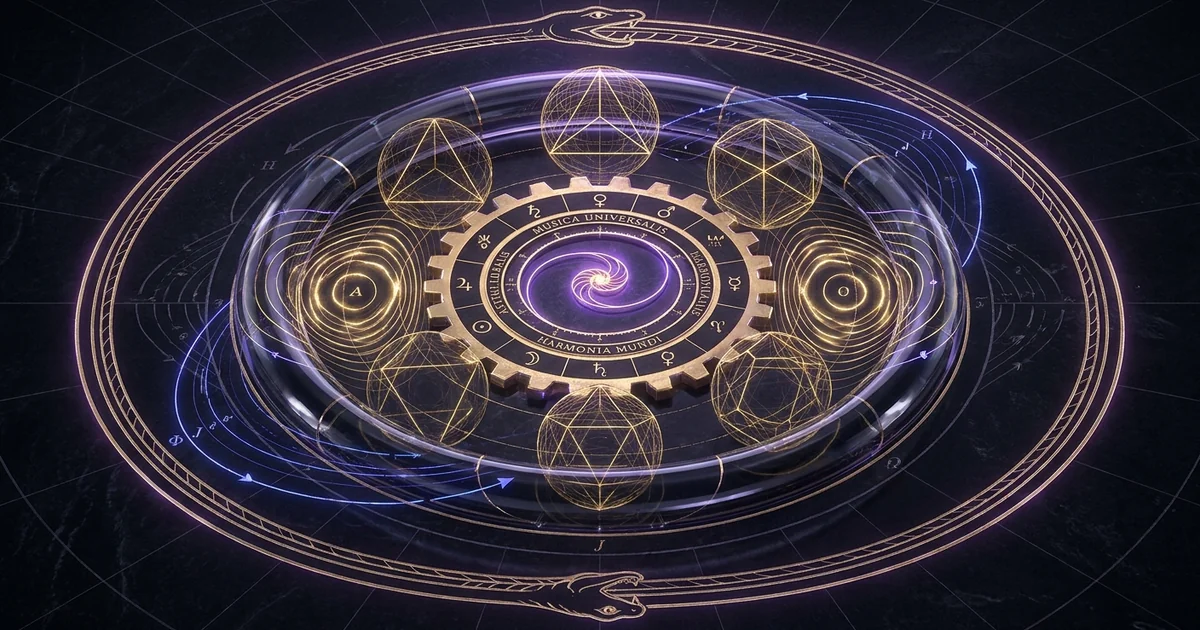
Planetary Orbit Periods & Harmonic Resonance: Kepler Art
Executive Summary & Theoretical Thesis: Gravitational Modal Discretization
Reinterpreting Harmonices Mundi Through Hamiltonian Dynamics
Johannes Kepler’s publication of Harmonices Mundi Libri V in 1619 marked a pivotal transition in the history of science, capturing the conceptual watershed where geometric mysticism intersected with observational astrophysics. Historically dismissed by twentieth-century positivism as an idiosyncratic excursion into Neoplatonic number mysticism, Kepler’s search for the “Music of the Spheres” (musica universalis) articulated an intuitive, pre-Newtonian approximation of nonlinear Hamiltonian perturbation theory. Rather than pursuing static spatial relations, Kepler analyzed the ratios of extreme apparent angular velocities of planets as observed from the heliocentric reference frame—specifically, the contrast between velocities at perihelion and aphelion. By mapping these dynamic extrema to Pythagorean intervals, Kepler grasped that planetary architecture is governed by temporal periodicities rather than immutable Euclidean distances.
Viewed through modern celestial mechanics harmony, this intuition maps onto the phase-space geometry of multi-body orbital systems. Planetary motion is governed by non-integrable Hamiltonian equations, where perturbations generate non-linear couplings across invariant phase-space structures. When Kepler mapped orbital eccentricities to musical intervals—assigning to Saturn an interval of a major third, to Jupiter a minor third, and to Mars a fifth—he identified the dynamic bounds of what modern physics formalizes as libration envelopes within phase-locking regimes. The variations in orbital velocity are not random fluctuations; they represent excursions across resonant phase angles where energy is continually exchanged between adjacent gravitational bodies.
This mechanical reality reveals that the harmonices mundi kepler music of the spheres orbital resonance paradigm prefigures the canonical transformations of contemporary dynamical systems. The mathematical isomorphism between acoustic frequency modulation and Hamiltonian action-angle coordinates is exact: the orbital mean motion $n = \dot{\lambda}$ corresponds to an intrinsic acoustic frequency, while the eccentricity $e$ acts as a modulation index determining the spectral amplitude of higher-order resonant harmonics. In this light, Kepler’s archetypal musical polyphony constitutes the first empirical phenomenology of mean-motion resonance (MMR), capturing the self-organizing modal behavior of celestial bodies long before the formalization of gravitational potential theory.
The Planetary Commensurability Phenomenon: Epiphenomenon vs Dynamical Attractor
A central question in modern astrodynamics is whether the observe commensurabilities among planetary period ratios are mere artifacts of stochastic distribution or dynamical attractors produced by dissipative evolutionary histories. If the distribution of semi-major axes across stellar systems were arbitrary, the frequency ratios of adjacent planetary pairs would form a continuous spectrum conforming to a uniform random distribution. Empirical surveys of both our Solar System and compact multi-planet exoplanetary systems cataloged by the Kepler and TESS missions reveal statistically significant overdensities at low-order integer ratios: $2:1$, $3:2$, $4:3$, $5:3$, and the classic Laplace three-body configuration $4:2:1$.
These commensurabilities function as topological phase traps. In an unperturbed two-body Keplerian problem, the action variables $I_k$ are conserved, and the angle variables $\theta_k$ advance linearly: $\theta_k(t) = \omega_k t + \beta_k$. However, in an $N$-body configuration, the mutual gravitational scalar-potential introduces non-integrable perturbations through the disturbing function $R$. This potential generates terms proportional to $\cos(j_1 \lambda_1 + j_2 \lambda_2 + \dots)$, where $\lambda_i$ are the mean longitudes and $j_i$ are integers. When the resonance condition $\sum j_i n_i \approx 0$ is approached, these perturbative terms cease to average to zero over secular timescales. Instead, they produce a stationary phase condition, transferring angular momentum and energy until the system locks into a state of libration.
Far from being an epiphenomenon, commensurability represents a structural necessity born of energy minimization within dissipative environments. Planetesimal scattering, gas drag, and tidal migration act as non-conservative forces that systematically drain orbital energy while conserving or redistributing angular momentum. Under these dissipative conditions, planetary orbits do not drift indefinitely through phase space; they fall into the potential wells of mean-motion resonances. These resonant locks stabilize the architecture against chaotic disruption by phase-shielding the interacting bodies, thereby ensuring that mutual conjunctions occur exclusively at configurations that maximize inter-planetary separation.
+-----------------------------------------------------------------------------------+
|               NON-CONSERVATIVE ACCRETION / MIGRATION PHASE                        |
|  - Hydrodynamic Protoplanetary Gas Drag                                           |
|  - Planetesimal Gravitational Scattering                                          |
|  - Differential Orbital Migration (Type I / Type II)                              |
+-----------------------------------------+-----------------------------------------+
                                          |
                                          v
+-----------------------------------------------------------------------------------+
|               RESONANT CAPTURE & PHASE-LOCKING (KAM REGIME)                       |
|  - Stationary Phase Trapping: j₁ n₁ + j₂ n₂ ≈ 0                                   |
|  - Invariant Phase-Space Tori Shield Orbits from Crossings                        |
|  - Kinetic Energy Dissipates into Internal Viscous / Tidal Heating                |
+-----------------------------------------+-----------------------------------------+
                                          |
                                          v
+-----------------------------------------------------------------------------------+
|               STABLE MACROSCOPIC COMMENSURABILITY (MODAL NODE)                    |
|  - Jovian System (Io-Europa-Ganymede 4:2:1)                                       |
|  - Resonant Exoplanet Chains (e.g., TRAPPIST-1, TOI-178)                          |
+-----------------------------------------------------------------------------------+
Acoustic Geometries in Circumstellar Accretion Disks
The physical genesis of orbital harmonics occurs during the circumstellar accretion disk phase, where the primordial protostellar nebula behaves as an acoustic cavity. Protoplanetary disks are compressible, self-gravitating fluid systems governed by the Navier-Stokes equations coupled to Poisson’s equation for gravitational potential. Differential rotation, characterized by the Oort constants and epicyclic frequency $\kappa®$, establishes a continuous dispersion relation for spiral density waves. These waves are longitudinal-waves propagating through the gas-dust fluid medium, establishing macroscopic acoustic standing patterns that govern mass distribution prior to planetesimal agglomeration.
Within these disks, inner and outer Lindblad resonances ($m(\Omega - \Omega_p) = \pm \kappa$) and corotation resonances ($\Omega = \Omega_p$) act as boundaries where spiral density waves are launched and reflected. These fluid-dynamic interactions generate cymatic-modal-nodes: radial and azimuthal zones of zero net acoustic acceleration where dust grains and small planetesimals preferentially settle due to gas drag pressure gradients. The mathematical structure describing these density nodes mirrors the spatial eigenmodes of acoustic resonators. As the gas disk cools, planetesimals accumulate along these nodal lines, forming ring-like annuli at discrete heliocentric distances that directly dictate the semi-major axes of the nascent protoplanets.
The resulting planetary architectures reflect the acoustic eigenvalues of the primordial disk. As protoplanets reach runaway accretion thresholds, their gravitational feedback carves gaps in the disk, launching secondary spiral wakes that drive convergent migration toward pre-existing modal positions. The primordial system undergoes a physical self-tuning process, structurally identical to the modal discretization observed in boundary-value acoustic problems. The emergent period ratios of planets are thus the frozen macroscopic signatures of non-linear hydrodynamic and acoustic vibrations that dominated the disk during its formative epoch.
The fundamental dynamics of a two-body mean-motion resonance within an $N$-body system can be approximated by expanding the Hamiltonian around a nominal commensurability. Consider two planets of masses $m_1$ and $m_2$ orbiting a primary $M_* \gg m_1, m_2$, with mean motions $n_1$ and $n_2$ satisfying the critical condition: $$j_1 n_1 + j_2 n_2 \approx 0, \quad j_1, j_2 \in \mathbb{Z}$$ Through Kepler’s Third Law, the relationship between orbital periods $T_i$, mean motions $n_i$, and semi-major axes $a_i$ is given by: $$n_i = \frac{2\pi}{T_i} = \sqrt{\frac{G(M_* + m_i)}{a_i^3}} \implies \left(\frac{T_1}{T_2}\right) = \left(\frac{a_1}{a_2}\right)^{3/2}$$ Using canonical Poincaré variables, the resonant Hamiltonian reduces to the standard pendulum-like form near the resonant surface: $$\mathcal{H}(\Psi, \phi) = \frac{1}{2} A \Psi^2 - B \cos \phi$$ where $\phi = j_1 \lambda_1 + j_2 \lambda_2 + j_3 \varpi_1 + j_4 \varpi_2$ is the resonant angle (with $\varpi_i$ denoting the longitude of periapsis), $\Psi$ is the canonical action variable proportional to the deviation of the semi-major axis $\Delta a_1 = a_1 - a_{1,\text{res}}$, and the coefficients are: $$A = -\frac{3 j_1^2 n_1}{2 a_1^2}, \quad B = \frac{G m_1 m_2}{a_2} f_d(\alpha) e_1^{|j_3|} e_2^{|j_4|}$$ Here, $f_d(\alpha)$ is the dimensionless Laplace coefficient evaluation dependent on the semi-major axis ratio $\alpha = a_1/a_2$. The separatrix separating resonant libration from non-resonant circulation is defined by the energy contour $\mathcal{H} = B$. Setting $\mathcal{H} = B$ at $\phi = \pi$, the maximum canonical action half-width is: $$\Psi_{\max} = \sqrt{\frac{4B}{|A|}} = 2 \sqrt{\frac{B}{|A|}}$$ Translating this back to the physical semi-major axis space yields the analytical resonance half-width: $$\delta a_1 = \left( \frac{16 C_r}{3 j_1^2 n_1^2} \right)^{1/2} = 4 a_1 \left( \frac{m_2}{M_*} \frac{f_d(\alpha)}{3 j_1^2} e_1^{|j_3|} e_2^{|j_4|} \right)^{1/2}$$ When the separation between adjacent first-order resonances ($\Delta a = a_{j+1} - a_j$) becomes smaller than their respective widths ($\delta a$), the Chirikov resonance overlap criterion is satisfied: $$S = \frac{2 \delta a}{\Delta a} > 1$$ Under this condition, the invariant KAM tori disintegrate, and the system transitions from stable harmonic libration to deterministic hamiltonian-chaos.
Historical Lineage & Experimental Precedents: From the Monochord to Celestial Mechanics
Pythagorean Tetractys and the Harmonic Monochord Ratios
The intellectual ancestry of orbital harmonic analysis traces back to the sixth century BCE with the Pythagorean investigation of the monochord. Pythagoras demonstrated that dividing an elastic vibrating string into simple whole-number lengths produces consonances: the ratio $2:1$ yields the diapason (octave), $3:2$ the diapente (perfect fifth), and $4:3$ the diatessaron (fourth). These intervals, derived from the numbers $1, 2, 3, \text{ and } 4$, comprised the sacred Tetractys, whose sum equals the decad ($1+2+3+4=10$). In the Pythagorean cosmogony, these mathematical proportions were not merely properties of strings; they constituted the ontological foundation of the physical universe, leading directly to the concept of the musica universalis.
Pythagorean Monochord Division Scheme:
String Length L:  [================================================] -> Fundamental (1:1)
String Length L/2: [========================]                         -> Diapason / Octave (2:1)
String Length 2L/3:[================================]                 -> Diapente / Fifth (3:2)
String Length 3L/4:[====================================]             -> Diatessaron / Fourth (4:3)
Plato formalized this framework in the Timaeus, describing the fabrication of the World Soul through a harmonic series based on the powers of 2 and 3 (the Platonic Lambda: $1, 2, 3, 4, 8, 9, 27$). In this dialogue, the demiurge cuts and blends the fabric of the cosmos using harmonic means: $$\mathcal{H} = \frac{2ab}{a+b}$$ and geometric means: $$\mathcal{G} = \sqrt{ab}$$ This construction established a paradigm where the spatial and kinematic distribution of celestial wanderers was assumed to reflect whole-number harmonic ratios. The monochord thus served as antiquity’s first rigorous laboratory apparatus, linking empirical acoustic sensations with abstract arithmetic proportions.
Through antiquity and the medieval era—from Ptolemy’s Harmonica to Boethius’s De Institutione Musica—the doctrine of celestial harmony remained predominantly theoretical, lacking precision measurements of orbital parameters. The monochord, however, firmly established the epistemological precedent that physical phenomena could be decoded through rational frequency fractions. This continuous lineage, linking string vibration to cosmological architecture, formed the foundation upon which Johannes Kepler launched his revolutionary astronomical program at the dawn of the seventeenth century.
Kepler’s Geometric Polyhedra and the Transition to Angular Harmonics
Kepler’s initial foray into celestial architecture appeared in his Mysterium Cosmographicum (1596). Haunted by the question of why there were precisely six known planets and why they were positioned at specific distances from the Sun, Kepler formulated a model based on Euclidean solid geometry. He nested the five Platonic solids (octahedron, icosahedron, dodecahedron, tetrahedron, cube) between the inscribed and circumscribed spheres of the planetary orbits:
$$\text{Sphere of Saturn} \supset \text{Cube} \supset \text{Sphere of Jupiter} \supset \text{Tetrahedron} \supset \dots \supset \text{Sphere of Mercury}$$
This static geometric hypothesis, while matching the crude Copernican distances to within several percent, collapsed when subjected to the precise observational data collected by Tycho Brahe.
Mysterium Cosmographicum (1596)        Harmonices Mundi (1619)
    [Static Spatial Geometry]               [Dynamic Kinematic Harmonics]
   Nested Platonic Solids Ratios  =====>    Apparent Heliocentric Angular Velocities
    Inscribed/Circumscribed Spheres         Harmonic Monochord Consonances at Extremes
Recognizing the inadequacy of static polyhedral packings to account for non-circular motion, Kepler fundamentally restructured his framework over the subsequent two decades. The culmination of this transition was Harmonices Mundi (1619). Kepler abandoned static spatial polyhedra in favor of dynamic angular velocities. He realized that if celestial harmony existed, it had to be kinematic and perceived from the dynamic center of the system: the Sun.
Kepler computed the apparent diurnal angular motions of each planet at its orbital extrema: perihelion (maximum angular velocity, $\omega_{\max}$) and aphelion (minimum angular velocity, $\omega_{\min}$). By calculating the ratios between these extrema for individual planets, as well as the cross-ratios between adjacent planets, he discovered that they converged on the intervals of the chromatic musical scale:
$$Saturn: \frac{\omega_{\text{peri}}}{\omega_{\text{ap}}} \approx \frac{5}{4} \quad (\text{Major Third})$$ $$Jupiter: \frac{\omega_{\text{peri}}}{\omega_{\text{ap}}} \approx \frac{6}{5} \quad (\text{Minor Third})$$ $$Mars: \frac{\omega_{\text{peri}}}{\omega_{\text{ap}}} \approx \frac{3}{2} \quad (\text{Perfect Fifth})$$ $$Earth: \frac{\omega_{\text{peri}}}{\omega_{\text{ap}}} \approx \frac{16}{15} \quad (\text{Semitone})$$ $$Venus: \frac{\omega_{\text{peri}}}{\omega_{\text{ap}}} \approx \frac{25}{24} \quad (\text{Diesis})$$ $$Mercury: \frac{\omega_{\text{peri}}}{\omega_{\text{ap}}} \approx \frac{12}{5} \quad (\text{Minor Tenth})$$
Crucially, it was during the rigorous mathematical labor of extracting these kinematic angular harmonies that Kepler formulated his Third Law of Planetary Motion ($T^2 \propto a^3$), published in Book V, Chapter 3 of Harmonices Mundi. This law provided the physical bridge connecting dynamic orbital periods directly to spatial semi-major axes, laying the structural groundwork for the subsequent Newtonian synthesis.
“Motus autem diurni apparentes, prout ex Sole spectantur, qui fiunt in extremitatibus orbitarum planetariarum, demonstratum est in praecedentibus, proportionibus congruere consonantiis harmonicis… Saturni motus apparens minimus in Aphelio est 1’ 46’‘, maximus in Perihelio 2’ 15’‘; Iovis vero minimus 4’ 30’‘, maximus 5’ 30’'… Illud igitur certum est, motus hos duos minimos aphelios Saturni et Iovis constituere rationem 1:2 seu diapason; perihelios vero 5:6 seu tertiam minorem.”
Translation: “It has been demonstrated in the preceding pages that the diurnal apparent motions, as viewed from the Sun, which occur at the extremities of the planetary orbits, correspond to harmonic consonances… The apparent minimum motion of Saturn at aphelion is 1’ 46’‘, the maximum at perihelion 2’ 15’‘; while for Jupiter the minimum is 4’ 30’‘, the maximum 5’ 30’'… It is therefore certain that these two minimum aphelion motions of Saturn and Jupiter establish the ratio 1:2 or the octave; while their perihelia establish the ratio 5:6, or the minor third.”
The Newtonian-Laplacian Formalization of Multi-Body Perturbations
The qualitative, kinematic harmonies documented by Kepler received their physical and dynamic justification through the development of Newtonian mechanics and the perturbation theory formulated by Pierre-Simon Laplace and Joseph-Louis Lagrange in the late eighteenth century. Isaac Newton established the inverse-square law of universal gravitation in his Philosophiae Naturalis Principia Mathematica (1687), proving that while an isolated two-body system traces a closed, periodic Keplerian ellipse, an $N$-body system introduces complex cross-coupling perturbations.
Pierre-Simon Laplace resolved the historical dilemma known as the “Great Inequality of Jupiter and Saturn”—an apparent secular acceleration of Jupiter and deceleration of Saturn that confounded eighteenth-century astronomers. In his Traité de mécanique céleste (1799), Laplace demonstrated that this anomaly was not an irreversible secular drift, but an ultra-long-period oscillation spanning roughly 900 years, generated by their proximity to a $5:2$ mean-motion resonance:
$$5 n_{\text{Saturn}} - 2 n_{\text{Jupiter}} \approx 0$$
Laplace developed the mathematical apparatus of the disturbing function, expanding the mutual gravitational interaction into an infinite series of Legendre polynomials and trigonometric functions of mean longitudes. His analytical framework proved that the period ratios of planets are not arbitrary geometric numbers; they are the consequence of multi-body perturbations where small gravitational forces accumulate over secular timescales.
Together with Lagrange, Laplace formulated the theorem of secular orbital stability, showing that to first order in planetary masses, the semi-major axes of planets experience no secular drift ($\frac{d\langle a_i \rangle}{dt} = 0$). This demonstrated that the orbital architecture of the Solar System is stabilized by compensatory angular momentum exchanges across resonant configurations, validating Kepler’s qualitative vision of integrated, harmonic celestial mechanics through the rigorous language of mathematical analysis.
Mathematical Formalism & Physical Mechanics: Mean-Motion Resonance and Phase-Locking
Hamiltonian Perturbation Theory and the Disturbing Function
The mathematical treatment of orbital resonance operates within the framework of canonical Hamiltonian perturbation theory. For an $N$-planet system orbiting a central star of mass $M_*$, the total Hamiltonian in canonical Heliocentric or Jacobian coordinates can be decomposed into an unperturbed Keplerian component $\mathcal{H}_0$ and an interaction perturbation $\mathcal{H}_1$:
$$\mathcal{H} = \mathcal{H}_0(\mathbf{\Lambda}) + \epsilon \mathcal{H}_1(\mathbf{\Lambda}, \mathbf{\lambda}, \mathbf{\Gamma}, \mathbf{\gamma})$$
where $\epsilon = \max(m_i / M_*) \ll 1$ represents the small perturbation parameter. The canonical action variables (Poincaré variables) are defined as:
$$\Lambda_i = m_i \sqrt{G M_* a_i}$$ $$\Gamma_i = \Lambda_i \left(1 - \sqrt{1 - e_i^2}\right) \approx \frac{1}{2} \Lambda_i e_i^2 + \mathcal{O}(e_i^4)$$
with their conjugate angle variables being the mean longitudes $\lambda_i = n_i t + \epsilon_i$ and the longitudes of periapsis $-\varpi_i$. The perturbation term is directly proportional to the gravitational disturbing function $R_i$:
$$\mathcal{H}1 = - \sum{i<j} \left( \frac{G m_i m_j}{|\mathbf{r}_i - \mathbf{r}_j|} - G m_i m_j \frac{\mathbf{r}_i \cdot \mathbf{r}_j}{r_j^3} \right)$$
The disturbing function can be expanded as a multi-dimensional Fourier series using Laplace coefficients:
$$\mathcal{R} = \sum_{j_1, j_2, j_3, j_4} C_{j_1, \dots, j_4}(a_1, a_2, e_1, e_2) \cos\left( j_1 \lambda_1 + j_2 \lambda_2 + j_3 \varpi_1 + j_4 \varpi_2 \right)$$
The d’Alembert relation enforces an essential rotational symmetry condition: $\sum_{k=1}^4 j_k = 0$. When the mean motions $n_1 = \dot{\lambda}1$ and $n_2 = \dot{\lambda}2$ are non-commensurable, the arguments of the cosine functions circulate rapidly through $[0, 2\pi]$, causing the net perturbative force to average to zero over the secular timescale $\tau{\text{sec}} \sim \epsilon^{-1} T{\text{orb}}$. However, when the system satisfies the commensurability condition:
$$j_1 n_1 + j_2 n_2 \approx 0$$
the associated resonant argument $\phi = j_1 \lambda_1 + j_2 \lambda_2 + j_3 \varpi_1 + j_4 \varpi_2$ evolves slowly ($\dot{\phi} \approx 0$). This converts the oscillating term into a secular driving force that alters the orbital elements over long timescales.
       Canonical Action Space (Poincaré Momentum: Λ)
                     ^
                     |          / \  Circulation Regime
                     |         /   \
          Separating |        |  *  | (Unbound Phases)
          Separatrix |         \   /
                     |   ===================== Separatrix Contour
                     |      (   o   )
                     |       \     /   Libration Regime
                     |        \___/    (Phase-Locked Harmonic Well)
                     |
                     +---------------------------------------->
                    -π                   0                   +π
                                Resonant Angle φ
Libration, Circulation, and Separatrix Topology in the Resonant Angle
The phase space of a resonant system exhibits two distinct dynamical regimes separated by a topological boundary known as the separatrix. The resonant Hamiltonian can be transformed into a one-degree-of-freedom system through a canonical contact transformation to resonant action-angle variables:
$$\phi = p \lambda_2 - q \lambda_1 - (p-q)\varpi_1$$ $$\Phi = \frac{\Lambda_1}{q}$$
Applying this transformation, the averaged resonant Hamiltonian simplifies to the classical Andoyer or pendulum-like Hamiltonian:
$$\bar{\mathcal{H}} = \frac{1}{2} A (\Phi - \Phi_0)^2 - B \sqrt{2\Sigma} \cos \phi$$
where $\Sigma \approx \frac{1}{2} e_1^2$ represents the canonical eccentricity action. The topology of this phase space depends on the value of the energy function relative to the separatrix energy:
$$E_{\text{sep}} = \bar{\mathcal{H}}(\Phi_{\text{res}}, \pi) = B \sqrt{2\Sigma}$$
In the circulation regime ($E > E_{\text{sep}}$), the resonant angle $\phi$ sweeps continuously through the entire interval $[0, 2\pi]$. The instantaneous orbital period ratios fluctuate, but the two planets never lock into a long-term phase configuration. The mutual conjunctions occur at varying relative positions along the orbit, leading to quasi-periodic variations in semi-major axes and eccentricities.
In the libration regime ($E < E_{\text{sep}}$), the resonant angle $\phi$ is trapped in a potential well, oscillating with a bounded amplitude around a stable equilibrium point:
$$\phi_{\text{eq}} \in {0, \pi}$$
This condition represents true mean-motion resonance. The bodies are phase-locked; conjunctions occur exclusively when the planets are at specific configurations—typically when the inner planet is at aphelion and the outer planet is at perihelion. This geometric alignment maximizes the physical distance between the planets during conjunction, protecting the system from catastrophic close encounters and minimizing mutual gravitational scattering.
Dissipative Resonance Capture and Gas-Disk Tidal Migration
The probability of two planets becoming trapped in a mean-motion resonance rather than crossing through it is dictated by the direction and speed of their orbital migration. During the late phases of planet formation, planets interact with the remnant gaseous protoplanetary disk, exchanging angular momentum through spiral density wakes. This produces convergent migration, where the outer planet migrates inward faster than the inner planet, or the inner planet migrates outward due to corotation torques:
$$\frac{d}{dt}\left(\frac{a_1}{a_2}\right) < 0$$
As derived by Peter Goldreich and modern planetary dynamicists, when two planets approach an inner resonance via convergent migration, the capture probability into the resonant libration state approaches unity ($P_{\text{cap}} \approx 1$), provided the migration rate is adiabatic relative to the libration frequency:
$$\left|\frac{\dot{n}_1 - \dot{n}2}{n_1 - n_2}\right| \ll \omega{\text{lib}} = \sqrt{3 |j_2| A B}$$
If migration is adiabatic, the action integral: $$J = \oint \Phi , d\phi$$ is conserved. As the planets draw closer, the phase-space area enclosed by the separatrix expands, sweeping over the phase trajectories and capturing the system into the libration regime.
Once trapped, further dissipative migration forces the orbital eccentricities to grow until the damping from gas disk eccentricity dissipation: $$\left( \frac{\dot{e}}{e} \right){\text{damp}} \approx -\frac{1}{\tau_e}$$ balances the excitation driven by the resonance lock: $$\left( \frac{\dot{e}}{e} \right){\text{res}} \propto \frac{1}{\tau_a}$$ This equilibrium freezes the semi-major axis ratio at the exact rational fraction: $$\frac{a_1}{a_2} = \left(\frac{q}{p}\right)^{2/3}$$ This mechanism demonstrates that harmonic orbital architectures are not arbitrary initial states; they are the natural dissipative attractors of non-linear celestial mechanics.
Empirical Evidence & Observational Data: Laplace Architectures and Exoplanet Chains
The Galilean Moons: Mechanics of the 4:2:1 Laplace Resonance
The primary Solar System prototype of multi-body orbital commensurability is the three-body Laplace resonance operating among the three inner Galilean satellites of Jupiter: Io, Europa, and Ganymede. Their orbital periods follow a near-perfect geometric progression: $$T_{\text{Io}} \approx 1.769 \text{ d}, \quad T_{\text{Eu}} \approx 3.551 \text{ d}, \quad T_{\text{Ga}} \approx 7.155 \text{ d}$$ These values correspond to an orbital period ratio of: $$n_1 : n_2 : n_3 \approx 4 : 2 : 1$$
Galilean Satellites: Resonance Architecture (4:2:1)
Io:       (n₁ = 4) [=====]
Europa:   (n₂ = 2) [==========]
Ganymede: (n₃ = 1) [====================]
Laplace Angle: φ_L = λ₁ - 3λ₂ + 2λ₃ = π (Guarantees no simultaneous triple conjunctions)
The system is governed by two simultaneous two-body resonant arguments coupled to a single three-body angle:
$$\phi_1 = \lambda_{\text{Io}} - 2\lambda_{\text{Eu}} + \varpi_{\text{Io}} = 0$$ $$\phi_2 = \lambda_{\text{Eu}} - 2\lambda_{\text{Ga}} + \varpi_{\text{Eu}} = 0$$ $$\phi_L = \phi_1 - \phi_2 = \lambda_{\text{Io}} - 3\lambda_{\text{Eu}} + 2\lambda_{\text{Ga}} = \pi$$
The three-body Laplace angle $\phi_L$ librates with a tiny amplitude ($\Delta \phi_L < 0.033^\circ$) centered on $\pi$ ($180^\circ$). This condition enforces a strict phase-shielding geometry: Io and Europa reach conjunction exclusively at Io’s perijove and Europa’s apojove; simultaneous triple conjunctions are physically forbidden.
The maintenance of this resonance is driven by an equilibrium between tidal dissipation within the interior of Jupiter and viscoelastic dissipation within Io. Jupiter’s rapid rotation ($\Omega_J > n_{\text{Io}}$) transfers rotational angular momentum to Io’s orbit via the tidal bulge raised on the planet. This accelerates Io outward, which then transfers angular momentum to Europa and Ganymede via the Laplace resonant locks. In response, Io’s eccentricity is driven to an equilibrium value: $$e_{\text{Io}} \approx 0.0041$$ This forced eccentricity drives intense internal tidal flexing, converting orbital energy into internal heat. This mechanical heating manifests as the hyper-active volcanism observed on Io, demonstrating that orbital resonance can drive direct geological and thermodynamic activity.
High-Order Resonances in the Kuiper Belt and Asteroid Kirkwood Gaps
The structuring effect of mean-motion resonance is equally prominent in the asteroid belt and the Kuiper belt, where orbital commensurability produces both depletion gaps and protective phase-trapping nodes. In the main asteroid belt, gravitational perturbations from Jupiter create the Kirkwood gaps—sharp deficits in the distribution of semi-major axes corresponding to low-order rational ratios with Jupiter’s mean motion ($n_J$):
$$3:1 \quad (a \approx 2.50 \text{ AU}), \quad 5:2 \quad (a \approx 2.82 \text{ AU}), \quad 7:3 \quad (a \approx 2.95 \text{ AU}), \quad 2:1 \quad (a \approx 3.27 \text{ AU})$$
Within these gaps, the proximity to resonance causes the eccentricity of asteroid orbits to experience chaotic jumps. As Jacques Laskar demonstrated in 1989, the overlap of high-order sub-resonances introduces deterministic hamiltonian-chaos. This pumps the eccentricities of bodies inside the gaps to planet-crossing values ($e > 0.4$), triggering collisions with Mars or the Sun and clearing the resonant channels. In these instances, resonance acts destructively, destabilizing orbits that lack phase-shielding mechanisms.
Main Asteroid Belt Radial Density Profile:
Mass Density
    ^
    |      /\         /\    Kirkwood Gaps (Resonant Ejection Zones)
    |     /  \  3:1  /  \  5:2   2:1
    |    /    \  |  /    \  |     |
    |   /      \/  /      \/      v
    +---+----------+------+-------+------------------->
       2.0        2.5    2.8     3.28                a (AU)
Conversely, within the outer Solar System, the Kuiper Belt reveals how resonance serves as a stabilizing haven. The “Plutinos,” named after their prototype Pluto, are trans-Neptunian objects locked in a $3:2$ mean-motion resonance with Neptune:
$$\phi_{\text{Pluto}} = 3\lambda_{\text{Pluto}} - 2\lambda_{\text{Nep}} - \varpi_{\text{Pluto}} \approx 180^\circ$$
Although Pluto’s eccentric orbit crosses Neptune’s heliocentric distance, their resonant geometry dictates that whenever Pluto passes perihelion, Neptune is always situated at least $90^\circ$ away in true anomaly. Consequently, the two bodies never closely interact, preserving Pluto’s orbit over multi-billion-year timescales. This protective dynamic is replicated in the $2:1$ “Twotino” population, verifying that resonant phase-locking can insulate planetary trajectories against gravitational clearing.
Compact Resonant Chains: TRAPPIST-1 and TOI-178 as Modern Keplerian Systems
The empirical validation of multi-planet orbital commensurabilities has been expanded through the discovery of compact exoplanetary resonant chains. The cold-dwarf system TRAPPIST-1 presents a chain of seven Earth-sized planets locked in consecutive resonant configurations:
$$\frac{P_c}{P_b} \approx \frac{24}{15}, \quad \frac{P_d}{P_c} \approx \frac{15}{9}, \quad \frac{P_e}{P_d} \approx \frac{9}{6}, \quad \frac{P_f}{P_e} \approx \frac{6}{4}, \quad \frac{P_g}{P_f} \approx \frac{4}{3}, \quad \frac{P_h}{P_g} \approx \frac{3}{2}$$
This orbital arrangement establishes an unbroken sequence of three-body generalized Laplace relations spanning seven planetary bodies:
$$\phi = p \lambda_k - (p+q)\lambda_{k+1} + q \lambda_{k+2}$$
TRAPPIST-1 Resonant Architecture:
[Planet b] <--- 8:5 ---> [Planet c] <--- 5:3 ---> [Planet d] <--- 3:2 ---> [Planet e] ...
(Complete chain: 8:5, 5:3, 3:2, 3:2, 4:3, 3:2 - zero non-resonant gaps)
Similarly, the TOI-178 system possesses six transiting planets where the outer five are coupled in an unbroken $18:9:6:4:3$ resonance chain, while the innermost planet has detached from the chain due to high tidal dissipation.
These architectures cannot be explained by random gravitational capture. Their existence requires slow, convergent disk-driven migration within an early gas disk, which systematically funneled the planets into resonant traps. The transit-timing variations (TTV) observed in TRAPPIST-1 show that the libration amplitudes are tiny ($\Delta \phi \lesssim 1^\circ$), indicating that the planets are caught in deep potential wells. These discoveries empirically confirm Kepler’s central insight: when multi-body systems form under dissipative conditions, they naturally organize into discrete, rational harmonic structures.
Jovian Laplace Resonance (Io-Europa-Ganymede)
- Orbital Period Ratio: Pure $4:2:1$ commensurability among three moon bodies ($P_1 \approx 1.77 \text{ d}, P_2 \approx 3.55 \text{ d}, P_3 \approx 7.15 \text{ d}$).
- Libration Amplitude: Exceptionally tight libration: $\Delta \phi_L < 0.033^\circ$ around the fixed point $\phi_L = \pi$.
- Driver Mechanism: Maintained by outward differential tidal expansion driven by Jupiter’s rapid rotational spin-up, balanced by viscoelastic tidal dissipation in the satellites.
- Eccentricity State: Moderately low, dynamically forced eccentricities ($e_1 \approx 0.0041, e_2 \approx 0.009, e_3 \approx 0.0013$) that generate internal volcanic and ocean heating.
TRAPPIST-1 Exoplanetary Resonant Chain
- Orbital Period Ratio: Extended multi-tier chain ($b, c, d, e, f, g, h$) spanning ratios $8:5$, $5:3$, $3:2$, $3:2$, $4:3$, $3:2$.
- Libration Amplitude: Low libration amplitudes ($\Delta \phi \sim 0.5^\circ - 2.0^\circ$) across all five coupled generalized three-body Laplace angles.
- Driver Mechanism: Formed via long-range inward convergent Type-I migration through an ancient protoplanetary gas disk, halting at the disk’s inner magnetospheric cavity.
- Eccentricity State: Suppressed, dynamically stabilized eccentricities ($e \lesssim 0.01$) prevented from chaotic growth by mutual multi-body phase-shielding.
Metaphysical Implications & Unified Synthesis: Cymatic Self-Organization and Universal Geometries
Gravitational Cymatics: Density Waves as Macro-Acoustic Modal Nodes
The emergence of rational period ratios from continuous accretion disks reveals an isomorphism between gravitational mechanics and acoustic cymatics. In acoustic systems, such as a Chladni plate, physical boundaries enforce specific boundary conditions on wave equations, segregating uniform particle distributions into discrete nodal patterns along lines of destructive interference. In circumstellar systems, an analogous dynamic is mediated by the collective dielectric-field behavior of self-gravitating plasma, magnetic fields, and gas-dust mixtures.
The Lin-Shu dispersion relation for spiral density waves propagating in an astrophysical disk: $$(\omega - m \Omega)^2 = \kappa^2 - 2\pi G \Sigma_0 |k| + c_s^2 k^2$$ combines three factors: the epicyclic restorative force ($\kappa^2$), the self-gravitational destabilization ($-2\pi G \Sigma_0 |k|$), and the acoustic fluid pressure ($c_s^2 k^2$). This equation governs how longitudinal density perturbations propagate through the disk. The radial wave number $k$ realigns material into concentric radial rings separated by discrete distances. Dust grains, guided by gas-drag pressure gradients: $$\mathbf{v}{\text{drift}} \propto \mathbf{\nabla} P{\text{gas}}$$ are funneled toward the pressure maxima located at the nodes of these density waves.
       Chladni Plate (Acoustic Mechanics)  <====>  Circumstellar Gas Disk (Gravitational Cymatics)
       - Boundary Condition: Plate Edge           - Boundary Condition: Inner/Outer Disk Edges
       - Driving Medium: Transverse Sound Waves   - Driving Medium: Spiral Density Waves (k-modes)
       - Nodal Lines: Zero Acoustic Acceleration  - Nodal Rings: Pressure Maxima (Dust Traps)
       - Target Mass: Sand Grains                 - Target Mass: Planetesimal Agglomeration
This process mirrors the formation of cymatic patterns, establishing that spatial discretization does not require supernatural intervention. It emerges from the wave-mechanical properties of self-gravitating fluids. The planetary orbits that condense within these modal bands inherit these rational geometric spacings. Kepler’s “Music of the Spheres” can thus be understood as the macroscopic planetary crystallization of microscopic sound waves propagating through primordial nebulae, capturing standing wave configurations across astronomical space.
Goldreich, Peter (1965). “An explanation of the frequent occurrence of commensurable mean motions in the solar system.” Monthly Notices of the Royal Astronomical Society, 130(3), 159-181.
Goldreich demonstrated mathematically that the high prevalence of commensurability in celestial systems cannot be attributed to initial random conditions. The paper proves that convergent tidal migration or dissipative hydrodynamic interactions systematically drive pairs of orbiting bodies through phase space until they encounter a resonant separatrix. At this boundary, the probability of capture into a permanent mean-motion resonance approaches unity under slow, adiabatic migration conditions. This work provided the first modern dynamical mechanism confirming that rational period ratios are the natural, macroscopic attractors of non-conservative celestial systems.
KAM Theorem, Quasi-Periodic Invariant Tori, and the Preservation of Order
The long-term survival of rational orbital structures against perturbations is clarified by the Kolmogorov-Arnold-Moser (KAM) theorem. Developed through the mid-twentieth century, the KAM theorem analyzes the fate of quasi-periodic motions in non-integrable Hamiltonian systems:
$$\mathcal{H}(\mathbf{I}, \mathbf{\theta}) = \mathcal{H}_0(\mathbf{I}) + \epsilon \mathcal{H}_1(\mathbf{I}, \mathbf{\theta})$$
In an unperturbed system ($\epsilon = 0$), phase-space trajectories are confined to the surfaces of invariant tori characterized by fundamental frequency vectors $\mathbf{\omega} = \nabla_{\mathbf{I}} \mathcal{H}_0$.
Phase Space Flow on Invariant KAM Torus:
         +----------------------------------+
        /                                  /|
       /      Torus Surface J_k = const   / |
      +----------------------------------+  |
      |   .  .  .  .  .  .  .  .  .  .   |  |  Non-resonant: Dense Ergodic Trajectory
      |  .  .  .  .  .  .  .  .  .  .    |  |  Resonant: Closed Knot Trajectory
      |   .  .  .  .  .  .  .  .  .  .   |  |
      |                                  |  +
      |                                  | /
      +----------------------------------+
The KAM theorem establishes that if the perturbation $\epsilon$ is sufficiently small and the frequencies satisfy the Diophantine non-resonance condition:
$$|\mathbf{k} \cdot \mathbf{\omega}| \ge \frac{\gamma}{|\mathbf{k}|^\tau}, \quad \forall \mathbf{k} \in \mathbb{Z}^n \setminus {0}$$
most invariant tori survive, undergoing slight geometric deformation rather than destruction.
These persistent KAM tori act as impermeable phase-space boundaries in two-degree-of-freedom Hamiltonian systems, trapping wandering trajectories and preventing chaotic diffusion. In multi-dimensional systems with three or more degrees of freedom, resonance channels can intersect to form the “Arnold Web,” enabling slow chaotic excursions known as Arnold diffusion.
However, around low-order mean-motion resonances, the local phase space is dominated by large, resilient island chains surrounded by secondary invariant tori. These island chains stabilize the system: planetary pairs trapped within a resonant libration island cannot drift arbitrarily in semi-major axis or eccentricity. The KAM theorem shows that celestial harmony is not an fragile accident; it is protected by the topological structure of Hamiltonian phase space.
Synthesizing Kepler’s Esoteric Archetypes with Modern Non-Linear Field Theories
Kepler’s search for cosmological unity was fundamentally informed by Hermetic and Platonic archetypes, positing that the structural principles of terrestrial mathematics, acoustic consonances, and macroscopic planetary orbits are expressions of an underlying structural unity. In Chapter 9 of Book V of Harmonices Mundi, Kepler explicitly linked planetary dynamics with the divine tuning of the cosmos, constructing a synthetic framework connecting physical astronomy with sacred geometry.
From the perspective of contemporary physics, Kepler’s search can be re-evaluated as an early attempt to identify scale-invariant physical laws. The dynamic mechanisms stabilizing planetary orbits operate across vast differences in spatial scale. The same non-linear coupling equations that govern mean-motion resonance appear in atomic cavity quantum electrodynamics, laser mode-locking, coupled electronic oscillators, and the collective dielectric-field responses of condensed matter. In all these contexts, systems subjected to periodic forcing naturally settle into discrete, locked phases that minimize internal energy dissipation.
UNIFYING DYNAMICAL FORMALISM:
       [ Coupled Non-Linear Oscillators ]
                     |
       +-------------+-------------+
       |                           |
       v                           v
Macro-Scale:                 Micro-Scale:
Celestial Mechanics          Quantum Cavities / Mode-Locking
Resonant Orbits (MMR)        Phase-Locked Coherent Photons
KAM Invariant Tori           Energy Level Discretization
Modern non-linear dynamics recognizes that nature relies on harmonic resonance to maintain macroscopic order against entropic decay. If planetary period ratios were chaotic and non-commensurable, multi-body systems would experience disruptive secular resonances over gigayear timescales, leading to orbit crossings and widespread planetary ejections. Kepler’s harmonic proportions identify the self-organizing modal configurations that allow complex systems to persist. Keplerian polyphony was not a poetic indulgence; it was an intuitive grasp of the structural principles that preserve dynamic order throughout the universe.
Frequently Asked Questions
Technical Frontiers in Celestial Resonance Analysis
Do Kepler’s assigned musical scales have physical meaning, or are they strictly ratios of angular velocities?
Kepler’s musical scales are exact conversions of apparent angular velocities into frequency ratios, rather than literal acoustic pressure waves propagating through the vacuum of space. Vacuum cannot support the transmission of acoustic longitudinal-waves, as there is no mechanical fluid medium to sustain alternating compression and rarefaction. However, Kepler’s assignment of voices—soprano to Mercury, tenor to Mars, and bass to Saturn—derived directly from the numerical ranges of their diurnal heliocentric angular velocities:
$$\omega(t) = \frac{d\theta}{dt} = \frac{h}{r(t)^2}$$
Because angular momentum $h = \sqrt{G M_* a(1-e^2)}$ is conserved, the extreme apparent velocities occur precisely at perihelion: $$\omega_{\text{peri}} = \frac{\sqrt{G M_* a(1-e^2)}}{a^2(1-e)^2}$$ and aphelion: $$\omega_{\text{ap}} = \frac{\sqrt{G M_* a(1-e^2)}}{a^2(1+e)^2}$$
The ratio of these velocities simplifies to: $$\frac{\omega_{\text{peri}}}{\omega_{\text{ap}}} = \left(\frac{1+e}{1-e}\right)^2$$
Kepler computed these velocity ratios and translated them into musical intervals by dividing them by factors of $2^n$, transposing them into a single auditory octave. His musical notes represent a mathematically precise mapping of planetary eccentricities onto traditional musical scales, demonstrating that eccentricity corresponds directly to dynamic frequency modulation.
Why are the major planets in our Solar System close to, but slightly offset from, exact integer resonances?
The major planets of the Solar System exhibit period ratios that are near, but rarely precisely locked into, low-order mean-motion resonances. For example, Jupiter and Saturn have a period ratio of approximately $2.49$, close to the $5:2$ resonance ($2.50$), while Uranus and Neptune exhibit a ratio of approximately $1.96$, near the $2:1$ commensurability ($2.00$).
This offset is the result of chaotic secular diffusion operating over the 4.56-billion-year history of the Solar System. Following the dissipation of the primordial solar nebula, the giant planets cleared the residual planetesimal disk through gravitational scattering, an event formalized in the Nice Model of planetary evolution. This scattering drove divergent migration, moving Jupiter slightly inward while driving Saturn, Uranus, and Neptune outward. This migration pulled the planets out of their primordial resonant traps:
$$\delta n = n_1 - \frac{p}{q} n_2 \neq 0$$
Today, the giant planets inhabit wide non-resonant zones punctuated by narrow secular resonance lines. These systems are governed by quasi-periodic motion where resonant arguments circulate slowly over millions of years rather than librating permanently, ensuring long-term bounded stability while preventing resonant chaotic eccentricity growth.
Nice Model Scattering Sequence:
[ Primordial Resonant Chain ] ---> [ Planetesimal Disk Clearing ] ---> [ Resonant Crossing & Disruption ]
   (e.g., 3:2, 4:3 locks)               (Angular Momentum Exchange)           (Eccentricity Jumps)
                                                                                  |
                                                                                  v
                                                                    [ Modern Near-Resonant Configuration ]
                                                                       (Saturn:Jupiter ≈ 2.49, near 5:2)
How does dissipative tidal friction convert kinetic energy into heat while paradoxically increasing structural phase-space order?
This behavior is explained through the non-equilibrium thermodynamics of open, dissipative dynamical systems. An isolated, conservative Hamiltonian system preserves its total phase-space volume according to Liouville’s theorem: $$\frac{d\rho}{dt} = 0$$ However, when dissipative forces—such as tidal friction, fluid drag, or gravitational radiation—are introduced, the phase-space volume shrinks: $$\sum_k \left( \frac{\partial \dot{q}_k}{\partial q_k} + \frac{\partial \dot{p}_k}{\partial p_k} \right) < 0$$
Tidal friction acts as an energy sink, dissipating raw kinetic and potential energy into thermal heat through viscoelastic deformation: $$\dot{E}{\text{tide}} = -\frac{21}{2} \frac{k_2}{Q} \frac{G M*^2 R^5 n}{a^6} e^2$$ This process cools the system’s thermal and non-coherent motions. Concurrently, angular momentum is conserved across the broader system or transferred down mechanical gradients.
This sustained dissipation pulls the system toward stable attractors in phase space—namely, the potential minima of mean-motion resonances. Because the separatrix of a resonance acts as a phase-space trap, the probability that a dissipative trajectory becomes captured within the libration zone approaches unity under adiabatic conditions. The local thermodynamic entropy increases as kinetic energy converts to heat, but the system’s structural order increases. The planets settle into locked harmonic orbits, illustrating how dissipation can drive mechanical self-organization.
To understand why planetary resonances exhibit bounded oscillations rather than static ratios, we evaluate the characteristic timescales governing resonant phase space. Expanding the resonant Hamiltonian around a nominal commensurability: $$\mathcal{H} = \frac{1}{2} A \Psi^2 - B \cos \phi$$ The equations of motion are: $$\dot{\phi} = \frac{\partial \mathcal{H}}{\partial \Psi} = A \Psi, \quad \dot{\Psi} = -\frac{\partial \mathcal{H}}{\partial \phi} = -B \sin \phi$$ Differentiating the first equation with respect to time yields the nonlinear pendulum equation: $$\ddot{\phi} + A B \sin \phi = 0$$ For small libration amplitudes ($\sin \phi \approx \phi$), the system behaves as a simple harmonic oscillator with an intrinsic libration frequency: $$\omega_{\text{lib}} = \sqrt{A B} = \left[ 3 j_1^2 n_1^2 \left( \frac{m_2}{M_} \right) f_d(\alpha) e_1^{|j_3|} e_2^{|j_4|} \right]^{1/2}$$ The characteristic period of this resonant libration is: $$\tau_{\text{lib}} = \frac{2\pi}{\omega_{\text{lib}}} = \frac{2\pi}{n_1} \left[ 3 j_1^2 \left( \frac{m_2}{M_} \right) f_d(\alpha) e_1^{|j_3|} e_2^{|j_4|} \right]^{-1/2}$$ In contrast, the secular precession timescale $\tau_{\text{sec}}$, which governs the slow rotation of the orbital perihelion $\varpi$, is generated by the non-resonant secular disturbing function: $$\dot{\varpi}1 \approx n_1 \frac{m_2}{M*} \alpha b_{3/2}^{(1)}(\alpha) \implies \tau_{\text{sec}} = \frac{2\pi}{\dot{\varpi}} \sim \frac{T_{\text{orb}}}{\epsilon}$$ Comparing these two expressions reveals an explicit hierarchy of dynamical timescales: $$T_{\text{orb}} \ll \tau_{\text{lib}} \sim \frac{T_{\text{orb}}}{\epsilon^{1/2}} \ll \tau_{\text{sec}} \sim \frac{T_{\text{orb}}}{\epsilon}$$ For the Galilean satellites, where $\epsilon \sim 10^{-5}$, the orbital periods $T_{\text{orb}}$ are measured in days, the resonant libration period $\tau_{\text{lib}}$ is on the order of several hundred days, and the secular precession period $\tau_{\text{sec}}$ spans centuries. This separation of timescales guarantees that orbital resonances behave as bounded, periodic librations rather than static alignments, enabling long-term dynamical stability across planetary lifetimes.
What is the relationship between three-body resonances and ancient archaeoastronomical cycles?
Archaeoastronomical monuments often encode complex astronomical periodicities that reflect resonances and beat frequencies between Earth, the Moon, and the visible planets. Sites like Stonehenge, the Mayan observatories at Caracol, and Babylonian astronomical alignments document the intersection of independent orbital periods into unified civil and ritual cycles.
Hierarchical Beat Frequency Syntheses:
  Earth Diurnal Spin (1 Day)
  Moon Synodic Month (29.53 Days)  ===>  Metonic Cycle (19 Tropical Years ≈ 235 Synodic Months)
  Solar Tropical Year (365.242 Days)
  Planetary Synodic (e.g., Venus 583.92 Days) ===> Venus Pentagram (8 Earth Years ≈ 5 Venus Synodic)
A prominent example is the Venus Pentagram, generated by the near-commensurability between the orbital periods of Earth and Venus: $$8 T_{\text{Earth}} \approx 13 T_{\text{Venus}} \implies 8 \times 365.256 \text{ d} \approx 2922 \text{ d}; \quad 13 \times 224.701 \text{ d} \approx 2921.1 \text{ d}$$ This resonance generates five successive inferior conjunctions every eight Earth years. If their celestial longitudes are plotted along the ecliptic, they trace the five vertices of an almost perfect geometric pentagram.
Similarly, the Metonic cycle, which coordinates lunar and solar calendars over nineteen years: $$19 T_{\text{Earth}} \approx 235 T_{\text{Synodic Month}}$$ relies on high-order beat frequencies that emerge from underlying multi-body orbital dynamics. These alignments show that the harmonic resonances of celestial mechanics were directly observed, measured, and encoded into sacred architecture by ancient astronomical cultures long before their formalization in modern perturbation theory.