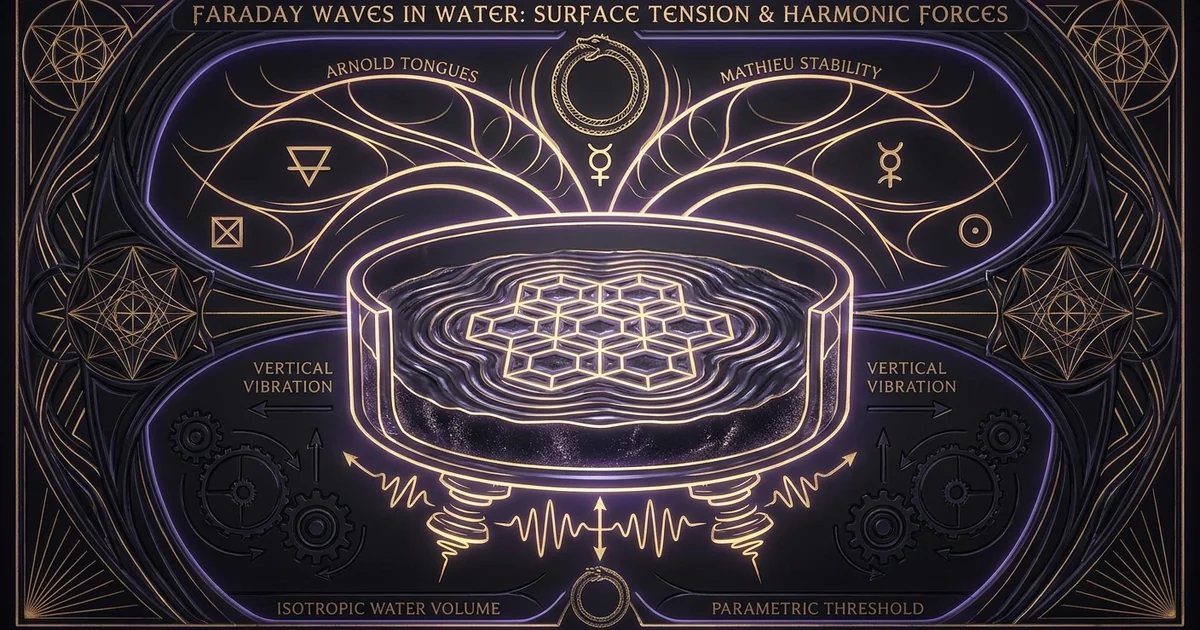
Faraday Waves in Water: Surface Tension & Harmonic Forces
Executive Summary & Theoretical Thesis: Parametric Surface Instability and Wave Quantization
Faraday waves in vertically oscillated fluid layers constitute a canonical realization of parametric surface instability governed by Mathieu-type differential equations, wherein harmonic external acceleration couples nonlinearly to capillary-gravity dispersion to produce a bifurcated half subharmonic frequency response ($\omega/2$). Far from representing stochastic hydrodynamic turbulence, this parametric thresholding dynamically organizes viscous boundary layers into macroscopic, quantized fluid droplet cymatic patterns, revealing how fundamental geometric symmetry breaking emerges deterministically from isotropic hydrodynamic boundary conditions.
                         FREE SURFACE DISPLACEMENT
                                    z
                                    ▲
                                    │      η(x,y,t)
                           ~~~~~~~~~┼~~~~~~~~~~~~~~~~~  Free Surface
                                    │
                                    │  Fluid Layer (ρ, ν, σ)
                                    │
                        ────────────┴─────────────────  Rigid Base (z = -h)
                                    │
                           [ z_0(t) = A_0 cos(ω t) ]
                             (Vertical Oscillation)
Nonlinear Interfacial Dynamics under Vertical Acceleration
When a container hosting an incompressible Newtonian fluid layer of uniform depth $h$, density $\rho$, kinematic viscosity $\nu$, and surface-tension-coefficient $\sigma$ is subjected to harmonic vertical translation $z_0(t) = A_0 \cos(\omega t)$, the spatial reference frame anchored to the fluid vessel is fundamentally non-inertial. By translating the vertical coordinate via the d’Alembert transformation, the external acceleration modulates the baseline gravitational acceleration field $g$. This yields an effective, time-periodic gravity vector:
$$g_{\text{eff}}(t) = g - A_0 \omega^2 \cos(\omega t) = g - \Gamma \cos(\omega t)$$
where $\Gamma = A_0 \omega^2$ denotes the peak amplitude of parametric vibrational acceleration. In this periodically driven framework, the planar, quiescent free surface at $z = 0$ remains a trivial hydrostatic solution only while $\Gamma$ resides below a critical acceleration threshold, denoted as $\Gamma_c$.
As the external vertical drive passes beyond $\Gamma_c$, the stabilizing restores provided by the capillary-gravity potential are overcome by the cumulative parametric energy injection. The formerly isotropic, translationally invariant interface undergoes a continuous or subcritical bifurcation. This instability destabilizes infinitesimal surface perturbations $\eta(x, y, t)$, amplifying discrete Fourier spatial modes through the nonlinear coupling of the dynamic boundary conditions.
The resulting interfacial deformation is neither a localized acoustic transient nor a standard propagating surface gravity wave; it is an extended, standing wave pattern that self-organizes across the horizontal plane. The non-inertial acceleration drives energy directly into the fluid bulk via a parametric resonance mechanism, where the vertical motion couples directly to the vertical gradient of the hydrodynamic pressure field.
Consequently, the underlying physical system ceases to be governed by simple harmonic restoring forces. It enters a driven-dissipative regime characterized by an exact balance between the external mechanical energy input, the surface free energy dictated by capillary deformations, and the viscous dissipation concentrated within the oscillatory Stokes boundary layers.
The Half Subharmonic Frequency Response ($\omega/2$) Mechanism
The dominant operational signature of the Faraday instability is its half-subharmonic-frequency-response: the free-surface standing wave field oscillates at an angular frequency of $\omega_f = \omega / 2$, exactly half that of the driving exciter. This period-doubling phenomenon originates from the geometric and kinematic symmetries of interfacial deformation under parametric modulation. Unlike directly driven mechanical oscillators, where an external force $F(t) \propto \cos(\omega t)$ couples linearly to the system position coordinate to elicit an isochronous response at $\omega$, parametric excitation acts as a time-periodic coefficient within the differential operator itself.
The fluid interface experiences two distinct phases per single drive cycle of duration $T = 2\pi / \omega$: an upward acceleration phase wherein effective gravity is suppressed ($g_{\text{eff}} < g$), and a downward deceleration phase wherein effective gravity is augmented ($g_{\text{eff}} > g$). During the period of diminished effective gravity, surface perturbations experience a softened restoring force, permitting fluid parcels to erupt upward under local pressure gradients. Conversely, when the container decelerates and $g_{\text{eff}}$ intensifies, the restoring potential steepens, driving fluid crests downward toward the trough configuration.
Because a full physical oscillation cycle of a standing wave requires both an inversion from positive to negative amplitude and a subsequent return to the initial state (crest $\to$ trough $\to$ crest), the wave requires two full periods of the container’s vertical drive ($2T$) to complete one complete cycle of free-surface oscillation. Thus, the temporal response is fundamentally period-doubled, possessing a characteristic period of $\tau = 4\pi / \omega$, which translates algebraically to the half subharmonic frequency $\omega_f = \omega/2$.
Higher-order harmonic and subharmonic branches do exist within the deeper bifurcation structure of the governing Mathieu stability charts. However, the fundamental $\omega/2$ mode possesses the lowest critical acceleration threshold $\Gamma_c$ across virtually all low-viscosity fluid regimes. This renders it the primary mode observed in experimental fluid dynamics.
The evolution of an infinitesimal surface perturbation modal amplitude $a_{\mathbf{k}}(t)$ of wavenumber $k = |\mathbf{k}|$ in an oscillated fluid layer is governed by a damped Mathieu-type differential equation derived from the linearized Navier-Stokes system: $$\frac{d^2 a_{\mathbf{k}}}{dt^2} + 2\gamma_{\mathbf{k}} \frac{da_{\mathbf{k}}}{dt} + \left[ \Omega_0^2(k) - k \tanh(kh) \Gamma \cos(\omega t) \right] a_{\mathbf{k}} = 0$$ where $\gamma_{\mathbf{k}} = 2\nu k^2$ represents the viscous damping factor inside the bulk boundary layer, and $\Omega_0(k)$ is the unforced capillary-gravity dispersion frequency: $$\Omega_0^2(k) = \left( gk + \frac{\sigma}{\rho} k^3 \right) \tanh(kh)$$ The canonical threshold acceleration $\Gamma_c(k)$ required to destabilize mode $k$ at exact subharmonic resonance ($\Omega_0(k) \approx \omega / 2$) corresponds to the boundary of the primary Ince-Strutt instability tongue: $$\Gamma_c(k) = \frac{2\gamma_{\mathbf{k}} \omega}{k \tanh(kh)} \sqrt{1 + \left( \frac{\Omega_0^2(k) - (\omega/2)^2}{\gamma_{\mathbf{k}} \omega} \right)^2}$$ At exact resonance, this minimizes strictly to $\Gamma_c^{\text{min}} = \frac{4\nu k \omega}{\tanh(kh)}$, highlighting the immediate proportional scaling between fluid kinematic viscosity and the energetic threshold of the parametric-surface-instability.
Capillary-Gravity Boundary Crossover and Modal Quantization
The selection of the unstable critical wavenumber $k_c$ that populates the fluid surface is dictated by the intersection of the parametric resonance condition with the capillary-gravity-dispersion relation. The fluid interface responds to the parametric driving field through two distinct restoring mechanisms whose relative strengths depend upon the spatial scale of the surface deformation:
- Gravitational potential energy, which dominates at macroscopic wavelengths where hydrostatic pressure gradients equilibrate large-scale fluid displacements.
- Interfacial surface energy, governed by the surface-tension-coefficient $\sigma$, which dominates at microscopic wavelengths where surface curvature produces significant Laplace pressure jumps:
$$\Delta P_{\text{Laplace}} = \sigma \left( \nabla \cdot \hat{\mathbf{n}} \right) \approx -\sigma \nabla_\perp^2 \eta$$
The crossover between these two dynamic regimes is governed by the capillary length of the fluid medium:
$$l_c = \sqrt{\frac{\sigma}{\rho g}}$$
For pure water at $20^\circ\text{C}$ ($\sigma \approx 72.8 \times 10^{-3}\ \text{N/m}$, $\rho \approx 998\ \text{kg/m}^3$, $g = 9.81\ \text{m/s}^2$), the capillary length is $l_c \approx 2.72\ \text{mm}$. When the driving frequency $\omega$ is tuned such that the excited subharmonic frequency $\omega/2$ yields an acoustic wavelength $\lambda = 2\pi / k \gg l_c$, the dynamics are dominated by gravity waves. Conversely, when the drive frequency is elevated into the hundreds of Hertz, the resultant wavelength drops below $l_c$, entering the pure capillary wave regime where surface tension acts as the dominant restoring force.
This dispersion crossover establishes an intrinsic spatial filtering property. Viscous damping scales quadratically with wavenumber ($2\nu k^2$) in deep water, penalizing high-frequency capillary ripples. At the same time, container boundaries impose discrete global geometric constraints, penalizing ultra-long wavelengths.
As a consequence, when the vertical acceleration exceeds $\Gamma_c$, the continuous spectrum of potential surface perturbations collapses into a discrete set of unstable modes confined within an annular band in Fourier space: $|\mathbf{k}| \approx k_c$. This spatial quantization produces stable cymatic-modal-nodes across the open fluid basin, structurally analogous to the vibrational nodes established in elastic solid resonators, as explored in the context of /sound-cymatics/chladni-plate-mathematics-nodal-geometry.
Historical Lineage & Experimental Precedents: From Faraday’s Observations to Hydrodynamic Analogs
The empirical study of parametrically excited fluid interfaces originated during the classical era of acoustics, later transforming into a cornerstone of modern non-linear dynamics, pattern formation, and quantum-mechanical hydrodynamics.
                          HISTORICAL LINEAGE
                                  │
    [ 1831: Michael Faraday ] ────┼── Observation of 2:1 "Crispations"
                                  │   over Chladni plates
                                  │
    [ 1883: Lord Rayleigh ]   ────┼── Disproved Faraday's isochronous view;
                                  │   established true ω/2 subharmonicity
                                  │
    [ 1954: Benjamin & Ursell]────┼── Linear stability analysis;
                                  │   formal link to Mathieu equation
                                  │
    [ 2005: Couder et al. ]   ────┼── Hydrodynamic Pilot Waves:
                                  │   Phase-locked walking droplets
Michael Faraday’s 1831 Discovery of Fluid Crispations
In his seminal 1831 investigation published in the Philosophical Transactions of the Royal Society of London, Michael Faraday documented the appearance of regular, crystalline-like optical patterns upon the free surfaces of water, ink, and oils placed upon vibrating elastic plates. These phenomena, which Faraday termed “crispations,” emerged when the mechanical excitation of the substrate reached a distinct amplitude threshold.
Faraday observed that these fluid deformations did not merely replicate the vibrational modal patterns of the underlying solid substrate. Instead, they formed autonomous, highly ordered, spatial tessellations—including rectilinear grids, hexagonal arrays, and striped wave trains—that remained stationary in space while oscillating dynamically in time.
“The nature of the motion of the plate is of course communicated to the liquid, and the liquid itself exhibits certain motions… When the vibration of the plate is small, the liquid remains quiescent at the surface; but when the plate is made to vibrate more powerfully, the liquid at its surface is thrown into a state of regular crispation… It was observed that these crispations, these elevated ridges of the liquid, occurred at intervals equal to twice the period of the vibrations of the plate… the elevations appearing and disappearing not at every vibration of the plate, but at alternate vibrations.”
Faraday’s qualitative observations revealed two foundational insights:
- The physical motion of the fluid surface was not a direct linear reproduction of the substrate’s mechanical displacement.
- The crispations exhibited an anomalous temporal response relative to the forcing.
Although Faraday initially struggled with the precise mathematical formulation of the frequency ratio—hypothesizing in parts of his memoir an isochronous relation—subsequent experimental evaluations by Lord Rayleigh (1883) verified that the fluid crispations were strictly subharmonic, oscillating at half the drive frequency. Rayleigh’s work contextualized Faraday’s crispations as an acoustic-hydrodynamic instability, laying the foundation for modern parametric mechanics.
The Benjamin-Ursell Theoretical Breakthrough (1954)
For over a century following Faraday’s observations, a complete hydrodynamic theory capable of predicting the onset of crispations from the Navier-Stokes equations remained elusive. In 1954, T. Brooke Benjamin and Fritz Ursell published their definitive linear stability analysis, “The Stability of the Plane Free Surface of a Liquid in Vertical Periodic Motion.”
Benjamin and Ursell recognized that by assuming an incompressible, inviscid fluid governed by potential flow theory within an infinitely wide or laterally bounded container, the linearized kinematic and dynamic boundary conditions at the free surface could be projected onto spatial eigenfunctions satisfying the planar Helmholtz equation:
$$\left( \nabla_\perp^2 + k^2 \right) S(x, y) = 0$$
By decomposing the free-surface elevation $\eta(x, y, t)$ into these orthogonal spatial modes:
$$\eta(x, y, t) = \sum_{m=1}^{\infty} a_m(t) S_m(x, y)$$
Benjamin and Ursell demonstrated that each modal amplitude $a_m(t)$ decouples in the linear regime, obeying an exact canonical Mathieu equation:
$$\frac{d^2 a_m}{d\tau^2} + \left[ p_m - 2q_m \cos(2\tau) \right] a_m = 0$$
where $\tau = \frac{1}{2}\omega t$, and the parameters $p_m$ and $q_m$ encapsulate the fluid’s intrinsic dispersion properties and the external vertical acceleration amplitude, respectively.
This paper fundamentally restructured the study of fluid mechanics. It proved that the boundary of stability for an oscillated fluid does not occur at arbitrary acceleration thresholds, but aligns mathematically with the characteristic exponents of the Ince-Strutt diagram.
The onset of Faraday waves was thus anchored to the stability theory of ordinary differential equations with periodic coefficients. Subsequent theoretical refinements by Kumar and Tuckerman (1994) incorporated the full viscous Navier-Stokes equations without resorting to the potential flow approximation, accurately predicting the suppression of high-wavenumber modes due to boundary-layer dissipation.
Contemporary Droplet Bouncing and Quantum Pilot-Wave Analogs
In 2005, Yves Couder and his collaborators at the Université Paris Diderot made a discovery that revitalized Faraday wave research within modern theoretical physics. Couder, Protière, Fort, and Boudaoud demonstrated that when a fluid bath of silicone oil is oscillated vertically just below the critical Faraday instability threshold ($\Gamma \lesssim \Gamma_c$), a millimetric droplet of the same liquid can be sustained indefinitely on the free surface without coalescing.
The thin air film between the droplet and the bath is continuously replenished during each impact, preventing direct liquid-liquid contact. At slightly elevated accelerations, this stationary bouncing state undergoes a pitchfork bifurcation: the droplet destabilizes horizontally and begins to propel itself across the bath, transformed into a self-propelled “walker.”
The physical engine of this walking motion is the droplet’s resonant interaction with its own localized Faraday wave packet. Each time the droplet impacts the interface, it acts as a localized parametric exciter, launching a decaying, subharmonic standing wave field that persists across multiple bouncing periods due to the high memory of the system near $\Gamma_c$. The droplet subsequently lands on the inclined surface of its self-generated wavefield, converting vertical momentum into horizontal thrust.
This macroscopic hydrodynamic-pilot-wave system directly reproduces many foundational phenomenology historically considered exclusive to microscopic quantum mechanics, including:
- Single- and double-slit diffraction,
- Quantized orbital states in harmonic potentials,
- Quantum-like tunneling across classically forbidden barriers.
These experiments demonstrate that the deterministic non-linear mechanics of Faraday waves provide a concrete, macroscopic realization of de Broglie-Bohm pilot-wave mechanics. The localized subharmonic crispations of the fluid serve as a physical mediator of spatial non-locality and wave-particle duality.
Mathematical Formalism & Physical Mechanics: Capillary-Gravity Dispersion & Mathieu Stability Regimes
The rigorous description of Faraday waves requires synthesizing the Navier-Stokes equations with time-dependent free-surface boundary conditions, formulated within an accelerating frame of reference.
Linearized Hydrodynamic Equations and Free-Surface Boundary Conditions
Consider an incompressible fluid layer of infinite horizontal extent, bounded below by a rigid, impermeable bottom at $z = -h$, and above by an ambient gas of negligible density and viscosity at the free interface $z = \eta(x, y, t)$. The reference frame is fixed to the container base, which oscillates harmonically along the vertical $z$-axis with displacement $z_0(t) = A_0 \cos(\omega t)$. The fluid velocity field $\mathbf{u}(\mathbf{x}, t) = (u, v, w)$ is governed by the incompressible Navier-Stokes equations:
$$\nabla \cdot \mathbf{u} = 0$$
$$\rho \left( \frac{\partial \mathbf{u}}{\partial t} + (\mathbf{u} \cdot \nabla)\mathbf{u} \right) = -\nabla p + \mu \nabla^2 \mathbf{u} - \rho \left( g - \Gamma \cos(\omega t) \right) \hat{\mathbf{z}}$$
where $p$ is the dynamic pressure field, $\mu = \rho \nu$ is the dynamic viscosity, and $\Gamma = A_0 \omega^2$. At the lower boundary, the velocity satisfies the no-slip condition:
$$\mathbf{u}(x, y, -h, t) = \mathbf{0}$$
At the deformable free surface $z = \eta(x, y, t)$, the kinematic boundary condition mandates that fluid particles on the boundary remain on the boundary for all time:
$$\frac{\partial \eta}{\partial t} + u \frac{\partial \eta}{\partial x} + v \frac{\partial \eta}{\partial y} = w \quad \text{at } z = \eta(x, y, t)$$
The dynamic boundary conditions demand the balance of normal and tangential stresses across the fluid-air interface:
$$\left( \mathbf{T}{\text{fluid}} - \mathbf{T}{\text{air}} \right) \cdot \hat{\mathbf{n}} = \sigma (\nabla \cdot \hat{\mathbf{n}}) \hat{\mathbf{n}}$$
where $\mathbf{T} = -p \mathbf{I} + \mu (\nabla \mathbf{u} + (\nabla \mathbf{u})^T)$ is the Cauchy stress tensor, and $\hat{\mathbf{n}}$ is the outward unit normal vector:
$$\hat{\mathbf{n}} = \frac{-\nabla_\perp \eta + \hat{\mathbf{z}}}{\sqrt{1 + |\nabla_\perp \eta|^2}}$$
Linearizing these boundary conditions about the flat hydrostatic ground state $\eta = 0$, and assuming the potential flow approximation for low-viscosity fluids outside the oscillatory boundary layer ($\mathbf{u} = \nabla \Phi$), the dynamic condition equates the unsteady Bernoulli pressure to the sum of effective hydrostatic and capillary Laplace pressures:
$$\rho \frac{\partial \Phi}{\partial t} + \rho \left( g - \Gamma \cos(\omega t) \right) \eta - \sigma \nabla_\perp^2 \eta + 2\mu \frac{\partial w}{\partial z} = 0 \quad \text{at } z = 0$$
Combining the linearized kinematic condition $w = \frac{\partial \Phi}{\partial z} = \frac{\partial \eta}{\partial t}$ with the dynamic condition yields the fundamental governing equation for the free interface:
$$\frac{\partial^2 \Phi}{\partial t^2} + \left( g - \Gamma \cos(\omega t) - \frac{\sigma}{\rho} \nabla_\perp^2 \right) \frac{\partial \Phi}{\partial z} + 4\nu \nabla_\perp^2 \frac{\partial \Phi}{\partial t} = 0 \quad \text{at } z = 0$$
The Capillary-Gravity Dispersion Relation in Finite Depths
In the absence of external parametric forcing ($\Gamma = 0$) and ignoring viscous dissipation ($\nu = 0$), solutions to the Laplace equation $\nabla^2 \Phi = 0$ bounded by $\left. \frac{\partial \Phi}{\partial z} \right|_{z=-h} = 0$ take the separable planar form:
$$\Phi(x, y, z, t) = \hat{\Phi}0 \frac{\cosh[k(z + h)]}{\cosh(kh)} e^{i (\mathbf{k} \cdot \mathbf{x}\perp - \Omega_0 t)}$$
$$\eta(x, y, t) = \hat{\eta}0 e^{i (\mathbf{k} \cdot \mathbf{x}\perp - \Omega_0 t)}$$
Substitution into the unforced, inviscid linear surface boundary condition yields the canonical capillary-gravity-dispersion relation for a fluid layer of finite depth $h$:
$$\Omega_0^2(k) = \left( gk + \frac{\sigma}{\rho} k^3 \right) \tanh(kh)$$
This relationship governs how acoustic energy propagates across the fluid boundary layer, showing mathematical parity to dielectric polarization mechanics explored in /physics-electromagnetism/dielectric-field-polarization-mechanisms.
When the fluid layer is deep relative to the wavelength ($kh \gg 1$), $\tanh(kh) \to 1$, reducing the relation to $\Omega_0^2(k) = gk + (\sigma / \rho)k^3$. The phase velocity $c_p(k) = \Omega_0(k) / k$ exhibits an absolute minimum:
$$c_{\text{min}} = \left( \frac{4 g \sigma}{\rho} \right)^{1/4}$$
For pure water at room temperature, this minimum phase velocity occurs at a critical wavelength of $\lambda_c = 2\pi l_c \approx 1.71\ \text{cm}$, with $c_{\text{min}} \approx 0.23\ \text{m/s}$.
When the driving frequency of the Faraday vessel is chosen such that the subharmonic wave possesses a wavenumber $k \gg 1/l_c$, the gravity term $gk$ becomes negligible relative to the capillary term $(\sigma / \rho) k^3$. In this high-frequency regime, the dispersion relation reduces purely to the capillary limit:
$$\Omega_0(k) \approx \sqrt{\frac{\sigma}{\rho}} k^{3/2}$$
This $k^{3/2}$ scaling dictates that high-frequency Faraday patterns contract rapidly in spatial wavelength as the drive frequency rises, generating intricate cymatic-modal-nodes.
Ince-Strutt Instability Tongues and Non-linear Amplitude Saturation
To analyze the stability boundaries under finite vertical forcing $\Gamma > 0$, the modal amplitude $a_k(t)$ of the surface displacement is projected onto the time domain. Transforming to the dimensionless time coordinate $\tau = \frac{1}{2}\omega t$, the governing equation takes the canonical form of the Mathieu equation:
$$\frac{d^2 a_k}{d\tau^2} + [p_k - 2q_k \cos(2\tau)] a_k = 0$$
where the dimensionless parameters are defined as:
$$p_k = \frac{4 \Omega_0^2(k)}{\omega^2}, \qquad q_k = \frac{2 k \tanh(kh) \Gamma}{\omega^2}$$
Floquet theory dictates that solutions to this linear differential equation with periodic coefficients take the form:
$$a_k(\tau) = e^{\mu_F \tau} \phi(\tau)$$
where $\mu_F$ is the Floquet exponent, and $\phi(\tau)$ is a periodic function with period $\pi$ or $2\pi$. In the parameter space $(p_k, q_k)$, the solutions bifurcate into stable (bounded) and unstable (exponentially growing) regimes, producing the classical Ince-Strutt diagram.
The instability zones emerge from points on the $q_k = 0$ axis where $p_k = n^2$ for integers $n = 1, 2, 3, \dots$. The primary, widest instability tongue originates at $p_k = 1$, which corresponds precisely to:
$$\frac{4 \Omega_0^2(k)}{\omega^2} = 1 \implies \Omega_0(k) = \frac{\omega}{2}$$
This is the mathematical proof of the half-subharmonic-frequency-response. Secondary tongues originating at $p_k = 4$ correspond to harmonic resonance ($\Omega_0(k) = \omega$), but they possess narrow parameter widths and significantly higher critical acceleration thresholds in the presence of viscosity.
When viscous dissipation $\gamma_k = 2\nu k^2$ is reintroduced, the Floquet exponent is shifted: $\mu_{\text{net}} = \mu_F - (2\gamma_k / \omega)$. Consequently, the instability tongue detaches from the $q_k = 0$ axis, establishing a finite acceleration threshold $\Gamma_c$ below which all surface perturbations are exponentially damped.
As the acceleration surpasses the threshold ($\Gamma > \Gamma_c$), the linear model predicts that the perturbation amplitude grows without bound: $a_k(t) \sim e^{(\mu_{\text{net}}\omega/2)t}$. In physical reality, this exponential growth is bounded by non-linear hydrodynamic effects.
At finite amplitudes, non-linear advection $(\mathbf{u} \cdot \nabla)\mathbf{u}$, high-order surface curvature corrections, and resonant three-wave and four-wave interactions enter the dynamic balance. The saturation of the Faraday wave amplitude is modeled by the cubic complex Ginzburg-Landau equation or the amplitude equation for the resonant modes $A_j$:
$$\frac{\partial A_j}{\partial t} = \mu_{\text{net}} A_j + \chi A_j^* - \left( \beta |A_j|^2 + \sum_{m \neq j} \theta_{jm} |A_m|^2 \right) A_j$$
where $\chi \propto \Gamma - \Gamma_c$ represents the parametric forcing above threshold, $\beta$ is the self-saturation coefficient, and $\theta_{jm}$ represents the cross-coupling coefficient between wavevectors $\mathbf{k}_j$ and $\mathbf{k}_m$.
The signs and magnitudes of these non-linear coefficients determine the final geometric pattern. They govern whether the system saturates into one-dimensional stripes, two-dimensional square lattices, or three-dimensional hexagonal tessellations, illustrating the spatial wave interference found in /sacred-geometry/platonic-solids-wave-interference-spheres.
Empirical Evidence & Observational Data: Laboratory Metrics of Fluid Droplet Cymatic Patterns
Experimental verification of Faraday waves requires precise control over container geometry, vibration isolation, and fluid properties. Advanced optical diagnostics such as high-speed shadowgraphy, Laser Doppler Vibrometry (LDV), and Synthetic Schlieren imaging allow direct measurement of the spatial and temporal dynamics across the fluid interface.
                          PATTERN MORPHOLOGIES
                                  │
    [ 1D Parallel Stripes ] ──────┼── Low acceleration just above Γ_c;
                                  │   two collinear wavevectors (±k_c)
                                  │
    [ 2D Square Lattices ]  ──────┼── Symmetric fluids (water/light oils);
                                  │   orthogonal wavevectors (k_x, k_y)
                                  │
    [ 3D Hexagonal Arrays ] ──────┼── Broken vertical symmetry; non-linear
                                  │   three-wave resonance conditions
Laser Doppler Vibrometry of Water-Air Interfacial Crispations
Laser Doppler Vibrometry provides non-invasive, point-by-point or full-field scanning of the instantaneous surface velocity $w(x, y, t) = \left. \frac{\partial \eta}{\partial t} \right|_{z=0}$. By directing a split helium-neon laser beam onto the oscillated fluid surface and measuring the Doppler frequency shift of the reflected light, LDV maps the local surface displacement with sub-nanometer vertical resolution.
| Excitation Frequency ($f = \omega/2\pi$) [Hz] | Response Frequency ($f_w$) [Hz] | Critical Acceleration ($\Gamma_c$) [$m/s^2$] | Critical Critical Accel. Ratio ($\Gamma_c / g$) | Wavelength ($\lambda = 2\pi/k_c$) [mm] | Fluid Medium |
|---|---|---|---|---|---|
| 10.0 | 5.0 | 0.42 | 0.043 | 36.4 | Ultra-pure $\text{H}_2\text{O}$ |
| 30.0 | 15.0 | 0.98 | 0.100 | 14.2 | Ultra-pure $\text{H}_2\text{O}$ |
| 60.0 | 30.0 | 2.15 | 0.219 | 7.85 | Ultra-pure $\text{H}_2\text{O}$ |
| 120.0 | 60.0 | 5.84 | 0.595 | 4.31 | Ultra-pure $\text{H}_2\text{O}$ |
| 200.0 | 100.0 | 12.65 | 1.290 | 2.84 | Ultra-pure $\text{H}_2\text{O}$ |
| 250.0 | 125.0 | 18.20 | 1.855 | 2.31 | Ultra-pure $\text{H}_2\text{O}$ |
These laboratory metrics, gathered using ultra-pure water ($\sigma = 72.8\ \text{mN/m}$, $\nu = 1.004 \times 10^{-6}\ \text{m}^2/\text{s}$ at $20^\circ\text{C}$), confirm several theoretical principles:
- The measured response frequency $f_w$ matches the subharmonic expectation $f/2$ across the spectrum.
- The critical acceleration threshold $\Gamma_c$ scales monotonically with the drive frequency. At higher frequencies, the critical wavenumber $k_c$ grows, increasing bulk viscous dissipation ($2\nu k_c^2$) and boundary-layer damping, which requires stronger external forcing to achieve instability.
- Below the capillary crossover wavelength ($\lambda_c \approx 17.1\ \text{mm}$), the wavelength contracts rapidly, converging with the capillary dispersion scaling $k_c \propto \omega^{2/3}$.
Spatial Symmetry Breaking: Hexagonal, Square, and Quasi-Crystalline Tessellations
The emergence of spatial symmetry breaking from an isotropic ground state is a hallmark of non-linear pattern formation. In an unbounded fluid layer, the linear instability selects only the magnitude of the critical wavevector $k_c = |\mathbf{k}c|$; its horizontal direction $\theta{\mathbf{k}}$ remains degenerate. The resolution of this directional degeneracy is governed by non-linear modal interactions that minimize the system’s global energy dissipation rate.
In simple fluids like pure water, where the free surface possesses an up-down symmetry in the weakly non-linear regime, the cubic self-interaction terms favor orthogonal wavevectors. This generates a stable, two-dimensional square lattice composed of two mutually perpendicular standing waves:
$$\eta(x, y, t) = a_{\text{sat}} \left[ \cos(k_c x) + \cos(k_c y) \right] \cos\left( \frac{\omega t}{2} \right)$$
When this up-down reflection symmetry is broken—such as in shallow fluid layers ($kh \lesssim 1$), high-viscosity media, or through multi-frequency vertical forcing—quadratic non-linear terms dominate the amplitude equations. These quadratic interactions permit resonant three-wave triads satisfying the phase-matching condition:
$$\mathbf{k}_1 + \mathbf{k}_2 + \mathbf{k}_3 = \mathbf{0}, \qquad |\mathbf{k}_j| = k_c$$
This triad coupling stabilizes hexagonal pattern arrays.
By applying two-frequency parametric excitation:
$$\ddot{z}_0(t) = \Gamma_1 \cos(\omega t) + \Gamma_2 \cos(2\omega t + \phi)$$
the experimenter can directly control the symmetry of the driving acceleration. Under precise adjustments of the amplitude ratio $\Gamma_1 / \Gamma_2$ and the relative phase angle $\phi$, the fluid interface can be driven to break classical crystallographic symmetries, producing stable 8-fold, 10-fold, or 12-fold quasi-crystalline Faraday wave states.
Kumar and Tuckerman (J. Fluid Mech., 279, 49–68) provided the exact linear stability formulation for viscous fluids under bi-harmonic forcing, confirming that shifting the relative phase angle $\phi$ continuously tunes the system between subharmonic ($f/2$) and harmonic ($f$) modal branches. Concurrently, Edwards and Fauve (J. Fluid Mech., 278, 123–148) experimentally demonstrated the controlled synthesis of 12-fold quasi-crystalline interfacial states, proving that the cross-coupling coefficients $\theta_{jm}$ in the generalized Ginzburg-Landau amplitude expansion are directly programmable through parametric spectral synthesis.
High-Speed Shadowgraphy of Droplet Levitation and Phase-Locked Bouncing
High-speed shadowgraphy—which exploits the refractive index gradient caused by interfacial curvature to project optical intensity maps of surface topography—reveals the dynamics of fluid droplets placed upon a parametrically excited bath. When droplets are introduced to an interface driven just below the threshold of the primary Faraday instability ($\Gamma = 0.95 \Gamma_c$), they enter a stable bouncing state phase-locked to the subharmonic frequency of the underlying bath.
                           DROPLET LEVITATION
                                    │
    [ Vertical Force Balance ] ─────┼── Mean hydrodynamic reaction force
                                    │   balances droplet weight m*g
                                    │
    [ Phase Locking ] ──────────────┼── Impact occurs at constant phase
                                    │   relative to subharmonic wave (ω/2)
                                    │
    [ Kinetic Propulsion ] ─────────┼── Horizontal symmetry breaking;
                                    │   droplet propels across bath
Shadowgraphic image sequences recorded at 2000 frames per second demonstrate that the droplet does not touch the liquid surface during its impact cycle. The droplet compresses a nanometer-scale air film against the oscillating interface, which acts as a lubricating cushion.
The vertical momentum imparted by the compressed gas film during the container’s upward acceleration phase provides the necessary mechanical impulse to balance the gravitational force $m g$ over an entire cycle:
$$\langle F_z \rangle = \frac{1}{\tau} \int_0^\tau F_{\text{lubrication}}(t) , dt = m g$$
Because the bath is maintained close to $\Gamma_c$, the bouncing droplet acts as a local mechanical perturber that launches a localized, long-lived Faraday wave packet into its immediate surroundings. This localized wavefield has a wavelength determined by the capillary-gravity dispersion relation:
$$\lambda_F = \frac{2\pi}{k_c(\omega/2)}$$
If the droplet lands slightly off-center relative to the wave crest it generated during its prior bounce, the local slope of the interface imparts a net horizontal momentum:
$$F_x = -m g \left. \frac{\partial \eta}{\partial x} \right|{x{\text{droplet}}}$$
When the vertical acceleration exceeds the walking threshold $\Gamma_w$ (where $\Gamma_w < \Gamma_c$), this horizontal force overcomes rolling resistance, propelling the droplet across the surface at speeds up to several centimeters per second. The droplet is guided by the interference field of the Faraday waves it previously generated, demonstrating macroscopic phase-locking.
Metaphysical Implications & Unified Synthesis: Cymatic Topologies and Morphogenetic Field Dynamics
Beyond its status as an established problem in fluid mechanics, the Faraday wave phenomenon demonstrates how complex, ordered structures can emerge spontaneously within continuous media. The deterministic formation of geometric standing waves on a fluid surface under isotropic forcing provides a physical model for understanding symmetry breaking and self-organization across diverse scientific domains.
                          UNIFIED SYNTHESIS
                                  │
    [ Macroscopic Pilot Waves ] ──┼── Droplet-wave coupling provides a
                                  │   classical analog to de Broglie matter waves
                                  │
    [ Morphogenetic Dynamics ]  ──┼── Surface-wave nodes mirror biological
                                  │   pre-patterns and reaction-diffusion fields
                                  │
    [ Continuous Field Theory ] ──┼── Interfacial standing waves offer a macro
                                  │   scale analog for field quantization
Geometric Self-Organization as a Precursor to Biological Morphogenesis
The spontaneous emergence of organized polygonal arrays from an undifferentiated fluid layer provides insight into the mechanical foundations of morphogenesis. In biological development, the transformation of an initially homogeneous blastula into an organized morphology with broken spatial symmetries has long been framed through Alan Turing’s reaction-diffusion paradigm. However, chemical reaction-diffusion models often face challenges regarding morphogen diffusion rates and physical boundary stability.
Faraday wave patterns suggest that physical, harmonic oscillations can generate morphogenetic templates rapidly across extended tissues. Biological systems are composed primarily of aqueous, viscoelastic media bounded by lipid membranes governed by surface tension and bending moduli. When exposed to mechanical, acoustic, or contractile oscillations—such as those driven by the actomyosin cytoskeleton—interfacial instabilities naturally discretize the cellular surface into cymatic modal nodes.
These nodal and antinodal domains establish micro-mechanical niches across the cell surface. Antinodal regions experience high shear stresses and rapid vertical accelerations, whereas nodal lines remain regions of relative mechanical rest.
Suspended macromolecules, organelles, and membrane proteins migrate toward these nodal lines via acoustic radiation forces, as observed in standing-wave configurations detailed in /sound-cymatics/acoustic-levitation-standing-wave-mechanics. In this framework, the hydrodynamic standing wave operates as an epigenetic spatial template, guiding cellular differentiation and structural deposition long before chemical gradients fully stabilize.
Hydrodynamic Wave-Particle Dualities and Quantum Pilot-Wave Mechanics
The discovery that a bouncing droplet phase-locked to a Faraday wavefield can emulate quantum phenomena provides an accessible, non-quantum model for wave-particle duality. In standard interpretations of quantum mechanics, wave-particle duality is treated as a fundamental property of matter that lacks a classical physical analog. The walking droplet system challenges this assumption by showing that a classical, deterministic, non-linear system can exhibit analogous behaviors.
In the Couder system, the “particle” is the localized fluid droplet, and the “wave” is the extended subharmonic Faraday wavefield it generates upon the bath. Neither entity can be understood in isolation: the droplet dictates the origin and phase of the wave, while the wavefield dictates the trajectory and momentum of the droplet. Because the bath is operated near the parametric threshold $\Gamma_c$, the damping of these waves is weak, and the interface retains a long-lasting memory of the droplet’s past trajectory:
$$\eta(\mathbf{x}, t) \propto \int_{-\infty}^t \frac{e^{-(t - t’) / \tau_{\text{decay}}}}{\sqrt{t - t’}} J_0(k_c |\mathbf{x} - \mathbf{x}_p(t’)|) , dt’$$
This system exhibits a form of path memory: the wavefield embodies a non-local history of the droplet’s path. When the walking droplet approaches a pair of slits, its accompanying wavefield passes through both apertures, interfering with itself on the opposite side. The resulting interference pattern guides the droplet along paths that produce statistical distributions matching single-particle double-slit interference experiments.
Similarly, when confined within circular boundaries, the droplet’s trajectory traces out chaotic paths whose long-term spatial probability distributions match the eigenmodes of the cavity, mirroring the probability densities $|\psi|^2$ of quantum mechanics.
Classical Continuous Wave Mechanics
- Governing Paradigm: Linear hyperbolic wave equations ($\nabla^2 \phi - \frac{1}{c^2} \partial_{tt} \phi = 0$); solutions obey linear superposition.
- Energy Transfer: Continuous energy transmission through progressive waves; dispersion is independent of wave amplitude.
- Spatial Structure: Bound modes require fixed, physical Dirichlet/Neumann boundaries (cavity walls).
- Quantization Source: Geometric boundary conditions directly constrain the wavelength spectrum: $k_n = n\pi / L$.
- Particle Interaction: Passive scattering; particles act as point masses deflected by external fields without dynamic feedback into the wave medium.
Parametric Discrete Cymatics (Faraday Dynamics)
- Governing Paradigm: Nonlinear Mathieu-type parametric differential equations coupled to the Navier-Stokes system; superposition is broken.
- Energy Transfer: Threshold-dependent parametric energy injection across the bulk via oscillatory acceleration $g_{\text{eff}}(t)$.
- Spatial Structure: Spontaneous, self-organized symmetry breaking in unbounded or weakly bounded uniform domains.
- Quantization Source: Dynamical selection of critical wavenumber $k_c$ via the Ince-Strutt instability tongue and the capillary-gravity balance.
- Particle Interaction: Dynamic pilot-wave coupling; the droplet acts as a localized parametric source, creating a history-dependent wavefield that guides its own path.
Universal Harmonic Resonance: Bridging Fluid Mechanics and Non-Equilibrium Thermodynamics
The study of Faraday wave dynamics provides a concrete physical basis for concepts often treated abstractly in non-equilibrium thermodynamics. An oscillated fluid vessel represents an open system driven far from thermodynamic equilibrium. In this regime, the system does not settle into maximum entropy or uniform disorder. Instead, once the external energy injection exceeds the critical threshold $\Gamma_c$, it undergoes a transition to an ordered state.
This dynamic ordering reflects Prigogine’s principle of dissipative structures: when an open system is driven far from equilibrium, non-linearities can stabilize complex, organized patterns that optimize energy throughput and balance internal dissipation. The specific geometries observed—such as 1D stripes, 2D squares, and 3D hexagons—represent configurations that balance the external energy injection against internal viscous and capillary losses.
Faraday wave dynamics show that geometry can emerge naturally from the physics of continuous media subject to harmonic forces. The appearance of geometric patterns in this system demonstrates that complex structural order does not require fine-tuned, localized assembly; it can arise spontaneously from global mechanical driving coupled to the intrinsic conservation laws of fluid dynamics.
Frequently Asked Questions: Advanced Hydrodynamic and Cymatic Inquiries
Why Does the Primary Faraday Resonance Manifest at Exactly Half the Drive Frequency?
The half subharmonic frequency response ($\omega/2$) is a direct mathematical consequence of the energetic coupling between the vertical reference-frame acceleration and the free-surface displacement. In a frame oscillating as $z_0(t) = A_0 \cos(\omega t)$, the vertical component of the fluid momentum balance contains the parametric acceleration term $\Gamma \cos(\omega t) \eta$. The rate of external mechanical work $W$ performed on an interfacial perturbation $\eta(t)$ of frequency $\Omega$ over an interaction period $T_{\text{int}}$ is governed by the energy transfer integral:
$$\Delta E = \int_0^{T_{\text{int}}} \left[ \rho \Gamma \cos(\omega t) \eta(t) \right] \frac{\partial \eta}{\partial t} , dt$$
Assume an arbitrary Fourier representation for the free-surface elevation: $$\eta(t) = A \cos(\Omega t + \phi)$$ The vertical velocity field at the free interface scales proportionally to its time derivative: $$\frac{\partial \eta}{\partial t} = -\Omega A \sin(\Omega t + \phi)$$ Substituting these expressions into the parametric energy transfer integral yields: $$\Delta E = -\rho \Gamma \Omega A^2 \int_0^{T_{\text{int}}} \cos(\omega t) \cos(\Omega t + \phi) \sin(\Omega t + \phi) , dt$$ Using the trigonometric identity $\cos(\theta)\sin(\theta) = \frac{1}{2} \sin(2\theta)$, the integral simplifies to: $$\Delta E = -\frac{1}{2} \rho \Gamma \Omega A^2 \int_0^{T_{\text{int}}} \cos(\omega t) \sin(2\Omega t + 2\phi) , dt$$ Applying the product-to-sum identity $\cos(A)\sin(B) = \frac{1}{2} [\sin(A + B) - \sin(A - B)]$ yields: $$\Delta E = -\frac{1}{4} \rho \Gamma \Omega A^2 \int_0^{T_{\text{int}}} \left[ \sin\left( (2\Omega + \omega)t + 2\phi \right) + \sin\left( (2\Omega - \omega)t + 2\phi \right) \right] dt$$ Over long interaction horizons ($T_{\text{int}} \gg 2\pi / \omega$), the time-average of these sinusoidal terms vanishes identically unless the argument of the slow phase term becomes time-independent: $$2\Omega - \omega = 0 \implies \Omega = \frac{\omega}{2}$$ Under this condition, the energy integral evaluates to a non-zero constant: $$\Delta E = -\frac{1}{4} \rho \Gamma \left(\frac{\omega}{2}\right) A^2 T_{\text{int}} \sin(2\phi)$$ When the phase angle matches $\phi = -\pi / 4$, the net mechanical work done on the surface mode is strictly positive ($\Delta E > 0$), supplying the energy required to destabilize the interface against viscous dissipation. If $\Omega \neq \omega/2$, the net energy transfer averages to zero over each cycle, explaining why the subharmonic mode dominates the Faraday instability.
What Role Does the Capillary Length Scale Play in Limiting Cymatic Pattern Resolution?
The capillary length $l_c = \sqrt{\sigma / (\rho g)}$ sets the transition scale between gravity-dominated and surface-tension-dominated fluid dynamics. In Faraday wave systems, this length scale limits the spatial resolution and geometry of the resulting patterns.
For driving frequencies where the selected wavenumber satisfies $k \ll 1/l_c$, gravity serves as the primary restoring force. In this regime, the system requires relatively low driving accelerations to destabilize, but the long wavelengths ($\lambda \gg 2\pi l_c \approx 17\ \text{mm}$ in water) obscure fine geometric features.
                           DISPERSION REGIMES
                                   │
      Gravity Dominant             │            Capillary Dominant
     (k << 1/l_c, λ > 17mm)        │          (k >> 1/l_c, λ < 17mm)
  ─────────────────────────────────┼──────────────────────────────────►
  • Low drive frequencies (< 20 Hz)│ • High drive frequencies (> 60 Hz)
  • Weak viscous dissipation       │ • Strong viscous damping (~ 2 ν k²)
  • Broad macroscopic waves        │ • High-resolution cymatic patterns
As the driving frequency $\omega$ is increased into the hundred-Hertz range, the critical wavenumber enters the capillary-dominated regime ($k \gg 1/l_c$). Here, surface tension $\sigma$ acts as the dominant restoring force, contracting the wavelength:
$$\lambda_c \approx 2\pi \left( \frac{\sigma}{\rho (\omega/2)^2} \right)^{1/3}$$
This allows the formation of sub-millimeter cymatic patterns.
However, this increase in spatial resolution is bounded by viscous dissipation. The bulk viscous damping rate scales quadratically with the wavenumber:
$$\gamma_k = 2\nu k^2$$
As the driving frequency increases, the critical acceleration $\Gamma_c$ required to trigger the instability rises sharply:
$$\Gamma_c \propto \nu \omega^{4/3}$$
Eventually, the acceleration required to induce pattern formation approaches levels that cause the free surface to rupture via chaotic droplet ejection rather than forming orderly standing waves. Consequently, the capillary length, together with fluid viscosity, defines the practical parameter window within which stable, ordered Faraday patterns can be sustained.
Can Faraday Wave Lattices Generate True Macroscopic Quantum Analogs?
Faraday wave lattices generate classical analogs of quantum phenomenology, though they remain deterministic systems governed entirely by the Navier-Stokes equations. The connection to quantum-like behavior arises when droplets are coupled to their own subharmonic Faraday wavefields, creating a macroscopic pilot-wave system.
This droplet-wave interaction recreates several canonical quantum milestones:
- In single- and double-slit experiments, walking droplets passing through a slit geometry exhibit statistical spatial distributions that mirror quantum diffraction patterns. The droplet passes through one slit, while its accompanying wavefield passes through both, influencing the droplet’s trajectory downstream.
- Under external confinement—such as a liquid bath rotating at angular frequency $\Omega_{\text{rot}}$—the Coriolis force acts as a classical analog to the magnetic Lorentz force ($\mathbf{F}C = 2m \mathbf{v} \times \mathbf{\Omega}{\text{rot}}$). Under these conditions, the droplet’s trajectories collapse into stable, quantized circular orbits with discrete orbital radii.
- When traversing a submerged mechanical barrier that creates an effective potential step, walking droplets exhibit a phenomenon analogous to quantum tunneling. A droplet approaching the barrier will occasionally cross into the classically forbidden region, with the transmission probability decaying exponentially as the barrier width increases.
While these hydrodynamic pilot-wave systems reproduce behaviors long thought exclusive to quantum mechanics, they operate on different physical foundations. Couder-type walking systems are dissipative, driven non-equilibrium systems that rely on a continuous external energy input ($\Gamma \cos(\omega t)$) to sustain the wavefield against viscous loss. Quantum mechanics, by contrast, is conservative and governed by unitary evolution.
Furthermore, hydrodynamic analogs do not easily reproduce quantum entanglement across multiple degrees of freedom without introducing complex, classical hydrodynamic couplings. Thus, while Faraday wave analogs demonstrate that wave-particle duality and statistical quantization can emerge within classical mechanics, they serve as macroscopic analogs rather than microscopic quantum systems. :::