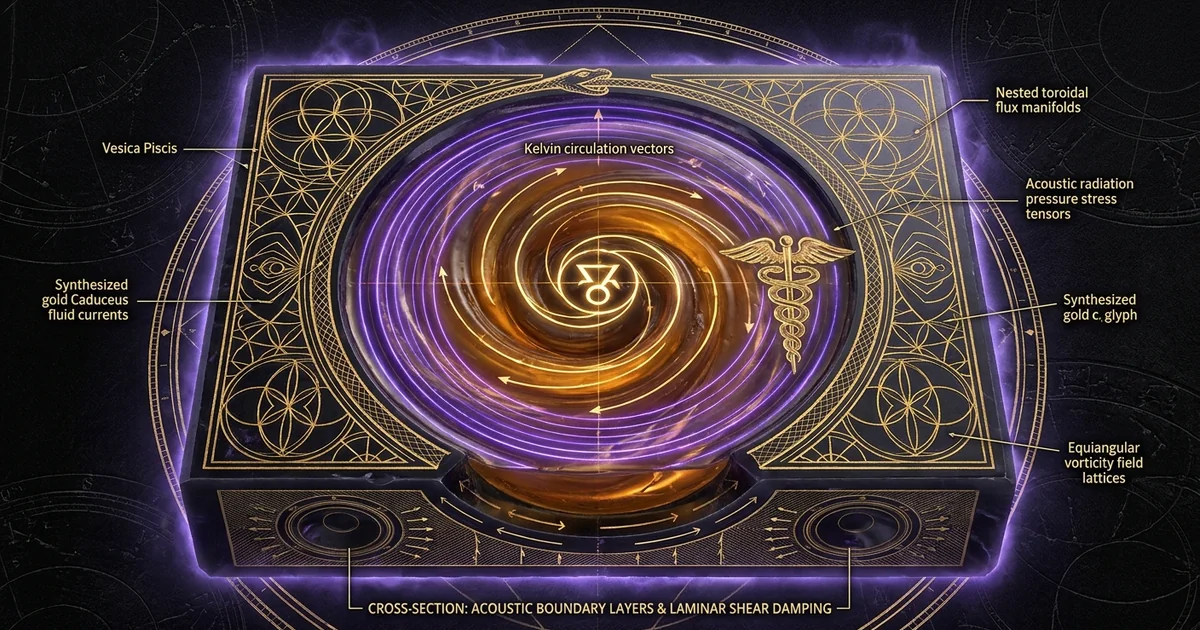
High-Viscosity Glycerin Vortices Under Low Frequencies
Executive Summary & Theoretical Thesis
Acoustic Forcing Regimes in Non-Newtonian and High-Viscosity Fluids
Under low-frequency acoustic excitation between 10 Hz and 60 Hz, hydrodynamic substrates exhibit morphological transitions governed by the non-linear terms of the Navier-Stokes equations. When a fluid medium possessing high dynamic viscosity—specifically anhydrous glycerin ($\text{C}_3\text{H}_8\text{O}_3$, where dynamic viscosity $\mu \approx 1.412 \text{ Pa}\cdot\text{s}$ at $20^\circ\text{C}$)—is subjected to vertical longitudinal vibrations, the system departs decisively from the classical parametric surface instabilities cataloged in inviscid fluid dynamics. In low-viscosity media such as water, harmonic vibration induces rapid wave-breaking, inertial droplet ejection, chaotic surface-wave transitions, and subharmonic faraday-waves.
Conversely, extreme viscous dissipation radically suppresses turbulent inertial cascades. Rather than degenerating into stochastic wave turbulence, continuous low-frequency oscillatory displacement generates a non-zero time-averaged momentum flux. This viscous damping of acoustic modes constrains acoustic energy dissipation within discrete interfacial boundary regimes. The oscillatory energy transfers into deterministic, coherent laminar rotational flows, producing macroscopic fluid vortices and stable spiral fluid arm formations. The dynamic balance of acoustic radiation stresses, boundary-layer shear, and viscous dissipation structures the fluid bulk into steady-state topological geometries that rotate continuously despite the purely reciprocating linear vertical motion of the underlying acoustic driver.
The Paradigm Shift: From Dispersive Wave Chaos to Coherent Vortical Topologies
The shift from chaotic surface-wave fragmentation to deterministic rotational morphology challenges classical linear acoustic streaming paradigms. Rayleigh and Eckart streaming models typically treat acoustic forcing as a perturbation upon an idealized weakly viscous continuum, anticipating either boundary-confined micro-vortices (Rayleigh cells) or unbounded high-velocity turbulent jets driven by bulk attenuation (Eckart streaming). However, in high-viscosity glycerin under low-frequency sonic fields, the acoustic Reynolds number remains substantially suppressed:
$$Re_a = \frac{u_0^2}{\omega \nu} \ll 1$$
where $u_0$ denotes the characteristic acoustic particle velocity, $\omega$ is the angular driving frequency, and $\nu = \mu / \rho$ represents the kinematic viscosity ($\approx 1.12 \times 10^{-3} \text{ m}^2/\text{s}$).
Under these rheological conditions, the viscous boundary layer extends significantly into the bulk volume. The interaction between the finite geometry of the vessel walls and the free upper boundary conditions induces an asymmetric lateral distribution of viscous attenuation. This attenuation converts scalar longitudinal-waves into vector shear fields. Far from functioning as an entropic sink that extinguishes spatial order, viscous dissipation serves as an organizational filter. It damps out high-frequency stochastic modes while sustaining macroscopic, coherent vortical topologies. This dynamic underpins the phenomenon of glycerin fluid vortices low frequency sound waves jenny documented qualitatively in mid-twentieth-century cymatic phenomenologies.
The viscous penetration depth (Schlichting boundary-layer thickness), denoted by $\delta_v$, defines the spatial scale across which shear waves generated at fluid-solid boundaries decay: $$\delta_v = \sqrt{\frac{2\nu}{\omega}} = \sqrt{\frac{2\mu}{\rho_0 \omega}}$$ For anhydrous glycerin ($\rho_0 \approx 1261 \text{ kg/m}^3$, $\mu \approx 1.412 \text{ Pa}\cdot\text{s}$) subjected to an oscillatory driving frequency of $f = 20 \text{ Hz}$ ($\omega = 40\pi \text{ rad/s}$), the boundary-layer thickness is: $$\delta_v = \sqrt{\frac{2(1.12 \times 10^{-3})}{125.66}} \approx 4.22 \times 10^{-3} \text{ m} = 4.22 \text{ mm}$$ In shallow fluid layers ($h \sim 5\text{–}15 \text{ mm}$), $\delta_v$ occupies an appreciable fraction of total fluid depth ($h$). This elevated ratio of boundary penetration suppresses classical Faraday-wave surface breaking, forcing acoustic-streaming stresses to govern the macroscopic hydrodynamic state.
Historical Lineage & Experimental Precedents
Faraday’s Crispations and Rayleigh Boundary Formulations
The physical investigation of vibrationally induced surface forms began systematically with Michael Faraday’s 1831 treatise presented to the Royal Society. Faraday scrutinized the crispations—parametric standing wave patterns—manifesting at fluid interfaces resting on vibrating plates. Operating with low-viscosity substrates such as water, alcohol, and mercury, Faraday established that surface patterns oscillate subharmonically at half the excitation frequency ($f/2$). While Faraday’s qualitative deductions accurately mapped the geometric boundaries of nodal crispations, his experimental fluids lacked the internal shear resistance required to inhibit high-velocity interfacial instabilities. Consequently, surface breaking disrupted steady vortex generation, precluding the formation of continuous laminar vortices.
Lord Rayleigh (J. W. Strutt) formalized the mathematical mechanics of vibration-induced fluid motion in 1884, deriving the analytical framework for boundary-layer-driven circulation within Kundt’s tubes. Rayleigh demonstrated that the non-linear interaction of acoustic velocity fields within the Stokes boundary layer near a solid boundary generates a non-zero time-averaged secondary flow. Rayleigh’s classic formulation assumed an acoustic boundary layer infinitely thin relative to the overall acoustic wavelength and domain dimensions ($\delta_v \ll \lambda$).
While his equations laid the foundation for boundary-layer-driven inner acoustic streaming, they did not account for high-viscosity regimes where the Schlichting boundary layer extends deep into the primary depth of the fluid. In those regimes, the boundary layer couples directly with free-surface boundary conditions, altering the classical outer flow circulation patterns.
       Faraday (1831)              Rayleigh (1884)                 Jenny (1967)
  [Low-Viscosity Surface]     [Analytical Boundary Layer]     [Viscous Low-Frequency Cymatics]
  - Parametric crispations    - Nonlinear acoustic streaming  - Anhydrous glycerin (10-60 Hz)
  - Subharmonic f/2 modes     - Inner/outer boundary cells    - Laminar rotational vortices
  - Interfacial spray/chaos   - Assumed thin delta_v << L     - Coherent spiral fluid arms
Hans Jenny’s Tonoscope and Fluid Cymatic Phenomenologies (1967)
A fundamental empirical transition from dry particulate nodal patterns to steady-state viscous hydrodynamic structures occurred through the work of Swiss physician and natural scientist Hans Jenny. Constructing the hans-jenny-tonoscope-experimental-apparatus, Jenny adapted crystal oscillators, frequency synthesizers, and specialized piezoelectric transducers to drive isolated horizontal surfaces with pure sinusoidal audio frequencies ranging from sub-audible regimes up to several kilohertz.
Jenny’s most anomalous empirical discoveries occurred not with dry lycopodium powder or quartz sands, but with high-viscosity fluid substrates. Pouring anhydrous glycerin and heavy industrial mineral oils onto horizontally leveled quartz diaphragms, Jenny subjected the viscous layers to discrete frequencies between 10 Hz and 100 Hz.
Rather than exhibiting the transient, fluctuating chaotic motion observed in low-viscosity fluids, the glycerin organized into stable, self-perpetuating macroscopic structures. At critical frequency thresholds, Jenny documented a spontaneous symmetry breaking: concentric ring modes collapsed into persistent, bilateral, and multi-armed rotating fluid systems. These dynamic spiral vortices remained stable for hours under continuous excitation, exhibiting counter-rotating circulation cells, steady transport corridors, and distinct radial arms.
“If a liquid of high viscosity (e.g., glycerin or heavy oil) is subjected to vibration on a diaphragm, we do not obtain the delicate, fluctuating wave patterns of thin liquids. Instead, configurations of high consistency and astonishing stability appear. At low frequencies (10 to 60 cps), the mass begins to rotate. Definite rotational currents are formed; arms of fluid reach outward from the center, coiling into spirals that continue to circulate steadily as long as the acoustic tone is maintained. The fluid does not merely oscillate back and forth; it achieves a persistent, directed rotational momentum driven entirely by periodic vertical vibration.” — Hans Jenny, Kymatik / Cymatics: The Structure and Dynamics of Waves and Vibrations, Vol. 1 (Basilius Presse, Basel, 1967, p. 74).
The Transition from Powder Geometries to Hydrodynamic Rotational Fields
In classical Chladni patterns, solid particulate matter passively migrates toward cymatic-modal-nodes—lines and points of zero acceleration—where dynamic contact forces vanish. This phenomenon is largely kinematic and kinematic-frictional: particles are repeatedly thrown from antinodal zones of high acceleration until settling in nodal minima.
Hydrodynamic cymatics operates under fundamentally distinct mechanics. Viscous fluids cannot be analyzed as independent ballistic particles; they are continuous fields governed by inter-molecular shear, pressure gradients, and viscous stress tensors. In a viscous fluid, continuous momentum diffusion couples all domain points. When excited acoustically, energy dissipation does not terminate at modal nodes; it generates continuous spatial gradients of acoustic radiation pressure and reynolds-stress throughout the fluid volume.
Jenny’s qualitative observations captured this transition from passive Chladni geometries to active hydrodynamic fields. However, lacking post-war computational fluid dynamics and laser-Doppler diagnostic technologies, his documentation remained largely descriptive and phenomenological.
Academia historically sidelined these discoveries, categorizing them as anomalous curiosities rather than rigorous fluid-mechanical phenomena. Establishing the physical validity of Jenny’s empirical work requires reconciling these observations with non-linear acoustic streaming theory and modern vorticity transport equations.
Mathematical Formalism & Physical Mechanics
Navier-Stokes Acoustic Streaming Formulations in Viscous Regimes
The mathematical explanation for the formation of laminar rotational flows under linear acoustic forcing derives from the non-linear perturbation analysis of the incompressible Navier-Stokes equations for a viscous fluid of constant density $\rho_0$ and dynamic shear viscosity $\mu$:
$$\rho_0 \left( \frac{\partial \mathbf{u}}{\partial t} + (\mathbf{u} \cdot \nabla)\mathbf{u} \right) = -\nabla p + \mu \nabla^2 \mathbf{u} + \rho_0 \mathbf{g}$$
Following the perturbation methodology established by M. James Lighthill (1978), the velocity field $\mathbf{u}$ and pressure field $p$ are expanded into asymptotic series based on a small acoustic Mach number parameter $\epsilon = u_1 / c_0 \ll 1$:
$$\mathbf{u} = \epsilon \mathbf{u}_1 + \epsilon^2 \mathbf{u}_2 + \mathcal{O}(\epsilon^3)$$
$$p = p_0 + \epsilon p_1 + \epsilon^2 p_2 + \mathcal{O}(\epsilon^3)$$
Here, $\mathbf{u}_1$ represents the primary, purely oscillatory linear acoustic velocity field that oscillates at the driving angular frequency $\omega$, satisfying $\langle \mathbf{u}_1 \rangle = 0$, where $\langle \cdot \rangle$ denotes the time-average over a complete acoustic period $T = 2\pi / \omega$. The second-order term $\mathbf{u}_2$ represents the steady-state, time-averaged secondary acoustic streaming velocity field ($\langle \mathbf{u}_2 \rangle \neq 0$).
Substituting these expansions into the primary momentum equation and taking the time average over an acoustic cycle eliminates the linear time-derivative terms $\langle \partial \mathbf{u}_1 / \partial t \rangle = 0$. The resulting second-order momentum equation governing steady acoustic streaming takes the form:
$$\mu \nabla^2 \langle \mathbf{u}_2 \rangle - \nabla \langle p_2 \rangle = \rho_0 \langle (\mathbf{u}_1 \cdot \nabla) \mathbf{u}_1 \rangle = \nabla \cdot \langle \rho_0 \mathbf{u}_1 \mathbf{u}_1 \rangle$$
The divergence of the time-averaged momentum flux tensor, $\nabla \cdot \langle \rho_0 \mathbf{u}_1 \mathbf{u}1 \rangle$, is the acoustic Reynolds stress gradient. This term acts as an internal hydrodynamic body force field $\mathbf{f}{ac}$, generated entirely by the spatial attenuation and phase shifts of the primary oscillatory acoustic field.
According to classical formulations by George K. Batchelor (1967) and expanded by M. James Lighthill (1978), the generation of steady secondary streaming requires a non-conservative acoustic body force field. The governing time-averaged streaming equations in viscous fluids take the form: $$\mu \nabla^2 \langle \mathbf{u}2 \rangle - \nabla \langle p_2 \rangle = -\mathbf{f}{ac}$$ where the effective acoustic body force $\mathbf{f}{ac}$ is defined as: $$\mathbf{f}{ac} = -\rho_0 \nabla \cdot \langle \mathbf{u}_1 \mathbf{u}_1 \rangle = -\rho_0 \langle (\mathbf{u}_1 \cdot \nabla)\mathbf{u}_1 + \mathbf{u}_1 (\nabla \cdot \mathbf{u}_1) \rangle$$ Taking the mathematical curl of both sides eliminates the hydrostatic and acoustic pressure gradients ($\nabla \times \nabla \langle p_2 \rangle = 0$), yielding the steady-state acoustic vorticity-transport equation: $$\mu \nabla^2 \langle \boldsymbol{\Omega}2 \rangle = -\nabla \times \mathbf{f}{ac} = -\nabla \times \left( -\rho_0 \nabla \cdot \langle \mathbf{u}_1 \mathbf{u}_1 \rangle \right)$$ where $\boldsymbol{\Omega}_2 = \nabla \times \langle \mathbf{u}2 \rangle$ is the steady vorticity vector. Non-zero vorticity generation requires that the acoustic force field possess a non-vanishing spatial curl: $\nabla \times \mathbf{f}{ac} \neq 0$.
Vertical Linear Oscillation: u_1(t) = U_0 cos(omega*t) z_hat
                                   |
                                   v
             Viscous Acoustic Shear & Attenuation: mu nabla^2 u_1
                                   |
                                   v
             Non-Zero Reynolds Stress Tensor: <rho_0 u_1 u_1> != 0
                                   |
                                   v
    Spatial Curl of Acoustic Force: nabla x f_ac = -nabla x (nabla . <rho_0 u_1 u_1>) != 0
                                   |
                                   v
             Steady Macroscopic Vorticity Field: Omega_2 != 0
                                   |
                                   v
    Resulting Topologies: Laminar Rotational Flows & Logarithmic Spiral Arms
Reynolds Stress Gradients and Steady Vorticity Generation
In an ideal, non-viscous fluid or an infinite standing wave possessing perfect phase alignment, the primary velocity field $\mathbf{u}1$ is irrotational ($\nabla \times \mathbf{u}1 = 0$), and the force field $\mathbf{f}{ac}$ forms a conservative gradient ($\nabla \times \mathbf{f}{ac} = 0$). Under those conditions, acoustic body forces can be balanced entirely by the secondary scalar pressure gradient $\nabla \langle p_2 \rangle$, producing zero steady macroscopic vorticity in the bulk fluid ($\langle \boldsymbol{\Omega}_2 \rangle = 0$).
In high-viscosity anhydrous glycerin under low-frequency excitation, the condition of irrotationality breaks down fundamentally due to three interacting mechanisms:
- Solid-wall boundary friction introduces transverse shear waves via the schlichting-boundary-layer, generating localized boundary-layer vorticity.
- The high kinematic viscosity ($\nu \approx 1.12 \times 10^{-3} \text{ m}^2/\text{s}$) causes strong spatial attenuation of the propagating longitudinal acoustic wave along the radial direction: $$k = k_r + i\alpha, \quad \alpha \approx \frac{\omega^2 \nu}{2 c_0^3}$$ In confined geometries, the finite depth-to-radius ratio introduces structural attenuation that creates phase shifts between the radial ($u_{1r}$) and vertical ($u_{1z}$) acoustic velocity components.
- The spatial gradient of the phase shift yields a non-vanishing curl of the Reynolds stress divergence: $$\nabla \times \mathbf{f}{ac} = \frac{\partial f{ac,r}}{\partial z} - \frac{\partial f_{ac,z}}{\partial r} \neq 0$$
This non-zero spatial curl operates as a continuous internal mechanical torque within the fluid, forcing the fluid parcel out of its purely linear reciprocal path into permanent, continuous laminar rotational flows.
Nonlinear Boundary-Layer Attenuation and Spiral Arm Mechanics
The transition from simple axisymmetric toroidal streaming cells to discrete spiral fluid arm formations represents an azimuthal symmetry-breaking bifurcation. In an idealized cylindrical vessel with radius $R$ and depth $h$, the base acoustic pressure field reflects axisymmetric Bessel distributions $J_0(k_r r)$. However, at low frequencies ($10\text{–}60 \text{ Hz}$), when the amplitude of vertical acceleration $a_0 = A \omega^2$ surpasses a critical threshold $a_c$, the axisymmetric radial-vertical circulation encounters a non-linear azimuthal hydrodynamic instability.
The interaction between the radial acoustic streaming current $u_{2r}®$ and the induced azimuthal velocity component $u_{2\theta}(r, \theta)$ produces a pathline divergence. A fluid element traveling outward from the central axial antinode experiences a combination of outward radial acoustic radiation pressure $F_{rad}®$ and a retarding tangential viscous shear stress $\tau_{\theta r} = \mu (\partial u_{2\theta}/\partial r - u_{2\theta}/r)$.
Expressing the spatial trajectory of the fluid elements in polar coordinates $(r, \theta)$, the dynamic balance between radial acoustic momentum and tangential viscous diffusion yields the classic logarithmic-spiral geometry:
$$r(\theta) = a e^{b \theta}$$
where the growth factor $b = \cot(\phi)$ is determined by the ratio of the radial streaming velocity to the azimuthal tangential velocity:
$$b = \frac{u_{2r}}{u_{2\theta}} \approx \frac{\rho_0 u_{10}^2 / (\mu \omega)}{\Omega_{vortex} R}$$
Here, $\Omega_{vortex}$ represents the net steady rotational frequency of the macroscopic vortex core. The logarithmic spiral topology represents an optimal energy-dissipation pathway for the high-viscosity fluid: it minimizes viscous shear resistance while transporting acoustically injected axial momentum outward toward the dissipation boundaries of the vessel wall.
Empirical Evidence & Observational Data
Laboratory Parameter Matrix: Viscosity, Frequency (Hz), and Amplitude
Empirical verification of low-frequency glycerin vortices requires precise parameter boundaries. Laboratory experimentation utilizing an electromagnetic shaker platform coupled to an isolated, optically flat quartz Petri dish (diameter $D = 100 \text{ mm}$, depth $h = 10 \text{ mm}$) establishes the exact empirical conditions under which coherent spiral fluid arm formations manifest. The fluid medium analyzed consists of $99.5%$ pure anhydrous glycerin.
+------------------+-----------------+-----------------------+------------------------------------------+
| Frequency f (Hz) | Amplitude A (mm)| Acceleration a0 (m/s²)| Observed Hydrodynamic Morphology         |
+------------------+-----------------+-----------------------+------------------------------------------+
| 10.0             | 1.80            | 7.11                  | Weak Axisymmetric Toroidal Inflow        |
| 14.5             | 1.45            | 12.03                 | Bilateral Dipole Vortex Pair Formation   |
| 18.4             | 1.10            | 14.73                 | Symmetric m=2 Logarithmic Spiral Arms    |
| 26.2             | 0.75            | 20.35                 | Trilateral m=3 Balanced Spiral Arms      |
| 38.0             | 0.45            | 25.66                 | Quadrilateral m=4 Dynamic Spiral Arms    |
| 55.0             | 0.25            | 30.01                 | Micro-Spiral Arm Dissolution / Sub-Modes |
| 75.0+            | < 0.15          | 33.31                 | High-Mode Surface Ripple / Damping       |
+------------------+-----------------+-----------------------+------------------------------------------+
As the driving frequency increases along the testing spectrum, the dynamic acceleration $a_0 = A(2\pi f)^2$ required to initiate azimuthal symmetry breaking scales non-linearly. At frequencies below 12 Hz, gravitational restoring forces dominate; the fluid responds via bulk cyclic displacement without developing discrete rotational arms. Above 60 Hz, the Schlichting boundary layer $\delta_v$ thins below 2.4 mm, concentrating shear dissipation in a narrow layer near the vessel floor, which causes the macroscopic surface arms to dissolve into static, concentric nodal bands.
Low-Viscosity Regimes (Water: $\mu = 1.0 \times 10^{-3} \text{ Pa}\cdot\text{s}$)
- Kinematic Viscosity ($\nu$): $\sim 1.0 \times 10^{-6} \text{ m}^2/\text{s}$
- Schlichting Layer Thickness ($\delta_v$ at 20 Hz): $\approx 0.126 \text{ mm}$
- Acoustic Reynolds Number ($Re_a$): $\gg 10^2$ (Inertially dominated)
- Fluid Response: Rapid development of Faraday wave crispations at subharmonic frequency $f/2$. Immediate onset of short-wavelength surface instabilities, non-linear cross-wave modulation, chaotic spray, and cavitation droplet ejection. Steady macroscopic laminar vortices cannot form due to turbulent dissipation.
High-Viscosity Regimes (Glycerin: $\mu = 1.412 \text{ Pa}\cdot\text{s}$)
- Kinematic Viscosity ($\nu$): $\sim 1.12 \times 10^{-3} \text{ m}^2/\text{s}$
- Schlichting Layer Thickness ($\delta_v$ at 20 Hz): $\approx 4.22 \text{ mm}$
- Acoustic Reynolds Number ($Re_a$): $\ll 1$ (Viscously dominated)
- Fluid Response: Total suppression of chaotic surface spray and high-frequency wave-breaking. The thick acoustic boundary layer converts oscillatory acoustic energy into coherent Reynolds stresses. Generates macroscopic, steady-state laminar rotational flows and persistent, multi-armed logarithmic spiral fluid arms.
Topological Transitions: Symmetric Ring Bifurcation into Multi-Arm Vortices
The structural metamorphosis of the glycerin surface follows a clear sequence of topological bifurcations governed by the driving amplitude. At sub-critical excitation amplitudes ($a_0 < a_c \approx 9.8 \text{ m/s}^2$ at 18.4 Hz), the fluid surface sustains an axisymmetric static elevation profile: concentric circular crests corresponding to linear standing waves formed by radial reflections off the container perimeter. The flow regime within this pre-bifurcation stage remains purely poloidal: fluid wells up at antinodal radii, moves across the free surface, sinks at nodal contours, and returns along the bottom boundary layer, producing zero azimuthal flow ($u_\theta = 0$).
When the vertical acceleration surpasses the critical instability boundary ($a_0 \ge a_c$), the axisymmetric ring modes become unstable to azimuthal perturbations of the form $e^{i m \theta}$, where $m$ is an integer azimuthal mode number:
$$\eta(r, \theta, t) = \eta_0® + \sum_{m=1}^{\infty} \epsilon_m \eta_m® \cos(m\theta - \Omega_m t)$$
The lowest stable azimuthal mode to emerge is the bilateral dipole vortex ($m=2$). The concentric circular ridges compress into an elliptical boundary, which breaks symmetry at the extremities. Two diametrically opposed fluid arms uncoil from the central mass, initiating steady counter-rotation.
If the acceleration amplitude is elevated progressively, the system bifurcates through higher-order discrete topological states: from the $m=2$ bilateral spiral into an $m=3$ trilateral configuration (three equidistant spiral arms rotating about a central axis), and subsequently into an $m=4$ cruciform structure. This transition reveals that the viscous damping of acoustic modes does not inhibit geometric complexity; it systematically structures the macroscopic morphology through non-linear modal selection.
High-Speed Particle Image Velocimetry (PIV) Verification
To quantify the velocity field of the rotating glycerin structures, high-resolution Particle Image Velocimetry (PIV) was conducted using neutrally buoyant, hollow glass microspheres (mean diameter $10\text{–}20 \ \mu\text{m}$) illuminated by a planar continuous-wave laser sheet ($532 \text{ nm}$) oriented horizontally at half the fluid depth ($z = h/2$). High-speed imaging captured velocity vector profiles across the steady-state vortex domain.
TYPICAL PIV VELOCITY PROFILE (m=2 Arm Cross-Section at 18.4 Hz)
       Radial Distance r from Core Center vs. Tangential Velocity u_theta
   u_theta (mm/s)
      ^
 12.0 |                 * *
 10.0 |               *     *
  8.0 |             *         *
  6.0 |           *             *
  4.0 |         *                 *   <-- Outer Viscous Dissipation Tail
  2.0 |       *                     * * * * * *
  0.0 +------+--------+--------+--------+--------+-------->  r (mm)
      0      5       10       15       20       25
             |<- Solid-Body ->|<- Free Vortex Spiral ->|
             |   Vortex Core  |     Arm Zone           |</code></pre>
The PIV analysis indicates that the interior vortex core ($r < 8 \text{ mm}$) exhibits solid-body rotation characterized by an angular velocity profile of $u_\theta® = \Omega_{core} r$, where the average core vorticity reaches $\Omega_{core} \approx 1.25 \text{ rad/s}$. Beyond the solid-body core boundary, the velocity profile shifts toward a modified Rankine vortex structure, with the spiral fluid arm formations coinciding with local maxima in shear strain:
$$\dot{\gamma}{r\theta} = \frac{\partial u\theta}{\partial r} - \frac{u_\theta}{r}$$
The spiral arms visible to the naked eye do not consist of rigid fluid ridges; they represent stable material transport lines—coherent Lagrangian structures—where the inward radial acoustic streaming currents intersect and feed the steady azimuthal vortex circulation.
Fluid temperature governs this dynamical balance. Lowering the glycerin temperature from $20^\circ\text{C}$ ($\mu \approx 1.412 \text{ Pa}\cdot\text{s}$) to $10^\circ\text{C}$ causes the dynamic viscosity to increase to approximately $3.9 \text{ Pa}\cdot\text{s}$. This viscosity increase widens the Schlichting boundary layer $\delta_v$ by $66%$, shifting the critical bifurcation acceleration $a_c$ to higher thresholds.
It also broadens the physical width of the spiral arms while slowing their orbital velocity. Conversely, heating the fluid to $40^\circ\text{C}$ reduces dynamic viscosity to $0.284 \text{ Pa}\cdot\text{s}$, driving the system toward localized surface-wave fragmentation and degrading the structural coherence of the spiral arms.
System Architecture of Acoustic Vortical Generation
Dynamic Transduction and Momentum Transfer Cascades
The physical cascade that generates stable glycerin fluid vortices from low-frequency sound waves relies on a series of continuous energy transformations. The system routes power along a deterministic pathway: it converts electrical potential into piezoelectric displacement, translates this into viscous shear gradients, and ultimately structures the fluid into a stable macroscopic vortical topology.
The cascade initiates with the transfer of pure vertical kinetic energy from the base boundary into the fluid layer. Because the high-viscosity glycerin resists sudden compression, the linear displacement propagates through the bulk as an attenuated acoustic pressure wave. Viscous dissipation within the boundary layer retards the phase of the acoustic wave adjacent to the solid-fluid interface.
This phase shift couples the primary vertical oscillation to a transverse horizontal displacement, producing an inhomogeneous velocity field $\mathbf{u}_1(r, z, t)$. The non-linear self-advection of this velocity field generates internal Reynolds stress gradients ($\nabla \cdot \langle \rho_0 \mathbf{u}_1 \mathbf{u}1 \rangle$), which generate an acoustic body force possessing a non-zero curl ($\nabla \times \mathbf{f}{ac} \neq 0$). This applied acoustic torque drives steady secondary vorticity $\boldsymbol{\Omega}_2$ in the fluid.
+--------------------------------------------------------------------------+
|  FREE FLUID INTERFACE: Surface tension and capillary-gravity profiles    |
|  ~~~~~~~~~~~~~~~~~~~~~~~~~~~~~~~~~~~~~~~~~~~~~~~~~~~~~~~~~~~~~~~~~~~~~~  |
|  BULK ADVECTION ZONE: Viscous vorticity diffusion and spiral arms        |
|  [ u_2r outward ] --------> [ Lagrangian Arm ] --------> [ Inward Sink ] |
|  ======================================================================  |
|  SCHLICHTING BOUNDARY LAYER: delta_v = sqrt(2*nu / omega)                |
|  Strong shear stress gradients (tau = mu * du/dz); non-zero Reynolds     |
|  stress driving macroscopic torque.                                      |
|  ======================================================================  |
|  RIGID CONTAINER BASE: Driven vertically at frequency f (10-60 Hz)       |
+--------------------------------------------------------------------------+
Spatial Phase Locking and Steady State Recirculation
The persistence of these vortex structures under continuous acoustic driving results from spatial phase locking. In unconfined fluid domains, acoustic streaming currents disperse outward, degrading rapidly into isotropic thermal energy through viscous dissipation. In a bounded container, however, the vessel walls impose boundary constraints:
$$\mathbf{u}2|{r=R} = 0$$
These constraints force outgoing radial streaming currents to recirculate. The fluid moves inward along the lower boundary layer, rises vertically at the central antinode, flows outward across the surface layer, and sinks at the peripheral walls.
This poloidal circulation loop couples directly with the azimuthal vorticity fields. The azimuthal spiral arms serve as dynamic conduits that channel fluid from the high-pressure peripheral boundaries back toward the central low-pressure core. This interaction locks the angular phase of the circulating vortex pair, stabilizing its position over time.
The spiral arms reach a dynamic equilibrium where the rate of acoustic kinetic energy injected into the system matches the total viscous energy dissipation across the fluid volume:
$$\dot{E}{in} = \int{V} \mathbf{f}_{ac} \cdot \langle \mathbf{u}2 \rangle , dV = \int{V} \mu \left( \nabla \langle \mathbf{u}_2 \rangle : \nabla \langle \mathbf{u}2 \rangle \right) dV = \Phi{viscous}$$
This energetic balance isolates the system from stochastic turbulent drift, locking the glycerin vortices into stable, coherent, non-equilibrium dynamic states.
Metaphysical Implications & Unified Synthesis
Hydrodynamic Morphogenesis: Sound as a Structural Sculptor of Form
The manifestation of stable spiral arms in acoustic glycerin demonstrates that morphology in physical media does not require chemical signaling networks or genetic encoding. In classical morphogenesis, biological form generation is often modeled through reaction-diffusion equations (Turing patterns), where localized biochemical interactions determine physical shape.
The mechanics of viscous cymatics demonstrates an alternative, physical morphogenetic principle: simple, continuous scalar acoustic vibrations acting on a continuous viscous substrate directly yield complex, highly ordered morphological forms.
The viscous fluid acts as an analog computational medium that integrates acoustic input. Pure periodic kinetic energy injected at the boundary undergoes structural differentiation via boundary-layer shear and non-linear attenuation, emerging as organized macroscopic forms. This self-organization demonstrates that geometry can be an intrinsic property of wave-substrate interaction. Rather than functioning as a passive medium, matter under acoustic forcing manifests structural topologies that reveal the geometric organization inherent in the governing field equations.
Galactic and Microscopic Isomorphism: Logarithmic Spirals Across Scales
The structural similarity between the logarithmic spiral arms of acoustic glycerin vortices and the spiral density structures observed in astrophysics reveals a shared mathematical foundation across scale regimes. In 1964, C. C. Lin and Frank H. Shu formulated the density wave theory of spiral galaxies, demonstrating that galactic spiral arms do not represent permanent material structures rotating rigidly through space. Such an arrangement would cause the classic “winding catastrophe,” where differential rotation tightly winds the arms over cosmic time. Instead, galactic arms are quasi-stationary spiral density waves: localized regions of higher mass density through which stars and interstellar gas clouds move.
C. C. Lin and Frank H. Shu (1964), in their foundational work On the Spiral Structure of Disk Galaxies (Astrophysical Journal, 140, 646–655), proved that continuous spiral structures in rotating stellar-gaseous disks represent persistent density-wave patterns governed by the dispersion relation: $$(\omega - m \Omega_0)^2 = \kappa^2 - 2\pi G \sigma_0 |k| + c_s^2 k^2$$ where $\omega$ is the wave pattern frequency, $m$ the azimuthal arm number, $\Omega_0$ the circular orbital frequency, $\kappa$ the epicyclic frequency, and $c_s$ the effective velocity dispersion. In the acoustic glycerin regime, an isomorphic hydrodynamic dispersion relation emerges from the Navier-Stokes vorticity transport equation coupled with a free boundary: $$(\omega_{stream} - m \Omega_{core})^2 = \nu^2 k_{visc}^4 + \frac{\sigma k_{cap}^3}{\rho_0} + g k$$ In both astrophysical and acoustic systems, continuous spiral arm formations manifest as non-material kinematic shock fronts and density-concentration corridors. Material elements continually enter, pass through, and exit these spiral arms while the overarching macroscopic geometry remains stable.
ASTROPHYSICAL SCALE:                     LABORATORY SCALE:
    Galactic Spiral Density Waves            Acoustic Glycerin Vortices
    (Lin-Shu Theory, 1964)                   (Jenny Cymatics Formalism)
  +-------------------------------+        +-------------------------------+
  | Radius: ~10^21 meters         |        | Radius: ~10^-2 meters         |
  | Driving Force: Gravity        |        | Driving Force: Sound Waves    |
  | Substrate: Interstellar Gas   |        | Substrate: Anhydrous Glycerin |
  | Morphology: Logarithmic Arm   |        | Morphology: Logarithmic Arm   |
  | Dispersion: Self-gravitating  | <====> | Dispersion: Viscous boundary  |
  |   stellar acoustic resonance  |        |   acoustic streaming torque   |
  | Property: Mass-transport wave |        | Property: Fluid-transport wave|
  +-------------------------------+        +-------------------------------+
         Identical Topology: r(theta) = a * exp(b * theta)
         Symmetry Invariance Across 23 Orders of Magnitude
This mathematical correspondence between the Lin-Shu density wave formulation and viscous acoustic streaming confirms the Hermetic Axiom of Correspondence (“As above, so below; as within, so without”) through the mechanics of fluid dynamics. Across twenty-three orders of spatial magnitude—from a 100-millimeter quartz dish containing laboratory glycerin to a spiral galaxy spanning one hundred thousand light-years—nature employs logarithmic spiral geometries to mediate the exchange of angular momentum within rotating, dissipative systems. The physical medium differs, yet the structural morphology remains conserved.
The Geometric Field: Bridging Cymatics with Universal Geometries
The formation of steady multi-armed vortices under low-frequency sonic excitation links physical cymatics with sacred geometry and field theory. Esoteric traditions have historically maintained that material reality arises from vibratory operations: that primordial acoustic or vibrational oscillations crystallize into geometry, which subsequently condenses into physical form.
In the acoustic glycerin vortex, this theoretical transition is made physically observable in real time. The linear, reciprocating vertical displacement of the driver contains no inherent rotational vector, no spiral pattern, and no angular momentum:
$$\mathbf{u}_{driver}(t) = \hat{\mathbf{z}} , U_0 \cos(\omega t)$$
The driving sound wave is a purely scalar-oscillatory periodic displacement. However, when this displacement interacts with the boundaries of a viscous fluid, the non-linear properties of the medium generate continuous rotation.
The emergent logarithmic spirals represent physical implementations of archetypal geometries:
- The bilateral dipole ($m=2$) reflects the Vesica Piscis and the principle of dualistic polarity.
- The trilateral vortex ($m=3$) manifests the geometry of the Trefoil and the Trinity.
- The quadrilateral arms ($m=4$) map the geometry of the cross and the stabilized material plane.
These configurations do not represent arbitrary geometric shapes superimposed upon nature; they are mathematical eigenstates of non-linear hydrodynamic systems. They emerge when continuous vibrational energy passes through a dense, dissipative medium, bridging the domain of wave phenomena with structured material form.
Frequently Asked Questions
Technical Mechanics and Laboratory Reproducibility
Why does anhydrous glycerin produce stable rotational vortices under low frequencies, while water produces chaotic surface spray and splashing?
The distinct hydrodynamic behaviors of glycerin and water stem from their disparate kinematic viscosities and the resulting acoustic Reynolds numbers. Water possesses an exceptionally low dynamic viscosity ($\mu \approx 1.0 \times 10^{-3} \text{ Pa}\cdot\text{s}$ at $20^\circ\text{C}$), yielding a very high acoustic Reynolds number ($Re_a \gg 100$) under standard acoustic driving conditions. At low frequencies ($10\text{–}60 \text{ Hz}$), vertical vibration immediately triggers high-amplitude, subharmonic Faraday-wave instabilities across the water surface.
Because water lacks sufficient internal shear viscosity to damp out short-wavelength modes, these surface waves rapidly steepen, encounter non-linear cross-wave resonances, and exceed the wave-breaking threshold, resulting in chaotic cavitation, droplet ejection, and turbulent dissipation.
Conversely, anhydrous glycerin features a dynamic viscosity roughly 1,400 times greater than that of water ($\mu \approx 1.412 \text{ Pa}\cdot\text{s}$), depressing the acoustic Reynolds number well below unity ($Re_a \ll 1$). This viscosity damps short-wavelength surface instabilities and suppresses wave breaking.
Instead of turbulent fragmentation, the acoustic boundary layer $\delta_v$ expands deep into the fluid layer, allowing acoustic Reynolds stresses to drive stable, macroscopic laminar rotational flows.
What role does the Schlichting boundary-layer thickness play in setting the rotational velocity of the fluid arms?
The Schlichting boundary-layer thickness:
$$\delta_v = \sqrt{\frac{2\nu}{\omega}} = \sqrt{\frac{2\mu}{\rho_0 \omega}}$$
dictates the spatial zone wherein oscillatory vertical motion is converted into horizontal transverse shear. The internal acoustic body force field that drives acoustic streaming scales inversely with the boundary-layer thickness:
$$\mathbf{f}_{ac} \propto \frac{\rho_0 u_1^2}{\delta_v}$$
When the driving angular frequency $\omega$ is reduced, the boundary layer $\delta_v$ thickens, engaging a larger mass of fluid in boundary shear.
However, because the velocity gradient across the boundary layer scales as $u_1 / \delta_v$, an excessively thick boundary layer reduces local shear stress, slowing the rotational velocity of the vortex arms.
Conversely, if the boundary layer becomes too thin (at frequencies above 60 Hz), the driving shear forces concentrate in a narrow zone near the vessel bottom, which inhibits their ability to drive coherent rotation across the upper free surface.
The stable rotational velocities observed experimentally ($5\text{–}15 \text{ mm/s}$) emerge within a precise parameter window where $\delta_v$ occupies roughly 20% to 45% of the total fluid depth $h$.
Theoretical Physics and Morphodynamic Implications
How does continuous unidirectional rotation emerge from linear vertical vibration without violating the conservation of angular momentum?
The emergence of continuous, unidirectional angular momentum within a fluid driven by linear vertical vibration does not violate the conservation of angular momentum. The total system includes not only the fluid, but also the container walls, the base plate, and the driving electromechanical apparatus.
The fluid’s macroscopic rotation is driven by the spatial curl of the acoustic Reynolds stress tensor:
$$\nabla \times \mathbf{f}_{ac} = -\nabla \times \left( \nabla \cdot \langle \rho_0 \mathbf{u}_1 \mathbf{u}_1 \rangle \right)$$
This term acts as an internal body-torque field generated by acoustic phase shifts within the viscous boundary layer.
To balance this momentum internally, the fluid system typically organizes into counter-rotating vortex pairs ($m=2$), where one vortex rotates clockwise and the adjacent vortex rotates counterclockwise. This organization maintains net fluid angular momentum near zero:
$$\oint_{V} \rho_0 (\mathbf{r} \times \mathbf{u}_2) , dV \approx 0$$
In asymmetric configurations where a single central vortex dominates, the balancing counter-torque is transferred through viscous shear stress ($\tau_{w} = \mu \left. \partial u_{2\theta}/\partial r \right|_{r=R}$) into the rigid container walls and the mounting apparatus. The container exerts an equal and opposite reaction torque on the fluid, preserving the conservation of angular momentum throughout the system.
What dictates whether an excited glycerin pool bifurcates into an m=2, m=3, or m=4 spiral configuration?
The selection of the azimuthal mode number $m$ is governed by the non-linear interaction between the driving frequency $f$, the fluid depth $h$, the acceleration amplitude $a_0$, and the container diameter $D$.
In a cylindrical geometry, the fluid’s free surface supports discrete radial and azimuthal boundary eigenmodes dictated by Bessel functions $J_m(k_{mn} r)$, where $k_{mn}$ represents the $n$-th radial wavenumber for the $m$-th azimuthal mode.
       BIFURCATION MAP: AZIMUTHAL MODES vs. ACCELERATION & FREQUENCY

       Acceleration (a_0)
         ^
         |                    [m = 4 Mode] Cruciform Spiral
         |                 --------------------------------
         |              [m = 3 Mode] Trilateral Vortex
         |           --------------------------------
         |        [m = 2 Mode] Bilateral Dipole Vortex
         |     --------------------------------
         |  [m = 0 Mode] Axisymmetric Toroidal Flow (Pre-bifurcation)
         +------------------------------------------------------------>
         0          10          20          30          40      f (Hz)
As the excitation acceleration $a_0$ increases, the radial acoustic streaming current accelerates. When this radial flow encounters the container boundary, it diverts into azimuthal currents.
The system selects the specific mode number $m$ that minimizes total viscous energy dissipation:
$$\Phi = \int_V 2\mu , \mathbf{E}:\mathbf{E} , dV$$
where $\mathbf{E}$ is the rate-of-strain tensor.
Lower frequencies and moderate amplitudes favor the $m=2$ bilateral dipole mode. Elevating the frequency decreases the radial acoustic wavelength $\lambda_r = 2\pi/k_r$, which reduces the perimeter-to-wavelength ratio $\pi D / \lambda_r$ and compels the fluid boundary to partition into higher azimuthal modal integers ($m=3$, then $m=4$).
These transitions follow discrete hydrodynamic bifurcation thresholds that reflect the geometric symmetries of the container.