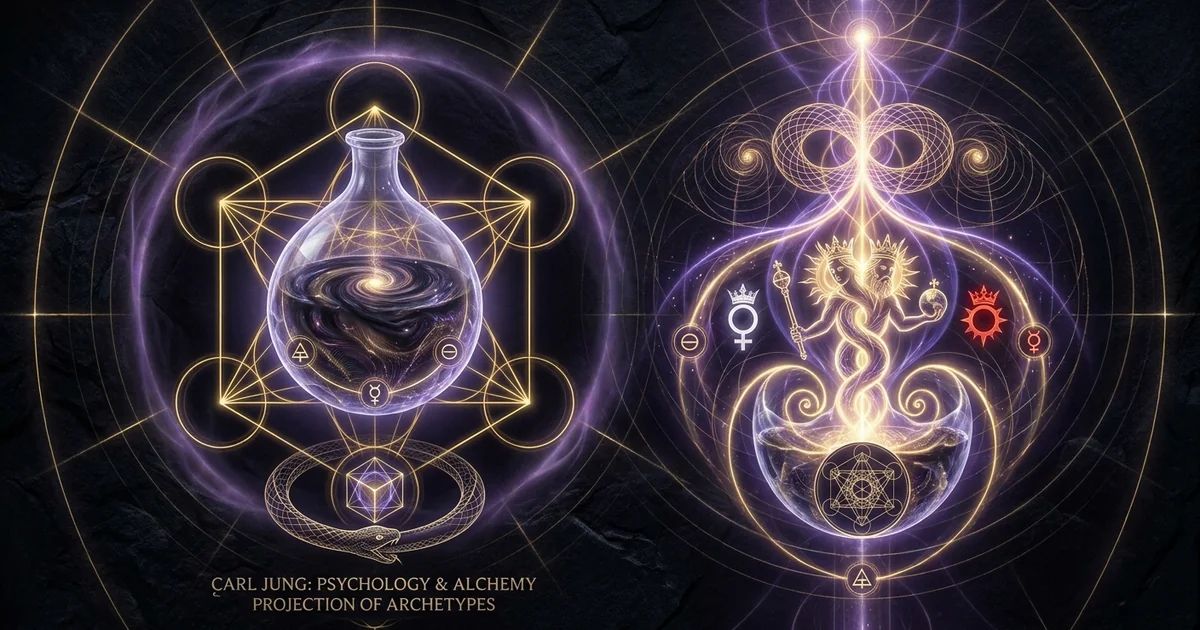
Carl Jung: Psychology & Alchemy Projection of Archetypes
Metaphysical Thesis & Epistemological Opening: The Hermetic Unconscious and the Projection of the Psychoid Substrate
Epistemological Failure of Post-Cartesian Physicalism
The modern scientific intellect remains bound to an epistemological fracture initiated by René Descartes’ radical bifurcation of reality into res cogitans (thinking substance) and res extensa (extended corporeal substance). By exiling subjective interiority from the mechanics of the material continuum, post-Cartesian physicalism effectively rendered nature mute, mechanistic, and devoid of intrinsic telos. Within this dislocated worldview, the pre-modern Hermetic tradition was retroactively classified as an embarrassing, infantile prelude to quantitative chemistry—a confused, superstitious fumbling after physical gold driven by crude metallurgical greed and pre-logical delusion.
This post-Enlightenment historiography, as critically interrogated by scholars of Western esotericism, fundamentally misunderstands the ontological conditions under which the historical adept operated. Before the entrenchment of scientific materialism, the boundary between the internal topography of the soul and the external behavior of physical elements was porous and non-dual. As explored in the study of Hermetic and Corpus Hermeticum origins, the archaic mind experienced the cosmos as a vital, ensouled hierarchy (anima mundi) in which somatic, psychological, and cosmic strata mirrored one another through universal correspondences. In severing this relational continuum, Cartesian dualism blindfolded the modern episteme to the realization that the historical alchemist was engaged in an operational ontology fundamentally alien to modern laboratory chemistry: an inquiry wherein the observer and the observed inhabited a unified phenomenological field.
The Chemical Retort as Phenomenological Speculum
Carl Gustav Jung’s encounter with the alchemical corpus during the 1930s provided the missing empirical and theoretical bridge between depth psychology and Western esotericism. Jung recognized that the historical alchemist, when peering into the murky opacity of the sealed alembic or cucurbite, was not observing mere physical matter in the modern objective sense. Instead, the adept encountered an epistemic vacuum: a chemically indeterminate substance whose precise compositional behavior was entirely unknown.
Under conditions of empirical obscurity, the human psyche does not simply register absence; it spontaneously and involuntarily exteriorizes its own unperceived internal dynamics. The chemical retort thus served as an externalized phenomenological speculum—a material mirror upon which the collective unconscious projected its foundational architectures.
Through this dynamic of projective identification, the swirling transformations of ores, acids, mercurial vapors, and metallic precipitates were perceived as dramatic cosmological dramas: kings being consumed by dragons, the violent dismemberment of bodies, incestuous couplings, and miraculous resurrections. The alchemist was not fabricating allegories; he was naively and directly observing his own psychic interiority inscribed onto the canvas of indeterminate matter. Consequently, the systematic study of carl jung psychology and alchemy projection of archetypes individuation demonstrates that the alchemical opus was never a failed physical technology, but rather the spontaneous historical operationalization of depth psychology centuries before the formal discovery of the unconscious.
The Unus Mundus and the Objective Psyche
The theoretical significance of this projection extends beyond mere cognitive error or subjective optical illusion. Jung’s ultimate philosophical contribution, formulated in close dialogue with the quantum physicist Wolfgang Pauli and the texts of the Paracelsian physician Gerhard Dorn, was the recovery of the unus mundus—the unitary reality underlying both physical nature and psychic manifestation. The unconscious is not merely a private reservoir of repressed personal biographical memories; it possesses an “objective” collective stratum populated by archetypal structures that transcend personal subjectivity.
“The alchemical opus has two parts: the work in the laboratory, which is the physical aspect, and the theoria, which is the psychic aspect. But for the adept, these two parts were not separated as they are for us. The chemical processes were at the same time psychic processes. The adept did not project his subjective ego, but rather the objective psyche: the autonomous archetypal structures of the collective unconscious which he found mirrored in the indeterminate darkness of matter.” — Carl Gustav Jung, Psychology and Alchemy (Collected Works, Vol. 12, § 346–349). Cross-referenced in Wouter J. Hanegraaff, Esotericism and the Academy: Rejected Knowledge in Western Culture (Cambridge University Press, 2012), pp. 278–284.
Because the psyche and the physical continuum emerge from the identical non-dual substrate of the unus mundus, archetypes possess a psychoid character: they are neither purely mental nor purely material, but exist at an ontological nexus where the distinction between interior thought and external event breaks down. Consequently, the historical alchemical treatise serves as an unfiltered topographical map of the objective psyche. The individuation process as magnum opus reveals itself not as an arbitrary modern metaphor, but as an empirical rediscovery of the Hermetic path of cosmic redemption, wherein the conscious integration of the unconscious coordinates the structural alignment of the human microcosm with the macrocosm.
Primary Codices & Historical Transmission: From Greco-Egyptian Metallography to Paracelsian Theosophy
Alexandrian Foundations: Zosimos and Gnostic Metallurgic Mysticism
The historical genealogy of alchemy reveals an unbroken hermeneutic transmission spanning two millennia, originating not in medieval Europe, but in the syncretic crucible of Hellenistic and Roman Alexandria around the turn of the common era. Here, practical Egyptian mortuary metallurgy, dye-making, and temple gem-tinting collided with Greek philosophical speculation—particularly Stoic pneumatic physics and Platonic cosmology—and the esoteric soteriology of early Gnosticism. The preeminent practitioner and chronicler of this foundational epoch was Zosimos of Panopolis (c. 300 CE), whose extant writings demonstrate that the physical manipulation of metals was already inseparable from the visionary ascent of the pneumatic soul.
       [ Alexandrian Hermetism & Gnosticism (Zosimos) ]
                              │
                              ▼
            [ Islamic Golden Age Transmutation ]
           (Jabir ibn Hayyan & The Turba Philosophorum)
                              │
                              ▼
         [ Latin Medieval Reception & Woodcut Codices ]
                 (Rosarium Philosophorum, 1550)
                              │
                              ▼
       [ Paracelsian Interiorization & Theosophical Union ]
                    (Gerhard Dorn, c. 1581)
                              │
                              ▼
        [ Modern Depth Psychology & Psychoid Realism ]
                (C.G. Jung & Wolfgang Pauli)
Zosimos did not approach the chemical operations of distillation, sublimation, and calcination as isolated technical protocols. In his Authentic Memoirs on the Art of Gold-Making and the Letter Omega, operations within the furnace are explicitly synchronized with ecstatic, terrifying visionary trances wherein metallic substances appear as sentient, suffering divine beings. To transform base metals into gold was to liberate the divine pneumatic spark imprisoned within the suffocating matrix of the material cosmos—a metaphysical project directly linked to Gnostic cosmology, Archons, and the Pleroma.
“I saw a brazen altar and a man standing above it who was the priest… And he said to me: ‘I am Ion, the priest of the inner sanctuaries, and I have submitted myself to an unendurable torment. For there came one at the dawn who overpowered me, and pierced me through with a sword, and cut me into pieces according to the method of harmony. And he flayed my head with the sword that he held, and he commingled my bones with the flesh, and burned them in the fire of the art, until I learned by the transformation of the body to become spirit.’ And even as he spoke these words, his eyes became as blood, and he vomited up all his own flesh.” — Zosimos of Panopolis, Authentic Memoirs on the Art of Gold-Making, III. “On the Letter Omega,” translated and edited by Howard M. Jackson (Scholars Press, 1978), pp. 17–19.
This foundational text unmasks the archaic origin of archetypal projection into matter: the sacrificial dismemberment of the homunculus in the brazen furnace is the pristine mythological expression of the ego’s violent mortification, an encounter with the archetypal unconscious experienced not as an intrapsychic reflection, but as an ontological drama enacted by the chemical elements themselves.
The Medieval Stemmata: The Rosarium Philosophorum and the Coniunctio
Following the preservation, refinement, and expansion of these Hellenistic texts by Islamic philosophers such as Jabir ibn Hayyan (Geber) and the authors of the Turba Philosophorum, alchemy permeated Latin Christendom during the twelfth and thirteenth centuries. By the mid-sixteenth century, this tradition reached a visual and doctrinal apogee in the Rosarium Philosophorum (1550), an illustrated tractate that Jung utilized as the primary clinical foundation for his landmark study, The Psychology of the Transference.
The woodcut sequence of the Rosarium is a symbolic grammar mapping the profound psycho-erotic tensions and catastrophic dissolutions governing the human soul’s encounter with its unconscious counter-sexual polarity: the anima in man and the animus in woman. The sequence initiates with the arrival of the King (Sol) and Queen (Luna), who meet as adversarial contraries. Their initial encounter is mediated not by rational discourse, but by the subterranean drive toward totality, leading to their naked embrace within a watery bath—the fountain of Mercurius. This immersion precipitates an incestuous, regressive union that is simultaneously creative and fatal:
[ Sol: Consciousness / Gold ] <─── Coniunctio ───> [ Luna: Unconscious / Silver ]
                                       │
                                       ▼
                       [ Putrefactio / Dead Hermaphrodite ]
                                       │
                                       ▼
                     [ Nigredo: Extraction of the Anima ]
                                       │
                                       ▼
                      [ Albedo: Dew of Resuscitation ]
                                       │
                                       ▼
                   [ Rubedo: The Androgynous Resurrected Lapis ]
The immediate consequence of this union is not illumination, but death: the King and Queen merge into a single two-headed, decomposing corpse trapped inside a sealed tomb (putrefactio). This paradoxical image captures the catastrophic phenomenology of the coniunctio oppositorum. The conscious ego, in attempting to integrate the archetypal contents of the collective unconscious, suffers a profound dissolution of its distinct borders. It plunges into a state of structural mourning and psychic paralysis—the nigredo—where the animating soul (anima) departs the physical organism and ascends toward the heavens, leaving only base, rotting matter behind. Only after an arduous process of ablution, symbolized by heavenly dew descending upon the corpse, does the resurrected, transfigured hermaphroditic body arise as the Rebis or sovereign lapis, illustrating the exact trajectory of psychic reconstitution through active imagination with symbols.
Gerhard Dorn, Paracelsus, and the Shift Toward Interior Transmutation
The shift from unconscious projection onto external matter to conscious psychological and theosophical interiorization found its most articulate proponent in the late sixteenth-century Paracelsian physician Gerhard Dorn. Dorn recognized that the chemical operations performed in the laboratory were fundamentally incomplete, and even dangerous, if divorced from the moral and spiritual transformation of the operator. In his Speculativa Philosophia, Dorn dismantled the naive materialist assumptions of his contemporaries by declaring that no one can transmute matter who has not first transmuted themselves: Transmutemini in vivos lapides philosophicos (“Be you transformed into living philosophical stones”).
Dorn formulated a three-tiered initiatic ascent that constitutes one of the most sophisticated phenomenological maps of individuation in the historical record:
- Unio Mentalis (The Mental Union): The preliminary withdrawal of the soul (anima) from its blind, instinctual subjugation to the corporeal appetites of the physical body. Through rigorous introspection and self-knowledge, the adept untangles consciousness from somatic compulsion, creating an interior, intellectual-spiritual citadel.
- Re-Union with the Purified Body: Dorn asserted that the unio mentalis is an incomplete and fundamentally dangerous stage of ascetic inflation if maintained indefinitely. The intellect must not flee the flesh; rather, the soul, having purified itself through the unio mentalis, must deliberately descend back into the physical organism, sanctifying and transfiguring the body into an integrated psychosomatic whole.
- Unio cum Macrocosmo (The Cosmic Union): The fully integrated human organism, having resolved its internal dualism of spirit and matter, expands into dynamic alignment with the cosmic unus mundus. At this juncture, the operator participates directly in the divine creative substrate, mirroring the macrocosmic order within the microscopic locus of the personal Self.
Dorn’s radical structuralization transformed laboratory alchemy into a fully conscious spiritual discipline, anticipating depth psychology’s mandate: that intellectual insight remains an impotent abstraction until it is fully embodied and grounded in the physical reality of lived existence.
Ontological Architecture & Cosmological Models: The Prima Materia and the Triadic Evolution of Soul
The Prima Materia as the Radical Unconscious Void
At the absolute foundation of the alchemical ontology lies the enigma of the prima materia—the primordial matter from which the Philosophers’ Stone must be forged. The historical texts indulge in endless paradoxical catalogs regarding its identity: it is simultaneously earth, water, air, and fire; it is dragon, venom, lead, urine, saliva, excrement, chaos, and the radical virgin soil of paradise. The alchemists repeatedly warned that this substance is ubiquitous, trodden underfoot by the ignorant, despised by the world, and sold for pennies, yet containing within itself the latent seeds of absolute cosmic glory (in stercore invenitur—“in filth it is found”).
From an archetypal perspective, the prima materia represents the radical, unshaped void of the collective unconscious, directly mirroring the Gnostic concept of Bythos (the abyssal primal father) or the unmanifest fullness of the pleroma. To the conscious ego, this domain is fundamentally terrifying, chaotic, and repulsive. It contains not only personal shadow material—the repressed, shame-ridden biographical detritus of failed ambitions and taboo drives—but also the vast, pre-personal, chthonic instincts of biological life.
The profane ego seeks to ignore, deny, or sanitize this abyssal foundation, choosing instead the polished surfaces of cultural convention. Yet the Hermetic axiom remains absolute: the Stone cannot be manufactured from gold or refined silver; it can only be extracted from that which is despised and discarded. The integration of unconscious shadow is the inescapable first step of the work. Without descending into the raw, unrefined sludge of our deepest complexes and instinctual roots, any subsequent spiritual ascent remains a fragile, disembodied fantasy.
The Alchemical Dialectic: Nigredo, Albedo, and Rubedo
The transformation of the prima materia into the incorruptible lapis philosophorum advances through a triadic dialectic characterized by distinct color transitions, marking structural shifts within the adept’s phenomenological field:
Nigredo: The Blackness of Putrefaction
- Cosmological State: Chaos, radical entropy, chthonic dissolution, solar eclipse, and bodily death.
- Psychological Phase: The catastrophic collapse of the persona; intense melancholia; radical confrontation with the unconscious shadow; ego-death; disintegration of previous cognitive structures.
- Epistemological Posture: Radical unknowing (docta ignorantia); unmediated suffering; abandonment of rational agency in the face of autonomous complexes.
- Inherent Hazard: Permanent psychotic break, terminal depression, nihilistic paralysis, or suicide triggered by total identification with chthonic shadow contents.
Rubedo: The Redness of Resurrection
- Cosmological State: Solar dawn, resurrected androgynous perfection, marriage of heaven and earth, aurum non vulgi.
- Psychological Phase: The actualization of the non-dual Self; total conscious integration of the shadow, anima/animus, and archetypal ground; incarnational wholeness.
- Epistemological Posture: The realization of the unus mundus; spontaneous alignment between internal subjective intuition and acausal material events (synchronicity).
- Inherent Hazard: Severe psychological inflation; the megalomaniacal trap of the Mana-personality; declaring the personal ego to be God rather than the conscious vessel of the divine.
The transitional phase bridging these two extremes is the albedo (the whitening). Following the unendurable psychic rot and structural devastation of the nigredo, the substance undergoes continuous washing (ablutio) and distillation. Psychologically, this represents the emergence of lunar consciousness: cold, reflective, detached, and serene. In the albedo, the ego emerges from the toxic mire of unconscious projection and achieves a purified, objective relationship with its internal contents.
The anima is differentiated from instinctual biological identification and recognized as the primary psychopomp—the guide of souls through the interior terrain. However, the albedo is not the culmination; it remains a silver, sterile, disembodied paradise. It must be subjected to the solar heat of the citrinitas (the yellowing) and finally plunged back into the chthonic crucible of worldly existence to produce the rubedo—the blazing red tincture that demonstrates its divine reality precisely by transforming the base, suffering elements of physical reality into living gold.
[ Prima Materia ] ──> ( Nigredo: Melancholia / Shadow )
                             │
                             ▼
                      ( Albedo: Washing / Anima Awakening )
                             │
                             ▼
                      ( Citrinitas: Solar Dawn / Intellect )
                             │
                             ▼
                      [ Rubedo: Transfigured Self / Stone ]
Microcosm-Macrocosm Isomorphism and the Psychoid Threshold
The operational validity of this triadic dialectic rests upon the ancient Hermetic postulate of the microcosm-macrocosm isomorphism, famously encoded in the Emerald Tablet: “That which is below is like that which is above, and that which is above is like that which is below, to perform the miracles of the one thing.” For Jung, this was not a poetic figure of speech, but an empirical description of the psychoid archetype.
The archetypes of the collective unconscious are not purely cognitive constructs residing within the neuronal architecture of the brain, nor are they abstract Platonic forms hovering in a disconnected metaphysical ether. Rather, they occupy a radical mid-point: a psychoid continuum where the structural ordering principles of the psyche and the structural ordering principles of physical matter are isomorphic.
When an archetypal dynamic is profoundly activated within an individual’s life, it does not remain confined to interior emotional states or dream sequences; it bleeds into the physical environment through acausal synchronistic phenomena. Clocks stop at the moment of death; rare animals appear matching the exact symbolic iconography of an unexpressed dream; anomalous physical events disrupt the immediate environment. In these moments, the psychoid threshold is crossed, empirically demonstrating that the material universe is not an alien machine, but the external, corporeal face of the same cosmic psyche whose interior landscape is encountered in depth meditation and dreams.
Phenomenological Mechanics & Interdimensional Interaction: Active Imagination and Autonomous Symbolic Form
Active Imagination as an Empirical-Theurgic Interface
To bridge the gulf between the conscious ego and the autonomous archetypes without falling victim to either unconscious possession or sterile intellectual rationalization, Jung developed the technique of active imagination. While modern psychological commentators frequently reduce this method to passive visualization or creative journaling, its mechanics operate as a rigorous, modern operationalization of classical active imagination and theurgic interfaces.
Active imagination begins with a deliberate, controlled lowering of the mental threshold (abaissement du niveau mental). The practitioner halts the stream of discursive rational thought and fixes attention upon an autonomous psychic fragment: a recurring dream motif, a terrifying emotional affect, or an intrusive hypnagogic image. However, unlike Eastern meditative practices that seek the systematic dissolution of all forms into unconditioned emptiness, and unlike ordinary passive fantasy where the ego lazily drifts along an unchallenging narrative, active imagination requires the conscious ego to maintain critical, alert presence:
[ Waking Rational Ego ]
         │  (Deliberate Abaissement du Niveau Mental)
         ▼
[ Liminal Dialectical Crucible ] <── Theurgic Invocation ──> [ Autonomous Complex / NHI Form ]
         │
         │  (Ethical Engagement & Conscious Dialogue)
         ▼
[ Crystallization into Conscious Life / Symbolic Lapis ]
The practitioner enters the liminal space and directly addresses the emerging symbolic figure as an autonomous, sentient interlocutor. If the figure speaks, the ego responds; if the figure threatens violence, the ego takes an ethical or defensive stand. The practitioner does not invent the responses of the entity; rather, the archetypal form speaks from its own intrinsic, trans-personal intentionality.
This process directly recovers the mechanics of ancient theurgy (theourgia), wherein late-antique Neoplatonists such as Iamblichus and Proclus utilized physical symbols (synthemata) and visionary rituals to draw down the divine potencies of the cosmos. Active imagination transforms the mundane consciousness into a living alembic, providing a stable, consecrated vessel within which autonomous non-human intelligences and archetypal complexes can articulate their nature without destroying the sanity of the operator.
Autonomous Complexes, High Strangeness, and the Valleean Informational Matrix
The phenomenological autonomy exhibited by figures during active imagination forces a radical confrontation with the ontology of non-human intelligence (NHI). As established in analytical psychology, when an unconscious complex reaches a critical saturation of emotional and mythic energy, it behaves not as a fragmented mechanism, but as a fully conscious, autonomous personality possessing its own intentions, memories, and worldview. In pre-modern terms, these entities were identified as spirits, daemons, angels, and gods; in late antiquity, they were the planetary Archons of Gnostic cosmology.
When these archetypal dynamics erupt beyond the intrapsychic boundary and breach the psychoid threshold, they generate phenomena characterized by intense “high strangeness.” Here, Jung’s alchemical psychology intersects with the informational ontology of anomalous phenomena pioneered by Jacques Vallée. As articulated in the framework of Vallée’s informational control systems, anomalous phenomena, encounters with entities, and interdimensional intrusions rarely manifest as physical nuts-and-bolts incursions from distant galaxies. Instead, they operate as a thermostatic informational control system—a reality-modulating matrix embedded directly within human consciousness and culture.
::: diagram [The Psychoid Informational Feedback Loop]
<div class="diagram-flow flex flex-col items-center gap-3 my-4 w-full">
<div class="diagram-row flex flex-wrap items-center justify-center gap-3">
<div class="diagram-node px-4 py-2 rounded-xl bg-elevated border border-gold/30 text-primary font-mono shadow-md transition-all">Unconscious Archetype / Non-Human Complex</div>
</div>
</div>
│
▼
<div class="diagram-flow flex flex-col items-center gap-3 my-4 w-full">
<div class="diagram-row flex flex-wrap items-center justify-center gap-3">
<div class="diagram-node px-4 py-2 rounded-xl bg-elevated border border-gold/30 text-primary font-mono shadow-md transition-all">Psychoid Boundary</div>
</div>
</div>
│
▼
<div class="diagram-flow flex flex-col items-center gap-3 my-4 w-full">
<div class="diagram-row flex flex-wrap items-center justify-center gap-3">
<div class="diagram-node px-4 py-2 rounded-xl bg-elevated border border-gold/30 text-primary font-mono shadow-md transition-all">Involuntary Projection onto Material Matrix</div>
</div>
</div>
│
▼
<div class="diagram-flow flex flex-col items-center gap-3 my-4 w-full">
<div class="diagram-row flex flex-wrap items-center justify-center gap-3">
<div class="diagram-node px-4 py-2 rounded-xl bg-elevated border border-gold/30 text-primary font-mono shadow-md transition-all">High Strangeness / Physical Reality Deformation</div>
</div>
</div>
│
▼
<div class="diagram-flow flex flex-col items-center gap-3 my-4 w-full">
<div class="diagram-row flex flex-wrap items-center justify-center gap-3">
<div class="diagram-node px-4 py-2 rounded-xl bg-elevated border border-gold/30 text-primary font-mono shadow-md transition-all">Active Imagination Interface</div>
</div>
</div>
│
▼
<div class="diagram-flow flex flex-col items-center gap-3 my-4 w-full">
<div class="diagram-row flex flex-wrap items-center justify-center gap-3">
<div class="diagram-node px-4 py-2 rounded-xl bg-elevated border border-gold/30 text-primary font-mono shadow-md transition-all">Ego-Integration & Individuation</div>
</div>
</div>
:::
The entities encountered by historical alchemists within their retorts (such as the homunculus or Mercurius the dragon), the daemons of classical theurgy, and contemporary trans-dimensional entities emerge from the identical psychoid informational stratum. They are neither subjective cognitive illusions that can be dismissed by neurology, nor simple physical objects amenable to classical instrumentation. They are ontologically indeterminate manifestations that utilize human archetypal structures as a linguistic interface to communicate, regulate, and steer human consciousness along its macro-evolutionary trajectory.
The Psychoid Interface: Projection as Reality Construction
The fundamental metaphysical realization emerging from the synthesis of Jungian alchemy and informational ontology is that projection is not an occasional, accidental cognitive error, but the primary mechanism through which human reality is constructed. The profane mind lives under the persistent illusion that it gazes out upon an objective, fully rendered material world that exists entirely independent of the consciousness perceiving it. Jungian psychology exposes this illusion: the world that humanity encounters is always already pre-filtered, shaped, and illuminated by the projected archetypes of the collective unconscious.
Projection is an involuntary ontological eruption. An individual or a culture does not deliberately choose its projections; rather, the psychoid archetype erupts from the unconscious depths, seizes the perceptual faculties, and organizes the physical and social landscape into a living mythopoetic drama. If an archetype is not recognized and integrated internally through the conscious labor of the magnum opus, it will relentlessly project itself externally, choreographing circumstances, attracting specific categories of individuals, and generating physical synchronicities until the subject is forced to confront its reality. The alchemist who stared into the bubbling retort was fundamentally wrestling with the cosmic forces that shape human destiny; by learning to consciously navigate these projections within the laboratory vessel, the adept took the first steps toward liberating the human mind from its passive, unreflecting entrapment within the projected matrix of material existence.
Initiatic Synthesis & Philosophical Implications: Shadow Transmutation and the Trans-Personal Lapis
Shadow Integration as the Sole Prophylactic Against Egregoric Possession
The refusal of modern civilization to engage in the alchemical work of shadow transmutation has precipitated catastrophic consequences in the macro-political and sociological realms. When the shadow—the chthonic prima materia containing humanity’s instinctual, aggressive, and trans-rational drives—is systematically repressed by rationalistic cultures, it does not disappear. Instead, it sinks into the collective unconscious, gathering immense autonomous momentum until it violently ruptures back into consciousness as mass psychosis.
An unacknowledged shadow inevitably projects itself onto the external enemy: the opposing political party, the rival nation, the foreign culture, or the ideological heretic. In these moments, the collective unconscious forms a powerful, predatory egregore—an autonomous psychic thought-form generated by collective fear and hatred that completely parasitizes the consciousness of the mob. Totalitarian movements and ideological mass murders are the macroscopic eruptions of the unintegrated alchemical nigredo:
[ Repressed Shadow Material ]
               │
               ▼
   [ Involuntary Collective Projection ]
               │
               ▼
  [ Formation of Ideological Egregore ]
               │
               ▼
 [ Totalitarian Possession & Mass Psychosis ]
Under the grip of an archetypal egregore, individual moral responsibility vanishes; the possessed population genuinely believes it is fighting cosmic evil, blind to the glaring fact that it has become the direct incarnation of the very monstrosity it claims to oppose. Therefore, the alchemical mandate to descend into the underworld and transmute the base, toxic prima materia within the individual vessel is not an isolated pursuit of personal self-actualization; it is the sole effective prophylactic against the collective demonic possessions that routinely devastate human civilization. The individual who takes conscious ownership of their shadow removes that much combustible fuel from the collective psychological pyre.
The Lapis Philosophorum as the Sovereign Non-Dual Self
The supreme goal of the alchemical opus is the generation of the lapis philosophorum—the Philosophers’ Stone. Historical tractates ascribe impossible, contradictory attributes to the Stone: it is made of fire yet resists flame; it is heavier than lead yet volatile as air; it cureth all sickness, converteth base metals into imperishable gold, and acts as a universal panacea (panacea universalis).
Psychologically, the lapis is the definitive symbolic actualization of the non-dual Self: the central organizing archetype of the collective psyche that unites all contradictory polarities into an indivisible, sovereign unity.
The ultimate danger encountered during the realization of the lapis is psychological inflation (inflatio). When an individual successfully navigates the nigredo and assimilates the deep, trans-personal energies of the collective unconscious, the conscious ego is seized by a powerful temptation: to identify itself directly with the trans-personal power it has channeled.
This creates the “Mana-personality”—the archetype of the Magus, the Prophet, the Great Healer, or the Living God. The individual fails to distinguish between the fragile personal ego and the vast, objective architecture of the Self.
This catastrophic failure of discrimination leads directly to spiritual psychosis, clinical megalomania, or destructive guru syndromes. The Hermetic practitioner must unceasingly remember that the ego is never the Stone; the ego is merely the earthen vessel within which the divine mystery of the Stone is catalyzed.
The Stone is the coincidentia oppositorum (coincidence of opposites) incarnate. It does not annihilate darkness to achieve pure light, nor does it extinguish the feminine to crown the masculine, nor does it destroy matter to liberate spirit. Rather, the lapis is precious precisely because it incorporates the base, chthonic, putrefied elements of the prima materia into its luminous, crystalline structure. It is an incorruptible, integrated totality that supersedes the sterile dualisms of puritanical, ascetic spiritualities that preach world-denial, as well as the blind, mechanistic physicalisms that reduce consciousness to dead matter. The individual who has actualized the lapis stands as an unshakeable, sovereign center within the storm of existence, embodying an adamantine consciousness that can engage with the deepest horrors of life without being corrupted or shattered.
Hermetic Co-Creation: Individuation as Cosmological Redemption
The ultimate philosophical implication of the Jungian alchemical synthesis completely subverts traditional religious frameworks of passive salvation. In conventional Western theological paradigms, human beings are fallen, impotent creatures who must await rescue by an external, transcendent deity. In the Hermetic-alchemical paradigm, the relationship between humanity and the divine is radically reciprocal and co-creative. God is not an immutable, finished monarch sitting atop a distant heaven; the divine spark is trapped, fragmented, and suffering within the dark, suffocating belly of the material matrix, waiting for the human adept to complete the work of cosmic redemption.
This alchemical cosmology directly echoes the Lurianic Kabbalistic concept of tikkun olam—the repair of the cosmic vessel—and the Gnostic mandate to gather and elevate the divine light scattered throughout the darkness of the lower spheres. The human mind is not an accidental biological aberration, but the indispensable evolutionary organ through which the cosmos achieves conscious awareness. By undertaking the arduous labor of individuation—voluntarily descending into the darkness of the unconscious, integrating the shadow, reconciling the war of internal contraries, and crystallizing the sovereign Self—the adept does not merely achieve personal psychological healing. The practitioner completes the unfinished work of creation itself.
In the crucible of the individuated soul, the dormant, unconscious Godhead awakens to self-reflective consciousness, achieving the ultimate Hermetic apotheosis: Deo concedente—the liberation of the divine spirit from the prison of matter through the sacred, conscious labor of human transformation.
Frequently Asked Questions: Epistemology, Projection, and the Alchemical Crucible
How Does Jungian Projection Differ from Freudian Defense Mechanisms?
Sigmund Freud conceived of projection primarily as a defensive, pathological maneuver executed by the personal ego. In the classical Freudian schema, projection occurs when an unacceptable internal drive, drive-related wish, or repressed instinctual impulse (typically sexual or aggressive) threatens the stability of the conscious ego or violates the moral strictures of the superego. To alleviate internal anxiety, the ego disowns this internal impulse and attributes it to an external object or person—for example, the person who harbors unacknowledged hostility perceives everyone around them as hostile and persecutory.
[ Freudian Projection ]
Unacceptable Ego Drive ──> Repression ──> External Displacement (Defensive)

[ Jungian Archetypal Projection ]
Autonomous Psychoid Archetype ──> Ontological Eruption ──> Reality Construction (Creative/Cosmic)
In sharp contrast, Carl Jung demonstrated that while Freudian defensive projection certainly operates within the personal shadow, it represents only the most superficial layer of a far deeper, archaic, and creative ontological dynamic. For Jung, archetypal projection is not fundamentally defensive, nor is it initiated by the conscious ego. Instead, it is an involuntary, spontaneous, and primary mechanism through which the trans-personal contents of the collective unconscious map themselves onto the unknown contours of the external world.
Jungian projection is the indispensable cognitive and metaphysical bridge through which the objective psyche externalizes its internal evolutionary blueprints into matter, cultural mythologies, religious systems, and cosmic symbols. Projection is not merely a path to be cured; it is the universal matrix through which human consciousness originally awakens to its own transcendent depth.
In What Manner Does the Lapis Philosophorum Embody the Non-Dual Self?
The lapis philosophorum (Philosophers’ Stone) serves as the supreme alchemical glyph of the non-dual Self because it systematically synthesizes all fundamentally irreconcilable antinomies of existence into a single, indestructible substance. Throughout the historical literature, the Stone is described through a relentless dialectic of impossible paradoxes: it is the rebis (the two-headed hermaphrodite), the ignis-aqua (fire-water), the aurum non vulgi (gold that is not the common gold), and the son of the philosopher who is also his own father.
These paradoxes are deliberately designed to paralyze and shatter the rational, binary apparatus of the conscious intellect (res cogitans). The non-dual Self cannot be comprehended as an intellectual concept because it encompasses both poles of every dualism simultaneously:
- It is the radical integration of the solar masculine (intellect, logos, discriminating clarity) and the lunar feminine (intuition, eros, unconscious receptivity).
- It bridges the trans-temporal majesty of the divine spirit and the visceral, decaying reality of the physical flesh.
- It demands the absolute inclusion of the dark, chthonic, rejected shadow within the luminous circle of conscious awareness.
The Greek term theurgy (theourgia, θεουργία) derives from θεός (theos, “god”) and ἔργον (ergon, “work”), translating literally as “divine work” or “god-working.” First appearing in the second-century Chaldean Oracles, it explicitly denoted ritual operations aimed not at coercing the gods (as in vulgar sorcery or goetia), but at purifying the human soul to become a consecrated vessel for divine descent and cosmic maintenance.
This directly informs Jung’s operationalization of the Latin phrase unus mundus (“one world”), a cosmological concept drawn directly from Gerhard Dorn’s sixteenth-century Paracelsian treatise Speculativa Philosophia.
Dorn used unus mundus to define the original, primordial potential world of the divine mind prior to the fracture into multiplicity. Jung reclaimed the term to signify the empirically verifiable psychoid domain wherein mental archetypes and objective material events share an undivided, acausal continuum.
The Stone is not a state of unblemished moral perfection; it is a state of absolute, unbreakable wholeness. By drinking the poison of the nigredo and enduring the fires of transformation, the lapis becomes an incorruptible diamond-body: a realization of the sovereign Self that bridges the Cartesian divide, anchoring the transcendent light of the pleroma directly into the corporeal reality of the human organism.
Did Historical Alchemists Attempt Physical Transmutation or Merely Interior Psychospiritual Work?
The recurrent modern debate regarding whether historical alchemists were “literal chemists” attempting physical metallic transmutation or “spiritual mystics” writing allegories of psychological transformation is an anachronistic historical illusion. It superimposes the Cartesian split onto a pre-Cartesian consciousness. The historical adept was engaged in a holistic paradigm wherein physical laboratory operations and spiritual visionary experiences were completely co-extensive.
The alchemist was literally working with crucibles, furnaces, mercury, sulfur, antimony, and lead. They suffered physical burns, inhaled toxic heavy-metal fumes, and meticulously noted physical reactions in their daybooks. However, because their relationship to matter was governed by the projective identification of the psychoid archetype, their conscious experience of the physical transformations inside the retort was indissolubly fused with their own intrapsychic processes:
[ Physical Chemical Metallurgy ] <── Psychoid Continuum ──> [ Visionary Soul Transmutation ]
                 │                                                   │
                 └───────────────> [ UNUS MUNDUS ] <────────────────┘
                                  (No Dualistic Split)
When an alchemist observed an ore purifying inside the fire, his soul experienced an identical, simultaneous purification. When the chemical compound turned jet black and smelled of rot, the alchemist plummeted into a genuine, agonizing psychological depression (nigredo). They did not distinguish between chemical transmutation and psychological spiritualization; to transfigure the physical metal was to redeem the fallen light within the physical universe, and to redeem the internal soul was to alter the material matrix of the cosmos.
The historical adept operated in the psychoid realm of the unus mundus—a non-dual realm where matter was spiritualized and spirit was materialized in a singular, continuous act of cosmic co-creation.