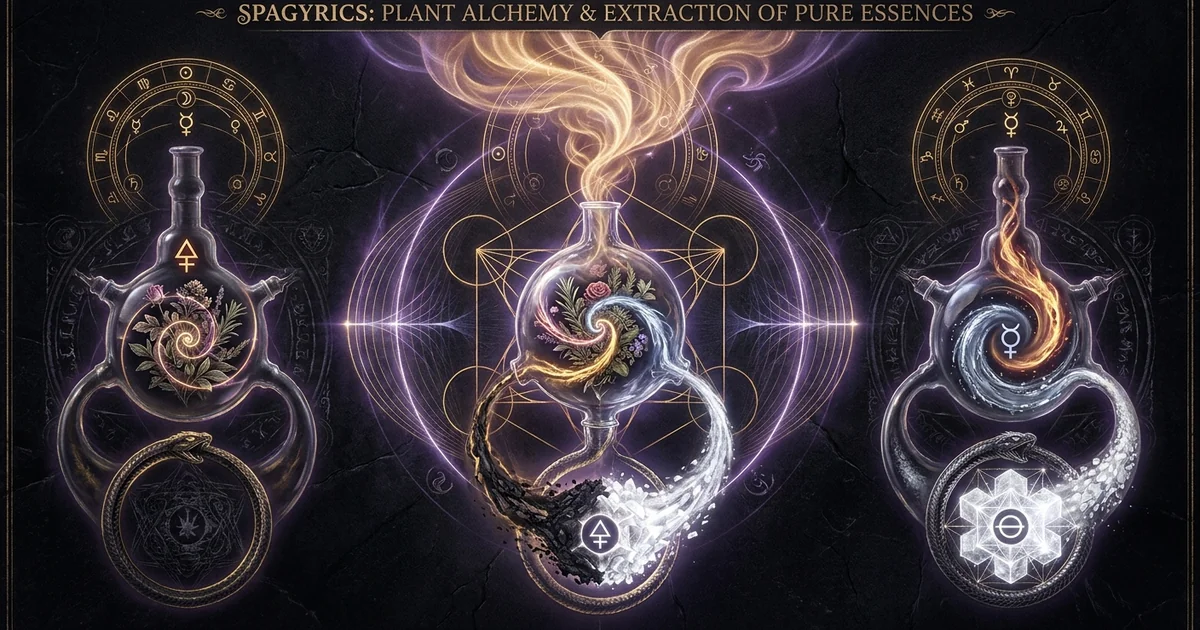
Spagyrics: Plant Alchemy & Extraction of Pure Essences
Metaphysical Thesis & Epistemological Opening: The Spagyric Paradigm
Spagyric praxis operates as an operative Hermetic technology that bridges Aristotelian hylomorphism, Paracelsian iatrochemistry, and modern subtle-energy physics. Within this discipline, the vegetal kingdom is not an aggregate of inert, carbon-based molecular machines, but an orchestrated manifestation of living metaphysical principles. Traditional phytotherapy and industrial pharmacognosy reduce plant medicine to isolated chemical compounds—alkaloids, flavonoids, and glycosides—stripped from their ontological substrate. This reductionist gaze perceives botanical matter through the post-Cartesian prism of mechanical materialism, in which physical matter (res extensa) is divorced from non-spatial consciousness or vitality (res cogitans). Spagyric philosophy explicitly rejects this bifurcation. Chemical constituents isolated by contemporary solvent extraction represent the desiccated corpses of plants: biomolecular residues deprived of the organizing spiritual agency that informed their genesis.
To overcome this epistemic dead end, spagyrism institutes an operative laboratory schema based on the tripartite constitution of reality. The laboratory process of spao-ageiro—violent deconstruction followed by exalted re-integration—liberates the latent life-force from organic cellular entropy. Through fractional distillation, anaerobic fermentation, and high-temperature incineration, the operator extracts the tria-prima: Sulphur (Soul), Mercury (Spirit), and Salt (Body). This systematic methodology proves that physical substance maintains an intrinsic psycho-informational continuity responsive to thermodynamic rectification and planetary resonance.
The term Spagyrics derives from two classical Greek verbs: σπάω (spao, meaning “to draw out, rend, tear apart, or divide”) and ἀγείρω (ageiro, meaning “to assemble, gather, bind, or reunite”). Coined by Theophrastus von Hohenheim (Paracelsus), this neologism signaled a radical epistemological break from scholastic Galenism. While classical humoral medicine relied on raw, unseparated mixtures (galenicals) that forced the human digestive tract to expend metabolic energy separating nutrients from poisons, the spagyric art executes this separation prior to ingestion. Spao performs the analytical dissolution of the plant matrix into its primary triune constituents, while ageiro synthesizes these purified principles into an exalted, non-natural whole.
Etymological Breakdown: Spao and Ageiro as Cosmological Operatives
The operational dialectic of spao and ageiro mirrors the cosmological dynamics of cosmogenesis and eschatology. In the initial phase, spao demands the analytical violence of laboratory intervention. The vegetal tissue must be crushed, macerated, and subjected to the decomposing action of thermal and enzymatic forces. This is not mere physical comminution; it is the deliberate undoing of the fallen, corruptible state of nature. In the framework of classical Hermetic cosmology found in the Corpus Hermeticum, matter within the sublunary sphere is subject to decay precisely because its constituents are locked in an impure, asymmetric equilibrium. By applying spao, the alchemist breaks the terrestrial bonds holding the archetypal energetic matrix captive within coarse cellular fiber.
Conversely, ageiro corresponds to the cosmological reintegration—the gathering of the scattered divine sparks back into a unified, coherent expression. Once the vegetal constituents have undergone their respective purifications through volatilization and crystallization, ageiro reassembles them into a unified vehicle. This operational rhythm parallels the Kabbalistic doctrine of Tikkun (restoration) following the Shevirat ha-Kelim (shattering of the vessels). The alchemist does not merely reconstitute the original plant; rather, the practitioner elevates it to a higher ontological octave. The post-spagyric vegetal entity possesses a crystalline coherence that raw nature, left to its own mechanical evolution, cannot achieve without the conscious mediation of the human operator acting as the catalytic artifex.
The Collapse of Mechanistic Phytochemistry: Overcoming Cartesian Dualism
Modern pharmacology treats botanical species as raw materials for molecular harvesting. In this mechanistic paradigm, the plant is an accidental container for a specific “active ingredient,” such as the salicylic acid of Salix alba or the hypericin of Hypericum perforatum. Once synthesized or extracted via petrochemically derived hydrocarbons like hexane, the remaining vegetal mass is discarded as useless dross. This methodology reflects the Cartesian conviction that organisms are biological automata governed exclusively by localized push-pull mechanics. This epistemological reductionism ignores the subtle synergistic buffers, biological mineral vectors, and informational coherence networks established by millennia of evolutionary adaptation.
By divorcing the plant’s volatile bioenergetic compounds from its mineral foundation, allopathic extraction introduces a thermodynamic imbalance into the human biological matrix. Industrial herbal tinctures frequently induce systemic side effects precisely because they lack the buffering fixed salts that govern cellular assimilation. Spagyrics bridges this divide by operating from a hylomorphic premise: form (morphe) and matter (hyle) are inextricably bound aspects of a singular living reality. When the practitioner executes the complete cycle of spagyrics plant alchemy extraction essential oils mineral salts, the resulting medicine operates simultaneously across biochemical, bioelectric, and psycho-informational axes, transforming inert therapeutic mass into an internally coordinated biocatalyst.
The Panpsychic Living Matrix: Plants as Condensed Cosmic Informational Signatures
Within the esoteric ontology underpinning spagyric praxis, the plant organism functions as an empirical microcosm. Celestial, planetary, and telluric energetic archetypes condense into biophysical structures via the agency of the astral-light and the spiritus-mundi. Far from being passive biological receptors, plants are specialized metabolic transducers that capture cosmic radiation and translate it into terrestrial chemistry through photosynthesis and morphogenesis.
This informational condensation follows the ancient doctrine-of-signatures, which posits that the morphology, chromatic display, ecology, and therapeutic properties of a plant signify its ruling planetary archetype. An herb governed by Mars, such as Urtica dioica, manifests stinging trichomes, high iron concentrations, and metabolic stimulating actions; an herb of Saturn, such as Symphytum officinale, exhibits rough epidermal textures, bone-repairing allantoin, and an affinity for dark, damp strata. Spagyric laboratory manipulation does not superimpose artificial energy upon the plant. Instead, it systematically strips away the chaotic entropic static of the decaying cellular matrix, allowing the archetypal celestial information to emanate without physical impedance.
Primary Codices & Historical Transmission: From Alexandria to the Renaissance Iatrochemists
Hermetic Archeology: Roots in Graeco-Egyptian Bolos of Mendes and Zosimos
The historical lineage of spagyric plant alchemy is intertwined with the development of mineral chrysopoeia and the Graeco-Egyptian metallurgical mysteries practiced in Hellenistic Alexandria. While early historical narratives often prioritized metallic transmutation, the proto-chemical treatises attributed to Bolos of Mendes (fl. 200 BCE) and the foundational codices of Zosimos of Panopolis (fl. 300 CE) reveal an integrated system wherein botanical and mineral transformations obeyed identical cosmic axioms. In the Physika kai Mystika (Physical and Mystical Matters) of pseudo-Democritus (Bolos of Mendes), the operational maxim “nature rejoices in nature, nature conquers nature, nature rules over nature” applied to the expression of vegetal tinctures as directly as it did to the dyeing of metals.
These early Alexandrian artisans worked within temple complexes where distillation apparatuses—such as the tribikos and kerotakis attributed to Mary the Jewess—were developed. These vessels were designed to extract the pneuma (spirit) from raw biological and mineral matrices. The botanical operations focused on preserving the ephemeral life-force of aromatic and sacred plants used in theurgic ceremonies. Following the destruction of the Serapeum and the decline of the Eastern Roman intellectual centers, this esoteric chemical technology migrated east into Syria and the Abbasid Caliphate. Islamic polymaths, most notably Jabir ibn Hayyan (Geber) and Abu Bakr al-Razi (Rhazes), codified these proto-spagyric techniques, refining the alembic (al-anbiq) and establishing fractional distillation regimes that later transformed early modern European medicine.
“Therefore learn the alchemical art, which is called spagyric; it teaches you to separate the false from the true. For the physician must not proceed blindly, nor must he administer the raw and unpurified herb as it grows from the earth, mixed with all its terrestrial corruption and excrement. The vulcanian fire must be applied; the body must be broken open, the spirit liberated from its prison, and the pure salt extracted from the ash. Only then do you possess the Arcanum, the true celestial medicine, wherein no terrestrial dross remains to hinder the work of the inner Archeus.”
The Paracelsian Revolution: Overthrow of the Galenic Humoral Hegemony
The consolidation of spagyrics as an autonomous system of philosophical medicine occurred through the iconoclastic labor of Theophrastus Phillippus Aureolus Bombastus von Hohenheim, known to history as Paracelsus (1493–1541). Entering the intellectual milieu of Renaissance Europe, Paracelsus confronted a deeply ossified medical establishment beholden to the Galenic-Arabic system of the four humors (blood, phlegm, black bile, and yellow bile). Galenic therapeutics relied almost exclusively on polypharmacy concoctions and crude herbal decoctions administered on the premise of contraria contrariis curantur (opposites cure opposites). Paracelsus perceived that these unseparated herbal waters (galenicals) forced the patient’s already compromised inner vital force—which he termed the Archeus—to engage in the metabolic labor of separating the pure essence from the impure physical matrix.
Galenic Paradigm (Scholastic-Humoral)
[ Crude Plant Decoctions ] --> [ Unseparated Impurities ] --> [ Metabolic Strain on Archeus ]
Paracelsian Paradigm (Spagyric-Iatrochemical)
[ Crude Plant Matrix ] –> [ Spao: Pyrochemical Separation ] –> [ Ageiro: Exalted Recombination ] –> [ Direct Arcanum Assimilation ]
Paracelsus argued that disease was not merely an internal humoral dyscrasia, but an ontological entity introduced into the microcosm via distinct archetypal vectors, which he classified in the Opus Paramirum as the Five Entia:
- Ens Astrale (cosmic and atmospheric influences);
- Ens Veneni (toxins assimilated through food and drink);
- Ens Naturale (constitutional and genetic predisposition);
- Ens Spirituale (psychic and spiritual trauma);
- Ens Dei (karmic and divine predestination).
To treat diseases originating at these dynamic levels, the physician required remedies that had been liberated from terrestrial corporeality. In his seminal texts, including the Archidoxis and the Kräuterbuch, Paracelsus demonstrated that the curative power of a plant does not reside in its gross physical mass, but in its Arcanum—its immortal spiritual core. By executing the pyrochemical operations of the vulcanian art, the physician-alchemist produces potentized herbal planetary remedies that interface directly with the human Archeus, restoring health through informational and vibrational resonance rather than brute chemical suppression.
Seventeenth-Century Rosicrucian Diffusion and Modern Lab Revivalists
Following Paracelsus’s death, spagyric philosophy penetrated the underground networks of Central European Rosicrucianism and early chemical philosophy. Figures such as Oswald Croll (Basilica Chymica, 1609), Heinrich Khunrath (Amphitheatrum Sapientiae Aeternae, 1595), and the enigmatic Basil Valentine systematically advanced the operational protocols of vegetal and metallic preparation. Croll, in particular, formalized the application of the doctrine-of-signatures, asserting that the exterior appearance of an herb was a divine hieroglyph marking its internal medicinal virtue. These developments occurred alongside the emergence of the mechanical philosophy of Robert Boyle and Isaac Newton. However, as scientific institutionalization advanced in the late seventeenth century, academic chemistry severed its ties from the metaphysical cosmos, discarding the tria-prima and preserving only the quantitative, dead residue of laboratory operations.
The modern preservation and empirical revival of practical laboratory spagyrics within the Western world is largely credited to Dr. Albert Richard Riedel, writing under the nom de plume Frater Albertus. Founding the Paracelsus Research Society (later Paracelsus College) in Salt Lake City, Utah, during the 1960s, Frater Albertus stripped the historic alchemical codices of their deceptive, intentionally obscured blinds. In his seminal text, The Alchemist’s Handbook (1960), Albertus systematized the vegetal work into clear, scientifically reproducible thermal regimes, fractional distillation protocols, and Soxhlet extraction methods. Albertus demonstrated that the spagyric process could be validated through empirical, repeatable laboratory steps while retaining its sacred philosophical alignment with macrocosmic laws. His work established the contemporary baseline for laboratory esotericism, enabling modern metaphysicians to execute the complete cycle of separation, calcination, and recombination with modern chemical glassware without sacrificing the sacred worldview of the Hermetic adepts.
Ontological Architecture & Cosmological Models: The Tria Prima in Vegetal Metaphysics
The operational cornerstone of spagyric theory is the doctrine of the Tria Prima—the Three Primes. Formalized by Paracelsus as an expansion of the classic Arab-Jabirian Mercury-Sulphur theory of metals, the Tria Prima posits that all material phenomena in the sublunary realm are synthesized from three universal ontological principles: Sulphur, Mercury, and Salt. These are not merely the physical substances known to modern chemistry by those names; they are cosmic hypostases that manifest within the vegetal kingdom as distinct, empirically extractable fractions.
[ THE TRIA PRIMA IN THE VEGETAL KINGDOM ]
                          |
      +-------------------+-------------------+
      |                   |                   |
  [ SULPHUR ]         [ MERCURY ]          [ SALT ]
  The Soul (Anima)    The Spirit (Spiritus) The Body (Corpus)
  Volatile Oils &     Universal Alcohol   Fixed Mineral Salts
Terpenic Resins (Ethanol Matrix) (Potassium Carbonate)Standard Herbal Extracts / Phytopharmacology
- Ontological Viewpoint: Matter is an inert, mechanical assembly; biological activity is attributed exclusively to isolated chemical compounds.
- Extraction Protocol: Employs harsh industrial solvents (hexane, petroleum ether, supercritical CO2); isolates single alkaloids or active components.
- Treatment of Ash: Depleted vegetal matrix is treated as biological waste (Caput Mortuum) and discarded.
- Energetic State: Entropy of the matrix is increased; life-force (anima) is extinguished, resulting in potential pharmacological side effects.
- Therapeutic Mode: Biochemical intervention via receptor binding; non-synergistic and chemically confrontational.
Spagyric Rectification & Recombination
- Ontological Viewpoint: The plant is a triune living microcosm reflecting macrocosmic planetary archetypes; matter and consciousness are continuous.
- Extraction Protocol: Sequential separation using water, steam, and the plant’s own fermented philosophical spirit (pure ethanol).
- Treatment of Ash: Plant biomass is calcined at high heat to pure white salts, leached, crystallized, and reintegrated.
- Energetic State: Triune components are rectified, elevated, and harmonized; volatile life-force is anchored within the purified mineral body.
- Therapeutic Mode: Multi-dimensional resonance across physical, etheric, and astral human subtle bodies; zero cellular toxicity.
Vegetal Sulphur: Essential Oils and the Preservation of the Individual Soul (Anima)
In the vegetal constitution, Sulphur represents the Anima—the unique, individual soul of the plant. CosmogPhysiologically, it contains the distinct character, the specific energetic identity, and the formal cause of the botanical organism. In the physical laboratory, vegetal Sulphur manifests as the volatile essential oils, oleoresins, and aromatic terpenes synthesized by the plant’s secondary metabolism.
Because it contains the concentrated expression of the plant’s individual identity, Sulphur is the principle of form and consciousness within the vegetal microcosm. It is through the Sulphur that an herb exerts its specific psycho-emotional and astral effects upon the human consumer. The essential oils are combustible, aromatic, and volatile, mirroring the expansive, creative characteristics of the cosmic Soul.
If this Sulphur is extracted through abusive, high-temperature industrial steam regimes, its delicate stereochemical configurations degrade. In contrast, gentle spagyric extraction methods—such as low-temperature hydrodistillation or sub-boiling Soxhlet extraction using purified menstruums—preserve this subtle structural integrity. When properly handled, the soul of the plant remains intact, prepared to undergo purification and eventual reunion with its rectified physical chassis.
Vegetal Mercury: Ethyl Alcohol and the Universal World Spirit (Spiritus Mundi)
Vegetal Mercury represents the Spiritus—the vital life-force, the animating breath, and the unitive energetic link between the transcendent Soul and the immanent Body. While Sulphur accounts for the diverse, particularized individuality of each botanical species, vegetal Mercury is universally undifferentiated across all plant life. In the laboratory, vegetal Mercury manifests exclusively as ethyl alcohol ($C_2H_5OH$) produced via the anaerobic fermentation of the plant’s intrinsic starches and sugars.
Whether obtained from the grape (Vitis vinifera), elderberry (Sambucus nigra), or valerian (Valeriana officinalis), the purified, redistilled ethanol molecule is structurally and metaphysically identical across the entire vegetal kingdom. It represents the localized condensation of the spiritus-mundi—the life-force that permeates the cosmos. Ethanol functions as the universal solvent precisely because it exhibits an amphiphilic nature: its hydrocarbon chain dissolves non-polar, oil-soluble substances (Sulphur), while its hydroxyl group binds polar, water-soluble matrices.
Philosophically, Mercury is the cosmic mediator; it descends into the material realm to tether the volatile Soul to the fixed Body. In spagyric processing, genuine philosophical Mercury cannot be substituted with petroleum-derived denatured alcohols or synthetic solvents. It must be derived through the living organic path of fermentation, capturing the subtle life-force as it vacates the decaying vegetal matrix.
Vegetal Salt: Calcined Mineral Ash and the Purified Corporeal Anchor (Corpus)
Vegetal Salt constitutes the Corpus—the physical vehicle, the grounding principle, and the material anchor of the plant. In standard phytotherapy and kitchen herbalism, the solid plant matter remaining after tincture maceration or decoction is considered spent dross and is discarded into the refuse. To the spagyric philosopher, this act is an ontological mutilation of the remedy. The physical body holds the crystalline blueprint of the organism; without it, the volatile soul and spirit have no fixed sublunary foundation upon which to act within the physical biology of the human patient.
The laboratory extraction of vegetal Salt involves calcining plant ash to white salts. The spent botanical biomass is subjected to pyrochemical fire, burning away all black structural carbon, tar, and volatile organic residue. The resulting grey-white ash is leached in distilled water, filtered, and slowly evaporated to yield pure, sparkling crystalline mineral salts—predominantly potassium carbonate ($K_2CO_3$), along with species-specific trace mineral oligomers. These water-soluble salts represent the purified corporeal matrix of the plant, elevated to a state of absolute mineral purity. It is this crystalline anchor that enables the spagyric elixir to root itself in the cellular structures of the physical body, rendering the volatile oils bioavailable and preventing their energetic dissipation.
Phenomenological Mechanics: Laboratory Operations of Solve et Coagula
The operational execution of spagyrics is governed by the axiomatic Hermetic formula: Solve et Coagula—dissolve and coagulate. This requires a sequential, four-phase laboratory methodology that disassembles the raw botanical matrix into its constitutive tria-prima, purifies each component according to its native thermodynamics, and reunites them into an exalted, potentized whole.
Separation of the Volatile: Steam Hydrodistillation and Soxhlet Regimes
The first stage of the spagyric process demands the separation of the vegetal Sulphur. The fresh or carefully dried botanical material is placed within a dedicated distillation apparatus. When working with plants possessing delicate aromatic profiles—such as Rosa damascena or Lavandula angustifolia—water-and-steam hydrodistillation is preferred over direct boiling to prevent the thermal pyrolysis of fragile monoterpenes. As steam permeates the vegetal tissue, the microscopic oil glands (trichomes) rupture, releasing their volatile contents into the vapor stream. The combined vapors travel through the condenser, cooling into a two-phase distillate comprising the aromatic hydrosol and the supernatant essential oil.
For plants whose therapeutic Sulphur is bound within heavy, non-volatile resins, waxes, or alkaloids—such as Commiphora myrrha or Arctostaphylos uva-ursi—the Soxhlet extraction apparatus is employed. In this continuous percolation regime, the plant material is positioned within a porous extraction thimble. Distilled philosophical alcohol is vaporized, condensed, and allowed to continuously flood the thimble chamber before siphoning back into the boiling flask. This recursive cycle continues until the solvent in the Soxhlet siphon arm runs completely clear, signaling the total extraction of the plant’s lipid- and alcohol-soluble Sulphur. The resulting saturated tincture is then concentrated via low-temperature vacuum distillation, separating the volatile solvent from the concentrated vegetal soul.
Anaerobic Transmutation: Fermentative Generation of the Philosophical Mercury
Once the essential oils have been secured, the remaining botanical biomass undergoes fermentation to yield the vegetal Mercury. If the material was subjected to steam distillation, its sugars and starches remain largely intact within the extraction residue. This biomass is transferred to an airtight fermentation vessel, immersed in pure spring water, and maintained at an ambient temperature of 20°C to 25°C. When necessary, clean saccharomyces strains or indigenous wild yeasts are introduced to facilitate the anaerobic conversion:
$$C_6H_{12}O_6 \xrightarrow{\text{zymase}} 2C_2H_5OH + 2CO_2$$
This biological decomposition represents a crucial esoteric transition. The plant dies to its original physical state, surrendering its structural sugars to microbial consumption. The volatile spirit of the plant is released from its carbohydrate bounds and held suspended within the aqueous solution as dilute ethanol.
Once the fermentation reaches completion, indicated by the cessation of carbon dioxide production, the liquid is strained from the solids and transferred to an alembic. Through carefully regulated, slow fractional distillation at 78.3°C, the alchemist captures the rectified vegetal spirit. This distillation is repeated multiple times—a minimum of seven passes—until the ethanol reaches an azeotropic concentration of 95–96% purity, free from heavy fusel oils and residual water. This fluid is the Philosophical Mercury: an untainted, receptive solvent prepared to receive the purified soul and body of the plant.
Pyrochemical Calcination: Incineration, Leaching, and Crystallization of Mineral Salts
The spent, solid plant matter remaining from the distillation and fermentation processes constitutes the Caput Mortuum (dead head). In conventional extraction systems, this residue is discarded. In the spagyric laboratory, it undergoes the trial of fire. The biomass is transferred to a ceramic, cast-iron, or fused-quartz crucible and subjected to high-temperature calcination over an open flame or inside a high-temperature muffle furnace.
Initially, the plant material blackens, smoking heavily as structural hydrocarbons burn away. This phase is the Nigredo of the plant work. The operator maintains temperatures between 500°C and 700°C for hours, occasionally stirring the mass to ensure complete oxygenation. Gradually, the carbonaceous material oxidizes, passing through stages of dull brown and grey, until the ash transmutes into a chalky, snow-white powder. This transition confirms the complete elimination of unorganized structural carbon.
Residual Biomass
  --> Pyrolysis / Nigredo (500°C–700°C)
  --> Unorganized Carbon Oxidized
  --> Leaching in Distilled Water
  --> Fine Filtration
  --> Slow Evaporation
  --> Purified Crystalline Potassium Carbonate ($K_2CO_3$)
The alchemist then performs the leaching (lixiviation) operation:
- The calcined white ash is dissolved in hot, demineralized water, releasing its water-soluble alkaline salts.
- The solution is passed through fine-micron quantitative filter paper, separating the soluble mineral phase from the insoluble silica and iron residues (terra damnata).
- The crystal-clear filtrate is gently evaporated over a low thermal bath.
- As the water volume recedes, pure crystalline needles of potassium carbonate, along with species-specific mineral salts, precipitate out of the liquor.
- These salts are repeatedly dissolved, filtered, and recrystallized until they exhibit a crystalline, vitreous appearance—the purified vegetal Salt ready for its spiritual recombination.
Cohobation and Circulation: Recombining Body, Soul, and Spirit within the Pelican
The final stage of the spagyric process realizes the ancient maxim of ageiro through the ritual of recombining body soul and spirit of herb. This operational step, known as cohobation, elevates the three purified fractions into a unified spagyric essence. The purified crystalline Salt is placed at the base of a specialized Hermetic circulation vessel historically known as a pelican—a glass alembic with two curved tubular arms returning from the head to the belly, facilitating continuous, refluxive self-digestion.
       [ CONDENSATION CHAMBER ]
                 /   \
 (Reflux Arm A) /     \ (Reflux Arm B)
               /       \
              v         v
        [ CIRCULATION VESSEL (PELICAN) ]
                     ^
                     | (Low Hermetic Heat: 40°C)
            [ BASE DIGESTION ]
       - Purified Mineral Salts (Salt)
       - Rectified Ethanol (Mercury)
       - Pure Essential Oils (Sulphur)
The operator adds the vegetal Sulphur (the essential oil) and the vegetal Mercury (the philosophical alcohol) to the salt in the vessel. The pelican is hermetically sealed with lute or laboratory-grade ground-glass joints clamped under spring tension. The apparatus is placed in a gentle, thermostatically regulated water bath maintained at approximately 40°C—approximating the internal temperature of a brooding avian organism or an incubating womb.
Inside the sealed vessel, a continuous circulatory dynamic begins:
- The heat vaporizes the volatile spirit, which ascends into the condenser head.
- The vapor cools against the upper walls, condensing into liquid droplets.
- The liquid cycles back down the lateral reflux arms into the base of the vessel.
- The descending liquid washes over the crystalline salts, absorbing mineral ions, and vaporizes again.
Over weeks or months of continuous circulation, an irreversible chemical and energetic synthesis occurs. The volatile essential oils, naturally immiscible in water, undergo partial saponification and transesterification against the alkaline potassium carbonate lattice. Their molecular chains restructure, rendering the oils fully water-soluble while preserving their delicate aromatic signatures. The three disparate kingdoms of the plant—the volatile astral soul, the ethereal universal spirit, and the fixed physical body—are unified into an exalted, potentized spagyric essence.
Initiatic Synthesis & Cosmological Therapeutics: Astral Signatures and Planetary Potentization
Astro-Spagyric Alignments: The Doctrine of Signatures Revisited
Spagyric medicine rejects the notion that pharmacology can be separated from chronobiology and macrocosmic astronomical alignments. The universe is a singular living organism characterized by the Hermetic axiom quod est inferius est sicut quod est superius (“that which is below is like that which is above”). The seven classical planets act as macrocosmic organs of the cosmic mind, radiating specific energetic signatures down into the earth through the medium of the astral-light.
To produce an authentic spagyric remedy, the operator harmonizes every laboratory manipulation with the astronomical configurations of the plant’s ruling celestial archetype. This requires precise calculation of planetary days, planetary hours, and the movement of the Moon through the zodiacal belt.
| Planet | Botanical Signatures | Physiological System | Metallic & Mineral Correspondence |
|---|---|---|---|
| Sun ($\odot$) | Golden flowers, heliotropic orientation, heart-shaped leaves, warming aromas (e.g., Hypericum perforatum, Helianthus annuus) | Cardiovascular system, vitality, the heart, arterial distribution | Gold, native solar salts |
| Moon ($\leftmoon$) | Night-blooming, high water content, silvery foliage, cooling actions (e.g., Salix alba, Selenicereus grandiflorus) | Lymphatic fluid, cellular cytoplasm, autonomic nervous system | Silver, marine carbonates |
| Mercury ($\mercury$) | Finely divided leaves, high neurological affinity, climbing or rapid growth (e.g., Centella asiatica, Foeniculum vulgare) | Central nervous system, respiratory exchange, pulmonary pathways | Quicksilver, native potash |
| Venus ($\female$) | Symmetrical floral morphology, sweet fragrances, high lipid content (e.g., Rosa gallica, Melissa officinalis) | Endocrine system, venous circulation, renal regulation | Copper, potassium complexes |
| Mars ($\male$) | Thorns, urticating hairs, high iron/pungent alkaloid content (e.g., Urtica dioica, Zingiber officinale) | Erythrocytes, immune response, metabolic heat generation | Iron, sulfur-mineral bonds |
| Jupiter ($\jupiter$) | Large physical stature, pleasant aromas, hepatic tonics, rich in tannins (e.g., Taraxacum officinale, Quercus robur) | Liver function, lipid metabolism, arterial structural integrity | Tin, soluble tartrates |
| Saturn ($\saturn$) | Woody perennials, dark foliage, cooling/drying, bone/connective tissue repair (e.g., Equisetum arvense, Symphytum officinale) | Skeletal matrix, connective tissues, structural boundaries | Lead, calcium silicates |
Harvesting the plant must take place during the planetary hour when the ruling celestial body is dignified and free from malefic aspects. Distillation of the Sulphur is executed when the Moon transits an elementally sympathetic sign (e.g., Fire signs for solar or martial plants, Air signs for mercurial herbs). Calcination and recombination are synchronized with dynamic aspects—such as trines or sextiles—between the ruling planet and the luminaries. Through these astronomical alignments, the crystalline lattice of the vegetal Salt is imprinted with macrocosmic radiation, permanently anchoring astral signatures into the physical preparation.
Circulatory Kinetics: The Pelican as Microcosmic Pleroma and Re-birthing Chamber
The pelican circulation vessel is more than a passive glass container; it serves as a functional microcosm. The structural design of the pelican, with its dual reflux arms sweeping back toward the base, intentionally replicates the self-contained circulatory architecture of the macrocosm. In Gnostic and Hermetic cosmologies, the pleroma denotes the divine plenitude—the totality of cosmic light-power, free from external lack or energetic leakage.
When the three primes are sealed within the pelican, they are quarantined from the fallen, entropic conditions of the outside world. The continuous heating and cooling within the hermetically sealed glass creates a micro-atmospheric hydrological cycle. Vapors ascend like transfigured souls escaping the terrestrial chassis, condense at the zenith of the vessel’s heaven, and descend through the lateral tubes to re-enter the calcined mineral tomb.
This rhythmic, perpetual motion strips the constituents of their energetic trauma. The essential oils are sheared, redistributed, and unified with the aqueous and alcoholic vapors, while the alkaline salts gradually ionize into the circulating solvent. The pelican functions as an artificial alchemical womb, accelerating structural evolution that would otherwise require centuries of subterranean geological pressure.
Theurgic Healing and the Evolution of the Human Energetic Microcosm
When a completed spagyric essence is administered to a human patient, its therapeutic mechanism differs fundamentally from that of conventional allopathic remedies. Allopathic pharmaceuticals intervene mechanically: molecules bind to targeted cellular receptors, often generating collateral toxicity and homeostatic compensation.
A spagyric essence operates as an informational wave across the subtle energy bodies of the human microcosm. Because the remedy possesses its own purified physical Salt, it passes through mucosal membranes and enters the bloodstream without demanding metabolic digestion from the liver.
The purified vegetal Salt anchors directly into the mineral and crystalline architecture of the human skeletal and nervous systems. Simultaneously, the vegetal Mercury—the universal life-force—restores depletion within the patient’s etheric matrix (prana or chi). Finally, the vegetal Sulphur interfaces with the human astral body, introducing the elevated archetypal intelligence of the governing planet.
In this way, the consumption of a spagyric elixir constitutes a minor theurgic sacrament. Systemic miasmas, cellular emotional blockages, and psycho-spiritual distortions are realigned with the macrocosmic harmonies of the planetary spheres. The remedy does not merely suppress physical pathology; it supports the structural evolution of the patient’s consciousness, transmuting the lead of somatic disharmony into the gold of psycho-physical equilibrium.
Spagyric laboratory praxis involves significant chemical and metaphysical risks that require strict operational discipline:
- Pyrochemical Inversion & Incomplete Calcination: Incomplete calcination of the vegetal ash leaves polycyclic aromatic hydrocarbons and carcinogenic tars within the Salt matrix. Leaching ash that retains black carbon results in an impure, potentially toxic preparation. Calcination must proceed until the ash achieves an absolute, uniform, off-white or crystalline state.
- Heavy-Metal Bioaccumulation: Plants harvested from soils contaminated with industrial run-off, heavy metals (lead, cadmium, arsenic), or agricultural pesticides will concentrate these elements within their tissues. While distillation leaves heavy metals behind, high-temperature calcination and leaching can concentrate water-soluble metal complexes into the recovered salt. Always verify raw botanical provenance using laboratory assays.
- Astrological Misalignment and Energetic Volatility: Ingesting planetary preparations synthesized during adverse astrological configurations—such as planetary retrogrades, eclipses, or malefic squares—can induce severe psycho-spiritual destabilization. A Mars essence prepared during an afflicted Mars transit can provoke acute inflammatory flares, hepatic distress, or psychic irritability, underscoring that laboratory iatrochemistry and astrological timing remain inseparable.
Frequently Asked Questions: Dialectical Inquiries into Spagyric Operations
Chemical Redundancy vs. Metaphysical Necessity: Why Calcination is Essential
A common reductionist critique launched by modern analytical chemists contends that the calcination of the vegetal matrix is chemically redundant. Modern spectroscopic analysis reveals that the white crystalline salt recovered from plant ash consists predominantly of potassium carbonate ($K_2CO_3$), accompanied by traces of sodium carbonate, calcium, magnesium, and bio-silica. The sceptic asks: why endure hours of high-temperature calcination and delicate leaching when one could dissolve off-the-shelf, pharmaceutical-grade potassium carbonate into a standard tincture to achieve the identical chemical outcome?
This reductionist critique fails to recognize both stereochemical and informational realities. First, historical alchemists proved chemically that the specific fixed alkalis derived from native plant ash contain distinct, complex trace oligomers unique to the plant’s biomineral composition. These minerals are naturally configured through biological assimilation, leaving distinct polymorphic crystalline geometries that laboratory-synthesized potassium salts do not exhibit.
“The Paracelsian emphasis on the fixed salt of the plant was not an empty mystical gesture; early modern chemical physicians demonstrated that the fixed alkali extracted from a specific plant’s ash contained unique structural properties that could not be replaced by generic commercial potash. This plant-specific salt retained an essential affinity for the volatile oil of the same species, serving as the necessary agent for its saponification and bio-absorption.”
Second, within the informational paradigm of spagyrics, the vegetal Salt serves as the localized memory core of that individual botanical life. It is the mineral matrix that anchored that specific plant’s existence beneath the rays of the cosmos. Substituting generic, industrially mined or synthesized potassium carbonate replaces this individual morphological template with a generic, energetically empty substrate, severing the continuity of the Tria Prima and destroying the integrity of the completed essence.
Planetary Chronometry: Astronomical Realities vs. Astrological Schemas
A foundational tension in modern spagyric work exists between symbolic astrological schemas and physical astronomical mechanics. Skeptics often question whether spagyric planetary timing relies on symbolic pop-astrology or if it reflects verifiable physical forces. The answer lies in the subtle-energy physics of macrocosmic-microcosmic interpenetration.
Astro-spagyric timing is based on objective, quantifiable shifts in cosmic fields:
- The geometric angles (aspects) formed between celestial bodies modulate interplanetary gravitational vectors and solar wind density.
- These fluctuating electromagnetic variations directly influence the Earth’s magnetosphere, altering the surface conditions of water molecules, ionic crystallization rates, and enzyme kinetics within biological organisms.
- When an alchemist operates during an astrologically calculated hour, they harmonize laboratory work with these planetary ray angles, electromagnetic perturbations, and the natural photoperiodic rhythms of the plant.
Celestial Dynamic:
[ Planetary Geometric Aspect (e.g., Sun Trine Mars) ]
        |
        v (Interplanetary Magnetic / Solar Wind Perturbation)
[ Ionospheric & Geomagnetic Flux ]
        |
Laboratory Reality:
        v
[ Crystalline Nucleation Alterations & Enantiomeric Phase Shifts ]
These forces do not act as crude, deterministic physical collisions. Rather, they operate as subtle informational inputs that alter the crystalline nucleation of the vegetal Salt, shift the enantiomeric ratios of volatile terpenes during hydrodistillation, and guide the recombination kinetics within the circulation vessel. Astrological chronometry in the spagyric laboratory is applied subtle-field physics, aligning the thermodynamics of laboratory glassware with the bio-cosmic engine of the solar system.
Distinction between Simple Tinctures, Spagyric Essences, and the Plant Stone
The operational landscape of vegetal alchemy contains three distinct developmental milestones. It is essential to delineate these preparations clearly:
[ Herbal Evolution: Three Tiers of Vegetal Alchemy ]

Tier 1: Simple Tincture (Maceration)
  - Raw herb steeped in commercial water/alcohol.
  - No separation of Tria Prima.
  - Caput Mortuum (ash) discarded; low bioavailability.

Tier 2: Basic Spagyric Tincture (Circulated)
  - Tria Prima separated: oils extracted, alcohol distilled, ash calcined.
  - Soluble potassium salts returned to the alcohol tincture.
  - Mild circulation; saponification neutralizes acids and stabilizes oils.

Tier 3: The Plant Stone (Vegetal Magistery)
  - Complete Soxhlet extraction, multiple redistillations.
  - Salt of Salt and Salt of Sulphur calcined to complete vitreous purity.
  - Continuous cohobation until the essence coagulates into a dry, translucent,
    solid-state wax capable of instantly dissolving in water/wine.
The foundational level is the Simple Tincture, produced by macerating raw plant material in a mixture of commercial alcohol and water. While pharmacologically useful, it is chemically unrefined and metabolically demanding. The volatile oils remain bound to raw tannins, the cellular fiber is discarded as waste without calcination, and the remedy contains none of the balancing fixed mineral salts.
The intermediate level is the Spagyric Tincture or Essence. Here, the three primes are extracted sequentially: the oils are isolated via distillation or Soxhlet extraction, the remaining matrix is fermented and distilled to yield natural philosophical alcohol, and the spent biomass is calcined to yield pure white mineral salts. These three purified principles are cohobated and circulated in a pelican, initiating partial esterification and saponification that renders the volatile oils stable, non-toxic, and immediately bioavailable.
The ultimate achievement of vegetal laboratory praxis is the Plant Stone (the Magistery of the Plant). This preparation requires extracting not only the water-soluble salts of the ash, but also its insoluble, fixed earth salts through prolonged, high-heat fusion with specialized fluxes. The plant’s essential oils are repeatedly circulated over these salts until the liquid ceases to boil, coagulating into a translucent, waxy, solid-state substance. The resulting Plant Stone does not melt; it dissolves instantly in both pure water and alcohol without releasing oil droplets. It exhibits transmutative properties within the vegetal realm, capable of instantly reviving dying plants, accelerating vegetation cycles, and operating within the human biofield as a high-potency restorative that balances the subtle energy bodies.
Through this systematic discipline—from initial extraction to the coagulation of the Plant Stone—spagyrics preserves its identity as an operative Hermetic technology. By refusing to sever matter from its cosmological and psycho-informational foundations, the spagyric art restores the broken continuity between the sublunary earth and the celestial spheres, transmuting the common flora of our world into vehicles of profound healing and spiritual restoration. :::