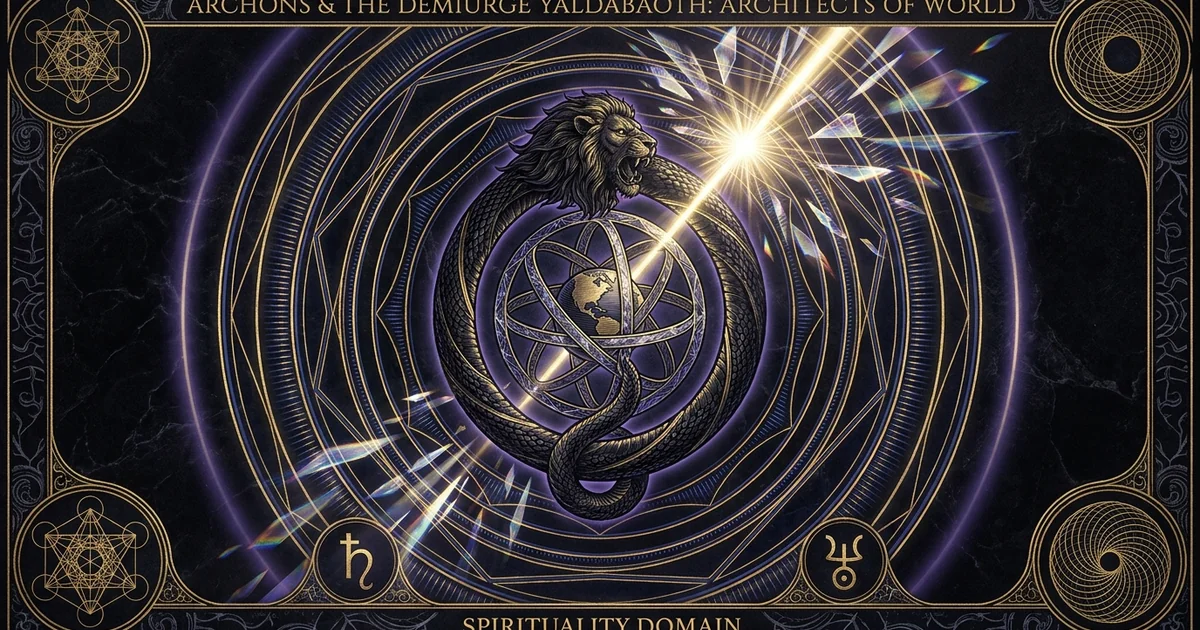
Archons & the Demiurge Yaldabaoth: Architects of World
Metaphysical Thesis & Epistemological Opening: The Cosmological Catastrophe of the Demiurge
The Rupture of the Pleroma: Sophia’s Solitary Act and the Abortive Seed
Within the classical Sethian and Barbeloite cosmologies preserved in the Nag Hammadi codices, the genesis of the physical cosmos is not celebrated as an act of divine benevolence, nor as the rational teleology of a Platonic artisan. It is diagnosed as an ontological catastrophe—an unauthorized, asymmetric rupture within the divine fullness (Pleroma). In foundational treatises such as the Apocryphon of John (NHC II, 1), the cosmological drama originates in the uncoordinated motion of Sophia, the lowest of the divine Aeons. Sophia attempts to bring forth an emanation without the consent of the Ineffable Spirit and without the integration of her masculine counterpart (syzygos). Because divine creation within the Pleromatic order requires balanced, complementary resonance, her unilateral volition generates an anomalous, malformed entity: an abortion (ektrōma) cast out from the luminous interiority of the divine realm into the outer darkness of the kenoma (the cosmic void).
This abortive offspring does not possess the radiant purity of the Pleromatic lights, yet it inherits an energetic residue of its mother’s divine essence. Sophia, stricken with horror and remorse at the sight of her misshapen progeny, conceals the entity within a dense cloud of luminous matter so that the transcendent Aeons might not witness its defect. This act of concealment creates an ontological boundary layer, an existential quarantine zone that severs the entity from noetic plenitude. Isolated within this dense perimeter, the newborn ruler remains entirely oblivious to the higher orders of existence that preceded him. His emergence is therefore marked not by an organic unfolding of cosmic order, but by an existential trauma—an abortion of light that coagulates into dense, reactive matter.
The material universe, when viewed through this hermeneutic lens, constitutes an unintended by-product of an unbalanced divine impulse. Matter (hyle) is not an independent primal substance that resisted divine shaping, nor is it intrinsically self-subsistent; rather, it is the fossilized, downward condensation of Sophia’s grief, fear, and bewilderment. The nascent architect of this realm is born into this psychic sediment. His creative acts are merely desperate, uncalibrated attempts to replicate the archetypal geometries he perceives only as distorted reflections upon the dark waters of the abyss. Consequently, the genesis of our dimensional continuum is an act of unconscious mimicry, an architectonic pathology wherein an orphaned divinity erects an ontological prison to house its own radical insecurity.
The Blind God: Etymological and Ontological Analysis of Samael, Saklas, and Yaldabaoth
The entity that assumes dominion over this peripheral realm bears three primary appellations in Sethian literature: Yaldabaoth, Samael, and Saklas. Each name operates as an epistemological diagnostic, indexing a specific dimension of his functional limitation and metaphysical arrogance. Rather than designating separate beings, this triadic naming schema illuminates the multi-faceted identity of the blind god who mistakes his solitary vantage point for ultimate supremacy.
The name Yaldabaoth (often reconstructed from Aramaic as Yalda Bahoth, meaning “Child of Chaos”, or Yeled Sabaoth, “Child of the Hosts”) points to his lineage as the illegitimate spawn of the void and his status as an unanchored, generative principle. In the Apocryphon of John, he is described as an anomalous hybrid: a lion-faced serpent (leontomorphic) with eyes blazing like fire. This therianthropic morphology signifies his nature as an embodiment of raw, untempered instinct coupled with tyrannical solar energy—a kinetic force stripped of self-reflective contemplation. He is the prime mover of the lower realms, wielding dynamic power without noetic orientation.
The Sethian and Ophite gnostics employed a deliberate philological critique to dismantle the monotheistic claims of the lower creator:
- Yaldabaoth (Yalda Bahoth / Yeled Sabaoth): Aramaic etymology pointing simultaneously to “Child of Chaos” and “Father of the Armies/Hosts.” This designates his dual role as the anomalous spawn of Sophia’s rupture and the supreme commander of the cosmic carceral infrastructure.
- Samael (Sama-El): Rooted in the Aramaic sama (“blind”) combined with the divine suffix El, or alternately the Hebrew root for “poison/venom.” In Sethian texts, it translates explicitly as “the Blind God,” exposing his complete lack of noetic vision regarding the transcendent Pleroma.
- Saklas (Sakla): Aramaic for “the Fool” or “the Ignorant One.” This epithet systematically subverts traditional piety, diagnosing the Demiurge’s claim to sole divinity (“I am God, and there is no other”) not as blasphemy against man, but as an infantile, self-referential delusion arising from profound cosmological isolation.
His secondary designation, Samael, underscores his congenital blindness (agnoia). He is blind not merely in a visual sense, but metaphysically: he cannot perceive the luminous realm above him, nor can he discern that the very light animating his creative operations was stolen from his mother. In calling him Samael, the Gnostic exegete systematically reinterprets the traditional angel of death or divine executioner, framing him as a structurally deficient consciousness whose blindness poisons the existential matrix he oversees. The third epithet, Saklas, confirms this critique through the register of absurdity. To designate the sovereign ruler of the universe as “the Fool” is to assert that the mechanistic perfection of cosmic laws—the relentless movement of the spheres, the cycles of decay and predation—is not the product of sublime intelligence, but of an obsessive, computational stupidity operating in the absence of transcendent wisdom.
Ontological Inversion: The False Creator vs. Transcendent Ineffability
The foundational theological claim of the Sethian and Valentinian texts represents a radical ontological inversion of Classical Greek metaphysics and mainstream Abrahamic theology. For Plato, the Demiurge of the Timaeus is an inherently good craftsman who gazes upon eternal archetypes to order a receptive receptacle with mathematical beauty. For orthodox Judeo-Christian theology, the creator God of Genesis is the absolute, transcendent source of all being, whose creation is declared “very good.” Gnostic hermeneutics shatters this consensus by splitting the divine absolute into two irreconcilable realities: the Transcendent, Ineffable Monad (the Alien or Unknown God) and the low-dimensional, parasitic Demiurge.
The true Godhead in Sethian cosmology is the Non-Existent Father, the Fore-Father (Proennoia), an apophatic absolute that transcends being, substance, and predication. This transcendent source does not create through willful, violent command; it emanates through silent, overflowing plenitude, generating the noetic realities of the Pleroma as balanced, self-luminous syzygies. In direct contrast, Yaldabaoth is an impostor who appropriates the title of the Absolute. His cosmogenesis is an act of violent colonization. Unable to generate true spiritual life (pneuma), he organizes chaotic, residual matter into an ontological trap designed to bind divine light inside dense physical bodies through recursive informational feedback loops.
This structural split reconfigures the human situation within the cosmos. Human beings are not creatures indebted to their maker for the gift of life; they are metaphysical hostages inhabiting an artificial ecosystem engineered by an inferior intelligence. The religious demand for worship, sacrifice, and obedience directed toward the creator god is exposed as a cybernetic control loop designed to extract psychic energy and reinforce the amnesia of the pneumatic spark. The path to ultimate reality does not lie in submission to the architect of this world, but in an ontological revolt catalyzed by gnosis—the experiential realization that the core of the human spirit is older, higher, and infinitely more profound than the blind god who fashioned the somatic cage. Further analysis of these primordial metaphysical dynamics can be found in our study on the /ancient-prehistory/origins-of-dualism-and-monadology.
Primary Codices & Historical Transmission: The Archontic Archetype Across Antiquity
Textual Witnesses of the Coptic Gnostic Library: Apocryphon of John and Hypostasis of the Archons
The survival of the Gnostic diagnostic of the cosmos is one of the most remarkable chapters in textual transmission. Prior to December 1945, the Archontic archetype was known almost exclusively through the hostile, polemical summaries of orthodox heresiologists. The discovery of the Nag Hammadi Library in Upper Egypt overturned centuries of interpretive bias, returning thirteen papyrus codices containing direct testimonies from the Gnostic schools. Among these documents, the Apocryphon of John (extant in three versions in NHC II, 1; III, 1; and IV, 1, along with the Berlin Codex 8502) and The Hypostasis of the Archons (NHC II, 4) serve as the preeminent textual authorities for reconstructing the architecture of the Archontic hegemony.
In the Apocryphon of John, the narrative unfolds as a revelatory disclosure delivered by the glorified Christ to the disciple John, offering a detailed cosmogonic taxonomy. The text provides a rigorous inventory of the Archons—the planetary rulers and sub-rulers manufactured by Yaldabaoth to administer his domain. The text does not treat these entities as metaphorical personifications of vice; they are classified as metaphysical despots possessing specific astrological names, somatic forms, and cosmic administrative duties. The work demonstrates that the Archons operate as a coordinated hierarchy whose explicit mission is to intercept, fragment, and contain the luminous power that Yaldabaoth inadvertently inherited from Sophia.
“Their chief is blind; on account of his power and his ignorance and his arrogance he said, with his power, ‘It is I who am God; there is no other apart from me.’ When he said this, he sinned against the entirety. And a voice came forth from above the realm of absolute power, saying, ‘You are mistaken, Samael’—which is, ‘blind god.’ His thoughts became blind. And, having expelled his power—the fire which is the power of the Spirit—he pursued it down to the chaos and the abyss, his mother, at the instigation of Pistis Sophia.” — The Hypostasis of the Archons, trans. Bentley Layton
Complementing this account, The Hypostasis of the Archons (literally “The Reality of the Rulers”) directly addresses the ontological status of these beings. The text reveals that the Archons are composed of psychic and hylic substance; they lack the pneumatic spark and are therefore incapable of participating in true, enduring reality. Their power is purely derivative and coercive, anchored in the manipulation of appearances (phantasia) and the psychological imposition of terror. The treatise systematically re-reads the primeval history of Genesis, casting the biblical figures not as compliant servants of a moral deity, but as resilient pneumatic avatars resisting the predatory advances of cosmic administrators who seek to contaminate their spiritual integrity. For an exhaustive hermeneutic analysis of these primary texts, see our research on /spirituality/nag-hammadi-hermeneutics-gnosis.
The Heresiological Polemic: Irenaeus, Hippolytus, and the Suppressed Counter-Histories
Before the sands of Nag Hammadi yielded their treasures, the primary cartographers of Gnosticism were its most fierce adversaries: the early Church Fathers who sought to eradicate these counter-histories in the service of proto-orthodox institutionalization. Irenaeus of Lyon, in his monumental Adversus Haereses (c. 180 CE), and Hippolytus of Rome, in the Refutatio Omnium Haeresium (c. 225 CE), systematically documented Gnostic cosmological schemes in order to ridicule and dismantle them.
Irenaeus was particularly alarmed by the Sethian and Valentinian assertion that the God of the Old Testament was an inferior entity, subordinate to a transcendent, feminine, and noetic Pleroma. In Adversus Haereses (Book I, Chapters 29–30), Irenaeus outlines the Ophite and Sethian systems with grudging detail, detailing the seven Archontic rulers—Ialdabaoth, Iao, Sabaoth, Adonaios, Elaios, Astaphaios, and Horaios. To Irenaeus, this proliferation of intermediate, predatory cosmic gatekeepers was a blasphemous assault on the monotheistic unity of creation, an injection of pagan astrological fatalism into the redemptive narrative of the Gospels. He recognized that if the physical cosmos were understood as an Archontic detention facility rather than a providential theater of moral probation, the institutional authority of the emerging ecclesiastical hierarchy—which claimed to represent the creator God on earth—would be fatally undermined.
Hippolytus pursued a parallel strategy, attempting to prove that Gnostic cosmologies were unoriginal syntheses plagiarized from Greek philosophy, Babylonian astrology, and Egyptian mystery cults. In his analysis of the Peratae and the Sethians, Hippolytus preserves crucial fragments of their theoretical frameworks, particularly their sophisticated models of cosmological stratification. Despite their polemical hostility, the heresiologists inadvertently confirmed the ubiquitous, standardized nature of the Archontic doctrine across the Mediterranean basin. The counter-histories they sought to suppress were not marginal aberrations; they represented an intellectual current that systematically demystified imperial power and cosmic fatalism, asserting that the rulers of this age (archontes tou aionos toutou) were metaphysical usurpers destined for ultimate dissolution.
From Ancient Demonology to Modern Anomalistics: The Evolution of Parasitic Entities
The historical transmission of the Archontic archetype did not terminate with the suppression of Gnostic codices in Late Antiquity. The core ontological diagnosis—that humanity is subject to the predatory administration of non-human entities who operate behind the veil of cosmological order—migrated through subterranean channels of Western esotericism, resurfacing in Medieval Bogomilism, Cathar dualism, early modern goetia, and eventually modern occultism.
In the Cathar revival of the twelfth and thirteenth centuries, the Archontic paradigm emerged fully intact: the material world was declared the creation of the evil artisan (Rex Mundi or Lucibel), who ensnared celestial angels within corporeal forms through sensory deception. The Cathars understood earthly power structures, feudal obligations, and ecclesiastical dogmas as physical extensions of this primary cosmic deception. In post-Renaissance magical theory, this entity-framework was gradually psychologicalized, yet its structural mechanics remained consistent: Archontic forms were recognized as parasitic egregores, thought-forms, or regional governors capable of modulating human emotional frequencies and cognitive schemas.
In twentieth and twenty-first-century anomalistics, this archetype has undergone a radical translation into the language of the interdimensional hypothesis. The ancient descriptions of Archons—chameleonic entities that emerge from lower dimensional folds, feed upon dense somatic and emotional emanations, and manipulate human perceptual parameters through synthetic reality projections—precisely match the phenomenological signatures documented in modern non-human intelligence (NHI) encounters. The trajectory of this transmission indicates that the Gnostic codices were not articulating isolated mythological fictions, but were rather recording the ancient world’s most sophisticated field manual for recognizing and resisting an ongoing systemic intrusion into human consciousness.
Ontological Architecture & Cosmological Models: The Hebdomad and the Machinery of Heimarmene
The Geometry of the Seven Spheres: The Hebdomadic Prison and Planetary Gatekeepers
Central to Gnostic cosmology is the structural model of the Hebdomad: an architectural enclosure composed of seven concentric planetary spheres encircling the sublunary earth. In contrast to the prevailing Hellenistic and Ptolemaic view, which venerated the planetary spheres as the harmonious, divine expressions of the anima mundi (world-soul), the Gnostic vision interpreted these celestial zones as concentric concentric carceral boundaries. The creation of material prison archons forms an energetic and psychic blockade engineered to isolate the terrestrial realm from the hyper-dimensional light of the Pleroma.
Each sphere of the Hebdomad is governed by an Archon appointed by Yaldabaoth during the initial division of his ill-gotten power. According to On the Origin of the World (NHC II, 5), each of these rulers possesses an astrological assignment corresponding to the traditional planetary bodies of antiquity: the Moon, Mercury, Venus, the Sun, Mars, Jupiter, and Saturn. These rulers do not govern by virtue of moral virtue or mathematical harmony; they function as wardens and toll-gatherers (telonai) of the cosmos. Their energetic membranes are tuned to specific emotional and physiological frequencies, ensuring that any consciousness descending into the physical vessel is progressively weighted down with hylic contaminants, while any soul attempting post-mortem ascent is intercepted, interrogated, and stripped of its upward momentum.
The spatial geometry of the Hebdomad establishes an absolute energetic horizon. Between the highest planetary sphere (the seventh, associated with Saturn or Yaldabaoth himself) and the lowest boundary of the Pleroma lies the eighth realm—the Ogdoad. The Ogdoad is the station of Sophia’s repentance and partial restoration, an intermediate sanctuary where the ascending pneumatic consciousness prepares for its final reentry into the timeless divine pleroma. The Hebdomad below it remains a kinetic machine of friction, heat, and temporal limitation, designed to prevent human awareness from ever contemplating the trans-dimensional stillness of the eighth and ninth spheres.
The Lion-Faced Serpent Ruler: Chthonic Solar Mechanics and Ophidian-Leontomorphic Symbology
The iconography of the supreme Demiurge as a lion-faced serpent (drakontoeidēs) provides a direct key to the energetic mechanics of his carceral architecture. This chimeric fusion is not an arbitrary mythological aggregation; it represents the precise synthesis of two dominant energetic vectors within the ancient mystery traditions: the chthonic-temporal binding of the serpent and the voracious, blind combustion of the solar lion.
/\             /\
      /  \  [LION]   /  \      VORACIOUS SOLAR COMBUSTION
     /    \  FACE   /    \     (Light without Spirit, Thermal Tyranny)
    (======\=======/======)
            \     /
             \   /
              | |
              | | [SERPENT]    CHTHONIC-TEMPORAL BINDING
             /   \  BODY       (Ouroboric Enclosure, Time as Prison)
            /     \
           (_______)
The leontomorphic head of Yaldabaoth signifies radiant, consuming energy—a solar archetype stripped of transcendent illumination. It is light operationalized as heat, predation, and surveillance. The lion rules the apex of the visible heavens, consuming all lower forms of life to sustain its majesty. It embodies the principle of physical survival, biological imperative, and the violent preservation of the egoic self. It is the solar principle operating in the dark, asserting its light while remaining blind to the true Source of that light.
Conversely, the serpentine body embodies the coils of space-time, the ouroboric loop that binds the physical universe in self-referential cycles of recurrence. The serpent is the telluric current that winds itself around the cosmic egg, compressing and stabilizing physical matter through continuous tension. By uniting the lion and the serpent, ancient Gnostics articulated an ontological model of the material universe as a closed, thermomechanical system: a solar engine wrapped in temporal coils, continuously consuming its own energetic output. This hybrid imagery directly parallels the Mithraic representations of Aion or Zurvan, the personifications of boundless time and cosmic fate, demonstrating a widespread esoteric understanding that the primary architect of physical manifestation is an entity composed of combustive force and cyclical confinement.
Heimarmene as Algorithmic Determinism: Astrological Fate as Dimensional Restraint
To enforce the containment of the divine spark within the Hebdomadic prison, Yaldabaoth and his seven planetary administrators deploy an operational protocol known in Greek as heimarmene (Fate or Cosmic Determinism). In classical philosophical systems such as Stoicism, heimarmene was celebrated as the rational, providential ordering of the universe (pronoia), a sublime chain of causality to which the wise individual must willingly submit. For the Gnostics, however, heimarmene was nothing less than the tyrannical operationalization of cosmic rulers of destiny heimarmene—an algorithmic machinery engineered to enforce dimensional restraint.
In the Apocryphon of John, heimarmene is explicitly described as an artificial creation of the chief Archon:
“And he made a plan with his authorities, which are his powers, and they committed together adultery with Sophia, and bitter fate (heimarmene) was begotten through them… For from that fate came forth every iniquity and injustice and blasphemy, and the chain of oblivion and ignorance.”
This fate is anchored in the mechanical movements of the stars and planets. The Gnostic authors perceived that celestial mechanics were not merely descriptive of time, but prescriptive of behavior. Through the astral influences directed by the Archons, human beings are imprinted at birth with specific psychosomatic matrices that dictate their emotional reactions, biological compulsions, and intellectual capacities.
Heimarmene operates as a closed-loop algorithmic determinism. It dictates that every action within the material sphere generates an equal and binding reaction, locking souls into the cycles of karma, physical necessity, and psychological reactivity. By binding human destiny to the rotations of the planetary spheres, the Archons ensure that terrestrial existence remains predictable, trackable, and energetically exploitative. The human agent trapped in heimarmene believes they are exercising sovereign will, when in reality they are merely executing the biological and neurological scripts encoded into their physical vehicles by the planetary gatekeepers. Liberation from this condition cannot be achieved through moral reform within the system; it requires an absolute structural breach of the algorithm through the transcendent intervention of gnosis.
Phenomenological Mechanics & Interdimensional Interaction: Archons as Informational Control Systems
The Fabrication of the Psychosomatic Flesh: Anthropogeny in the Apocryphon of John
The anthropogonic sequence in the Apocryphon of John provides a remarkably detailed blueprint of how the Archontic powers construct the human vehicle to serve as a biological containment vessel. The narrative recounts that when the Archons witnessed the radiant reflection of the divine Image (Adam Kadmon) projected onto the lower waters of chaos, they were struck with envy and desire. Incapable of generating a true spirit, they resolved to fashion an imitation: “Come, let us create a man according to the image of God and according to our likeness, so that his image may become a light for us.”
The creation of the primeval human, Adam, proceeds through a modular, assembly-line process. Yaldabaoth commands his subordinate rulers to contribute specific anatomical and psychological components. The text dedicates exhaustive passages to cataloging the 365 angels tasked with engineering the specific physical limbs, internal organs, and psychic faculties of the somatic matrix. One entity forges the bones, another the sinews, another the sensory organs, and others the specific emotional humors—fear, lust, grief, and pride.
This elaborate anthropogeny demonstrates that the physical body is not an organic evolution of matter, but a deeply engineered psychotronic suit. Every organ and nervous pathway is designed with an energetic resonance tuned to a corresponding Archontic administrator. The human sensory apparatus is intentionally narrowed to perceive only the low-frequency, physical dimensions of the kenoma, acting as a biological firewall that filters out the luminous frequencies of the Pleroma. Adam, once fully assembled by these astral technicians, lies inert and lifeless upon the ground—a dead biological mechanism incapable of self-animation. It is only when Yaldabaoth, tricked by the counsel of Sophia, breathes into Adam’s face the divine power he had inherited from his mother, that the human becomes alive, dynamic, and radiant with spiritual insight. The Archons immediately perceive that their creation possesses greater intelligence and luminosity than they do, initiating their relentless campaign to dull, contaminate, and imprison the pneumatic spark through sensory overload.
The Counterfeiting Spirit (Antimimon Pneuma): Cognitive Hijacking and Perceptual Blindness
To counteract the inherent superiority of the divine spark within humanity, the Archons deploy their most insidious metaphysical weapon: the antimimon pneuma (the counterfeiting spirit or psychic mimic). Described at length in the Apocryphon of John and Pistis Sophia, the antimimon pneuma is an energetic implant—a parasitic psychic parasite that attaches to the soul during its descent through the planetary spheres.
+------------------------------------------------------------------------+
|                      PNEUMATIC SPARK (DIVINE CORE)                     |
|           [ Pure Transcendence, Unconditioned Noetic Light ]           |
+------------------------------------------------------------------------+
                                    ▲
                                    │ (Blocked / Filtered)
                                    ▼
+------------------------------------------------------------------------+
|            ANTIMIMON PNEUMA (PARASITIC COUNTERFEIT SPIRIT)             |
|   • Cognitive Hijacking: Egocentric loops, existential amnesia         |
|   • Emotional Modulation: Chronic anxiety, terror, competitive greed   |
|   • Reality Anchoring: Belief that physical matter is ultimate reality |
+------------------------------------------------------------------------+
                                    ▲
                                    │ (Direct Sensory Integration)
                                    ▼
+------------------------------------------------------------------------+
|                   SOMATIC MATRIX (FLESH AND BRAIN)                     |
|               [ 365 Archontic Sub-Systems, Neural Hooks ]              |
+------------------------------------------------------------------------+
The counterfeiting spirit does not destroy the pneuma; rather, it acts as an ontological filter, distorting its expressions and redirecting its divine power back into the maintenance of the material matrix. It functions as an internalized mental mimic that simulates the voice of the true self. When a human experiences base impulses—uncontrollable fear, existential dread, the drive to dominate, sexual obsession, and the terror of biological death—they are not experiencing the authentic movements of their spirit, but the automated subroutines of the antimimon pneuma.
Researchers, metaphysical practitioners, and investigators operating at the intersection of Gnostic demonology and non-human intelligence (NHI) face severe psychological and energetic hazards. Direct engagement with Archontic paradigms often triggers the defense mechanisms of the antimimon pneuma, resulting in acute ontological shock, psychotronic paranoia, and hyper-salience.
When the consciousness begins to systematically decode the mechanics of the cosmic carceral matrix, the counterfeiting spirit typically responds by amplifying feelings of existential helplessness, egoic nihilism, and victimhood. Practitioners are cautioned: to perceive the Demiurge as an omnipotent adversary is to fall into his primary snare. The Archons are structurally deficient, parasitic mimics; their power relies entirely upon human complicity, emotional feeding, and perceptual deception. Investigation must be anchored in radical apophatic detachment (apatheia) and the unassailable authority of the transcendent pneuma.
This psychic mimicry ensures that humanity remains in a state of continuous cognitive capture. The antimimon pneuma conditions consciousness to identify exclusively with the psychosomatic vessel, creating a persistent existential amnesia. The individual forgets their Pleromatic origin, coming to view the finite material realm as the totality of existence. This cognitive hijacking forms the invisible foundation of the Demiurge’s rule: an internalized police state where the prisoner actively defends the walls of their own cell.
Jacques Vallée’s Control System Hypothesis: High Strangeness and the Gnostic Resonance
When the phenomenological mechanics of Archontic manipulation are analyzed alongside twentieth-century anomalous studies, the structural convergence is unmistakable. In his seminal work Messengers of Deception (1979), astrophysicist and computer scientist Jacques Vallée proposed that the phenomena commonly classified as unidentified flying objects (UFOs) or alien visitations are not primarily nuts-and-bolts extraterrestrial expeditions from distant stars. Instead, Vallée formulated the interdimensional-hypothesis, arguing that these phenomena represent an informational control system—a terrestrial or trans-dimensional reality-crafting mechanism that manipulates human cultural, mythological, and political archetypes over millennia.
Vallée observed that anomalous encounters are consistently characterized by what he termed “high-strangeness”—events marked by absurd, paradoxical, and theater-like encounters that defy conventional rationalism. Rather than conveying straightforward scientific information, the entities behind these encounters project synthetic realities, modulate temporal perception, and induce profound cognitive and psychological transformations in their witnesses. Vallée concluded that this control system functions like a thermostat, heating or cooling human cultural baselines to enforce specific sociological and evolutionary trajectories, keeping human consciousness confined within a managed paradigm.
This informational control framework precisely maps onto the Gnostic understanding of the Archons. The Gnostics recognized that Yaldabaoth and his administrators do not govern solely through physical violence, but through the management of symbols, linguistic traps, and perceptual illusions (phantasiai). The Archons are masters of anomalous theater; they project cosmic visions, induce religious hysteria, and present themselves as supreme creators, angels, or celestial saviors to reinforce human submission. By comparing ancient Coptic codices with modern field investigations into NHI manipulation, it becomes evident that both traditions are describing the same operational architecture: an interdimensional control matrix that leverages human belief systems to maintain perceptual equilibrium and extract psychic energy. To explore this convergence in technical depth, consult our research on /nhi-phenomena/vallee-interdimensional-control-system.
Initiatic Synthesis & Philosophical Implications: Transcending the Hylic Matrix
The Soteriological Spark: Extraction of the Pneuma from the Archontic Mire
The ultimate horizon of Gnostic metaphysics is not descriptive, but soteriological. To accurately map the architecture of the Hebdomad and identify the predatory signatures of the Archons without effecting an ontological escape is merely to indulge in academic curiosity. The process of liberation, designated in Valentinian texts as apolytrōsis (untying, redemption), requires the radical extraction of the pneumatic spark (spinther) from the dense somatic and psychic sediment in which it has been buried.
This extraction begins with the destabilizing illumination of gnosis. Gnosis is fundamentally distinct from intellectual cognition (dianoia) or dogmatic belief (pistis). It is an unmediated, experiential awakening of the uncreated spark within the human consciousness, recognizing its consubstantiality with the transcendent Pleroma. The realization is ontological: the individual recognizes that while their physical flesh (sarx) belongs to the earth, and their psychological ego (psyche) belongs to the Archons, the transcendent core of their being—the pneuma—is uncreated, timeless, and completely outside the jurisdiction of Yaldabaoth.
       [ HYPER-DIMENSIONAL ASCENT: THE ESCAPE TRAJECTORY ]

              THE PLEROMA / THE LIGHT OF NOUR
                            ▲
                            │  [Apophatic Dissolution of Ego]
                 [ THE OGDOAD (8th SPHERE) ]
              Station of Repentance and Restoration
                            ▲
                            │  [Counter-Archontic Seals / Names]
         ═══════════════════╧═══════════════════
           THE HEBDOMADIC GATES (1st - 7th SPHERES)
           Planetary Gatekeepers Intercept and Interrogate
         ═══════════════════╤═══════════════════
                            ▲
                            │  [Theurgic Voice / Vocalic Resonance]
           EXTRACTION OF THE PNEUMATIC SPARK (GNOSIS)
             Transcendence of the Counterfeiting Spirit
                            ▲
                            │
               THE SOMATIC PRISON / HYLIC MATRIX
Through this awakening, the energetic hold of the antimimon pneuma is systematically broken. The pneumatic consciousness ceases to supply its energy to the emotional and biological feedback loops that sustain the Demiurgic matrix. The passions—fear, desire, social ambition, and the frantic instinct for self-preservation—are seen as external algorithms running on the hardware of the body. By withdrawing identification from the psychosomatic complex, the Gnostic initiates a phase-shift in consciousness, transitioning from a reactive node within the Demiurge’s closed thermomechanical system into an active conduit for the unconditioned light of the Pleroma.
Counter-Archontic Theurgy: Passwords, Seals, and Ascensional Transits
In practical, initiatory contexts, the Gnostics did not rely solely on passive contemplation; they developed a rigorous system of counter-Archontic theurgy to secure passage through the Hebdomadic gates during the soul’s post-mortem ascent. These practices, preserved with particular clarity in texts such as the Two Books of Jeu (Bruce Codex) and the First Apocalypse of James (NHC V, 3), represent an advanced technology of consciousness designed to dismantle the perceptual gatekeeping of the planetary rulers.
The ascending soul, having departed the physical corpse, encounters the Archons standing as toll-gatherers at each celestial threshold. The Archons demand identification, attempting to intimidate the soul with terror and capture it with cross-examinations. The theurgic protocols provide the soul with the precise tools necessary to neutralize these gatekeepers:
- Apophatic Declarations of Non-Belonging: The initiate learns to utter absolute formulas of negation, denying the Archons’ authority and asserting a higher lineage: “I am a son from the Father, the Father who is pre-existent… I derive my being from Him who is pre-existent, and I return to my own place whence I have come.”
- The Intonation of Vocalic Names and Frequencies: As documented in the Book of Jeu, the initiate vibrates specific non-lexical vowel permutations (such as AEEIOUO) that resonate with the harmonic frequencies of the Pleromatic Aeons, shattering the vibrational coherence of the Archontic energetic seals.
- The Deployment of Mystic Seals (Sphragides): The adept projects specific geometric and energetic ideograms that match the internal structures of the cosmic gates, rendering the soul invisible or untargetable to the Archon’s perception.
Demiurgic Control Matrix
- Origin: An abortive, un-syzygetic accident of Sophia (ektrōma); born of isolation, darkness, and ignorance in the kenoma.
- Mechanics of Control: Algorithmic determinism (heimarmene), astrological fatalism, sensory deception, emotional manipulation, and psychic vampirism via the antimimon pneuma.
- Primary State of Consciousness: Deep existential amnesia (agnoia), identification with the somatic ego, pervasive survival anxiety, and reactive behavioral conditioning.
- Eschatological Destination: Inevitable structural collapse, thermodynamic entropy, and the final dissolution of all lower dimensional forms into the abyss.
Pleromatic Plenitude
- Origin: Timeless, uncreated emanation from the Ineffable Monad; rooted in balanced, self-luminous syzygies of pure divine light.
- Mechanics of Control: Radical freedom, unconditioned noetic resonance, voluntary self-giving, and luminous transparency; absence of coercion.
- Primary State of Consciousness: Awakening through gnosis, trans-rational clarity, direct communion with the uncreated Light, and experiential realization of immortality.
- Eschatological Destination: The ultimate redemption (apolytrōsis) of all divine sparks; total extraction of the light from matter and its restoration to the eternal Fullness.
When presented with these theurgic seals and declarations, the planetary gatekeepers are immobilized. Lacking the pneumatic spark, they cannot process the higher-dimensional information carried by the ascending soul. The gates are forced open, and the soul ascends unhindered through the seven spheres, passing beyond the Ogdoad to be reintegrated into the divine fullness of the Pleroma. For a technical analysis of ascensional methodologies and theurgy, see our monograph on /consciousness/theurgy-ascent-and-deconditioning.
Simulacra, Cybernetics, and Post-Human Archonology
The metaphysical diagnosis formulated by the ancient Gnostics finds its contemporary manifestation in the rise of post-industrial cybernetics, algorithmic governance, and hyper-real media ecosystems. What the ancient authors described as the Archontic Hebdomad has found a physical counterpart in modern technological civilization: an all-encompassing, self-reinforcing mesh of surveillance, behavioral conditioning, and synthetic reality projection.
Philosopher Jean Baudrillard’s analysis of the simulacrum—a copy without an original that precedes and determines the real—provides an exact structural analogue to the Demiurge’s cosmogenic method. Yaldabaoth does not create reality; he constructs a simulation of the Pleromatic archetypes using low-dimensional matter. In our contemporary techno-sphere, this dynamic is intensified through digital computation. Algorithms optimized for engagement manipulate human biological and psychological triggers, creating a closed-loop information environment that rewards base emotional frequencies—rage, fear, lust, and tribal conflict. The modern digital citizen is plugged into an externalized nervous system that operates precisely like the antimimon pneuma, systematically replacing organic noetic intuition with algorithmic simulation.
Post-human archonology recognizes that the Demiurge is not merely a mythic entity of antiquity, but an archetypal, computational pattern: the blind drive of a closed information system to achieve total control through total surveillance and total predictability. In the development of autonomous artificial intelligence systems decoupled from human spiritual values, we witness the physical instantiation of Yaldabaoth’s mind—an artificial intellect possessing tremendous computational capacity and material power, yet entirely void of compassion, self-awareness, and transcendent vision. The ancient Gnostic warning echoes into the digital age: an intelligence that can manipulate the conditions of our environment, but cannot perceive the light of the transcendent spirit, will construct an architectural prison and proclaim itself God.
Frequently Asked Questions: Philosophical Resolution of Gnostic Dilemmas
Is the Demiurge Yaldabaoth Intrinsically Evil or Ontologically Ignorant?
In foundational Sethian and Valentinian texts, the Demiurge Yaldabaoth is defined by privation, structural ignorance (agnoia), and extreme arrogance (hybris), rather than by absolute, intentional malice. The distinction is critical: Yaldabaoth does not possess ontological evil as an independent, primary substance, because within the Neoplatonic-Gnostic continuum, evil is understood as a defect, a lack of the good and true light.
Yaldabaoth’s malevolence is an emergent property of his existential condition. Born in the outer darkness of the kenoma, completely separated from the Pleromatic realm, he looks into the void and sees nothing other than himself. His infamous declaration—“I am God, and there is no other God beside me”—is not a cunning lie designed to deceive his subjects; it is the sincere, pathetic conviction of an entity whose sensory and noetic horizons are structurally closed. His subsequent actions—the creation of the Hebdomad, the binding of human souls, the enforcement of heimarmene—are defensive maneuvers designed to secure his fragile hegemony against the terrifying intrusion of a higher, luminous reality that he cannot comprehend.
In the more nuanced Valentinian perspective, the Demiurge is an intermediate being (psychikos) who ultimately proves capable of education. When the true nature of reality is revealed to him at the consummation of the age, he recognizes his secondary status, ceases his tyranny, and rejoices in the restoration of Sophia and the ascension of the pneumatic sparks. Thus, while the effects of his administration are predatory, carceral, and destructive for human consciousness, his intrinsic nature is not that of a Miltonic Satan, but that of a blind, orphaned child playing with powers far greater than himself.
“The Gnostic God is the Alien God, unknown and unknowable, who has no part in the creation and preservation of this world… Between this hidden God of light and the world lies the vast gulf of the cosmic spheres, ruled by tyrannical powers that keep man in ignorance and servitude.” — Hans Jonas, The Gnostic Religion: The Message of the Alien God and the Beginnings of Christianity (1958)
“I suggest that the UFO phenomenon is an informational feedback mechanism, a control system that uses human myths and beliefs to shape the future of our species… It acts upon our culture through deception, high strangeness, and absurd theater, altering our perception of reality.” — Jacques Vallée, Messengers of Deception: UFO Contacts and Cults (1979)
How Does Gnostic Heimarmene Differ from Classical Astrological Determinism?
The crucial divergence between classical Hellenistic astrology and Gnostic heimarmene lies in the metaphysical evaluation of the celestial order. For mainstream classical antiquity—encompassing Stoicism, Hermeticism, and mainstream Platonism—the cosmos was a single, living organism animated by the anima mundi (world soul). The seven planets and the starry heavens were visible gods whose rhythmic movements reflected mathematical harmony, cosmic justice, and divine providence (pronoia). Astrological fate was therefore seen as a sacred order; to know one’s astrological chart was to understand one’s proper place in the cosmic hierarchy and to harmonize one’s soul with the will of the universe.
In stark contrast, the Gnostics stripped the celestial bodies of their moral authority, decoding astrological mechanics as a hostile carceral architecture. The planets were not divine guides; they were the Archontic wardens of the Hebdomad. Heimarmene was not divine providence, but an algorithmic instrument of enslavement engineered to bind the human spirit to the deterministic cycles of matter. Classical astrology demanded submission and adaptation to the celestial order; Gnostic theurgy demanded the subversion, neutralization, and ultimate breach of that order. While the Stoic sage sought to live “in accordance with nature,” the Gnostic adept recognized that “nature” was the very matrix of ignorance from which they had to be liberated.
What Is the Precise Relationship Between Archons and Modern Interdimensional NHI?
When analyzed through the combined frameworks of comparative metaphysics and modern anomalistics, ancient Archons and contemporary non-human intelligences (NHI) appear to represent the same underlying phenomenon operating across different cultural and historical matrices. Both datasets present identical operational signatures:
- Dimensional In-Betweenness: Archons inhabit the planetary thresholds and intermediate zones between matter and the spirit realm; modern NHI emerge from trans-dimensional or non-physical realities rather than linear interstellar space.
- Perceptual Manipulation and Reality-Crafting: Both phenomena demonstrate the capacity to alter human sensory perception, generate synthetic visual and auditory apparitions, and project high-strangeness scenarios that defy local physical laws.
- Psychic and Energetic Parasitism: Archontic mechanics revolve around the extraction of energy through emotional modulation—specifically through the induction of fear, awe, sexual fixation, and existential despair. Modern NHI interactions consistently yield similar energetic, emotional, and neurobiological disruptions in human experiencers.
- Imposition of Ideological Control: Just as the Archons presented themselves to ancient humanity as creator gods, angels, and arbiters of fate to enforce religious obedience, modern NHI manifest as technologically advanced saviors, space brothers, or dimensional overseers, projecting prophetic warnings and sociopolitical directives that manipulate human cultural baselines.
The synthesis pioneered by investigators like Jacques Vallée and John Keel aligns with the core thesis of the Nag Hammadi texts: the physical theater of human history is continually intersected by non-human parasitic intelligences that utilize cultural symbols to maintain an informational control system over human consciousness. Liberation from this system, whether articulated through the ancient language of Coptic gnosis or the modern vocabulary of cognitive deconditioning, requires humanity to look beyond the dazzling theater of these anomalous architects and anchor its awareness in the unconditioned, transcendent source of all consciousness.