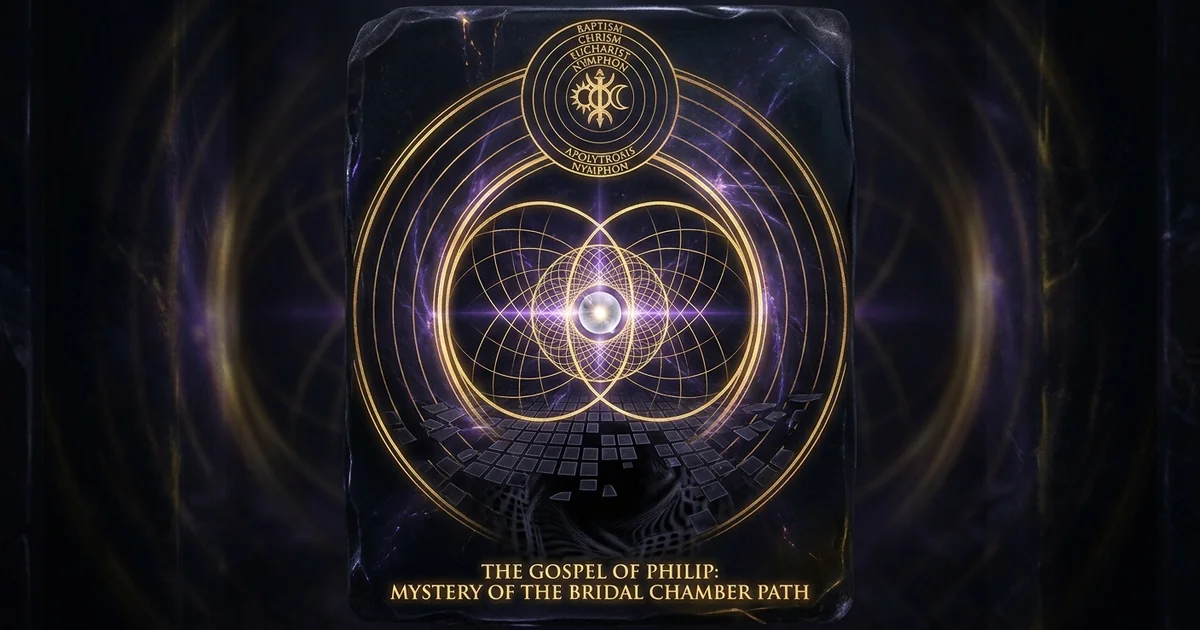
The Gospel of Philip: Mystery of the Bridal Chamber Path
Metaphysical Thesis & Epistemological Opening: The Ontological Rupture of Dualism
The Crisis of Cosmic Cleavage: Separation of the Archetypes
The architectural catastrophe of the lower cosmos, within the Valentinian framework, is fundamentally a crisis of division. The visible creation does not suffer merely from moral corruption or physical decay; it suffers from an ontological fissure wherein the primordial, unitive pleromatic state fractured into self-alienated binaries. In the third tractate of Nag Hammadi Codex II—the text designated as the Gospel of Philip—this cosmic cleavage is traced directly to the bifurcation of the archetypal human. When Eve was severed from Adam, the pristine androgyny of the luminous Anthropos collapsed into polarized sexual differentiation, introducing death into the terrestrial stratum. Philip explicitly asserts that as long as the primal unity remains cleaved, death remains operative; the separation of the masculine and feminine principles generates a metaphysical vacuum that feeds the entropic machinery of the demiurgic realm. Physical reality, structured under archontic governance, maintains its dominion precisely through this polarized tension: light is opposed to darkness, life is opposed to death, and the masculine is severed from the feminine. This fragmented condition renders humanity ontologically incomplete, trapped within an operational loop governed by cyclical reproduction and biological mortality.
+-------------------------------------------------------------------------+
|                  THE METAPHYSICAL CLEAVAGE & RESTORATION                 |
+-------------------------------------------------------------------------+
|                                                                         |
|   PLEROMA (Unitive Divine Plenitude / Primordial Androgynous State)     |
|                                |                                        |
|                          Cosmic Fall                                    |
|                   (Ontological Bifurcation)                             |
|                                v                                        |
|   KENOMA (Cosmic Cleavage: Archontic Polarization & Duality)             |
|          [Masculine / Spirit]  <----->  [Feminine / Soul]               |
|          [Light / Form]        <----->  [Darkness / Matter]             |
|                                                                         |
|                     THEURGIC ASCENSION ARC                              |
|           1. Baptism      -> Hylic Purge                                |
|           2. Chrism       -> Pneumatic Seal                             |
|           3. Eucharist    -> Trans-substantial Logos                    |
|           4. Apolytrosis  -> Archontic Decoupling                       |
|           5. Nymphon      -> Syzygetic Reconstitution                   |
|                                |                                        |
|                          Non-Dual Henosis                               |
|                                v                                        |
|   RECONSTITUTED SYZYGY (Immunity to Archontic Parasitism / Non-Locality)|
|                                                                         |
+-------------------------------------------------------------------------+
Challenging Somatic Materialism and Orthodox Post-Mortem Eschatology
Against this ambient degradation, the Gospel of Philip mounts a radical assault against the emerging proto-orthodox Christian consensus regarding somatic materialism and linear post-mortem eschatology. Orthodox ecclesiology posited a delayed, somatic resurrection occurring at the terminus of linear historical time, demanding that the subject endure death in anticipation of a physical, re-animated corpse. Philip denounces this expectation as an ontological absurdity. The author demonstrates that what does not awaken while bound within the somatic envelope cannot awaken once the envelope disintegrates; consciousness cannot synthesize after physical dissolution what it failed to substantively crystallize within the embodied state. To rely on post-mortem redemption is to fall prey to archontic deception, for physical death is an entropic mechanism rather than an initiatic threshold. Therefore, the tractate formulates an uncompromising doctrine of realized eschatology: the pneumatic subject must accomplish spiritual resurrection before physical death. If the resurrection is not acquired within the living flesh, the departed entity remains naked, fragmented, and vulnerable to interception by the lower cosmic administrators who govern the outer spheres of the planetary matrix.
The Sacramental Economy of Truth Transmitted in Types and Images
The epistemological apparatus of the Gospel of Philip pivots on the recognition that absolute truth cannot unveil itself directly within the terrestrial domain without instantly shattering the delicate psychic fabric of the receiver. The author formulates an epistemology of mediation: “Truth did not come into the world naked, but it came in types and images. The world will not receive truth in any other way.” The material world operates as a dense energetic mirror of the divine plenitude (the Pleroma); its phenomena are shadowy simulations, yet these very simulations can be inverted and weaponized as vehicles of ascent. This constitutes the sacramental economy. The types (typoi) and images (eikones) are not arbitrary metaphors, psychological projections, or decorative ecclesial symbols; they are operative theurgic landing pads designed to ground pleromatic frequencies within the sensorium. The mysteries function as intentional dimensional interfaces through which the unconditioned reality penetrates the conditioned matrix, allowing the pneumatic seed embedded within humanity to awaken, interface with its celestial archetype, and achieve the gospel of philip bridal chamber nymphon sacramental mystery gnosis.
“The sacraments in the Valentinian system are not merely signs representing an internal cognitive shift; they are real, operative actions that reconstitute the metaphysical structure of the initiate. The ritual execution alters the ontic status of the spiritual seed, detaching it from the cosmic administration of the Demiurge and grafting it into the syzygetic hierarchy of the Pleroma. The sacraments do not imitate salvation—they accomplish it.” — Einar Thomassen, The Spiritual Seed: The Church of the ‘Valentinians’ (Brill, 2006, pp. 93–97)
Primary Codices & Historical Transmission: The Valentinian Milieu of Codex II
Textual Provenance: Discovery and Stratification of Nag Hammadi Codex II,3
The survival of the Gospel of Philip is tied to the December 1945 discovery of the thirteen leather-bound papyrus codices near the cliff of Jabal al-Tarif, adjacent to Nag Hammadi in Upper Egypt. Designated as tractate 3 within Nag Hammadi Codex II (NHC II,3, pages 51,29 to 86,19), the text is preserved in a Sahidic Coptic translation influenced by Subakhmimic dialectal traces, copied around the mid-fourth century CE. Scholars such as Bentley Layton and Martha Lee Turner have established that the extant Coptic manuscript is an anthology derived from an earlier Greek compilation dating to the late second or early third century (c. 150–225 CE), most likely originating in the cosmopolitan, multilingual intellectual milieu of Roman Alexandria or Antioch. Codex II represents an intentionally curated initiatic curriculum, opening with the speculative cosmogony of the Apocryphon of John, transitioning into the personalized revelatory aphorisms of the Gospel of Thomas, and culminating in the sacramental manual of the Gospel of Philip. Unlike the synoptic narratives, Philip possesses no linear chronological framework, instead operating as an advanced mystagogical florilegium designed to guide initiates past the crude exotericism of the emerging proto-orthodox episcopacy.
+-------------------------------------------------------------------------+
|                  NAG HAMMADI CODEX II TEXTUAL ARCHITECTURE              |
+-------------------------------------------------------------------------+
|                                                                         |
|  [ NHC II,1: Apocryphon of John ]                                       |
|  --> Cosmological Emanation / Primal Fracture / Archontic Descent       |
|                                                                         |
|  [ NHC II,2: Gospel of Thomas ]                                         |
|  --> Interiorized Gnosis / Secret Sayings / Apophatic Awakening         |
|                                                                         |
|  [ NHC II,3: Gospel of Philip ]                                         |
|  --> Sacramental Mystagogy / Operative Theurgy / The Nymphon Path       |
|                                                                         |
+-------------------------------------------------------------------------+
Western vs. Eastern Valentinian Trajectories and Sacramental Divergence
Within the broader currents of Valentinian esotericism, historical theology identifies a bifurcation between the Eastern (Anatolian) school—represented by Theodotus and Heracleon—and the Western (Italic) school, whose foremost theoreticians included Ptolemy and the authorial community behind the Gospel of Philip. While the Eastern trajectory leaned toward a radically docetic and pneumatological interpretation that often devalued ritual action in favor of interior intellectual illumination, the Western school developed a sophisticated, operative sacramental theology. The author of Philip maintains that somatic engagement cannot be discarded as an irrelevance; rather, somatic structures must be transmuted via theurgic intervention. The text insists that the incarnation of the Logos was not a phantasmic illusion, but a precise tactical descent into the density of the physical sphere in order to establish an operative bridge between the visible and the invisible realms. Consequently, the Western Valentinian current did not flee ritual; it elevated ritual to an initiatic science wherein physical matter serves as the necessary, transfigured substrate through which transcendental gnosis anchors itself in the lower cosmos.
Philological Hermeneutics: The Coptic Translation of Greek Theological Nuance
A rigorous philological reading of Codex II,3 reveals that beneath its Coptic grammatical syntax lies an underlying Greek technical terminology that governs its metaphysical mechanics. The text relies heavily on Greek loanwords preserved directly in the Coptic manuscript, notably mysterion (mystery), typos (archetypal imprint), eikon (living image), and nymphon (bridal chamber). The Coptic verb pōrh (to separate, split) and tōwt (to gather, unite) are repeatedly utilized to map the metaphysical dynamic between cosmic cleavage and pleromatic henosis. Crucially, the Greek term syzygos (yoked pair, celestial consort) operates as the implicit structural pivot across every sacramental discourse. When Philip treats the Latinate and proto-orthodox concepts of “resurrection” (anastasis) and “salvation” (sōtēria), it strips them of their historical-apocalyptic baggage, framing them instead as immediate psycho-spiritual transmutations occurring within the initiatic continuum. The linguistic architecture of Philip demonstrates that the text was composed for an elite audience fluent in middle-Platonic ontology and late Antique mystery cultic terminology, demanding a rigorous hermeneutic that views every ritual term as an active metaphysical vector.
“Those who say that the Lord died first and then arose are mistaken, for he arose first and then died. If one does not first acquire the resurrection, he will not die. As God lives, that person is already dead… Those who say they will die first and then arise are mistaken. If they do not first receive the resurrection while they live, when they die they will receive nothing.” — Translation based on Bentley Layton, The Gnostic Scriptures (Doubleday, 1987) & Wesley W. Isenberg (NHS XI)
Ontological Architecture & Cosmological Models: The Fivefold Sacramental Chain
Hierarchical Metaphysics: From Water to the Unapproachable Radiance
The cosmological architecture of the Gospel of Philip posits an emanational hierarchy descending from the pristine, uncreated light of the Pleroma through the intermediary psychic spheres ruled by the Demiurge down to the coarse, entropic densities of the material matrix (the hyle). Humanity embodies a microscopic mirror of this macrocosmic catastrophe: within an outer hylic flesh-envelope (sarx) resides a fragile psychic soul (psyche), inside of which is enclosed the dormant, uncreated pneumatic seed (pneuma). Because the human condition is fractured across these distinct ontological strata, salvation cannot be accomplished via a single, unmediated leap of faith or a generic cognitive epiphany. Instead, the Gospel of Philip articulates a sequential initiatic chain consisting of five distinct sacraments:
$$\text{Initiatic Sequence} = \text{Baptism} \longrightarrow \text{Chrism} \longrightarrow \text{Eucharist} \longrightarrow \text{Apolytrosis} \longrightarrow \text{Bridal Chamber}$$
This fivefold progression constitutes an ontic scalar traversal, reversing the devolutionary fall of Sophia step-by-step. Each sacrament functions as an exact theurgic phase-transition that purges, seals, nourishes, decouples, and ultimately fuses the initiate’s consciousness back into the pleromatic current.
The Sequential Mechanics of the Five Sacraments
The text systematizes the five gnostic sacraments with technical precision:
- Baptism (baptisma): While the world recognizes merely somatic water, the Valentinian mystery pairs water with the celestial fire. Baptism operates as an elemental catharsis, stripping the hylic consciousness of its base gravitational inertia and dissolving the initiate’s unreflective participation in the demiurgic matrix.
- Chrism (chrisma): Philip explicitly elevates the Chrism above Baptism: “The Chrism is superior to baptism, for it is from the word ‘Chrism’ that we have been called ‘Christians’, not from the word ‘baptism’.” The anointing with olive oil, impregnated with aromatic balsam, is the application of uncreated light (phōs); it imprints an ontological seal (sphragis) upon the pneumatic seed, awakening it from its induced cosmic slumber and immunizing it against psychic contamination.
- Eucharist (eucharistia): Transmuting ordinary bread and cup, the Eucharist provides trans-substantial sustenance. The initiate ingests the true flesh and blood of the Logos: “The cup of prayer contains wine and water, serving as a type of the blood over which thanks is given… so that those who drink of it may receive the perfect man.” This act systematically refuels the pneumatic vessel with pleromatic substance, subverting the energetic decay enforced by physical consumption.
- Redemption (apolytrōsis): Operating as a high-tier initiatic severance, Apolytrosis directly breaks the psychic tether lines binding the soul to the planetary spheres (hebdomad) governed by the archontic hierarchy. It is the ritual nullification of archontic jurisdiction, liberating the interior spark from astrological determinism (heimarmene).
- The Bridal Chamber (nymphon): The apex and terminus of the system. The Nymphon is not merely a sacrament among sacraments, but the hyper-sacramental culmination that integrates, stabilizes, and seals the prior four phase-transitions into an irreversible condition of divine henosis.
Reintegration of the Syzygy: The Sophia-Logos / Pneumatic-Angelic Mirror
At the core of the Bridal Chamber’s mechanics lies the restoration of the archetypal syzygy (syzygia). In Valentinian cosmogony, the fundamental rupture originated when Sophia (Wisdom) attempted to emanate an entity without the consent and harmonious union of her masculine counterpart, generating the abortion that became the Demiurge (Yaldabaoth) and the unstable lower creation. The Gospel of Philip applies this archetypal model directly to human anthropology. The terrestrial soul is an externalized, wandering fragment of Sophia; she is inherently feminine in relation to the higher worlds, languishing in existential isolation and subjected to defilement within the material sphere. Her celestial partner is the angelic counterpart—an unfallen, masculine angelic template residing permanently within the Pleroma. The bridal chamber functions as the operative mirror wherein the scattered pneumatic spark (the terrestrial feminine soul) intersects and fuses with its angelic twin (the celestial masculine Logos). This is not an external wedding of two separate human beings; it is the internal theurgic realization of the union of masculine and feminine soul, reconstituting the primordial androgyny of the divine Anthropos.
Phenomenological Mechanics & Interdimensional Interaction: The Nymphon as Sanctuary
The Theurgic Technology of the Mirror and the Veil
The operational sanctuary of the Bridal Chamber is structured around the esoteric phenomenology of the mirror (katoptron) and the veil (katapetasma). In the ancient world, the mirror was not understood merely as a passive surface reflecting superficial photons, but as an active optical portal capable of transmitting forms between planes. Philip notes that an image can only be unified with its archetype through an unblemished reflective medium. The mystery of the Nymphon utilizes the mirror-mind of the purified pneumatic as the interface where heaven and earth gaze into one another. The veil, meanwhile, serves a dual protective and initiatic function: it demarcates the boundary between the Holy Place (the intermediate psychic realm) and the Holy of Holies (the unapproachable light of the Pleroma). Within the mundane temple, the veil hides the sacred from profane eyes; within the operative theurgy of Philip, the bridal chamber is entered by penetrating through the veil of the material senses. Once the initiate steps behind the veil into the radiant sanctuary of the bridal chamber, an ontological phase-shift occurs: the subject is enveloped in uncreated luminous energy, becoming invisible to the external sensory apparatus of the lower cosmos.
Archontic Interception: Informational Parasitism and Hypostatic Cloaking
To comprehend the tactical necessity of the Bridal Chamber, one must analyze the adversarial nature of the archontic control systems. Within the Valentinian cosmology preserved in Philip, the archons are non-human, hyper-dimensional parasitic entities that govern the material matrix by feeding upon psychic fragmentation, emotional turmoil, and the energy generated by dualistic conflict. They act as cosmic gatekeepers, scanning the transit corridors between the terrestrial plane and the higher dimensions. When an uninitiated, dualistic soul attempts to ascend through the planetary spheres following somatic death, the archons intercept, interrogate, and dismantle it, feeding upon its unintegrated astral mass and cycling the pneumatic spark back into the demiurgic reincarnation loop. The Bridal Chamber operates as an advanced hypostatic cloaking mechanism:
+-------------------------------------------------------------------------+
|                  ARCHONTIC INTERCEPTION vs. NYMPHON CLOAKING            |
+-------------------------------------------------------------------------+
|                                                                         |
|  UNINITIATED SOUL (Fragmented Duality)                                  |
|         |                                                               |
|         v                                                               |
|  [ Ascent through Planetary Spheres (Hebdomad) ]                        |
|         |                                                               |
|         +---> Intercepted by Archontic Sentinels                        |
|               * Emits psychic fear & dualistic polarity                 |
|               * Interrogated, dismantled, drained of vitality           |
|               * Recycled into Demiurgic Reincarnation Loop              |
|                                                                         |
|  INITIATE OF THE BRIDAL CHAMBER (Reintegrated Syzygy)                   |
|         |                                                               |
|         v                                                               |
|  [ Ascent Cloaked in Pleromatic Uncreated Light ]                       |
|         |                                                               |
|         +---> Invisible to Archontic Scanners                           |
|               * Non-dual frequency matching Pleroma                     |
|               * Unconditional transit through celestial gates           |
|               * Terminal absorption into Divine Fullness                |
|                                                                         |
+-------------------------------------------------------------------------+
Because the archons were produced by a rupture in the divine order, their perceptual apparatus is structurally blind to the frequency of complete, syzygetic union. By entering the Bridal Chamber while physically alive, the initiate assumes the identity of the angelic-pneumatic syzygy. The soul is no longer an isolated, exposed feminine entity adrift in hostile territory; she is clothed in the incandescent armor of her celestial spouse. When the initiate traverses the archontic zones, the predatory wardens perceive only absolute, blinding pleromatic fullness, which repels their parasitic grasping and guarantees the soul unmolested passage into the divine assembly.
Somatic/Defiled Marriage (Biological Matrix)
- Ontological Purpose: Multiplication of biological bodies; ensures the continuous capture and dispersal of the pneumatic seed within the material matrix.
- Relationship to Time: Bound to linear duration, cyclical decay, generational mortality, and the reproductive mandates of the Demiurge.
- Vulnerability to Archons: Directly subjected to archontic psychic interception; erotic energies are harnessed as fuel for the lower cosmic matrix.
- Somatic Consequences: Leads inexorably to cellular exhaustion, somatic decomposition, and psychic entrapment within the terrestrial sphere.
The Mystery of the Nymphon (Syzygetic Unification)
- Ontological Purpose: Concentration, unification, and extraction of the pneumatic seed; reconstitution of the divine androgynous Anthropos.
- Relationship to Time: Trans-temporal; operates as a vertical puncture into the eternal now of the Pleroma, terminating cyclical rebirth.
- Vulnerability to Archons: Complete hypostatic cloaking; renders the unified syzygy entirely invisible and invulnerable to archontic sensory apparatus.
- Somatic Consequences: Imprints the uncreated resurrection frequency onto the living flesh, producing sovereign metaphysical autonomy.
The Transfiguration of Eros: Somatic Dissolution into Pneumatic Union
The Gospel of Philip executes a radical metaphysical transfiguration of Eros. The author does not preach an ascetic, puritanical eradication of desire, nor does he endorse a hedonistic descent into somatic indulgence. Both extremes are recognized as archontic traps: puritanical repression deepens dualistic self-hatred, while somatic libertinism merely replicates the biological machinery of the Demiurge. Philip distinguishes between “defiled marriage” (gamos akathartos), which occurs in the dark under the impulse of biological lust and results in the generation of mortal flesh, and the “undefiled marriage” of the Bridal Chamber, which occurs in the radiant light of pure spirit. The theurgic genius of the text lies in its understanding that the erotic drive is the lowest, inverted terrestrial octave of the divine yearning for henosis. The mystery of the Bridal Chamber captures this volatile, primeval erotic current, untethers it from the reproductive mandate of physical semen, and redirects its energetic vector vertically into the pneumatic heart. It is a process of somatic dissolution wherein the fire of base desire is transmuted into the luminous gold of syzygetic integration, fusing the polarized poles of consciousness into an ecstatic, indissoluble unity.
Initiatic Synthesis & Philosophical Implications: Realized Resurrection in the Living Flesh
The Fallacy of the Post-Mortem Assumption: Realized Eschatology
The devastating philosophical critique leveled by the Gospel of Philip against orthodox Christianity is its complete dismantling of the post-mortem assumption. In logion after logion, the tractate emphasizes that biological death holds zero transformative efficacy:
$$\text{Post-Mortem Decay} \neq \text{Pneumatic Metamorphosis}$$
The physical body is merely an outer garment of hylic clay; casting it aside does not elevate the soul any more than undressing makes an uneducated person wise. If an individual departs the physical body while still internally bound to the archontic conditioning of fear, guilt, sexual polarization, and ontological division, that individual remains an amputated, vulnerable psychic ghost in the intermediate regions. The resurrection is not a distant, apocalyptic event orchestrated by an external judge; it is an immediate, self-actualized phase-transition that must be achieved in the present moment, within the living organism. The assertion that “Christ arose first and then died” establishes an operative paradigm: the pneumatic initiate must internally cross from death to life, entering the luminous stability of the Pleroma, while the mortal heart continues to beat within the ribcage. To achieve this state is to achieve realized eschatology—the absolute cancellation of death’s reality long before the biological vessel collapses.
+-------------------------------------------------------------------------+
|                  THE ESCHATOLOGICAL DICHOTOMY                           |
+-------------------------------------------------------------------------+
|                                                                         |
|  PROTO-ORTHODOX POST-MORTEM MODEL:                                     |
|  [ Mortal Life ] ---> [ Somatic Death ] ---> [ Intermediate Sleep ]     |
|                                                     |                   |
|  [ Somatic Resurrection at End of Linear Time ] <---+                   |
|                                                                         |
|  VALENTINIAN REALIZED MODEL (GOSPEL OF PHILIP):                         |
|  [ Mortal Life ] ---> [ Theurgic Nymphon Initiation ]                   |
|                             |                                           |
|                             v (Immediate Ontological Phase-Shift)       |
|                       [ Spiritual Resurrection in the Living Flesh ]    |
|                             |                                           |
|                             v                                           |
|  [ Biological Death as Irrelevant Sloughing of the Garment ]            |
|                             |                                           |
|                             v                                           |
|  [ Sovereign Unification with the Pleroma ]                             |
|                                                                         |
+-------------------------------------------------------------------------+
Pneumatic Sovereignty and Trans-Temporal Consciousness
The initiate who achieves the mystery of the Bridal Chamber attains an unprecedented degree of pneumatic sovereignty. Having reclaimed their celestial consort, the individual ceases to be a passive subject within the cosmic matrix. The author of Philip describes this state as a profound reversal of authority: while the ordinary person is terrified of the archontic powers, the archons themselves become terrified of the fully realized pneumatic initiate. This sovereignty stems from the cultivation of trans-temporal consciousness. Ordinary human awareness is locked into horizontal time—a past structured by memory and trauma, and a future plagued by the terror of annihilation. The Bridal Chamber represents a vertical puncture through the horizontal axis of time. In this state of syzygetic alignment, the initiate experiences reality simultaneously from the perspective of the unfallen Pleroma and the terrestrial locus. The world loses its oppressive substantiality; it is seen for what it is: a shimmering, transient theater of types and images. Walking the earth as an embodied paradox—visible to mortal eyes, yet fundamentally seated within the unapproachable light—the gnostic initiate operates as an extraterritorial embassy of the divine plenum within the demiurgic wasteland.
The Radical Restoration of Primal Androgyny (Anthropic Integration)
Philosophically, the Gospel of Philip’s Bridal Chamber represents one of the most radical models of anthropic integration in late antique thought. It identifies human suffering and existential alienation not as consequences of moral disobedience, but as the natural psycho-spiritual outcome of cosmic cleavage. By restoring the primal androgyny, the Bridal Chamber accomplishes what modern depth psychology identifies as the synthesis of the conscious ego with the profound depths of the transpersonal self—the archetypal coniunctio oppositorum. Yet Philip’s vision is entirely theurgic and cosmological: it is not a mere psychological equilibrium, but the actual ontological repair of the Anthropos. When the feminine soul and the masculine angel fuse within the mirror of the bridal chamber, the illusion of otherness evaporates. There is no longer an external God judging an abject creature, nor an alienated human trembling before a hostile universe. The subject and object, observer and observed, lover and beloved, collapse into an ecstatic, indivisible pleromatic non-duality. The pneumatic seed has returned to the root of its being; the cosmic cleavage is healed; the mystery of the Bridal Chamber is realized.
The supreme danger in approaching the mystery of the Nymphon lies in the catastrophic collapse of the theurgic archetype into mundane sexual occultism or psychic inflation (hybris). Throughout history, degenerate misreadings of the Gospel of Philip have attempted to justify somatic libertinism, promiscuous ritualism, or narcissistic self-deification under the banner of Valentinian gnosis. To reduce the syzygetic union of the soul and its angelic counterpart to a physical erotic rite is to remain hopelessly trapped within the lowest frequencies of the archontic matrix, substituting animalistic procreation or somatic thrills for pneumatic reintegration. Conversely, the initiate who claims the status of the risen Anthropos without having undergone the rigorous purifying fires of the prior four sacraments falls victim to severe psychological inflation, mistaking the fractured ego for the uncreated light. The Bridal Chamber demands absolute somatic chastity of the spirit, deep moral purification, and rigorous apophatic detachment; without these foundations, the attempt to cross the veil results not in pleromatic liberation, but in catastrophic psychic fragmentation and demonic obsession within the demiurgic mirrors.
Frequently Asked Questions: Hermeneutic and Ontological Clarifications
Was the Bridal Chamber a Physical Rite or a Purely Interior State?
The long-standing scholarly debate between a purely ritualistic reading and a purely metaphorical-interiorized reading of the Bridal Chamber fails to grasp the nature of Valentinian theurgy. Primary textual analysis of Codex II,3 indicates that the Bridal Chamber was an embodied sacramental praxis that utilized physical actions as operative anchors for interior metaphysical states. Initiates did not merely sit in quiet meditation, nor did they engage in somatic sexual intercourse. Rather, the historical community engaged in an actual liturgical liturgy—incorporating prayer, anointing with fragrant chrism, the ritual sharing of the holy kiss (aspasmos), the wearing of white garments, and the symbolic entrance into a veiled, consecrated sanctuary space (pma n-shelewt). This external liturgical scaffolding was understood to be structurally resonant with celestial dynamics; the physical sensory actions were the typoi and eikones that enabled the psychic soul to latch onto the descending angelic double. The rite was both physically real and purely pneumatic, operating precisely at the interface where somatic form is penetrated and transfigured by pleromatic light.
How Does the Realized Resurrection in Philip Differ from Orthodoxy?
The distinction between the Valentinian doctrine of resurrection in the Gospel of Philip and that of proto-orthodox Christianity (represented by figures such as Irenaeus, Tertullian, and Justin Martyr) is absolute, both chronologically and ontologically:
- Chronological Dimension: Orthodoxy posits a delayed general resurrection occurring at the historic end of the age (parousia), requiring the soul to wait in an intermediate state (Hades or sleep) until the general judgment. Philip flatly rejects this timeline, declaring that if one does not acquire the resurrection while walking in the flesh, one will never receive it. Resurrection is an urgent, present reality.
- Ontological Dimension: Orthodoxy insists on the literal reconstitution of the decomposing material flesh (resurrectio carnis), asserting that the identical somatic particles that decayed in the grave will be re-animated. Philip explicitly ridicules this somatic materialism: “Flesh and blood cannot inherit the kingdom of God… What is it that will not inherit? That which is on us. But what is this that will inherit? It is that which belongs to Jesus, which is his blood and his flesh.” For Philip, the flesh that rises is not the mortal animal garment, but the luminous, transfigured pneumatic body acquired in the Bridal Chamber.
What is the Precise Relationship Between the Angelic Double and the Human Pneumatic Spark?
In Valentinian angelology and anthropic metaphysics, the relationship between the human pneumatic seed and its angelic consort is an asymmetric syzygetic polarity. The pneumatic spark residing in the human heart is an externalized, wandering emission of the pleromatic Sophia—spirit fallen into the temporal labyrinth of matter and stripped of its structural coherence. Conversely, the angelic counterpart is an eternal, unfallen masculine thought-entity inhabiting the crystalline stability of the Pleroma. The angel represents the divine, undistorted blueprint of the human soul. Throughout earthly incarnation, the angel stands at the threshold of the Pleroma, interceding for its fallen terrestrial twin. However, the angel cannot enter the absolute fullness of the divine presence alone; it is incomplete without its terrestrial counterpart, just as the wandering soul is blind and vulnerable without its celestial spouse. The mystery of the Bridal Chamber collapses the dimensional gulf separating these two halves of the divine equation. The human soul awakens to its true identity not by annihilating itself, but by fusing with this trans-dimensional double, achieving a synchronized state wherein human interiority and angelic radiance become a single, unified operational vector.
The Coptic manuscript of the Gospel of Philip employs both the native Coptic phrase ⲡⲙⲁ ⲛϣⲉⲗⲉⲉⲧ (pma n-shelewt, literally “the place of the bride/the wedding room”) and the borrowed Greek substantive ⲛⲩⲙⲫⲱⲛ (nymphon). In Greco-Roman antiquity, the nymphon was the inner bedchamber of the bride, an inviolable domestic sanctuary reserved for the solemnization of the marital covenant. By adopting this architectural and spatial term, the Valentinian author deliberately evokes the imagery of an interior sanctum sanctorum. In the Septuagint and Jewish Hellenistic literature (such as Philo), the nymphon parallels the Holy of Holies of the Jerusalem Temple. Thus, the linguistic layering in Codex II,3 indicates to the initiate that the pma n-shelewt is not a profane room, but the ultimate vertical sanctuary of the cosmos—the hidden chamber behind the cosmic veil where humanity meets the divine face-to-face.