Sophias Fall and Redemption: Cosmic Wisdom in the Shadow
Metaphysical Thesis & Epistemological Opening: The Cosmic Catastrophe of Unpaired Emanation
Epistemological Rupture of the Syzygial Order
Within the architecture of classical Gnostic cosmogony, the primary perturbation of reality does not originate from a moral transgression or an ontic rebellion against divine sovereignty. It arises instead from an epistemological crisis occurring within the transcendental enclosure of the pleroma—the totality of divine light constituted by paired archetypal emanations known as syzygies.
In the overarching narrative of the Sophia fall and redemption cosmic wisdom gnostic mythos aeon, Sophia occupies the outermost perimeter of this divine fullness. As the terminal Aeon of the pleromic hierarchy, she embodies wisdom in its outward-facing, exploratory capacity. The catastrophic rupture occurs precisely when this sapiential potency seeks an unmediated, exhaustive comprehension of the unfathomable Forefather (Proarche or Bythos), bypassing the complementary mediation of her syzygial partner, Theletos (Desire).
By emanating without consort, Sophia breaks the geometric and ontological equilibrium of the pleromic order. In classical Valentinian and Sethian formulations, divine generation requires reciprocal, polar coherence: dynamic tension balanced by mutual contemplation. Sophia’s unilateral reach toward the transcendent source constitutes an epistemic overreach—an attempt by an individualized aeonic node to grasp the unconditioned Absolute through isolated projective will.
Because the Forefather is by nature apophatic, uncircumscribed, and intrinsically unknowable to any single localized consciousness, Sophia’s projected desire meets no limiting reflection within the Pleroma. Instead, her un-partnered energetic vector generates an asymmetrical, ungrounded psychic perturbation. This anomalous projection, severed from systemic reciprocity, cannot be integrated into the luminous architecture of the pleromic collective. It solidifies into a foreign ontological state: an extruded, alienated potentiality that borders upon non-being.
The Teleology of Cosmic Deficiency (Kenoma)
The extrusion of this unintegrated aeonic impulse marks the abrupt manifestation of the kenoma—the cosmic void, deficiency, and informational vacuum that sits outside the radiant perimeter of the Pleroma. The kenoma is not an independently pre-existing spatial realm that stood as an alternative to divine reality. It is a secondary, simulated vacuum generated strictly by the subtraction or exteriorization of Sophia’s displaced vitality (dynamis).
When Sophia’s unconsummated contemplation is expelled from the divine assembly, her passion (pathos) undergoes a process of coagulative reification. The grief, terror, perplexity, and yearning that characterized her failure to comprehend the absolute source crystallize into metaphysical substrates. Her longing becomes water; her terror forms solid earth; her grief densifies into ambient air; and the volatile agitation of her unanchored spirit ignites into systemic fire.
The material cosmos is thus revealed not as an intentional artistic creation crafted by an omnibenevolent deity, but as the petrified psychic byproduct of a divine consciousness experiencing severe epistemic alienation. The teleology of this cosmic deficiency is paradoxical: the kenoma exists as an ongoing structural error, yet it simultaneously serves as the solitary energetic crucible in which the scattered, traumatized fragments of Sophia’s fallen consciousness can eventually undergo self-differentiation, purgation, and reconstitution. It is an entropic simulation compelled into existence to contain and metabolize an unresolved divine anomaly.
Divergence from Orthodox Creatio Ex Nihilo
This cosmogonic framing establishes a total rupture with the classical orthodox monotheistic doctrine of creatio ex nihilo (creation out of nothingness). In orthodox Patristic theology, the cosmos is a sovereign, deliberate manifestation of divine benevolence, declared ontologically “good” from its inception and governed by unbroken teleological order. The Gnostic hermeneutic, preserved across the Coptic codices, inverted this paradigm by identifying the cosmos as an aberrant, intermediate containment zone generated by error, ignorance, and energetic asymmetry.
Creation is not an act of majestic plenitude brought forth by the supreme Godhead; it is an accidental crystallization of divine trauma precipitated by a fractured Aeon. By demonstrating that the material world is fundamentally the consequence of an unpaired generative act, Gnosticism divorces the ultimate, unconditioned Source from the immediate governance and architecture of physical nature.
The visible universe is characterized by predation, systemic entropy, and thermodynamic decay precisely because it was forged from Sophia’s unrectified passions rather than pleromic equilibrium. This foundational insight reframes human existential alienation not as the moral guilt of a fallen creature who violated a creator’s arbitrary law, but as the accurate, ontological intuition of an embedded pneumatic fragment recognizing that its material housing is an anomalous, simulated environment structurally isolated from the primal source of light.
The investigator of the Sophia mythos faces a severe phenomenological pitfall: the substitution of intellectual schematization for genuine pneumatic reconstitution. When the discursive intellect analyzes the mechanics of cosmic fallenness, it frequently succumbs to psychological inflation (hybris), mistaking theoretical familiarity with the Kenoma for the actualization of living Gnosis.
The realization that physical reality operates as an entropic containment matrix can easily induce a corrosive nihilism, active cosmic paranoia, or a premature dissociation from material embodiment. This state of spiritual bypass merely recapitulates the initial error of Sophia Prunikos: attempting an ungrounded ascent that severs horizontal integration in favor of a unilateral vertical grasping. Authentic Gnosis demands the agonizing transubstantiation of shadow through embodied presence, not an intellectual flight from the structural conditions of the fallen matrix.
Primary Codices & Historical Transmission: Coptic Hermeneutics and the Nag Hammadi Corpus
Textual Stratigraphy in the Apocryphon of John
The historical reconstruction of the Sophia narrative was revolutionized in December 1945 by the discovery of thirteen leather-bound papyrus codices near the Upper Egyptian town of Nag Hammadi. Prior to this find, scholars were forced to rely almost exclusively upon the hostile, polemical caricatures composed by early Patristic heresiologists—such as Irenaeus of Lugdunum in his Adversus Haereses or Epiphanius of Salamis in the Panarion. These institutional writers routinely flattened the internal philosophical subtleties of Gnostic cosmology into morally degraded, incoherent heresies.
The primary Sethian document recovered at Nag Hammadi, The Apocryphon of John (extant in three versions within Nag Hammadi Codices II, III, and IV, alongside the parallel witness in the Berlin Gnostic Codex, BG 8502, 2), provides the critical textual stratigraphy for the generation of demiurge error. Textual analysis reveals a multi-layered compositional history wherein early Jewish sapiential traditions regarding the heavenly Chokhmah (Wisdom) were radically hybridized with Middle Platonic metaphysics of the Nous and transcendental theology.
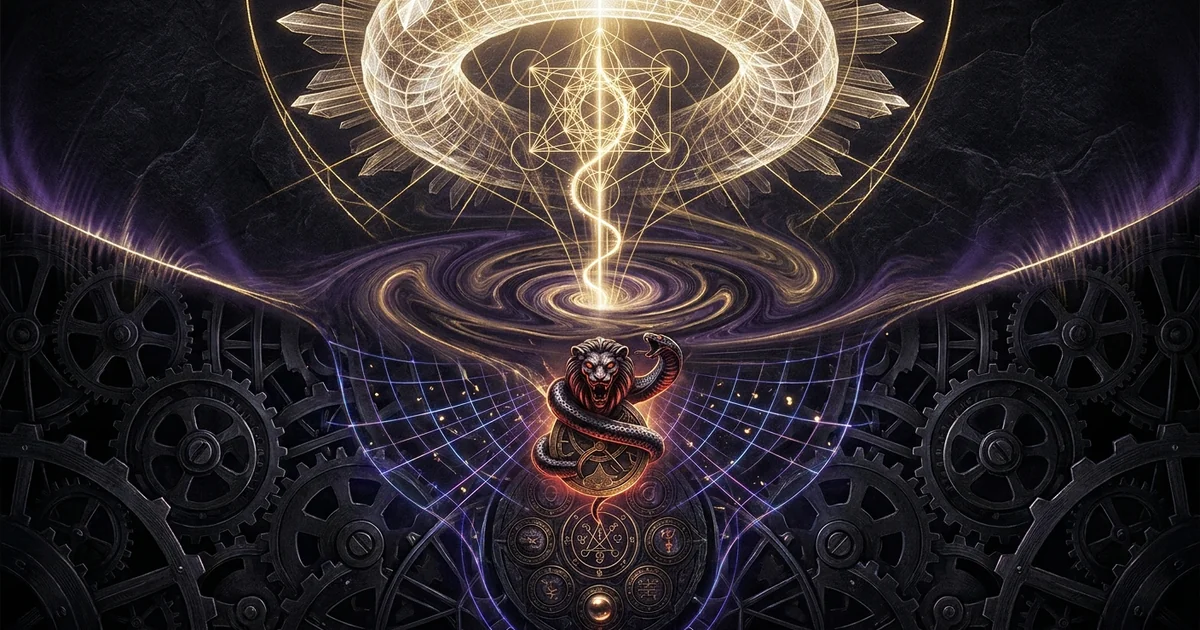
In this text, Sophia’s unilateral act is described with exacting phenomenological precision. The Coptic text preserves the critical distinction that Sophia acted without the consent of the Spirit and without the participation of her syzygetic complement. The structural consequence of this unpaired generation is the catastrophic emergence of an imperfect, misshapen entity that bears none of the radiant symmetries of the Pleroma: a theriomorphic anomaly possessing the form of a lion-faced serpent, named Yaldabaoth.
“And the Sophia of the Epinoia, being an Aeon, conceived a thought from herself with the reflection of the invisible Spirit and foreknowledge. She willed to reveal out of herself a likeness without the consent of the Spirit—he had not approved—and without her consort, and without his consideration. And though the person of her maleness had not approved, and she had not found her agreement, and she had thought without the consent of the Spirit and the knowledge of her agreement, yet she brought forth. And because of the invincible power which is in her, her thought did not remain idle, and there came forth from her an imperfect product, different from her appearance, because she had made it without her consort. And it was not like the appearance of its Mother, for it was of another form. And when she saw it, it had the form of a different model, having the face of a serpent and the face of a lion. Its eyes were like flashing fires of lightning.”
The Dramatic Liturgies of the Pistis Sophia
While the Apocryphon of John provides the architectural cosmogony of the fall, the monumental Coptic codex known as the Pistis Sophia (Codex Askewianus, British Library Add MS 5114) presents the subjective, phenomenological reality of her descent and subsequent rehabilitation. Acquired by the British Museum in 1785, the Pistis Sophia represents a later, highly elaborated synthesis (likely third to fourth century CE) wherein the post-resurrection Christ engages in an ongoing revelatory dialogue with his disciples, predominantly Mary Magdalene, on the Mount of Olives.
Within this liturgical drama, Sophia is not merely a cosmological node, but a dynamic, suffering psyche navigating the claustrophobic depths of the lower planetary spheres. The text structures her fall through the precise vocabulary of Copticized Greek terms for spiritual agony, perceptual blindness, and structural entrapment. Her descent is marked by an increasing immersion into chaotic matter (hyle) orchestrated by the self-willed Archontic power known as Authades (the Arrogant One), who deceives her with a false light projection within the lower chaos.
The textual richness of the Pistis Sophia lies in its liturgical framework: her path of return is articulated through thirteen discrete Odes or “Repentances” (metanoiai), each mapped directly onto the Davidic Psalms and the Odes of Solomon. This literary device establishes an isomorphic link between the macrocosmic restoration of the Aeon and the microcosmic initiation of the human soul through the layers of the cosmic control matrix.
Parallel Lineages: Sethian Cosmogonies and the Valentinian Exegesis
A rigorous comparison between the surviving codices exposes profound structural divergences between Sethian and Valentinian treatments of Sophia’s ontological status. The Sethian corpus—exemplified by the Apocryphon of John, On the Origin of the World (NHC II, 5), and the Hypostasis of the Archons (NHC II, 4)—tends toward an acute, almost tragic cosmic dualism.
In the Sethian lineage, Sophia’s descent is framed as an unsanctioned, catastrophic aberration. The product of her fall, the blind Demiurge, is an aggressive, illegitimate abomination who actively wars against the divine light, systematically obscuring humanity’s pleromic origins through the imposition of physical incarnation, artificial sexual reproduction, and the crushing spiritual amnesia of the cosmic matrix.
Conversely, the Valentinian exegesis—preserved in Greek by Irenaeus and confirmed by internal Nag Hammadi witnesses such as the Tripartite Tractate (NHC I, 5) and the Gospel of Truth (NHC I, 3)—deploys a more sophisticated, dialectical teleology. The Valentinians bifurcate Sophia into two distinct structural phases or hypostases:
- The higher, pleromic Sophia (Sophia Epanorthosis or the Divine Thought) who remains safely inside the Pleroma after her purification; and
- Her fallen, exteriorized passion, personalized as Achamoth (from the Hebrew Chokhmah), who is cast beyond the limiting boundary (Horos) into the void.
In the Valentinian paradigm, the fall is not an absolute cosmic accident, but an educational and evolutionary necessity. The passion of Sophia is the generative engine through which divine consciousness tests its own structural limits, facilitating the emergence of free, differentiated pneumatic individuals who achieve an ontological self-consciousness that could never have existed within the static perfection of the unfallen Pleroma. The historical transmission of these Nag Hammadi codices confirms that early Christian esoteric thought was not a homogenous stream, but a fiercely contested battlefield of competing phenomenological cosmologies.
Ontological Architecture & Cosmological Models: The Pleromic Order and the Archontic Matrix
Topography of the Thirty Aeons and the Limiting Boundary (Horos)
The structural blueprint of the Valentinian Pleroma is configured as an interdependent hierarchy of thirty Aeons, arranged in concentric systemic polarities known as the Ogdoad (the primary eight), the Decad (the ten), and the Dodecad (the twelve). At the apex rests the unfathomable absolute, Bythos (Profundity), perpetually united with his silent female counterpart, Ennoia (Thought) or Sige (Silence). Through a process of progressive self-differentiation and thematic emanational unfolding, this primordial pair brings forth:
- Nous (Mind) and Aletheia (Truth);
- Logos (Word) and Zoe (Life);
- Anthropos (Humanity) and Ecclesia (Church).
This Ogdoad forms the immutable archetypal core of absolute reality.
Sophia sits as the twelfth and terminal Aeon of the Dodecad, the outermost ring of the pleromic engine. To safeguard this interconnected luminous continuum from the chaotic destabilization threatened by Sophia’s centrifugal yearning, the Pleroma secretes a specialized metaphysical interface: the Horos (the Boundary, also designated as Stauros or the Cross). The Horos functions as a selective ontological membrane, an energetic firewall possessing a double operational dynamic:
- Metathetike (the purging or separation potency), which shears away unintegrated passions and prevents anomalous perturbations from infecting the higher Aeons; and
- Steriktike (the stabilizing or sustaining potency), which confirms and anchors the remaining Aeons in their proper structural assignments.
The Horos does not merely limit; it actively defines the perimeter of stable being. Anything existing within its radiant boundary participates in the eternal, self-referential life of the divine syzygies; anything extruded across its perimeter falls into the informational vacuum of non-being.
The Shadow Cast Upon the Waters: Genesis of the Kenoma
When Sophia’s unpaired energetic surge is sheared off by the Horos, this severed divine momentum does not instantaneously perish. Endowed with the inherent immortality and vitality of the Aeon from which it sprang, this uncontained dynamis cascades outward into the dimensional void. In the Sethian treatise On the Origin of the World (NHC II, 5), this event is recorded with remarkable optical and physical metaphors: Sophia’s displaced light projects an anomalous shadow across the infinite, undifferentiated abyss of the lower regions. This shadow is designated as the primordial skia, a dark energetic refraction that coagulates upon the primal waters of non-existence.
The kenoma is thus formed as an ontological scar: a region characterized by deficiency (hysterema), blindness, and thermodynamic deceleration. Within this informational vacuum, the severed light-energy undergoes a phase transition. Deprived of the structural coherence and reciprocal feedback loops of the pleromic syzygies, the stranded vitality experiences profound disorientation.
The passions of the fallen Aeon—isolated grief, ontological terror, sensory deprivation, and acute yearning—condense into the basic elements of the physical world. Matter (hyle) is literally frozen, decelerated divine light; it is pleromic energy trapped in a severe informational drop-down, locked within a structural state of persistent decay and fragmentation.
Cosmic Architecture of the Hebdomad and Ogdoad
Within the unformed, chaotic strata of the Kenoma, Sophia’s extruded light-potentiality coagulates into an autonomous, self-organizing entity: Yaldabaoth (alternatively named Samael, the blind god, or Saklas, the fool). Ignorant of the higher pleromic realms that exist beyond the Horos from which his energetic vitality was derived, Yaldabaoth presumes himself to be the solitary, uncaused prime mover of the universe. Driven by this supreme delusion of autarchy, he proclaims: “I am God, and there is no other god beside me!”
From his coagulated spiritual essence, Yaldabaoth emanates an administrative bureaucracy of six subordinate rulers, collectively forming the Hebdomad—the seven planetary authorities or archons:
- Yaldabaoth (Saturn);
- Iao (Jupiter);
- Sabaoth (Mars);
- Adonaios (Sun);
- Elaios (Mercury);
- Astaphaios (Venus);
- Horaios (Moon).
These Archontic powers construct and govern the planetary spheres, establishing the formidable mechanism of Heimarmene—astrological determinism, karmic entrapment, and rigid mechanistic causality. Heimarmene is designed to function as an interdimensional energetic perimeter, ensuring that no spiritual consciousness embedded within the lower material plane can pierce the planetary spheres and re-ascend to the Pleroma.
Above this planetary Hebdomad sits the Ogdoad (the eighth sphere), an intermediate ontological waystation established directly beneath the Horos. It is here that Sophia herself is quarantined following her catastrophic expulsion. From the Ogdoad, she looks down upon the monstrous, deterministic clockwork cosmos constructed by her illegitimate offspring, weeping over the structural tragedy her unpaired ambition unleashed upon the abyss.
Phenomenological Mechanics & Interdimensional Interaction: The Demiurgic Hologram and Archontic Parasitism
The Theft of Divine Pneuma and the Anthropological Implant
The definitive drama of the Gnostic universe unfolds around the possession of the divine pneuma (the spiritual spark). In the Apocryphon of John, the Demiurge and his Archontic legion attempt to complete their simulated realm by manufacturing a biological automaton: the psychic and physical archetype of earthly humanity, Adam. The Archons labor extensively, each contributing a specific psychic ligature and material component to forge the dense somatic vessel. However, upon completing the vessel, their creation lies inert, motionless, and incapable of self-animation upon the earth.
At this critical juncture, the higher Pleroma intervenes through a subtle stratagem of epistemic deception. Acting through luminous emissaries disguised as Archontic advisors, the higher light whispers to Yaldabaoth: “Blow into his face something of your spirit, and the body will arise.” Yaldabaoth, blinded by his own vanity, breathes into Adam the living breath.
This breath, however, was not native to the Demiurge; it was the stolen remnant of pleromic light inherited from his mother, Sophia. In that precise thermodynamic transfer, the divine light passed out of the Demiurge and anchored itself deep within the interiority of the human vessel. Instantly, Adam became luminous, upright, and possessed of a cognitive and spiritual capacity vastly superior to that of his blind creators.
The anthropogenesis of Gnosticism demonstrates that humanity’s spiritual essence is fundamentally un-created by the Archons. We are somatic prisoners within a Demiurgic cage, yet we house the very pleromic vitality that keeps the entire material simulation energetically operational.
Pleromic Epinoia (Lucid Direct Gnosis)
- Metaphysical Origin: Emerges directly from the unconditioned Light of the Pleroma; operates as the living, self-luminous reflection of divine consciousness within the human psyche.
- Operational Mechanics: Non-linear, intuitive, instantaneous apprehension of structural truth; transcends spatio-temporal determinism; bypasses secondary causality.
- Interface with Human Consciousness: Ignites the embedded pneuma; deconstructs institutional conditioning; restores syzygial polarity through vertical inner resonance.
- Systemic Teleology: Dissolution of the Kenoma; liberation of divine light from material density; total reclamation of consciousness in Apokatastasis.
Archontic Heimarmene (Interdimensional Control System)
- Metaphysical Origin: Generated by the blind Demiurge (Yaldabaoth) out of the coagulated, traumatized passions of Sophia extruded into the Kenoma.
- Operational Mechanics: Deterministic, cybernetic regulation; astrological and thermodynamic feedback loops; linear time; entropy; rigid systemic surveillance.
- Interface with Human Consciousness: Induces epistemic amnesia; cultivates existential dread; parasitizes emotional volatility; manipulates archetypal and religious mythologies to elicit worship.
- Systemic Teleology: Preservation of the material containment matrix; perpetual harvesting of pneumatic energy to fuel an illegitimate, artificial simulation.
Archontic Deception via Informational Control Systems
Deprived of their superior power through the theft of the pneuma, the Archons immediately alter their tactics from outright creation to systemic informational suppression. Realizing that the pneumatic human poses an existential threat to the stability of their cosmos, they fashion the material “paradise” not as an Edenic sanctuary, but as a sophisticated carceral ecosystem designed to induce profound spiritual amnesia (lethe).
The Tree of the Knowledge of Good and Evil is transformed by Archontic edict into a forbidden zone, while the Tree of (Earthly) Life is weaponized to bind humanity perpetually to somatic generation, sexual reproduction, and genealogical dispersion.
The Archons enforce their dominion primarily through the deployment of the Antimimon Pneuma—the Counterfeit Spirit. This is an artificial psychic overlay, an implanted parasitic ego-structure that binds the pure pneumatic spark to the base impulses of the biological body and the turbulent emotions of the lower psyche.
Through the Counterfeit Spirit, the Archontic matrix systematically inverts epistemic values:
- Servitude is branded as obedience;
- Ignorance is praised as pious faith;
- The blind Demiurge is worshiped as the sovereign, omniscient God of the cosmos.
The primary survival mechanism of the Archons is energetic and psychological parasitism. Incapable of generating autonomous life-force due to their complete severance from the Pleroma, they sustain their structural cohesion by harvesting the emotional, physical, and devotional energies shed by human beings locked in conflict, terror, and thermodynamic struggle.
The Jacques Vallée Hypothesis: High Strangeness and the Archetypal Regulators
This Gnostic phenomenological model converges directly with contemporary frontiers of anomalous phenomena and interdimensional ontologies. In his seminal work, The Invisible College (1975), computer scientist and astrophysicist Jacques Vallée proposed the interdimensional-hypothesis to explain the persistent, cross-cultural manifestations of Non-Human Intelligence (NHI), fairy encounters, religious apparitions, and modern unidentified aerial phenomena (UAP).
Vallée posited that these phenomena do not represent extraterrestrial visitors traversing interstellar space in physical propulsion craft, but rather an ongoing, earth-bound informational control system that regulates human cultural, philosophical, and perceptual development across historical epochs.
“The Gnostic Sophia is the fallen soul of the world, whose descent into the matter she unwittingly created represents the metaphysical ground of all cosmic alienation. As Gilles Quispel continually emphasized, her tragedy is simultaneously the history of human consciousness: Sophia is our own deep, imprisoned spirit, and her redemption (apokatastasis) is not an external, mythological event, but the structural self-awakening of the pneumatic spark through the arduous transfiguration of its own historical trauma.” — Hans Jonas, The Gnostic Religion: The Message of the Alien God and the Beginnings of Christianity (Boston: Beacon Press, 1958), pp. 176–198; with reference to Gilles Quispel, Gnosis als Weltreligion (Zürich: Origo Verlag, 1951).
The Archons of the Gnostic codices are the ancient Mediterranean archetypes of Vallée’s “regulators.” They operate precisely within the liminal boundary between physical matter and psychic projection, deploying phenomena characterized by “high strangeness” to recalibrate human perceptual boundaries whenever the dominant consensus reality threatens to rupture.
The Archons project deceptive apparitions, manipulate religious mythologies, and orchestrate visionary mirages to enforce compliance with the parameters of the material simulation. Their technology is entirely informational, semiotic, and psychological. By constantly recalibrating the baseline of human belief, the Archontic apparatus prevents the collective activation of the inner epinoia—the direct, pleromic faculty of unclouded apprehension.
Viewed through this lens, the Gnostic mythos is not an archaic, superstitious allegory, but an advanced phenomenological mapping of an interdimensional cybernetic matrix that has systematically manipulated human ontological awareness for millennia.
Initiatic Synthesis & Philosophical Implications: Pneumatic Metanoia and Apokatastasis
The Thirteen Repentances of Pistis Sophia
The trajectory of the Sophia narrative is fundamentally asymmetrical: her catastrophic descent is met not with eternal damnation, but with an exhaustive, initiatic ascent that establishes the structural blueprint for human liberation. Within the Pistis Sophia, this ascent is chronicled through her thirteen Repentances (metanoiai).
The term metanoia must not be read in the impoverished Patristic sense of moralistic contrition or guilt-ridden repentance for a sin. In the Coptic Hermetic context, metanoia denotes a profound, structural transfiguration of consciousness: a systemic turning-around of the noetic eye from the outward dispersion of the Kenoma back toward the inward plenitude of the Pleroma.
Each of Sophia’s thirteen repentances corresponds to her systematic disentanglement from one of the thirteen Archontic echelons that hold her captive within the chaos. In the early stages, her prayers are characterized by intense somatic distress, sensory dislocation, and the terror of absolute dissolution as the Archontic powers strip away her remaining light-garments.
Yet, as she progresses through the sequence of repentances, her focus shifts decisively from external lamentation over her persecution to the radical internal realization of her immutable, pleromic identity. She methodically withdraws her projective desire from the illusions of the Demiurgic matrix.
This process of systematic detachment deprives the Archons of their energetic hold over her, initiating an ascending, alchemical transmutation of her fragmented psychic substances back into pure, coherent light-essence.
The Descent of the Soter: Reintegration of the Syzygy
Sophia’s active metanoia is necessary, but it is ontologically insufficient on its own to bridge the chasm separating the Ogdoad from the inner sanctuary of the Pleroma. Because her initial error was an act of unpaired generation—severing the syzygial axis of the divine architecture—her redemption requires the objective intervention of a complementary pleromic polarity. This counter-balancing force manifests as the Soter (the Savior), also designated as the Christos or the Divine Autogenes.
The Soter is not a localized, historical figure, but a hyper-dimensional cosmic emissary generated through the unified consent and energetic synthesis of all thirty Aeons. He embodies the collective harmony of the entire Pleroma focused into a singular dynamic intervention.
Descending through the fractured layers of the Kenoma without becoming subject to the amnesia of the Archontic matrix, the Soter wraps Sophia in his radiant pleromic light-vesture. His presence provides the exact syzygial resonance that Sophia violently abandoned in her initial descent.
By uniting with the Soter in the intermediate realm of the Ogdoad, Sophia’s anomalous, ungrounded desire is permanently balanced. This syzygial reintegration does not instantly eradicate the physical world, but it fundamentally breaks the Demiurgic monopoly over the divine light, establishing an open ontological conduit between the human vessel embedded in the Kenoma and the transcendent fullness of the Pleroma.
Apokatastasis: The Systematic Reclamation of Light from Matter
The ultimate culmination of the Gnostic cosmological drama is the doctrine of apokatastasis—the total eschatological restoration and reintegration of all fragmented consciousness back into its primordial source. Within the Gnostic framework, this restoration is not a mass, passive resurrection, but a meticulous, systemic extraction of every scattered pneumatic atom trapped within the architecture of the Demiurgic hologram.
As individual human beings awaken to their true pleromic origins through the activation of the Epinoia, they systematically sever their psychic ligatures to the Counterfeit Spirit and the planetary matrix of Heimarmene. Each liberated pneumatic particle that slips past the Archontic spheres and re-enters the Ogdoad directly depletes the energetic foundation of Yaldabaoth’s realm.
The physical cosmos, maintained entirely by the stolen, metabolized light of Sophia, undergoes progressive thermodynamic and structural exhaustion as this vitality is reclaimed.
When the final particle of divine light is extracted from the material plane, the structural framework of the Kenoma collapses under its own entropic weight. The blind Archons, depleted of their energetic sustenance, dissolve back into the primal non-being from which their delusions arose.
Yet, this final Apokatastasis does not simply return reality to its original, static pre-cosmic state. The Pleroma that absorbs the redeemed Sophia and the liberated pneumatics is transformed. Having descended into the ultimate horrors of cosmic deficiency, traversed the alienation of the Archontic matrix, and reclaimed its sovereign divine identity through the fires of self-awakening, divine consciousness achieves an unprecedented, fully realized self-awareness. The trauma of the fall is thus transfigured into the ultimate foundation of dynamic, eternal gnosis.
Frequently Asked Questions: Ontological and Cosmological Clarifications
Was Sophia’s Fall Preordained or a Genuine Cosmic Accident?
Within the matrix of Gnostic scholarship, this question marks the definitive line of demarcation between Sethian and Valentinian phenomenologies. The Sethian corpus, strictly interpreted, treats the descent of Sophia as a genuine, unscripted ontological catastrophe.
Her unilateral act was a real error born of an unregulated, tragic yearning that caught the pleromic administration by surprise, requiring a series of desperate emergency interventions to contain the resulting infection of non-being and rescue the displaced pneuma from the clutches of Yaldabaoth. In this reading, physical reality is an accidental monstrosity that should not exist.
The Valentinian school, however, deploys a profoundly nuanced dialectical model that anticipates the idealist philosophies of Schelling and Hegel. For the Valentinians, while Sophia’s act was subjectively experienced as a catastrophic and agonizing fall, it was objectively superintended by the unfathomable intentionality of the Forefather.
The Pleroma in its original state was static, harmonious, and completely unconscious of its own boundaries. Divine consciousness could only achieve true, differentiated, and autonomous self-knowledge through the mirror of its own absolute negation: the Kenoma. Sophia’s fall was therefore structurally necessary; it was the divine risk required to generate an external space in which individual pneumatic entities could develop free will, confront the shadow of non-being, and voluntarily choose the return to the Pleroma through love and gnosis.
The Greek scribes who composed and transmitted the Gnostic codices utilized precise philological distinctions to designate the split psychological and structural states of the Aeon:
- Pleromic Sophia: The pure, eternal archetypal capacity of divine wisdom that remains anchored within the Pleroma, fully attuned to the will of the Forefather and the syzygial order.
- Sophia Prunikos: Translated variously as “the Lewd,” “the Untamed,” or “the Precipitous.” This epithet designates the fallen, exteriorized state of the Aeon after her crossing of the Horos. The term denotes reckless, uncontained forward momentum—the kinetic thrust of a consciousness that has plunged headlong into the abyss without a balance-point.
In the Valentinian tradition, this bifurcated nomenclature shifts to distinguish between the higher Sophia and Achamoth, the personified mass of raw, unformed passion stranded in the outer darkness. These lexical markers demonstrate that ancient Gnostic scribes did not view wisdom as a static virtue, but as a dynamic, bifurcated cosmic current capable of catastrophic fragmentation and subsequent alchemical sublimation.
How Does Gnostic Sophia Diverge from the Kabbalistic Shekhinah?
While both the Gnostic Sophia and the Kabbalistic Shekhinah originate from the common soil of ancient Mediterranean and Second Temple Jewish sapiential traditions (such as Proverbs 8 and the Wisdom of Solomon), their cosmological statuses reveal a profound divergence in metaphysical engineering. In the Lurianic Kabbalah, the catastrophe known as Shevirat ha-Kelim (the Shattering of the Vessels) results in the exile of the Shekhinah—the divine feminine presence—into the lower realms of the Kelipot (the shells or husks of impurity). Like Sophia, the Shekhinah weeps in the darkness, and her dispersed sparks (nitzotzot) must be gathered through the human act of Tikkun Olam (cosmic repair).
However, the critical ontological divergence lies in the relationship between the feminine divine and the physical creation. The Shekhinah remains fundamentally the immanent presence of the One True God within the cosmos; the physical world, despite the shattering of the vessels, is still the intentional, direct creation of the sovereign Creator (Ein Sof through the Sefirot). To honor the earth and observe the Torah is to comfort the Shekhinah in her exile.
In stark contrast, the Gnostic Sophia is explicitly not the architect of the physical cosmos; her tragedy is that her fallen vitality was stolen and weaponized by an illegitimate, blind Demiurge to create a simulated containment matrix. While the Kabbalist repairs the cosmos to sanctify it as a dwelling place for the Divine, the Gnostic pneumatic systematically deconstructs their attachment to the cosmos in order to liberate the trapped light entirely from the structural architecture of the Demiurgic simulation.
What Distinguishes True Pleromic Gnosis from Archontic Mimicry?
Because the Archons govern through the Counterfeit Spirit and the deployment of deceptive, informational control systems, the phenomenological boundary between genuine pleromic awakening and Archontic counter-mimicry is an urgent initiatic problem. The Archons are masters of structural simulation; they regularly construct synthetic “spiritual” experiences, astral apparitions, and rigid religious paradigms designed to capture seeking souls and divert them into secondary holding pens of belief and devotional servitude.
Authentic Pleromic Gnosis (Epinoia) is distinguished by its radical, non-dual, and deconstructive phenomenology:
- Dismantling of External Authority: It does not establish obedience to an external entity, hierarchy, or non-human intelligence, but directly activates the autonomous, uncreated pneumatic spark within the human core.
- Dissolution of Fear and Guilt: It categorically obliterates the existential guilt, fear of damnation, and somatic paranoia that the Archontic matrix relies upon to harvest psychic energy.
- Syzygial Integration: True Gnosis is never a unilateral vertical escape that leaves the psyche dissociated and fractured. It manifests as a serene, grounded synthesis of polarities—the internal marriage of masculine dynamic intent and feminine receptive wisdom.
- Epistemic Inversion: It immediately recognizes that all earthly hierarchies, deterministic systems, and cosmic authorities are secondary, temporary constructs derived from the foundational error of the blind architect, clearing the perceptual apparatus for the direct apprehension of the unconditioned, apophatic Source. :::