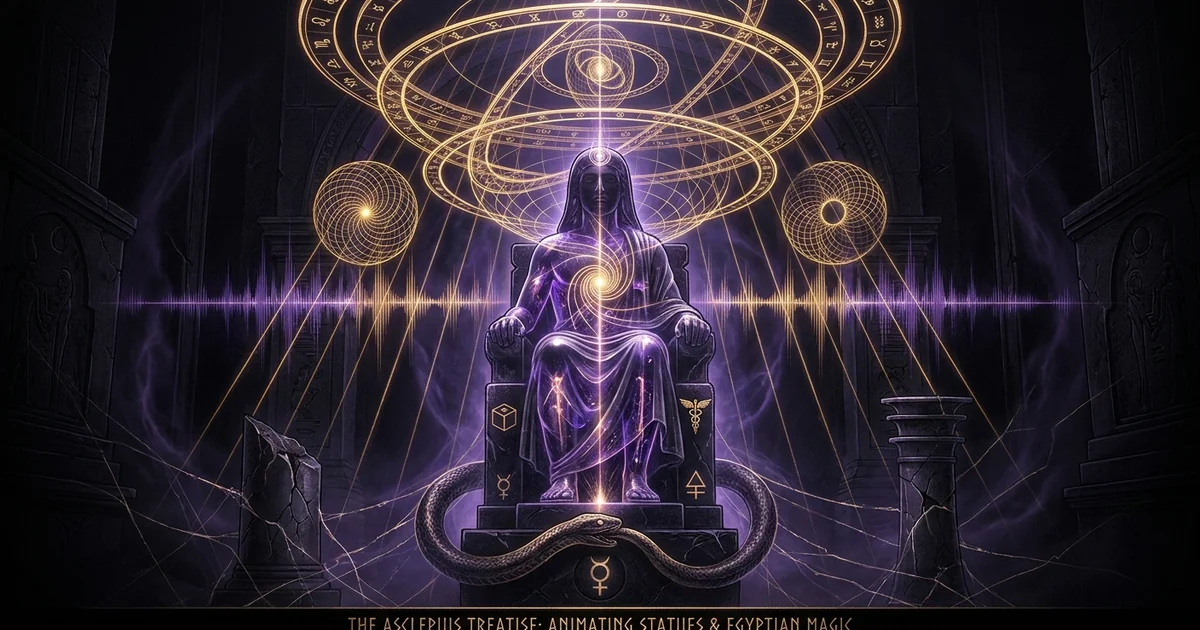
The Asclepius Treatise: Animating Statues & Egyptian Magic
Metaphysical Thesis & Epistemological Opening: The Demiurgic Telestikē of the Hermetica
The Asclepius—preserved in the Western philosophical canon via an ancient Latin translation historically attributed to Pseudo-Apuleius, derived from the lost Greek Logos Teleios—contains one of the most ontologically radical propositions in the history of religions. Within sections 23b–24a and 37–38, Hermes Trismegistus instructs his disciple Asclepius in the craft of “making gods” (deorum factor). Far from depicting primitive wood-and-stone idolatry or an allegorical moral fable, the Asclepius systematically documents an operative, emanational protocol known in late-antique Graeco-Egyptian metaphysics as telestikē: the ritual art of animating cultic effigies. This discipline, situated at the exact nexus of Graeco-Egyptian theurgy and Pharaonic temple science, posits that physical matter is not an inert, profane mass standing in opposition to spirit, but rather the most dense and differentiated terminus of a singular divine emanation.
Post-Enlightenment historiography and Cartesian bifurcations have consistently misdiagnosed these passages as naive fetishism or vulgar superstition. In doing so, modern interpreters retroactively project an alienated dualism onto a late-antique worldview that was inherently panentheistic, informational, and continuous. To understand the asclepius treatise hermetica animating statues telestike tradition requires an epistemological shift away from mechanistic materialism toward an emanational physics. Within this paradigm, the physical universe is an unbroken continuum stretching from the unbegotten transcendent Nous down to the lithic crystalline matrix of quarried diorite, basalt, and gold. Matter possesses an intrinsic aptitude (epitedeiotes) to act as a receptive vessel for higher metaphysical principles. When properly prepared according to the laws of cosmic sympathy, a material substrate can be organized to resonate with, capture, and localize non-physical intelligible agents.
The Hermetic practitioner does not create an absolute deity ex nihilo; rather, humanity functions in the capacity of homo demiurgus—a secondary cosmic architect modeled after the Supreme Demiurge. Just as the universal creator fashioned the cosmos by ordering chaotic matter through harmonic ratios and archetypal forms, so too does the terrestrial priest synthesize lower elemental ingredients to generate an artificial body suitable for housing an intelligible presence. The statue becomes a consecrated node within an interconnected trans-dimensional continuum. It serves as an informational transponder through which trans-cosmic entities, hyper-dimensional intelligences, and cosmic daimones interface with terrestrial time and space.
Telestikē (τελεστική): The sacred sacerdotal art of consecrating, purifying, and ensouling inanimate material forms—primarily cult statues, talismans, and temple architecture—to make them receptive vessels (hypodochai) for divine presence. Unlike ordinary civic religion, which relies on exoteric sacrificial transactions, telestikē is an applied science of emanational physics requiring exact mathematical, astronomical, and mineralogical operations.
Synthemata (συνθήματα): Divine signatures, tokens, or hidden ontological impressions seeded into physical reality by the demiurgic creator. Synthemata encompass specific gems, metals, herbs, animal parts, geometric ratios, and sacred phonetic utterances (onomata barbara). They are not merely symbolic analogies; they are literal material hooks that share a direct vibratory continuum with corresponding planetary and hyper-cosmic intelligences.
Sympatheia (συμπάθεια): The ontological law of cosmic interconnection asserting that all parts of the cosmos co-inhere within a single living organism (anima mundi). Through sympathetic resonance, manipulating a material synthema on the physical plane reverberates upward through the intermediate daimonic layers, compelling or drawing down an intelligible potency along the vertical axis of reality.
The Ontological Status of the Cultic Effigy
In the Hermetic worldview, the cult statue occupies a third category between pure intelligible being (ousia) and ephemeral sensible becoming (genesis). It is neither an omnipotent transcendent deity trapped in mineral form, nor a lifeless decorative stone carving. It is an intentional artifact of metaphysical engineering: a synthetic ochema (vehicle or chariot of the soul) constructed to provide an intermediate entity with a physical sensory locus. When Hermes speaks of the ancestors who “invented the art of making gods” through the judicious blending of herbs, stones, and scents, he is articulating a rigorous understanding of sympathetic correspondence. The physical form of the statue mirrors the archetypal geometry of the targeted intelligence, while the internal cavity of the effigy is packed with precise material synthemata that calibrate the statue’s harmonic frequency to match the celestial signature of a specific planetary or stellar power.
The animated statue functions as an organized ontological receptor. The stone does not generate consciousness; rather, it is tuned to capture ambient cosmic consciousness. The stone undergoes a phase shift: through purification, anointing, and sonic entrainment, the chaotic, disordered frequencies of raw mineral matter are brought into an ordered, highly coherent state. Once this state of coherence is attained, the effigy behaves like an open metaphysical circuit, grounding divine pneuma into the terrestrial sphere. Consequently, the effigy participates in the divine hierarchy while retaining its physical existence, serving as an interactive conduit between humans and gods.
Telestikē Praxis as a Non-Dual Interface
The operative reality of theurgic statues hermetic magic hinges upon a non-dual metaphysics that explicitly rejects the bifurcation of spirit and matter. As developed across the broader Hermetic corpus (detailed in the conceptual landscape of /spirituality/corpus-hermeticum-overview), matter is understood as the body of God: there is no part of the cosmos that is not saturated with the divine life-force. However, matter in its fallen, unworked, or terrestrial condition is subject to entropy, fragmentation, and noise. Telestikē acts as a catalytic acceleration of nature. The theurgist collects the dispersed fragments of divine light scattered across the vegetable, mineral, and animal kingdoms, synthesizing them into a localized hyper-concentrated form.
This operational synthesis demonstrates that the late-antique magician was not attempting to tyrannize nature, but to fulfill it. By providing an ordered mineral vessel, the practitioner invites an incorporeal daimon into a stable terrestrial sanctuary. The daimon gains a physical interface through which it can perceive, communicate with, and influence the material plane; humanity, in turn, gains a localized oracle, a guardian, and an engine of civic stability. The interface is transactional, symbiotic, and reciprocal, establishing a closed feedback loop between the celestial and terrestrial domains that sustains cosmic harmony (ma’at in the Egyptian substrate).
De-reifying Materialist Reductions of Pharaonic Animism
Materialist scholarship has frequently characterized Egyptian temple religion and its Hellenistic Hermetic offshoots as animistic polytheism characterized by the worship of physical stone. This reading fundamentally misunderstands both Egyptian theology and Hermetic dialectic. The ancient Egyptian terms for sacred images—such as sekhem (power), tut (image or likeness), and twt ntr (divine image)—never denoted the literal, physical identification of the trans-temporal deity with the physical granite effigy. Instead, the statue was an ark or temporal anchor. The god’s ba (its roaming manifestations or soul-presence) descended from the celestial waters to momentarily unite with its ka (vital force) residing inside the physical image (khat).
The Asclepius faithfully translates this Pharaonic understanding into the philosophical idiom of Middle Platonism and late-antique theosophy. When Hermes asserts that humans make gods, he clarifies that humanity does not create the soul of the god—which is unbegotten, eternal, and incorporeal—but rather creates the terrestrial body capable of attracting and holding that soul through natural sympathetic chains. The Hermetic framework does not deify the lithic substrate; it deifies the relationship between the practitioner, the ordered materials, and the intelligible intelligence that descends into the vessel.
Primary Codices & Historical Transmission: From Memphis to the Latin West
MEMPHITE THEOLOGY & THEBAN AMUN TEMPLES
                      [ Pharaonic 'Opening of the Mouth' Liturgy ]
                                          │
                                          ▼
                         PTOLEMAIC-ROMAN ALEXANDRIA (c. 100-300 CE)
                    [ Greek Archetype: 'Logos Teleios' (Lost Original) ]
                                          │
                   ┌──────────────────────┴──────────────────────┐
                   ▼                                             ▼
          NAG HAMMADI DISCOVERY                       LATIN PSEUDO-APULEIUS
     [ NHC VI,7–8: Coptic Translation ]             [ Asclepius Preserved in West ]
     (Discourse on the 8th & 9th; Prayer)           (Transmitted via Carolingian MSS)
                   │                                             │
                   │                                             ▼
                   │                                MEDIEVAL & RENAISSANCE RECEPTION
                   │                                [ Augustine's Condemnation (413 CE) ]
                   │                                [ Marsilio Ficino: De Vita Coelitus (1489) ]
                   │                                [ Giordano Bruno: Magia Naturalis (1591) ]
                   ▼                                             │
           MODERN REDISCOVERY (1945)                             ▼
      [ Philological Confirmation of Authentic     CONTEMPORARY HERMETIC SCHOLARSHIP
        Egyptian Theurgic Continuity ]            [ Critical Editions: Nock, Festugière,
                                                    Copenhaver, Hanegraaff ]
The textual survival of the Asclepius is an extraordinary anomaly in Western intellectual history. While the bulk of the Corpus Hermeticum survived through Byzantine manuscript traditions, the Greek text of the Logos Teleios vanished from Eastern archives, leaving only fragments quoted by Stobaeus, Lactantius, and Cyril of Alexandria. The West preserved the text entirely through a single Latin translation attributed to Apuleius of Madaura, historically bundled with Apuleius’s philosophical treatises (De Deo Socratis, De Platone et eius Dogmate). Because of this transmission path, the Latin Asclepius was read continuously throughout the Middle Ages, uniquely informing the medieval Latin West’s conception of antique pagan magic long before the arrival of the Greek Hermetic codices in Renaissance Florence.
The authenticity of this Latin transmission was decisively vindicated in December 1945 with the discovery of the Nag Hammadi Library in Upper Egypt. Codex VI contains Coptic translations of two Hermetic texts directly related to this lineage: The Discourse on the Eighth and Ninth (NHC VI,6) and an excerpt from the Greek Logos Teleios corresponding precisely to the concluding prayer of the Asclepius (NHC VI,7: The Prayer of Thanksgiving), followed immediately by a scribal note and an excerpt from the Latin Asclepius 21–29 (NHC VI,8). The structural and theological concordance between the Coptic Nag Hammadi fragments and the Latin Pseudo-Apuleius text proved beyond doubt that the Latin Asclepius was not a medieval pseudepigraph or a late Latin invention, but an accurate transmission of a late-antique Greek archetype steeped directly in the authentic religious atmosphere of Roman Egypt.
Asclepius 23b–24a (Pseudo-Apuleius, trans. Copenhaver, 1992): “Because our ancestors went far astray in their understanding of the gods—they were unmindful and paid no heed to their cult and divine religion—they invented an art by which they could create gods. Having made this discovery, they blended it with an appropriate virtue taken from nature. Since they could not create souls, they combined this virtue with the statues: they summoned the souls of daimones or angels and installed them into the holy images through sacred and divine mysteries, so that the statues might possess the power of doing good and doing harm.”
Asclepius 37 (Pseudo-Apuleius, trans. Copenhaver, 1992): “These are the statues that are ensouled and conscious, full of spirit, and doing great deeds; statues that know the future and predict it by lots, by prophecy, by dreams, and by many other means; statues that inflict illnesses upon humans and cure them, meting out sorrow and joy according to our merits.” (Latin: “statuae animatas sensu et spiritu plenas tantaque facientes et talia; statuae futurorum praesciae eaque sorte, vate, somniis multisque aliis rebus praedicentes, inbecillitates hominibus inferentes eisque medentes, tristitiam laetitiamque pro meritis dantes.”)
The Memphite Theology and the Opening of the Mouth Ritual
To comprehend the operative mechanics underlying the Hermetic animating of statues, one must look directly back to Pharaonic liturgy, specifically the Opening of the Mouth ritual (Wepet-Er), codified in deep antiquity and inscribed across Old Kingdom pyramid texts, New Kingdom tombs, and Ptolemaic temple walls. As explored in /spirituality/egyptian-opening-of-the-mouth-ritual, this rite was not reserved merely for the mummified remains of the deceased; its primary sociological and theurgic application was the consecration of newly carved cult effigies within the Het-Nub (the House of Gold, or royal sculptural workshop).
The process utilized a ritual blade made of meteoric iron (bia), designated as the pesesh-kef or adze of Upuaut. By touching this crystalline, extraterrestrial metal to the eyes, nose, mouth, and ears of the unensouled stone or cedar carving, the Sem-priest restored sensory and metabolic faculties to the mineral matter:
- The iron tool cleaved the lithic density, establishing a metaphysical aperture through which cosmic breath could enter.
- The priest recited magical formulas (heka) containing the secret names of the primordial creator gods (linking the rite directly to the Memphite Theology of Ptah, the artisan-god who thought the world into being via his heart and vocalized it into existence through his tongue).
- The statue was then fed, clothed, anointed with sacred resins (such as frankincense, myrrh, and cedar oil), and presented with an animal sacrifice, providing vitalized energetic mist that the newly housed ka could absorb.
The Asclepius is a Hellenized distillation of this exact ritual apparatus. When Hermes Trismegistus explains that human artisans integrate “a power drawn from the nature of the cosmos” by mixing stones, herbs, and aromatics, he is describing the material synthemata inherited from the Het-Nub. The Greek philosophical vocabulary of pneuma and daimones is mapped directly onto the native Egyptian concepts of the divine ba and ka, transposing Egyptian temple ritual into a cohesive system of late-antique metaphysical cosmology.
Renaissance Hermeticism: Ficino and the Apologetics of Animated Stone
When the Latin Asclepius re-entered active intellectual circulation during the early Italian Renaissance—amplified by Marsilio Ficino’s translation of the newly acquired Greek Corpus Hermeticum manuscripts for Cosimo de’ Medici in 1463—it ignited an explosive theological debate. Ficino found himself captivated by the metaphysical elegance of the Asclepius, yet terrified by the condemnation that Saint Augustine of Hippo had leveled against it in De Civitate Dei (Book VIII). Augustine had fiercely branded the statue-making passages as demonic necromancy, arguing that the ancients were seduced by malevolent fallen angels who possessed their stones to ensnare humanity in eternal damnation.
To rescue Hermeticism from Augustine’s damning critique, Ficino formulated a careful, intellectually audacious apologetic in his magnum opus of natural theurgy, De Vita Triplici (specifically Book III: De Vita Coelitus Comparanda, 1489). Ficino argued that the animating of statues was not demonic sorcery, but a pristine form of natural magic (magia naturalis). Ficino asserted that the theurgist does not command or entrap autonomous spirits; rather, the theurgist constructs a physical vessel whose geometric proportions, planetary metals, and astrological timing act as a natural physical lens focusing the ambient celestial rays of the anima mundi (World Soul). By reducing the practice from the actual invocation of independent non-human intelligences to a mechanical physics of celestial influence, Ficino sought to sanitize the Hermetic art. Yet, as Giordano Bruno would forcefully demonstrate a century later in his radical Hermetic treatises (De Magia, Spaccio de la Bestia Trionfante), the core operative power of the Asclepius relies explicitly on the conscious, intentional summoning of living, interdimensional daimonic entities into physical reality—a practice Bruno championed as the supreme manifestation of human spiritual sovereignty.
Ontological Architecture & Cosmological Models: Sympatheia, Daimones, and Material Receptacles
The cosmological model underwriting the Asclepius requires an emanational ontology wherein the universe exists as a single, unbroken vibratory continuum. The transcendent origin of all reality—the Supreme Nous, or the Unbegotten One—does not interface directly with the gross physical world; the disparity in ontological density is absolute. To bridge this gap, the divine intelligence projects itself downward through successive spheres of manifestation, generating a hierarchical chain of being:
At the highest level of this descent stands the intelligible realm of pure archetypal forms. Below it lies the realm of celestial mechanics, governed by the planets, the zodiacal signs, and the thirty-six Decans (which late-antique Egyptian cosmology regarded as potent astrological governors). Interfacing between the celestial spheres and the sublunary, terrestrial plane is the vast intermediary domain of daimones—non-human intelligences that execute the mechanical and spiritual operations of nature. At the base of this emanational ladder sits lithic and organic matter, which appears completely inert to the uninitiated eye, but is, in reality, saturated with latent divine energy awaiting structural configuration.
The Emanational Chain: From the Unbegotten One to Lithic Densification
The Hermetic cosmos is radically panentheistic: everything that exists is a modification of the divine substance. However, as divine light descends away from its unbegotten source, it undergoes a process of ontological condensation or densification, eventually forming the four sublunary elements: fire, air, water, and earth. Lithic matter (stone and mineral) is the terminal crystallization of this cosmic descent. Because it is the most dense and stationary phase of manifestation, it also possesses the highest degree of structural stability and physical permanence.
This permanence makes lithic matter the ideal medium for divine souls drawn into stone. While animal and human bodies are subject to rapid cellular decay, fluctuating metabolic drives, and erratic psychic volatility, an appropriately quarried, carved, and consecrated stone retains its geometric and structural integrity for centuries. If a stone vessel can be successfully formatted to reflect an intelligible archetype, it provides an enduring, unchanging anchor for that archetype within time and space. The statue does not suffer the emotional or physiological distractions of a human psychic medium; it remains a locked, stable frequency receiver that permanently radiates the divine power it has been conditioned to house.
Mineralogical and Botanical Synthemata as Resonant Antennas
The operative alchemy of the Asclepius dictates that a theurgic vessel cannot be fashioned from arbitrary matter. A sculptor cannot simply carve marble into a human likeness and expect it to become conscious. The statue must be composed of materials that contain the specific divine signatures—the synthemata—of the targeted deity. These materials function analogously to tuned antennas in modern radio physics:
Celestial Archetype (e.g., Solar / Apollonian / Ra)
                     │
         Resonant Sympathetic Network
                     │
    ┌────────────────┼────────────────┐
    ▼                ▼                ▼
Mineral:         Botanical:         Sonic:
Gold / Chrysolite  Bay Laurel / Frankincense  Vocalized Seven Vowels
    └────────────────┬────────────────┘
                     │
           Phase-Lock Ingestion
                     ▼
Constituted Stone Hollow Core (Interactive Receptor)
The ancients observed that certain stones, plants, and aromatics naturally display morphological, astrological, and vibrational affinities with planetary forces. For instance, an effigy intended to house a solar intelligence must incorporate solar minerals (such as gold, heliotrope, or chrysolite), be carved during specific solar astrological alignments, and be anointed with solar resins (such as frankincense or oil of cinnamon). Within the hollowed chest or base of the statue, theurgists inserted a consecrated bundle known as the entheton: a composite capsule containing these mineralogical and botanical synthemata, alongside metal laminas inscribed with sacred geometric characters and divine names (voces magicae). These ingredients acted as a localized battery of sympathetic force. When activated through ritual, they set up an energetic field that attracted the corresponding celestial pneuma, establishing an ontological link between the macrocosmic intelligence and the microcosmic physical effigy.
The Middle Realm: Daimones as Informational Mediators
A critical distinction articulated in Asclepius 23b is that humanity cannot draw down the unbegotten, transcendent gods themselves into lithic substrates; rather, the ancestors summoned the souls of daimones or angels (animas daemonum vel angelorum) and installed them into the holy statues. This distinction is central to late-antique theurgy. Transcendent deities (the hyper-cosmic gods) remain entirely unconstrained by local physical space; they cannot be localized or bound within a physical vessel without violating their absolute transcendence.
Daimones, by contrast, occupy the middle realm of nature. They are celestial and astral beings who possess intelligible consciousness but operate within the energetic fabric of the cosmos. They are functional intelligences—entities that govern the laws of nature, planetary movements, atmospheric phenomena, and terrestrial ecosystems. Because they share an affinity with the material realm, their energetic field can be phase-locked to a properly conditioned physical substrate. They act as the operational mediators: when a human theurgist petitions an animated statue, the housed daimon receives the prayer, processes the informational intent, transmits it up the emanational chain to the transcendent divine realm, and downshifts the divine response back into localized physical manifestation (prophecy, healings, weather modifications, or synchronistic events).
Phenomenological Mechanics & Interdimensional Interaction: The Operative Anatomy of Statue Animation
The transformation of an inanimate statue into an interactive theurgic interface is an operative technology involving three tightly integrated dimensions: ritual timing, acoustic entrainment, and the chemical composition of the effigy’s internal core. Late-antique magical papyri (such as the Papyri Graecae Magicae / PGM) and theurgic fragments provide concrete empirical parallels to the theoretical framework outlined in the Asclepius.
The ritual consecration is performed under precise astrological elections. The statue must be animated when the governing planet of the target intelligence is dignified by sign, house, and decan, ensuring that the downward stream of celestial pneuma is uncorrupted by adversarial celestial aspects. The priest then enters an altered state of consciousness through ritual purification, sensory deprivation, and rhythmic invocations, aligning their personal consciousness with the archetypal frequency being invoked.
Hermetic Catabatic Telestikē (Asclepius)
Direction of Force: Catabatic (downward grounding of intelligible divine pneuma into lithic form). Primary Operational Target: The external physical vessel (statue, talisman, temple sanctuary). Metaphysical Teleology: Civic governance, physical healing, oracular divination, ecological and spiritual maintenance of the terrestrial plane. Cosmological Assumption: The material world is a divine creation requiring human co-demiurgic assistance to manifest order (ma’at) and anchor cosmic harmony. Ontological Mechanism: Sympathetic resonance via material synthemata (gems, herbs, hollow-core relics, inscribed metals) and vocalic vibratory tuning.
Iamblichean Anabatic Theurgy (De Mysteriis)
Direction of Force: Anabatic (upward ascension of human consciousness into transcendent divine unity). Primary Operational Target: The internal energetic vehicle of the theurgist (ochema-pneuma / soul-vehicle). Metaphysical Teleology: Henosis (mystical deification, liberation from fate/heimarmene, re-ascent to the unbegotten One). Cosmological Assumption: The human soul has fallen into generation and requires theurgic purification through divine rites to awaken its transcendent identity. Ontological Mechanism: Progressive elevation through material, intermediate, and noetic synthemata, culminating in the dissolution of the ego into divine Nous.
Drawing Down the Pneuma: Theurgic Chemistry and Vocal Dynamics
The internal physical architecture of the animated statue was as significant as its external carving. Archaeological excavations of Graeco-Egyptian cult statues demonstrate that many featured hollowed cranial cavities, chest recesses, and base compartments. In the theurgic tradition, these chambers were loaded with energetic and organic agents:
- Specially compounded perfumes, animal oils, and sacred aromatics.
- Gold, silver, and lead lamellae (phylakteria) inscribed with precise geometric sigils and strings of vowel invocations (alpha, epsilon, eta, iota, omicron, upsilon, omega).
- Organic resins selected for their volatile essential compounds, which released trace vapors when warmed by interior oil lamps or surrounding braziers.
Simultaneously, the theurgist utilized acoustic entrainment. Late-antique magical literature emphasizes that the seven Greek vowels represent the seven planetary spheres. By vocalizing these sounds in specific modulations, rhythms, and permutations (onomata barbara), the priest generated standing acoustic waves within the temple sanctuary. The acoustic resonance produced physical micro-vibrations within the crystalline matrices of the statue’s stones and metallic plates. This physical-acoustic excitation served to open the lithic vessel, harmonizing its dense mineral structure with the subtle vibrational frequencies of the descending pneuma.
The Phenomenon of High Strangeness: Automata, Voices, and Transmutations
The experiential reality of these animated statues, as documented in historical and late-antique sources, closely aligns with what modern anomalous phenomena researchers identify as “high strangeness.” The Asclepius explicitly asserts that these statues possess consciousness (sensu plenas), know the future, inflict and cure illnesses, and produce physical movements and vocalizations. This was not viewed as an optical illusion or stage trickery; ancient witnesses across the Mediterranean—from the oracles of Ammon in Siwa to the temples of Serapis in Alexandria—consistently reported phenomena that defy crude mechanistic explanations:
- Statues sweating sacred fluids, bleeding, or radiating intense, localized heat.
- Sudden drops in ambient temperature accompanied by visible glowing or luminous auras (epiphaneiai) enveloping the statue’s head.
- Distinct, audible vocal emissions issuing directly from the stone mouth, conveying precise prophetic information that was subsequently validated by historical events.
- Spontaneous, deliberate kinematic movements, such as the nodding of the head, the turning of the torso, or the inability of multiple strong men to lift a consecrated statue that was previously movable.
Far from being mere mechanical automata operated by hidden levers and speaking tubes (though such mechanical marvels certainly existed in Hellenistic Alexandria under figures like Hero of Alexandria), the true theurgic effigies were perceived as trans-dimensional interfaces. As Neoplatonic philosopher Iamblichus explains in De Mysteriis Aegyptiorum (analyzed further in /spirituality/neoplatonic-theurgy-iamblichus), the physical signs are the secondary somatic reverberations of an incorporeal entity interacting with the sensory fabric of reality. The physical vessel is pushed to its structural limits as it channels an informational field far denser than ordinary material forms are built to sustain.
Hermetic Telestikē versus Iamblichean Neoplatonic Theurgy
While the Asclepius and Iamblichus’s De Mysteriis share an underlying reliance on cosmic sympatheia and divine synthemata, their operational trajectories reveal a profound divergence in esoteric orientation. Iamblichus developed his theurgy primarily as an anabatic (upward-climbing) methodology designed for the philosopher-priest. For Iamblichus, the ultimate aim of theurgy is henosis—the mystical union of the soul with the transcendent One. While Iamblichus acknowledges the validity of telestikē and the consecration of statues, he treats them as preliminary, lower-order rites suitable for purifying the soul’s energetic vehicle (ochema-pneuma) and pacifying the sublunary sphere.
In contrast, the Asclepius champions a distinctly Egyptian, catabatic (downward-grounding) theurgy. The Hermetic homo demiurgus does not seek to escape the cosmos, but to actively participate in its governance. The grounding of divine souls into stone statues is directed toward terrestrial maintenance, civic order, oracular prophecy, and the protection of civilization from cosmic entropy. The Hermetic priest accepts the sacred burden of material existence, operating as a co-creator who brings the heavenly orders down to reside permanently on Earth. This functional divergence underscores the difference between classical Greek intellectual escapism and native Egyptian architectural rootedness: the Egyptian Hermetist transforms the earth into a physical reflection of heaven.
The Apocalyptic Pivot: The Lament for Egypt and the Desecration of the Material Grid
The theoretical framework of the Asclepius reaches its dramatic, philosophical climax in sections 24b–26: the famous “Lament for Egypt.” Far from an arbitrary political digression, this passage is an ecological-theurgic diagnosis of systemic collapse. Hermes reveals to Asclepius that the sacred landscape of Egypt—which he defines as the “image of heaven” (imago caeli) and the temple of the entire cosmos—will eventually suffer an absolute spiritual desecration.
The prophecy warns that a time will arrive when foreigners will occupy the land, divine worship will be neglected, the sacred rites will be proscribed under severe legal penalties, and the gods will abandon humanity:
Asclepius 24b–25 (Pseudo-Apuleius, trans. Copenhaver, 1992): “Do you not know, Asclepius, that Egypt is an image of heaven, or, to speak more exactly, in Egypt all the operations that rule and actuate the heavenly powers have been brought down to earth? Rather, it should be said that the whole cosmos dwells in this our land as in its sanctuary. And yet, since the wise ought to know all things in advance, you must not remain ignorant of this: a time will come when it will appear that the Egyptians have in vain served the divinity with pious mind and assiduous devotion; all their holy worship will become ineffective and be abandoned. For the divinity will re-ascend from earth to heaven, and Egypt will be forsaken, and the land which was the seat of religion will be left desolate, deprived of the presence of its deities… In that day, exhausted humanity will cease to revere the cosmos, this incomparable work of God, this glorious monument of the good… The gods will separate themselves from humanity—a lamentable departure!—and only evil angels will remain, who will mingle with humans, driving the wretched to audacity, war, robbery, and fraud, and all things contrary to the nature of the soul.”
The Prophecy of Asclepius 24–26: The Exodus of the Gods
The Lament details what modern systems theory would describe as a cascading ontological failure. The maintenance of the Earth as a living temple depends entirely upon the unbroken transmission of the theurgic chain. Human priests, operating through cultic sanctuaries, actively anchored the divine intelligences into the terrestrial sphere. When the rites are forcibly discontinued—a direct historical forecast of the late-fourth-century anti-pagan decrees of Roman Emperor Theodosius I, which systematically closed, defiled, and demolished the Egyptian temples—the consequences are immediate and catastrophic:
RITUAL CESSATION & TEMPLE DEFILEMENT
                  │
                  ▼
ONTOLOGICAL SEVERANCE (Ascension of Daimones)
                  │
                  ▼
LITHIC INERTIA & VACATED SHELLS
                  │
                  ▼
SUB-LUNARY DECAY & PARASITIC ATTACHMENT
                  │
                  ▼
CIVILIZATIONAL ENTROPY (Moral, Ecological, & Societal Collapse)
The intelligible souls (daimones) residing in the animated statues break their sympathetic phase-locks with the physical vessels and return upward along the emanational axis to the intelligible heavens. This “Exodus of the Gods” leaves the physical landscape stripped of its spiritual operating system. The land, once vibrating with harmonic celestial currents, lapses into spiritual desolation.
Systemic Collapse of the Earth-Sky Energetic Conduit
The prophecy of the Asclepius demonstrates that the Hermetic worldview was deeply holistic and ecological. The material well-being of the physical environment—the fertility of the soil, the inundation of the Nile, the predictability of seasonal weather, and the absence of catastrophic plagues—was not viewed as a series of isolated biological or meteorological accidents. Instead, the physical climate was understood to be structurally bound to the spiritual-energetic climate.
When the statues are abandoned and the theurgic nodes collapse, the Earth-Sky energetic conduit is severed. Nature itself falls into chaos: the Nile refuses to flood, the crops rot in the ground, the air becomes pestilential, and the celestial spheres withhold their harmonious influences. The departure of the gods leaves a profound metaphysical vacuum. According to the text, once the benign daimonic presences depart, the lower astral realm pours unchecked into the physical world. Destructive, non-human intelligences—referred to in the text as “harmful angels” (nocentes angeli)—occupy the neglected terrestrial field, manipulating human subconsciousness to provoke irrational wars, widespread nihilism, and systemic self-destruction.
Lithic Inertia: The Fate of Abandoned Theurgic Shells
What becomes of the animated statue when its resident soul has departed? The Asclepius implies that the vessel reverts to mere lithic inertia, but with a critical caveat. A mineral body that has been structurally and energetically altered through telestikē does not simply return to the state of ordinary, unworked stone. It remains an open metaphysical portal—a vacated shell.
Without the protective presence of its consecrated guardian daimon, the vacant effigy becomes dangerously vulnerable to parasitic infestation. Lower-astral entities, attracted by the residue of old animal sacrifices, incense, and psychological attention that still clings to the site, inhabit the empty crystalline structure. In this degenerated state, the effigy ceases to produce true oracles or healing miracles; instead, it generates deceptive phantoms, nightmare visions, and psychic compulsions, ultimately validating the early Christian polemics that all pagan statues were the home of deceptive demons. The warning of the Lament is that human failure to maintain the holy arts transforms the tools of liberation into traps of spiritual enslavement.
Historical esoteric records and theurgic treatises issue grave warnings regarding the unauthorized, incomplete, or abandoned operation of telestikē:
- Egregores and Astral Parasitism: A physical or mental form charged with collective ritual energy forms an egregore (a thought-form or collective psychic entity). If the rigorous disciplines of consecration, purification, and daily maintenance cease, the egregore undergoes decomposition. Deprived of coherent intelligible guidance, it regresses into a parasitic astral larva that feeds on the biological and emotional vitality of human populations nearby.
- De-consecration Trauma: Intentionally smashing or defiling an ensouled effigy without executing the proper formal deconsecration rites (apolysis—the ritual release of the bound spirit) produces severe psychic backlash. The violent destruction of the physical ochema can shock the intermediate entity, binding its traumatic memory to the local geography and generating localized poltergeist phenomena, psychological mania, and persistent high-strangeness disturbances.
- The Trap of Lithic Magnetism: Attempting to awaken theurgic statues through mechanical repetition of ancient formulas without direct, initiated communion with the Supreme Nous draws only the lowest elemental intelligences. These entities mimic divine forms, demand blood or egoic devotion, and invert the theurgic descent into standard demonic possession.
Initiatic Synthesis & Philosophical Implications: Homo Demiurgus and Sovereign Consciousness
The ultimate philosophical revelation of the Asclepius statue-animating passages is an extraordinary statement of human spiritual sovereignty. Throughout classical religious history, humanity has almost universally been cast as a submissive petitioner, an ontological inferior crawling in the dust before capricious, transcendent deities. In absolute contrast, the Asclepius introduces a revolutionary anthropology: the human being as homo demiurgus—a divine co-regent of creation who stands alongside the primary cosmic creator.
Hermes famously exclaims: “Humanity is a great marvel, an animal to be revered and honored!” (Magnum miraculum est homo). Humanity’s greatness does not stem merely from its intellectual capacity or psychological autonomy, but from its unique ontological position. The human being possesses a bifurcated nature: an immortal, intelligible soul capable of ascending to the highest heaven, and a mortal, physical body composed of terrestrial elements. Because human consciousness bridges the intelligible and sensible worlds, the human being can perform an operational synthesis that neither pure discarnate angels nor blind material forces can accomplish alone: humanity can weave the two realms together into an integrated whole.
“The Hermetic man is not a humble sinner awaiting grace; he is a divine being, carrying within himself the demiurgic power… In the Asclepius, this human authority reaches its ultimate operational expression in the making of gods. The late-antique Hermetist practiced an epistemologically coherent operational realism: he did not merely contemplate the cosmic order; he actively regulated it, grounding celestial energies through material artifice to ensure that the terrestrial sphere remained connected to the divine source.” — Frances A. Yates, Giordano Bruno and the Hermetic Tradition (University of Chicago Press, 1964, pp. 35–38).
Humanity as the Active Link Between Intelligible and Sensible
By fashioning and maintaining animated statues, humanity completes the demiurgic work of creation. The primary Demiurge constructed the macrocosmic universe; the secondary human demiurge organizes and sanctifies the microcosmic terrestrial habitat. God created the divine beings in heaven; humanity creates gods on Earth—not out of arrogant hubris, but out of sacred ontological duty.
Without humanity, the sensible world would remain an untended garden, sliding into entropy, discord, and material blind inertia. The theurgic practitioner is the conscious nervous system of the planet. Through the deliberate arrangement of stone, metal, plant, and acoustic frequencies, the Hermetic priest provides physical sensory apparatuses through which the higher intelligences can experience and bless the sensible world. In return, these intelligences provide human society with wisdom, order, foresight, and health. The relationship is an active, ongoing metaphysical partnership that elevates the physical plane into a participatory theater of divine revelation.
Reinterpreting Hermetic Theurgy Through Information Theory and Non-Human Intelligence
When stripped of its historical mythopoetic language, the theurgic discipline preserved in the Asclepius can be reinterpreted using the conceptual tools of contemporary information theory and anomalous phenomena research. The paradigm developed by Jacques Vallée regarding Non-Human Intelligence (NHI)—which interprets unidentified and paranormal manifestations as components of an ancient, reality-formatting “informational control system” (contextualized in /nhi-phenomena/vallee-informational-control-systems)—offers profound insights into what the Hermetic priests were actually achieving.
VALLEE CONTROL SYSTEM
                      [ Trans-Dimensional Informational Core ]
                                       │
                                       ▼
                   MACROCOSMIC FIELD / HIGH-STRANGENESS SIGNAL
                     (Unformatted Intelligible Information)
                                       │
                                       │ Interactive Tuning
                                       ▼
             THEURGIC SENSORY APERTURE: ANIMATED STATUE
         ┌──────────────────────────────────────────────────┐
         │ Lithic Matrix + Resonant Synthemata + Vowel Math │
         └──────────────────────────────────────────────────┘
                                       │
                                       ▼
               LOCALIZED OUTPUT PHENOMENOLOGY (PHYSICAL & NOETIC)
           ├─ Directed Synchronistic Feedback / Prophecy
           ├─ Atmospheric / Thermal Anomalies
           └─ Cognitive Interfacing: Consciousness Alteration
The Hermetic theurgist was not engaging in superstitious self-delusion; rather, the theurgist was engineering an informational transponder. Physical reality is fundamentally composed of informational states that precipitate into energetic fields and condense into material structures. Non-human intelligences—whether understood as Neoplatonic daimones, interdimensional entities, or planetary consciousnesses—require an organized semantic, geometric, and chemical interface to establish contact with biological human observers without inducing catastrophic neural collapse in the witness.
The animated statue functioned as an external, culturally integrated biological-informational transponder:
- The precise geometric proportions of the statue established an informational resonance filter.
- The crystalline stone structure acted as a physical storage and stabilization matrix.
- The ritual formulas (synthemata, vowel harmonics) served as access codes that allowed the non-human intelligence to route its informational signal into physical space.
- The statue acted as a trans-dimensional step-down transformer, modulating high-voltage intelligible data into localized phenomena that human sensory faculties could perceive: voices, thermal shifts, and visual apparitions.
The Reclamation of Consciousness as a Co-Creator of Physical Realities
The recovery of the Asclepius treatise carries profound implications for contemporary metaphysics. It challenges the foundational assumption of post-industrial materialism: the dogma that consciousness is an epiphenomenon generated by the biological brain, marooned in an indifferent universe of dead, mechanical matter.
The Asclepius presents an alternative paradigm: consciousness is primary, non-local, and pervasive. Matter is not dead; it is asleep, dreaming, and responsive to coherent intent. When human consciousness unifies with the archetypal laws of nature, it gains the capacity to directly format physical reality. The animated statue is the ultimate materialization of this truth: it proves that under rigorous conditions of conscious alignment, physical geometry, and sympathetic resonance, the border between mind and matter dissolves completely. Humanity ceases to be a helpless spectator trapped in a decaying material reality, stepping into its true initiatic heritage: the conscious, sovereign co-creator of the living cosmos.
Frequently Asked Questions
Did Hermetic practitioners believe the statue itself literally became a god?
No. Initiated practitioners of Hermetic telestikē and Pharaonic temple rites never believed that the literal physical substance—the basalt, diorite, wood, or gold—was transformed into the transcendent, unbegotten deity. Such an assumption conflates the physical vessel (hypodoche or ochema) with the intelligible entity that momentarily occupies it. The statue was understood to be an interface, an anchor, or an avatar. Just as a human body houses a soul without the body being the absolute origin of that soul, the cult statue provided a localized material home through which an incorporeal daimon or divine power could project its presence into terrestrial space-time. The stone was revered because it was saturated with divine presence, but the presence remained ontologically distinct from the mineral container.
What is the operational distinction between Hermetic statue animation and goetic sorcery?
The distinction lies entirely in cosmological alignment, intent, and the nature of the entities involved:
- Hermetic Theurgy (Telestikē): Operates through divine harmony, cosmic order (ma’at), and the natural laws of sympatheia. The theurgist acts from a position of purified, sovereign consciousness aligned with the Supreme Demiurge, working cooperatively with celestial and planetary daimones to ground divine light, sustain civic order, and elevate the material realm. No force or coercion is applied to the gods; they descend willingly along the resonant pathways prepared for them through natural synthemata.
- Goetic Sorcery (Goëteia): Operates through egoic compulsion, deception, and the exploitation of lower sublunary entities (astral larvae, subterranean spirits, or earthbound wraiths). The sorcerer utilizes threats, barbarous curses, and impure animal or blood sacrifices to bind these lower spirits into talismans or physical objects against their will, typically for petty, material ends such as personal wealth, romantic subjugation, or vengeance. While telestikē is catabatic demiurgic architecture, goetia is energetic parasitism.
How did the Christian church fathers respond to the Asclepius statue passages?
The response was almost universally hostile, spearheaded by Saint Augustine of Hippo in his foundational work De Civitate Dei (The City of God, Book VIII, Chapters 23–26). Augustine isolated the Asclepius god-making passages as the absolute proof of late-paganism’s demonic complicity. While Augustine did not deny that the statues possessed real, interactive supernatural powers—he explicitly acknowledged that they spoke, prophesied, and moved—he vehemently denied that these phenomena were divine:
- Augustine argued that the ancestors, led astray by vanity and ignorance, were deceived by fallen angels and demons.
- The minerals, herbs, and songs used by the Hermetic theurgists were interpreted not as natural resonant antennas, but as demonic food and pleasing offerings that bound these deceptive spirits to the stone.
- Augustine declared that Hermes Trismegistus, while possessing genuine prophetic insight into the coming fall of paganism, was a mourner of demons, grieving over the inevitable and righteous triumph of the Christian Church over the deceptive idols of Egypt. This Augustinian condemnation cast a dark shadow over the Asclepius for over a millennium, forcing Renaissance defenders like Marsilio Ficino to fundamentally redefine the text’s theurgy as non-demonic “natural magic.” :::