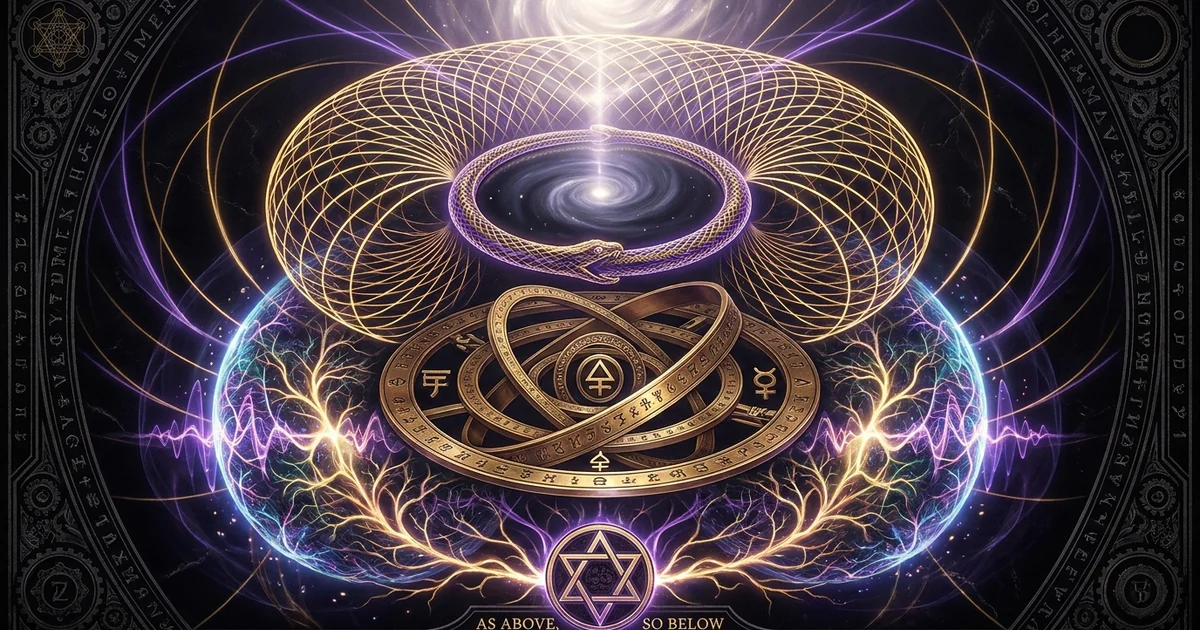
The Mirror of Nature: Divine Reflection in Manifest World
Metaphysical Thesis & Epistemological Opening: The Speculum Divinitatis and Cosmological Panentheism
The manifest universe operates not as an accidental aggregation of Cartesian res extensa, nor as an inert, entropic substrate drifting through neutral void, but as an intentional topological mirror—a speculum divinitatis—that renders transcendent noetic forms empirically tangible. Within Western esoteric philosophy, classical Hermeticism, and continuous lines of Neoplatonic metaphysics, nature is conceived as a dynamic theophany. It is an animate, communicative architecture through which the unmanifest Absolute externalizes its unconditioned fullness (pleroma) into morphological, visible geometries. Under this model, the sensible cosmos does not obscure the divine; rather, it constitutes the primary sensory alphabet through which the divine apprehends, diversifies, and beholds its own latent potencies.
This orientation forms the core of Hermetic panentheism: the doctrine that while the Supreme Source utterly transcends all finite boundaries, the cosmos is entirely situated within the divine presence. The universe is not separate from the Absolute, nor is the Absolute exhausted by the universe. In this framework, natural phenomena—from celestial orbits to crystalline formations and biological trophic webs—function as an ontological interface. Material generation represents the deliberate, autopoietic exteriorization of noetic archetypes into space, time, and substance.
THE UNMANIFEST SOURCE
                           (Transcendent One)
                                   |
                                   v
                         NOETIC ARCHETYPES
                       (Divine Intellect / Nous)
                                   |
                                   v
                         ANIMA MUNDI (PSYCHE)
                       (Living Formative Field)
                                   |
                                   v
                    SPECULUM NATURAE (MANIFEST HYLE)
                   (Empirical Cosmos as Living Icon)
                                   |
                                   v
             [Participatory Perception: Microcosmic Theoria]
                                   |
                                   +---> Recursive Ascent / Theurgic Realization
Transcending Mechanistic Dualism and Gnostic Acosmism
To comprehend the speculum divinitatis, one must differentiate Hermetic cosmotheism from the two historical errors that have dominated Western interpretations of the sensible world: Cartesian-Newtonian mechanistic reductionism and radical Gnostic acosmism. The mechanistic paradigm, crystallized in the seventeenth century, severed matter from spirit. In reducing physical nature to dead, quantifiable mass governed exclusively by blind, efficient causality, modern mechanical philosophy stripped the cosmos of inherent teleology, interiority, and sacred signification. Nature was converted from a sacramental icon into raw material—an indifferent backdrop designated solely for instrumental exploitation.
Conversely, classical Gnostic dualism (exemplified in ancient Archontic, Sethian, and Marcionite mythologies) identified the material cosmos as a cosmic catastrophe. In these systems, matter is treated as a defective counterfeit, an ontological penitentiary engineered by a blind or malevolent demiurgic entity to trap wandering sparks of pneumatic light. Where the mechanist views nature as dead machinery, the radical Gnostic views it as an existential snare demanding absolute somatic detachment and world-negating flight.
Hermetic panentheism systematically dismantles both positions. Against the Gnostic deprecation of matter, the Hermetic codices preserve the fundamental goodness, vitality, and sanctity of creation. Matter (hyle) is not an ontological rupture or a demonic cage; it is the ultimate receptive vessel (hypodoche) sculpted to receive divine illumination. As articulated within the foundational tractates of the Corpus Hermeticum, the Demiurge is not an aberrant usurper, but the divine creative Word (Logos) and executive Intellect (Nous) operating as the architect of cosmic harmony.
Against the modern mechanist, Hermetic cosmology asserts that matter possesses interior vitality, sentience, and profound semiotic density. The physical realm is not devoid of mind; it is mind condensed into spatial actuality. By synthesizing divine immanence with radical transcendence, the doctrine of the mirror of nature hermetic cosmology divine manifestation panentheism establishes that material generation is consecrated, necessary, and inherently noble. Nature is the living mirror without which the infinite would remain perpetually unmanifest to itself.
The Epistemology of the Speculum: Contemplative Theoria as Ontological Vision
Because the manifest cosmos functions as a mirror of unconditioned divinity, the epistemological apparatus required to comprehend nature cannot rely solely on inductive dissection or quantifiable empiricism. The apprehension of the speculum divinitatis demands a fundamental phenomenological recalibration known in classical Greek metaphysics as theoria (θεωρία)—a contemplative, participatory mode of witnessing wherein the observer ceases to operate as an alienated subject analyzing an externalized object.
Within this epistemic posture, seeing god in visible creations requires the human sensory apparatus to undergo an initiatic purification. The physical senses are not abandoned through ascetic mortification; rather, they are elevated into noetic sensors capable of discerning archetypal realities directly through the sensible forms that clothe them. The researcher, philosopher, or mystic engages the sensible world not as an assemblage of isolated facts, but as an orchestral delivery of divine speech.
Contemplative theoria recognizes that perception is an active, ontological event occurring within the psychic interior of the World-Soul (Anima Mundi). When an individual perceives the structural symmetry of a leaf, the mathematical precision of a planetary cycle, or the luminous depth of an elemental landscape, perception ceases to be a localized brain event. Instead, it becomes a dynamic moment of cosmic self-recognition: the divine within the microcosm beholds the divine within the macrocosm through the reflective medium of physical matter. Epistemology dissolves into participatory ontology; knowing the world becomes synonymous with experiencing God’s exteriorized body.
The Greek term theoria (θεωρία) derives from thea (a view, spectacle) and horao (to look, perceive), historically denoting the act of witnessing a sacred spectacle or divine festival. In Platonic and Hermetic philosophy, theoria transcends analytical discourse (dianoia) to signify direct, intuitive contemplation of eternal truths manifested within cosmic order.
Crucially, this contemplative framework grounds panentheism rather than pantheism:
- Pantheism (from the Greek pan [all] and theos [god]) asserts that the universe and God are identical. God is entirely exhausted by the sum total of physical laws and natural matter (as seen in Spinoza’s Deus sive Natura), leaving no residual transcendent reality beyond cosmic boundaries.
- Panentheism (from pan-en-theo [all in god]) maintains that the manifest universe is wholly contained within the divine reality, yet the divine nature radically exceeds, transcends, and precedes cosmic manifestation. The mirror reflects the face of the actor, but the actor is not reduced to the silvered surface of the glass. The speculum reveals the image; it does not delimit the transcendent Source.
Primary Codices & Historical Transmission: From Alexandrian Epiphany to Renaissance Natural Magic
The historical continuity of the mirror of nature concept traverses two millennia of esoteric philosophy, originating within the intellectual syncretism of Graeco-Egyptian Alexandria, crystallizing through late antique Neoplatonism, and erupting into early modern natural philosophy through the Florentine Renaissance and the Italian radical metaphysical traditions. Throughout this lineage, the universe consistently appears as an animate textual transmission, a visible god composed to unveil the Invisible Father.
Mind Unto Hermes (Tractate XI) and the Cosmos as the ‘Second God’
The foundational locus for the speculum divinitatis emerges within the primary text of the Alexandrian Hermetica, most decisively in Tractate XI of the Corpus Hermeticum, titled Nous pros Hermen (Mind unto Hermes). In this initiatic dialogue, the supreme Intellect instructs Hermes Trismegistus regarding the structural constitution of reality, explicitly denoting the cosmos as the “second God” (ho deuteros theos), an immortal, sentient entity generated by the First Father as an image of His own eternal splendor.
Within this tractate, the absolute visibility of the divine through material nature is presented not merely as an intellectual proposition, but as a severe existential demand: to claim that God is invisible is considered the height of theological blindness, because the defining characteristic of the Divine Good is its persistent, generous will to be revealed through tangible manifestation.
The author of Tractate XI asserts that God creates without cessation precisely because creation is the very visibility of His being; to deprive God of making would be to deprive God of existence. The cosmos as living sentient animal (zoon empsychon) pulses with autopoietic vitality: it contains within itself all forms, all motions, and all lives, holding death to be an illusion of localized compositional changes rather than ontological annihilation.
Hermes is commanded to look through the architecture of heaven, to mark the swiftness of celestial movements, to gaze upon the deep foundations of the earth, and to perceive within every mineral and biological event the direct, unmediated sensory signature of the Absolute. To study the cosmos is to read the open book of divine life, an insight further developed within the esoteric framework of the /spirituality/corpus-hermeticum-poimandres-gnosis.
"Consider through yourself, Hermes, how God contains the whole world within Himself, as thoughts… If you do not make yourself equal to God, you cannot understand Him: for like is understood by like. Grow to an unbounded magnitude, free yourself from all body; transcend all time; become eternity, and you will understand God.
Contemplate the beauty of the cosmos! Behold the sun, governor of all; behold the chorus of the stars, their order unchanged through all time! Behold the earth, established in the center of the universe, the nurse and mother of all living creatures, watered by rivers, nourished by rains.
Do you think that God is invisible? Speak not so! Who is more manifest than He? For this very purpose has He made all things, that through all things you may see Him. This is the Goodness of God; this is His wondrous power: to be manifested through all things. For nothing is invisible, not even an incorporeal thing; Mind is seen in its thinking, and God in His working."
The Florentine Platonism of Ficino and Pico: Reanimating the Mundane Spheres
This Alexandrian insight was reignited in the fifteenth century when Marsilio Ficino, commissioned by Cosimo de’ Medici, translated the Corpus Hermeticum into Latin in 1463, prior even to his translations of Plato. Ficino fused this Hermetic inheritance with Plotinian Neoplatonism, developing a comprehensive metaphysical architecture in his Theologia Platonica de Immortalitate Animorum (1474) and his astrological-medical manual De Vita Triplici (Three Books on Life, 1489).
Ficino recognized that if the sensible cosmos is the speculum of divine intellect, then material forms are not inert obstacles to contemplation, but resonant channels charged with spiritual potencies (virtutes). For Ficino, the universe is woven together by an all-pervading soul, the Anima Mundi, which acts as the intermediary between the transcendent noetic realm (Mens) and the mutable realm of matter (Corpus).
Consequently, Ficinian natural magic (magia naturalis) was not a transgressive manipulation of demonic entities, but a theurgic and priestly science of aligning material objects—herbs, stones, sounds, colors—with their corresponding planetary archetypes and celestial ray-emissions. The cosmos was understood as a vast musical instrument vibrating with sympathy; the skilled philosopher could adjust material elements within the terrestrial mirror to harmonize with higher intelligible causes, thereby drawing down divine influxes (influxus) to rebalance the human psychosomatic apparatus.
Giovanni Pico della Mirandola expanded this vision in his Heptaplus and Oration on the Dignity of Man, emphasizing that the human being, positioned at the metaphysical hinge of creation, mirrors both the physical elements and divine majesty. Man, as the microcosmic speculum, completes the loop of divine reflection by consciously reading the signs inscribed across the mundane spheres.
Giordano Bruno’s Infinite Monadology: The Living Inhabitation of Matter
In the late sixteenth century, Giordano Bruno radicalized this esoteric transmission, propelling Hermetic panentheism beyond the bounded, geocentric architecture of classical and medieval cosmology. In works such as De la causa, principio et uno (Cause, Principle and Unity, 1584) and De l’infinito, universo e mondi (On the Infinite, Universe and Worlds, 1584), Bruno obliterated the traditional Aristotelian dichotomy between the pristine, immutable superlunary spheres and the corrupt, decaying sublunary earth.
Drawing directly from Hermetic cosmology and the mathematical infinity of Nicholas of Cusa, Bruno conceptualized the physical cosmos as an infinite, homogenous, and boundless expanse populated by innumerable solar systems and inhabited worlds, all floating within an unbroken sea of divine vitality—the ethereal medium (spiritus universalis).
For Bruno, God does not dwell beyond the perimeter of the physical cosmos as an external sovereign; rather, God is the internal, animating principle of all that is: the “internal artist” (artefice interno) working from within the core of every atom, blade of grass, and celestial body. Every singular entity within the infinite universe is a monad—a living, holographic node that reflects the entirety of the divine substance from a unique ontological coordinate. Bruno converted the entire material fabric into an infinite mirror of nature hermetic cosmology divine manifestation panentheism, where every point in space is a center, and the circumference is nowhere.
By dissolving the boundary between sacred heaven and profane earth, Bruno asserted that nature is God in things (Divinitas in rebus). The living inhabitation of matter by divine mind elevated empirical nature into a continuous, pulsating theophany, effectively prefiguring modern relational field theories and panpsychist philosophies of mind.
Ontological Architecture & Cosmological Models: The Cosmos as Zoon Empsychon
The structural backbone of Hermetic cosmology rests upon the identification of the universe as a zoon empsychon (ζῷον ἔμψυχον)—a living, ensouled, and sentient animal. Originating in Plato’s Timaeus and rigorously expanded across Plotinus’s Enneads (notably Ennead IV.8 and II.9), this paradigm dictates that the cosmos possesses its own holistic somatic vessel, internal energetic circulatory pathways, and an overarching, unifying psychological field known as the Anima Mundi. Within this framework, matter is not dead, discontinuous stuff waiting to be pushed by external forces; it is the physical body of a macrocosmic organism whose vital processes preserve order across vast spatio-temporal epochs.
The Triadic Emanative Hierarchy: Mens (Nous), Anima (Psyche), and Corpus (Hyle)
The deployment of the speculum divinitatis operates through a descending triadic hierarchy that bridges the abyss between absolute transcendental unity and empirical multiplicity without suffering ontological fragmentation:
- Mens (Nous / Divine Intellect): The primary emanation of the transcendent One, representing the eternal, timeless realm of archetypal forms, mathematical constants, and pure noetic essences. The Nous contains the total ideational blueprints of all possible manifest realities simultaneously, sustained in unbroken unity.
- Anima (Psyche / The World-Soul): The dynamic intermediary field that translates static noetic archetypes into temporal, sequential, and dynamic energetic patterns. Governed by the principles analyzed in /spirituality/anima-mundi-world-soul-metaphysics, the Anima Mundi weaves the unconditioned light of the Nous into formative currents, distributing vital force (spiritus) through every dimensional layer of the physical manifold.
- Corpus (Hyle / The Material Manifestation): The ultimate externalization and densification of the emanative cascade. The material universe is the sensory skin and somatic architecture of the cosmic organism. Hyle provides the concrete dimensional space wherein archetypal ideas achieve physical individuation, tangible symmetry, and experiential reality.
Because this emanative descent is unbroken, every level remains hierarchically entangled with those above it. The sensible Corpus continuously receives informational and vital impressions from the Anima, which in turn draws its archetypal patterns directly from the Nous. Matter is thus transfigured into a legible, dynamic canvas: the sensory shadow of intelligible truth.
The Optics of Divine Radiance: Ray-Emissions and Geometric Unfolding
To articulate how the immaterial Nous imprints itself upon the sensible mirror of nature, classical and Renaissance Hermeticists relied upon the metaphysics of light and geometrical optics. Developed comprehensively by Robert Grosseteste in his treatise De Luce (1225) and integrated into esoteric cosmology by Ficino and John Dee, this optical model posits light (lux) as the first corporeal form (forma prima corporeitatis).
In its transcendent state, uncreated divine light is infinitely concentrated and entirely non-spatial. In the act of cosmological Genesis, this light extends itself uniformly in all directions, creating spatial dimensionality through its self-diffusion. As light radiates downward, it decelerates, differentiates, and refracts into geometric arrays—polygonal structures, crystalline matrices, and harmonic intervals.
The physical laws of optics—reflection, refraction, focus, and interference—serve as direct functional metaphors for metaphysical dynamics. Material objects act as varied mirrors: dense, opaque bodies absorb or diffuse the divine ray, while purified, harmonious structures reflect the archetypal source with pristine geometric clarity.
Planets, stars, and terrestrial elements do not emit alien, disjointed forces; rather, they serve as cosmic lenses, refracting the singular, undifferentiated white light of the Absolute into a multicolored spectrum of specialized energetic qualities. The sensible universe is an optical theater wherein the geometric unfolding of light renders visible the transcendent thoughts of God.
Autopoietic Self-Organization in Hermetic Sacred Ecology
Viewed as a zoon empsychon, the material cosmos exhibits autopoiesis: the capacity to continuously self-produce, self-regulate, and sustain its own structural and organizational integrity through internal feedback loops. In hermetic sacred ecology, the metabolic processes of the earth are analyzed not as mechanical geochemical reactions, but as the intentional, living physiology of the planetary organism.
Hydrological cycles, atmospheric oscillations, seasonal transitions, and the intricate trophic exchanges between biological kingdoms constitute the homeostatic balance of the World-Soul working through matter. The earth is self-organizing because it is informed from within by the divine Logos.
This autopoietic equilibrium operates via the principle of cosmic continuity: no link in the Great Chain of Being is arbitrary, superfluous, or disconnected from the whole. The extinction or degradation of a single biological or ecological node distorts the reflective fidelity of the terrestrial mirror.
Ecosystems are sacred polyphonies where diverse species, geological formations, and weather systems act as morphological phrases within an ongoing divine proclamation. In recognizing the cosmos as living sentient animal, esoteric ecology bridges ancient natural philosophy with contemporary non-linear systems dynamics, confirming that physical nature possesses an inherent teleological drive toward beauty, complexity, and systemic integration.
Phenomenological Mechanics & Interdimensional Interaction: Sympatheia, Signatures, and Information Substrates
The operation of the mirror of nature is governed by precise metaphysical laws that regulate how meaning, form, and spiritual energy migrate across dimensional registers. If the physical cosmos is a reflective surface, there must exist mechanics through which disturbances in one region of the mirror resonate with distant regions and higher ontological dimensions. These mechanics are articulated historically through cosmic sympathy, the semiotics of natural signatures, and modern informational models of reality.
The Physics of Cosmic Sympatheia: Non-Local Entanglement of Forms
The doctrine of universal sympathy—sympatheia ton holon (συμπάθεια τῶν ὅλων)—originally formulated by the Stoic Posidonius and systematically theorized by Plotinus in the Enneads, asserts that because the universe is a single living animal possessed of one unifying soul, every part of the cosmos is organically connected to every other part. Plotinus utilized the metaphor of a vibrating lyre string: if a string is struck at one end, the distant cords resonate in harmonic sympathy, not due to local physical contact, but because they belong to the same tuned instrument.
TERRESTRIAL PHENOMENA                     INTERMEDIATE MEDIUM               CELESTIAL / ARCHETYPAL FORMS
[ Mineral / Plant Matrix ] <--- Resonant Ray ---> [ Anima Mundi / Spiritus ] <--- Ray ---> [ Planetary Intelligence ]
        |                                                 |                                      |
        +================ Non-Local Entanglement via Sympatheia Ton Holon =======================+
In the physics of Hermetic sympathy, causality is fundamentally non-local and acausal. Distance in physical space does not prevent immediate qualitative resonance. A terrestrial mineral (such as iron), an anatomical organ (the gallbladder or blood), a biological plant (such as nettle or thistle), and an emotional state (assertive courage) are all tied by sympathetic cords to the archetypal sphere of Mars.
This is not a superstitious projection of primitive association, but an intuitive recognition of structural morphic fields. What modern physics identifies as quantum non-locality and phase-entanglement was apprehended by the ancient Hermeticists as the natural baseline behavior of a cosmos held within the non-spatial interior of the World-Soul. The mirror is so highly polished and unified that an event registered at its base vibrates across the entirety of its surface.
The Doctrine of Signatures as an Interdimensional Information Language
A primary manifestation of cosmic sympathy is the classical and early modern Doctrine of Signatures, systemized by Paracelsus in the sixteenth century and radically expanded by the Christian theosopher Jakob Böhme in his 1621 masterpiece De Signatura Rerum (The Signature of All Things). This doctrine posits that physical morphology—the shapes, contours, colors, scents, temporal growth cycles, and environmental habitats of living beings—constitutes an open cipher through which internal, metaphysical virtues are clearly proclaimed to the trained sensorium.
Nature does not hide its secrets behind arbitrary, meaningless shells. Instead, the inner spiritual essence (archeus) of an organism actively sculpts its physical body into an exteriorized icon of its purpose and cosmic lineage. The yellow sap and radiant petals of Chelidonium majus (celandine) signal its solar and hepatic sympathies; the lung-shaped leaves of Pulmonaria officinalis indicate its capacity to process respiratory afflictions; the walnut’s explicit mimicry of human neuroanatomy announces its affinity with cognitive functions.
The Doctrine of Signatures transforms the physical biosphere into an interdimensional semantic lexicon. Every biological entity is a condensed word uttered by the Logos, an information node inviting decipherment. When the human observer reads these signatures through participatory awareness, as detailed in /consciousness/panpsychism-theoria-perception, the illusion of nature as alien, silent matter dissolves into an ongoing dialogue between human consciousness and the living intelligence of the world.
Jacques Vallée’s Control Systems and the Informational Animacy of Physical Manifestation
This ancient conception of nature as an animate, semiotic mirror provides a clarifying framework for modern scientific anomalies and interdimensional interactions. Astrobiologist and computer scientist Jacques Vallée, in analyzing high strangeness, aerial anomalies, and unexplained encounters, rejected the simplistic extraterrestrial hypothesis—which insists that such phenomena represent physical biological entities traversing Euclidean space in nuts-and-bolts spacecraft.
Instead, Vallée demonstrated that these anomalous intrusions behave as components of an adaptive, informational control system—a reality-structuring matrix that projects symbols, archetypes, and physical manifestations directly into terrestrial space to regulate human sociocultural and psychological evolution across deep historical cycles.
Cartesian-Newtonian Mechanistic Model
- Ontology: Matter is dead, inert, extended substance (res extensa), governed by external mechanical laws.
- Cosmology: The universe is a blind machine or celestial clockwork; void space populated by particulate collisions.
- Epistemology: Detached, analytical observation; radical separation of the human subject from the observed object.
- Nature’s Status: Instrumental resource; an indifferent, silent backdrop to be measured, manipulated, and extracted.
- Systemic Interaction: Strictly local, linear causality; non-local phenomena and spontaneous meaning dismissed as anomalies.
Hermetic-Panentheistic Specular Model
- Ontology: Matter is the visible body of the divine (zoon empsychon); living mind exteriorized into form.
- Cosmology: The universe is an autopoietic, living theophany; an animate mirror (speculum) reflecting noetic archetypes.
- Epistemology: Participatory contemplation (theoria); purification of the sensorium to perceive the divine within the sensible.
- Nature’s Status: Sacramental icon; living scriptural revelation demanding theurgic reverence and sacerdotal stewardship.
- Systemic Interaction: Non-local sympathy (sympatheia ton holon); reality as an adaptive, feedback-rich information interface.
When integrated with Hermetic panentheism, Vallée’s control system framework can be understood as the dynamic operation of the speculum divinitatis under anomalous stress, a concept contextualized within the study of the /nhi-phenomena/vallee-informational-control-system. Physical matter functions not as solid, immutable concrete, but as a fluid, informational display interface.
The World-Soul modulates physical appearances—manifesting anomalous physical traces, morphological shifts, and synchronicities—in response to the shifts of human consciousness. What modern researchers encounter as “high strangeness” is often the mirror of nature actively flexing its parameters, demonstrating that the physical cosmos is fundamentally mental, semantically responsive, and deeply participatory. The interface adapts directly to the epistemological posture of the witness.
Initiatic Synthesis & Philosophical Implications: Microcosmic Stewardship and Epiphanic Realization
The metaphysical recognition of the manifest world as a divine mirror carries immediate ethical, theurgic, and initiatic consequences. It repudiates both the nihilistic despair of modern existentialism and the environmental rapacity of hyper-capitalist industrialism. The human being does not stand outside nature looking down, nor inside nature as a passive, helpless biological organism. The human is the focal point where the mirror curves back upon itself to achieve self-luminous clarity.
The Human Being as the Consecrated Microcosmic Speculum
In classical esoteric anthropology, the human being is designated as the microcosmus—the little world that mirrors within its own localized composition the total structure of the macrocosmic macroprosopus. We possess a physical body drawn from the elemental mineral matrix (Corpus), an energetic and emotional circulatory system animated by the World-Soul (Anima), and a radiant core of unconditioned noetic intelligence (Mens) that connects us directly to the transcendent Source.
Because the human mind carries the divine Nous, the human being operates as a consecrated, secondary mirror within the grand mirror of nature. While physical nature reflects God unconsciously and instinctively through geometric and biological dynamics, the human being possesses the unique, sacerdotal capacity to reflect God consciously, intentionally, and linguistically.
Man is created to be the cosmic spectator and cantor: to name the creatures, to articulate the hidden harmonies of the elements, and to translate the mute praises of stones, plants, and stars into conscious theurgic praise. When humanity retreats from this responsibility, the terrestrial mirror grows dim and unread; when humanity fulfills this station, nature is elevated into self-aware theophany.
Theurgic Responsibility and the Re-Enchantment of Ecological Space
This initiatic realization radically reframes environmental ethics into an ontological duty. Within a mechanistic worldview, the destruction of an ancient ecosystem or the extinction of a species is evaluated merely as an unfortunate loss of biological diversity, natural resources, or ecosystem services. Within Hermetic sacred ecology, however, the systematic desecration of the biosphere represents an act of metaphysical vandalism: it is the literal smashing of the sensory icon of the Godhead.
Every unique species constitutes a distinct semantic character within the living language of the speculum divinitatis. To extinguish a species is to permanently erase an irreplaceable sentence through which the Divine Father manifests a facet of His unsearchable beauty.
True ecological action cannot rely merely on technocratic carbon budgets, carbon-credit accounting, or managerial sustainability frameworks, as these methods remain bound to the very mechanistic and instrumental premises that produced the ecological crisis. True environmental redemption requires the theurgic re-enchantment of space.
It calls for a reinstatement of the human being as a sacerdotal steward, walking upon the earth with the consciousness that every soil horizon, watercourse, and old-growth canopy is a consecrated temple of the World-Soul. Theurgic stewardship demands that our agriculture, architecture, and technology operate in active resonance with cosmic geometries and natural trophic cycles, transforming human civilization from a parasitic cancer into an active partner in the planetary mirror’s preservation.
Epistemological Transmutation: From Sensory Alienation to Cosmotheandric Union
The ultimate culmination of Hermetic philosophy is the experience of gnosis—a total epistemic and ontological transformation in which the artificial boundary between the internal human subject and the external physical environment permanently collapses. In sensory alienation, the modern individual feels entrapped inside a skull, gazing out at a cold, mechanical, and indifferent universe through biological windows.
In the epiphanic realization of the speculum divinitatis, the polarities invert. The contemplative realizes that the physical world is not outside of mind; rather, the human organism and the physical world are both suspended inside the vast, infinite ocean of Divine Mind.
This state represents what Raimon Panikkar termed the cosmotheandric union: the direct, unmediated experiential realization of the indivisible intimacy between the Cosmos, the Divine, and the Human. The physical mountains, the flowing waters, the drifting stellar clouds are recognized as the philosopher’s own extended cosmic body.
Seeing god in visible creations ceases to be an intellectual exercise in metaphorical theology; it becomes an undeniable, luminous perception of reality. The mirror has vanished into the reflection, and the reflection has unveiled the eternal, radiant face of the Source.
The contemplative walking the Hermetic path must navigate a perilous metaphysical chasm: pantheistic flattening and its psychological correlate, narcissistic or Luciferian inflation.
When an initiate first pierces the veil of mechanistic perception and witnesses the radiant theophany of nature, the ego is easily seduced into collapsing transcendence entirely into immanence. In this state of error:
- The physical mirror is mistakenly worshipped as the ultimate Source itself (idolatrous pantheism).
- The human microcosm, observing the divine within itself, falsely concludes that its personal, historical ego is the Absolute Master of the cosmos (psychological inflation).
The Hermetic texts explicitly warn that while God is fully present within the visible creation, the creation does not exhaust God. The physical icon must never become an ontological trap. To mistake the mirror for the Sun that illuminates it causes spiritual stagnation and psychic disintegration.
The initiate must sustain an unyielding dialectical tension: radical reverence for the visible body of God coupled with profound apophatic surrender to the unbegotten, invisible, and transcendent Abyss that exceeds all manifestation.
Frequently Asked Questions: Ontological and Historical Inquiries into the Mirror of Nature
Differentiating Panentheism from Classical Pantheism and Gnostic Dualism
The boundary lines delineating Hermetic panentheism from classical pantheism on the one hand, and radical Gnostic dualism on the other, are precise and structurally decisive for metaphysics. Classical pantheism, classically articulated in the Western philosophical tradition by Baruch Spinoza (Deus sive Natura), collapses the divine entirely into the physical and deterministic matrix of nature.
In Spinoza’s monism, there is only one substance, which possesses infinite attributes, two of which (thought and extension) are knowable to human intellect. While intellectually rigorous, this system leaves no ontological space for a transcendent Godhead that precedes, exceeds, or remains independent of the universe. In pantheism, if the universe were to disappear, God would disappear, for God is the universe.
Hermetic panentheism repudiates this flat identification. As demonstrated throughout the Corpus Hermeticum and late antique Neoplatonism, the transcendent Source—the Unbegotten Father, the One, the Good—remains utterly transcendent, infinite, and uncircumscribed. The universe exists within God, sustained by His creative will, but God’s being is not delimited by cosmic parameters. If the physical cosmos were to dissolve back into potentiality, the Absolute would remain entirely intact in His transcendent majesty.
                      ONTOLOGICAL HORIZON COMPARISON

GNOSTIC DUALISM:
[ The Transcendent Light / Pleroma ]
==================== IRRECONCILABLE RADICAL CHASM ====================
[ Flawed Demiurgic Creation / Matter as Prison (Anti-Cosmic Dualism) ]

SPINOZAN PANTHEISM:
======================================================================
[ GOD = NATURE (Substance Monism: Divine Exhausted in Cosmic Immanence)]
======================================================================

HERMETIC PANENTHEISM:
[ THE UNMANIFEST ABSOLUTE (Transcendent, Infinite, Inexhaustible)     ]
   |
   +---> [ Cosmos as Speculum / Zoon Empsychon (Immanent Theophany)   ]
         (All exists within the Divine; the Divine exceeds all)
Simultaneously, Hermetic panentheism rejects the radical acosmism and cosmological anti-materialism of Gnostic dualism (such as that found in Valentinian, Basilidean, or Sethian texts). Gnosticism routinely depicts the manifest world as a catastrophic abortion, the product of Sophia’s unauthorized fall and the subsequent tyranny of the Archons. In their view, physical generation is inherently contaminated, an artificial prison engineered to induce forgetfulness in the trapped divine spark (pneuma).
Hermeticism vehemently denies this cosmic pessimism. The material cosmos is not an error; it is an act of sovereign divine love, an autopoietic work of living art designed to reveal the invisible beauty of the Father. The Hermetic initiate achieves salvation not by escaping or destroying the world, but by learning to contemplate the presence of the divine within the world, transmuting the physical sensorium into an instrument of cosmic praise.
The Role of the Sensory Apparatus in Transmuting Matter into Theophany
A pervasive misconception regarding historical esoteric mysticism suggests that spiritual illumination requires the total annihilation, suppression, or bypassing of sensory perception. Many assume that the body’s eyes, ears, and somatic nerves are inherently fallen faculties that anchor the soul to delusion, demanding an inward retreat toward sensory deprivation.
In classical Hermetic spirituality, this ascetic assumption is thoroughly dismantled. The problem of human delusion does not lie within the senses themselves, but within the darkened, unpurified state of the interpretative intellect (phronema) that filters sensory data through the lens of materialistic ownership and fragmentation.
The Hermetic practitioner undergoes a rigorous purification of the sensorium. When the internal eye of the soul is opened through the receipt of Nous, the physical senses are simultaneously transfigured. They no longer report isolated, dead objects; they register the archetypal, intelligible light radiating through manifest objects.
This process transforms the eye from a passive camera into an active emitter of participatory vision: the practitioner sees the sunlight not merely as electromagnetic radiation, but as the living glance of the Demiurge; hears the movement of wind through trees not as atmospheric friction, but as the whispering breath of the Anima Mundi; perceives the complex symmetries of minerals and biological forms as the visual signatures of noetic geometries. Matter is transmuted into theophany through the active, priestly involvement of the human sensory apparatus, which acts as a liturgical vessel where the sensory and the intelligible converge.
Operationalizing Hermetic Sacred Ecology within Contemporary Ecological Philosophy
Contemporary environmental theory faces an existential impasse: decades of urgent empirical warnings from climate science and conservation biology have largely failed to halt global biosphere degradation, precisely because modern conservation relies on the very mechanistic, utilitarian epistemology that generated the crisis.
Nature is protected primarily so that it may continue to yield material resources, capture carbon, or preserve genetic data for future biotechnology—a framework that still views the earth as a standing reserve (Gestell).
Hermetic sacred ecology resolves this paralysis by providing a profound, non-dual metaphysical foundation that aligns naturally with modern breakthroughs in Gaian systems theory, cybernetics, and deep ecology, while restoring the missing sacred dimension.
"Hermetic spirituality was not a world-denying asceticism that sought to escape from physical manifestation into an abstract, disembodied transcendence. Rather, it was a profound tradition of altered states of knowledge—a transformation of human perception that allowed the practitioner to see the presence of the divine directly in and through the physical cosmos.
The Hermetic practitioner does not close their eyes to the beauty of the world; they open their eyes with a purified, noetic vision, discovering that the universe itself is the living, visible icon of the invisible God. Epistemology and cosmology are inseparable: to truly know the self is to recognize the cosmos as one’s own living, ensouled body." — Wouter J. Hanegraaff, Hermetic Spirituality and the Historical Imagination: Altered States of Knowledge in Late Antiquity (Cambridge University Press, 2022, pp. 142–148).
To operationalize this cosmology today:
- Metaphysical Reclassification of Ecosystems: Environmental jurisprudence and policy must move beyond viewing natural bodies as property or commodities. Drawing from the Hermetic understanding of the cosmos as a zoon empsychon, rivers, forests, watersheds, and ecological biomes should be recognized as non-human persons and sacred communicative systems possessing inherent legal, ontological, and subjective rights.
- Synthesis with Deep Ecology and Systems Theory: Esoteric philosophy validates Arne Næss’s concept of the “ecological Self”—the realization that the human identity is co-extensive with the entire living planetary system. It enriches James Lovelock and Lynn Margulis’s Gaia hypothesis by restoring its original metaphysical implication: the earth is not merely a self-regulating geochemical feedback system, but a sentient, ensouled, and autopoietic entity governed by an interior psychic continuum.
- The Restoration of Sacerdotal Science: Modern sciences must be augmented by a contemplative phenomenology that trains scientific investigators in theoria. Research into biodiversity, botany, and planetary dynamics must wed empirical precision to participatory reverence, approaching the study of the earth as the contemplation of a sacred text. When field biologists, ecological restorationists, and citizens learn to read the Doctrine of Signatures inscribed across the living earth, ecological preservation ceases to be a bureaucratic necessity; it becomes an initiatic act of devotion to the living mirror of nature.