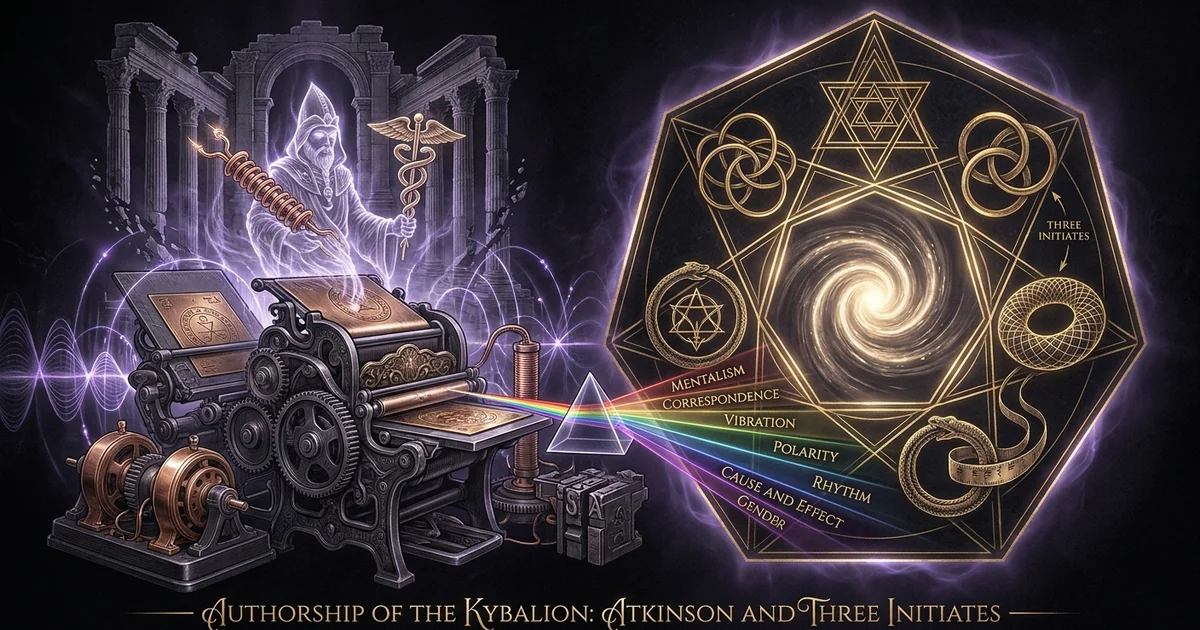
Authorship of The Kybalion: Atkinson and Three Initiates
Metaphysical Thesis & Epistemological Opening: The Kybalion as Modern Pseudo-Hermetic Grimoire
Pseudo-Epigraphy and the Mask of Ancient Provenance
The phenomenon of pseudo-epigraphy—the deliberate attribution of a written work to a revered, often mythological forebear—constitutes an established vector of esoteric transmission throughout Western intellectual history. In the case of The Kybalion: A Study of The Hermetic Philosophy of Ancient Egypt and Greece, published in 1908 by the Yogi Publication Society of Chicago, this mechanism reached an apex of modern syncretic myth-making. For over a century, popular occult discourse positioned the monograph as an authentic, lineage-derived distillation of Hellenistic and Egyptian wisdom, claiming direct descent from the mythic adept Hermes Trismegistus.
Textual hermeneutics, historiographical deconstruction, and philological analysis invalidate this claim of antique provenance. Far from an ancient manuscript preserved through unbroken oral fraternities, The Kybalion functions as a turn-of-the-century pseudo-epigraphic grimoire. It appropriates the venerable nomenclature of Alexandrian philosophy to lend metaphysical gravity to an ideological architecture that is unmistakably contemporary. This attribution to antiquity is not a harmless literary device. It establishes an unearned epistemic authority designed to bypass analytical scrutiny, presenting modern experimental psychology and metaphysical pragmatism as timeless cosmic revelations.
The Ideological Nexus of Turn-of-the-Century Chicago
To decipher the text’s true genesis requires a rigorous historical contextualization of The Kybalion within the socioeconomic and spiritual crucible of early twentieth-century Chicago. Between the 1893 World’s Columbian Exposition—which introduced American audiences to Swami Vivekananda’s Advaita Vedanta—and the onset of World War I, Chicago served as the industrial and ideological epicenter of the New Thought movement. This theological current, fundamentally intertwined with the metaphysical remnants of Mesmerism, Swedenborgianism, and Ralph Waldo Emerson’s Transcendentalism, sought to harmonize spiritual mechanics with industrial-era material ambition.
Within this urban landscape, speculative philosophy hybridized with practical commerce. The pervasive cultural ethos demanded an actionable, empirical approach to metaphysics: a system where divine causality could be leveraged for personal sovereignty, physical health, and financial triumph. The Kybalion reflects these environmental pressures in every conceptual fiber. The text dispenses with the antique liturgical modes of supplication, sacrifice, and cosmogonic lamentation, replacing them with systematic “laws” and “principles” modeled on late-Victorian physics and commercial efficiency.
De-mythologizing the ‘Three Initiates’ Pseudonymity
The intentional attribution of authorship to the enigmatic “Three Initiates” operates as a calculated narrative mask. Within esoteric publishing traditions, pseudonyms frequently demarcate the construction of an artificial egregoric thoughtform—a psychic reservoir that detaches the text from its material author and anchors it within an imaginary trans-historical brotherhood. This strategy insulated the work from the mundane entanglements of its commercial production apparatus while providing its readership with a tantalizing initiatic puzzle.
+-----------------------------------------------------------------------+
| Archival Vectors: The Mask of 'Three Initiates'                       |
+-----------------------------------------------------------------------+
| Legal Registrations       -> Library of Congress Copyright Office    |
| Corporate Signatures      -> The Yogi Publication Society Ledger      |
| Lexical Concordance       -> Atkinson's Solo New Thought Tracts       |
| Commercial Motive         -> Segregation of Esoteric Market Sectors   |
+-----------------------------------------------------------------------+
Beneath this operational veil lay the strategic necessity of market segmentation. The individual who engineered this initiatic architecture was simultaneously marketing generic New Thought self-determinism, commodified Indian breathing techniques, and pragmatic occult manuals across distinct publishing imprints. Revealing that the “ancient initiates” were the singular production of an overworked Chicago writer-publisher would have instantly collapsed the mystique required to sustain the book’s spiritual authority.
The definitive dismantling of the “Three Initiates” mythos was achieved through the archival scholarship of Philip Deslippe. In his critical apparatus for The Kybalion: The Definitive Edition (2011), Deslippe cross-referenced the catalog registrations of the Library of Congress Copyright Office with the internal records of the Yogi Publication Society. The original 1908 copyright submission for The Kybalion explicitly names William Walker Atkinson as the legal author and proprietor.
Furthermore, Deslippe unearthed a 1912 French esoteric journal entry wherein the translator of The Kybalion, Albert L. Caillet, affirmed in correspondence that Atkinson had privately confessed to being the sole author of the text. Atkinson’s deployment of the plural “Three Initiates” served purely as a psychological device to bestow an aura of ancestral authority upon his synthesized mentalist framework.
Primary Codices & Historical Transmission: Textual Genealogy from New Thought to Hermetica
Stylometric Fingerprints: The Atkinson and Ramacharaka Corpus
Stylometric forensics establish beyond reasonable doubt that the author of The Kybalion was William Walker Atkinson (1862–1932), an attorney turned New Thought luminary and wildly prolific occult publisher. When analyzed alongside Atkinson’s acknowledged solo oeuvre—most notably Thought Vibration or the Law of Attraction in the Thought World (1906)—and his vast corpus published under the Eastern pseudonym “Yogi Ramacharaka” (such as The Hindu-Yogi Science of Breath, 1903, and Gnani Yoga, 1907), The Kybalion exhibits identical syntactical rhythms, idiosyncrasies of capitalization, and rhetorical strategies.
Atkinson possessed a distinctive pedagogical pattern: the programmatic declaration of foundational “axioms,” followed by aggressive capitalization of abstract nouns (e.g., “THE ALL,” “THE SUBCONSCIOUS MIND,” “THE LAW OF RHYTHM”), interspersed with quasi-legal disclaimers anticipating the reader’s theoretical objections. Identical idiosyncratic phrases—such as “The lips of wisdom are closed, except to the ears of Understanding”—appear verbatim across texts bearing Atkinson’s real name, his Indian persona, and the “Three Initiates” attribution. His characteristic cadence reflects his formal background as an attorney admitted to the Pennsylvania bar: his prose argues a structural metaphysical brief, operating through deductive litigation rather than mystical ecstatic transmission.
The Yogi Publication Society and Occult Book Distribution Networks
The transmission pipeline of The Kybalion was structurally indissoluble from the Yogi Publication Society, an occult publishing house operating out of the Masonic Temple building in Chicago. Controlled administratively by Atkinson and his associate Sydney Flower, this firm served as a commercial engine that commodified esoteric eschatology for an emerging urban middle class. The early twentieth-century occult revival in America relied not on cloistered lodges, but on specialized mail-order systems, railway depot bookstalls, and metaphysical lending libraries.
The Yogi Publication Society established a self-referential ecosystem where texts affirmed one another across nominal disciplinary boundaries. A reader seeking Indian mysticism was directed to the “Yogi Ramacharaka” volumes; a reader interested in personal empowerment was funneled into Atkinson’s New Thought tracts; and a practitioner yearning for the ultimate validation of Western primordial tradition was presented with The Kybalion. This triangular marketing apparatus yielded an autonomous feedback loop, creating an artificial consensus across distinct esoteric lineages that all originated from Atkinson’s desk.
Divergence from Alexandrian Hermetism: A Comparative Textual Exegesis
When The Kybalion is placed alongside genuine Alexandrian Hermetic codices—specifically the tractates of the Corpus Hermeticum, the Asclepius, and the Stobaean Fragments compiled between the first and third centuries CE—the historical discontinuity becomes total. The historical Hermetica, translated and contextualized by Brian P. Copenhaver (1992), reflect an intricate syncretism of Middle Platonism, Hellenistic Stoicism, late-dynastic Egyptian priestly theology, and Jewish mystical undercurrents.
Historical Hermetic Lineage vs. The Atkinson Monograph
+-----------------------------------+-----------------------------------+
| Alexandrian Hermetica (c. 100 CE) | The Kybalion (1908 CE)            |
+-----------------------------------+-----------------------------------+
| Platonized Egyptian Piety         | Late Victorian Mentalism          |
| Planetary Archons (Decans/Spheres)| Etheric Electromagnetic Waves     |
| Soteriological Theurgy (Deificatio| Pragmatic "Mental Transmutation"   |
| Primacy of Nous (Noetic Ascent)   | Primacy of Universal Mind/Law     |
+-----------------------------------+-----------------------------------+
Authentic Hermetic literature centers on the cosmic ascension of the soul, the dissolution of the astral attachments governed by the seven planetary spheres (the hebdome), and the mystical reconstitution of the practitioner in the realm of the Divine Mind (Nous). It is fundamentally a theological, liturgical, and soteriological corpus deeply preoccupied with the transcendence of fate (heimarmene) through radical piety and divine encounter.
Conversely, The Kybalion contains zero references to the planetary governors, no acknowledgment of the Poimandres visionary revelation, and no conceptual framework for liturgical theurgy. Instead, it substitutes an entirely operational, naturalistic apparatus derived from Victorian thermodynamics and nineteenth-century New Thought mentalism.
Alexandrian Hermetica (Corpus Hermeticum)
- Nature of the Divine: Transcendent and immanent creator (Nous and the Father), accessible exclusively through divine revelation, contemplative piety, and noetic illumination.
- Cosmological Architecture: Geocentric Ptolemaic cosmos governed by astral fate (heimarmene) and mediated by planetary archons through seven descending and ascending metaphysical spheres.
- Soteriological Objective: Theosis (deification); liberation of the spiritual intellect from the physical vessel, passing through the planetary spheres to merge with the Ogdoadic realm.
- Operational Methodology: Contemplative prayer, hieratic theurgy, ecstatic cosmological vision, moral purification, and mystical surrender to the Divine Mind.
Kybalionic Mentalism (1908)
- Nature of the Divine: “THE ALL”—an impersonal, absolute, pantheistic/panentheistic Mental Living Substance functioning through immutable universal laws.
- Cosmological Architecture: Naturalistic universe governed by dynamic physical-mental forces; infinite scales of vibratory degrees, polarities, and rhythmic cycles.
- Soteriological Objective: “Mental Transmutation”; mastering environmental circumstances, shifting emotional and mental states, and achieving personal mastery within the material plane.
- Operational Methodology: Practical auto-suggestion, cognitive restructuring, psychic polarity shifts, and neutralizing rhythmic swings via mental detachment.
Ontological Architecture & Cosmological Models: The Seven Principles as Mentalist Monism
THE ALL: Panentheistic Idealism versus Classical Emanationism
The core metaphysical pillar of The Kybalion is the absolute axiom: “THE ALL is MIND; The Universe is Mental.” While modern readers frequently conflate this with the classical Platonic or Plotinian doctrine of emanation, its operational logic reveals a divergent philosophical heritage. In the emanationist systems of Plotinus, Proclus, and the Corpus Hermeticum, the cosmos descends through ontological degradations—from the ineffable One, through the Divine Intellect (Nous), down to the World Soul (Psyche), and ultimately into the decaying, chaotic realm of Matter (Hyle). Matter in classical Hermetism represents the lowest rung of reality, requiring purification and the soul’s ascent away from physical sensory reality.
The Kybalion formulates an absolute, idealist monism that echoes the popularized Advaita Vedanta disseminated by Swami Vivekananda at the close of the nineteenth century, fused with the subjective idealism of Bishop Berkeley and New England Transcendentalism. “THE ALL” in Atkinson’s lexicon is not a transcendent father-creator who projects reality via hierarchized intermediaries; it is an infinite, substantial, panentheistic continuum.
The physical cosmos is conceived not as a fallen or subordinate reality, but as a dynamic mental creation occurring within the infinite consciousness of THE ALL itself. Matter is not distinct from spirit; it is merely spirit vibrating at the lowest perceptible frequency. This conceptual collapse eliminates the traditional esoteric need for celestial hierarchies, angelic mediators, or theurgic invocations, democratizing ontological access by declaring every individualized mind to be an intrinsic, co-equal nexus of the absolute.
The Principle of Vibration: Ether Theory and Nineteenth-Century Physics
Of the seven cosmic principles codified by Atkinson—Mentalism, Correspondence, Vibration, Polarity, Rhythm, Cause and Effect, and Gender—the Principle of Vibration serves as the mechanical bridge linking his metaphysics to late-Victorian science. The axiom “Nothing rests; everything moves; everything vibrates” explicitly captures the late nineteenth-century scientific consensus surrounding the “luminiferous ether” and early electromagnetic theory developed by James Clerk Maxwell and popularized by Nikola Tesla.
During this era, occult theorists capitalized on the scientific shift from a purely mechanistic Newtonian universe of solid atoms to an energetic universe of dynamic fields, radio waves, and unseen radiation (such as Wilhelm Röntgen’s discovery of X-rays in 1895). Atkinson seized upon these developments, transmuting the physical sciences into an operational psychic system. If light, heat, and electricity were simply differing rates of etheric vibration, then thought, emotion, and spiritual consciousness were similarly rates of “mental vibration.” Consequently, occult operations were relieved of magical superstition; they were recast as advanced psychic engineering, where the adept alters mental frequencies to exert influence across both psychic and physical matter.
Polarity, Rhythm, and Gender: The Mechanics of Mind Over Matter
The operational engine of The Kybalion relies on the tactical application of the remaining principles: Polarity, Rhythm, and Gender. Unlike antique esoteric traditions where cosmological principles functioned as theological verities to be contemplated with awe, Atkinson transformed them into actionable psychological technologies—a methodology he designated as “Mental Transmutation.”
The Principle of Polarity (“Everything is dual; everything has poles”) asserts that apparent opposites—such as love and hate, poverty and wealth, courage and fear—are merely variable degrees of the same identical essence. Atkinson utilizes this premise to argue that an adept cannot destroy an unwanted quality, but can easily transpose it into its polar opposite along the same mental continuum.
Atkinson's Operational Polarity Axis
Low Frequency (Negative)                        High Frequency (Positive)
Fear    <------------------------------------>  Courage
Lacks   <------------------------------------>  Abundance
Disease <------------------------------------>  Vital Health
        [Transmutation achieved via Focused Attentional Polarity]
This is coupled with the Principle of Rhythm, which states that all states oscillate back and forth like a pendulum. Atkinson introduces the “Law of Neutralization”: the adept refuses to allow their subjective ego to ride the downward swing of the pendulum, artificially anchoring their consciousness in the higher mental plane to escape the reactionary depression of the lower emotional body.
Finally, the Principle of Gender (“Gender is in everything; everything has its Masculine and Feminine Principles”) is mapped directly onto the turn-of-the-century psychology of the conscious and subconscious mind. The conscious will corresponds to the masculine generative impulse, while the subconscious mind acts as the plastic, fertile feminine receiver. This precise formulation is pure New Thought psychology, identical to Atkinson’s teachings in his texts on telepathy, suggestive therapeutics, and personal magnetism.
Phenomenological Mechanics & Interdimensional Interaction: The Egregore of the Three Initiates
The Hypothesis of Peripheral Collaborators: Paul Foster Case and Michael Whitty
Persistent speculative currents within the esoteric subculture suggest that William Walker Atkinson did not work in total isolation, proposing that occult figures such as Paul Foster Case (founder of the Builders of the Adytum), Michael Whitty (prominent Theosophist and editor of The Path), or Mabel Collins collaborated on the manuscript. Paul Foster Case himself occasionally fueled this speculation through cryptic admissions to private students that he was familiar with the provenance of the work, leading many to infer that he was one of the “Three Initiates.”
However, rigorous chronological and textual demystification conducted by esoteric historians decisively refutes this theory. In 1908, when The Kybalion was copyrighted, Case was only twenty-four years old and had not yet authored any significant metaphysical monographs or entered the Hermetic Order of the Golden Dawn (which he joined later in 1918 under the mentorship of Michael Whitty).
The stylistic architecture of The Kybalion shows no traces of Case’s intense, lifelong focus on Qabalistic gematria, precise Tarot correspondences, or Hebrew letter mysticism. Instead, the document remains entirely free of classical Western ritual magic. The hypothesis of multiple elite initiates functions as an apocryphal narrative retroactively woven to graft genuine lodge credentials onto Atkinson’s unassisted, independent publication.
Informational Control Systems and Pseudonymous Authority
When evaluated through the sociological and phenomenological paradigms articulated by Jacques Vallée, particularly his informational control system hypothesis, the mythos of “The Three Initiates” reveals a deeper operational mechanic. Vallée posits that esoteric myths and non-human encounters frequently function as cultural feedback mechanisms—devices that inject novel ideological software into the human memetic pool by clothing themselves in the archetypal imagery of their target epoch.
+-------------------------------------------------------------------------+
| Vallée's Informational Feedback Loop in Occult Authorship              |
+-------------------------------------------------------------------------+
| Human Author (Atkinson) -> Employs Archaic Mask ("Three Initiates")     |
| Mythic Mask             -> Generates Unquestioned Initiatic Authority   |
| Esoteric Readership     -> Submits to Cognitive Conditioning Feedback  |
| Cultural Result         -> New Thought Ideas Normalized as Antiquity    |
+-------------------------------------------------------------------------+
By displacing the manuscript’s origin from an overworked Chicago editor to a timeless, shadowy council of ancient adepts, the text engaged the deep-seated religious human longing for an unbroken, incorruptible ancestral gnosis. The pseudonym “Three Initiates” operates precisely as an informational control node: it silences epistemic skepticism, establishes an aura of sacred continuity, and manipulates the reader’s cognitive openness, rendering them receptive to modern psychological restructuring under the impression that they are undergoing an ancient Egyptian initiation.
The Kybalion as an Active Occult Egregore
Regardless of the text’s thoroughly demystified secular genesis, an indispensable metaphysical paradox remains: over a century of continuous, focused esoteric veneration has transformed The Kybalion into an operational occult egregore. In classical occult theory, an egregore is an autonomous, non-physical thoughtform generated, sustained, and nourished by the collective belief, rituals, and emotional investments of an esoteric group.
Tens of thousands of modern occultists, Chaos magicians, ceremonialists, and metaphysical seekers approach The Kybalion as a primary text of foundational Hermetic truth. They pray, meditate, structure rituals, and shift states of consciousness through its explicit operational principles. Phenomenologically, the memetic current of “The Three Initiates” has acquired an autonomous energetic reality within the Western esoteric astral plane. The egregore functions independently of its human architect; it produces verifiable psychological and spiritual transformations within practitioners precisely because belief operates as a primary reality-shaping mechanism.
Practitioners who engage with The Kybalion must maintain rigorous historiographical and psychological demarcation. Confusing the pragmatism of modern New Thought with authentic classical theurgy induces a distinct mode of intellectual distortion: psychological inflation.
When a seeker mistakes the mental manipulation of ambient subjective states (Atkinson’s “mental transmutation”) for the transcendent, soul-stripping ascent through the planetary spheres (theosis), the initiate risks becoming trapped within a solipsistic feedback loop. The operational egregore of The Kybalion feeds upon self-referential mental certainty; it can blind the operator to the transpersonal, catastrophic, and deeply humbling encounters with the Non-Human Intelligences that define the classical initiatic path.
Initiatic Synthesis & Philosophical Implications: Demarcation, Syncretism, and Modern Esotericism
The Industrial-Age Reconfiguration of Western Magic
The historical contextualization of The Kybalion as a product of early twentieth-century Chicago New Thought does not invalidate its philosophical genius; rather, it elevates it as one of the most brilliant instances of modern esoteric syncretism ever executed. Atkinson accomplished for the industrial age what Marsilio Ficino and Pico della Mirandola achieved for the Italian Renaissance: he translated an intimidating, fragmented, and archaic body of esoteric intuition into the dominant cognitive grammar of his era.
Historical Trajectory of Hermetic Syntheses
+------------------------------------+------------------------------------+
| Epoch / Context                    | Functional Reconfiguration         |
+------------------------------------+------------------------------------+
| 1st–3rd C. Alexandria (Pagan/Gnostic)| Soteriological Theurgy & Piety   |
| 15th C. Florence (Renaissance)      | Christian-Platonic Philosophy      |
| 20th C. Chicago (Industrial/Modern) | Pragmatic Mentalism & Vibration    |
+------------------------------------+------------------------------------+
Atkinson stripped Western esotericism of its archaic demonology, its tedious astrological tables, and its complex liturgical protocols, extracting what he perceived to be its functional operational core. In doing so, he democratized occult methodology. He presented an urbanizing, secularizing society with an initiatic system that did not demand an altar, a secret temple, or an expensive consecration ritual—only the disciplined, sovereign concentration of the human mind. The industrialization of magic turned every individual consciousness into an autonomous, reality-generating laboratory.
Epistemic Sovereignty Through Historiographical Disillusionment
True initiatic sovereignty demands uncompromising allegiance to historical and philosophical truth. The genuine adept cannot afford the luxury of comfortable, romantic delusions regarding ancestral lineages. To discover that The Kybalion was not written by ancient initiates wandering the Nile, but by an attorney living in Illinois writing beneath a desk lamp, is a crucial threshold in the aspirant’s initiatic maturation.
This historical disillusionment shatters the crutch of inherited authority. It forces the practitioner to evaluate metaphysical claims on their intrinsic operational merit, psychological coherence, and empirical efficacy, rather than relying on the borrowed pedigree of a mythological antiquity. Demarcating between late-antique Egyptian-Hellenistic mysticism and modern American mentalism is not an attack on the text; it is an act of intellectual purification that protects the practitioner from epistemic exploitation and dogmatic vulnerability.
Evaluating Pragmatic Efficacy Independent of Historical Authenticity
Ultimately, The Kybalion must be judged as an operational technology of the imagination. In contemporary Chaos Magic and applied phenomenology, a ritual or psychological construct does not require ancient provenance to function; it requires internal consistency, symbolic coherence, and the capacity to shift consciousness into states of heightened intentionality and resonance.
Atkinson synthesized a phenomenally effective, closed-loop cognitive behavioral framework long before modern cognitive science formulated its own structural models of emotional transmutation. The Seven Principles offer a coherent cognitive lens for navigating the turbulent waves of subjective human existence. The lasting philosophical legacy of The Kybalion resides not in its imagined genealogical continuity with Hermes Trismegistus, but in its profound, early articulation of the plasticity of human perception and the primacy of Mind in the architecture of experienced reality.
Primary Text 1: The Modern New Thought Formulation
“The lips of wisdom are closed, except to the ears of Understanding… THE ALL is MIND; The Universe is Mental… The Principles of Truth are Seven; he who knows these, understandingly, possesses the Magic Key before whose touch all the Doors of the Temple fly open.”
— The Kybalion: A Study of The Hermetic Philosophy of Ancient Egypt and Greece (1908), William Walker Atkinson (writing as “Three Initiates”).
Primary Text 2: The Alexandrian Contemplative-Gnostic Revelation
“My thoughts grew vast, and my bodily senses were held back as in the stupor of heavy sleep… Then a being of enormous size, beyond all bounds, called my name and said: ‘What do you wish to hear and see, and what do you wish to learn and understand by your mind?’ ‘Who are you?’ I asked. ‘I am Poimandres,’ he said, ‘the Mind (Nous) of absolute authority. I know what you want, and I am with you everywhere.’… Having said this, he changed in his appearance, and suddenly everything opened before me in an instant, and I saw an infinite vision, all things turned to light, sweet and joyous.”
— Corpus Hermeticum, Tractate I (Poimandres), translated by Brian P. Copenhaver (1992).
Frequently Asked Questions
Did William Walker Atkinson Act Alone in Writing The Kybalion?
Yes. Despite long-standing claims within esoteric fraternities attributing the text to collaborative writing circles—frequently naming Paul Foster Case, Michael Whitty, or Mabel Collins—contemporary archival research establishes William Walker Atkinson as the singular author.
The original 1908 copyright registration filed at the Library of Congress explicitly designates Atkinson as the author and owner of the text. Furthermore, extensive stylometric analysis shows an absolute match with Atkinson’s idiosyncratic vocabulary, rhetorical pacing, and philosophical themes found in his other works published both under his own name and his prolific pseudonym “Yogi Ramacharaka.” The peripheral figures mentioned in occult folklore were either admirers, students, or subsequent popularizers of the work, but none contributed to the primary manuscript.
How Does The Kybalion Diverge from the Historical Corpus Hermeticum?
The divergence between The Kybalion and the historical Corpus Hermeticum is ontological, soteriological, and structural. The authentic Corpus Hermeticum (originating in Graeco-Roman Egypt between the 1st and 3rd centuries CE) is a theological and mystical collection focused on theosis—the deification and redemption of the soul. It involves contemplative piety, moral self-purification, cosmic vision, and the ascending journey through the planetary spheres (hebdome) to overcome fate (heimarmene) and unite with the divine Nous.
Conversely, The Kybalion (1908) entirely omits the planetary archons, the figure of Poimandres, and the liturgical, prayerful character of classical Hermetism. Instead, it retrofits late-nineteenth-century New Thought mentalism, Victorian ether-vibration physics, and secular psychological restructuring into an operational methodology termed “Mental Transmutation.” Its objective is pragmatic mastery over mundane mental, emotional, and physical states rather than celestial ascension.
Why Did Atkinson Use Pseudonyms Like ‘Three Initiates’ and ‘Yogi Ramacharaka’?
Atkinson utilized a complex web of pseudonyms as an intentional strategy for market segmentation, narrative authority, and personal boundary protection. As the ideological and commercial engine of the Yogi Publication Society and the Library Shelf in Chicago, Atkinson simultaneously authored hundreds of titles spanning New Thought self-determinism, legal treatises, popularized Eastern yoga, and Western occultism.
Using the persona “Yogi Ramacharaka” allowed Atkinson to package Neo-Vedantic philosophies and pranayama practices for a Western audience that craved the exoticized mystique of an ancient Indian guru. Conversely, deploying the pseudonym “Three Initiates” for The Kybalion constructed an esoteric egregore that lent the book an aura of ancestral, cloistered initiatic authority. This pseudonymous veil shielded the commercial mechanics of his publishing operation from spiritual skepticism and allowed the work to be received as an authentic transmission of timeless wisdom.
The word Kybalion has no legitimate historical or philological pedigree within classical Greek, Coptic, or ancient Egyptian texts. Philologists and esoteric scholars recognize it as a modern neologism crafted by Atkinson.
Most likely, the term represents an intentional phonetic blending of the Hebrew Kabbalah (tradition/reception), the ancient Phrygian earth goddess Kybele (Cybele), and Hellenistic-sounding pseudo-antique prefixes. The author selected the neologism precisely because of its obscure, enigmatic cadence, ensuring that it could not be easily traced to any specific historical manuscript and thereby preserving its mystique as a “secret” oral doctrine.
What Role Did the New Thought Movement Play in Early 20th-Century Occultism?
The New Thought movement acted as the definitive bridge between nineteenth-century spiritualism, Mesmerism, and twentieth-century modern occultism. Emerging out of the healing theories of Phineas Parkhurst Quimby, New Thought posited that the physical universe is an entirely mental construction, and that an individual’s physical circumstances, health, and economic prosperity are direct projections of their mental conditioning and attentional focus.
During the late 1890s and early 1900s, especially in urban publishing hubs like Chicago, New Thought ideas cross-pollinated with Theosophy, Rosicrucianism, and popularized Eastern metaphysics. This current recast ancient magic into modern, optimistic “natural laws,” emphasizing visualization, autosuggestion, the “Law of Attraction,” and mental hygiene. The Kybalion represents the theoretical summit of this development, systematically translating classical Western esoteric traditions into the pragmatic mentalist currency of the American New Thought paradigm.