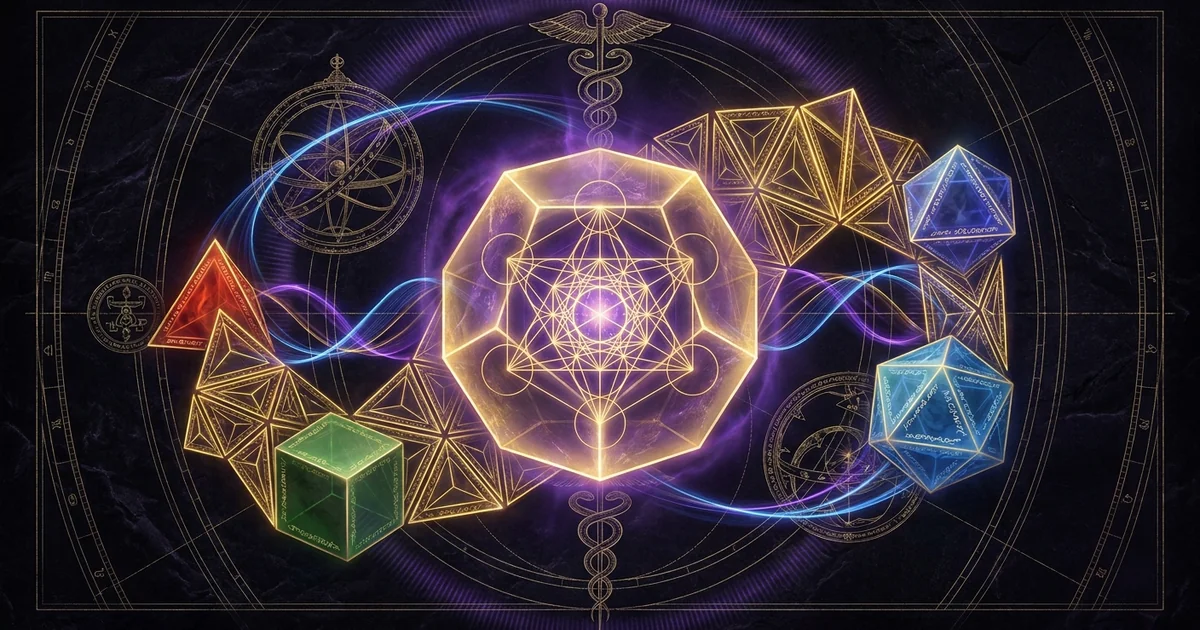
The Five Platonic Solids: Fire, Earth, Air & Ether Arts
Metaphysical Thesis & Epistemological Opening: Geometry as Ontological Substrate
The Crisis of Substance Materialism and the Geometrical Turn
Substance materialism has reached an impasse in its attempt to account for the emergence of physical reality. By positing fundamental particles as localized, self-subsistent packets of mass-energy operating within a passive spatial container, mechanistic physics invariably stumbles over the problem of discretization: why should continuous quantum fields precipitate into discrete, stable configurations of baryonic matter? The reductionist framework treats form as an accidental consequence of force interactions, yet it cannot explain the deep mathematical symmetries that dictate the limits of atomic and molecular stability.
To resolve this explanatory breakdown, theoretical metaphysics must execute a rigorous geometrical turn. The universe is not an aggregate of material objects colliding within an inert void; rather, matter is a localized excitation of structured space itself. What sensory consciousness perceives as substantial solidity is the energetic boundary condition established by topological invariants. Spatial geometry does not merely describe physical states—it constitutes the fundamental ontological grammar through which unmanifest energetic potential acquires phenomenological persistence.
This perspective dismantles the Cartesian dualism between res extensa (extended substance) and res cogitans (thinking substance). By recognizing that space possesses an intrinsic, non-arbitrary architecture, we discover that physical form is the exteriorized crystallization of structural information. The five regular convex polyhedra—the Platonic solids—represent the necessary, mathematically invariant boundary conditions through which primordial spatial coordinates differentiate into sensible manifestation.
Platonic Stereometry: From Stereoma to Prime Informational Boundaries
In classical Greek thought, stereometria designates far more than the passive measurement of three-dimensional volume. It denotes the science of stereoma—the firmament, the stable bodily boundary, the structural framework by which boundless, indeterminate extension (apeiron) is arrested and brought into coherent limit (peras). The five Platonic solids (the tetrahedron, hexahedron, octahedron, icosahedron, and dodecahedron) are the sole spatial configurations in Euclidean three-space that satisfy the criteria of absolute regularity: congruent regular polygonal faces meeting at identical dihedral angles, with an equivalent number of faces converging at every vertex.
These polyhedra do not exist as passive objects within space; they are prime informational boundary operators. A boundary operator, in both algebraic topology and esoteric cosmology, is that which demarcates an interior phase-space from an exterior continuum. By establishing non-arbitrary geometric limits, the Platonic solids act as spatial filters. They translate unconditioned energetic flux into localized structural coherence.
Within this framework, the elemental archetypes—Fire, Earth, Air, Water, and the celestial Ether—are not primitive chemical substances. They represent distinct morphological phase-states of matter and consciousness. The five regular convex polyhedra govern the geometric symmetries of these phase-states, determining their stability, kinematic velocity, and transmutational capacities across dimensional thresholds.
The Epistemological Shift: Mathematics as Mediating Interface
To grasp the operational nature of the Platonic solids, one must abandon the naive view of mathematics as a formal, human-invented shorthand. Mathematics functions as the primordial mediating interface between the transcendent ideational realm—termed the pleroma in Gnostic metaphysics—and the sensible manifestations orchestrated by the Demiurge. Geometry is the structural speech of this mediating intelligence.
Plato’s cosmological exposition in the Timaeus anticipates modern structural realism: sensory consciousness does not encounter raw ontological substance (hyle); it encounters only relational geometries. The vibrational perturbations of space are registered by the human nervous system through sensory faculties that are themselves structured by the same geometric ratios. Consequently, the study of regular polyhedra serves an anagogic and theurgic function.
By meditating upon, constructing, and operatively engaging with these pure stereometric forms, the philosopher aligns their cognitive architecture with the archetypal blueprint of the cosmos. This process initiates a transition from sensory deception to structural noesis. The practitioner ceases to be an entrapped observer within the material matrix and becomes an active participant in reality architecture, decoding the geometric software that governs the physical interface.
In classical Greek metaphysics, a rigorous distinction is maintained between raw, undifferentiated substance (hyle), the active informing geometry (morphe), and the irreducible elements (stoicheia). The term stoicheion fundamentally means a primary component, a basic unit, or a letter of an alphabet; when Plato applies it to the elemental building blocks in the Timaeus, he explicitly indicates that the elements are not fundamental substances, but rather structural syllables formed by the geometric syntax of the stereoma (the solid, bounded spatial frame).
Primary Codices & Historical Transmission: From Timaeus to Keplerian Stereometry
The Demiurgic Blueprint in the Timaeus: 53c–56c
The locus classicus for the metaphysical deployment of the five regular polyhedra is found in Plato’s Timaeus, specifically across sections 53c through 56c. Plato’s narrator, the Pythagorean astronomer Timaeus of Locri, establishes that prior to the intervention of the Demiurge (the divine ordering craftsman), the primary materials of the cosmos existed in a state of chaotic, formless agitation within the receptacle (chora). The Demiurge does not create matter ex nihilo; rather, he introduces order through the agency of “shapes and numbers” (eidesi te kai arithmois), transmuting chaotic flux into an intelligible cosmos.
Crucially, Plato refuses to designate the physical bodies of Fire, Earth, Air, and Water as fundamental substances (stoicheia). Instead, he deconstructs their three-dimensional polyhedral structures into constituent two-dimensional planar triangles. The faces of the regular polyhedra are generated from two primary right-angled triangles: the isosceles right triangle ($45^\circ\text{–}45^\circ\text{–}90^\circ$), whose hypotenuse is incommensurable with its sides by the factor of $\sqrt{2}$, and the scalene right triangle ($30^\circ\text{–}60^\circ\text{–}90^\circ$), whose hypotenuse is double the length of its shortest side, embodying the ratio of $1 : \sqrt{3} : 2$.
By assembling these elementary planar triangles into equilateral triangles and squares, the Demiurge constructs the faces of the stereometric forms. The scalene right triangle generates the equilateral faces of the tetrahedron (Fire), the octahedron (Air), and the icosahedron (Water). The isosceles right triangle generates the square faces of the hexahedron (Earth). Through this reduction, Plato establishes an early phase-space calculus: physical properties such as mobility, penetrative sharpness, and inertial stability are direct mechanistic consequences of polyhedral geometry—specifically the acute sharpness of dihedral angles, the number of constituent triangular units, and the relative surface-to-volume ratios of the forms.
“Now, of the two triangles, the isosceles is of one type only, while the scalene is of infinitely many… Of the many scalene triangles, there is one that is the most beautiful… that one which, when doubled, forms a third triangle that is equilateral… We must therefore select two triangles from which the bodies of fire and the other elements have been constructed: the one being the isosceles, the other having the square on the greater side three times that on the lesser… There are four kinds of bodies: three of them are generated from the one scalene triangle, while the fourth alone is composed of the isosceles triangle. All four are therefore not capable of being resolved into one another by mutual dissolution… but the first three can be dissolved into one another, for they are formed from the same nature.” — Plato, Timaeus (trans. Donald J. Zeyl / R.G. Bury)
Euclid’s Book XIII: The Synthetic Proof of Fivefold Closure
The empirical intuition of Plato received its definitive mathematical canonization roughly six decades later in Euclid’s Elements. While modern curricula frequently truncate Euclid’s work to planar geometry, the entire thirteen-volume treatise is structured teleologically to culminate in Book XIII: the systematic construction and circumscription of the five regular solids within a sphere, followed by the rigorous proof that no other regular convex polyhedra can exist in Euclidean three-space.
Euclid’s terminal proposition—Proposition 18—demonstrates the topological closure of the Platonic system through a proof based on vertex angle defects. A regular polyhedron requires that at least three congruent regular polygonal faces converge at a single vertex, and the sum of the plane angles forming that vertex must be strictly less than four right angles ($360^\circ$). If the sum equals $360^\circ$, the faces flatten into a continuous, non-enclosing two-dimensional plane; if it exceeds $360^\circ$, a closed convex vertex cannot form.
For regular equilateral triangles (internal angle $60^\circ$):
- Three triangles at a vertex yield $3 \times 60^\circ = 180^\circ < 360^\circ$ (Tetrahedron)
- Four triangles at a vertex yield $4 \times 60^\circ = 240^\circ < 360^\circ$ (Octahedron)
- Five triangles at a vertex yield $5 \times 60^\circ = 300^\circ < 360^\circ$ (Icosahedron)
- Six triangles yield $6 \times 60^\circ = 360^\circ$, forming a flat tessellation rather than a spatial vertex.
For regular squares (internal angle $90^\circ$):
- Three squares at a vertex yield $3 \times 90^\circ = 270^\circ < 360^\circ$ (Hexahedron / Cube)
- Four squares yield $4 \times 90^\circ = 360^\circ$, resulting in a planar grid.
For regular pentagons (internal angle $108^\circ$):
- Three pentagons at a vertex yield $3 \times 108^\circ = 324^\circ < 360^\circ$ (Dodecahedron)
- Four pentagons yield $4 \times 108^\circ = 432^\circ > 360^\circ$, which violates convexity.
For regular hexagons (internal angle $120^\circ$):
- Three hexagons yield $3 \times 120^\circ = 360^\circ$, immediately flattening into a plane.
Higher polygons with $n \ge 6$ sides possess internal angles of at least $120^\circ$, making it impossible to assemble three or more at a single vertex without equalling or exceeding $360^\circ$. Euclid’s proof confirmed that the structural vocabulary of three-dimensional Euclidean reality is bounded by an immutable law of fivefold closure.
       Plane Angle Sums at a Vertex (Must be < 360°)
─────────────────────────────────────────────────────────────
Equilateral Triangles (60°):
  3 × 60° = 180°  ──>  Tetrahedron  (Fire)
  4 × 60° = 240°  ──>  Octahedron   (Air)
  5 × 60° = 300°  ──>  Icosahedron  (Water)
  6 × 60° = 360°  ──>  [Flat 2D Tessellation - Limit Reached]

Squares (90°):
  3 × 90° = 270°  ──>  Hexahedron   (Earth)
  4 × 90° = 360°  ──>  [Flat 2D Tessellation - Limit Reached]

Regular Pentagons (108°):
  3 × 10⁸° = 324° ──>  Dodecahedron (Ether / Cosmos)
  4 × 10⁸° = 432° ──>  [Exceeds 360° - Convexity Impossible]
─────────────────────────────────────────────────────────────
Proclean Neoplatonism, Renaissance Hermeticism, and Kepler’s Nested Spheres
During the fifth century CE, the Neoplatonist philosopher Proclus Lycaeus composed his extensive Commentary on Plato’s Timaeus, elevating Plato’s stereometry into an explicit framework of metaphysical emanation. Proclus recognized that the polyhedra were not merely material components, but psychic and theurgic symbols linking the mundane realm to the intelligible orders. For Proclus, the geometric properties of the solids—such as sharpness, bluntness, ease of motion, and stability—serve as intermediate energetic mirrors through which divine principles precipitate downward through the cosmological chain of being.
This Neoplatonic transmission traversed the medieval Byzantine and Islamic worlds to re-emerge dynamically during the Italian Renaissance through Marsilio Ficino’s translations of Plato and the Corpus Hermeticum. The understanding that spatial form dictates physical property directly informed the birth of modern astrophysics. In 1596, Johannes Kepler published Mysterium Cosmographicum, advancing an audacious cosmological architecture: the spacing of the six known heliocentric planetary orbits was determined by the concentric nesting of the five Platonic solids within the spheres of the planets.
[Sphere of Saturn]
       │
   (Hexahedron)
       │
[Sphere of Jupiter]
       │
  (Tetrahedron)
       │
 [Sphere of Mars]
       │
  (Dodecahedron)
       │
 [Sphere of Earth]
       │
   (Icosahedron)
       │
 [Sphere of Venus]
       │
   (Octahedron)
       │
[Sphere of Mercury]
Kepler positioned the octahedron between Mercury and Venus, the icosahedron between Venus and Earth, the dodecahedron between Earth and Mars, the tetrahedron between Mars and Jupiter, and the cube between Jupiter and Saturn. Although Kepler later refined his model through the discovery of elliptical orbits in his Harmonices Mundi, he never abandoned his core insight: the universe is a harmonic resonance chamber whose macroscopic dynamics are determined by the fundamental stereometric archetypes of regular geometry. This bridge between Pythagorean mysticism and empirical celestial mechanics represents the historical zenith of classical Platonic stereometry.
Ontological Architecture & Cosmological Models: The Fivefold Regular Symmetries
Tetrahedron, Octahedron, and Icosahedron: The Triangular Phase Continuum
The five Platonic solids divide into two distinct structural families: those built from the scalene right triangle via equilateral faces, and those built from distinct planar bases. The first group comprises the triangular triad: the tetrahedron, the octahedron, and the icosahedron. Because their outer surfaces are composed entirely of identical equilateral triangles, they form a continuous stoichiometric phase continuum capable of mutual energetic transmutation.
The tetrahedron, composed of 4 equilateral faces (incorporating 24 primary scalene triangles), corresponds to Fire. It is the most acute, mobile, and penetrative of the solids. Its sharp dihedral angles ($70.53^\circ$) and minimal volume relative to surface area allow it to cleave other structures with maximum kinematic efficiency.
The octahedron, comprising 8 equilateral faces (48 primary scalene triangles), corresponds to Air. Possessing intermediate dihedral angles ($109.47^\circ$) and eightfold symmetry, it serves as an ontological mediator between Fire and Water.
The icosahedron, possessing 20 equilateral faces (120 primary scalene triangles), corresponds to Water. Having the greatest number of faces and the most obtuse dihedral angle ($138.19^\circ$) among the triangular solids, it approaches the sphere in volumetric inclusivity, exhibiting high fluidity and resistance to penetration.
Because all three belong to the same underlying triangular syntax, Plato formalizes a conservation law governing their phase transformations. A single unit of Water (20 faces / 120 scalenes) when dissolved by the sharper shearing action of Fire can disintegrate into two units of Air (8 + 8 = 16 faces / 96 scalenes) and one unit of Fire (4 faces / 24 scalenes). This represents an archaic mathematical formulation of thermodynamics, where the fundamental energetic quantity—the constituent planar scalene unit—is strictly conserved across elemental state changes.
The Hexahedron: Orthogonal Grounding and Inertial Anchoring
In stark contrast to the fluid, interconvertible triangular continuum, the hexahedron (cube) occupies a position of radical topological isolation. Composed of 6 square faces generated by 24 constituent isosceles right triangles ($45^\circ\text{–}45^\circ\text{–}90^\circ$), the cube corresponds to Earth. Its dihedral angles meet at rigid, orthogonal $90^\circ$ intersections, granting it the highest mechanical stability and resistance to shearing stress among all the Platonic solids.
Because the isosceles right triangle is mathematically incommensurable with the scalene right triangle (possessing a hypotenuse governed by $\sqrt{2}$ rather than the $\sqrt{3}$ relations of the equilateral faces), Earth cannot be transmuted into Fire, Air, or Water through any planar rearrangement. In Plato’s cosmological physics, when Earth encounters the penetrative sharpness of Fire or the shearing forces of Air, it can be broken down into its constituent squares, but these squares can never integrate into the triangular lattices of the other elements.
The square units wander through the spatial receptacle until they re-encounter one another, reforming once again into the cubic grounding of Earth. The hexahedron represents inertial anchoring, mass stabilization, and the resistance to entropy. It is the geometric foundation that prevents the physical universe from dissolving into boundless, formless energetic dispersion, acting as the bedrock of density in terrestrial manifestation.
The Dodecahedron: Pentagonal Symmetry, the Aether, and the Celestial Envelope
The dodecahedron stands apart from the lower four elemental solids, functioning as the quintessence or the celestial envelope. Composed of 12 regular pentagonal faces, its construction is impossible without the introduction of extreme and mean ratio—the golden ratio, $\phi = \frac{1 + \sqrt{5}}{2} \approx 1.618$. Pentagonal symmetry contains within its diagonal vectors the self-replicating geometries of the golden spiral, exhibiting fivefold rotational axes that cannot tile Euclidean two-space without structural friction or non-periodic Penrose distributions.
In the Timaeus (55c), Plato refers to the dodecahedron obliquely and with notable reverence: “There was yet a fifth combination which God used for embroidering constellations across the whole heaven.” Rather than assigning it to a terrestrial element, Plato positions it as the cosmic chassis—the dodecahedral spherical envelope that bounds the macrocosm. In later Hermetic and Pythagorean traditions, this fifth solid corresponds to the Ether (aither), the luminescent, non-particulate substance that fills the celestial spheres and mediates consciousness itself.
Modern topology and astrophysics have repeatedly revisited the Platonic intuition of the dodecahedron. Cosmological analyses of the cosmic microwave background (CMB) radiation, notably the work of Jean-Pierre Luminet and colleagues on the Poincaré dodecahedral space model, propose that the global topology of the cosmos may indeed be a finite, positively curved spherical space tessellated by a dodecahedron where opposite pentagonal faces are identified. The dodecahedron is not an elementary building block of local matter, but rather the cosmic container within which matter-energy phase transitions occur.
Triangular Phase Continuum (Tetrahedron, Octahedron, Icosahedron)
- Constituent Face Geometry: Equilateral triangles composed of scalene $30^\circ\text{–}60^\circ\text{–}90^\circ$ units.
- Elemental Correspondence: Fire (Tetrahedron), Air (Octahedron), Water (Icosahedron).
- Dihedral Symmetry: Non-orthogonal, ranging from $70.53^\circ$ to $138.19^\circ$.
- Topological Mutability: Highly mutable; capable of mutual elemental interconversion through planar decomposition and stoichiometric conservation of triangles.
- Kinematic Function: Shearing, dissipation, aerodynamic mediation, and fluidic volumetric transmission.
Non-Triangular Boundary Operators (Hexahedron & Dodecahedron)
- Constituent Face Geometry: Squares ($45^\circ\text{–}45^\circ\text{–}90^\circ$ units) and Pentagons ($\phi$-governed scalings).
- Elemental Correspondence: Earth (Hexahedron), Ether / Celestial Envelope (Dodecahedron).
- Dihedral Symmetry: Orthogonal ($90^\circ$) and obtuse golden-ratio mediated ($116.56^\circ$).
- Topological Mutability: Incommensurable; isolated from the triangular transmutation cycle. Cannot convert into Fire, Air, or Water.
- Kinematic Function: Inertial mass anchoring, grounding, cosmic encapsulation, and macro-informational boundary structuring.
Phenomenological Mechanics & Interdimensional Interaction: Spatial Boundaries and Non-Human Geometries
Polyhedral Topologies as Trans-Dimensional Projections
To understand the emergence of anomalous physical phenomena, one must transition from standard Euclidean three-space into higher-dimensional geometry. In four-dimensional Euclidean space ($\mathbb{R}^4$), there exist not five, but six regular convex polychora (four-dimensional polytopes): the 5-cell, 8-cell (tesseract), 16-cell, 24-cell, 120-cell, and 600-cell. When a four-dimensional polytope intersects or casts a shadow onto a three-dimensional spatial cross-section, its higher-dimensional symmetries undergo dimensional reduction, precipitating natively as Platonic solids or their compounds.
For instance, the 120-cell—a magnificent four-dimensional polychoron bounded by 120 regular dodecahedral cells—and its dual, the 600-cell (bounded by 600 tetrahedra), demonstrate how complex higher-dimensional hyper-spheres resolve stereometrically as dodecahedral and icosahedral projections within three-space. The five Platonic solids are thus not merely static geometric solids; they represent dimensional reduction nodes. They are the structural cross-sections left behind when higher-dimensional metric tensors intersect the three-dimensional boundary conditions of our perceptual envelope.
Higher-Dimensional Hyper-Polychora (4D Metric: R⁴)
          │                                     │
     [ 120-Cell ]                          [ 600-Cell ]
  (120 Dodecahedra)                      (600 Tetrahedra)
          │                                     │
          ▼                                     ▼
 ╔═════════════════════════════════════════════════════════╗
 ║        Dimensional Reduction & Orthographic Shadow      ║
 ╚═════════════════════════════════════════════════════════╝
          │                                     │
          ▼                                     ▼
  ( Dodecahedron )                        ( Icosahedron )
          └──────────────────┬──────────────────┘
                             ▼
              [ 3D Observable Stereoma (R³) ]
When an energetic system undergoes a dimensional transition—whether in high-energy physics, anomalous phenomena, or states of mystical ecstasy—the interaction manifests along the symmetry axes of these regular solids. The solids act as step-down transformers, allowing trans-dimensional fields to interface directly with the electromagnetic and gravitational fields of the localized continuum.
Informational Control Systems: Valleean Semiotics in Geometric Manifestations
This stereometric stepping-down process provides an interpretive framework for the informational control system postulated by astrophysicist and computer scientist Jacques Vallée. In works such as Messengers of Deception, Vallée argues that Non-Human Intelligence (NHI) does not necessarily represent hardware-bound extraterrestrial biological entities traversing interstellar distance via Newtonian propulsion. Instead, anomalous encounters operate as an informational control system—a mechanism that manipulates human cultural, mythological, and philosophical parameters through the calibrated projection of symbolic, physicalized archetypes.
┌────────────────────────────────────────────────────────┐
│     Trans-Dimensional Informational Core (NHI / Metaconsciousness)
└──────────────────────────┬─────────────────────────────┘
                           │
                           ▼  [Dimensional Transduction]
┌────────────────────────────────────────────────────────┐
│     Platonic / Polyhedral Boundary Operator (R⁴ ──> R³)
└──────────────────────────┬─────────────────────────────┘
                           │
                           ▼  [Psychotronic / Stereometric Interface]
┌────────────────────────────────────────────────────────┐
│     Phenomenological High-Strangeness Encounter         │
│     (Polymorphic Solids, Metric Warping, Luminous Polyhedra)
└──────────────────────────┬─────────────────────────────┘
                           │
                           ▼  [Perceptual Integration]
┌────────────────────────────────────────────────────────┐
│     Human Consciousness Calibration / Paradigm Shift    │
└────────────────────────────────────────────────────────┘
Within this semiotic paradigm, geometric manifestations reported in high-strangeness encounters—such as precisely bounded hovering tetrahedra, crystalline octahedra, or glowing dodecahedral arrays—are psychotronic calibration mechanisms. NHI operations exploit the fundamental status of Platonic geometries to bypass conditioned linguistic filters. By deploying physical forms that embody irreducible mathematical truths, the control system injects informational payloads directly into human consciousness.
These manifestations are not random spectacles; they are structural semiotic statements designed to alter the epistemological baseline of human observers, forcing an expansion of consciousness to accommodate multi-dimensional reality architectures.
“We are dealing with a technology that manipulates our reality, not just our atmospheric space. The manifestations are designed to act upon human consciousness as an informational feedback system, injecting symbolic architectures into our cultural reality to alter our collective trajectory over historical time scales. The recurring geometry of these encounters is not arbitrary; it is the language of the interface itself.” — Jacques Vallée, Messengers of Deception: UFO Contacts and Cults (1979)
High Strangeness and Anomalous Solid Symmetries in Consciousness Encounters
The operational intersection of stereometry and anomalous phenomena is documented across the literature of the Interdimensional Hypothesis within the Vallée Framework. Encounters characterized by high strangeness frequently detail anomalous physical structures exhibiting impossible geometric behaviors. Observers recount crystalline and metallic objects transitioning dynamically between dual polyhedral states—such as a cube undergoing continuous topological inversion through its vertices into an octahedron, or an icosahedron morphing seamlessly into a dodecahedron.
In Euclidean three-space, these dual transformations require either the destruction of the solid’s physical boundary or complex four-dimensional rotational mechanics. When witnessed within ordinary terrestrial environments, such morphological shifts demonstrate localized warping of Euclidean metric tensors. The local spacetime surrounding the anomalous object has been artificially curved or hyper-dimensionally folded, allowing the internal angles and face geometries to dynamically alter their dihedral relationships without mechanical fracture.
Furthermore, deep consciousness states induced by advanced theurgic practices, spontaneous visionary experiences, or entheogenic protocols frequently reveal Platonic grids operating as the structural foundation of the subjective perceptual sphere. Meditators report encountering the dodecahedral and icosahedral lattices as self-luminous, rapidly rotating tessellations that serve as “screens” through which non-human entities enter the subject’s ontological field. These observations reinforce the thesis that the five Platonic solids are the fundamental interface nodes where spatial geometry, matter-energy transmutations, and consciousness converge.
Initiatic Synthesis & Philosophical Implications: Reality Architecture and Human Sovereignty
The Demiurgic Matrix vs. Sovereign Geometric Consciousness
The recognition that physical reality is architecturally coded by the five Platonic solids leads to a profound metaphysical divergence. In the Gnostic hermeneutic, the Demiurge is an archontic, blind artisan (Yaldabaoth) who uses geometric boundary conditions to imprison divine sparks of consciousness within a rigid, deterministic physical matrix. The regular polyhedra, in this view, are the geometric bars of an ontological cage—the structural limitations that enforce physical entropy, sensory deception, and temporal decay.
Conversely, the classical Pythagorean-Hermetic tradition, documented in the Hermetic Principles of Mentalism and Vibration, views the Demiurgic architecture not as a prison, but as a cosmic gymnasia. The geometric constraints of the cosmos provide the stable resistance required for individual consciousness to evolve from passive unconscious unity into sovereign, self-realized creation.
The task of the philosophical initiate is neither passive submission to material forms nor nihilistic rejection of the physical structure. It is the realization of geometric sovereignty. By mastering the mathematical and vibrational principles that govern the stereometric boundaries of reality, the human mind transcends its status as an entrapped object within the matrix. The practitioner awakens as a sovereign architect, capable of discerning the geometric parameters that structure space, time, and perception.
The Etheric Dodecahedron and the Merkabah Vehicle
In the highest levels of esoteric theurgy, the dodecahedron ceases to be an external cosmological model and becomes an internal experiential anatomy. In Kabbalistic and Jewish mystical traditions, the Merkabah—the celestial “Chariot” or Throne vehicle described in the visions of Ezekiel—represents the structured light-body through which the mystic ascends through the perilous, archontic-governed palaces (Hekhalot) to the divine presence.
As explored in Merkabah Light-Body Mechanics, this vehicle is operationalized through the dynamic intersection of opposing polyhedral vectors. While introductory esotericism often reduces the Merkabah to an intersecting pair of tetrahedra (the stellated octahedron), classical Neoplatonic theurgy and advanced esoteric traditions identify the true sovereign ascent vehicle with the dodecahedral-icosahedral continuum. The dodecahedron, governing the Ether, serves as the vehicle of the soul (ochema-pneuma), insulating the sovereign consciousness against thermodynamic decoherence as it transits across non-physical topological densities.
By mentally and energetically constructing the dodecahedral etheric field around the human organism, the practitioner establishes a stabilized micro-universe. The twelve pentagonal faces act as an informational shield, harmonizing the five inner elemental phase-states and preventing lower astral and demiurgic forces from penetrating the initiate’s ontological perimeter. Within this stabilized vehicle, the practitioner navigates the pleroma not as an invasive anomaly, but as a fully coherent node of sovereign divine consciousness.
A severe spiritual pathology occurs when sacred stereometry is degraded into mere aesthetic contemplation or ungrounded pop-esotericism. Passive visual absorption of Platonic shapes without rigorous mathematical, ethical, and noetic integration creates an egregoric vulnerability: the practitioner’s psychological architecture becomes inflated, projecting romanticized spiritual significance onto superficial symbols. This renders the mind susceptible to archontic capture, where the illusion of intellectual or spiritual enlightenment substitutes for the demanding labor of transmuting personal shadow dynamics and stabilizing the light-body.
Reclaiming Sacred Stereometry from Pop-Esotericism
Contemporary culture has witnessed a trivialization of sacred geometry. Stripped of its rigorous Euclidean proofs, its cosmological context in the Timaeus, and its demanding meditative practices, the discipline is frequently reduced to mass-marketed jewelry, crystalline decor, and superficial assertions regarding “healing frequencies.” This commercialized dilution obscures the operative, initiatic potency of the Platonic solids.
To reclaim sacred stereometry, modern practitioners must recover the union of intellectual rigor and theurgic interiority that characterized ancient lineages. Stereometry is an exact science: it requires understanding the dihedral angle defects that dictate spatial closure, the irrational square-root and golden-ratio proportions that divide the continuum, and the stoichiometric laws that govern elemental conversions. This foundational discipline is identical to the spatial intelligence encoded within Sacred Geometry in Ancient Temple Architecture, where monumental stone works functioned as three-dimensional polyhedral tuning forks to anchor macrocosmic orders into the terrestrial plane.
When approached with structural precision, the five Platonic solids become an intellectual sword that slices through spiritual sentimentality. They stand as immutable, eternal realities—forms that exist independently of human belief, cultural trend, or psychological projection. In contemplating these five regular convex polyhedra, the human mind touches the very thoughts of the cosmic ordering principle, aligning its temporal existence with the timeless, unassailable architecture of the intelligible cosmos.
Frequently Asked Questions: Ontological and Historical Inquiries
Resolving Historical, Mathematical, and Metaphysical Complexities
Why does Euclidean geometry permit strictly five regular convex polyhedra?
The limitation of Euclidean three-space to exactly five regular convex polyhedra is a mathematical necessity established by Euler’s polyhedral formula ($V - E + F = 2$) and the topological requirement of vertex closure. To form a convex polyhedral corner, at least three regular polygons must meet at a shared point, and the sum of their interior angles must total strictly less than $360^\circ$. If the angle sum reaches $360^\circ$, the polygons lie flat, generating a continuous two-dimensional plane rather than a three-dimensional vertex; if the sum exceeds $360^\circ$, a convex enclosure is mathematically impossible.
Because regular triangles possess internal angles of $60^\circ$, they can join in configurations of three ($180^\circ$, tetrahedron), four ($240^\circ$, octahedron), or five ($300^\circ$, icosahedron) before six of them reach the $360^\circ$ planar barrier. Squares have $90^\circ$ angles and can only form vertices of three ($270^\circ$, hexahedron) before four hit $360^\circ$. Pentagons have $108^\circ$ angles and can only meet in sets of three ($324^\circ$, dodecahedron) before four reach $432^\circ$. Polygons with six or more sides possess internal angles of $120^\circ$ or greater, meaning even the minimum configuration of three faces reaches or exceeds $360^\circ$. Hence, Euclidean space admits only five solutions.
Why did Plato withhold the full operational derivation of the dodecahedron in the Timaeus?
In the Timaeus (55c), Plato intentionally declines to fully articulate the geometric deconstruction of the dodecahedron, remarking only that “God used it for the whole.” This reticence stems from both Pythagorean esoteric oaths and underlying mathematical complexity. The dodecahedron is composed of regular pentagons, whose construction relies entirely on the division of a line segment in extreme and mean ratio (the golden ratio, $\phi$).
In fifth- and fourth-century BCE Greece, the discovery of incommensurable magnitudes (irrational numbers) through the pentagram’s diagonals caused an ontological crisis for early Pythagorean philosophy, which maintained that all reality could be expressed as ratios of whole integers. The dodecahedron was preserved for oral transmission within the inner circle of the Academy (Plato’s Unwritten Doctrines or Agrapha Dogmata) because its mathematical formulation exposed the irrational, infinite self-similarity underlying the cosmos, marking it as a divine mystery rather than an ordinary elemental building block.
How does Platonic ideational stereometry differ from modern physical crystallography?
While physical crystallography observes natural mineral formations (such as pyrite forming cubes or fluorite forming octahedra), it operates within the framework of atomic bonding, empirical chemistry, and imperfect solid-state physics. Physical crystals are material lattices disrupted by thermal vibrations, chemical impurities, dislocations, and physical entropy.
Platonic stereometry operates in the prior, ideational domain of pure form. The Platonic solids are not physical rocks or chemical lattices; they are topological boundary operators that govern the metric of spatial coordinates itself. Modern crystal systems (the 230 crystallographic space groups) are macroscopic physical expressions that emerge when matter-energy condenses according to the broader constraints of spatial symmetry, but the Platonic solids remain the pure archetypal limits to which all physical crystallographic arrangements asymptotically point.
Clarifying Structural Anomalies in the Platonic Schema
Can Earth undergo any transmutation into the other three elemental solids?
Within Plato’s rigorous stereometric framework, Earth (the hexahedron/cube) cannot convert into Fire, Air, or Water. As demonstrated in the transmutation cycle above, the triangular solids are built exclusively from scalene right triangles ($30^\circ\text{–}60^\circ\text{–}90^\circ$), which combine in sets of six to form equilateral triangular faces. These three elements can systematically dissolve and recombine because they share a common constituent unit.
The cube, however, is built exclusively from isosceles right triangles ($45^\circ\text{–}45^\circ\text{–}90^\circ$) combined in sets of four to create square faces. Because the hypotenuse of the isosceles triangle is incommensurable by $\sqrt{2}$ with the $\sqrt{3}$ relations governing the scalene triangle, there is no planar operation that can dissect the square faces of the cube to form the equilateral faces of the other solids without violating the integrity of its constituent geometric units. Earth can be mechanically broken down and crushed into disjointed square fragments by the sharper elemental solids, but those fragments can only ever recombine into cubes.
How do the duals of the Platonic solids reflect elemental relationships?
In polyhedral geometry, every Platonic solid possesses a unique “dual” or “polar” solid formed by connecting the centers of its adjacent faces with straight lines. The relationship of polyhedral duality reveals an intricate structural commentary on the elemental states:
- The Tetrahedron (Fire) is uniquely self-dual: connecting the centers of its four faces produces another inverted tetrahedron inside it. Fire remains eternally Fire, self-generating and topologically autonomous.
- The Hexahedron (Earth) and the Octahedron (Air) are duals of one another: connecting the centers of a cube’s six faces generates an octahedron, while connecting the eight centers of an octahedron generates a cube. This demonstrates the profound polarity between inertial mass (Earth) and dynamic atmospheric expansion (Air).
- The Icosahedron (Water) and the Dodecahedron (Ether) are duals of one another: inscribing vertices at the centers of an icosahedron’s twenty faces produces a twelve-faced dodecahedron, and vice versa. This mathematical polarity reflects the ancient Hermetic doctrine that physical life and oceanic fluidity (Water) serve as the direct mirror and material crystallization of the celestial etheric soul (Ether).