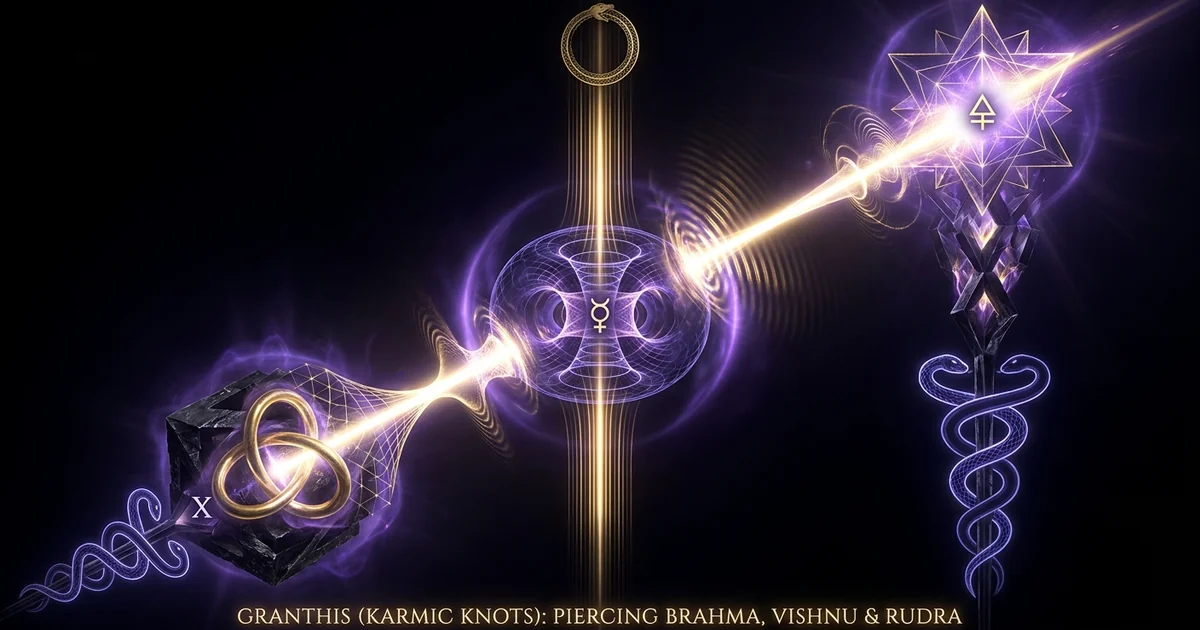
Granthis (Karmic Knots): Piercing Brahma, Vishnu & Rudra
Metaphysical Thesis & Epistemological Opening: Granthis as Dimensional Bottlenecks
The Ontological Coagulation: Cit-Śakti Trapped in Prakṛti
In the classical metaphysics of Tantric Śaivism and Advaita-infused Haṭha systems, the macrocosmic descent of consciousness (Cit) into inert matter (Prakṛti) is mirrored within the psychophysical organism as a series of structural compressions. The human vessel is not a static anatomical entity, but an open energetic circuit sustained by the dynamic polarity of Śiva (transcendental unmanifest consciousness) and Śakti (immanent creative kinetic power). Within this energetic topography, the granthis—translated literally as “knots” or “entanglements”—constitute primary informational bottlenecks where trans-phenomenal awareness suffers localized ontological collapse. Far from serving as mere somatic metaphors or psychological complexes in the Western psychoanalytic sense, the granthis operate as ontological lock-gates embedded in the subtle axis of the subtle body anatomy and nadis.
At these choke points, the non-dual current of Cit-Śakti is progressively coagulated, stratified, and subordinated to the governing laws of space, time, and karmic causality. This coagulation produces the persistent illusion of individual agency (ahaṃkāra) and dualistic alienation. According to the Ṣaṭ-Cakra-Nirūpaṇa of Pūrnānanda Svāmī, the central energetic channel, the suṣumnā nāḍī, acts as the cosmic axis (merudaṇḍa) within the human microcosm; yet its path is obstructed by three specific dimensional seals: Brahma Granthi, Vishnu Granthi, and Rudra Granthi.
Each knot corresponds to a distinct phase-boundary of cosmic manifestation, tethering the soul (jīva) to successive tiers of material identification. The systematic resolution of these knots—known across tantric lineages as granthi bhedana (the piercing of the knots)—is the sine qua non of spiritual liberation. Without the rupture of these structural nodes, the ascent of Kuṇḍalinī-Śakti remains stalled within the lower energetic circuits, reducing spiritual practice to mere subjective mental gymnastics or, worse, pathological energetic congestion.
+-------------------------------------------------------------------------+
|                  COSMIC CONSCIOUSNESS (CIT-SAKTI)                       |
+-------------------------------------------------------------------------+
                                     |
                                     v
+-------------------------------------------------------------------------+
|  RUDRA GRANTHI: Dissolution of Subject-Object Divide & Noetic Ego       |
+-------------------------------------------------------------------------+
                                     |
                                     v
+-------------------------------------------------------------------------+
|  VISHNU GRANTHI: Dissolution of Emotional Clinging & Relational Continuity|
+-------------------------------------------------------------------------+
                                     |
                                     v
+-------------------------------------------------------------------------+
|  BRAHMA GRANTHI: Dissolution of Physical Form, Instinct & Biological Will|
+-------------------------------------------------------------------------+
                                     |
                                     v
+-------------------------------------------------------------------------+
|                   INCARNATE SOMA / PRAKRTI INERTIA                      |
+-------------------------------------------------------------------------+
The Tri-Fold Informational Restraint of the Subtle Body
The structural anatomy of the subtle body reveals that the granthis three psychic knots brahma vishnu rudra granthi piercing process maps precisely to the triadic architecture of cosmic delusion (māyā). The absolute consciousness collapses into the conditioned individual through three primary defilements or stains (malas): āṇavamala (the primordial conviction of incompleteness and limitation), māyīyamala (the illusion of ontological difference and multiplicity), and kārmamala (the binding imperative to act based on desire and aversion). These cosmic malas solidify within the subtle body as the three granthis.
To understand the mechanics of these dimensional restraints, one must challenge the reductive materialism of contemporary neurobiology. The physical central nervous system, with its cerebral-spinal axis and autonomic plexuses, does not generate consciousness; rather, it is the three-dimensional shadow cast into biological tissue by the higher-dimensional geometry of the nāḍīs. When Kuṇḍalinī lies dormant at the base of the spine, folded three and a half times over the svayambhū liṅga, the subtle currents of prāṇa and apāna are diverted into the lateral channels, iḍā and piṅgalā. This bifurcated flow sustains the binary processing of the human mind: subject versus object, attraction versus repulsion, past versus future.
The granthis are precisely the crossover anchor points where iḍā and piṅgalā weave around the suṣumnā, cinching the central canal shut. Consequently, navigating the thresholds of spiritual awakening kundalini requires an epistemological and physiological revolution. The practitioner must reverse the lateral dispersion of life-force and drive it into the central conduit, generating the thermodynamic pressure necessary to rupture these structural bottlenecks.
The term granthi (ग्रन्थि) derives from the Sanskrit verbal root granth, meaning “to tie, bind, knot, or compose.” In the context of subtle tantric physiology, it designates an informational and energetic occlusion where the flow of prāṇa-śakti is cinched within the suṣumnā nāḍī. This knotting prevents the ascent of Kuṇḍalinī by locking consciousness into specific vibrational bands of the guṇas (tamas, rajas, and sattva). A granthi is neither purely anatomical nor purely mental; it is a psychophysical vortex where subtle karmic imprints (saṃskāras) crystallize into dense somato-energetic blockages, anchoring the subject into a finite simulation of temporal reality.
Primary Codices & Historical Transmission: The Textual Hermeneutics of the Tantric Knots
Classical Exegesis in the Śiva Saṃhitā and Haṭha Yoga Pradīpikā
The formal textual exposition of granthi bhedana emerged as an internalizing reform of Vedic sacrificial ritualism. Whereas the Vedic liturgy externalized the conquest of death through the fire altar (yajña), medieval Haṭha and Nātha codices transposed the sacrificial arena directly into the central axis of the human organism. In the Śiva Saṃhitā (c. 14th–15th century CE), attributed to an anonymous tantric master, the macrocosm is declared to reside entirely within the body: Mount Meru is the spinal column, the sun and moon are piṅgalā and iḍā, and the sacred pilgrim sites are the junctures of the nāḍīs. The text warns that the nectar of immortality (amṛta) flowing from the cranial vault is continuously devoured by the solar fire at the navel, a tragic dissipation engineered and maintained by the structural presence of the granthis.
Svātmārāma’s Haṭha Yoga Pradīpikā (c. 15th century CE) provides the foundational technical taxonomy of this process in its fourth chapter on Samādhi. Svātmārāma delineates four sequential stages of practice (avasthās): ārambha (the beginning stage), ghaṭa (the vessel-clearing stage), paricaya (the stage of intimate acquaintance), and niṣpatti (the state of final consummation). These four stages are functionally synonymous with the sequential rupture of the three psychic knots and the stabilization of the resulting transpersonal awareness.
In Svātmārāma’s schema, the piercing of Brahma Granthi occurs at the stage of ārambha avasthā. Here, the friction of prāṇa forced through the lower portion of the suṣumnā shatters the foundational inertia of the material ego. This event is phenomenologically marked by the emergence of the anāhata nāda—the un-struck, internal sound currents—specifically manifesting initially as a sweet, tinkling, or ringing tone resembling celestial ornaments. The Haṭha Yoga Pradīpikā insists that without direct, experiential navigation of these acoustic and energetic markers, any claim of yogic attainment is purely conceptual. The text positions granthi bhedana not as an elective meditative visualization, but as a mechanical, biological, and energetic imperative for transcending mortal consciousness.
ब्रह्मग्रन्थेर्भवेद्भेदादानन्दः शून्यसम्भवः । विचित्रः क्वणको नादः श्रूयते मध्यमे शरीरे ॥ ७० ॥ घटादिषु तथा द्वितीये घटीकृत्य वायुना । विष्णुग्रन्थिं यदा भित्त्वा लभते वैणवं ध्वनिम् ॥ ७२ ॥ तृतीये तु विज्ञेयो विहायसो मर्दलध्वनिः । महाशून्यं तदा याति सर्वसिद्धिगुणाश्रयम् ॥ ७३ ॥ रुद्रग्रन्थिं यदा भित्त्वा सर्वपीठगतोऽनिलः । निष्पत्तौ वैणवः शब्दः क्वणद्वीणाक्वणो भवेत् ॥ ७६ ॥
“When the Brahma Granthi is pierced by pranic force, a distinct joy arises from the void (śūnya); wondrous, tinkling sounds are heard echoing within the middle body (the central channel). In the second stage (ghaṭa), the prāṇa unites fully in the central path; piercing the Vishnu Granthi, the sound of the flute (veṇu) resounds. In the third stage (paricaya), the mardala (drum) sound is perceived in the expanse, and consciousness enters the great void (mahā-śūnya), the foundation of all siddhis. In the fourth stage (niṣpatti), having pierced the Rudra Granthi, the vital breath reaches the supreme seat of power; then resounds the pure vibration of the vīṇā, culminating in total cognitive absorption.” — Svātmārāma, Haṭha Yoga Pradīpikā, Chapter IV, Verses 70, 72, 73, 76 (Trans. Avalon/Muktibodhananda hermeneutic composite).
The Upaniṣadic Archetypes: Yoga Kuṇḍalinī and Varāha Upaniṣads
Complementing the technical manuals of Haṭha Yoga are the Yoga Upaniṣads of the late medieval canon, particularly the Yoga Kuṇḍalinī Upaniṣad and the Varāha Upaniṣad. These texts elevate the mechanics of granthi bhedana to an explicitly cosmological and soteriological register. The Yoga Kuṇḍalinī Upaniṣad (I.65–85) details how the goddess Kuṇḍalinī, awakened by the heat of prāṇāyāma and the contraction of the pelvic floor (mūla bandha), ascends the Sarasvatī nāḍī and strikes the dense barrier of the Brahma Granthi at the base of the spinal axis.
The Upaniṣadic hermeneutic identifies the three granthis with the primary Hindu trinity—Brahma the Creator, Vishnu the Sustainer, and Rudra the Destroyer. This correlation is profoundly revealing:
- Brahma Granthi acts as the gatekeeper of sṛṣṭi (creation, manifestation, physical form).
- Vishnu Granthi acts as the gatekeeper of sthiti (preservation, moral continuity, emotional persistence).
- Rudra Granthi acts as the gatekeeper of laya (dissolution, mental collapse, reabsorption into the void).
The Varāha Upaniṣad frames the piercing of these knots as an absolute operational threshold. It warns that if an aspirant seeks the fruits of meditation without resolving the knots, the prāṇa will rebound violently into the autonomic nervous system. The knot acts like a physical dam; when high-voltage prāṇa is forced into a constricted conduit without adequate purification of the lateral channels (nāḍī śodhana), the resulting turbulence does not produce liberation (kaivalya), but rather manifests as deep psychological destabilization, physiological disease (vyādhi), or severe perceptual distortion. The texts systematically insist that the granthis must be engaged sequentially; one cannot breach the transcendental divide of the third eye (Rudra Granthi) while remaining an existential prisoner to the survival terrors anchored in the perineum (Brahma Granthi).
Ontological Architecture & Cosmological Models: The Triadic Structural Matrix
SAHASRARA (Non-Dual Infinite Light)
                       ^
                       |
             [ ! RUDRA GRANTHI ! ]  <-- Seat of Sattva & Siddhis
                       |
               AJNA (Mind / Manas)
                       |
            VISUDDHA (Ether / Space)
                       |
            [ ! VISHNU GRANTHI ! ]  <-- Seat of Rajas & Compassion
                       |
             ANAHATA (Air / Prana)
                       |
           MANIPURA (Fire / Digestion)
                       |
            [ ! BRAHMA GRANTHI ! ]  <-- Seat of Tamas & Survival
                       |
        SVADHISHTHANA (Water / Procreation)
                       |
          MULADHARA (Earth / Matter)
Brahma Granthi: The Perineum, Earth Element, and Physical Fixation
Situated in the pelvic basin, anatomically anchored between the perineum (mūlādhāra cakra) and the reproductive plexus (svādhiṣṭhāna cakra), the Brahma Granthi represents the densest coagulation of consciousness within the material matrix. Cosmologically aligned with the earth element (pṛthvī tattva) and ruled by the quality of tamas (inertia, heaviness, unconsciousness), this knot establishes the primordial illusion of bodily identity (deha-buddhi). It is the structural seat of the instinctual drive: physical self-preservation, territorial security, existential terror of physical mortality, and the relentless procreative imperatives dictated by biological evolution.
When consciousness is mediated exclusively through the Brahma Granthi, the subject is epistemologically blind to subtle realities. The universe appears exclusively as an aggregate of solid, discrete, colliding Newtonian objects. The existential blockage here manifests as an absolute vulnerability to physical death and material scarcity. To pierce the Brahma Granthi is to dismantle the nervous system’s biological conviction that consciousness is an epiphenomenon of physical cellular tissue.
The rupture of this knot requires the total subjugation of the downward-moving energy (apāna vāyu). As the practitioner applies the pelvic contractions and generates internal bio-thermal heat, the solid foundation of tamasic inertia undergoes a phase transition—melting the foundational fixations of the perineum and heart, and opening the entry point to the central canal known as the brahmadvāra (the door of Brahman).
Vishnu Granthi: The Heart Center, Anāhata Dynamics, and Emotional Bondage
Ascending past the fire of the digestive center (maṇipūra), the ascending prāṇa encounters the second major structural bottleneck: the Vishnu Granthi. Anchored at the cardiac plexus and heart center (anāhata cakra), this knot is governed by the element of air (vāyu tattva) and ruled by the quality of rajas (passion, activity, relational yearning, emotional movement). If the Brahma Granthi binds the soul to the biological form, the Vishnu Granthi binds the soul to the psychological self: its lineage, emotional narratives, relational attachments, and the existential craving for historical and affective continuity.
The Vishnu Granthi is arguably the most insidious barrier on the spiritual path because it cloaks its bondage in the guise of virtue. Here lie the sublime traps of spiritual sentimentalism, institutional religious devotion, moral self-righteousness, and the unexamined desire to preserve the individual soul as an eternal, distinct lover of the divine. It is the seat of kāma (desire) and anurāga (affective attachment).
At this juncture, the ego no longer fears physical death; rather, it fears the loss of its emotional identity, its loved ones, and its capacity to empathize within a dualistic framework. Piercing the Vishnu Granthi demands a ruthless phenomenological sacrifice: the surrender of personal emotional sovereignty and the collapse of the relational boundary between “I” and “Thou.” The somatic symptoms accompanying the breach of this knot often manifest as acute cardiac pressure, spontaneous hyperventilation, deep psychophysical grief without a cognitive object, and finally, the overwhelming eruption of transpersonal compassion (karuṇā) that is no longer anchored to any individual entity.
Rudra Granthi: The Third Eye, Ajna Nexus, and the Subtle Dualistic Divide
The final barrier on the vertical axis is the Rudra Granthi, situated at the cavernous plexus between the eyebrows, within the ājñā cakra and extending toward the crown (sahasrāra). Cosmologically associated with mahat (the cosmic mind) and the element of primordial space, this knot is governed by the quality of sattva (luminosity, purity, intellectual clarity, harmony). Because its medium is sattvic, the Rudra Granthi represents the subtlest and most intoxicating threshold of spiritual awakening kundalini.
Here, the practitioner has already conquered physical survival instincts and emotional attachments. The danger at the Rudra Granthi is entirely noetic and metaphysical: it is the obstacle of the transcendental observer. At the ājñā cakra, the mind experiences panoramic visions, mastery over subtle energetic forces, prophetic cognition, and the emergence of transnormal psychic abilities (siddhis).
The Rudra Granthi preserves the ultimate dualism: the absolute subject observing the manifest objective universe. It is the locus of spiritual pride, where the yogin mistakes an exalted, cosmic ego-complex for unconditioned non-dual realization. The consciousness feels itself to be a distinct, luminous, god-like point of observation (draṣṭā) surveying the cosmos.
Piercing the Rudra Granthi requires the dissolution of this final observer-node. The conceptual separation between consciousness and its content must be obliterated. When the lightning-flash of Kuṇḍalinī shatters this knot, the ājñā dissolves into the thousand-petaled lotus of the sahasrāra; the subtle cognitive mechanism (antaḥkaraṇa) is permanently demagnetized, and individual perception collapses into the boundless expanse of non-dual awareness (Advaita).
Brahma Granthi (Physical/Tamasic)
- Location: Mūlādhāra & Svādhiṣṭhāna (Perineum / Pelvic Basin).
- Guna & Element: Tamas / Pṛthvī (Earth).
- Governing Deity: Brahma (The Cosmic Creator / Progenitor).
- Existential Impediment: Physical mortality terror, instinctual survival compulsions, dense material inertia, body-centric identity (deha-buddhi).
- Phenomenological Sign: Ringing bells, tinkling ornaments, emergence of heat in the pelvic basin, sudden sensation of weightlessness.
Vishnu Granthi (Emotional/Rajasic)
- Location: Anāhata (Cardiac Plexus / Heart Center).
- Guna & Element: Rajas / Vāyu (Air).
- Governing Deity: Vishnu (The Cosmic Preserver / Sustainer).
- Existential Impediment: Sentimental attachment, relational bondage, moral pride, fear of emotional dissolution, devotion to distinct divine forms.
- Phenomenological Sign: Sound of the flute (veṇu) and conch shell, cardiac heat, spontaneous expansion of non-referential grief and unconditional empathy.
Rudra Granthi (Mental/Sattvic)
- Location: Ājñā (Cavernous Plexus / Third Eye Center).
- Guna & Element: Sattva / Manas & Mahat (Mind / Cosmic Space).
- Governing Deity: Rudra (The Cosmic Destroyer / Dissolver).
- Existential Impediment: Spiritual pride, attachment to psychic visions (siddhis), persistence of the transcendental witness-ego (draṣṭā).
- Phenomenological Sign: Sound of the kettledrum (mardala) and vīṇā, blinding white-blue lightning radiance, total collapse of the subject-object horizon.
Phenomenological Mechanics & Somato-Energetic Interfaces: Thermodynamic Piercing
Hydrostatic and Bio-Thermal Inversion: The Role of Prāṇāyāma
The piercing of the granthis is not achieved through cognitive reflection; it demands an explicit thermodynamic and hydrostatic inversion of the subtle energetic economy. In standard human biology, the primary life-force is continually squandered through unceasing mental proliferation and metabolic expenditure. The subtle breath moves outward through the nostrils in measures ranging from nine to sixteen digits in length, carrying with it the solar heat of piṅgalā and the lunar cooling of iḍā. To shatter the dense informational seals of the granthis, this external expenditure must be arrested, reversed, and funneled into the dormant vacuum of the suṣumnā nāḍī.
This thermodynamic inversion is achieved through specific, rigorous forms of prāṇāyāma, most notably Bhastrikā (bellows breath) and Kevala Kumbhaka (spontaneous or forced non-respiratory retention). In the execution of Bhastrikā, rapid diaphragmatic contractions act as a physical and pneumatic piston. This friction heats the kanda—the bulbous root of the nāḍīs situated between the anus and the genitals.
According to the Ṣaṭ-Cakra-Nirūpaṇa, the dormant Kuṇḍalinī is awakened by this bio-thermal friction, like a serpent struck by a rod. Her dormant slumber, which formerly plugged the entrance to the central channel, gives way to an erect, upward-surging vector. As the breath is retained (kumbhaka), the internal pressure forces the hot prāṇic currents into direct collision with the first major resistance: the Brahma Granthi at the base of the spine.
+---------------------------------------------+
       |             JALANDHARA BANDHA               |
       |  (Throat Lock / Prana Driven Downward)      |
       +---------------------------------------------+
                              |
                              | [Downward Vector: Prana]
                              v
       +~~~~~~~~~~~~~~~~~~~~~~~~~~~~~~~~~~~~~~~~~~~~~+
       |              UDDIYANA BANDHA                |
       |      (Abdominal Retraction Engine)          |
       |  Thermal Collision Zone in Sushumna Nadi   |
       +~~~~~~~~~~~~~~~~~~~~~~~~~~~~~~~~~~~~~~~~~~~~~+
                              ^
                              | [Upward Vector: Apana]
                              |
       +---------------------------------------------+
       |                MULA BANDHA                  |
       |   (Pelvic Lock / Apana Driven Upward)       |
       +---------------------------------------------+
Bandhas as Physical Locks: Kinetic Triggers of Granthi Bhedana
The somatic interface through which the subtle body is manipulated rests squarely upon the master keys of Haṭha Yoga: the three primary bandhas (energetic/physical locks). Without the simultaneous application of these muscular contractions, the subtle currents cannot attain the hydrostatic compression required to rupture the granthis. The bandhas physical locks release stored kinetic and electromagnetic potential, transforming the spinal cord into a pressurized, superconducting column:
- Mūla Bandha (The Root Lock): Executed by contracting the perineal muscles, drawing the center of the pelvic floor vertically inward toward the navel. This contraction violently arrests the natural downward dissipation of apāna vāyu, compelling it to turn 180 degrees upward.
- Jālandhara Bandha (The Throat Lock): Executed by extending the cervical spine, drawing the chin tightly back and down into the jugular notch (kaṇṭha-kūpa). This locks the downward descent of the cranial nectar and drives the upward-surging prāṇa vāyu back downward.
- Uḍḍīyāna Bandha (The Abdominal Lift): Executed on complete exhalation by lifting the diaphragm deep into the thoracic cavity and drawing the abdominal wall back against the spine. This creates a powerful negative pressure gradient within the retroperitoneal space, drawing the converging currents of prāṇa and apāna directly into the central axis of the suṣumnā.
When Mūla Bandha and Jālandhara Bandha are held simultaneously in kumbhaka, the upward-moving apāna and the downward-moving prāṇa collide violently at the navel (maṇipūra) under the hydraulic pull of Uḍḍīyāna Bandha. This collision is known in esoteric texts as the union of Sun and Moon. The friction generates an intense, non-combustive metaphysical heat (tapas), which vaporizes the karmic debris blocking the brahmadvāra. Under this sustained bio-thermal pressure, the structural coherence of the Brahma Granthi fails, allowing the awakened Kuṇḍalinī to pierce the knot with the sound of an energetic detonation, rocketing into the higher regions of the spinal conduit.
Thresholds of Awakening: Energetic Symptoms and Pathological Traps
The experiential reality of granthi bhedana is profoundly intense, frequently pushing the physical and psychological limits of the practitioner. It is marked by distinct somato-sensory phenomena that must not be confused with mere psychosomatic disturbances. As documented in clinical analyses of spiritual crises, such as the frameworks articulated in kundalini awakening symptoms and stages, the rupture of each knot triggers an acute reconfiguration of the autonomic nervous system.
Upon the piercing of Brahma Granthi, the practitioner often experiences an intense, searing heat ascending the sacral and lumbar spine, accompanied by involuntary motor releases (kriyās), such as violent shaking, pelvic spasms, and spontaneous cessation of the breath (kevala kumbhaka). This is followed by profound sensory detachment (pratyāhāra), where the external world suddenly seems flat, non-threatening, and fundamentally illusory.
The piercing of Vishnu Granthi shifts the somatic epicenter to the chest. Practitioners frequently report feelings of cardiac arrhythmia, an intense crushing pressure behind the sternum, followed by an explosive, cool sensation that feels like liquid ice flooding the circulatory system. Epistemologically, this event triggers the sudden surfacing and burning of vast reservoirs of unintegrated karmic imprints (saṃskāras): past traumas, ancestral grief, and profound sentimental yearnings are cast into the fire of consciousness, accompanied by the perception of celestial, acoustic frequencies (anāhata nāda).
The rupture of Rudra Granthi presents the most severe psychological risks. As the third-eye knot is shattered, the visual cortex and the vestibular system are inundated with non-physical sensory input. Practitioners report seeing blinding fields of pure white or ultramarine light (bindu), experiencing sensations of the skull “cracking open” or dissolving, and the total destabilization of linear time perception.
If this piercing occurs prematurely—without adequate purification of the moral will and emotional substrate—it can precipitate profound energetic pathologies. High-voltage prāṇa overflowing into unpurified cranial nāḍīs can result in what classical tantric codices diagnose as vāyu-roga (pranic deregulation) and what modern transpersonal psychiatry identifies as Kuṇḍalinī psychosis: acute disorientation, paranoia, grandiosity, sensory hallucinations, and the total inability to integrate consensus reality.
Initiatic Synthesis & Philosophical Implications: Trans-Dimensional Sovereignty
From Triadic Enslavement to Non-Dual Freedom (Kaivalya)
The resolution of the three granthis marks the definitive movement from conditioned existential imprisonment to sovereign non-dual freedom (kaivalya or mokṣa). In the philosophical framework of the Śiva Sūtras, individual existence is defined as cittam nātma (“the mind is not the Self”). As long as the granthis remain intact, the individual operates as a fragmented sub-program within the cosmic display, bound to react compulsively to the mechanical oscillations of the three guṇas.
The three granthis constitute the somatic hardware supporting the software of egoic identification:
- Brahma Granthi anchors the soul to the biological automaton (tamas).
- Vishnu Granthi anchors the soul to the personal narrative and the social drama (rajas).
- Rudra Granthi anchors the soul to the supreme illusion of spiritual separation (sattva).
When all three knots are permanently unraveled through granthi bhedana, the structural architecture supporting the ego-complex (ahaṃkāra) completely collapses. The lateral currents of iḍā and piṅgalā are permanently absorbed into the central blazing furnace of the suṣumnā.
In this state, the macrocosm and the microcosm are recognized as identical. Consciousness is no longer viewed as being “inside” the physical body; rather, the entire material universe is experienced as arising within the infinite, transparent clearing of unconditioned awareness. The yogin realizes the primary axiom of Kashmir Śaivism: Citiḥ svatantrā viśva-siddhi-hetuḥ—absolute consciousness, in its supreme freedom, is the foundational cause of all cosmic manifestation.
The Dissolution of Cosmic Illusion: Overcoming Māyā and the Demiurgic Grip
When viewed through the comparative hermeneutics of Western Esotericism and non-human intelligence frameworks, the granthis can be understood as intrinsic somatic analogues to the Gnostic archontic planetary spheres. In classical Gnosticism, the pneumatic spark (pneuma) descends from the trans-cosmic Pleroma, becoming trapped within the material cosmos engineered by the Demiurge (Yaldabaoth). During this descent, the soul is fitted with planetary garments or seals, administered by the archons, which bind it to cosmic fate (heimarmene), desire, and sensory oblivion.
The granthis function precisely as these archontic seals, written into the very subtle anatomy of the human organism:
- The Brahma Granthi corresponds to the demiurgic imperative of physical embodiment, entropy, and survival terror.
- The Vishnu Granthi corresponds to the astral sphere of sentimental manipulation, relational entanglement, and the emotional mechanics that sustain temporal society.
- The Rudra Granthi corresponds to the highest archontic gatekeeper—the Luciferian intellect that mimics divine illumination while reinforcing the subtle, impenetrable wall of ontological separation.
Piercing the granthis is thus a radical act of metaphysical rebellion. It is the bio-energetic execution of theurgy and Hermetic ascension. By systematically detonating these dimensional choke points, the practitioner neutralizes the informational control system that keeps human consciousness operating as a localized biological resource. The collapse of the granthis strips the cosmic illusion (māyā) of its structural scaffolding. The world is no longer an archontic prison or a demiurgic trap, but rather the luminous, self-luminous play (līlā) of absolute consciousness manifesting as form.
Reintegration of the Divinized Vessel: Jīvanmukti
The ultimate realization articulated in tantric non-dualism is that liberation is not a disembodied escape from the flesh. Unlike ascetic dualist systems that seek the permanent abandonment of the material vehicle, the Haṭha and Tantric traditions champion the ideal of the jīvanmukta—the one who is radically liberated while still embodied. The piercing of the granthis does not destroy the physical organism; rather, it transfigures it into a divinized instrument (divya-deha).
Having traversed the vertical axis from the perineum to the crown, Kuṇḍalinī does not remain permanently locked in the transcendental void of the sahasrāra. True consummation demands the downward descent. Śakti, now fully united with Śiva in the supreme crown center, turns back upon the vessel. She cascades downward through the previously ruptured granthis, flooding the central and lateral channels with the ambrosial nectar of non-dual realization (amṛta).
The biological body is reassumed, but its operating system has been utterly transfigured. The perineum no longer reacts with primal terror; it rests as the stable, immovable footstool of cosmic space. The heart no longer grasps with needy attachment; it radiates trans-personal grace and spontaneous action (sahaja). The third eye no longer clings to prophetic visions or psychic powers; it rests as the transparent aperture through which the cosmos gazes upon itself. The jīvanmukta lives in the world, fully engaged in the domain of time, space, and human relationship, yet inwardly untouched by karmic consequence—an incarnate embodiment of transcendent sovereignty.
The most dangerous failure mode on the initiatic path occurs at the threshold of the Rudra Granthi. As the knot begins to fray under the pressure of ascending prāṇa, the ājñā cakra discharges extraordinary cognitive and psychokinetic potentials (siddhis): clairvoyance, spontaneous telepathy, manipulation of elemental matrices, and the perception of non-human entities.
The unpurified ego often seizes these phenomena as validation of personal deification. This is the archontic trap par excellence: the yogin mistakes psychic dominance over the phenomenal realm for the non-dual realization of the Absolute. If the practitioner succumbs to spiritual inflation at this juncture, the Rudra Granthi re-coagulates into an impenetrable psychic wall, trapping the consciousness within a solipsistic, mentalized simulation of liberation. Authentic piercing demands the immediate and total renunciation of all psychic phenomena (sarva-siddhi-tyāga), casting even the luminous witness itself into the non-dual fire of pure consciousness.
Frequently Asked Questions: Technical and Ontological Clarifications
Can Granthis Re-Coagulate After Being Pierced?
In the preliminary and intermediate stages of spiritual practice, the piercing of a granthi can be transient. Tantric codices distinguish between a temporary bhedana (piercing or breach) and absolute śodhana (complete purification and structural dissolution). During intensive energetic cultivation, a surge of Kuṇḍalinī-Śakti may punch through the Brahma or Vishnu Granthi, giving the practitioner a temporary, blinding glimpse of unconditioned consciousness or ecstatic dissolution. However, if the practitioner promptly returns to conditioned patterns of behavior, unchecked instinctual indulgence, emotional manipulation, or intellectual pride, the dormant karmic imprints (saṃskāras) will rapidly re-aggregate.
The subtle body is profoundly plastic. Just as physical muscle memory re-asserts postural imbalances if corrective movement is not integrated, the nadic geometry of the subtle body will re-crystallize along historical channels. The granthis re-solidify through the lingering gravity of vāsanās (deep-seated psycho-emotional tendencies). A granthi is only permanently unraveled when the corresponding vṛttis (mental modifications) and their underlying karmic seeds (bījas) are completely roasted in the fire of non-dual gnosis (jñāna-agni). Until the state of niṣpatti avasthā (final integration) is stabilized, the practitioner must maintain rigorous ethical, meditative, and somatic discipline to prevent the informational matrix from re-establishing its dimensional seals.
TEMPORARY ENERGETIC BREACH              PERMANENT DISSOLUTION (SODHANA)
==========================              ==============================
Prana surges upward temporarily         Prana permanently established in Sushumna
Vasana seeds remain viable              Vasana seeds roasted by Jnana-Agni
Ego reconstructs upon somatic return    Ahamkara permanently dissolved into Cit
Structural knot re-coagulates           Nadic matrix permanently transfigured
How Do Bandhas Physically Trigger Subtle Energetic Knot Dissolution?
The bandhas physical locks release stored kinetic energy by operating as a biological transduction bridge between the gross musculoskeletal system, the autonomic nervous system, and the subtle nadic network. Modern biomedical research suggests that the human nervous system is mirrored by a piezoelectric fascia network—a fibrous, liquid-crystalline matrix that generates subtle electromagnetic fields under mechanical stress and compression.
When an adept executes the three bandhas simultaneously (mahā bandha):
- Perineal Compression: The intense contraction of the pubococcygeus and levator ani muscles during Mūla Bandha compresses the pelvic nerve plexuses and the sacral pump, halting the downward autonomic tone of the parasympathetic system and stimulating the base of the dural sheath.
- Abdominal Retraction: The upward and inward vacuum created by Uḍḍīyāna Bandha drastically alters intra-thoracic and intra-abdominal pressures, stretching the vagus nerve and mechanically pulling the splanchnic nerves and mesenteric plexuses toward the spine.
- Cervical Occlusion: Jālandhara Bandha compresses the carotid sinuses, slowing heart rate and inducing a profound shift in baroreceptor signaling, which prevents high-pressure cranial stroke during intensive retention while opening the central canal of the spinal cord (canalis centralis).
This unified muscular tension transforms the spinal axis into a closed, pressurized, resonant bio-electric waveguide. The upward mechanical vector of Mūla Bandha drives the bio-electricity of the sacral plexus upward, while the downward vector of Jālandhara Bandha drives cranial currents downward.
They fuse at the solar plexus under the suction of Uḍḍīyāna Bandha. This event depolarizes the primary resistance of the spinal cord, allowing the subtle, high-voltage current of Kuṇḍalinī-Śakti to enter the normally microscopic canalis centralis (the physiological correspondent of the suṣumnā nāḍī). The sheer electromagnetic and piezoelectric output generated by this hydraulic lock breaks the physical-energetic adhesions of the granthis, facilitating their structural dissolution.
What Differentiates Clinical Psychosis from Rudra Granthi Transmutation?
The differential diagnosis between clinical psychiatric breakdown (such as schizophrenia, bipolar mania with psychotic features, or dissociative disorder) and the transmutative rupture of the Rudra Granthi is one of the most critical topics in transpersonal psychology and esoteric science. Because the Rudra Granthi governs the third-eye nexus and the cognitive ordering of reality, its breach generates perceptual phenomena that superficially mirror clinical psychosis: dissolution of ego boundaries, visual and auditory aberrations, profound shifts in the perception of time and space, and encounters with seemingly non-physical entities.
However, the differences become stark when evaluated through diagnostic markers of coherence, integration, and intentionality:
“Spiritual emergency can be defined as a critical and experiential transformation that involves the entire being. It takes the form of profound psychological, emotional, and psychosomatic shifts, often involving transpersonal experiences, intense somatic sensations, and the opening of deep psychic faculties. The crucial distinction between this transformative crisis and classic clinical psychosis lies in the integrity of the organizing center: where the psychotic ego is fragmented, shattered, and overwhelmed by unconscious material with zero cognitive sovereignty, the individual undergoing a true kundalini crisis retains an underlying capacity for metacognitive awareness, intentional surrender, and rapid spontaneous reintegration once the energetic recalibration of the subtle nervous system is complete.” — Stanislav Grof and Christina Grof, The Stormy Search for the Self: A Guide to Personal Growth Through Transformational Crisis (New York: Tarcher/Penguin, 1990).
In clinical psychosis, the ego structure fractures catastrophically (fragmentation). The patient is typically overwhelmed by persecutory terror, severe cognitive confusion, tangential thinking, and a complete absence of metacognitive insight. The psychotic individual firmly believes their delusions within a personalized, defensive framework (e.g., “The government is poisoning my food through the radio”). There is marked deterioration in daily functional capacities, flat or inappropriate affect, and profound somatic disintegration.
Conversely, during the authentic piercing of the Rudra Granthi (transmutation):
- The ego is not shattered into chaotic shards; it is deliberately surrendered into a higher-order, panoramic awareness (de-construction rather than destruction).
- The practitioner maintains an acute, calm, observational capacity—the transcendental witness (sākṣin) remains fully operational, watching the collapse of the mental structures without becoming fundamentally hysterical.
- The experiences are accompanied by deep, non-referential peace, profound universal compassion, and the recognition of non-dual emptiness (śūnyatā).
- Somatically, the event is preceded by years of disciplined energetic stabilization, characterized by the clear, orderly ascension of bio-thermal heat through the lower cakras, rather than chaotic, random energetic storms.
- Finally, whereas clinical psychosis leads to severe social and existential dysfunction, the piercing of the Rudra Granthi results in enhanced cognitive clarity, spontaneous ethical alignment, and a profoundly integrated, sovereign presence within consensus reality.