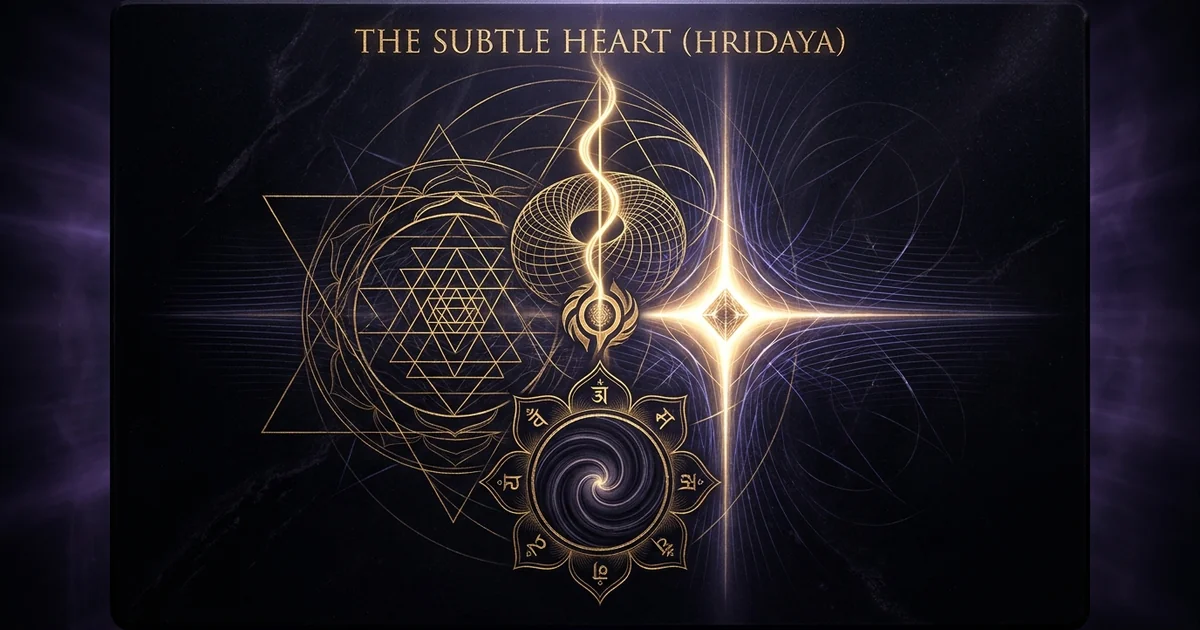
The Subtle Heart (Hridaya): The Spiritual Heart Center
Metaphysical Thesis & Epistemological Opening: The Trans-Anatomical Hridaya
Deconstructing the Somatic and Pranic Fallacy
Within the lineages of contemplative metaphysics and trans-dimensional ontology, few concepts suffer from as pervasive an ontological conflation as the Hridaya—the spiritual heart center. Standard colloquialisms routinely collapse this center into the physical organ of circulation, the biological myocardium, or alternatively map it directly onto the anahata chakra, the fourth psycho-energetic nodal point within the subtle body’s spinal axis. Both identifications constitute category errors that truncate the profound metaphysical architecture discovered across the Upanishads and validated in the phenomenological laboratory of Mount Arunachala.
The spiritual heart center is fundamentally distinct from both the biological myocardium and the psycho-energetic anahata chakra, occupying an ontological rather than physical or pranic dimension. Whereas the physiological heart operates mechanically within the coordinates of three-dimensional Euclidean biology, pumping blood to sustain the temporary psychosomatic organism, and whereas the anahata processes emotional, vital, and auditory (nada) energies within the subtle nervous system (sukshma sharira), the Hridaya resides outside the framework of the five sheaths (pancha koshas). It is not an energetic vortex subject to the thermodynamic fluctuations of the vital winds (pranas), nor is it a biological organ destined for cellular entropy.
To comprehend the Hridaya requires an epistemological shift from somatic objectification to ontological ground. The heart is not a discrete object within an observing consciousness; rather, it is consciousness itself recognizing its primary locus of unconditioned self-awareness. When Eastern contemplative traditions refer to this center as the true seat of the self atman, they do not delineate an interior anatomical compartment, but rather the primordial singularity from which both the psychosomatic apparatus and the manifest cosmos continuously emanate.
The Sanskrit designation Hridaya (hṛdaya) is an ontological compound rather than a merely descriptive physiological term. Rooted in the primary syllables hṛt (to take back, absorb, withdraw, or center) and ayam (this, the immediate, the non-referential here), Hridaya signifies “this is the center” or “that which absorbs everything into itself.” Classical grammarians and Advaitic commentators delineate this from the biological muscle, termed hṛd, by emphasizing that Hridaya is that unconditioned reality into which the entire objective universe, alongside the cognitive apparatus of the subject, is permanently resolved.
The Asymmetrical Locus: Two Digits to the Right of the Sternum
The empirical discourse surrounding the subtle heart center reached its philosophical peak in the twentieth century through the direct phenomenological disclosures of Sri Ramana Maharshi. When pressed by Western phenomenologists and Eastern pandits to identify the spatial localization of this unconditioned ground within the psycho-physical framework of embodiment, Maharshi repeatedly noted that the experiential node of the Hridaya is felt two digits (angulas) to the right of the median line of the chest. This claim—seemingly paradoxical when juxtaposed against the leftward anatomical orientation of the physical heart—has bewildered both materialist neurologists and traditional yogis who fixate upon the central cerebrospinal axis.
This asymmetrical designation functions not as an absolute coordinate in Cartesian space, but as a phenomenological gateway and psychophysical coordinate where the primary knot of ignorance (granthi) binds unconditioned consciousness to the psychosomatic vehicle. Ramana Maharshi’s designation of the hridaya spiritual heart center ramana maharshi two digits right provides an operational reference for the contemplative practitioner. It marks the psychophysical aperture where the pure, unextended light of the Self (Atman) is refracted through the root-tendency of individuation (aham-vritti), projecting the illusion of an egoic subject localized inside a mortal skull.
The empirical location of the Hridaya on the right chest does not imply that the absolute Self possesses physical dimensions or lateral bias. Instead, it demarcates the precise point of interface between the unconditioned field of reality and the subtle architecture of the embodied human form. When the awareness of the spiritual seeker shifts from externalized mental proliferation back toward the origin of identity, the physiological sensation of this return is invariably registered in the right thoracic cavity, entirely distinct from the cardiac rhythms of the muscular heart or the emotional vibrations of the central chest.
Consciousness as Prior to Spatial Extension
To understand how a trans-spatial reality can possess a somato-phenomenological locus requires re-evaluating the nature of space itself. Within the framework of /spirituality/advaita-vedanta-ontology, space (akasha) is not an empty, pre-existing container within which material objects, neural networks, and conscious agents emerge. Space is the primary objective modification projected by consciousness. Therefore, attempting to locate the Hridaya “inside” the physical ribcage fundamentally mistakes the container for the contained.
Investigating this locus via self-inquiry reveals that space is an appearance within consciousness, subverting the materialist model of brain-derived intentionality. The physical chest, the ribs, the sternum, and the empty volume of the thoracic cavity are cognitive and sensory modifications arising within the field of awareness. The Hridaya is the metaphysical zero-point from which this projective geometry originates. When the practitioner focuses inward upon the subtle heart two digits to the right of the sternum, they do not direct their attention to a location in physical space; they trace the projected ray of awareness back to the luminous source that projects space itself.
Consciousness precedes spatial extension, temporal sequence, and dimensional division. The localization of the Hridaya serves as an intuitive springboard—an epistemological concession to the embodied mind. Just as the horizon appears to demarcate a boundary between earth and sky while possessing no material reality of its own, so the right-side heart center acts as an experiential event horizon. It is the precise threshold where the localized, reflected consciousness (chidabhasa) dissolves into the infinite, non-localized ocean of the unconditioned Atman.
Primary Codices & Historical Transmission: From Vedic Dahara Vidya to Tiruvannamalai
The Upanishadic Cavity (Guha) and the Dahara-Ākāśa
The doctrine of the subtle heart does not originate with modern non-dual mysticism; its structural architecture is preserved within the oldest codices of the Vedic corpus. Central among these is the Dahara Vidya—the contemplative discipline of the subtle cavity—detailed in the eighth chapter of the Chandogya Upanishad (VIII.1.1-6). Here, the Vedic rishis present an uncompromising metaphysical equivalency: the minute internal space within the lotus of the heart (daharākāśa) is directly coextensive with the entirety of the external cosmic space (paramākāśa).
The Upanishadic text asserts that within the small lotus cavity residing in the city of Brahman (the human body), there exists an internal space. Within this singular subtle ether reside heaven and earth, fire and air, the sun and the moon, lightning and the constellations—all that belongs to the manifest cosmos and all that remains unmanifest. The Chandogya radically collapses the macrocosm into this infinitesimal metaphysical singularity. The guha, or internal heart-cave, is presented not as a metaphorical poetic device, but as the cosmic portal through which the individual soul (jiva) sheds its conditional attributes and rediscovers its identity as the immortal, unaging, and sorrowless Brahman.
This teaching was supplemented across the early contemplative treatises, finding an especially vivid expression within the Mahanarayana Upanishad. There, the subtle architecture of the heart is visually codified as an inverted lotus bud, suspended between the throat and the naval, blazing with a central flame of pure consciousness that illuminates the entirety of the created order.
“In the center of that [flame] resides the Supreme Self. That is Brahma, that is Shiva, that is Hari, that is Indra, that is the Imperishable, the Absolute, the Autonomous Light.” — Mahanarayana Upanishad (13.6-12)
“The Heart is the center from which everything springs. Because the world is seen by the mind, that which is the source of the mind is the source of the world as well. That is the Heart, the Atman. From the Heart, consciousness rises to the head through the Amrita Nadi, and from there spreads throughout the body. When the mind rests in the Heart, the ego dissolves, and the natural state shines forth.” — Sri Ramana Gita (Chapter V, verses 8-11, ed. Kavyakantha Ganapati Muni)
The integration of the Dahara Vidya into classical Vedantic hermeneutics, particularly through Adi Shankara’s commentaries on the Brahma Sutras (I.3.14-21), codified the heart-space as the singular ontological anchor point within human embodiment. Shankara maintained that while the absolute Brahman is without spatial limitations, it is apprehended within the daharākāśa because the subtle heart functions as the purest reflective medium (upadhi) for the self-effulgent Light of Consciousness.
Kashmiri Shaivite Formulations of Hridaya-Spanda
While Advaita Vedanta emphasized the static, transcendent silence of the heart-as-witness, the non-dual Shaivite tantras of Kashmir developed a dynamic, vibratory phenomenology of the Hridaya. In the masterworks of Abhinavagupta (c. 975–1025 CE), notably the Parātrīśikā Vivaraṇa and the Tantraloka, the Hridaya ceases to be merely a passive ontological void. Instead, it is identified as Hridaya-Spanda—the supreme heart of consciousness pulsing with autonomous creative freedom (svatantrya).
Abhinavagupta defines the Heart (Hridaya) as the dynamic resonance between the static light of consciousness (Prakasha) and its innate, reflective self-awareness (Vimarsha). The heart is not an inert void; it is the universal throb (spanda), the cosmic matrix wherein the union of Shiva and Shakti takes place continuously. In this Kashmiri Shaivite formulation, the Hridaya is the absolute subject that both emits and reabsorbs the totality of the thirty-six ontological levels (tattvas).
By framing the subtle heart as the living cosmic self-awareness, Abhinavagupta prevented the reification of the heart into a static metaphysical object. The heart is simultaneously the transcendent depth of consciousness and its creative pulsation. It is the unconditioned core from which all speech (para-vak), all sensory experience, and all dimensional domains emerge, and into which they collapse during the practice of radical contemplative introversion (samavesha).
The Direct Path (Vichara-Marga) at Mount Arunachala
The historical transmission of the doctrine of the subtle heart culminated in the twenty-first century’s direct non-dual renaissance through the teachings of Sri Ramana Maharshi at Tiruvannamalai. Maharshi stripped the Upanishadic and Tantric formulations of their ritualistic, liturgical, and yogic complexities. He bypassed the intricate requirements of pranayama, visualization, and mantra repetition, offering the direct path of self-inquiry (atma-vichara).
Maharshi’s direct transmission was rooted in his own spontaneous awakening at the age of sixteen, where he experienced the absolute death of the physical vehicle while his consciousness plunged directly into the spiritual heart center. He identified this center not through secondary textual study, but as an immediate phenomenological fact: the heart on the right side of the chest is the gateway to non-dual illumination and the true seat of the self atman.
By grounding self-inquiry in the actual source of the “I-thought” (aham-vritti), Maharshi unified the ancient cosmology found in /ancient-prehistory/upanishadic-cosmology with a radically streamlined contemplative epistemology. He established that every manifestation of thought, emotion, and perception is merely an energetic branch of the primary root-thought “I.” By tracing this “I” back to its point of origin, the seeker inevitably lands in the subtle heart, where the illusory boundaries of personal identity collapse into the unconditioned Atman.
Ontological Architecture & Cosmological Models: Hridaya Versus Anahata Chakra
Pranic Vortices vs. The Unconditioned Ground
To achieve precision in contemplative practice and metaphysical theory, one must rigorously distinguish the anahata chakra from the trans-pranic Hridaya. The anahata chakra is a structural component of the pranamaya kosha (the energetic sheath) and the sukshma sharira (the subtle body). It is situated along the cerebrospinal axis (merudanda) at the level of the cardiac plexus, operating as the subtle transformer for the air element (vayu tattva), interpersonal affect, aesthetic sensibility, and the reception of unmanifest sound (anahata-nada).
The anahata remains an energetic organ—a vortex within the multidimensional fluid dynamics of the subtle human vehicle. Consequently, experiences centered within the anahata chakra, no matter how profound, remain phenomenal. They encompass rapturous states of universal love, astral visions of deities, spontaneous emotional catharsis, and the perception of internal luminous fields or celestial symphonies. While these phenomena indicate an opening of the psycho-spiritual apparatus, they belong entirely to the realm of the modified mind (chitta-vritti) and subtle matter (prakriti).
The Hridaya, conversely, is entirely beyond physical anahata chakra dynamics. It is not an energetic vortex, it possesses no petals, it is governed by no presiding deity, and it contains no elemental resonance. It is not a center within the subtle body; it is the ground within which the subtle body itself appears and dissolves. The Hridaya is the unconditioned canvas upon which the six chakras are painted as functional nodes of manifestation. Confusing the ecstatic experiences of the anahata with the absolute stabilization of the Hridaya arrests spiritual development within the subtle-astral domain, leaving the core root-ignorance of the ego-construct intact.
Anahata Chakra (Spinal Axis)
- Dimensional Domain: Pranamaya & Manomaya Koshas (Subtle Astral Vehicle).
- Spatial Coordinate: Axial spine, level with the physical cardiac plexus.
- Elemental Affinity: Vayu (Air), tactile sensation, cosmic sound (nada).
- Phenomenological Profile: Subtle perceptions, energetic surges, emotional expansion, visions, subject-object duality.
- Functional Role: Psycho-energetic transducer mediating prana between lower and higher chakras.
Hridaya Center (Spiritual Heart)
- Dimensional Domain: Trans-spatial, unconditioned ground (Atman/Brahman).
- Spatial Coordinate: Experienced two digits to the right of the sternum.
- Elemental Affinity: Non-elemental; primordial ground of all tattvas.
- Phenomenological Profile: Absolute cessation of mental modifications, silence, non-dual illumination, voidness.
- Functional Role: The source and terminal sink of the mind, prana, and the cosmos; root of the Amrita Nadi.
The Anatomy of the Amrita Nadi and the Sushumna
The operational divergence between the chakric system and the Hridaya is crystallized in the esoteric anatomy of the nadis (subtle conduits). Traditional Kundalini Yoga maps the ascent of spiritualized prana through the sushumna nadi—the central channel running from the muladhara at the perineum directly up through the spinal column to the crown of the head, the sahasrara chakra. This yogic trajectory represents the path of ascent (arohana), wherein the dormant serpentine power (kundalini-shakti) systematically pierces the six chakras (shat-chakra-bhedana).
Yet, as preserved within the advanced esoteric teachings of /spirituality/kundalini-vs-amrita-nadi and elucidated by Ramana Maharshi in the Sri Ramana Gita, the sahasrara is not the final termination point of consciousness. The crown center is merely the supreme terminal of the reflected light of the Self, acting like a cosmic reflector or satellite dish for the cerebral cortex. The complete circuit of liberation requires the descent of consciousness from the sahasrara into the Hridaya via a channel known as the Amrita Nadi (the immortal conduit, also referred to as the Atma Nadi or Para Nadi).
The Amrita Nadi is not a conduit for the circulation of pranic air; it is the avenue of pure, unconditioned consciousness. While the sushumna connects the pelvic base to the cranial vault, the Amrita Nadi forms the profound loop of pure consciousness between the crown (sahasrara) and the subtle heart on the right side of the chest. It remains latent in the ordinary individual, choked by the primary knot of the heart (hridaya-granthi). Only when the mind dissolves entirely into its source does the Amrita Nadi open, permanently uniting cranial transcendence with thoracic ground.
[ Sahasrara Chakra ]  <--- Supreme Cranial Terminal
                |      \
  Sushumna Nadi |       \  Amrita Nadi (Para / Atma Nadi)
  (Pranic Path) |        \ (Avenue of Pure Consciousness)
                v         v
     [ Lower Chakras ]    [ Hridaya (Two Digits Right) ]
                           <-- Ultimate Terminal Sink
The Six Centers (Shat-Chakra) as Phenomenological Modifications
When the structural dynamic between the Amrita Nadi and the Hridaya is recognized, the traditional six-chakra architecture undergoes a radical phenomenological reappraisal. The chakras from muladhara to ajna are not primary metaphysical substances; they are secondary, stepped-down energetic prisms through which the singular light of the Hridaya refracts to animate the human vehicle.
When the pure light of the Self shines forth from the Hridaya, it travels through the Amrita Nadi to the crown, from which it cascades down into the sensory apparatus and the chakric centers:
- Refracted into the ajna chakra, it manifests as discursive intellect, subtle vision, and conceptual dualism.
- Refracted into the visuddha chakra, it operates as vocalized articulation and the vibrational resonance of space.
- Refracted into the anahata chakra, it produces the spectrum of emotional dynamics and somatic warmth.
- Refracted into the lower chakras (manipura, svadhisthana, muladhara), it manifests as metabolization, reproduction, survival drive, and material density.
The six centers are thus revealed as phenomenological modifications—transient expressions of a single, indivisible radiance. Yogic practices that focus exclusively on awakening and raising energy through the chakras remain bound to the energetic modifications of consciousness. They manipulate the currents of the stream without addressing the ocean from which the stream originates. Liberation does not occur when energy reaches the apex of the skull; it occurs when the cranial energy collapses backward through the Amrita Nadi and drowns permanently within the unconditioned depths of the Hridaya.
Phenomenological Mechanics & Interdimensional Interaction: Dissolution of the I-Thought
The Mechanics of Self-Inquiry (Atma-Vichara)
The direct technology for penetrating the subtle heart is the rigorous phenomenological method of self-inquiry (atma-vichara). Rather than deploying the mind to visualize forms, manipulate energy channels, or chant sacred syllables, the practitioner turns the investigative beam of attention back upon the subjective sense of presence itself. This method directly tracks the genesis of the primary “I-thought” (aham-vritti).
The aham-vritti is the fundamental cognitive postulate upon which all subsequent mental operations depend. Before one can perceive an external world, conceive a thought, or register a sensation, there must first arise the implicit assumption: “I am.” In the unenlightened state, this primary “I” instantly fuses with psychophysical predicates: “I am this body,” “I am these emotions,” “I am this thinker.” This illicit identification is the granthi, the metaphysical knot that binds pure consciousness to inert biological matter.
Self-inquiry dismantles this identification through a process of reverse-engineering. Whenever an objective phenomenon arises—whether an external sound, an internal memory, or a metaphysical vision—the practitioner does not engage the content of the perception. Instead, they formulate the retrograde interrogative: “To whom does this thought arise?” The inevitable response is: “To me.” The practitioner then poses the fundamental question: “Who am I?” This inquiry redirects attention away from the objective domain (idam) and isolates the bare subjective core (aham).
The Collapse of the Reflected Consciousness (Chidabhasa)
As attention fixes steadily upon the bare, unadorned feeling of “I,” an extraordinary phenomenological phase change occurs. The mind, which had historically operated by projecting itself outward toward sensory objects or inward toward cognitive concepts, finds no secondary object to grasp. Deprived of objective support, the reflected consciousness (chidabhasa) begins to lose its structural coherence.
The individual ego is revealed to be nothing more than the reflected light of the Self, cast upon the mirror of the mind (manas). When the mirror is turned to face the light source itself, the separate existence of the reflection vanishes. The aham-vritti is drawn backward along the track of the Amrita Nadi, pulled by the gravitational force of the unconditioned ground.
This collapse constitutes an ontological phase change, causing the energetic dissolution of subtle vasanas (latent mental tendencies) at their source. As detailed in the phenomenology of /consciousness/non-dual-phenomenology-ramana-maharshi, this inward descent is accompanied by the sensation of the mind sinking into the right side of the chest. It is not an act of psychological suppression; it is the total subsumption of the individual sense of agency into the universal, non-dual field of Being.
The Absorption of Prana and Mind into the Heart Core
The final stage of this retrograde movement entails the simultaneous absorption of both the mind (manas) and the vital life-force (prana) into the subtle heart center. Classical Indian metaphysics maintains that the mind and prana are twin branches of a single underlying root: chit-shakti (the conscious power). Where the mind wanders, the prana is directed; where the prana concentrates, the mind is anchored.
During the culmination of atma-vichara, as the “I-thought” is reabsorbed into the Hridaya, the external movements of the breath spontaneously stabilize and subside without the artificial interventions of hatha-yogic breath retention (kumbhaka). The prana, which had been dispersed throughout the subtle nervous system driving the metabolic and sensory engines, is drawn back through the central and peripheral nadis into the heart core.
This inward collapse reveals an interdimensional feedback loop:
$$\text{Mind (Aham-Vritti)} \xleftrightarrow{\text{Co-dependent Resonance}} \text{Prana (Vital Movement)}$$
As both currents collapse through the Amrita Nadi, the subject-object split dissolves. The observer, the act of observation, and the observed universe collapse into the singular, unconditioned reality of the Atman. The right chest center experiences a deep, unshakeable fullness—an internal throb characterized by absolute silence, total absence of egoic fear, and the direct, non-dual realization of reality as it is.
Initiatic Synthesis & Philosophical Implications: Radical Non-Duality and Reality Architecture
The Transcendence of Yogic Dualism into Sahaja Samadhi
The realization of the subtle heart marks the clear demarcation between classical dualistic yoga and the radical non-duality of Advaita Vedanta. The path of Patanjali’s classical yoga culminates in Nirvikalpa Samadhi—a trance state achieved through rigorous meditative concentration wherein the mind is temporarily stilled, sensory awareness is blocked, and the individual spirit (Purusha) isolates itself from nature (Prakriti). While sublime, this state is impermanent. As soon as the yogi exits the trance and returns to the physical senses, the mind re-emerges, the ego-construct reconstructs itself, and the primary knot of ignorance reasserts its dominion.
Realization of the Hridaya bypasses the need for progressive ascent through cosmic planes, establishing the practitioner in Sahaja Nirvikalpa Samadhi—the natural, effortless state of continuous absorption while functioning in daily life. In Sahaja Samadhi, the mind has not merely been temporarily suspended; it has been permanently consumed in the heart. The Amrita Nadi remains permanently open.
[ Classical Yogic Trance (Kevala Samadhi) ]
  Temporary suspension of mind --> Return of ego upon waking --> Incomplete liberation

[ Heart-Realization (Sahaja Samadhi) ]
  Permanent dissolution of mind in Hridaya --> Continuous non-dual awareness --> Sahaja Jivanmukti
Consequently, the liberated sage (jivanmukta) perceives the sensory world without the distorting medium of the ego-construct. Actions are performed, words are spoken, and thoughts are deployed when necessary, yet all arise as spontaneous, unattached movements within the infinite ocean of the Hridaya. The practitioner does not need to retreat into mountain caves or maintain rigid meditative postures to sustain enlightenment. The heart has reclaimed its rightful sovereignty as the unconditioned background of all apparent manifestation.
Epistemological Sovereignty and the Demise of Egregoric Control
The realization of the Hridaya carries profound implications for the interdimensional and informational sovereignty of the practitioner. When identity is anchored within the cerebrospinal axis, the subtle energetic bodies, or the mental plane, human consciousness remains vulnerable to external manipulation. Subtle entities, astral architectures, religious egregors, and the informational control systems identified by Jacques Vallée operate by manipulating the sensory-cognitive apparatus, subtle emotional bodies, and chakric polarities of the human vehicle.
By stabilizing identity in the spiritual heart, the consciousness becomes impervious to informational manipulation, egregoric capture, and psychic phenomena associated with astral and subtle-body encounters. These external agencies and trans-dimensional archetypes operate strictly within the bounds of manifest form, utilizing the polarities of light and dark, frequency modulation, and psychological projection. The Hridaya, however, resides completely outside the dimensional gridworks where subtle entities operate.
The subtle heart center is zero-point awareness—the unconditioned void that contains no informational hooks, no energetic vulnerabilities, and no subjective grasping upon which an egregore or control system could exert influence. In the blazing light of the Hridaya, all phenomenal manifestations—whether divine visions, extraterrestrial intelligences, or hyper-dimensional matrices—are unmasked as transient projections of mind. The seeker ceases to be an experiencer susceptible to spiritual predation, realizing their identity as the transcendent ground of reality itself.
Practitioners must be explicitly warned against the spatial fetishization of the right chest. To reify the physical coordinates “two digits to the right of the sternum” into an absolute spatial container is to invert the path of liberation, converting an ontological gateway into another material idol.
Meditating upon the somatic chest while maintaining the perspective of an embodied ego produces muscular tension, hyper-focused somatic fixations, cardiac neuroses, and delusional pseudo-enlightenment. The right chest serves merely as an initial pointer—an experiential marker of where the ego-construct surrenders its hold. Once the threshold is crossed, the practitioner must recognize that the Hridaya possesses neither interior nor exterior, neither right nor left, but is the infinite, centerless matrix within which the very concept of a physical body arises.
The Heart as the Metric of Cosmic Coherence
Ultimately, the Hridaya is recognized not as an interior organ belonging to an individual human being, but as the infinite matrix within which universes, beings, and dimensional realities appear, dance, and dissolve. The microcosm-macrocosm duality, meticulously maintained by occult traditions and esoteric cosmologies, collapses entirely at this threshold.
The external cosmos is not “outside” the body, nor is the internal spiritual heart “inside” the chest. Both internal experience and external environments are modifications of the single, unified field of consciousness radiating from the Hridaya. When an individual discovers this center, they do not gain access to a personal, private enlightenment; they realize the universal ground of Being. The subtle heart stands as the ultimate metric of cosmic coherence—the immutable still point around which the colossal cycles of universal projection, preservation, and dissolution effortlessly revolve.
Frequently Asked Questions Regarding the Subtle Heart Center
Clarifying the Bodily Asymmetry of the Heart Locus
The persistent designation of the subtle heart as existing specifically two digits to the right of the sternum frequently strikes rational inquirers as arbitrary or contradictory, particularly given the omnipresent nature of pure consciousness. This tension was famously addressed during Sri Ramana Maharshi’s dialogues with the British philosopher Paul Brunton. When Brunton asked why the infinite, non-localized Self should have a specific physical location on the right side of the chest, Maharshi clarified that the right-side locus is not an absolute geographical truth for consciousness itself, but an experiential absolute for the embodied human vehicle.
Because the physical body is an asymmetrical energetic instrument, the cosmic light of consciousness reflects through specific somatic focal points. Just as the brain functions as the operational center for cognitive-rational data processing without restricting consciousness strictly to neural pathways, so the right chest functions as the somatic origin-node of the felt sense of personal identity. Contemplative practitioners who successfully plunge deep into self-inquiry confirm that when the “I-thought” collapses, the physiological and energetic release of the primary knot (hridaya-granthi) is directly felt on the right side of the sternum, releasing an extraordinary sensation of coolness and relief that subsequently radiates throughout the whole organism.
“Maharshi’s localization of the Hridaya to the right chest constitutes a unique contribution to the phenomenological mapping of non-dual consciousness. It is neither a theoretical construct borrowed from prior texts nor an anatomical claim, but an empirical report of experiential topology. The right side is identified as the portal where the reflected ray of awareness (chidabhasa) rejoins its unreflected source.” — Arthur Osborne, Ramana Maharshi and the Path of Self-Knowledge (London: Rider & Co, 1954).
“In the Advaitic phenomenology of Arunachala, the physical asymmetry of the heart locus functions as a critical deconstructive device. By locating the Self on the right, Maharshi deliberately prevents the seeker from confusing the trans-pranic ground with the left-sided biological heart or the center-aligned anahata, forcing an ontological rupture with conventional somatic mapping.” — Lance Nelson, The Dualism of Nondualism: Contemplative Somatics in Advaita Vedanta, Journal of Indian Philosophy (1998).
Resolving Confusions Between Anahata and Hridaya
The confusion between the anahata chakra and the Hridaya is arguably the most pervasive misunderstanding in modern esoteric literature, largely propagated by twentieth-century occult syncretisms that mapped Eastern subtle anatomy onto Western emotional frameworks. The anahata chakra is situated along the central spinal axis (sushumna), associated with the element air (vayu), the green color spectrum, emotional-relational life, and the generation of internal subtle sounds (anahata nada).
Yogis who practice exclusively through the mechanics of pranayama, breath manipulation, and Kundalini activation can easily open the anahata, experiencing dramatic expansions of unconditional love, clairaudience, cosmic empathy, and energetic heat. However, opening the anahata does not constitute the destruction of the ego-knot (granthi-bheda). The anahata remains a temporal station within the sukshma sharira (the subtle body). It is still fundamentally a domain of duality—there is an experiencer enjoying an ecstatic experience.
The Hridaya, situated beyond physical anahata chakra dynamics and located to the right of the central meridian, is the trans-spatial ground from which the spinal axis and all its chakric nodes emerge. The Hridaya is void of all qualities (nirguna), devoid of elemental characteristics, and utterly indifferent to the emotional or energetic currents that sweep through the anahata. Penetration of the Hridaya-guha (the cave of the heart) annihilates the very experiencer of the experience, transmuting the seeker from an advanced astral voyager into the unconditioned Atman.
Safety and Mechanics of Meditating on the Right Side
Practitioners approaching the subtle heart often ask about the safety, technical protocols, and potential neurosis associated with meditating on the right side of the chest. It is of paramount importance to understand that attention on the Hridaya should never involve muscular concentration, violent somatic strain, or forceful breath retention (kumbhaka). Attempting to forcefully focus on the right chest through sheer willpower can cause thoracic spasms, nervous strain, and deep energetic imbalances.
The proper practice requires gentle inward turning (antar-mukha dristi), relying entirely on self-inquiry rather than somatic manipulation:
- Rather than forcing the physical gaze or the mental focus to dwell upon the right side of the chest, one simply investigates the origin of the sense of “I.”
- By continually interrogating the arising ego-thought (“Who am I?”), attention naturally detaches from sensory objects and thoughts.
- As this detachment deepens, consciousness automatically gravitates toward its genetic source, settling into the subtle heart center effortlessly, like a bird returning to its nest.
- The somatic sensation two digits to the right of the sternum arises spontaneously as an after-effect of the mind’s dissolution, not as a target to be attacked through forceful concentration.
When undertaken with this gentle, investigative attitude, resting in the Hridaya is the safest of all contemplative practices, as it does not agitate the pranic currents or stir the latent energetic fires of the subtle body. It is the immediate entry into the peace of the unconditioned Self, the true seat of the self atman, and the singular gateway to non-dual illumination. :::