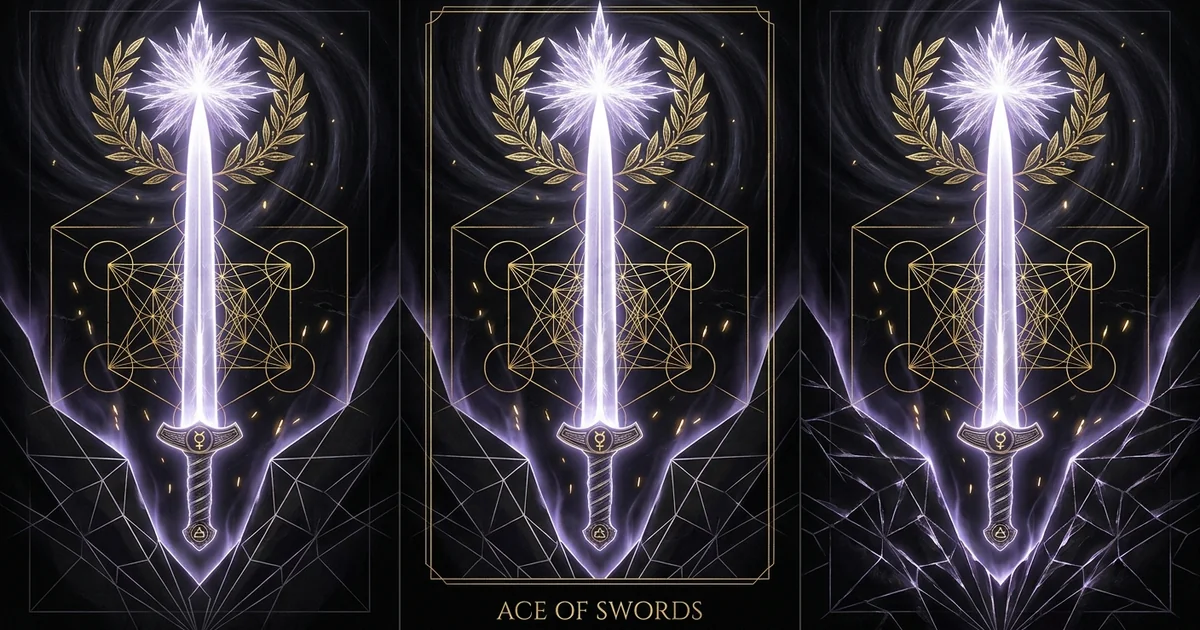
Ace of Swords: Piercing Blade of Clear Cosmic Intellect
Archetypal Thesis & Systemic Paradigm: The Epistemic Rupture of the Logos
The Vector of Radical Discrimination
The Ace of Swords embodies the catastrophic, necessary genesis of the mental plane. Within the psycho-cosmological matrix of the Western esoteric tradition, this card does not signify an incidental event, a passing thought, or a localized dispute. Instead, it designates the radical emergence of conscious discrimination out of the oceanic stupor of the undifferentiated unconscious. Before the sword descends, reality exists in a state of pre-reflective continuity—a seamless, uroboric matrix wherein the subject is hopelessly entangled with its environment, unable to distinguish impulse from object, interior psyche from external world. The Ace of Swords operates as the primordial ontological incision. It is the sudden, vertical introduction of the active-intellect, a pristine vector of noetic light that rends the primordial continuum in twain, establishing the baseline architecture of the subject-object divide.
+-----------------------------------------------------------------------+
|                       THE PRIMORDIAL INCISION                         |
|                                                                       |
|   PRE-REFLECTIVE CONTINUUM                  DIFFERENTIATED LOGOS      |
|                                                                       |
|      [   Uroboric   ]                             [  Subject  ]       |
|      [ Unconscious  ]    ========[ | ]========>         |             |
|      [  Continuum   ]         (The Cut)                 v             |
|                                                   [  Object   ]       |
+-----------------------------------------------------------------------+
This ontological rupture is inherently violent, yet its violence is metaphysical rather than sociopathic. It represents the structural requirement for self-reflective awareness. When the single, upright blade pierces the atmospheric field, it introduces the principle of polarity into a domain previously characterized by energetic entropy. To know a thing is to distinguish it from what it is not. The sword provides the instrument of this initial negation; it says “No” to the all-encompassing maternal matrix so that the individual “I” may pronounce its own existence. Through this operation, the blade performs the central work of the logos—the ordering, classifying, and articulating principle of the cosmos. Far from an emotional or physical agent, the card symbolizes pure, unconditioned intentionality: the unbent ray of divine intelligence cleaving through the inertial fog of instinctive existence.
+-----------------------------------------------------------------------+
|                        THE DYNAMICS OF Ruach                          |
|                                                                       |
|    ATZILUTH (Archetypal / Chokmah-Binah)                              |
|       |                                                               |
|       v  [ Influx of Primordial Pneuma ]                              |
|    YETZIRAH (Formative / Ruach Matrix)                                |
|       |                                                               |
|       +--> [ Epistemic Scalpel ] ---> Formative Cognition             |
|       |                                                               |
|       +--> [ Syntax & Category ] ---> Spatial-Temporal Map            |
|       |                                                               |
|       v                                                               |
|    ASSIAH (Material / Action)                                         |
+-----------------------------------------------------------------------+
Within the anatomy of the suit of swords, this first card establishes the axiomatic foundation upon which all subsequent mental phenomenology depends. Where the other cards of the suit will chart the inevitable degradation, stabilization, conflict, and exhaustion of thought as it grapples with time and matter, the Ace remains suspended in pristine, unadulterated potency. It represents thought before it is compromised by doubt, neurosis, or circumstance. It is the capacity for categorical perception itself—the raw capability of the human and cosmic mind to isolate a phenomenon, extract it from the background noise of the phenomenal universe, and hold it aloft in crystalline clarity.
Genesis of Yetzirah and the Ruach Matrix
To comprehend the structural architecture of the Ace of Swords, one must analyze its location within the Four Worlds of Cabalistic cosmology. The card occupies the supreme position of kether within the World of yetzirah—the Formative Realm. While the preceding worlds of Atziluth (Archetypal) and Briah (Creative) operate via unmanifest divine emanations and primary ideation, Yetzirah is the world wherein ideas undergo structural differentiation, clothing themselves in the subtle matter of language, geometry, and mental imagery. In this formative domain, the governing psychological and spiritual faculty is the ruach—the vital breath of intellect, rational synthesis, and conscious discernment.
The Ace of Swords constitutes the absolute fountainhead of this ruach matrix. It is the unmanifest spark of Kether descending into the atmospheric sphere of mental composition, instigating the linguistic and categorical architecture that makes spatial and temporal navigation possible. The ruach is not merely passive cognition; it is the dynamic, gaseous element that circulates between the transpersonal supernal triad and the animal soul (nephesh). When Kether illuminates Yetzirah through the Ace of Swords, the divine breath crystallizes into an epistemic scalpel. It gives birth to syntax, to the capacity for symbolic manipulation, and to the geometric structuring of psychic space.
This mechanism ensures that the intellectual faculty does not emerge as a byproduct of material evolution, but as a direct fractal reflection of the primordial macrocosmic order. The mental plane, as expressed through the pristine attribution of the air element, is endowed with the capacity to mirror divine law through conceptual precision. When the intellect functions according to this formative ideal, it does not invent truths arbitrarily; it perceives and articulates the latent geometry of the cosmos. The Ace is this precise moment of intellectual genesis, where the formative breath ceases to be an unshaped atmospheric current and consolidates into a focused, vertical vector of penetrating discernment.
“The Logos is the principle of differentiation, of discrimination, of clarification. It is that which cuts through the maternal unconscious, through the darkness of nature, and sets up a conscious realm over against the blind strivings of the instincts. It is symbolized by the sword, the weapon that divides and penetrates, separating light from darkness and creating order out of the primordial chaos.” — Carl Gustav Jung, Aion: Researches into the Phenomenology of the Self (Collected Works, Vol. 9, Part 2, §178)
Transcendence Over Uroboric Inertia
The functional operation of the Ace of Swords is thoroughly non-compensatory. Unlike the emotional water of the Cups, which seeks dissolution, boundary-transgression, and symbiotic reunion with the maternal origin, the Ace of Swords operates through surgical, unrelenting detachment. It demonstrates absolute indifference to emotional comfort, bodily homeostasis, or psychic equilibrium. The card’s essential imperative is the revelation of absolute metaphysical truth via the radical severance of false identifications, regardless of the existential vertigo such severance induces.
In analytical psychology, the maternal uroboros represents the gravitational pull of unconsciousness—the desire of the fragile ego to retreat from the harsh demands of individuation back into the protective, somnolent warmth of instinctual immersion. The Ace of Swords represents the psychic instrument that makes such regression impossible. It shatters the blissful illusions of participation mystique. When this archetype is constellated within the psyche, the individual is compelled to view their reality through an uncompromising, dispassionate lens. The blade cuts away the sentimental rationalizations, systemic neuroses, and emotional consolations that obscure the factual nature of existence.
This radical severance cannot be negotiated. The Ace does not offer terms of compromise, nor does it cushion the blow of insight. Its arrival in the psychological theater signals the death of an illusion. The ace of swords tarot meaning centers precisely upon this uncompromising lucidity: it is the realization that clarity often demands the sacrifice of innocence, and that genuine illumination requires the painful dismantling of cherished self-deceptions. By cutting through uroboric inertia, the card forces the psychic apparatus into the austere, rarefied heights of conscious accountability, setting the stage for the dialectical confrontations that characterize the rest of the Swords suit.
Classical Provenance & Textual Lineage: The Genesis of the Root of the Powers of Air
Fifteenth-Century Italian Precedents and the Sola Busca Innovations
The iconography of the suit of swords in early European cartomancy originated within the aristocratic martial context of fifteenth-century northern Italy. In the Visconti-Sforza tarocchi decks, the Ace of Swords is depicted with stark, heraldic functionalism: a massive, double-edged broadsword held upright, flanked by ornate foliage or ribbons, serving primarily as an emblem of sovereign justice, military prowess, and the temporal power of the ruling dynasty. In these early Renaissance artifacts, the esoteric dimensions of the card remained largely obscured beneath the surface conventions of feudal heraldry and Christian virtues—most notably Iustitia (Justice), who wielded the temporal blade to punish transgression and maintain civic harmony.
+-------------------------------------------------------------------------+
|                  ICONOGRAPHIC EVOLUTION OF THE BLADE                    |
|                                                                         |
|   Visconti-Sforza (15th c.)     Sola Busca (c. 1491)     Waite-Smith    |
|   -------------------------     --------------------     -----------    |
|   Feudal Martial Emblem   --->  Alchemical Talisman ---> Cabalistic     |
|   Sovereign Justice             Volatile Mercurius       Pneuma / Crown |
+-------------------------------------------------------------------------+
A profound epistemic shift occurred with the production of the Sola Busca tarot (c. 1491). Within this enigmatic deck—the earliest known complete seventy-eight-card structure featuring fully illustrated pips—the Ace of Swords begins its transformation from an inert instrument of martial authority into an alchemical and hermetic talisman. In the sola-busca, the swords are heavily charged with classical, mythic, and metallurgical symbolism, reflecting the influence of Paduan and Venetian humanist circles. The blade is no longer merely a weapon held by an invisible arm; it becomes an active, volatile agent of transmutative philosophy, linked to the metallic transformation of iron into psychic steel and the philosophical operation of separatio.
The Renaissance magus Heinrich Cornelius Agrippa provided the theoretical underpinnings for this transformation in his classic 1533 treatise on natural and celestial magic. Agrippa systematized the elemental and occult virtues, framing the weapon of air as a physical condenser of the world-soul’s active, discriminating breath. Through Agrippa’s cosmology, the sword ceased to be a simple metal weapon and was formally recognized by Western esotericism as an earthly mirror of the celestial intellect, capable of slicing through terrestrial illusions and commanding astral spirits through the authority of the geometric word.
“Iron is the metal of Mars, and when fashioned into the edge of a weapon, it partakes of the nature of the piercing spirit. Yet when directed by the understanding, it receives the virtue of the superior intellects, which divide the pure from the impure, severing the bond between the subtle form and the heavy body by the authority of the celestial breath.” — Heinrich Cornelius Agrippa, De Occulta Philosophia Libri Tres (Book II, Chapter 27)
The Hermetic Order of the Golden Dawn and Book T
The modernization and occult codification of the Ace of Swords reached its definitive structural crystallization in the late nineteenth century within the inner order of the Hermetic Order of the Golden Dawn. In their foundational manuscript, Book T: The Tarot, synthesized primarily by S. L. MacGregor Mathers, the utilitarian playing card was systematically integrated into a universal matrix of Hermetic Cabala, astrology, and Enochian magic. Mathers assigned to the card its definitive esoteric title: “The Root of the Powers of Air.”
+-----------------------------------------------------------------------+
|                    THE GOLDEN DAWN ATTRIBUTION                        |
|                                                                       |
|   Card: Ace of Swords                                                 |
|   Title: The Root of the Powers of Air                                |
|   Sephira: Kether (The Crown)                                         |
|   World: Yetzirah (The Formative Realm)                               |
|   Letter of the Tetragrammaton: Vau (Waw)                             |
|   Associated Element: Divine Ruach (Spiritual Wind / Intellect)       |
+-----------------------------------------------------------------------+
Within the Golden Dawn system, the four Aces are not attributed to specific zodiacal decans; rather, they represent the supernal sources of the elements, the primordial seeds from which the manifest universe unfolds. The Ace of Swords was assigned to kether in the world of yetzirah, representing the unconditioned origin of the mental plane. The blade is linked explicitly to the letter Vau of the divine name tetragrammaton, signifying the divine son, the coordinating conscious link between the Supernal Mother (Binah) and the terrestrial Bride (Malkuth).
“The Ace of Swords: The Root of the Powers of Air. A white radiating Angelic Hand, issuing from clouds, and grasping the hilt of a sword, which supports a White Diadem or Crown, from which depend on the right an olive branch of Peace, and on the left a palm branch of Suffering. Six Vaus or Yods fall from the Crown. It represents Great Power in an evil direction, but also Great Power used for good; it is the Sword of Justice and of Wrath; yet also the Sword of strength through endurance.” — S. L. MacGregor Mathers, Book T: The Tarot (Private Order Manuscripts, 1888)
This textual formulation directly informed the visual composition executed by Pamela Colman Smith under the instruction of Arthur Edward Waite in 1909. In the Rider-Waite-Smith deck, the sword is held aloft by a celestial hand emerging from a cloud, signifying the divine influx entering the formative sphere. The tip of the blade pierces a radiant, golden crown, from which hang an olive branch on the right and a palm frond on the left. This visual synthesis deliberately encodes the equilibrium of the Cabalistic Tree: the olive branch reflects the Pillar of Mercy (Chesed), while the palm frond signifies the Pillar of Severity (Geburah). The sword stands as the central Middle Pillar of Consciousness, balancing cosmic mercy and severe discernment through the singular verticality of absolute truth.
Crowley’s Liber Theta and the Crowned Blade
In the mid-twentieth century, Aleister Crowley, working alongside the artist Lady Frieda Harris, expanded the esoteric mechanics of the card in The Book of Thoth (1944). Crowley designated the card as the initial mechanical vector of Liber Theta, stripping away the conventional Judeo-Christian moralism that had lingered in earlier Golden Dawn commentaries. Crowley focused intensely on the Ace of Swords as the explosive, uncompromising descent of the divine Ruach into the phenomenal world, characterizing the card as a mathematical formula of pure ideation.
In the Harris-Crowley rendering, the composition is stripped of scenic landscape and rendered as a dynamic, geometrical diagram of cosmic forces. The sword dominates the vertical axis, its pommel anchored in the supernal source, while the blade is encircled by an intricate, twenty-two-pointed crown—representing the twenty-two letters of the Hebrew alphabet and the twenty-two paths of the Tree of Life. The blade does not merely balance mercy and severity; it shatters the lower worlds through the pristine velocity of pure mathematical mind. Crowley insisted that the Ace of Swords is fundamentally linked to the creative will of the absolute, operating as an intellectual engine that cuts through the dualistic illusions of time and space.
Crowley’s interpretation aligns closely with the archetypal mechanics of /tarot/magician-tarot-meaning. Where the Magician acts as the conscious operator wielding the elemental weapons on the plane of manifestation, the Ace of Swords is the primordial weapon itself—the uncreated, self-existent blade of the divine intellect before it is claimed or manipulated by any individualized ego. It is the absolute idea, pure and terrifying in its geometric perfection, requiring complete identification with transpersonal truth for its rightful handling.
Structural Mechanics & Symbolic Geometry: Kether in Yetzirah
The Cabalistic Matrix: Kether of Air
To understand the systemic mechanics of the Ace of Swords, one must analyze the card’s specific station within the architecture of the Tree of Life: Kether in the World of Yetzirah. Kether is the Crown, the point of absolute singularity, the dimensionless origin, and the undifferentiated fountain of divine will. Yetzirah is the world of formation, of winds, of volatile currents, and of cognitive construction. Therefore, the Ace of Swords represents the pure, undivided singularity of Kether manifesting within the dynamic, relational medium of the mental realm.
+-----------------------------------------------------------------------+
|                    THE FOUR-WORLD MATRIX (Kether)                     |
|                                                                       |
|   Atziluth (Fire)      --> Ace of Wands  (Primordial Will)           |
|   Briah (Water)        --> Ace of Cups   (Primordial Love / Gnosis)  |
|   Yetzirah (Air)       --> Ace of Swords (Primordial Intellect)      |
|   Assiah (Earth)       --> Ace of Disks  (Primordial Crystallization)|
+-----------------------------------------------------------------------+
Because it resides at the level of Kether, this intellect is completely free from the dialectical fragmentation that plagues the lower sephiroth of Yetzirah. It is prior to the polarization of Chokmah and Binah within the mental sphere; it is prior to the discursive debates of Netzach and Hod, and far above the unstable material reflections of Yesod. In the Ace of Swords, mind does not calculate, argue, or deliberate. It does not weigh options or vacillate between competing hypotheses—a state of division that only emerges later, as seen in the polarized hesitation of the /tarot/two-of-swords-peace-restored.
The Ace of Swords is the instant of direct noetic apprehension. It is the sudden flash of categorical knowing (gnosis via the intellect) wherein an entire systemic architecture is perceived simultaneously in a single, unified point of consciousness. The mind here operates not by sequential logic, but by divine geometric intuition. It is the blueprint of thought before the sentence is spoken, the pure equation before it is calculated across the axis of time.
The Geometry of the Crown, the Blade, and the Six Yods
The visual components of the stabilized Waite-Smith iconography reveal a tightly integrated geometric and Cabalistic cipher. The verticality of the blade forms the central axis mundi, establishing an absolute plumb-line of objective reality against which all phenomenal deviations are measured. The steel of the blade represents tempered discipline—the rigorous purification of the rational apparatus through logical scrutiny and the elimination of cognitive bias.
+-----------------------------------------------------------------------+
|                     GEOMETRY OF THE WAITE-SMITH PIP                   |
|                                                                       |
|                            [ KETHER ]                                 |
|                                /\   <-- Tip of the Sword              |
|                             .-'  '-.                                  |
|                            (  CROWN )                                 |
|                             '-.  .-'                                  |
|                            /   ||   \                                 |
|            [ CHESED ]     /    ||    \     [ GEBURAH ]                |
|           Olive Branch   *     ||     *    Palm Frond                 |
|          (Pillar of Mercy) *   ||   *     (Pillar of Severity)        |
|                             *  ||  *                                  |
|                       Six Yods || Falling                             |
|                                ||                                     |
|                                ||                                     |
|                             [ POMMEL ]                                |
|                                |                                      |
|                       [ Angelic Hand / Cloud ]                        |
|                                                                       |
+-----------------------------------------------------------------------+
The crown suspended at the apex of the blade signifies that true sovereignty of mind belongs only to that intellect which pierces through the veil of terrestrial illusion to unite with supernal consciousness. The sword does not conquer the crown; it penetrates and supports it. This geometric interpenetration demonstrates that individual human understanding achieves its highest realization only when it serves as a vessel and conduit for divine order. The suspended olive and palm branches articulate the reconciliation of cosmic polarities: the olive (representing peace, expansive mercy, and constructive synthesis) is balanced precisely against the palm (representing martial victory, ascetic severity, and analytical dissolution). The blade maintains this dynamic equilibrium not through sentimental compromise, but through the tension of absolute justice.
Surrounding the blade are six falling golden sparks, traditionally recognized as the Hebrew letter Yod. In the Cabala, the Yod is the elemental seed of the alphabet, the primordial point of light from which all other letters are derived. The presence of six falling Yods carries a precise mathematical attribution: six is the number of the Sephira Tiphareth (the Sun, Beauty, and the Higher Ego), the seat of the conscious soul on the Middle Pillar. The falling Yods denote the descent of divine vitality (pneuma) from the transpersonal crown down the vertical shaft of the sword into the human heart. Far from being a cold, lifeless weapon, the Ace of Swords is animated by solar life-force. It proves that ruthless intellectual clarity does not desiccate the soul; instead, it showers the lower vehicles with the golden sparks of unconditioned truth.
- Sephira: Kether (The Crown / Primordial Unity)
- World: Yetzirah (The Formative World / Mental Sphere)
- Element: Air (Ruach / Spiritual Breath and Discursive Intellect)
- Letter of Tetragrammaton: Vau (The Son, Microprosopus, Integrative Mind)
- Astrological Coordinate: The Root of the Element of Air (Airy Triplicity: Gemini, Libra, Aquarius)
- Directional Orientation: East (The realm of the rising sun, illumination, and the dawn of awareness)
Elemental Air as Dynamic Intellectual Matrix
In the physics of the Western hermetic cosmos, the air element is defined by the dual qualities of heat and moisture: it is active, volatile, diffusive, communicative, and intrinsically relational. Air occupies the intermediate zone between the rarefied, radiant fire of the heavens and the dense, receptive waters and earths of the lower worlds. Consequently, elemental air acts as the supreme communicative medium of the cosmos—the atmosphere that transmits light, carries sound, and sustains biological respiration.
Within the psychological architecture, air constitutes the dynamic intellectual matrix. It is the capacity of the mind to step back from direct somatic sensation and emotional flooding in order to construct symbolic models of the world. The Ace of Swords represents this airy matrix in its state of maximum coherence. In ordinary human experience, the mental atmosphere is turbulent, choked with the particulate matter of neurotic complexes, cultural indoctrination, and unchecked anxieties. In the Ace of Swords, the atmosphere is cleared by a cosmic tempest; the air becomes razor-sharp, crystalline, and transparent.
This elemental purity introduces the mechanical foundation of formal dialectics. The double edge of the blade reflects the inherent structure of intellectual synthesis: thesis and antithesis carved by the two edges, converging at the singular, razor-sharp point of transcendent resolution. Every assertion made by the intellect contains within its own geometry the mechanism of its potential negation. The Ace of Swords wields this dialectical tension not to destabilize consciousness, but to systematically eliminate error. It serves as an epistemic centrifuge, spinning the volatile contents of the mind until the extraneous and illusory elements are thrown outward, leaving behind only the indivisible core of diamond-hard reality.
Psychological Dynamics & Operational Praxis: The Scalpel of Active Intellect
Cognitive Differentiation vs. Intellectual Dissociation
In clinical and archetypal psychological praxis, the constellating of the Ace of Swords marks an acute, destabilizing crisis of consciousness: the demand for absolute cognitive differentiation. Differentiation, as defined by Carl Jung, is the process by which an individual separates distinct psychological functions—thinking, feeling, sensation, and intuition—from their primitive, contaminated fusion within the unconscious. When the Ace of Swords drops into the psychic field, the individual is summoned to separate what they objectively know from what they merely feel, fear, or desire.
+-------------------------------------------------------------------------+
|                  THE PSYCHOLOGICAL SCALPEL: TWO MODES                   |
|                                                                         |
|   DIFFERENTIATION (Upright / Integrated)                                |
|   - Ego separates cleanly from unconscious complexes                    |
|   - Rejection of projection; dispassionate self-inquiry                 |
|   - Surgical extraction of truth while honoring psychic reality        |
|                                                                         |
|   DISSOCIATION (Inverted / Pathological)                                |
|   - Ego splits violently from somatic and emotional reality             |
|   - Hyper-rational defense mechanisms (intellectualization)             |
|   - Cynical, sterile cruelty; defensive weaponization of logic          |
+-------------------------------------------------------------------------+
This operation requires the ego to extract itself from the labyrinth of psychological projection. In ordinary states of consciousness, the human psyche constantly projects its unacknowledged contents—the Shadow, the Anima/Animus, unhealed wounds—onto external persons and sociopolitical structures. The Ace of Swords acts as the surgical instrument that severs these projection fibers. It cuts the tether between the subjective ego and the external screen, forcing the individual into an agonizing confrontation with the objective reality of their own internal architecture. The pain experienced during this process is not the result of external harm; it is the friction of the ego’s false identifications being systematically amputated.
However, this surgical potential carries profound psychological hazards. The line between true cognitive differentiation and pathological intellectual dissociation is razor-thin. When an ego is overwhelmed by traumatic affect or existential terror, it frequently seizes upon the archetype of the sword as a defensive weapon rather than an instrument of truth. In this state, the intellect is used not to clarify reality, but to construct impenetrable intellectual fortresses that divorce the conscious mind from somatic sensation and emotional vulnerability. When this occurs, the blade ceases to be a tool of the Supernal Crown and degenerates into a mechanism of psychic sterilization, blinding the individual to the vital wisdom of the heart and body.
Interpretive Mechanics: Upright Potency vs. Inverted Malice
The interpretive mechanics of the Ace of Swords within analytical divination depend entirely upon the orientation of the blade and the maturity of the psychic vessel receiving its voltage. When the card appears upright, it radiates the pristine, uncompromised potency of surgical discernment. It indicates an epistemic breakthrough: a moment of sudden, blinding realization that dispels long-standing ambiguities. It represents the breakthrough of original thought, the courage to speak a radical, objective truth into an environment dominated by consensus hallucinations, and the definitive collapse of an internal neurotic stalemate.
Conversely, the inversion of the Ace of Swords signals the corruption of the logos into destructive rationalism, cynical nihilism, and intellectual cruelty. When the blade points downward toward the earth, the heavenly authority of Kether is inverted; the intellect becomes demonic, dedicated to the service of the unintegrated shadow. In this state, logic is weaponized to inflict sadistic wounds upon others or to systematically tear down the self through obsessive self-criticism and paranoid rumination.
Upright Blade: Surgical Discernment
- Epistemic Clarity: Direct apprehension of objective truth; piercing through social and familial gaslighting.
- Radical Autonomy: Clean severance of codependent enmeshments, toxic loyalties, and infantile projections.
- The Dispassionate Witness: Establishment of the transcendent ego capable of observing intense emotional states without being hijacked by them.
- Constructive Separation: Amputation of dead structural systems, obsolete career paths, and corrupt psychic contracts to liberate life-force.
Inverted Blade: Intellectual Tyranny
- Cynical Rationalization: Using high-level dialectical gymnastics to justify destructive behaviors or avoid emotional vulnerability.
- Verbal Sadism: Weaponizing superior intellectual or analytical capability to humiliate, disarm, and psychologically dominate others.
- Paralytic Skepticism: Complete epistemic collapse into cynicism; the refusal to trust any perception, resulting in mental paralysis.
- Barren Dissociation: Absolute severance of the head from the somatic vessel, producing emotional frigidity, chronic anxiety, and creative sterility.
The inverted Ace also denotes the condition of mental exhaustion—the psychic state wherein the individual has pushed the analytical apparatus beyond its natural limits, resulting in a breakdown of the nervous system. When the mind attempts to resolve problems that belong properly to the domains of the heart (Cups) or the body (Pentacles) exclusively through the violent mechanics of the intellect, it produces a state of chronic hyper-arousal and psychic inflammation. The inverted blade becomes a lightning rod that grounds destructive astral static directly into the mental vehicle of the querent.
The Decisive Severance of Neurotic Entanglements
In operational praxis, the Ace of Swords acts as the ultimate catalyst for psychological liberation. Neurosis is structurally characterized by endless circularity: the repetition compulsion, wherein the psyche loops through the same obsolete behavioral loops, emotional reactions, and self-defeating narratives. These loops persist precisely because the individual lacks the acute, decisive energy required to cut the Gordian knots of their own conditioning. The psyche prefers the agonizing familiarity of its suffering to the terrifying void of radical change.
The Ace of Swords provides the exact psychic intervention required to break these cycles: the clean cut. In the theater of personal relationships, it represents the definitive utterance of boundaries—the cold, clear, irrevocable “Enough” that instantly dissolves toxic enmeshments that have persisted for decades. It is the archetype that oversees the signing of divorce decrees, the termination of exploitative alliances, the drafting of manifestos, and the sudden, resolute departure from ideological echo chambers.
This severance must not be confused with emotional petulance or reactive anger. Reactive anger belongs to the lower octaves of fire (Wands) or the corrupted martial aspects of Geburah; it is noisy, volatile, and deeply entangled with the object of its fury. The severance enacted by the Ace of Swords, by contrast, is chillingly silent and dispassionate. It does not argue, scream, or seek revenge. It simply observes the objective reality of the situation, recognizes that the relationship or habit is incompatible with truth, and slices the cord with the absolute finality of an executioner’s blade. Once this cut has been made by the authentic logos, reunion with the illusion becomes an ontological impossibility.
Philosophical Synthesis & Macrocosmic Correspondence: The Dialectic of the Dual Blade
Heraclitean Strife as Creative Ordering
At its highest level of philosophical abstraction, the Ace of Swords is the visual and symbolic correlate of the Heraclitean cosmology. The pre-Socratic philosopher Heraclitus famously asserted that polemos (strife, conflict, division) is the father and king of all things. In the Heraclitean framework, reality does not emerge from a static, peaceful monism; it is generated, sustained, and perpetually renewed through the dynamic tension of opposing forces held in structural opposition by the logos.
+-----------------------------------------------------------------------+
|                    THE HERACLITEAN LOGOS (Strife)                     |
|                                                                       |
|   UNDIFFERENTIATED CHAOS (Primordial Night)                           |
|        |                                                              |
|        v                                                              |
|   [ THE HERACLITEAN CUT ]                                             |
|        |                                                              |
|        +--> [ Edge A: Affirmation (Form) ]                            |
|        |                                                              |
|        +--> [ Edge B: Negation (Void)    ]                            |
|        |                                                              |
|        v                                                              |
|   STRUCTURED COSMOS (Dynamic Relational Harmony)                      |
+-----------------------------------------------------------------------+
The Ace of Swords represents this primordial polemos. It demonstrates that creation cannot occur without destruction, and that order cannot be established without the initial structural rift that demarcates space, time, and conceptual identity. If there is no division, there is only the black void of unmanifest potential—the sleep of the cosmic mind. By descending into the formative world, the sword creates the friction necessary for the universe to know itself. The two edges of the blade embody the primary cosmic binary: affirmation and negation, contraction and expansion, being and non-being.
Far from being an omen of tragedy, this strife is the very mechanism of cosmic beauty. The tension of the sword holds the dualities in an embrace of mutual definition. Just as the harmony of the bow or the lyre depends upon the tension of the string being pulled in opposite directions, the structural integrity of human consciousness depends upon the mind’s continuous capacity to balance opposing truths without collapsing into monistic delusion or dualistic despair. The Ace of Swords is the eternal guarantor of this creative tension, ensuring that the cosmos remains an open, evolving, dialectical masterpiece rather than a stagnant, finished monument.
The Sword as the Philosophic Mercurius
In the laboratory of Hermetic alchemy, the sword serves as one of the most enigmatic and vital visual glyphs, representing the dual nature of the Philosophic Mercurius. Mercurius is both the universal solvent (alkahest) and the unifying agent; he is the volatile spirit that penetrates all dense bodies, breaking them down into their primary matter (prima materia) so that they may be reconstructed in an immortal, incorruptible form (the Philosophers’ Stone).
The Ace of Swords embodies Mercurius in his penetrating, volatile, and martial aspect. The steel of the blade corresponds to the alchemical operation of separatio—the deliberate, conscious dissection of the chaotic, contaminated mass of the unexamined psyche. In the alchemical vessel, the matter must be subjected to the sharpest instruments of analysis. The false syntheses, the infantile dependencies, and the spiritualized delusions must be excised with merciless precision. The alchemical sword does not kill the life-force; it strips away the corrupt, accidental accretions that hold the true golden essence hostage within the leaden matrix of the unevolved self.
+-----------------------------------------------------------------------+
|                       ALCHEMICAL SEPARATIO                            |
|                                                                       |
|     [ Unrefined Prima Materia ] (Neurotic, unexamined self)           |
|                  |                                                    |
|                  v                                                    |
|         [ THE VOLATILE BLADE ] (Mercurius as Epistemic Scalpel)       |
|                  |                                                    |
|                  v                                                    |
|     [ Dissolved Elements ]  --> [ Calcination & Sublimation ]         |
|                  |                                                    |
|                  v                                                    |
|     [ The Philosophers' Stone ] (Integrated, Crystalline Soul)        |
+-----------------------------------------------------------------------+
Furthermore, this alchemical blade represents the volatile water that does not wet the hands—the liquid fire of pure intelligence that penetrates metal like a spirit. When the adept integrates the archetype of the Ace of Swords, they gain access to this universal solvent. They become capable of dissolving any mental knot, any entrenched dogma, and any systemic ideological trap simply by bringing to bear the concentrated, volatile solvent of hyper-lucid critical inquiry. The sword dissolves the false structure so that the underlying, eternal crystalline form may shine forth without impediment.
Systemic Alignment within the Tree of Life
The overarching function of the Ace of Swords is the total systemic alignment of the individual microcosm with the cosmic macrocosm. In the esoteric mapping of the Tree of Life, the human organism is structured as a living temple, a miniature reproduction of Adam Kadmon (the Primordial Archetypal Human). In this alignment, the physical crown of the head corresponds to Kether, the throat to the invisible Sephira Da’ath (the abyss of knowledge and crossing point), the heart to Tiphareth, and the base of the spine to Malkuth.
+-----------------------------------------------------------------------+
|                    THE ADVENT OF THE VERTICAL RAY                     |
|                                                                       |
|   [ KETHER ]      The Radiant Diadem (Primordial Mind)                |
|       |                                                               |
|       v                                                               |
|   [ DA'ATH ]      The Abyss of Knowledge (Surgical Passage)           |
|       |                                                               |
|       v                                                               |
|   [ TIPHARETH ]   The Solar Heart (Conscious Integration)             |
|       |                                                               |
|       v                                                               |
|   [ MALKUTH ]     The Material Ground (Somatic Embodiment)            |
+-----------------------------------------------------------------------+
The Ace of Swords represents the unimpeded, vertical descent of the supernal flash of lightning (the Flaming Sword) striking down through the central axis of this human temple. It originates in the supernal diadem of Kether, plunges directly through the perilous abyss of Da’ath—slashing through the chaotic phantoms and mental static of the abyss—and grounds its fiery tip directly into the solar core of Tiphareth. This alignment demonstrates that true intellectual clarity is not an arbitrary human invention, a cultural convention, or a subjective opinion. Genuine clarity is the direct, unmediated alignment of human consciousness with the cosmic Logos.
When an individual operates under the fully integrated voltage of the Ace of Swords, their speech ceases to be mere personal opinion and takes on the transformative authority of structural truth. They speak not from their personal neurosis, but from the systemic necessities of reality itself. The sword aligns the individual’s cognitive faculties with the crystalline geometry of the cosmos, allowing the vertical ray of absolute truth to illuminate the dark, convoluted corridors of the terrestrial plane. It is the ultimate reclamation of the mind’s divine birthright: the power to see, to name, and to order the universe in accordance with eternal spiritual principles.
Frequently Asked Questions
How Does the Ace of Swords Differ from the Rest of the Swords Suit?
The Ace of Swords occupies a fundamentally unique structural category that sets it apart from cards Two through Ten of the swords suit. The numbered cards from Two to Ten represent the sequential descent of the airy element through the lower Sephiroth of the Tree of Life, intersecting with the specific, conditioned astrological decans of Gemini, Libra, and Aquarius. Consequently, those cards portray the mental faculty as it becomes increasingly tangled with time, emotional reactivity, psychological fatigue, social conflict, and material decay. They represent discursive, conditional thinking grappling with existential friction.
The Ace of Swords, by stark contrast, is the pure, undivided elemental root: the “Root of the Powers of Air.” Because it is seated at the supreme elevation of Kether in Yetzirah, it exists prior to any zodiacal division, planetary contamination, or decanic decay. It is not an experience of thought struggling within circumstance; it is the genesis of the intellectual capacity itself. The Ace does not calculate, argue, or suffer; it illuminates and differentiates. It is the divine seed of the mind before the first neurotic doubt has been conceived, offering a direct, unconditioned channel to absolute truth that remains perpetually accessible above the chaotic battles of the lower minor arcana.
Does the Ace of Swords Invariably Indicate Interpersonal Conflict?
It is an enduring error of superstitious, low-level cartomancy to interpret the Ace of Swords exclusively as an omen of external aggression, verbal attacks, physical surgery, or bitter interpersonal rupture. While the card can certainly manifest in the mundane sphere as a definitive, confrontational conversation or a decisive legal severance, its primary and most significant operation is an internal, epistemic transformation of consciousness.
The “conflict” signified by the Ace of Swords is almost always the friction that occurs within the subjective psyche when absolute, undeniable truth collides with long-cherished, comfortable illusions. The blade does not cut human flesh; it severs the psychic cords of projection, codependency, cognitive bias, and unconscious script-adherence. If interpersonal conflict does follow the emergence of the Ace of Swords, it is merely the downstream sociological consequence of an individual finally claiming absolute clarity, establishing radical boundaries, and refusing to participate any longer in the collective hallucinations of their environment. The sword does not attack; it reveals.
What Is the Significance of the Falling Dewdrops or Yods Around the Blade?
The golden dewdrops floating around the blade in the classical Waite-Smith iconography—specifically shaped as the Hebrew letter Yod—are among the most structurally crucial symbols on the card, counteracting any purely destructive interpretation of the sword. In the Cabala, the Yod is the foundational glyph of the entire Hebrew alphabet, representing the concentrated seed of the divine name, the infinitesimal spark of pure, uncreated light, and the vital fluid of life (Chokmah).
Their descent around the blade demonstrates the esoteric truth that divine severity is inseparable from divine mercy. The sword pierces and divides, but the incisions it makes do not bleed mortal blood; instead, they shower the mundane plane with the golden sparks of divine grace, clarity, and spiritual animation. The six Yods signify the descent of this life-force into the sixth Sephira, Tiphareth (the solar heart). This proves that the true operation of the active intellect is not cold, sterile, or deadening. Genuine epistemic clarity vivifies the psyche; it purges the infectious debris of mental confusion so that the authentic, creative life of the soul can flow unimpeded into the manifest world. The blade clears the ground so that absolute life may flourish.