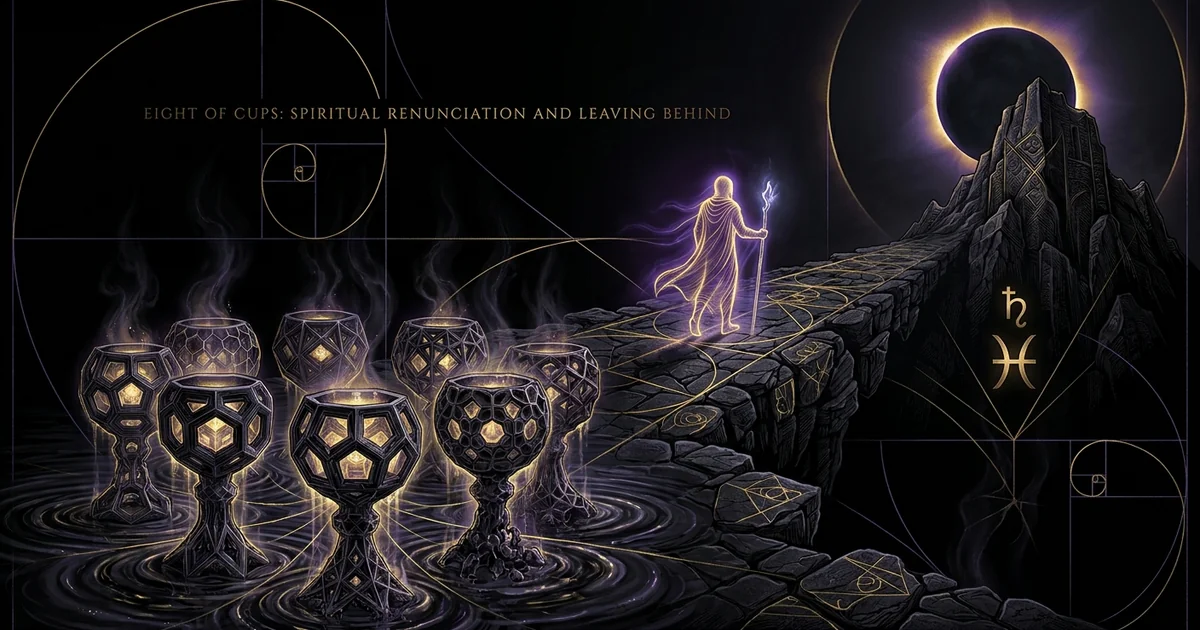
Eight of Cups: Spiritual Renunciation and Leaving Behind
Archetypal Thesis & Systemic Paradigm: The Mechanics of Voluntary Disillusionment
Asymptotic Satiation and the Void in the Emotional Matrix
The eight of cups tarot meaning occupies a precise phenomenological coordinate within esoteric psychology: the crisis of asymptotic satiation. Within the developmental trajectory of the cups suit, consciousness traverses an evolutionary arc through the water element, moving from the primal unformed font of the Ace to the affective equilibrium of the Ten. At the stage of the Eight, however, a critical systemic threshold is breached. The psyche encounters the fundamental ontological insufficiency of its own accumulated emotional architecture. The emotional matrix, having achieved coherent structural realization through the preceding stages, reveals an inherent vacuum at its core. This is not the trauma of unexpected deprivation, but rather the sobering discovery that total fulfillment within the parameters of the lower emotional plane fails to satisfy the transpersonal imperative of the Self.
In this state, the subject experiences an existential nullity precisely because the vessel of experience has been filled to its operational capacity without transmuting the underlying thirst of consciousness. The water element—governing relational bonds, psychic cohesion, aesthetic contentment, and instinctual security—reaches a point of diminishing returns. The eight accumulated vessels do not shatter; rather, their contents grow inert, calcifying into monuments of past psychic investments. This phenomenological stalling signals that the psychic economy has reached systemic entropy. When an affective structure can no longer serve as a conduit for numinous vitality, its preservation transforms into a mechanism of psychic imprisonment.
The Teleology of Abandonment: Renunciation versus Loss
A rigorous esoteric cartography requires an absolute operational distinction between involuntary loss and deliberate renunciation. Within the phenomenology of the minor arcana, emotional dissolution frequently manifests as a traumatic, reactive rupture. The Five of Cups exemplifies this mode: the crisis is experienced as an external catastrophe, an unexpected assault on the ego that leaves three spilled vessels and a posture of paralyzed bereavement. In stark contrast, the Eight of Cups governs an autonomous, self-authored departure. The eight of cups tarot meaning is grounded in intentional abandonment; no external agency overturns the chalices, no tectonic upheaval shatters the terrain, and no adversary breaches the sanctuary.
The placement of the Eight of Cups at the Sephira Hod (Splendor/Intellect) within the World of Briah (the Creative/Archetypal-Watery realm) establishes a critical operational paradox. Hod is the sphere of Mercury—analytical, discriminating, structural, and separating. When Hod operates upon the fluidic, unitive medium of Briah, it introduces cognitive detachment into the oceanic waters of affective experience.
The intellect identifies the boundary conditions, systemic loops, and latent corruptions within the emotional matrix. Hod functions here as a scalpel: it measures the affective investments of the personality against the ultimate horizon of spiritual truth, pronouncing the forms structurally complete yet spiritually vacant. This intellectual intervention breaks the hypnotic spell of the seven-of-cups-illusion-astral, crystallizing affective attachments so thoroughly that the will can disengage and seek the unmanifest heights of Kether.
The teleology of this departure is rooted in a homeostatic feedback loop. The psyche realizes that further caloric, psychic, and affective expenditure within the existing matrix yields mathematically negative returns on spiritual individuation. The subject does not leave because the cups are broken; the subject leaves precisely because the cups are intact, yet thoroughly incapable of mediating the next phase of ontological development. renunciation here is neither nihilistic flight nor a manifestation of depressive surrender; it is a teleological necessity executed by an ego-consciousness that has recognized the structural obsolescence of its most cherished attachments.
Topological Rupture: The Conscious Severance of Astral Attachments
To comprehend the mechanics of this arcanum, one must analyze the severance of the invisible energetic cords that anchor consciousness to the astral-matrix. Human attachment operates via subtle energetic conduits formed through repetitive emotional projection, mutual validation, and instinctual habituation. In the lower octaves of the water element, these astral threads bind the individual to social roles, lineage expectations, and self-reinforcing narratives of personal identity. The departure designated by the Eight of Cups requires an active, topological rupture—a clean slicing through these coagulated astral ligaments.
This rupture is inherently disorienting because it demands that consciousness repudiate structures that previously served as its foundational reality. The subject must turn their back on a coherent ecosystem of meaning that they themselves labored to construct. The psychic gravity of the eight vessels exerts a continuous pull, attempting to draw the renegade awareness back into the comfort of established affective loops. To successfully escape this gravitational field, consciousness must invoke an absolute act of will that severs the projection of the numinous from the material vessel. The water within the cups is recognized as borrowed light, and the pilgrim turns toward the dark, unmapped mountainous topography that conceals the unconditioned Source.
Classical Provenance & Textual Lineage: The Evolution of Indolence and Transmutation
Golden Dawn Hermetic Foundations: The Lord of Abandoned Success
The foundational taxonomy of modern Western esoteric tarot originates within the cipher manuscripts and synthesized curricula of the Hermetic Order of the Golden Dawn. In their internal attribution tables, Samuel Liddell MacGregor Mathers and his circle designated the Eight of Cups as the “Lord of Abandoned Success.” This title contains a deliberate hermetic tension: the presence of “Success” denotes that the operations of the cups have attained their structural fruition, while “Abandoned” affirms that this very fruition has been voluntarily vacated.
The Golden Dawn mapped the card to the first decan of Pisces, a face co-ruled by Saturn according to the traditional Ptolemaic scheme of planetary rulerships. In the Golden Dawn system, the combination of a watery, mutable sign with the heavy, restrictive, temporal force of Saturn was viewed as inherently fraught. Mathers posited that the structural manifestation of this card represents success left behind, an undertaking abandoned just as the material or emotional harvest has been secured. The original teachings emphasized that this abandonment is not necessarily born of nobility; it can signify a weariness of the flesh, a satiety of the heart that turns to ash upon the tongue, precipitating an urgent need to vacate the theater of past triumphs.
S.L. MacGregor Mathers, The Equinox / Golden Dawn Cipher Manuscripts (1888/1909):
“Eight of Cups: The Lord of Abandoned Success. Hod in the World of Briah. Saturn in Pisces. Temporary success, but without further result. Things thrown aside as soon as gained; not lasting, even in the matter at hand. Indolence in success. Journeying from one place to another. Misfortune and sorrow in the midst of apparent prosperity.”
Arthur Edward Waite, The Pictorial Key to the Tarot (1910):
“A man of dejected aspect is deserting the cups of his felicity, enterprise, undertaking or previous concern… Conjointly with the typical cast of the card, there are also these meanings: Desertion, flight, leaving behind, departing from an undertaking, instability… But it signifies also a decline in a matter that has reached its term; the matter has ceased to be of purpose or consequence, and it is left because the life has gone out of it.”
The Crowley-Harris Revision: From Sloth and Stagnation to Regenerative Hunger
In The Book of Thoth, Aleister Crowley, collaborating with Lady Frieda Harris, diverged radically from the ambulatory iconography popularized by the Rider-Waite-Smith deck, opting instead for a stark, hydro-chemical representation of stagnation titled simply “Indolence.” Crowley’s vision grounded the card entirely within its astrological and elemental mechanics: the corruptive impact of Saturn’s cold, drying, crystallizing nature when plunged into the deep, oceanic, mutable waters of Pisces.
Crowley observed that water, by its occult nature, requires continuous movement, circulation, and engagement to preserve its living vitality. When subjected to the saturnine influence in Hod, the creative waters of Briah lose their hydrostatic momentum, degenerating into a calcified, putrefying marsh. Harris depicted the eight cups not as robust chalices, but as shallow, cracked, and misshapen vessels arranged in two descending tiers, into which pale, phosphorescent water drips sluggishly from withered lotus blossoms. For Crowley, the card embodies a state of poison through inertia—a spiritual dead-end wherein the personality has become bloated on past achievements, paralyzed by an insidious refusal to evolve.
Yet, within Crowley’s teleology, this extreme stagnation constitutes the very catalyst for awakening. The agony of indolence—the absolute horror of remaining trapped in a putrefying emotional swamp—generates the violent, restorative hunger required to shatter the calcified vessels and initiate the ascent toward the next cycle of initiation.
Iconographic Shift in the Waite-Smith Corpus: The Cloaked Pilgrim
The contemporary psychological and esoteric understanding of the Eight of Cups owes its visual architecture almost exclusively to the iconographic innovation of Pamela Colman Smith, working under the direction of Arthur Edward Waite. Smith broke decisively from the static, heraldic arrangements typical of the Tarot de Marseille and Crowley’s subsequent geometric diagrams, introducing an explicit narrative drama dominated by a human protagonist.
[ Mountain Heights: Supernal Transcendence ]
                         ^
                        / \  (Ascent via narrow pass)
                       /   \
  [ Moon/Sun Conjunction ]   \
            |                 \
            v                  \
 [ Stagnant Tidal Waters ] ---> [ Cloaked Pilgrim with Staff ]
                                      |
                               (Voluntary Turn)
                                      |
                         [ Stood-down Array of 8 Cups ]
Smith’s composition depicts an ambulatory figure draped in a vermilion or crimson cloak, grasping a pilgrim’s staff and actively ascending a barren, rocky precipice that rises out of a dark coastal inlet. The figure’s back is turned squarely to the observer and to the eight golden chalices neatly arranged in the foreground. This visual syntax is revolutionary: it pivots the card’s operational axis from passive decay to active pilgrimage. The red cloak signifies the survival of the vital, solar-martian will—the preservation of libido that refuses to drown in the stagnant waters below.
By rendering the chalices in a deliberate, highly ordered stack, Smith demonstrates that the emotional past has not collapsed; it has been consciously vacated. The pilgrim’s staff indicates that this departure is an arduous, measured traversal through inhospitable terrain, transforming an astrological malefic into an intentional, heroic pursuit of the transpersonal horizon.
Structural Mechanics & Symbolic Geometry: Astrological Decanates and Qabalistic Coordinates
Saturn in Pisces: The Chthonic Restrictor in the Waters of the Infinite
The astrological architecture of the Eight of Cups is governed by the assignment of the first decanates of Pisces (0° to 10° Pisces), designated in classical astrology as a decan ruled by Saturn according to the Chaldean order, or Jupiter according to the triplicity rulerships recorded by Claudius Ptolemy in the Tetrabiblos. Heinrich Cornelius Agrippa, in Book II of his Three Books of Occult Philosophy, describes the image of this decan as a man carrying baggage, holding a staff, and journeying through difficult places, directly informing the iconographic lineage executed by Smith centuries later.
The systemic dynamic operating between Saturn and Pisces is one of structural incompatibility, generating acute existential friction. Pisces represents the archetypal ocean of consciousness—boundless, undifferentiated, dissolving, and porous. Saturn represents the principle of form, limitation, temporal boundary, and the inexorable demand of reality testing. When Saturn operates within the first decan of Pisces, the Great Architect encounters the formless abyss. The immediate consequence is the enforcement of a boundary upon the boundless: the boundless waters are experienced as an ocean of tears, a reservoir of collective sorrow, or a stagnant estuary that must be drained.
Saturn acts as a chthonic restrictor, chilling the mutable, emotional waters of Pisces. Under this influence, affective experiences that previously offered oceanic communion are stripped of their numinous projection. The subject confronts the structural limitations of all worldly joy. The decan forces an uncompromising confrontation with impermanence: every human construct, every emotional bond, every temporal achievement is subjected to the slow erosion of Saturnine time. This astrological configuration makes continuous residence in the watery realm intolerable; consciousness is compelled to seek solid ground upon the rocky heights of the spirit.
Hod in the World of Briah: Intellect Dissecting Affective Forms
Within the Tree of Life, the number Eight corresponds invariably to the Sephira Hod (Splendor), the eighth emanation situated at the base of the Pillar of Severity. Hod is the sphere of concrete intellect, communication, discrimination, science, and the articulation of form. When the structural dynamics of Hod are projected into the four cabalistic worlds, the eight of each suit reveals how intellectual discrimination interacts with that world’s specific elemental medium.
In the Suit of Cups, Hod operates within the World of Briah (Olam ha-Briah), the World of Creation, which corresponds to the primordial water element and the raw substrate of archetypal feeling. The synthesis of Hod in Briah represents an ontological crisis: the cool, dry, analytical mercury of the intellect entering the warm, moist, unitive waters of the soul. Hod acts as a structural prism, breaking the oceanic unity of Briatic feeling into discrete, measurable components.
The intellect conducts a ruthless audit of the emotional matrix. It observes the eight vessels and calculates their ultimate spiritual utility. Hod’s presence prevents the ego from indulging in the comforting illusions of the preceding card, the Seven of Cups. Under the gaze of Hod, the fantasies, projections, and compensatory daydreams that characterize the astral matrix are systematically dismantled. The intellect determines that the current affective paradigm cannot be redeemed or upgraded through minor adjustments; it must be abandoned entirely. Hod provides the objective clarity required to perform the surgery of renunciation.
Spatial Semiotics: The Crescent Moon, Missing Vessel, and Ascending Chasm
The symbolic geometry of the Rider-Waite-Smith Eight of Cups reveals multiple layers of spatial semiotics that deepen the card’s operational significance. Chief among these is the deliberate structural anomaly present in the arrangement of the eight chalices in the foreground. The vessels are stacked in a distinct configuration: a base tier of five cups supporting an upper tier of three cups. Between the central vessels of the upper tier, an unmistakable aperture or missing space exists.
       [Cup 6]     [GAP / VOID]     [Cup 7]     [Cup 8]
  [Cup 1]     [Cup 2]     [Cup 3]     [Cup 4]     [Cup 5]
This intentional void signals that the stack cannot accommodate a final ninth cup within its existing geometry. To attain the ultimate satisfaction promised by the Nine of Cups, the entire arrangement must be reorganized from a higher ontological altitude. The missing vessel is the Divine Spark, the transpersonal object of desire that cannot be contained within the lower manifest cups. The gap functions as a spatial signifier of incompletion, a visual reminder that no matter how harmoniously the lower five senses and three mental faculties are aligned, an unfillable void remains that can only be resolved through transcendence.
Above this terrestrial arrangement, in a sky painted an unnatural, nocturnal slate-black, hangs a luminary displaying a complex astronomical phenomenon: a crescent moon cradling or eclipsing a full circular disk, often interpreted as the conjunction of the solar ego and the lunar unconscious, or a total eclipse. This celestial semiotic demonstrates the suspension of normal temporal causality. The solar vitality of the day is veiled by the night of the unconscious. The luminous crescent acts as an eye observing the pilgrim’s flight, indicating that this renunciation is witnessed and mandated by the cyclic laws of the transpersonal Self. The ascending chasm—the jagged, barren rock formations splitting the background—signifies the threshold of the axis mundi, the vertical path of initiation that demands the surrender of all emotional cargo before the summit can be attained.
Psychological Dynamics & Operational Praxis: The Individuation Pilgrimage
The Nekyia and the Dark Night of the Senses
From the perspective of analytical psychology, the eight of cups symbolism describes the critical turning point of the nekyia—the classical descent into the underworld or the night sea journey documented across global mythological traditions. Carl Gustav Jung identified this phase as an unavoidable structural requirement of the individuation process. When the conscious ego has exhausted the developmental potential of a specific psychological epoch, it enters a period of profound disorientation characterized by the withdrawal of libido from collective values and external adaptations.
“The psychic energy which is thus withdrawn from conscious circulation accumulates in the unconscious, where it activates those archetypal contents that possess the capacity to compensate the one-sidedness of the conscious attitude. This withdrawal is not an arbitrary act; it is an involuntary, biological necessity… The ego feels this withdrawal as a loss of value, an affective deadening, a state of spiritual exile, until it recognizes that the lost libido is preparing a new synthesis within the depths of the night sea journey.” — Carl Gustav Jung, The Archetypes of the Collective Unconscious (Collected Works Vol. 9i), §115–118
This dynamic aligns precisely with the classical mystical paradigm articulated by St. John of the Cross in the Dark Night of the Senses. In this stage of spiritual development, the soul is systematically stripped of the consolations, emotional satisfactions, and sensory delights that previously characterized its devotional life. The divine presence, which was once experienced as an intimate, nourishing warmth within the waters of the soul, now feels like an absolute void, an arid desert of basalt and ash.
The subject feels abandoned by the very reality that once provided meaning. Yet, within both the mystical and Jungian frameworks, this affective deadening is profoundly teleological: it is the ego’s necessary purgation from its addiction to spiritual pleasure, forcing consciousness to cultivate an autonomous will capable of proceeding without the bribery of affective reward.
+--------------------------------------------------------------------------+
|                       THE NEKYIA TRAJECTORY                              |
|                                                                          |
|  [ Conscious Ego ]                                                       |
|         |                                                                |
|         |  (Exhaustion of outward psychic adaptation)                    |
|         v                                                                |
|  [ Libido Deadening / Acedia Threshold ]                                 |
|         |                                                                |
|         |  (Voluntary rupture with persona capital)                      |
|         v                                                                |
|  [ Dark Night of Senses / Ingress into Chasm ]                           |
|         |                                                                |
|         |  (Subterranean processing of repressed libido)                 |
|         v                                                                |
|  [ Emergence of the Transcendent Function ]                              |
+--------------------------------------------------------------------------+
Disidentification with the Persona’s Emotional Capital
A primary obstacle during the intermediate stages of Jungian individuation is the ego’s identification with its accumulated emotional and social capital. Throughout the formative stages of psychological maturation, the individual constructs a complex matrix of relationships, career milestones, moral stances, and social investments that constitute the structural scaffolding of the persona. These achievements are experienced as the eight golden vessels of the psyche—the hard-won trophies of emotional adaptation and personal labor.
The eight of cups tarot meaning marks the exact developmental crisis wherein these trophies transform into psychological impediments. The ego discovers that it has become the curator of a museum of past identities. To preserve these eight cups, an enormous amount of daily psychic energy must be expended in maintenance, validation, and defense. The persona becomes a gilded prison.
Disidentification demands an uncompromising psychological divestment. The individual must confront the terrifying realization that their social standing, their relational roles, and their recognized emotional competencies no longer reflect the vital pulse of their inner life. The operational praxis demanded by this card is the systematic withdrawal of projections from these external structures. The pilgrim who turns their back on the cups does not denigrate their historical value; rather, the pilgrim acknowledges that to remain anchored to them is to condemn the soul to spiritual petrifaction.
Diagnostic Protocols: Distinguishing Depressive Acedia from Sacred Renunciation
In applied clinical psychology and esoteric diagnosis, the Eight of Cups presents a delicate diagnostic challenge: the clinician or investigator must rigorously distinguish between regressive depressive withdrawal—traditionally classified in monastic theology as the demon of acedia—and genuine, sacred renunciation.
[ CRISIS OF AFFECTIVE SATIATION ]
                       |
       +---------------+---------------+
       |                               |
       v                               v
[ REGRESSIVE ACEDIA ]        [ SACRED RENUNCIATION ]
- Involuntary collapse       - Conscious, measured departure
- Loss of executive agency   - Retained will (staff in hand)
- Paralysis in the swamp     - Active ascent of the mountain
- Resentment toward cups - Acknowledgment of completionAcedia, or clinical depression, is characterized by an involuntary collapse of executive agency, a generalized anhedonia that paralyzes the motor will, and a pervasive bitterness toward a reality that feels withholding. The individual experiencing acedia does not climb the mountain; they collapse into the stagnant coastal estuary, submerged beneath the weight of the water, viewing the eight cups with resentment, shame, or despair. There is no destination, no deliberate mobilization of psychic energy, and no conscious engagement with the transcendent.
Conversely, sacred renunciation preserves the integrity of the sovereign will. In Pamela Colman Smith’s visual lexicon, this distinction is highlighted by the pilgrim’s firm grasp on the walking staff and the purposeful, forward-leaning posture of the body. The individual undergoing authentic renunciation exhibits the following characteristics:
- The departure is conscious, intentional, and fully owned by the ego.
- The eight cups are left intact and upright, rather than kicked over, defaced, or smashed in an infantile tantrum.
- The individual experiences grief, yet this grief is accompanied by an unmistakable sense of internal liberation and clarity of purpose.
- The trajectory is vertical—moving from the stagnant, low-lying watery plane toward the elevated, crystalline peaks of the mountains.
Philosophical Synthesis & Macrocosmic Correspondence: Hermetic Transmutation of Fluidity
The Polarity of Solutio and Coagulatio in the Alchemical Vessel
Within the operational philosophy of Western alchemy, the Great Work (Magnum Opus) advances through a rhythmic, dialectical alternation between two primordial operations: Solutio (dissolution) and Coagulatio (coagulation), codified in the universal axiom Solve et Coagula. The Eight of Cups represents the final, radical exhaustion of the Solutio phase operating within the affective dimensions of the personality, serving as the preparatory threshold for an alchemical Coagulatio upon a transcendent octave.
In the initial operations of the cups suit, the fluid medium functions as a universal solvent, dissolving rigid mental boundaries, softening the calcified structures of the ego, and allowing consciousness to experience relational communion and imaginative depth. However, when the water element remains contained within the lower vessel for too long, it undergoes a reverse transformation: it begins to putrefy (Putrefactio). The waters lose their solvent power and become heavy, toxic, and stagnant.
The Eight of Cups marks the termination of personal Solutio. The alchemist recognizes that the prima materia can no longer be refined within this specific bath. The fluid must be evaporated; it must undergo the process of Sublimatio—rising as a vapor from the lower retort toward the cool, crystalline alembic head of the mountains. The red cloak of the pilgrim embodies the alchemical sulfur (Sulfur), the indomitable fiery seed of the solar will that survives the watery putrefaction and carries the refined essence upward toward a higher crystallization.
Five of Cups: Catastrophic Involuntary Loss
- Astrological Attribution: Mars in Scorpio (Structural Rupture via Strife)
- Operational Mechanism: Involuntary, violent disruption of emotional security
- Psychic Orientation: Paralyzed gaze fixed upon spilled, destroyed vessels
- State of Libido: Libido trapped in mourning, trauma fixation, and shock
- Terrain & Geometry: Flat riverbank; structural blockage preventing forward transit
- Alchemical Phase: Mortificatio / Traumatic Putrefaction
Eight of Cups: Sovereign Voluntary Renunciation
- Astrological Attribution: Saturn in Pisces (Temporal Limitation & Dissolution)
- Operational Mechanism: Conscious, self-authored evacuation of intact structures
- Psychic Orientation: Intentional back turned to complete, upright vessels
- State of Libido: Libido successfully mobilized into vertical ascension
- Terrain & Geometry: Rising mountain pass crossing water toward the heights
- Alchemical Phase: Sublimatio / Intentional Severance
Comparative Arcana: The Divergence of Death (XIII), The Tower (XVI), and the Eight of Cups
To accurately situate the Eight of Cups within the macrocosmic cartography of the Tarot, its mechanisms must be differentiated from other major initiatory arcana that govern termination, rupture, and departure. Specifically, the card must be compared against Arcanum XIII (Death) and Arcanum XVI (The Tower).
Arcanum XIII (Death) represents an absolute, non-negotiable cosmic law: the inexorable biological and structural cessation of forms whose temporal cycles have expired. In Death, the scythe cuts impartially; the individual ego has no vote, no agency, and no capacity to negotiate terms. Death operates via necessity (ananke), stripping the personality of its somatic and psychological garments so that the underlying skeletal core may be reseeded.
Arcanum XVI (The Tower) represents the sudden, cataclysmic destruction of structures built upon false premises, Hubris, or outlived mental paradigms. The lightning strike is external, vertical, and violent. It shatters the calcified tower from above, casting the occupants down into the abyss. The transition enforced by The Tower is catastrophic, disorienting, and thoroughly non-consensual from the perspective of the conscious ego.
The Eight of Cups stands apart from both. It does not possess the structural violence of The Tower, nor the somatic inevitability of Death. It represents an exercise of internal sovereignty. The eight cups remain intact, standing upon the shore; the sky, while eclipsed, does not strike them with lightning bolts; the earth does not open to swallow them. The agent of departure is the pilgrim’s own foot, guided by the pilgrim’s own hand upon the staff. The Eight of Cups is the quietest card in the Tarot, yet arguably the most heroic: it is the human soul choosing exile over stagnation, walking away from the banquet of its own accord because it has tasted the bread of eternity and can no longer feast on shadows.
The Law of Hydrodynamic Entropy within Esoteric Cartography
The macrocosmic mechanics of the Eight of Cups operate under the spiritual equivalent of the second law of thermodynamics: hydrodynamic entropy. In the physical universe, entropy dictates that a closed thermodynamic system inevitably progresses toward maximum disorder, thermal equilibrium, and the exhaustion of usable energy. When an ecosystem is sealed off from fresh inputs of external energy, it dies.
In esoteric hydrodynamics, water obeys the identical law. If the water element remains confined within a closed emotional circuit—a static configuration of relationships, an unquestioned institutional doctrine, or an unchanging psychological self-concept—its vitality decays:
$$\Delta S_{\text{astral}} \ge 0$$
The usable emotional energy drops to zero, and the system reaches affective equilibrium: absolute indifference, boredom, and psychological death.
The Eight of Cups marks the moment the psyche acknowledges this entropic inevitability. The eight vessels constitute a closed system. Within that closed basin, no further spiritual work can occur. The only mechanism capable of reversing hydrodynamic entropy is to breach the basin’s perimeter and introduce an open thermodynamic system. This requires an operational shift in the phase of the water itself.
The stagnant water must be left in the valley to be purified by the sun and earth, while the consciousness that observed it transitions into an atmospheric phase—scaling the basalt heights where water does not pool in swamps, but condenses as mountain mist, freezes into pure glacial ice, and descends once more as living, torrential rain. The departure depicted in the Eight of Cups is therefore an act of ecological and spiritual hygiene, preserving the dynamic vitality of the soul’s water by forcing it into a new elemental cycle.
Frequently Asked Questions: Resolving Advanced Symbolic Inquiries
Does the Eight of Cups Imply Inevitable Failure or Abandonment of Responsibility?
The Eight of Cups is frequently misinterpreted in superficial divinatory frameworks as an omen of failure, unreliability, or the irresponsible abandonment of obligations. This reading stems from an ego-centric bias that equates the preservation of any existing structure with moral virtue, and its cessation with failure. In rigorous esoteric psychology, the Eight of Cups does not signify failure; it signifies evolutionary supersession.
The card explicitly portrays an enterprise that has succeeded within its own structural parameters. The cups are gathered, filled, and neatly arranged in a stable geometric pattern. The abandonment occurs not because the project collapsed, but because the soul has outgrown the developmental stage that the project was designed to foster.
There is an immense metaphysical distinction between neglecting an active moral duty out of weakness and disengaging from an outlived structure whose continued preservation would constitute spiritual mendacity. The Eight of Cups represents the courage to admit when a marriage, a career, an artistic identity, or a spiritual affiliation has exhausted its living purpose. To remain within a structure out of fear, social compliance, or habit is the true failure; to leave it with dignity and deliberate intent is the mark of authentic moral maturity.
How Does the Astrological Decan Influence the Card’s Reversal Dynamics?
When the Eight of Cups appears in a reversed orientation or in an afflicted dignitary status, its structural dynamics do not invert into an entirely new meaning; rather, they reveal the pathological distortions of its governing astrological decan: Saturn in the first decan of Pisces.
In a state of reversal, the card typically bifurcates into one of two systemic extremes:
-
Saturnine Paralysis and Calcification (Under-Departure): The individual recognizes that the cups are spiritually vacant, yet remains thoroughly incapable of executing the required physical departure. The cold, heavy, restrictive influence of Saturn dominates the mutable fluidity of Pisces, cementing the pilgrim’s feet into the coastal mud. The subject succumbs to acedia, profound depression, cynicism, and habitual dread. They stay in the toxic relational or professional matrix out of terror of the unknown mountain pass, choosing slow, miserable petrifaction over the acute pain of renunciation.
-
Unanchored Piscean Evasion (Hyper-Departure): The mutable, porous, evasive qualities of Pisces swamp the stabilizing boundaries of Saturn. Here, the reversed card signifies premature flight, chronic spiritual bypassing, or a pathological inability to sustain affective commitments long enough to build meaningful structures. The individual flees at the first sign of emotional difficulty, masking an infantile fear of intimacy or discipline behind the spiritualized rhetoric of “letting go.” The vessels are not abandoned because they were mastered and exhausted; they are abandoned because the individual lacked the structural stamina to fill them in the first place.
What Differentiates the Departure in the Eight of Cups from the Hermit (IX)?
While both the Eight of Cups and Arcanum IX (The Hermit) feature solitary, cloaked figures traversing desolate, elevated topographies with walking staffs in hand, they occupy fundamentally distinct operational and topological planes within the Tarot hierarchy.
+--------------------------------------------------------------------------+
|                     SYSTEMIC OPERATIONAL CONTRAST                        |
+------------------------------------+-------------------------------------+
|         THE EIGHT OF CUPS          |             THE HERMIT              |
+------------------------------------+-------------------------------------+
| Minor Arcanum (Localized Crisis)   | Major Arcanum (Macrocosmic Path)    |
| Transits *out of* Briatic Waters   | Walks the Heights of Tiphareth-     |
|                                    | Chesed / Path of Yod                |
| Movement of psychic divestment     | Ontological state of illumination   |
| Back turned to the viewer          | Facing forward / displaying lantern |
| Staff used for physical balance    | Staff as the Axis Mundi / Adeptship |
| Purgative Phase (The Dark Night)   | Illuminative Phase (The Guide)      |
+------------------------------------+-------------------------------------+
The Eight of Cups is a Minor Arcanum operating within the localized, affective coordinates of Hod in Briah. It depicts an individual in the messy, painful process of transition—a psychological evacuation from an outlived emotional habitat. The figure’s face is hidden, their body is turned away from the conscious field, and they are actively ascending through the transition zone between the swamp and the mountain. The pilgrim’s staff is an instrument of physical support, a necessity for a traveler negotiating hazardous, unfamiliar rocks. The focus of the card is on what is being left behind and the immediate friction of the departure.
The Hermit, by contrast, is a Major Arcanum—the archetypal embodiment of the illuminated Adept standing upon the highest mountain peaks of spiritual attainment. The Hermit has already completed all minor renunciations lifetimes ago. He is not fleeing a swamp; he is the Master of the Summit. His staff is the Rod of Power, a conduit of spiritual authority, and his lantern contains the radiant, six-pointed star of Tiphareth, held aloft not to light his own footsteps, but to guide the upward pilgrimage of those struggling far below in the valleys of the Minor Arcana.
The Eight of Cups is the mortal pilgrim in the midst of the purgative dark night; The Hermit is the eternal archetype of the Initiated Self awaiting that pilgrim at the journey’s end.