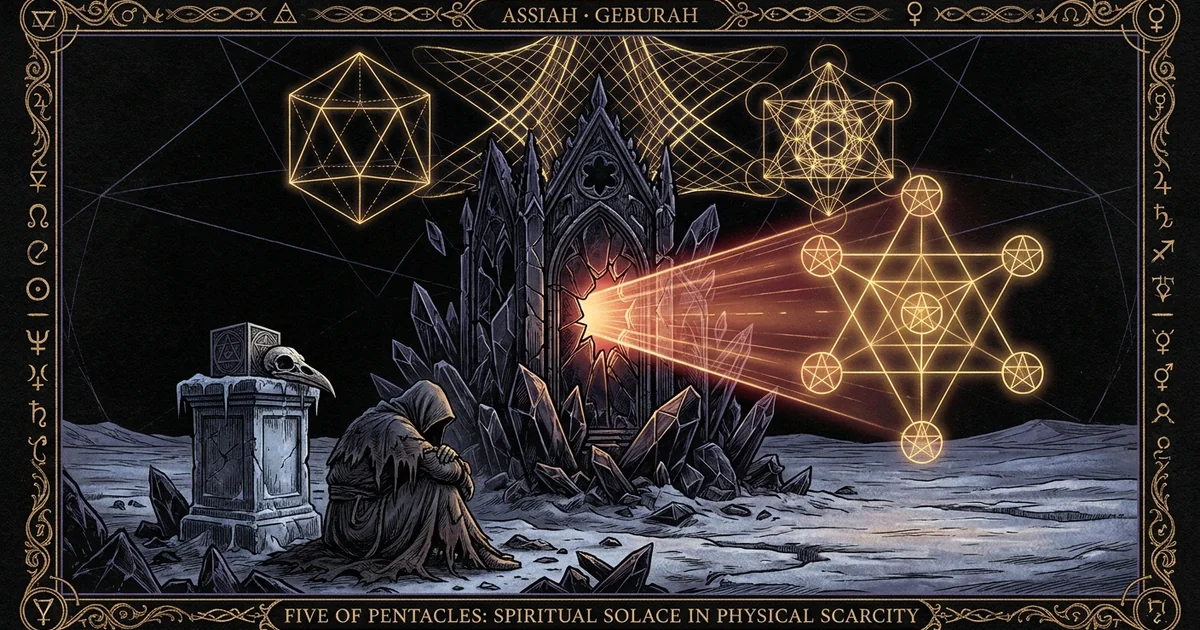
Five of Pentacles: Spiritual Solace in Physical Scarcity
Archetypal Thesis & Systemic Paradigm: The Mechanics of Scarcity in Assiah
The Geburic Disruption within the Earth Element
The five of pentacles tarot meaning cannot be reduced to a pedestrian omen of financial destitution or medical calamity. Within the formal mechanics of the Hermetic Qabalah, this arcanum charts the catastrophic yet evolutionarily indispensable collision between the Fifth Sephirah, Geburah (Severity, Purgation, Martial Volition), and the densest planetary sphere: Assiah, the World of Action and physical matter. In the preceding station of the suit, delineated in the /tarot/four-of-pentacles-meaning, the terrestrial current reaches an unyielding, hyper-calcified equilibrium. There, the ego establishes a defensive perimeter around its accumulated assets, arresting dynamic circulation to stave off mortality. The Five arrives not as a punitive misfortune, but as a structural inevitability. It is the volcanic rupture of that crystalline stasis. Geburah acts upon the earth element as an alchemical solvent, shattering the structural ossification of the Four to compel the living organism back into metabolic exchange with its environment.
This martial intervention within the terrestrial plane generates immediate cognitive and somatic friction. Because Malkuth—the physical footing of Assiah—is governed by inertia, the surgical severance delivered by Geburah is registered by the unintegrated ego as violence, privation, and thermodynamic collapse. The pentacles suit tracks the realization of spirit within substance; therefore, the introduction of the number Five destabilizes the base quaternary of form (the four classical elements, the four cardinal points, the four legs of the animal kingdom) by introducing the quintessence as an agonizing developmental crisis. The matter of the physical vehicle is forcibly cleared of its false security constructs. Scarcity, viewed through this structural paradigm, is not an absence of divinity, but divinity operating via the purgative agency of lack. It strips the perceptual apparatus of external dependencies, exposing the underlying architecture of consciousness when deprived of worldly scaffolding.
The Paradox of the Sanctuary: Architecture of Alienation
Pamela Colman Smith’s visual grammar for the arcanum establishes a definitive diagnostic paradox: two figures trudge through driving snow, their bodies broken and wrapped in rags, utterly oblivious to the glowing stained-glass window of an illuminated sanctuary rising directly above them. This spatial composition invalidates the thesis that the card denotes absolute, objective exclusion from resources. The sanctuary is geographically proximate, its perimeter porous, and its interior visibly charged with warmth and light. The tragedy depicted is an architectural alienation born of perceptual catatonia. The mendicants do not enter the basilica because their gaze is locked into the downward, horizontal vector of the snowdrifts—the immediate somatic agony of their frostbitten progress.
When Geburah (Severity/Mars) projects its current into Assiah (the Material World), it does not manifest as the heroic martial combat seen in Atziluthic or Briatic spheres. Constrained by the heavy inertia of Malkuth, the martial energy implodes into systemic friction, somatic decay, institutional disenfranchisement, and the direct experience of resource restriction. The number 5 is the mathematical disruption of the stable 4; it forces the quaternary cube of matter to accommodate the volatile quintessence through the violent decompression of physical assets.
The card demonstrates that the condition of extreme scarcity induces a radical tunnel-vision within consciousness. Neurologically and archetypally, acute deprivation triggers survival-oriented hyper-focus, which paradoxically blinds the subject to proximate systemic alternatives. The church window—divided into the geometric schema of the pentacles suit—functions as an archetypal threshold. The sanctuary represents institutional, ancestral, and spiritual sustenance that remains functionally inert until an act of perceptual reorientation occurs. The mendicants suffer not because the universe has withheld its abundance, but because their cognitive vectors have collapsed into identification with the wound. Scarcity operates here as an epistemological trap: the physical manifestation of cold and exhaustion becomes an all-encompassing reality that obscures the immediate availability of transpersonal refuge.
The Nigredo Phase: Somatic Destitution as Alchemical Redirection
In analytical psychology and classical alchemy, the condition configured by the Five of Pentacles corresponds precisely to the initial stage of the Great Work: the nigredo, or the blackening of the prima materia. Carl Gustav Jung, in his extensive exegesis of alchemical phenomenology, demonstrated that before any psycho-spiritual integration (coniunctio) can transpire, the conscious ego must undergo an exhaustive mortification (mortificatio). The ego’s inflated fantasy of autonomy, sustained by the external scaffolding of social status, economic liquidity, and physical vigor, must be brought down into the putrefaction of the base earth.
This process models a somatic dark night of the soul. The libido, formerly invested in external objects, career trajectories, and relational attachments, is abruptly withdrawn by the unconscious. The subject experiences this energetic withdrawal not as a psychological insight, but as objective ruin: bank accounts dwindle, bodily joints inflame, and social safety nets dissolve. Yet, as Heinrich Cornelius Agrippa observed regarding the occult virtues of the earth element in De Occulta Philosophia, physical matter holds within its lowest, most degraded expressions the latent seed of the highest celestial virtues. The destitution depicted in the card is an operational necessity. By dismantling the illusion that safety can be engineered through material accumulation alone, the psyche is forced into an alchemical calcination, burning away the persona’s defenses to reveal the indestructible, non-contingent core of the Self.
Classical Provenance & Textual Lineage: From ‘Lord of Material Trouble’ to Archetypal Exile
Golden Dawn Hermetic Foundations: The Decanic Title
The structural codification of this card originates in the late nineteenth-century curriculum of the Hermetic Order of the Golden Dawn. S.L. MacGregor Mathers, synthesizing the esoteric correspondences inherited from medieval manuscripts and Renaissance astrological magic, designated the Five of Pentacles as the “Lord of Material Trouble.” This title was not intended as a simplistic fatalistic prognostication, but as an exact technical description of decanic mechanics. The card was mapped to the first decan of Taurus, a terrestrial sign ruled by the planet Mercury according to the ancient Chaldean astrological sequence.
The Golden Dawn’s cryptographic manuscripts delineate how the volatile, rapid, and intellectually mutable planetary energy of Mercury operates when forced into the dense, fixed, and unyielding earth of Taurus. The decanic title captures the intrinsic dissonance of this combination: the intellect (Mercury) attempts to rationalize, manipulate, and secure physical matter (Taurus), only to discover that the material substrate is resisting intellectual control. The analytical mind spins in obsessive cycles of anxiety over its inability to stabilize the material realm. The “trouble” indicated by Mathers is therefore fundamentally cognitive; it is the panic of the analytical mind confronting the inexorable laws of material entropy and decay within Assiah.
Pamela Colman Smith’s Iconographic Transmutation of Waite’s Rubric
Prior to the publication of the Rider-Waite-Smith deck in 1909, historic representations of the card—such as those found in the Tarot de Marseille—relied on purely geometric arrangements of five decorative coins, occasionally interlaced with floral arabesques that offered subtle symbolic hints of vitality pressing through structure. Arthur Edward Waite, in collaboration with the artist Pamela Colman Smith, enacted a revolutionary iconographic mutation. Waite’s textual prompt in The Pictorial Key to the Tarot was deceptively sparse, noting that the card denotes “material troubles,” “destitution,” and “ruin,” yet emphasizing that it simultaneously carries connotations of an “illuminated church” and spiritual resources.
“The first decan of Taurus is ruled by Mercury… It is the Lord of Material Trouble. Herein the Martial Severity of Geburah acts upon the lowest and most stubborn plane, producing anxiety, loss of employment, monetary embarrassment, and somatic distress through the inability of intellectual cunning to command the slow processes of the physical world.”
— S.L. MacGregor Mathers, The Tarot: Its Occult Signification, Use in Fortune-Telling, and Method of Play (1888)
“Five of Disks: Worry. The number Five, Geburah, in the element of Earth, indicates the disruption of stability… It is the dull, heavy, inert resistance of matter to the spiritual will. It is represented by unstable, fluctuating disks; the intellect has turned upon itself to contemplate the hopelessness of its own physical imprisonment.”
— Aleister Crowley, The Book of Thoth (1944)
Smith transformed this rubric into an indelible sociological and archetypal tableau. Drawing on visual tropes of medieval outcasts, mendicants, and lepers wandering outside the walls of consecrated institutions, she introduced the pair: one figure hobbling on crutches with a bell around his neck (the historical signifier of the unclean pariah), and another cloaked, walking barefoot across the snow. Smith’s genius was the deliberate spatial juxtaposition of these pariahs against the high Gothic window. By placing the sanctuary’s radiant window directly above the broken path of the outcasts, she crystallized the Hermetic doctrine that material destitution runs parallel to sacred immanence. The figures do not lack access because the church doors are barred; they fail to seek entry because their somatic misery has foreclosed their capacity to look upward.
Crowley’s Attribution: The Decadence of Fixed Matter
In The Book of Thoth, Aleister Crowley diverged from the pictorial sentimentality of Smith’s mendicants, renaming the card “Worry” (Five of Disks) and stripping it of anthropomorphic narrative. Crowley grounded his visual analysis in pure dynamic geometry. He arranged the five disks into an inverted pentagram, evoking the descent of spirit into the darkest, most inert strata of matter. The disks themselves are depicted as unstable, churning cog-wheels, their rims chipped and their teeth failing to mesh cleanly, suspended over a background of sickly yellow and mud-brown canvas.
Crowley identified the card as the state where the dynamic tension of Geburah fails to liberate the earth element, instead degrading into an obsessive, grinding friction. In his framework, when the terrestrial current is not systematically circulated through the generous redistribution found in the /tarot/six-of-pentacles-meaning, it inevitably stagnates. The intellect, ruled by Mercury in this decan, turns in upon itself, obsessing over the threat of physical annihilation. Crowley demonstrated that the true terror of the Five of Pentacles is not the external poverty itself, but the psychological condition of worry—the cognitive looping of an ego trapped in the illusion of its own physical fragility, frantically running calculations of deficiency within an autopoietic system that demands radical surrender.
Structural Mechanics & Symbolic Geometry: Astrological Decans and Qabalistic Topography
Decanic Geometry: Mercury in Taurus (0°–10° Taurus)
The astrological underpinning of the Five of Pentacles is the first decan of Taurus, spanning from 0°00’ to 9°59’ of the fixed earth sign. Under the Chaldean order of planetary rulership, this initial face is allocated to Mercury, the psychopomp and archetype of intellectual cognition, commerce, communication, and neurological transmission. To understand the structural dynamics of this placement, one must consult the detailed systemic analysis in the /astrology/mercury-in-taurus-decan monograph. Taurus is the fixed sign of the earth element; its archetypal drive is consolidation, somatic security, resource accretion, and the maintenance of physical continuity.
When the quicksilver, mutable current of Mercury is plunged into this dense, vegetative field, an acute operational mismatch occurs. Mercury demands rapid transmission, linguistic fluidity, and instantaneous exchange; Taurus demands patience, organic gestation, and sensory palpability. The result is a profound cognitive deceleration. The analytical apparatus is bogged down in material logistics. In this decan, the intellect becomes obsessively preoccupied with survival metrics: caloric intake, balance sheets, physical ailments, and structural vulnerabilities. The mind cannot transcend the body; it is chained to the body’s immediate, unyielding somatic demands, generating the psycho-somatic phenomenon of existential dread rooted in physical precarity.
+-------------------------------------------------------------------+
|               ASTROLOGICAL & QABALISTIC METRICS                   |
+---------------------+---------------------------------------------+
| Astrological Decan  | Taurus I (0°00' – 9°59' Taurus)             |
| Planetary Ruler     | Mercury (Chaldean Order)                    |
| Qabalistic Station  | Geburah in Assiah                           |
| Elemental Formula   | Martial Fire acting on Fixed Earth          |
| Alchemical State    | Nigredo / Mortificatio                      |
| Primary Paradox     | Invisible Sanctuary within Somatic Trauma   |
+---------------------+---------------------------------------------+
The Tree of Life Coordinates: Geburah of Assiah
To accurately position the five of pentacles symbolism upon the metaphysical cartography of the Tree of Life, one must trace the vertical descent of energetic tension through the four worlds. Geburah is the Fifth Sephirah, positioned on the left Pillar of Severity, directly opposing Chesed (Mercy) across the central path of Tiphareth. Geburah is pure corrective force, the cosmic immune system that prunes the overgrown branches of Chesed’s unmitigated expansion. When this high-frequency, martial intelligence descends into Assiah—the dense, chemical realm of physical manifestation—its impact is experienced as material privation.
In Atziluth, Geburah is the sacred warrior purifying the divine will. In Briah, it is the systemic dismantling of unsustainable psychic architectures. In Yetzirah, it manifests as intellectual discernment and the anxiety of doubt. But in Assiah, Geburah strikes the bedrock of physical form. It crystallizes as the sudden severance of income, the breakdown of the physical vehicle, systemic institutional rejection, and the raw vulnerability of the human organism exposed to the elemental forces. The Five of Pentacles is the exact spatial coordinate where this corrective severity penetrates the biological and socioeconomic matrix. It acts as an ontological crisis designed to demonstrate that any security built exclusively upon Assiatic foundations is fundamentally illusory.
Vector Analysis of the Stained-Glass Octagram
The visual geometry embedded within the church window of the Smith-Waite arcanum holds the structural key to resolving this crisis. The stained glass does not depict random ornamentation; it features an eight-pointed star, or octagram, organized around the geometric configuration of five golden pentacles. The number eight is the mathematical signature of Hod, the Eighth Sephirah on the Tree of Life, which corresponds precisely to Mercury—the planetary ruler of the decan. Furthermore, within Hermetic geometry, the octagram is the sacred symbol of regeneration, resurrection, and the intermediate threshold between the earthly square (four) and the heavenly circle (one/infinity).
The stained-glass window is thus an esoteric diagram of Hodian intellect redeemed by sacred geometry. The five pentacles within the window represent the five senses purified and harmonized through spiritual discipline, contrasting sharply with the five senses of the mendicants below, which are trapped in somatic trauma. The light passing through the red, blue, and gold glass demonstrates that the spiritual matrix is not distant; it is structurally adjacent to the outcasts, separated from them only by a transparent, luminous membrane. The solution to the somatic freeze of the Five of Pentacles is not to be found in frantic, horizontal survivalism across the snow, but in recognizing the Hodian geometric intelligence that hovers directly above the field of suffering.
Psychological Dynamics & Operational Praxis: The Archetype of the Scapegoat and Outcast
Shadow Projection and the ‘Pauper Complex’
From the vantage of depth psychology, the Five of Pentacles represents the constellation of what may be termed the “Pauper Complex”—a profound, unconscious fracture wherein the ego identifies entirely with lack, fragility, and victimization, while projecting all power, abundance, and containment onto external entities. The church in the Smith-Waite card functions as a classical projection screen for the archetypal Great Mother and the Paternal Upholder. The individual afflicted by this complex experiences themselves as an ontologically disenfranchised orphan, walking in outer darkness, while the “chosen” dwell within the warm, impenetrable walls of institutional privilege.
This dynamic frequently crystallizes as the archetype of the Scapegoat. The mendicants carry the somatic burden of systemic failure. In family systems and corporate hierarchies, an individual embodying the five of pentacles tarot meaning often carries the unacknowledged material and emotional bankruptcy of the entire collective. They become the identified patient, the sick member, or the financially incompetent pariah whose visible failure allows the rest of the system to maintain its illusion of stability. The psychological breakthrough occurs when the individual recognizes that the church is not an exclusionary institution hoarding sustenance, but an externalized image of their own alienated spiritual agency. The snowstorm is an internal psychic climate: the freezing over of libidinal energy caused by the refusal to claim ownership of the inner sanctuary.
Unintegrated Manifestation: Egoic Deprivation
- Perceptual Vector: Fixated downward onto the horizontal axis of immediate physical agony and lack.
- Psychic Mechanism: Projection of authority, nourishment, and wealth onto external, inaccessible institutions.
- Somatic State: Freezing, stagnation, somatic conversion of emotional panic into physical disability.
- Behavioral Loop: Chronic rumination (Mercury in Taurus), adopting the identity of the martyr or outcast.
- Systemic Status: The isolated thermodynamic fragment slowly losing coherence in the storm.
Integrated Realization: Poverty of Spirit (Kenosis)
- Perceptual Vector: Vertical alignment; recognition of the illuminated threshold directly adjacent to the wound.
- Psychic Mechanism: Re-integration of the projected Self; withdrawal of dependency on worldly systems.
- Somatic State: Humility, sensory simplification, acute somatic listening, the bodily halt that forces introspection.
- Behavioral Loop: Radical self-emptying; abandonment of false persona architectures to enter sanctuary.
- Systemic Status: The autopoietic organism using entropy to restructure its baseline of existence.
The Dynamics of Somatization: Pain as Bodily Hermeneutic
The somatic details of the card—the crutches, the bandaged foot, the bare skin meeting the frozen earth—provide a profound hermeneutic of bodily distress. When psychological tension cannot be processed through the mental apparatus of Hod or the emotional waters of Netzach, it invariably descends into the somatic bedrock of Malkuth. The body becomes the final canvas for the unresolved complex. Somatization, in the context of the Five of Pentacles, operates as a forced physiological intervention. The crutch indicates an artificial, compensatory ego structure that has collapsed under the weight of reality, while the limping gait reflects an asymmetrical distribution of psychic libido.
The physical symptom in the Five of Pentacles is teleological: it has purpose. It forces an abrupt cessation of normal kinetic engagement with the world. The individual cannot run; they can barely walk. This somatic freeze brings the hyperactive, outwardly focused personality to an absolute halt. The pain of the frostbitten flesh is a brutal call to somatic presence, demanding that the individual cease the exhausting maintenance of outward facades and attend to the immediate, fundamental requirements of the organism. The body becomes the primary site of initiation. Through physical vulnerability, the illusions of omnipotence, self-sufficiency, and purely intellectual mastery over life are conclusively dismantled.
Consultation Dynamics: Navigating the Inversion of Scarcity
In the clinical context of a psychological tarot consultation, the appearance of the Five of Pentacles signals that the querent is caught in an acute crisis of material or emotional dislocation. The practitioner’s primary diagnostic task is to navigate the inversion of scarcity. Querents invariably present this card with a narrative of external victimization: a job loss, a divorce, a financial ruin, or a devastating medical diagnosis. The consultant must validate the empirical reality of the Assiatic friction while systematically shifting the querent’s interpretive framework away from fatalistic despair toward structural threshold mechanics.
The operational intervention requires confronting the querent with the spatial paradox of the image: Why are you refusing to knock on the door? The consultant must investigate what psychic secondary gain is being derived from remaining in the cold. Frequently, wandering in the snow confirms a deeply rooted core belief of unworthiness or martyrdom, which feels psychologically safer than entering the luminous sanctuary—a transition that would demand relinquishing the cherished identity of the disenfranchised outcast. The five of pentacles tarot meaning must be decoded not as an insurmountable sentence of ruin, but as a severe invitation to spiritual sanctuary that requires the querent to look up, pivot ninety degrees, and cross an institutional or psychological threshold that their current defensive posture has rendered invisible.
Philosophical Synthesis & Macrocosmic Correspondence: Kenosis and the Dialectic of Earth
The Mystical Concept of Kenosis: Divine Emptying
The philosophical apogee of the Five of Pentacles is discovered in the classical theological doctrine of kenosis (from the Greek κένωσις, the act of emptying). In Christian mysticism, particularly within the contemplative lineages of St. John of the Cross and Meister Eckhart, kenosis signifies the voluntary divestment of egoic sovereignty and material attachment, mirroring Christ’s self-emptying into human embodiment. To receive the fullness of the divine presence, the human vessel must be thoroughly voided of its transient contents.
[ Pleroma: Unmanifest Fullness ]
           |
           v (Voluntary Divestment of Form)
[ Kenosis: The Voided Vessel / Five of Pentacles ]
           |
           v (Inflow of Transmuted Grace)
[ Tiphareth: Restored Solar Equilibrium / Six of Pentacles ]
The Five of Pentacles represents the involuntary, structural experience of kenosis within the terrestrial plane. The world of form strips the individual of their possessions, their health, their status, and their cherished illusions of control. While the human ego experiences this stripping as catastrophic humiliation, the mystical intelligence recognizes it as the indispensable clearing of the ground. The vessel must be completely emptied before it can be refilled with the higher-frequency transmutations characteristic of the /tarot/six-of-pentacles-meaning, where material and spiritual resources are redistributed in accordance with solar balance. The “pauper” is the only one who can enter the kingdom, precisely because the pauper has no luggage left to squeeze through the needle’s eye.
Thermodynamic Parallels: Entropy as Prerequisite for Autopoiesis
In modern systems theory and non-equilibrium thermodynamics, a living system sustains its organizational coherence—its autopoiesis—only by continually processing energy from its environment and exporting entropy. When a systemic architecture becomes too rigid, closed off from external feedback (as demonstrated in the Four of Pentacles), it approaches a condition of fatal equilibrium, a thermodynamic death disguised as security.
“The nigredo or blackness is the initial state, either present from the beginning as a quality of the prima materia, or produced by the separation (solutio, separatio, divisio, putrefactio) of the elements… The psychological equivalent is the encounter with the shadow, the confrontation with the dark, unadapted, and inferior aspects of the personality. It is the essential prelude to the work of redemption, for without the descent into the darkness of the earth, no true transformation of the soul can occur.”
— Carl Gustav Jung, Psychology and Alchemy (Collected Works, Vol. 12, par. 334)
“The experience of absolute poverty and outer helplessness in the alchemical process corresponds to the mortificatio of the King. The conscious personality must be brought to acknowledge its absolute dependence on the transpersonal ground of being, which cannot happen so long as it is shielded by the worldly apparatus of success and social consensus.”
— Marie-Louise von Franz, Alchemy: An Introduction to the Symbolism and the Psychology
The Five of Pentacles represents a localized spike in entropy that radically disrupts this catastrophic equilibrium. The structural crisis—be it economic collapse, physical sickness, or social ostracization—is the mechanism through which the closed system is forcibly reopened to thermodynamic exchange. In complex adaptive systems, structural decay is the indispensable evolutionary precursor to higher-order self-organization. Without the localized failure of the earth element, without the breakdown of existing somatic and socioeconomic structures, the organism lacks the developmental imperative to evolve new operational paradigms. Entropy, within the macrocosmic mechanics of the pentacles suit, is not the ultimate destroyer, but the evolutionary catalyst that prevents living form from turning into permanent stone.
The Alchemical Nigredo and the Rebirth of Tiphareth
The complete archetypal arc of the pentacles suit traces the redemption of fallen matter, a trajectory that requires the soul to descend progressively through the ten Sephiroth as manifested in Assiah. Within this overarching framework (analyzed comprehensively in the /tarot/suit-of-pentacles-archetypes document), the Five is the point of maximal divergence from the solar equilibrium of Tiphareth. Matter is experienced here as heavy, recalcitrant, resistant to the light, and plagued by scarcity. It is the valley through which the initiate must pass to dismantle the naive assumption that the physical realm is an end in itself.
In the alchemical laboratory, the nigredo yields the black ash, the base earth that has survived the fire. Only from this decomposed caput mortuum can the white stone of the albedo be extracted. The outcasts of the Five of Pentacles, pacing through the frozen night, are carrying the prima materia in its most potent, unrefined state. The snow that chills them is simultaneously the blanket that preserves the subterranean seeds of the coming spring. By enduring the physical scarcity of the station without succumbing to spiritual despair, the conscious subject transmutes base suffering into psychological gold, preparing the ground for the miraculous restoration of balance, charity, and illuminated flow that awaits in the Six of Pentacles.
Frequently Asked Questions: Advanced Decodings of the Five of Pentacles
Exegesis of Essential Questions
How does the somatic withdrawal of the Five of Pentacles differ mechanistically from the mental retreat of the Four of Swords?
While both cards represent a radical cessation of outward activity, their operational vectors, elemental substrates, and psychological mechanisms are fundamentally distinct. The Four of Swords operates in the element of Air (Yetzirah); it is a conscious, voluntary withdrawal of the analytical mind into a state of meditative convalescence, sanctuary, and cognitive truce to prevent psychic fragmentation. The subject in the Four of Swords is protected within an enclosed, sacred crypt, resting deliberately upon a bed of contemplative silence.
Conversely, the Five of Pentacles operates in the element of Earth (Assiah); its withdrawal is involuntary, somatic, and experienced as an external material crisis. In the Five, the body itself is wounded, cold, and displaced into the outer elements. The crisis is not one of mental exhaustion, but of physical, socioeconomic, or structural breakdown that strips the subject of their worldly defenses. While the Four of Swords is an act of deliberate mental preservation, the Five of Pentacles is an alchemical calcination through somatic exposure, forcing an encounter with fragility, mortality, and the raw vulnerability of living in a biological shell.
Why does the card depict the church as elevated and illuminated, yet structurally decoupled from the figures below?
The structural decoupling of the church and the mendicants in Pamela Colman Smith’s composition is an intentional visual demonstration of archetypal projection and perceptual dissociation. The elevated, illuminated church represents the transpersonal Self, spiritual sanctuary, and ancestral nourishment, while the outcasts represent the fragmented, suffering ego complex.
Smith deliberately omitted a clearly defined path leading directly from the figures to the church door to illustrate that the barrier between the human ego in crisis and its spiritual source is not an objective architectural obstruction, but an epistemological fissure. The outcasts are decoupled from the sanctuary because their attentional field is wholly captured by the horizontal vector of survival and somatic misery. The card demonstrates that sanctuary is always immediately adjacent to the dark night of the soul, but it remains inaccessible so long as consciousness seeks solutions solely on the horizontal plane of physical struggle, refusing to execute the vertical perceptual pivot required to perceive the sacred threshold.
What are the diagnostic criteria for differentiating the upright from the reversed manifestation in depth psychological practice?
In the upright orientation, the Five of Pentacles diagnoses an active, acute collision with the nigredo. The individual is currently undergoing the necessary breakdown of their external material scaffolding; the ego is experiencing the terror of scarcity, somatic vulnerability, and institutional disenfranchisement. The therapeutic imperative for the upright card is to facilitate the radical acceptance of the kenotic state—teaching the querent how to inhabit physical vulnerability without generating secondary cognitive neurosis (worry), and assisting them in identifying the proximate spiritual or communal sanctuary they are currently ignoring.
+-------------------------------------------------------------------+
|               DIAGNOSTIC CRITERIA: ORIENTATION DYNAMICS            |
+---------------------+---------------------------------------------+
| Upright Orientation | • Active collision with the nigredo         |
|                     | • Acute somatic vulnerability and lack      |
|                     | • Ego-breakdown through material friction   |
|                     | • Perceptual blindness to immediate help    |
+---------------------+---------------------------------------------+
| Reverse Orientation | • Awakening from the Pauper Complex         |
|                     | • The vertical pivot: looking up from snow  |
|                     | • Reintegration of somatic agency           |
|                     | • Crossing the threshold into the sanctuary |
+---------------------+---------------------------------------------+
When reversed, the arcanum signifies the turning point of the crisis: the awakening from the Pauper Complex. The reversed Five of Pentacles indicates that the necessary purgation of Geburah in Assiah has completed its structural work. The individual begins to look up from the frozen path. Libido returns to the somatic organism; the querent ceases the obsessive projection of nourishment onto unavailable external authorities and begins the practical, physical movement toward the sanctuary door. It marks the gradual thawing of the psychic frost, the clearing of the perceptual apparatus, and the immediate transition into the restorative, dynamic equilibrium governed by the Six of Pentacles.
Resolving Apparent Contradictions in Divination
A frequent source of interpretive confusion in professional practice involves instances where the Five of Pentacles appears in a spread for an individual who is objectively wealthy, professionally successful, and physically healthy. Diviners relying on superficial folklore often find themselves bewildered by this apparent contradiction, misdiagnosing the card as an impending, literal bankruptcy.
Seen through the lens of psycho-cosmological coordinates, the arcanum indicates that the individual’s material wealth is functioning as a defensive, calcified barrier against an underlying, unacknowledged spiritual destitution. The querent is psychically walking in the snow despite their millions; they are suffering from an acute inner pauperization, haunted by the deep, unconscious terror of loss, meaninglessness, and existential freezing. The card’s appearance in an affluent context diagnoses the complete failure of material assets to provide psychic sanctuary, brutally unmasking the spiritual poverty that festers beneath the gilded persona. The prescription remains structurally identical: the individual must undergo an intentional, psychological kenosis, divesting their identity of its reliance on external accumulations to discover the authentic, non-material sanctuary of the Self.