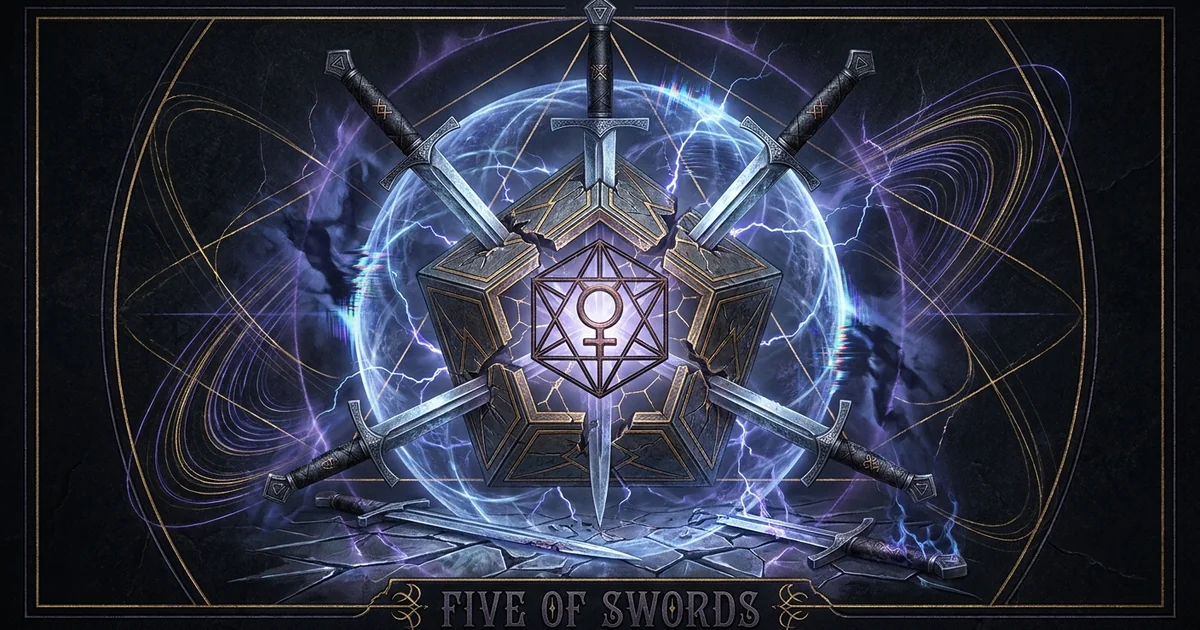
Five of Swords: Hollow Victory and Resolving Mental Strife
Archetypal Thesis & Systemic Paradigm: The Anatomy of Hollow Victory
Within the psycho-cosmological architecture of the Western Mystery Tradition, the Five of Swords marks a critical structural inflection point. It denotes the moment where the discursive intellect detaches from organic relationality, weaponizing its analytical capacity against its own foundational matrix. In the cartography of the Hermetic Qabalah, this card represents the kinetic descent of the fifth Sephirah, Geburah—the locus of martial severity, radical elimination, and corrective judgment—into the formative astral sphere of Yetzirah, the world of the mental faculties and the archetypal element of Air. The intersection of Geburic force with the fluid, connective medium of Yetzirah generates an acute ontological crisis within the Ruach (the conscious rational mind). The analytical apparatus, designed to discern and categorize phenomena in the service of understanding, undergoes a pathological inversion: it begins to pursue tactical supremacy at the absolute expense of systemic equilibrium, culminating in the archetype of the Pyrrhic victory.
KETHER (Crown)
                        |
                 TIPHARETH (Beauty)
                        |
       GEBURAH (Severity) ---> YETZIRAH (Ruach / Air)
                        |
               [ FIVE OF SWORDS ]
          (Catastrophic Egoic Decoupling)
The resulting dynamic is characterized by an intellectual triumph that guarantees systemic isolation. When Geburah’s shearing, uncompromising force enters the mental domain without the tempering mediation of Tiphareth (the solar center of spiritual integrity and psychic balance), the discursive intellect acts as an unbridled scalpel. It cleaves not merely falsehood from truth, but self from other, subject from object, and ego from community. The victory rendered by this card is hollow precisely because its operational triumph depends upon destroying the very relational network that confers meaning upon the victor. The intellect operates under the delusion that total dominance over an ideological adversary constitutes personal validation, blind to the reality that it has merely scorched the psychological earth upon which its own cognitive scaffolding depends.
The descent of the Fifth Sephirah (Geburah: Martial Severity, Judgement, Dynamic Force) into the Formative World (Yetzirah: Astral Fabric, Intellectual Processing, Air) produces an elemental volatility wherein the shearing power of Mars acts upon the mercurial Ruach. Because Yetzirah is governed by the volatile permutations of the Air element, the unmitigated application of Geburic severity shears discursive communication into hostile debate, fracturing cognitive cohesion and producing an acute structural disequilibrium within the mental vehicle.
Geburic Disruption within the Ruach
To comprehend the psychological mechanics of the Five of Swords, one must map the precise metaphysical friction generated when Geburic energy acts upon the Ruach. In classical Hermetic psychology, the Ruach corresponds to the middle tier of the soul—the cognitive clearinghouse comprising the conscious ego, the faculties of logic, language, and discursive deliberation. When working in harmonious concert with the higher spiritual triad (Neshamah), the Ruach functions as an open system, constantly metabolizing empirical experience and transmuting it into conceptual coherence. However, when struck by the direct, unmediated impact of Geburah, the Ruach experiences this dynamic severity not as evolutionary discipline, but as an existential threat that triggers hyper-defensive calcification.
Under this Geburic duress, the cognitive faculties undergo a survivalist retrenchment. The Ruach ceases to serve as an epistemological bridge to transcendent truth and instead transforms into a fortified ideological redoubt. The capacity for conceptual synthesis is obliterated; the mind retains only its analytical blade. Every exchange becomes an interrogation, every alternative perspective is classified as an assault on ego-integrity, and the internal dialectic collapses into rigid binary warfare. This structural rupture forces the Ruach to optimize exclusively for self-preservation through discursive domination, severing its energetic tether to the integrative virtues of mercy, reciprocity, and transpersonal understanding.
The Pathology of Discursive Domination
The resulting psychological syndrome manifests as the pathology of discursive domination—a state wherein the structural mechanisms of language and logic are decoupled from their communicative teleology. In healthy cognitive operations, the air-element governs dialectical exchange: thesis and antithesis engage within a shared relational field to yield a more comprehensive synthesis. In the dysfunctional state mapped by the Five of Swords, the dialectic is degraded into an arena of zero-compromise subjugation. The individual does not deploy argument to illuminate truth, but to execute an intellectual execution of the other.
This pathology reveals itself through hyper-rationalized cruelty, pedantic reframing, and the relentless exploitation of rhetorical vulnerabilities. The individual operating under this archetypal current demonstrates an uncanny ability to identify the precise structural weaknesses in an opponent’s emotional or conceptual architecture, striking with surgical, unsympathetic precision. Yet this discursive dominance is entirely barren. Because it seeks only the annihilation of the interlocutor’s position, it generates no novel insight, no enduring consensus, and no ethical elevation. It leaves behind an intellectual graveyard littered with silenced interlocutors, while the victorious ego stands atop the rhetorical heap, sovereign over an empire of ash.
Zero-Sum Dynamics and Psychic Alienation
The foundational error of the Five of Swords lies in its mistaken conflation of non-zero-sum communicative ecosystems with zero-sum territorial contests. Within human relationality and psychological integration, the flourishing of the individual is fundamentally entangled with the vitality of the intersubjective field. When the mind models its social and psychic interactions through a zero-sum paradigm—presuming that its own ascendancy requires the total disenfranchisement or humiliation of the other—it sets in motion an inexorable cybernetic feedback loop of alienation.
By securing a victory that leaves the counterpart devastated, humiliated, or emotionally disenfranchised, the victor fundamentally destabilizes the system that sustains them. The immediate payoff of ego-inflation is instantly offset by systemic blowback: the emergence of latent resentment, the destruction of trust, and the profound, chilling silence that follows the silencing of one’s peers. The psyche becomes entombed within the prison of its own unassailable cleverness. The hollow victor discovers that by winning every tactical skirmish through ruthless intellectualization, they have lost the strategic war for belonging, intimacy, and psychological cohesion.
Classical Provenance & Textual Lineage: From ‘Lord of Defeat’ to Modern Hermeticism
The historical transmission of the Five of Swords reveals a remarkably stable consensus among Western esoteric cartographers regarding its disruptive, adversarial nature. When the Hermetic Order of the Golden Dawn synthesized its system of correspondences in the late nineteenth century, it codified the card within the astrological-decan framework as the “Lord of Defeat.” This titular designation did not signify passive capitulation alone; rather, it crystallized the profound failure inherent within an unprincipled or uncontained conflict. The card was understood as the functional antithesis to the preceding card, the Four of Swords, which had established a precarious, hermetically sealed sanctuary of meditative truce and mental convalescence.
“The Five of Swords: Lord of Defeat. Geburah in the Sphere of Air. Venus in Aquarius. Quarrelling, fighting, defeat, failure, sorrow, cowardice, malice, spite, dishonour; yet with some potentiality of recovery if the energy be turned into higher channels. Cruelty, deceit, an untidy and treacherous nature. It represents the contest of the petty mind against forces it cannot comprehend, yielding a victory more disastrous than any loss.” — S. L. MacGregor Mathers, The Tarot: Its Occult Signification, Use in Fortune-Telling, and Method of Play (1888).
The transition from the Four to the Five represents the inevitable decay of static peace when the underlying tensions have been repressed rather than transformed. In the Golden Dawn lineage, as articulated by S. L. MacGregor Mathers in his 1888 treatise, The Tarot: Its Occult Signification, the card operates under the attribution of Venus in Aquarius. While modern astrological neophytes often struggle to reconcile the planetary archetype of Venus—associated with love, attraction, and aesthetic harmony—with an image of bitter confrontation, the Golden Dawn adept understood that Venusian energy, when forced through the icy, detached, and highly conceptual framework of fixed Air, degrades into a sterile, aloof perfectionism. When this detached aesthetic encounters the martial severity of Geburah, the result is not harmony, but a cold, calculating, and treacherous drive toward dominance.
FOUR OF SWORDS                    FIVE OF SWORDS
  [ Rest / Stasis / Truce ]  --->  [ Kinetic Conflict / Rupture ]
  (Equilibrium in Chesed)          (Severity in Geburah)
The Golden Dawn Attribution: The Lord of Defeat
In the operational manuals of the Golden Dawn, the title “Lord of Defeat” carries an esoteric duality that transcends exoteric notions of losing a battle. Defeat, in this context, applies equally to the conqueror and the conquered. The manuscripts stress that this decanic attribution signifies the debasement of the intellectual faculty when it operates untethered from supernal wisdom. The sword, which in its pure Ketheric manifestation represents the cosmic logos and the discerning power of divine truth, is here dragged into the terrestrial mud of petty ego-defense and ideological factionalism.
Mathers emphasized that the card embodies malice, spite, and untamed contestation. The structural architecture of the decan forces the individual to confront the limitations of sheer cleverness. In this sphere, intellect is deployed not to create, but to deconstruct, unravel, and sabotage. The Golden Dawn tradition viewed this node as a profound occult warning: whenever the initiate attempts to manipulate metaphysical laws or logical syllogisms for personal aggrandizement or the subjugation of others, the current immediately turns toxic, drawing the practitioner into an energetic vortex of spite and social disintegration.
Crowley’s Thoth Hermeneutic: Intellectual Arrogance and Spite
In The Book of Thoth (1944), Aleister Crowley deepened this esoteric diagnosis, preserving the title “Defeat” while intensifying the psychological indictment of the card’s underlying current. For Crowley, the Five of Swords represents the complete breakdown of the mental vehicle through its own hubris. He posited that the Ruach, when devoid of the downward illumination from Chokmah (Wisdom) and Binah (Understanding), degenerates into an engine of spite, malice, and self-defeating cleverness.
Crowley observed that the intellect, left entirely to its own devices, becomes intensely suspicious, conspiratorial, and adversarial. In his commentary, he noted:
“The card represents the defeat of the intellect by its own analytical processes. In the sphere of Yetzirah, the shearing blade of Geburah produces an endless fragmentation of the mind. The swords are arranged in an asymmetrical, broken configuration; their hilts form the sinister pentagram, yet their points do not meet at a central focus. It is the symbol of a mind that has torn its own house asunder through the pursuit of sterile, malicious argument.” — Aleister Crowley, The Book of Thoth (1944).
Crowley saw this card as the tragic illustration of logic weaponized against the soul. The victory celebrated by the petty ego is immediately unveiled as a structural defeat, because the very instrument used to achieve the victory—pure, unmitigated, hyper-rationalized skepticism—ultimately turns upon the victor, slicing through their own capacity for joy, trust, and spiritual ascent.
Pamela Colman Smith’s Scenographic Cartography of Spoilage
The pictorial representation executed by Pamela Colman Smith under the direction of Arthur Edward Waite in the 1909–1910 deck provides the definitive Western visual archetype of the Five of Swords. Smith’s scenographic genius transformed the abstract decanic geometry into a poignant psychological drama of alienation and ethical degradation. In the foreground, an arrogant figure with an ambiguous, contemptuous smirk looks back over his left shoulder, clutching three swords—two resting on his shoulder, one planted firmly in the earth. In the middle ground, two disarmed combatants walk away toward the shoreline, their slumped postures conveying absolute despondency, defeat, and emotional fragmentation.
+-------------------------------------------------------+
|  JAGGED, CIRRUS-STRIATED SKY (Atmospheric Agitation)  |
|                                                       |
|    [Victor: Gloating, Holding 3 Blades]               |
|                                                       |
|         [Middle Ground: 2 Disarmed, Slumped Figures]  |
|                                                       |
|  CHOPPY, TURBULENT WATER (Emotional Disruption)       |
+-------------------------------------------------------+
The environmental details of Smith’s composition are deeply communicative. The sky is filled with jagged, serrated clouds moving in severe, turbulent vectors across the canvas. This atmospheric agitation visually mirrors the hyper-excited, hostile mental climate of the air element when invaded by Geburah. The water in the background is choppy and gray, indicating that the emotional undercurrents (Water) have been disturbed and chilled by the violent display of weaponized intellect. The two discarded swords lying on the ground near the victor emphasize the unilateral disarmament of the community; the victor has not engaged in a fair, consensual contest of ideas, but has exploited an asymmetrical vulnerability, stripping his companions of their defenses and driving them from the shared field into psychic exile.
Structural Mechanics & Symbolic Geometry: Astrological Decans and Qabalistic Coordinates
The underlying cosmological architecture of the Five of Swords is governed by the rigorous system of the Chaldean decans, which maps the thirty-six 10-degree segments of the zodiac to specific planetary forces and minor arcana cards. The Five of Swords corresponds directly to the first decan of Aquarius, spanning precisely from 0°00’ to 9°59’ of the sign of the Water-Bearer. This decan is assigned to the planetary governance of Venus, creating an exquisite, deeply challenging psycho-astrological matrix wherein the archetypal principle of beauty, union, and relational balance is forced to express itself through the fixed, detached, and hyper-conceptual modality of Aquarius.
Harmonic Venusian Potential
- Relational Field: Deep emotional attunement, authentic empathy, and mutual vulnerability.
- Dialectical Method: Integrative consensus-building; seeks common ground and transpersonal harmony.
- Ethical Teleology: Preserves the psychological integrity of the community; prioritizes collective healing over individual victory.
- Cognitive Mode: Intuitive synthesis; ideas are held in service of loving human connection.
Degraded Venus in First Decan Aquarius
- Relational Field: Impersonal detachment, ideological rigidity, and aloof superiority.
- Dialectical Method: Weaponized rhetorical deconstruction; seeks unilateral domination and intellectual submission.
- Ethical Teleology: Subordinates living human beings to abstract, unyielding socio-political systems.
- Cognitive Mode: Dogmatic rationalization; human empathy is discarded as irrational weakness.
In David Pingree’s Latin translation of the seminal medieval grimoire Picatrix (Ghāyat al-Ḥakīm), the first face of Aquarius is depicted through imagery of profound struggle, labor, and ideological fixation. Pingree notes the classical Arabic and Hellenistic descriptions:
“There arises in the first face of Aquarius a man who laments and seeks things which are unattainable, a figure of unresolved striving, who gathers weapons and yet finds his house empty.” — David Pingree (Trans.), Picatrix: The Latin Version of the Ghāyat al-Ḥakīm (1986).
This historical imagery accurately codifies the energetic mechanics of the decan. The Venusian urge to establish connection and harmonious systems, when locked within the fixed air of Aquarius, produces a hyper-idealized, abstract conception of how the world, human relations, or ideological systems ought to be structured. The individual becomes intensely attached to a bloodless, theoretical ideal of perfection. When living human reality inevitably fails to conform to this intellectual blueprint, the detached Venusian aesthetic curdles into profound frustration, disdain, and cold cruelty.
Venus in Aquarius: The Frigid Aesthetic of Detached Conflict
The placement of Venus within Aquarius is inherently contradictory. Venus is a nocturnal, humid, and cohesive planetary force whose astrological dignities reside in Taurus, Libra, and Pisces—signs fundamentally oriented toward sensory embodiment, direct social partnership, or mystical dissolution. Aquarius, by contrast, is a diurnal, masculine, fixed air sign ruled traditionally by the malefic Saturn. Aquarius is objective, remote, highly ideological, and structurally committed to systemic, universal principles rather than individual, feeling-toned nuances.
When Venus operates within this Saturnian atmosphere, her innate drive for relational union is entirely intellectualized. Love transforms into an ideology; harmony is redefined as ideological compliance. The individual operating under this decanic influence does not relate to human beings as living, breathing psychological entities, but as theoretical components within an abstract intellectual framework. When conflict arises, the subject adopts a stance of frigid, unassailable detachment. They do not fight with hot, passionate rage (which would belong to Mars or the Fire element); instead, they execute conflict through cold, surgical critique, leveraging superior logic to dismantle the other with an aesthetic pleasure in their own intellectual efficiency.
The First Decan of Aquarius (0° to 10°): Fixed Ideation Confronting Discord
The first decan of any zodiacal sign represents that sign’s purest, most primordial, and often most volatile structural expression. In the first decan of Aquarius, the fixed quality of the air element is established. Fixed air represents ideation that refuses to bend, crystallizing into immutable theories, dogma, and social blueprints. Because this decan marks the transition from the cardinal earth of Capricorn (which structures material reality) to the fixed air of Aquarius (which conceptualizes utopian reality), it is characterized by an intense, radical determination to reshape the collective consciousness.
However, when this fixed ideation encounters the martial severity of Geburah, it produces an intractable conflict between ideological theory and real-world friction. The subject experiences any dissent, disagreement, or emotional complexity as an intolerable corruption of their perfect ideological architecture. Consequently, the first decan of Aquarius manifests an intense impatience with human weakness. The intellectual elite within this archetype will gladly sacrifice the living, immediate relationship on the altar of theoretical correctness. They will sever bonds of deep kinship over intellectual disagreements, maintaining an icy composure that masks a catastrophic inner failure to connect.
The Geometry of Severance: Five Points of Force in the Element of Air
The esoteric geometry of the number Five provides further structural illumination. In sacred geometry and esoteric arithmology, the number Four represents stability, containment, structural perfection, and the established realm (as seen in the stability of the Four of Swords). The number Five, however, shatters this equilibrium. It introduces an asymmetrical, kinetic, dynamic point of force that penetrates the enclosed perimeter of the four. It is the pentagram, the quintessence, but in its unbalanced, Yetziratic manifestation, it acts as a wrecking ball swung into the serene chamber of contemplation.
       STABLE QUATERNARY                     ASYMMETRICAL PENTAGRAM
      (Four of Swords)                          (Five of Swords)
        [·]-------[·]                                 / \
         |         |                                 /   \
         |         |              --->              [·]   [·]
         |         |                                 | \ / |
        [·]-------[·]                                [·]   [·]
    (Equilibrium / Peace)                     (Friction / Dynamic Crisis)
In the element of Air, which operates along the horizontal plane of communication, syntax, and conceptual mapping, this fifth point of force manifests as an intrusive, aggressive anomaly. It breaks the symmetry of mutual dialogue. The five points of the swords cannot be organized into a harmonious, closed polygon without creating intense internal shear. The geometry itself forces an odd blade out—the sword of the victor that remains unengaged, held in reserve, precisely like the blades held by the smirking figure in the Smith-Waite card. The presence of the five in the realm of the mental guarantees that any attempt to preserve an old consensus through authoritarian control will inevitably lead to systemic rupture.
Psychological Dynamics & Operational Praxis: Shadow Confrontation and Cognitive Resolution
Viewed through the lens of analytical and archetypal psychology, the Five of Swords serves as an unsparing diagnostic tool for illuminating one of the most toxic defenses of the human ego: the Machiavellian Ego-Defense Complex. In his seminal work Aion: Researches into the Phenomenology of the Self (Collected Works, Vol. 9, Part 2), Carl Gustav Jung rigorously mapped the mechanisms through which the unintegrated Shadow commandeers the conscious faculties of the intellect, projecting its own unacknowledged hostility and terror of vulnerability onto the external environment.
Jung demonstrated that when the ego feels acutely threatened by unconscious feelings of inferiority, helplessness, or moral deficiency, it frequently compensates by inflating its intellectual mastery. The ego identifies entirely with the archetypal Shadow figure of the Saboteur or the Cynic. Under the influence of this identification, the individual begins to interpret every interpersonal engagement as a latent dominance hierarchy. They operate under the profound delusion that the best defense is an overwhelming, preemptive intellectual strike. This results in the systematic deployment of gaslighting, hyper-critical deconstruction, and emotional ambushing, designed to incapacitate the other before the other can expose the subject’s own profound, underlying insecurity.
The Machiavellian Ego-Defense Complex
The Machiavellian complex signified by this card is fundamentally an anxiety disorder disguised as supreme arrogance. The individual who hoards the three swords while their companions retreat is not genuinely psychologically autonomous or secure; rather, they are paralyzed by the terror of being conquered, manipulated, or found intellectually wanting. To forestall this unbearable outcome, the psyche constructs an elaborate, labyrinthine defensive apparatus of absolute cynicism.
In practical clinical scenarios, this manifests as an obsession with winning arguments at all costs. In marital, professional, or academic settings, the patient or client demonstrates an inability to yield even the most trivial point of contention. If their partner attempts to express an emotional grievance, the individual immediately invalidates the emotional syntax of the partner by interrogating their logic, demanding empirical citations, or exploiting rhetorical inconsistencies. The objective is never resolution, but unilateral disarmament. When the partner ultimately retreats into silent weeping or disengaged despair—precisely like the slumped figures walking toward the gray sea—the Machiavellian ego registers a successful defense, completely oblivious to the fact that it has just committed relational suicide.
Navigating Upright vs. Reversed Modalities
In the praxis of esoteric cartography and clinical divination, the orientation of the Five of Swords reveals the developmental stage of this mental crisis. The upright orientation universally diagnoses the active, kinetic phase of the conflict: the battle is either ongoing, or the hollow victory has just been unilaterally seized. It indicates that the querent is actively engaged in an adversarial dynamic—either as the perpetrator of an unprincipled triumph, or as the devastated victim who has been caught off guard by an unsparing betrayal. The upright card demands an immediate halt to hostilities; it sounds an urgent, shrill alarm that continuing along the current trajectory of argumentative dominance will result in irrevocable collateral damage.
Conversely, the Five of Swords reversed signals the agonizing aftermath of the hollow victory, or the emergence of a transformative tipping point. It represents the psychological exhaustion that inevitably follows an extended campaign of spite and adversarial posturing. In the reversed state, the defenses of the ego begin to buckle under the sheer weight of its self-imposed isolation. The querent is forced to stare directly into the barren landscape they have constructed.
       UPRIGHT FIVE OF SWORDS                     REVERSED FIVE OF SWORDS
  - Active ideological warfare              - Exhaustion of adversarial defenses
  - Ruthless discursive domination           - Confrontation with hollow spoils
  - Egoic inflation via humiliation of other - Surrender of the need to be "right"
  - Imminent systemic alienation             - Beginning of the passage to Six of Swords
At its most evolutionary, the reversed card marks the voluntary surrender of the mental weapon. It indicates that the individual, finally recognizing the futility of Pyrrhic dominance, is willing to lay down the sword, admit ethical or intellectual compromise, and initiate the humble labor of communicative restitution. It is the psychic threshold that enables the passage toward the healing waters of the Six of Swords.
Dialectical Integration: Transmuting Spite into Discernment
The operational resolution of the mental strife governed by the Five of Swords does not require the destruction of the analytical intellect; rather, it demands its fundamental transmutation through dialectical integration. Healthy Air is the faculty of authentic discernment—the capacity to make precise, ethical distinctions without animus, spite, or the compulsion to dominate. Corrupted Air, by contrast, is hyper-rationalized defense, where analysis is entirely subordinated to the preservation of the false self.
To transmute this current, the initiate or psychological subject must engage in rigorous shadow-work targeting their addiction to being “right.” The individual must consciously dismantle the unconscious equation that equates intellectual concession with psychic death. This requires the cultivation of what epistemologists define as epistemic humility: the recognition that human perception is fundamentally bounded, fallible, and interdependent. By consciously refusing to exploit an opponent’s rhetorical misstep, by choosing understanding over subjugation, and by learning to sit with the discomfort of unresolved disagreement, the individual redirects the Geburic force. The blade is no longer turned outward to dismember the social fabric; instead, it is turned inward, serving as the scalpel of self-discipline that shears away the parasitic growth of egoic pride.
Philosophical Synthesis & Macrocosmic Correspondence: Game Theory, Discourse Ethics, and Eros
Beyond its utility in individual psychological diagnosis, the Five of Swords operates as a profound philosophical model of collective civilizational pathology. When scaled up to the macrocosm, the card depicts the structural collapse of communicative rationality into pure instrumental violence. It mirrors with startling precision the socio-philosophical critiques advanced in contemporary continental philosophy, particularly the discourse ethics developed by Jürgen Habermas, as well as the mathematical formalisms of non-cooperative game theory.
“The animus, when possessed by the shadow, does not search for truth; it searches for an argument. It constructs an unassailable system of rationalizations whose sole purpose is to maintain the ego’s illusion of intellectual sovereignty. Wherever this current rules, the living Eros is extinguished, replaced by a cold, calculating drive to expose, humiliate, and subjugate the other.” — Marie-Louise von Franz, Shadow and Evil in Fairy Tales (1974), Spring Publications.
In The Theory of Communicative Action (1981), Jürgen Habermas drew a vital distinction between two fundamentally opposing modes of human interaction: “communicative action” and “strategic action.” Communicative action represents an intersubjective process wherein social actors coordinate their plans and actions through consensual dialogue aimed at mutual understanding, anchored by claims to truth, normative rightness, and subjective authenticity. Strategic action, by contrast, is an orientation wherein actors view others not as equal linguistic partners, but as obstacles to be overcome or instruments to be manipulated to achieve an egoistic goal. The Five of Swords is the quintessential visual and archetypal glyph of the total collapse of communicative action into hostile strategic action. The interlocutor ceases to be a human “Thou” (in Martin Buber’s terminology) and becomes a conquered “It”—a stripped combatant walking away into the background of history.
The Collapse of Habermasian Discourse Ethics
The ethical failure codified by the Five of Swords is precisely the abandonment of the ideal speech situation. In Habermas’ formulation, valid consensus requires that all participants have equal opportunities to advance arguments, challenge assertions, and express desires without internal or external coercion. The victor in the Five of Swords actively sabotages these conditions. By hoarding all the instruments of discursive power (the collected swords), the victor monopolizes the discursive space.
This ethical degeneration creates an illusion of consensus through forced silence. The victor believes that because the opposition has been silenced, the victor’s ideological position has been validated as universally true. This philosophical delusion is rampant in modern social, legal, and academic discourse, where procedural or rhetorical mastery is continually mistaken for normative validity. The Five of Swords exposes the reality that a dialogue won through intimidation, ridicule, or technical disenfranchisement is not a consensus at all; it is simply structural violence mediated through the syntax of the Air element.
Game-Theoretic Breakdown: The Defector’s Tragedy
Within the mathematical formalisms of game theory, the Five of Swords represents the catastrophic equilibrium of the Iterated Prisoner’s Dilemma when both players succumb to the temptation of defection. In classic game theory, two participants can achieve the highest collective payoff through mutual cooperation. However, if one player defects while the other cooperates, the defector achieves an immediate, asymmetrical windfall, while the cooperator suffers the “sucker’s payoff.”
PLAYER B: COOPERATE         PLAYER B: DEFECT
              +--------------------------+--------------------------+
  PLAYER A:   |     Mutual Harmony       |    Pyrrhic Victory (A)   |
  COOPERATE   |   High Systemic Yield    |    A: Sucker's Payoff    |
              |   (Four of Swords)       |    B: Hollow Spoils      |
              +--------------------------+--------------------------+
  PLAYER A:   |    Pyrrhic Victory (B)   |   Universal Rupture      |
  DEFECT      |    A: Hollow Spoils      |   Mutual Depletion       |
              |    B: Sucker's Payoff    |   (Five of Swords)       |
              +--------------------------+--------------------------+
The victor in the Five of Swords is the archetypal defector. In a single-round game, unprincipled defection appears to be the dominant, rational strategy: the defector walks away with all the swords, having expended minimal defensive resources. Yet the mathematical beauty of game theory lies in its demonstration that in an iterated game—which human life and psychic integration unquestionably are—a strategy of unprovoked defection inevitably triggers retaliatory defection, collapsing the entire system into a Nash equilibrium of mutual destruction and perpetual suspicion.
The Five of Swords proves that hyper-rational self-interest, when divorced from collective ethical commitments, is fundamentally self-annihilating. The defector has not outsmarted the system; they have simply ensured that in all subsequent rounds of interaction, no participant will dare to enter the relational field unarmed. The victor has poisoned the commons of trust, condemning themselves to perpetual paranoia and ceaseless, exhausting vigilance.
Reclaiming the Sword: Restoring Truth to the Service of Unity
The macrocosmic resolution of this archetype requires the complete re-consecration of the Sword. In esoteric chivalry and Arthurian mythos, the sword is not an instrument of personal ego-aggrandizement; it is a sacred trust held in service of the divine sovereign—the King, who represents the aligned center of Tiphareth and Kether. Excalibur is given by the Lady of the Lake (the deep, unconscious well of living wisdom) and must ultimately be returned to the water when the sovereign’s earthly work is complete.
       WEAPONIZED LOGIC                     CONSECRATED LOGOS
       (Geburic Anarchy)                 (Tipharethic Integration)
  Analytical mind serves ego-fear  --->  Intellect serves transpersonal truth
  Hoards blades / Subjugates other       Restores sword to the spiritual center
  Result: Isolation & Sterile Air        Result: Clarity, Discernment, Harmony
To resolve the mental strife of the Five of Swords, the analytical intellect must undergo a radical act of psychic fealty: it must surrender its claim to sovereign rule and recognize its rightful place as a servant to the higher unity of the Self, governed by Eros. When the sword is aligned with Eros—the principle of dynamic, relational love and cosmic connectivity—it ceases to be an instrument of spite. It becomes the flaming sword of the Cherubim, guarding the sanctity of the Tree of Life by cutting away illusion, false rationalization, and toxic self-deception. The analytical intellect is redeemed not by blunting its edge, but by directing its clarifying sharpness toward the liberation of all participants within the intersubjective field.
Frequently Asked Questions: Technical and Esoteric Clarifications
How Does the Five of Swords Differ Functionally from the Seven of Swords?
While both cards operate within the psychological domain of the suit of Swords and explore distortions of the air element, their tactical mechanics, underlying astrology, and ethical expressions are fundamentally distinct. The Five of Swords represents overt, confrontational rupture, shameless egotism, and direct relational warfare. Governed by Venus in the fixed sign of Aquarius under Geburic severity, the Five of Swords operates in broad daylight. The victor does not hide their conquest; rather, they gloat over the defeat of their peers, asserting direct ideological dominance and visibly hoarding the spoils of conflict.
In stark contrast, the Seven of Swords represents covert evasion, tactical stealth, and asymmetrical circumvention. Governed astrologically by the Moon in the third decan of Aquarius and operating through the Sephirah Netzach (Victory/Instinct), the Seven of Swords avoids direct, open battle. It embodies the archetype of the thief, the spy, or the lone tactician who slips into the enemy’s camp under cover of darkness to quietly confiscate resources, evade confrontation, or resolve a dilemma through cunning rather than force.
While the Five of Swords leaves an overt trail of collateral damage, crushed spirits, and broken relationships, the Seven of Swords leaves behind a trail of unanswered questions, subtle deceptions, and strategic disappearances. The Five is an intellectual brawl that breaks the community; the Seven is an intellectual escape that circumvents the community entirely.
Why is Venus Assigned to a Card Representing Defeat and Discord?
The assignment of Venus—the traditional benefic planet associated with love, beauty, harmony, and attraction—to the “Lord of Defeat” is one of the most brilliant and counter-intuitive insights of the Golden Dawn astrological system. This decanic attribution must be analyzed through the operational lens of astrological essential dignities and elemental chemistry.
Venus is an elementally moist and nocturnal planet whose natural cosmic function is cohesion: bringing disparate elements together into sympathetic, unified wholes. However, when Venus is placed within the first decan of Aquarius, she is submerged in an environment alien to her essential nature. Aquarius is a diurnal, fixed, masculine air sign traditionally ruled by Saturn—the planet of boundaries, bone, ice, isolation, and structural limitation. In this decan, the Venusian drive for union is stripped of its organic warmth and moisture; it is freeze-dried into an abstract, intellectual ideal.
Furthermore, within the Qabalistic framework, this decan receives the direct, unbuffered influence of Geburah (Mars). When the connective, harmony-seeking drive of Venus is subjected to the rigid, detached ideation of fixed Air and then struck by the shearing martial severity of Geburah, the Venusian urge curdles. Harmony is no longer experienced as a living, messy, forgiving emotional reality; it is demanded as rigid ideological compliance.
The aesthetic sense becomes weaponized: the individual experiences a perverse, detached aesthetic pleasure in dismantling an opponent’s argument with cold, elegant precision. Venus in the first decan of Aquarius thus reveals what happens when the desire for perfection is decoupled from human empathy, yielding a sterile, aloof cruelty that inflicts catastrophic defeat upon its surroundings while admiring its own reflection in the polished surface of the blade.
What Concrete Practices Resolve the Mental Strife Signified by this Archetype?
Resolving the toxic current of the Five of Swords requires deliberate, highly disciplined operational interventions targeted at the Ruach. Because this card represents the hyper-reactivity of an insecure ego utilizing weaponized intellect, resolution cannot be achieved through further intellectualization or argument. The following three practices provide concrete modalities for transmuting this archetype:
-
Strategic Epistemic Concession (The Voluntary Sheathing of the Blade): When the querent recognizes the presence of this current within an interpersonal conflict, they must enact an immediate, conscious cessation of adversarial discourse. This does not mean passive-aggressive submission; rather, it involves the deliberate refusal to capitalize on an interlocutor’s communicative errors. The practitioner consciously adopts the practice of acknowledging the valid elements within the other’s perspective, voluntarily surrendering the compulsion to have the “last word” or to secure a definitive rhetorical victory. By stepping out of the zero-sum dialectic, the practitioner deprives the Machiavellian defense complex of its energetic fuel.
-
Shadow Confrontation of the Saboteur: The practitioner must engage in reflective analytical inquiry into the immediate sensations of vulnerability that precede their deployment of intellectual cruelty. Whenever an intense urge arises to deploy sarcasm, pedantic correction, or scathing analysis against another, the subject must suspend the outward reaction and turn the analytical blade inward. The core diagnostic questions must be asked: What internal inadequacy am I attempting to conceal by humiliating this person? What terror of being dominated is driving my compulsion to dominate? Identifying the wounded, terrified inner child that commands the armored machinery of the intellect breaks the ego’s identification with the Shadow Saboteur.
-
Restitution and Intersubjective Healing: Because the Five of Swords leaves real-world psychological collateral damage in its wake, cognitive resolution remains incomplete without tangible ethical restitution. If the individual has achieved a Pyrrhic victory that resulted in the alienation or humiliation of others, they must perform the difficult, ego-effacing labor of returning to the scene of the conflict. This involves acknowledging the destructive manner in which the victory was seized, validating the emotional injuries suffered by the counterparts, and offering authentic, non-defensive reparations. By actively inviting the disenfranchised figures back from the shoreline of exile into the shared communicative sanctuary, the individual dissolves the toxic Geburic residue and initiates the transformative, restorative passage toward the higher decanic equilibrium of the suit of Swords. :::