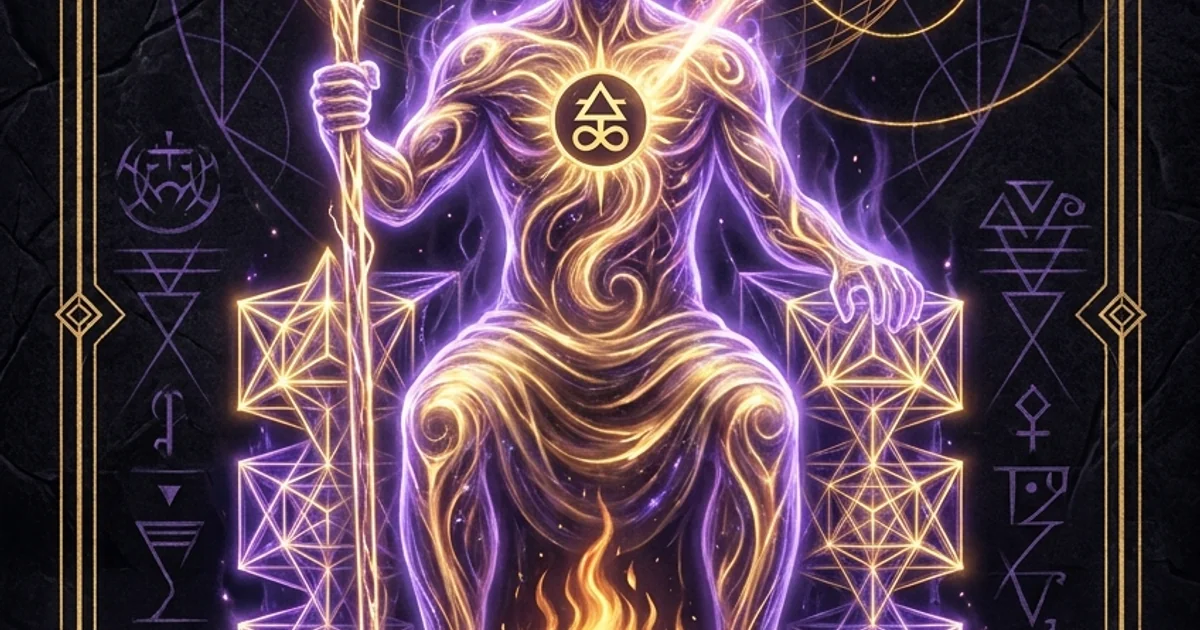
King of Wands: Master of Inspiration and Fiery Vision
Archetypal Thesis & Systemic Paradigm: The Sovereign Volition of Fire
The King of Wands represents the sovereign institutionalization of primordial Fire, translating raw teleological volition into sustained, systemic macro-manifestation. Within the psycho-cosmological taxonomy of the Western Mystery Tradition, the court cards do not denote static personalities or fatalistic human encounters. Rather, they demarcate dynamic vector-states of consciousness—stabilized energetic nodes through which the elemental forces achieve progressive refinement. Within the /tarot/minor-arcana-wands-suit, the King occupies the structural apex of the volitional continuum. Where the Ace presents the undifferentiated, unmanifest seed of energy, and the lower numbered cards map its turbulent decanic descent through trial, competition, and labor, the King embodies the total governance and systemic integration of this energetic current. He is the living engine of creative statecraft, converting psychic entropy into structured civilizing momentum.
Metaphysics of Fire of Fire: The Seminal Spark of Chokmah
In Hermetic Qabalah, the elemental attribution of the King of Wands is the “Fire of Fire”—the unmitigated, masculine-creative dynamic operating at the highest octave of formless manifestation. Situated structurally within the Sephira Chokmah (Wisdom) in the World of Atziluth (the Archetypal World of pure emanation), this archetype represents the initial, kinetic divergence from the absolute unity of Kether. Chokmah is the great Father, the Abba, the primordial Yod of the Tetragrammaton whose nature is dynamic assertion, velocity, and radiant expansion.
When Fire operates upon Fire within the Atziluthic sphere, consciousness experiences no friction, resistance, or material inertia. However, this absence of resistance carries the inherent peril of explosive dissolution. Without an architectonic container, unmitigated Fire consumes itself in an instantaneous, blinding flash. The King of Wands resolves this metaphysical paradox: he is not merely the volcanic surge of prana or creative libido, but the conscious, executive will that channels this surge toward defined civilizational and spiritual architectures. He transforms the chaotic flash of inspiration into an enduring sovereign beacon, providing the initial impulse that sets the entire machinery of manifestation into irreversible motion.
- Qabalistic Sephira: Chokmah (Wisdom / Primordial Dynamic Force)
- Four Worlds Coordinate: Atziluth (Archetypal / Emanational World)
- Tetragrammatonic Value: Yod ($\text{י}$), the Archetypal Father
- Elemental Synthesis: Fire of Fire (Dynamic Volition modulating Pure Energy)
- Astrological Sphere: The unified Fire Triplicity, primarily spanning $20^\circ$ Cancer to $20^\circ$ Leo (Golden Dawn system for the Prince/King attribution) or ruling the decanic vectors of Fixed Solar Will into Mutable Sagittarius.
Teleological Vision and Directed Psychic Libido
Interpreted through the framework of Jungian analytical psychology, the king of wands tarot meaning is best understood as the conscious integration of directed libido. Carl Gustav Jung, in his seminal investigations into psychic energetics, differentiated between undirected, associative fantasy-thinking and directed, teleological thinking. The King of Wands personifies the latter in its most concentrated manifestation. Here, the fiery instinctual drive—the raw, primitive libido that bubbles up from the somatic unconscious—is not repressed by Victorian inhibition, nor is it permitted to run rampant in infantile hedonism or manic hysteria. Instead, it is wedded to a conscious ego-ideal capable of rigorous teleological projection.
This directed libido functions as an organizing field within the psyche. When an individual engages with the archetype of the King of Wands, the diffuse, paralyzing array of potential choices is subordinated to a singular, non-negotiable teleological trajectory. The King does not query whether an ambition is difficult; he evaluates whether it aligns with the internal vector of his sovereign vision. He represents the capacity of the human mind to construct an overarching mythos for its life and to execute that mythos across time. In this sense, the King of Wands functions as the psychological bridge between the unconscious instinctual reservoir and the conscious executive apparatus, enabling the subject to bear the burning heat of their own creative potential without succumbing to psychic dissociation or neurotic inflation.
The Ouroboric Salamander: Self-Sustaining Energetic Equilibrium
A critical iconological key to understanding the King of Wands lies in the recurrent motif of the salamander, particularly the specimen depicted on his robes and beside his throne which takes its own tail into its mouth. In classical and Renaissance bestiaries—as compiled in texts such as Heinrich Cornelius Agrippa’s De Occulta Philosophia Libri Tres—the salamander was believed not merely to endure the flame, but to feed upon it and to extinguish its destructive fury through its own intrinsic, freezing coldness or supernatural harmony. In the iconographic schema of this card, the salamander curled into an ouroboros signals a state of closed-loop energetic self-sufficiency.
[ Primordial Libido ]
                 │
                 ▼
   [ Macrocosmic Volition (Atziluth) ]
                 │
                 ▼
   ┌───────────────────────────────┐
   │  The Ouroboric Salamander:    │
   │  Self-Regulating Energetic    │
   │  Containment & Equilibrium    │
   └───────────────┬───────────────┘
                   │
                   ▼
  [ Sovereign Civilizing Creation ]
This ouroboric equilibrium differentiates the mature monarch from the adolescent Knight of the same suit. While the Knight rides forth into the world, burning through psychic fuel and leaving a wake of exhaustion, the King embodies the principles of non-equilibrium thermodynamics operating within an open, dissipative structure. His internal heat is continually cycled and regulated; the passion does not exhaust the vehicle because the vehicle has been forged to metabolize that exact energetic frequency. The fire is no longer a catastrophic conflagration that burns outward until all fuel is consumed; it has become a sustained, controlled fusion reactor that powers the monarch’s entire psycho-spiritual imperium.
Classical Provenance & Textual Lineage: Historical Genesis of the Fiery Monarch
The structural morphology of the King of Wands has undergone a profound esoteric evolution over the past six centuries. Originating as a courtly portrait within late medieval card games, it was progressively re-engineered by Renaissance humanists, nineteenth-century occult revivalists, and twentieth-century depth psychologists into a multidimensional glyph of cosmic and psychological volition.
Visconti-Sforza / Marseille ────> Golden Dawn (Book T) ────> Waite-Smith Synthesis (1910)
  (Feudal Chivalric Model)     (Prince/King of Fire)      (Sovereign Architectonic Will)
Evolution of Court Iconography: From Visconti-Sforza to the Tarot de Marseille
In the fifteenth-century Visconti-Sforza and Brambilla tarot decks, the Re di Bastoni (King of Batons) is delineated through the iconography of Northern Italian feudal nobility. Clad in heavy velvets and brocades, the monarch grips a stout wooden staff—a direct emblem of secular power, military authority, and agrarian territorial dominion. In these early iterations, the batons were explicitly linked to the physical rod of office, the scepter of civil justice, and the blunt bludgeon of martial coercion. The elemental mechanics of the suit were latent, cloaked under the sociopolitical realities of the Italian Renaissance, wherein the four suits reflected the four estates of feudal society: Batons representing the peasantry or the administrative stewards who oversaw the physical estates.
With the codification of the Tarot de Marseille in seventeenth-century France, particularly through the woodblock masters Nicolas Conver and Jean Noblet, the Roi de Bâton began to acquire a more pronounced esoteric posture. The Marseille King sits enthroned in profile or three-quarter view, his gaze directed firmly toward the left (the side of the unconscious, memory, and instinctual origin), holding his rugged, uncarved cudgel resting firmly upon the ground or poised upon his knee. The Marseille imagery emphasizes the raw, mineral density of the wooden implement. It is not yet a flowering branch of divine revelation, but a heavy, organic pillar of earth-rooted strength. The card in this era symbolized masculine maturity, executive stability, and the unyielding defense of physical law and order within the material realm.
Hermetic Order of the Golden Dawn: Codification of the ‘King of the Spirits of Fire’
The crucial metamorphosis of this archetype occurred within the inner sanctuaries of the Hermetic Order of the Golden Dawn during the late 1880s. Under the editorial hand of Samuel Liddell MacGregor Mathers and William Wynn Westcott, the traditional court cards were completely dismantled and reconstituted according to the rigorous structural matrix of the Qabalistic Tree of Life and Enochian elemental tablets. In their foundational document, Book T: The Tarot, the traditional King was recalibrated. In the Golden Dawn’s precise nomenclature, the figure seated upon the throne associated with the Yod force was designated the “Prince of the Chariot of Fire,” while the mounted figure was designated the “Lord of the Flame and the Lightning: the King of the Spirits of Fire.”
“He is represented as a winged King, seated upon a Chariot of Fire, drawn by a Lion or a Salamander. He is crowned, and bears upon his breast the Sun. In his hand is the Wand of the Conjuror, surmounted by the Cone of the Pine. Beneath his chariot are leaping flames of dynamic expansion, and in his aura play the spirits of fiery transformation. He is the dynamic initiator of action, the swift, violent manifestation of divine purpose.”
This re-articulation radically transformed the card from an administrative feudal magistrate into a pure cosmic engine. Mathers severed the card from its mundane associations with earthly monarchs, aligning it instead with the violent, regenerative velocity of solar-elemental mechanics. Crowley would later inherit this operational structure in The Book of Thoth (1944), renaming the card the “Knight of Wands” to preserve the Yod-Chokmah dynamic, emphasizing: “His velocity is tremendous… He is the quintessential expression of the active, fertilizing, masculine spark, leaping forth like the thunderbolt to impregnate the passive waters of Binah.”
The Waite-Smith Iconological Synthesis: Leonine Symbolism and the Royal Regalia
When Arthur Edward Waite and artist Pamela Colman Smith published the Rider-Waite-Smith (RWS) deck in 1910, they executed a deliberate synthesis between the esoteric attributions of the Golden Dawn and the exoteric readability of the traditional Marseille framework. Waite restored the title of “King” to the seated figure, ensuring democratic accessibility while quietly packing the background and regalia with occult semiotics.
In the RWS composition, the King is depicted in full profile, seated upon a massive cubic throne of carved golden stone. Smith adorned the fabric of his radiant orange mantle and the tapestry suspended behind the throne with alternating emblems of the roaring lion and the ouroboric salamander. The crown upon his head does not follow the standard heraldic patterns of European monarchs; rather, its crest rises in acute, stylized tongues of flame, visually fusing the royal skull with the fire element itself.
The King holds an unpeeled, living staff that sprouts verdant, leafy shoots at its crown and along its nodes—a visual reference to the budding Rod of Aaron (Numbers 17:8), proving that his authority is not dead, mechanical law, but an organic, self-renewing spiritual mandate. Waite remarks in The Pictorial Key to the Tarot (1910) that the King’s nature is “generous, impassioned, noble, and authoritative,” consciously downplaying the more destructive, catastrophic dimensions of the Golden Dawn’s fiery warlord in favor of an integrated, highly moral sovereign whose consciousness has stabilized the primal instinctual flames.
Structural Mechanics & Symbolic Geometry: Astrological Decans and Qabalistic Coordinates
To master the king of wands symbolism, one must map the card across the precise celestial and esoteric coordinates codified in the Hermetic traditions. Far from being an arbitrary artistic assembly, the card’s visual geography mirrors specific mathematical and cyclical measurements of time, space, and planetary force.
Decanic Cartography: Fixed Leo to Mutable Sagittarius Transitions
In the Golden Dawn astrological schema, the Prince/King of the Fire suit presides over a designated sector of the celestial sphere spanning the third decan of Cancer through the first two decans of Leo ($20^\circ$ Cancer to $20^\circ$ Leo), while other Hermetic traditions bind the sovereign King directly to the primary axis of Fixed Leo transitioning into the philosophical velocity of Mutable Sagittarius. To understand this mapping, consult the broader doctrine of /astrology/decans-zodiacal-degrees.
When the fixed, solar radiance of Leo—governed by the heart, the central Sun, and the unchanging sovereign ego—is modulated by the exploratory, wide-angle vector of Sagittarius (governed by Jupiter), the resulting psychic dynamic is one of visionary statecraft. The fixed quality provides stability, preventing the volatile fire from burning out prematurely, while the mutable fire of Sagittarius guarantees that the sovereign vision does not ossify into rigid dogma or stagnant complacency.
The King sits at this exact astronomical intersection: he holds the center like the Sun at high noon (Leo), yet his gaze is fixed on the distant, unmapped horizon (Sagittarius), scanning the terrain for the next frontier of conquest or civilizing expansion. This decanic tension makes the King of Wands a profoundly restless monarch; his throne is not a bed of repose, but a command center from which campaigns of consciousness are directed across the macrocosm.
Semiotics of the Throne: The Lions, Salamanders, and the Flowering Staff
The symbolic geometry of the King’s immediate environment reveals the precise cybernetic mechanisms of his internal control. The throne itself is a cubic block of stone—the symbol of the physical universe, the Salt of the earth, and the fourfold structure of matter. By resting his fiery nature upon this cubic foundation, the King demonstrates that his spiritual and creative passion is thoroughly grounded in phenomenal reality.
                  ▲ Living Flowering Staff (Axis Mundi / Chokmah Spark)
                  │
┌─────────────────┴─────────────────┐
│     The King of Wands' Domain     │
├───────────────────────────────────┤
│ • Mantle: Salamanders & Lions     │  <-- Dynamic Instinctual Forces
│ • Base: Cubic Stone Throne        │  <-- Material Manifestation & Law
└───────────────────────────────────┘
The tapestries hanging behind him feature the lion and the salamander standing in alternating succession. The lion, as the terrestrial apex predator and astrological glyph of the Sun, represents the noble, conscious, heroic ego that has mastered the beast of somatic desire. The salamander, as an amphibious creature belonging to the elemental underworld, represents the primal, cold-blooded instinctual libido that can survive within the highest heat of the unconscious without burning away.
Crucially, the flowering staff held in the King’s right hand serves as an axis mundi. Held strictly in the right hand—the hand of Mercy (Chesed), active projection, and conscious giving—the wand demonstrates that creative authority remains sterile unless it is perpetually rooted in living, organic spiritual emanation. The staff is not a dead, polished scepter of gold or steel; it is wood, living and green, retaining its sap and botanical vitality. It is a conduit, channeling the supernal fire from the archetypal world of Atziluth directly down into the cubic seat of the material world.
Color Theory and Chromatic Potency: Crimson, Gold, and Solar Ray Dynamics
The chromatic palette employed within the classic iconological synthesis operates according to the strict occult mechanics of the Golden Dawn’s Queen Scale of color. The King of Wands is saturated with crimson, burnt orange, golden yellow, and flashes of emerald green at the crown of his staff:
- Crimson (Geburah / High Volition): The undergarments of the King display deep crimson, signaling the underlying presence of Martian energy (Geburah), the fierce, martial cutting-force necessary to excise hesitation and impose order upon chaotic circumstances.
- Gold and Saffron Orange (Tiphareth / Solar Radiance): His outer mantle is a brilliant, blinding saffron, the color of the solar dawn and the alchemical Citrinitas (the yellowing stage of the /archetypes/magnum-opus-alchemical-stages). This gold reflects the radiant integration of Tiphareth, the heart center, demonstrating that the monarch operates from an illuminated ego-Self axis.
- Slate Blue and Verdant Green (The Water and Earth Balances): A minor, often-overlooked detail is the faint strip of cool slate-blue lining his cape and the emerald tips of his flowering staff. These cooler hues act as chromatic stabilizers. Without the cool blue (the reflective, receptive wisdom of Binah) and the living green (the vegetative fecundity of Netzach), the blinding crimson and gold would indicate an unmitigated energetic blaze that would blind the monarch and incinerate his subjects.
Psychological Dynamics & Operational Praxis: The Integration of Executive Vision
Within the consulting room and the internal laboratory of analytical self-inquiry, the King of Wands ceases to be an external mythological figure and emerges as a specific, highly charged structural component of the human psyche: the archetype of the Creative Sovereign.
The Archetype of the Creative Sovereign in Analytical Psychology
In the Jungian paradigm, the King is the central organizing archetype of the mature masculine consciousness, standing alongside the Warrior, the Magician, and the Lover. When manifested through the /tarot/minor-arcana-wands-suit, this archetype specifically governs the execution of creative vision and moral courage. The King of Wands is the functional ego-complex that has undergone the ordeal of self-discovery and returned with an unshakeable sense of divine purpose. He is the internal sovereign who can look upon chaotic, frightening, or demoralizing circumstances and declare: “Let there be light, let there be order, and let the work proceed.”
This archetype plays a decisive role in the integration of the animus within the feminine psyche, representing the capacity for lucid, non-reactive, teleological conviction—the voice of focused authority that cuts through self-doubt and paralyzing societal conditioning. In the masculine psyche, it represents the transcendence of the puer aeternus (the eternal youth, often embodied by the Knight of Wands) into the mature, generative patriarch who builds enterprises, schools, philosophies, and communities to shelter and inspire future generations. The King of Wands does not create art or start movements for the fleeting thrill of applause; he creates because he is structurally incapable of allowing his internal vision to remain unmanifest.
Shadow Manifestations: Megalomania, Tyranny, and Psychic Burnout
When the archetype of the King of Wands is compromised—either through unconscious repression, severe ego-inflation, or structural dissociation—its psychic energy inverts, generating catastrophic shadow topologies.
The Integrated Sovereign (Luminous Monarch)
- Charismatic Authority: Inspires autonomous action in others through transparent, infectious vision.
- Dynamic Energetic Regulation: Operates as a self-sustaining dissipative structure, cycling fire without burning out.
- Moral and Creative Courage: Confronts systemic crisis with decisive, teleological clarity.
- Organic Grounding: Maintains the living connection between divine inspiration and material realization (Flowering Staff).
The Shadow Sovereign (Tyrant / Burnout)
- Narcissistic Inflation: Demands absolute subservience, viewing collaborators as mere fuel for his personal bonfire.
- Volatile Entropic Dissipation: Swings between manic, volcanic eruptions of rage and catastrophic depressive paralysis.
- Autocratic Paranoia: Crushes all dissenting viewpoints, perceiving novelty as a direct threat to his hegemony.
- Desiccated Tyranny: The living staff becomes a dead club; creative volition decays into mechanical domination.
The primary shadow manifestation is the Tyrant: an individual possessed by the untamed fire of the ego, mistaking personal whim for universal law. In this state, the individual brooks no opposition, uses others as instrumental fuel for their personal aggrandizement, and displays explosive, unpredictable rage whenever reality refuses to conform to their internal blueprints.
Conversely, the shadow can manifest as the Enervated King: a state of acute somatic and psychic burnout. In this condition, the individual has attempted to run the colossal current of the Atziluthic Fire through a fragile, ungrounded nervous system. The result is total thermodynamic collapse: chronic fatigue, cynicism, creative impotence, and a profound, paralyzing terror of taking the slightest executive risk. The fire, unable to express itself outward in creative statecraft, turns inward, consuming the somatic vessel in auto-immune exhaustion, inflammatory illness, and existential dread.
Analytical Hermeneutics: Decoupling Divinatory Fate from Synchronistic State-Space
When working with this card within a clinical or introspective divinatory framework, the practitioner must firmly reject crude, deterministic fortune-telling. To claim that the King of Wands simply signifies “a generous blond man entering your life” or “a promotion at work” is an intellectual failure that degrades the archetypal architecture of the Tarot.
Instead, the card must be conceptualized as an emergent property of a synchronistic state-space. It indicates that the querent’s psychic field has reached a critical threshold requiring the immediate activation of executive volition. The card functions as an operational diagnostic:
- Where is the sovereign authority currently situated? Has the individual outsourced their executive capacity to an external institution, an authoritarian partner, or a paralyzing societal expectation?
- What is the thermodynamic status of the psychic libido? Is the creative fire burning the individual alive through impulsive, fragmented micro-projects (Knight/Page level), or is it being funneled into a sustained, long-range institutional architecture?
- The Operational Imperative: The King of Wands demands that the subject cease deliberating, cease apologizing for their ambition, and actively assume sovereign responsibility for their life-domain. It is an injunction to step onto the cubic throne of one’s own circumstances, lift the living staff of intentionality, and govern with radiant, courageous, and uncompromising clarity.
Philosophical Synthesis & Macrocosmic Correspondence: Thelema, Cybernetics, and Creative Entropy
To fully articulate the metaphysical and scientific implications of the King of Wands, one must synthesize the esoteric philosophy of Aleister Crowley’s Thelema with modern paradigms of complexity theory and non-equilibrium thermodynamics.
[ Cosmic Super-System ]
                 │
                 ▼
 ┌────────────────────────────────┐
 │     The Thelemic Sovereign     │
 │     (True Will as Dynamic      │
 │       Universal Vector)        │
 └───────────────┬────────────────┘
                 │
                 ▼
 ┌────────────────────────────────┐
 │     Dissipative Structure      │
 │  • Imports High-Grade Energy   │
 │  • Exports Entropy External    │
 │  • Maintains Coherent Order    │
 └───────────────┬────────────────┘
                 │
                 ▼
[ Evolution of Conscious Macrocosm ]
Thelemic Volition: The True Will as Self-Regulating Vector
In the philosophical framework of Thelema, every individual possesses a True Will (Thelema)—not a transient psychological desire or reactionary craving, but the precise, mathematically coherent vector of their orbit through the cosmic order. Crowley posited that “Every man and every woman is a star.” Conflict, neurosis, and suffering arise solely when an individual deviates from their native orbital trajectory, colliding with the orbits of other stars or grinding against the cosmic fabric.
The King of Wands is the supreme visual and spiritual personification of the initiated True Will. He does not impose his will upon the universe through brute, violent exertion; rather, because his will is completely aligned with the fundamental evolutionary current of the cosmos, the universe effortlessly yields to his momentum. He demonstrates that genuine authority requires zero strain. When a master of fire speaks, the reality field shifts not because the master shouted, but because the word spoken was the exact formula demanded by the macrocosm at that precise temporal coordinate. The King’s wand is not an instrument of tyrannical suppression; it is a lightning rod that grounds the absolute necessity of the cosmic macrocosm into the micro-structure of the immediate present.
Non-Equilibrium Thermodynamics: Dissipative Structures and Psychic Energy
In the physics of Ilya Prigogine, a dissipative structure is an open system operating far from thermodynamic equilibrium that maintains a highly ordered internal state by continuously importing energy from its environment and dissipating entropy outward. Living organisms, convective cells, and complex human civilizations are prime examples of dissipative systems.
[ Energy Influx ] ───> ┌───────────────────────────┐ ───> [ Entropy Outflux ]
                         │     Dissipative System    │
                         │ (Internal Complex Order)  │
                         └───────────────────────────┘
The King of Wands is the archetypal personification of a psychological dissipative structure. Raw psychic energy—instinct, emotional turmoil, somatic drives, raw sensory inputs—is pulled into his sovereign gravitational field. Left alone in a closed system, this energy would succumb to the Second Law of Thermodynamics, degrading into maximum entropy: psychic chaos, depression, and structural decay.
The King, however, maintains internal order by transforming this high-entropy input into directed, low-entropy structural output: organizations, philosophies, works of enduring art, and cohesive cultural systems. He prevents the internal combustion of the psyche by continuously generating external coherence. He proves that the only way to master the fire element is to keep it moving through an open, generative circuit; to dam the river of fire is to invite catastrophic structural explosion.
“Fire is the archetype of libido itself—at once the most dangerous, devouring physical passion that destroys the vessel, and the spiritualizing light of human consciousness that elevates the beast into the creator. To master this fire is the supreme challenge of the hero’s journey; the sovereign must learn to sit within the furnace without becoming ash.”
The Transcendent Synthesis: Harmonizing Fire and Will in the Great Work
Ultimately, the King of Wands embodies the triumphant completion of the Alchemical Magnum Opus at the operational level. In the traditional hermetic progression, the base lead of unrefined, instinctual personality is submitted to the fires of the Calcinatio, reducing the fragmented ego to ash, before being coagulated through the philosophical waters and spiritualized into gold.
The King of Wands is the conscious artisan who has mastered this furnace. He has synthesized the apparent duality between the creator, the tool, and the creation. When he acts, there is no split between the internal motivation and the external movement; the intention and the manifestation occur simultaneously. He represents that sublime state of flow where self-consciousness disappears into the pure act of creation. In this supreme synthesis, the monarch realizes that the royal throne he occupies is not his personal possession, but the focal point through which the absolute divine will of the cosmos contemplates, commands, and continuously re-invents itself.
Frequently Asked Questions: Analytical Clarifications on the King of Wands
How Does the King of Wands Function Differently from the Knight and Queen of the Same Suit?
The court cards of the wands suit represent distinct evolutionary stages and functional roles in the metabolization of the fire element. The differences between the King, the /tarot/queen-of-wands-archetype, and the /tarot/knight-of-wands-meaning can be understood through their tetragrammatonic and dynamic profiles:
- The Knight of Wands (Vau / Air of Fire): Represents the adolescent, highly dynamic, but unstable projection of fire. The Knight is the questing adventurer, the ideological crusader, and the romantic pioneer. His focus is movement, velocity, and disruption. He is incapable of sitting upon a throne; he lacks the architectural capacity to maintain or govern what he conquers. He rides into a territory, sets it ablaze with inspiration, and immediately gallops toward the next horizon, often leaving an exhausted landscape in his wake.
- The Queen of Wands (Heh / Water of Fire): Represents the internal, receptive, and magnetic cultivation of the fire element. She is the priestess of the hearth, the master of emotional charisma, intuitive transformation, and relational magnetism. Her fire does not conquer through external decree; it draws reality toward itself through sheer radiance, personal authenticity, and deep psychic warmth. She sustains the life-force internally, nurturing creative potential in the dark until it is ready for birth.
- The King of Wands (Yod / Fire of Fire): Represents the fully integrated, structural governance of the fire element. Unlike the Knight, he is seated; his velocity has been crystallized into institutional and strategic authority. Unlike the Queen, whose primary axis is magnetic and relational, the King’s axis is teleological and executive. He takes the raw creative seed generated by the Queen and the terrain charted by the Knight, and builds upon it an enduring sovereign empire.
What Distinguishes the King of Wands from the Emperor (Major Arcana IV)?
While both cards represent the supreme masculine executive principle within the Tarot architecture, they operate upon fundamentally different elemental and structural frequencies:
The Emperor (Major Arcana IV) is governed by Aries and is structurally situated upon the Tree of Life on the path connecting Chokmah to Tiphareth. The Emperor’s authority is fundamentally architectural, legalistic, and territorial. He embodies the principle of Constitutional Structure—the establishment of fixed borders, defensive walls, statutory laws, and administrative hierarchies. The Emperor’s primary element is Mars/Aries modulating terrestrial stability; he governs through the sword of justice, institutional mandate, and imperial decree. His primary danger is ossification: the living empire hardening into a totalitarian state.
The King of Wands (Minor Arcana), by contrast, governs through Inspirational and Charismatic Teleology. He is not an administrative bureaucrat or a legal codifier; he is a visionary leader. His authority does not derive from a static secular crown or ancestral right, but from the unmistakable brilliance of his living creative fire. People follow the Emperor because he commands the legal and physical apparatus of the state; people follow the King of Wands because his vision captures their imagination, ignites their own creative libido, and reveals a compelling future that did not previously exist. The Emperor builds the city walls; the King of Wands convinces the populace to march out of the gates and colonize an uncharted continent.
How Should the King of Wands Reversed Be Diagnosed in Psychological Tarot Consultations?
In an analytical reading, diagnosing the King of Wands reversed requires moving beyond simplistic labels of “a bad boss” or “an angry man.” The practitioner must evaluate the card as a systemic bottleneck in the distribution of the client’s psychic libido. This dysfunction typically manifests along two distinct polarities:
- The Autocratic Inflation (Hyper-Active Inversion): In this diagnosis, the conscious ego has identified completely with the fiery mana of the sovereign archetype, leading to an inflation of the ego-personality. The individual becomes rigid, hyper-controlling, intolerant of any feedback, and prone to narcissistic rage. They demand absolute ideological compliance from colleagues, friends, or family members. Here, the reversed card serves as a severe clinical warning: the individual’s inner furnace is overheating, their relationships are being scorched, and an alchemical explosion (psychic crisis, professional rebellion, or interpersonal severance) is imminent unless the ego abdicates its claim to absolute supremacy.
- The Somatic and Visionary Collapse (Hypo-Active Inversion): In this diagnosis, the channel between the archetypal fire of Chokmah and the conscious executive apparatus has been severed or blocked. The individual experiences a total drought of inspiration, deep creative paralysis, and debilitating imposter syndrome. They are terrified of making an executive decision, feeling structurally incapable of bearing the responsibility of their position or life-path. This state is frequently accompanied by physiological symptoms of exhaustion, chronic fatigue, or burnout.
When diagnosing the King of Wands reversed, the operational imperative is never passive resignation. The consultation must identify where the individual’s energy is leaking, prune away entropic projects that lack true teleological value, and systematically rebuild the somatic and psychological boundaries necessary to host the sovereign fire of the creative self once again. :::