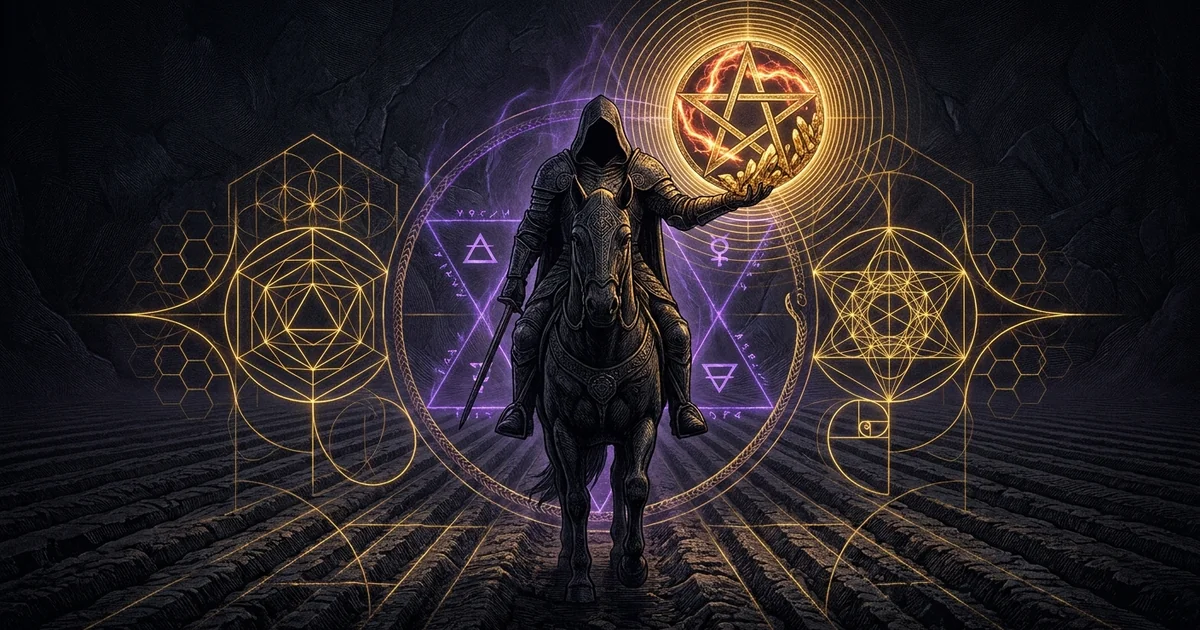
Knight of Pentacles: Enduring Diligence and Methodical Act
Archetypal Thesis & Systemic Paradigm: The Fire of Earth and Teleological Inertia
Thermodynamic Grounding: The Fire of Earth Sub-Element
Within the structural taxonomy of Hermetic Qabalah, the Knight of Pentacles represents the thermodynamic condensation of archetypal intent into dense physical actuality. Operating under the elemental permutation of the “Fire of Earth” (the Yod sub-element acting within the sphere of Heh final), this court card manifests the dynamic paradox of kinetic energy bound by material resistance. In the broader taxonomy of the /tarot/court-cards-elemental-permutations, while elemental Fire represents unmitigated expansion, plasma, and radical upward volition, its immersion within the earth element forces an ontological shift. The flame does not disperse into atmospheric dissipation; instead, it is driven downward into the subterranean matrix, functioning as geothermal pressure or the latent heat trapped within alchemical-salt (sal).
This sub-elemental mechanics dictates that the Knight of Pentacles does not seek rapid territorial conquest or conceptual revelation. Rather, it models the application of sustained, directional energy against high coefficients of physical friction. The cardinal error in exoteric interpretations of the knight of pentacles tarot meaning is the conflation of low velocity with static inertia. In classical mechanics, momentum ($p$) is the product of mass ($m$) and velocity ($v$). Where the Knight of Swords maximizes velocity at the expense of mass, the Knight of Pentacles maximizes mass, generating colossal kinetic momentum despite an imperceptibly measured velocity. The kinetic will of the Yod does not vanish; it undergoes systemic transduction into torque, sustained load-bearing capacity, and teleological endurance. It is the steady thermal current that governs the slow maturation of the seed beneath the winter frost, perfectly embodying the foundational ethos of the /tarot/suit-of-pentacles-archetypes.
The Alchemical Heavy Horse: Static Pacing vs. Impulsive Volatility
The symbolic contrast between the mount of the Knight of Pentacles and those of the preceding Knights illuminates this thermodynamic reality. The Knights of Wands, Swords, and Cups ride mounts depicted in states of radical acceleration, aerial leaping, or fluid pacing. Their steeds mirror the volatility of their respective mediums: fire consumed in rapid combustion, air driven by atmospheric pressure differentials, and water undulating in tidal surges. In stark opposition, the steed of the Knight of Pentacles is a heavy cold-blood draft horse, archetypally aligned with the Belgian draft, the Percheron, or the English Shire horse. This beast is bred not for the evanescent burst of the cavalry charge, but for the agricultural labor of deep-furrow plowing, the extraction of timber from dense woodlands, and the hauling of quarried stone.
In the iconography of the card, the horse stands motionless, its hooves planted firmly upon the dark loam of the earth. This deliberate stance signifies the mastery of metabolic and operational pacing. Where impulsive volatility consumes its fuel through rapid entropic expenditure, the Knight of Pentacles practices absolute energy conservation. Every metabolic expenditure is calibrated against its teleological yield. The horse does not bolt because it operates within a psychological continuum that recognizes the resistance of the material world as an inescapable reality rather than an obstacle to be bypassed. The knight understands that to conquer physical matter, one must submit to its fundamental constraints: gravity, density, resistance, and the relentless, non-negotiable metric of linear time.
Classical Provenance & Textual Lineage: From Renaissance Trionfi to the Golden Dawn Corpus
From Visconti-Sforza Cavalier to Mathers’ ‘Lord of the Wild and Fertile Land’
The historical evolution of this archetype reflects an epistemological migration from feudal military iconography to sophisticated occult natural philosophy. In the 15th-century Trionfi decks, such as the Visconti-Sforza, the Cavallo di Denari was depicted simply as an aristocratic youth astride an ornate courser, holding a gold coin as an emblem of dynastic wealth, mercantile power, and imperial patronage. The figure was largely interchangeable with the other cavaliers of the deck, distinguished primarily by the heraldic suit sign rather than a specialized elemental or psychological profile. The early Italian cartomantic tradition treated the figure as an external historical agent: an emissary, a wealthy suitor, a reliable merchant, or a state messenger bearing tangible assets.
The late 19th-century occult revival, driven by the Hermetic Order of the Golden Dawn, stripped the card of its purely feudal trappings and resituated it within a rigorous Qabalistic and astrological framework. In S. L. MacGregor Mathers’ 1888 treatise, The Tarot: Its Occult Signification, Use in Fortune-Telling, and Method of Play, and subsequently within the secret instructional papers of Book T, the figure was formally titled “The Lord of the Wild and Fertile Land; The King of the Spirits of Earth.”
“He represents the concentrated and stable force of the Earth, the heavy slow labor of the soil, the patient and unwearying effort that brings forth the fruit in due season. He is dark, heavy, and dull in outward semblance, yet possesses immense endurance and secret generative power. His virtue is prudence, his vice is materialist obstinacy; he rules the fertile fields as well as the untilled wastes.” — S. L. MacGregor Mathers, Book T: The Tarot of the Golden Dawn
This Golden Dawn recontextualization altered the operational scope of the figure. No longer a passive merchant or courtly rider, the Knight was elevated to an elemental sovereign—the demiurgic agency responsible for animating the mineral matrix and regulating agricultural fertility. Aleister Crowley, carrying this lineage into The Book of Thoth (1944), designated this card the “Knight of Disks” (aligning with the Golden Dawn’s original attribution of Knights to the fiery Yod force), emphasizing the card’s subterranean generative potency: “He is the generative force of Earth; he is the stag in the rut, the heavy bull… He brings about the actual physical birth of things that were conceived in the spiritual and mental spheres.”
The Pictorial Key Shift: Pamela Colman Smith’s Plowed Furrows and Fixed Steed
When Arthur Edward Waite and artist Pamela Colman Smith synthesized their seminal deck in 1909, published alongside Waite’s The Pictorial Key to the Tarot (1910), they executed a quiet iconographic revolution. Smith broke radically with the Continental pictorial traditions of the Tarot de Marseille, where the Knight was depicted in active, albeit lumbering, transit across an undifferentiated landscape. Instead, Smith arrested the figure completely.
In Smith’s rendering, the Knight sits upright, encased in plain, functional plate armor, holding an unadorned, heavy disk upon his palm. Crucially, his gaze is not directed outward toward an horizon of conquest, but inward, contemplating the pentacle with profound, monastic concentration. Beneath the hooves of his black warhorse lies freshly turned, dark-brown arable land, segmented into deep, parallel furrows. Beyond this cultivated field, the background reveals a golden, rolling pasture under a flat, unclouded sulfur-yellow sky.
This compositional shift anchors the knight of pentacles symbolism firmly in the rhythm of the agrarian cycle. The furrows signify human labor applied directly to raw nature; the wilderness has been subjected to the discipline of the plow. The stationary steed underscores that the primary task of this figure is not relocation through space, but the vigilant surveillance and continuous maintenance of a dedicated domain. By fixing the horse in place, Smith transformed the Knight of Pentacles from a transitional voyager into an embodied archetype of stewardship, vigilance, and structural method.
+-------------------------------------------------------------+
| HISTORICAL TRAJECTORY OF THE EARTH KNIGHT                   |
+-------------------------------------------------------------+
| Renaissance Trionfi  -> Aristocratic Courtier / Wealth-Sign |
| Golden Dawn (Book T) -> Elemental Demiurge / Earth Spirits  |
| Waite-Smith (1909)   -> Agrarian Steward / Disciplined Soil |
| Book of Thoth (1944) -> Chthonic Phallus / Vegetative Force |
+-------------------------------------------------------------+
Structural Mechanics & Symbolic Geometry: Astrological Decans and Qabalistic Coordinates
Decanic Span: Leo 20° to Virgo 20° and the Prudence of the Harvest
In the Hermetic astrological architecture established by the Golden Dawn, the court cards do not govern single zodiacal signs. Instead, each Knight, Queen, and Prince rules an arc of thirty degrees consisting of the final decan of one sign and the first two decans of the succeeding sign. The Knight of Pentacles is assigned the astrological sector spanning from 20° Leo to 20° Virgo. This precise astronomical coordinate captures a profound seasonal and psychological transition: the culmination of high summer’s solar sovereignty and its structural contraction into the analytical, harvest-oriented vigilance of early autumn.
- Sector: 20° Leo to 20° Virgo (inclusive of three distinct 10° decans).
- Decan I (Leo 20°–30°): Ruled by Mars (Six of Wands: Victory). Here, the raw, solar will of Leo is focused by Martian discipline into structured dominance, establishing the necessary stability to initiate physical organization.
- Decan II (Virgo 0°–10°): Ruled by the Sun (Eight of Pentacles: Prudence). The solar principle enters the mutable earth domain of Virgo. Creative vision is demoted from grandiosity to micro-craft, demanding meticulous, iterative labor and technical accuracy.
- Decan III (Virgo 10°–20°): Ruled by Venus (Nine of Pentacles: Material Gain). The structural labor of the previous decan begins to coalesce into self-sustaining physical abundance, agricultural harvest, and disciplined leisure.
By bridging the final third of Leo with the first two-thirds of Virgo, the Knight of Pentacles models the transmutation of solar ego-expression into systemic material utility. The martial heat of the final Leo decan provides the sheer caloric driving force, while the mercurial and venereal registers of the /astrology/decans-of-virgo provide the precise discriminatory faculties required to measure seed yields, schedule crop rotations, and construct granaries. The card embodies the operational intelligence that understands passion without method yields starvation; the sovereign will of the King (Leo) must inevitably be executed through the humble, calculating hands of the agricultural laborer (Virgo).
Chokmah in Assiah: The Generative Seed Anchored in the Material Matrix
Within the metaphysical map of the Qabalistic Tree of Life, the court cards correspond directly to the Four Worlds (Atziluth, Briah, Yetzirah, and Assiah) and the four letters of the Tetragrammaton ($Yod\text{-}Heh\text{-}Vau\text{-}Heh$). In the traditional Golden Dawn system, the Knights correspond to the sphere of Chokmah (Wisdom)—the primary energetic impulse, the dynamic paternal principle, and the primordial Yod of the divine name. When this Chokmah impulse is projected into Assiah, the World of Action and Material Making, a profound structural tension is generated.
Chokmah is the point of unbounded kinetic energy, the father of forms that has not yet assumed form. Assiah, conversely, is the world of dense, crystallized shells, dominated by the tenth Sephirah, Malkuth (the Kingdom). Therefore, the Knight of Pentacles represents Chokmah in Assiah: the direct descent of unconditioned generative will into the heaviest matrix of material reality.
$$\text{Knight of Pentacles} = \text{Chokmah} \xrightarrow{\text{descent}} \text{Assiah} , (Malkuth)$$
This structural placement reveals why the Knight of Pentacles is the absolute master of manifestation. He does not contemplate forms within the intellectual space of Briah, nor does he formulate astral currents within Yetzirah. He acts immediately upon the substance of Assiah. His will is expressed through direct physical interaction with the matter at hand—through the hammer, the plow, the ledger, and the muscle. The celestial Chokmah seed is buried deep within the dark womb of Malkuth, requiring the long, dark, alchemical incubation of vegetative time before its systemic geometry can be perceived by the waking mind.
Psychological Dynamics & Operational Praxis: The Archetype of Methodical Labor and Somatic Integration
Introverted Sensation (Si) and the Dissolution of Puer Inflation
In the lexicon of analytical psychology developed by Carl Gustav Jung in Psychological Types (1921), the Knight of Pentacles represents the supreme archetypal expression of the Introverted Sensation ($Si$) function, paired with auxiliary Extraverted Thinking ($Te$). Introverted Sensation does not merely perceive the objective qualities of the physical world; it registers the profound subjective, somatic, and archaic resonance of the material object within the physical body of the subject.
Jung observes that Introverted Sensation apprehends the background of the physical world—the slow, monumental, archetypal patterns of matter that have endured across evolutionary epochs. For the $Si$ type, the weight, resistance, texture, and physical reliability of an object carry an almost numinous authority. The Knight does not ask what an object might mean conceptually (an Intuitive inquiry), but what the object is, how it behaves under compressive stress, and what historical precedents govern its structural integrity.
       [ PUER AETERNUS ]                [ KNIGHT OF PENTACLES ]
   (Volatile, Inflationary)               (Rooted, Disciplined)
              │                                     │
   • Aerial, ungrounded ideation         • Somatic embodiment & craft
   • Refusal of temporal limits          • Submission to the clock & seasons
   • Terrified of mundane labor          • Sanctification of repetition
   • High velocity, zero friction        • Low velocity, immense mass
This psychological configuration makes the Knight of Pentacles the sovereign antidote to the neurosis of the puer aeternus—the eternal youth who remains suspended in a state of volatile potentiality, terrified of committing to a single craft, location, or temporal constraint. As explored extensively within the dynamics of /jungian-archetypes/puer-and-senex, the puer is chronically inflated by grand, unmanifested visions, avoiding the mundane reality of daily effort.
The Knight of Pentacles dissolves this inflation through the relentless therapy of the somatic limit. He forces the ego to submit to the reality of the body: its fatigue, its biological rhythms, and its need for iterative conditioning. By surrendering to the discipline of repetitive, unglamorous labor, the ego ceases to be an unmoored aerial spark and becomes a grounded, load-bearing pillar.
Integrated Archetype: Systemic Diligence
- Operational Reality: Absolute fidelity to material constraints and temporal sequences.
- Psychological Posture: Grounded, unhurried, somatically calibrated; immune to manic trends.
- Energetic Strategy: Minimization of entropic loss; maximum kinetic conversion of will into durable assets.
- Relational Mode: Unshakable dependability, transactional integrity, silent protective stewardship.
Shadow Degeneration: Hyper-Fixated Stagnation
- Operational Reality: Pathological inertia; substitution of endless preparation for decisive execution.
- Psychological Posture: Cynical materialism; total affective blunting; obsessive-compulsive micromanagement.
- Energetic Strategy: Complete systemic hoarding; terror of risk; energetic calcification into somatic numbness.
- Relational Mode: Utilitarian instrumentalism; viewing human relationships solely through economic metrics.
Shadow Pathologies: Inertial Paralysis, Cynical Materialism, and Obsessive Compulsion
When the equilibrium of this card fails, its elemental architecture collapses into profound pathology. The shadow of the Knight of Pentacles does not manifest as explosive destruction, but as cold, grinding calcification. In this state, the friction of the earth element completely overcomes the kinetic heat of the inner fire. The sub-elemental formula degenerates into pure, unventilated lead.
The primary manifestation of this pathology is inertial paralysis: the individual becomes so hyper-aware of the difficulties, logistical complexities, and material costs of an undertaking that the capacity for initiation is entirely snuffed out. The subject falls prey to a profound cynicism that masks itself as “realism.” Any venture that cannot be fully guaranteed by empirical precedent or financial actuarial tables is dismissed as juvenile fantasy.
This state inevitably breeds obsessive-compulsive behavioral patterns. The individual retreats into the mechanical manipulation of mundane minutiae—endlessly refining spreadsheets, organizing physical tools, or obsessing over administrative protocols—specifically to avoid the existential terror of dynamic action. The psyche becomes mechanized, transformed into a bureaucratic apparatus that views spontaneous, intuitive, or emotional impulses as hazardous contaminations that must be rigorously suppressed.
Diagnostic Protocol in Consultation: Evaluating Pacing and Energy Expenditure
In practical cartomantic consultation, the appearance of the Knight of Pentacles necessitates an immediate, rigorous diagnostic audit of the querent’s operational rhythm and metabolic allocation. The card rarely speaks to sudden changes in fortune; rather, it assesses the long-term viability of the querent’s current trajectories.
The Hermetic practitioner must systematically interrogate three operational variables:
- The Coefficient of Friction: Is the querent attempting to force a swift outcome in a matrix that inherently requires biological or bureaucratic incubation? The Knight demands that the practitioner evaluate whether the querent’s frustration stems from a systemic defect in their plan or merely an immature refusal to endure the required temporal friction.
- Kinetic Symmetry: Is the querent expending energy in chaotic, erratic bursts (the failure mode of the Knight of Wands) or through rhythmic, unyielding pacing? The Knight indicates that victory in the matter under interrogation is entirely contingent upon the establishment of unbreakable, unvarying daily protocols.
- Somatic Anchoring: Is the querent disconnected from their somatic vehicle? The appearance of this card frequently flags acute physical burnout disguised as psychological anxiety. It commands an immediate retreat into somatic maintenance: sleep optimization, mineral replenishment, direct contact with physical labor, and the conscious deceleration of cognitive processing.
Philosophical Synthesis & Macrocosmic Correspondence: Chronobiology and Cybernetic Feedback
The Law of Conservation in Hermetic Teleology
At the highest philosophical register, the Knight of Pentacles represents the esoteric doctrine of absolute conservation. In classical physics, the First Law of Thermodynamics establishes that energy can neither be created nor destroyed, only transformed from one state to another. In Hermetic teleology, a precise spiritual equivalent applies: no authentic spiritual realization or material manifestation can occur without an exact energetic payment. The universe does not offer discounts to spiritual initiates.
RAW COSMIC VOLITION (Fire)
                  │
                  ▼
   [ ENTROPIC LOSS ] ---> [ Chaotic Action ] (Inefficient Transduction)
                  │
                  ▼
[ KNIGHT OF PENTACLES ] -> Minimal Entropic Dissipation via Methodical Form
                  │
                  ▼
    SUSTAINABLE MANIFESTATION (Earth)
The Knight of Pentacles is the master of this law. He understands that every act of manifestation requires a deliberate transaction with the medium of space-time. The romantic occultist dreams of instantaneous transmutation—evoking spirits to bridge the gap between desire and reality through sheer will. The Knight of Pentacles represents the higher, more terrifying realization of the adept: that the most potent magical circle is the daily discipline of the workshop, and the most supreme talisman is the habitual alignment of the physical body with the divine will. He minimizes entropic dissipation by constructing closed cybernetic feedback loops. Every unit of energy expended in labor is designed to return as a structural foundation for the next iteration of work, creating an expanding, self-reinforcing engine of physical manifestation.
Morphogenetic Habits: Repetition as Consciousness Architecture
The repeated act, far from being a mind-numbing symptom of industrial subjugation, functions in this archetype as a premier technology of consciousness transformation. In modern developmental biology and cognitive science, the formation of biological structures and neural pathways relies upon the continuous, iterative signaling of morphogenetic fields and synaptic repetition. Habits literally construct the physical brain; they etch grooves into the neurobiological substrate through which consciousness flows with progressively decreasing resistance.
“The only cure for the puer aeternus is work. But it must be real work, not an intellectual hobby or an escape into imaginative games. It must be routine, daily, mundane work that involves the hands, the physical body, and the acceptance of boredom. The puer must learn to endure the grayness of life, for it is precisely within that grayness that the true alchemical gold is slowly generated.” — Marie-Louise von Franz, The Problem of the Puer Aeternus (1970)
When the adept assumes the mantle of the Knight of Pentacles, they engage in repetition not as an automaton, but as an alchemical operative. The rhythmic stroke of the scythe, the daily entry of transactions, the cyclic lifting of stone, and the unvarying rhythm of breathing in pranayama are all expressions of the same metaphysical principle: the crystallization of volatile consciousness into permanent, load-bearing spiritual architectures.
By sanctifying the mundane routine, the Knight of Pentacles bridges the cosmic rift between heaven and earth. He proves that the divine does not merely dwell within the transrational lightning flashes of Kether, but is equally, fully, and permanently anchored in the quiet, methodical turning of the dark earth in Malkuth.
Frequently Asked Questions: Advanced Hermetic Inquiries
Resolving Golden Dawn Knight vs. Waite-Smith Court Nomenclature
A point of perpetual confusion among serious practitioners is the structural divergence in court card nomenclature between the historic Hermetic Order of the Golden Dawn, Aleister Crowley’s The Book of Thoth, and the popularized Waite-Smith deck. To analyze this card accurately within comparative Hermetic frameworks, one must decode these taxonomic shifts.
In the original Golden Dawn systemic assignment (preserved strictly by Crowley):
- The Knight is the Yod force (Fiery, dynamic, mounted on a galloping horse, corresponding to Chokmah).
- The Queen is the Heh force (Watery, receptive, enthroned, corresponding to Binah).
- The Prince is the Vau force (Airy, intellectual, mounted in a chariot, corresponding to Tiphareth).
- The Princess is the Heh final force (Earthy, stabilizing, standing, corresponding to Malkuth).
Arthur Edward Waite, in designing the Rider-Waite-Smith deck for a broader public audience, deliberately retained the traditional French/English chivalric nomenclature: King, Queen, Knight, and Page. In doing so:
- Waite’s King inherited the seated, structural position that Crowley assigned to the Prince (Vau / Tiphareth), yet conflated it visually with the elder father figure.
- Waite’s Knight remained the mounted horseman, conceptually retaining the Yod / Chokmah kinetic impulse, but visually executing the grounded, transitional labor attributed to the Golden Dawn Prince of Earth.
Consequently, while the Waite-Smith Knight of Pentacles displays the steady, deliberate stillness of the Prince of Earth (the airy/rational part of earth governing seasonal transitions), his underlying Qabalistic engine within pure Hermetic analysis remains the primordial Fire of Earth (Yod in Assiah). When cross-referencing systems, the student must recognize that Crowley’s Knight of Disks and Waite’s Knight of Pentacles describe the exact same cosmic node—the generative will driving down through the subterranean loam—despite the radical divergence in their surface-level equine choreography.
Distinguishing Knight of Pentacles Inertia from Major Arcana Stasis (The Hanged Man)
It is crucial for the cartomantic cartographer to clearly delineate between the apparent stillness of the Knight of Pentacles and the programmatic suspension seen in Key XII, The Hanged Man. While both archetypes involve a suspension of linear, forward-rushing momentum, their ontological origins, elemental fields, and mechanical outputs are profoundly distinct.
The Hanged Man operates under the elemental dominion of Water (Mem). His stasis is an inverted, mystical surrender—a voluntary self-sacrifice wherein the ego actively suspends volition to achieve a cognitive reversal of perspective. In Key XII, the stillness is absolute and vertical: the individual is suspended between heaven and earth, disconnected from physical agency, undergoing an internal baptism of the astral matrix. It is an intentional, contemplative cessation of all material doing.
The Knight of Pentacles, by contrast, operates under the elemental dominion of Earth (Heh final). His stillness is not a mystical surrender, but a mechanical pause for operational recalibration. He does not invert himself; his boots are firmly anchored in the terrestrial mud. Furthermore, the Knight’s stasis is purely horizontal and metabolic. He pauses not because he has renounced action, but because he is waiting for the precise, correct chronobiological moment to strike the furrow. The Hanged Man seeks spiritual redemption through the death of the personal will; the Knight of Pentacles seeks systemic manifestation through the rigorous, patient conditioning of that will to harmonize with natural law.
+-------------------------------------------------------------+
| DISTINCTION OF OPERATIONAL SUSPENSION                       |
+-------------------------------------------------------------+
| The Hanged Man (Key XII)   | Knight of Pentacles            |
|----------------------------+--------------------------------|
| Elemental Water (Mem)      | Elemental Earth (Heh Final)    |
| Inverted / Mystical Axis   | Grounded / Horizontal Axis     |
| Renunciation of agency     | Conservation of kinetic torque |
| Transpersonal epiphany     | Teleological manifestation     |
+-------------------------------------------------------------+
Remediating Blocked Pentacle Flow Through Somatic Ritual
When the diagnostic audit reveals that a querent is caught within the severe shadow polarity of the Knight of Pentacles—manifested as chronic procrastination, logistical dread, somatic ossification, or cynical burnout—intellectual analysis alone is completely impotent. The earth element does not respond to verbal persuasion or mental insights; it responds exclusively to tangible, physical, and somatic interventions.
To remediate blocked pentacle flow, the practitioner must execute a sequence of grounding protocols designed to introduce dynamic heat (Yod) directly into the calcified material matrix (Assiah):
- The Protocol of Intentional Friction: The subject must abandon theoretical planning and identify the single most avoided, low-level physical task within their immediate operational environment. This task must be engaged with rigorous, non-verbal somatic presence. Cleaning the workspace, organizing raw tools, or transcribing physical ledgers must be treated as an operative alchemical rite. The metric of success is not conceptual satisfaction, but the generation of bodily heat through sustained, methodical labor.
- Chronobiological Realignment: The subject must immediately restore biological symmetry. This requires fixing the temporal coordinates of their baseline somatic functions: waking, eating, strength training, and sleep must be scheduled at unvarying, non-negotiable points within the circadian cycle. This re-establishes the rhythmic, cybernetic feedback loops that allow the nervous system to feel structurally supported rather than existentially destabilized.
- Weight and Resistance Therapy: The psyche must be re-anchored into somatic limits through direct physical resistance. This may involve rigorous, heavy compound movement (deadlifting, weighted carrying), deep tissue physical therapy, or barefoot contact with untilled, unpaved terrain. By submitting the muscular and skeletal system to external compressive forces, the inflated, fragmented cognitive faculties are forced to collapse back into the biological present, liberating the latent kinetic energy of the Knight to resume its slow, monumental march toward manifestation.