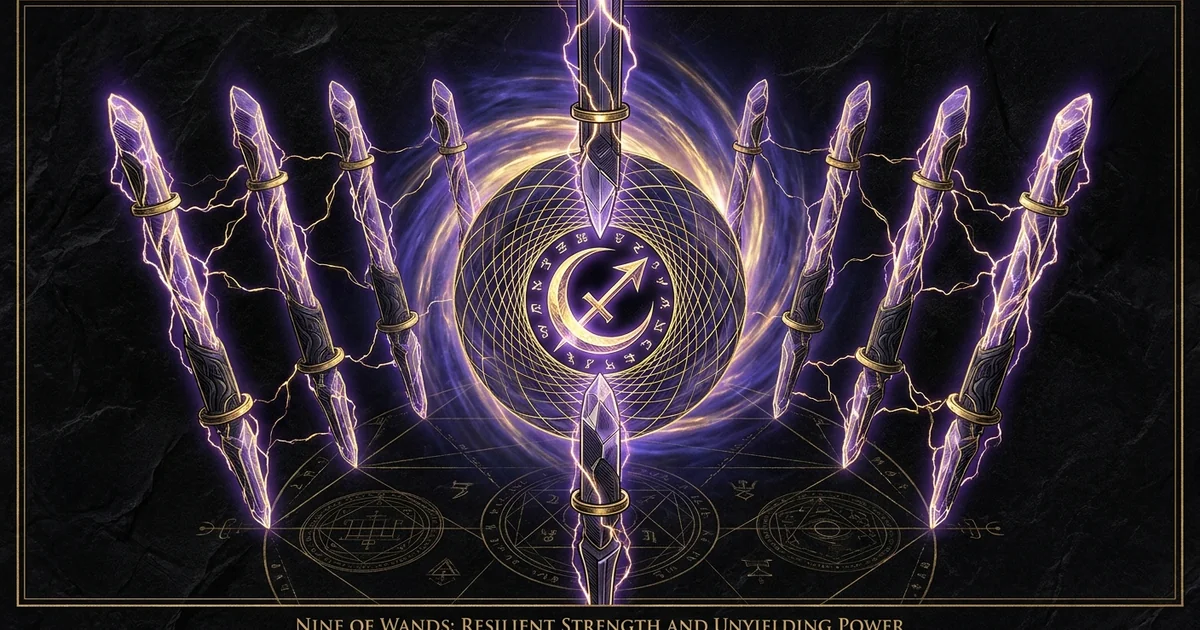
Nine of Wands: Resilient Strength and Unyielding Power
Archetypal Thesis & Systemic Paradigm: The Architecture of Sustained Volition
The Dynamic Entropy of the Fire Element at the Boundary Layer
The nine of wands tarot meaning cannot be comprehended through the reductive lens of passive depletion or mere psychological exhaustion. Rather, it represents the terminal, highly pressurized thermodynamic threshold of the fire element as it encounters spatial containment. In metaphysical mechanics, fire is inherently expansive, radiantly entropying outward from its point of ignition in an unceasing quest to consume and transmute adjacent fuel. When this dynamic kinetic current descends toward the end of its suit’s numerical sequence, it collides with systemic boundary layers. It is precisely at this juncture that the pure, unconditioned will must evolve from an open-loop dispersal of force into a closed-loop homeostat.
Within this systemic paradigm, the Nine of Wands models the precise moment the psycho-spiritual organism detects ambient entropy threatening to destabilize its core orientation. It is an operational threshold where energy is conserved not through absolute cessation of motion, but through a dialectic of continuous resistance. The archetypal sentinel does not rest; he absorbs dynamic shockwaves and converts incoming destabilizing forces into architectural tension. The fire is no longer wild conflagration; it has become concentrated, radiant plasma restricted to a defensive perimeter. The system must perpetually regenerate its own structural coherence against an environment actively attempting to dissolve it back into chaos.
Consequently, this card maps the cybernetics of spiritual resistance. When consciousness engages in sustained creative or spiritual work, the initial propulsion eventually meets the dragging friction of manifested reality. The Nine of Wands represents the intentional stabilization of this friction. It constitutes the spiritual nervous system’s capacity to recognize systemic fatigue not as a signal to capitulate, but as an energetic parameter indicating that the outer defenses have successfully localized the conflict to the boundary zone, keeping the inner sanctuary intact.
Suit: Wands (Atziluth / Primordial Volition)
Sephira: Yesod (Foundation / The Receptive Matrix of Form)
Element: Fire of Air within the Formative Tree
Formula: Yod-Heh-Vau-Heh applied to the energetic crystallization of the Will prior to material precipitation in Malkuth.
Yesod in Atziluth: The Crystallization of Will into Structural Defense
To trace the formal anatomy of this state, one must map its coordinates upon the Tree of Life. The Nine of Wands corresponds to the Sephira Yesod operating within the world of Atziluth, the archetypal realm of Pure Emanation and Divine Will. In classical Qabalah, Yesod functions as the generative foundation, the astral receptacle, and the clearinghouse through which all upstream emanations must condense before solidifying into the physical matrix of Malkuth. When the unbridled, transcendent masculine fire that erupted from Chokmah reaches Yesod, it enters the sphere of the lunar, the reflective, and the structural apparatus of memory and habit.
Yesod in Atziluth is an inherently paradoxical attribution. Atziluth is frictionless, primordial intention; Yesod is an integrative, formatting node characterized by cyclic tension and magnetic containment. Thus, the fiery current of Atziluth, arriving at the base of the Pillar of Equilibrium, is forced to assume an architectural scaffolding. The kinetic drive ceases to colonize new territory; instead, it crystallizes into defensive infrastructure. The raw divine volition undergoes structural condensation, becoming the armor of the soul.
This Sephiric positioning demonstrates that the defensive perimeter depicted in the card is not an accidental fortification, but the inevitable metaphysical consequence of the will attempting to manifest without dissolving. In this foundational layer, the energy forms a protective torus. Yesod acts as a psychological and energetic buffer that preserves the integrity of the Atziluthic impulse against the downward gravitational pull of gross matter. Without the Yesodic consolidation of the Nine, the transformative fire of the Wands would scatter into fragmented, impotent sparks upon entering the physical sphere.
The Threshold Guard: Transmuting Fatigue into Vigilant Self-Correction
At the human interface, this structural geometry translates into the archetypal threshold guard. The human psyche, undergoing the strenuous crucible of individuation, arrives repeatedly at this coordinate: the place where previous encounters with trauma, opposition, or energetic drain have inscribed deep defensive reflexes into the ego-complex. This is the posture of the wounded warrior. The wound itself is not an indictment of failure; it is the physical and phenomenological proof of prior survivals, serving as the sensory organ through which the environment is continually scanned for asymmetrical threats.
Fatigue, within this framework, undergoes an essential transmutation. In naive psychology, exhaustion is viewed merely as an energy deficit requiring inert collapse. In the esoteric discipline of the sentinel, however, fatigue is recalibrated into acute vigilance. The psychic sensorium, stripped of the luxury of surplus energy, discards every superficial distraction. Only the essential parameters of survival and structural equilibrium are retained. The ego operates with hyper-economic precision, maintaining the threshold between the internal sanctum of emergent consciousness and the hostile projections of the external unconscious.
This vigil establishes an autonomous self-correcting loop. Each external pressure that pushes against the boundary is met with an equal and opposite distribution of skeletal tension. The warrior leans upon the ninth wand, using the weapon itself as a structural crutch and an instrument of measurement. The card demonstrates that resilience is not the absence of suffering or the naive expectation of peace; it is the ontological capacity of the sovereign self to stand unyielding at the border of its own perimeter, maintaining tactical readiness even when the physical vessel is pushed to its absolute threshold of endurance.
Classical Provenance & Textual Lineage: From Medieval Emblems to Hermetic Synthesis
The Sola Busca and Mantegna Precedents of Fortitude and Containment
The iconographic lineage of fortified endurance can be traced historically through the evolution of early European emblem traditions and proto-Tarot design. In the fifteenth-century Sola Busca Tarot—the earliest known complete seventy-eight card deck with fully illustrated minor arcana—the suit of Batons (Wands) frequently diverges from naive agricultural or chivalric tropes to encode complex martial and alchemical dramas. The ninth card of this suit illustrates human figures embedded within geometries of interlocked wood, evocative of field palisades and military Roman vallum systems. These early Renaissance engravings drew heavily on classical Roman virtues, specifically Constantia (steadfastness) and Fortitudo (moral and physical strength in the face of siege).
[ Classical Fortitudo ]
         │
         ▼
[ Sola Busca (Palisades) ]
         │
         ▼
[ Mathers / Golden Dawn ("Lord of Great Strength") ]
         │
         ▼
[ Waite-Smith (Wounded Sentinel) ] ─── [ Crowley (Central Caduceus-Wand) ]
Similarly, the Mantegna prints, while not a conventional Tarot deck, established the prevailing cosmological hierarchy that early Italian card-makers utilized. Within these prints, the depictions of martial discipline emphasize not the frenzied kinetic assault associated with Mars, but the Saturnian containment of Martian impulse. The emblem of the armed guard standing before a gate or retaining a precarious post serves as a direct ancestor to the modern Nine of Wands. The weapon in these early emblems is consistently held in a grounded, vertical or semi-vertical orientation, signaling that its primary tactical function is no longer offensive conquest, but spatial interdiction and the demarcation of sacred or sovereign territory.
The Hermetic Order of the Golden Dawn and the Lord of Great Strength
The definitive operational synthesis of these historical currents was executed in late nineteenth-century England by the Hermetic Order of the Golden Dawn. In their foundational instructional text, Book T, the Nine of Wands is stripped of its merely folkloric interpretations and systematically invested with Qabalistic and astrological rigor under the title “The Lord of Great Strength.” S. L. MacGregor Mathers, in his 1888 treatise The Tarot: Its Occult Signification, Use in Fortune-Telling, and Method of Play, began the systematic codification of the suit of Wands as correlating directly to the element of Fire and pure spiritual force.
“The Lord of Great Strength… attributed to the Moon in Sagittarius. It is the influence of Yesod in the sphere of Atziluth… dynamic energy brought to its utmost limit of stability, verging upon change, yet stubbornly maintaining its station.” — Aleister Crowley, The Book of Thoth (1944)
The Golden Dawn’s cryptographic manuscripts situated the card precisely within the second decan of Sagittarius, ruled astrologically by the Moon. By synthesizing the Sephira Yesod with the Atziluthic Fire and Lunar-Sagittarian dynamics, Mathers and his circle redefined the card’s nature. It was no longer understood as simple physical stubbornness, but as the cosmic and psychological reality of “Great Strength”—a strength forged entirely through the stabilization of dynamic tensions. The Golden Dawn recognized that true strength does not reveal itself during frictionless ascent; it is realized only when the system is subjected to severe counter-forces that demand absolute fidelity to the foundational intent.
Waite, Smith, and Crowley: Divergent Visions of the Besieged Sentinel
When Arthur Edward Waite and Pamela Colman Smith published their deck in 1909, they translated the esoteric cyphers of the Golden Dawn into a stark, visceral tableau that fundamentally altered subsequent occult cartography. Smith’s rendering of the nine of wands symbolism introduces the iconic figure of the solitary sentinel: a bandaged soldier, clutching an upright staff, his gaze cast suspicious and alert over his right shoulder toward an unseen approach. Behind him stands an orderly, impenetrable stockade of eight wands driven firmly into the earth.
The bandaged brow serves as a profound psychological cipher. It communicates that the subject has engaged in direct combat, sustained real structural damage, and survived. The eight wands behind him are uniform, rhythmic, and rooted; they represent the successful psychic consolidations of the past—specifically the swift directional alignment of the Eight of Wands now anchored into fixed barricades. The ninth wand, held firmly in the hands of the defender, is differentiated: it is mobile, conscious, and ready to act as a reactive vector.
In radical contrast, Aleister Crowley, collaborating with Lady Frieda Harris in the creation of The Book of Thoth (1944), eliminated the anthropomorphic soldier entirely, returning to an austere geometric and alchemical representation. Crowley retained the title “Strength,” but expressed the card’s internal friction through an architecture of eight crossed, stylized wands forming an intricate lattice, balanced and dominated by a massive, central wand surmounted by the Sun and the Moon.
Crowley explicitly rejected the sentimentality of the wounded soldier, framing the card instead as a dynamic scientific problem of thermodynamic equilibrium:
“This card represents the dynamic energy of Fire brought to its utmost limit of stability… verging upon change, yet stubbornly maintaining its station through the harmonization of the Solar and Lunar currents.”
Crowley emphasized that the stability of the Nine of Wands is precarious. Because it resides in the sphere of Yesod—which is naturally fluid and prone to shift—the maintenance of strength requires an unyielding, continuous application of internal will to prevent the structure from collapsing into the inertia of the physical world.
Structural Mechanics & Symbolic Geometry: Astrological and Qabalistic Coordinates
Planetary Mechanics: The Moon in the Second Decan of Sagittarius
The celestial engine driving the Nine of Wands is the Moon in the second decan of Sagittarius, spanning from 10° to 20° of the sign of the Archer. In classical astrology, as codified by Heinrich Cornelius Agrippa in his 1533 masterpiece Three Books of Occult Philosophy (De Occulta Philosophia libri tres), each decan possesses a distinct daemonic and energetic signature. The second decan of Sagittarius is characterized by Agrippa as a face depicting fear, lamentation, and acute defensiveness, but simultaneously one that confers an uncanny mastery over untamed forces and wild beasts.
┌─────────────────────────────────────────────────────────────┐
│               DECANIC POLARITY SPECTRUM                     │
├──────────────────────────────┬──────────────────────────────┤
│  LUNAR MATRIX (Fluctuation)  │ SAGITTARIAN VECTOR (Telos)   │
├──────────────────────────────┼──────────────────────────────┤
│  Instinctual defensive reflex│ Expansive, visionary reach   │
│  Somatic memory of trauma    │ Transcendent philosophical aim│
│  Cyclic conservation of energy│ Constant forward trajectory  │
└──────────────────────────────┴──────────────────────────────┘
The synthesis of the Moon and Sagittarius produces a complex structural tension. The Moon is the luminary of instinct, somatic memory, systemic fluctuations, and the deep, irrational desire for psychological safety and protection. Sagittarius, conversely, is a mutable fire sign governed by Jupiter—expansive, heroic, philosophically driven, and inherently compelled toward long-range horizons and uncontained exploration. When the receptive, protective Moon is submerged into the mutable, combustible currents of Sagittarius, the archetype of the spiritual seeker is forced into the role of the fortress guard.
The visionary quest of Sagittarius is suddenly subjected to the cyclical anxieties and survival imperatives of the Moon. This is not a comfortable placement; the Archer wants to loose the arrow toward the infinite, but the Moon demands that the home base, the encampment, and the body be guarded at all costs. Consequently, the visionary drive is deployed as a long-range defensive radar. The mind anticipates future threats long before they materialize, transforming the broad philosophical vision of Sagittarius into a tactical threat-assessment apparatus.
The Decan of Endurance: Thermal Dissipation Meets Lunar Flux
This specific decan represents the critical transition zone between the pure enthusiasm of initial expansion and the crushing realization of systemic limits. As the middle decan of a mutable sign, it bears the burden of holding a course while the season prepares to die into the winter solstice of Capricorn. Thermodynamically, the heat generated by the early fires of Sagittarius begins to dissipate into the cold atmosphere of late autumn.
The Moon’s governance over this decan infuses the waning fire with moisture and cold reflection, producing a dense energetic steam. The rapid, unreflective speed of the Eight of Wands (governed by Mercury in Sagittarius) here grinds to an abrupt halt. The system can no longer sprint; it must entrench. The lunar influence brings the awareness of physical vulnerability, finite biological reserves, and psychological scarring into the pristine, theoretical ambition of the fire element.
Furthermore, this decanic mechanics explains the profound psychological feeling of waiting that saturates the Nine of Wands. The Moon rules the tides, cyclical return, and gestation. In the second decan of Sagittarius, the individual discovers that victory is not achieved through a single, heroic charge, but through the grueling, unglamorous capacity to outlast the siege. Endurance becomes an active esoteric technology: the art of remaining stationary and intact while the shifting external tides of circumstance spend their fury against the defensive perimeter.
Vector Analysis of the Palisade: 8+1 Defensive Geometry
The structural geometry of the card, particularly in the traditional RWS paradigm, operates upon an asymmetrical “8+1” vector topology. The visual and spatial arrangement of the nine rods is not arbitrary; it encodes a profound Qabalistic and structural truth regarding the relationship between stabilized past experiences and present active awareness.
The eight wands arranged in the background function as an externalized, architectural lattice. These eight poles represent the work that has already been accomplished, the battles that have been fought, and the commitments that have been fixed into the psychic terrain. In Qabalah, the number eight corresponds to Hod (Intellect, Structure, and Boundaries). These wands have been driven directly into the earth; they are static, vertical, and immovable. They form an artificial horizon, a deliberate barrier constructed to separate the internal territory of the self from the external domain of chaos.
The ninth wand, held in the hands of the central figure, represents Yesod: the unifying foundation and the active ego-consciousness. This wand is held diagonally or dynamically vertical, detached from the static soil. It is an active vector, possessed of mobility, responsiveness, and tactical flexibility. The geometry demonstrates that an effective defense cannot rely solely on static walls. A fortress without an intelligent, observant sentinel is simply a tomb waiting to be breached. The eight wands provide the defensive shelter, but the singular ninth wand provides the decisive agency. It is the focal point where the will remains awake, translating the structural protection of the past into the immediate survival of the present.
Psychological Dynamics & Operational Praxis: The Anatomy of Hyper-Vigilance and Resilience
Trauma Encodings and the Neurobiology of the Defensive Complex
When viewed through the lens of modern archetypal and analytical psychology, the Nine of Wands serves as the primary diagnostic mapping of the trauma-hardened ego-complex. Carl Gustav Jung, writing in The Structure and Dynamics of the Psyche (Collected Works, Vol. 8), demonstrated that complexes are autonomous fragments of the psyche that coalesce around an archetypal core, frequently galvanized by experiences of psychic wounding:
“The complex has a sort of body, a certain amount of its own physiology… It possesses a high degree of autonomy, it will submit to no conscious direction, and it behaves like an animated foreign body in the sphere of consciousness.”
The sentinel depicted in the Nine of Wands is the visual embodiment of this traumatized complex assuming conscious governance over the psychic field. The bandaged head denotes neurobiological and somatic encoding of past conflicts. The nervous system of the subject is locked into a state of chronic sympathetic activation. The amygdala continually scans the horizon for micro-signals of threat; the defensive reflexes are primed for immediate, defensive retaliation or bracing.
This psychological posture represents an essential developmental stage in the individuation process. Before the ego can surrender its autonomy to the transcendent Self, it must first establish that it has the sovereign capacity to exist, protect its boundaries, and withstand the disintegrating intrusions of both the personal unconscious and the collective shadow. The wound is held with honor; it is no longer an open, bleeding site of victimhood, but a cicatrix—scar tissue that has regenerated with greater tensile strength than the uninjured flesh it replaced.
“The defensive structures of the personality, erected to preserve the integrity of the nascent self, inevitably turn into prisons if the psyche fails to recognize that the historical threat has subsided. The sentinel becomes the captive of his own fortress.” — Marie-Louise von Franz, On Divination and Synchronicity: The Psychology of Meaningful Chance (1980)
Operational Praxis in Divinatory Diagnosis: Active Fortification vs. Paranoia
In the clinical and diagnostic application of the Tarot as a state-space mapping system, the appearance of the Nine of Wands demands an immediate, critical differentiation between necessary energetic fortification and pathological paranoia. The divination practitioner must determine whether the querent’s current stance of resistance corresponds to an active, incoming environmental threat or if it represents an obsolete defensive posture operating upon historical inertia.
If the structural mechanics indicate genuine external pressure—such as systemic professional conflict, spiritual crisis, or psychological boundary violations—the Nine of Wands functions as an operational mandate: Hold the perimeter. In this state, the querent must not seek reconciliation, compromise, or expansion. The energy must be rigorously conserved. The advice is to lean upon the accumulated strength of previous victories (the eight rooted wands), maintain absolute sobriety of mind, and refuse to abandon the sovereign station, regardless of how overwhelming the subjective sensation of fatigue may be.
       DIAGNOSTIC VECTOR CRITERIA

[ Real Environmental Pressure ] ──► ACTION: Reinforce Boundaries
                                           Conserve Resources
                                           Stand Firm

[ Obsolete Historical Complex ] ──► ACTION: Dismantle Scaffolding
                                           De-escalate Hyper-Vigilance
                                           Discharge Defensive Armor
Conversely, if the diagnostic context indicates that the threat has long passed, the Nine of Wands flags an acute pathology: the sentinel has become trapped within his own fortress. The ego is caught in an anticipatory anxiety loop, treating every approaching figure as an invading enemy. In this condition, the defensive structures that were originally constructed to ensure survival have ossified into a psychic prison that prevents intimacy, creative vulnerability, and fresh spiritual inputs. The individual’s life force is entirely consumed by the logistical maintenance of their own defenses.
The Alchemy of Fatigue: Conserving Prana at Systemic Limits
The esoteric technology embedded within the Nine of Wands offers a precise operational methodology for navigating chronic burnout and energetic depletion. When the physical, emotional, and mental bodies are pushed to their ultimate limit, the standard methodologies of action become obsolete. The individual cannot simply “push through” using brute force; attempting to deploy martial, offensive energy when the reserve tanks are dry results in catastrophic collapse into the Ten of Wands.
Instead, the Nine of Wands dictates the transmutation of action into posture. This is the alchemical conservation of prana (the life-force). When a warrior is too exhausted to swing the sword, he sets the butt of the spear into the earth and braces his weight against it. The skeletal structure carries the load that the musculature can no longer sustain.
In operative psychological praxis, this translates to the establishment of non-negotiable boundaries, ruthless minimization of commitments, and the strategic deployment of active-imagination. Through active imagination, the subject consciously confronts the figures of their defensive complexes, validating their historic protective functions while realigning their energy toward internal conservation. The subject ceases all unnecessary psychological expenditure. They do not attack the shadows; they do not launch preemptive strikes; they do not argue with detractors. They simply maintain their station, immobile, impenetrable, and immovable, until the atmospheric pressure shifts.
Philosophical Synthesis & Macrocosmic Correspondence: Hermetic Equilibrium at the Brink
The Law of Polarity: The Tension Between Will and Resistance
The Nine of Wands serves as the supreme symbolic manifestation of the Hermetic Principle of Polarity as expounded in the classical traditions. This universal law establishes that everything is dual, everything has poles, and opposites are identical in nature, differing only in degree. In the realm of the human spirit, volition (Will) cannot exist in a vacuum; it requires a corresponding field of resistance to realize its own reality and power.
Without resistance, the will remains a theoretical, untested potential—a phantom fire that consumes nothing and illuminates nothing. The Nine of Wands marks the coordinates where the Will achieves self-awareness through its encounter with total resistance. The hostile environment, the fatigue of the vessel, the scars of historical combat, and the encroaching shadows are not external anomalies disrupting the spiritual path; they are the necessary friction without which the fire cannot hold form.
True spiritual strength is therefore redefined not as the unilateral capacity to dominate or conquer an external domain, but as the capacity to achieve absolute equilibrium under extreme pressure. It is the steady-state dynamic tension where the incoming compressive force of the cosmos is matched precisely by the expansive, radiant push of the awakened soul. The warrior does not triumph by destroying the enemy; he triumphs by remaining entirely himself, fully intact, when the siege has exhausted its fury.
The Transition from Nine to Ten: Entropy and the Inevitable Collapse into Malkuth
Within the structural logic of the decimal number system and the Tree of Life, the number Nine represents the final dynamic outpost of the ideal world before it crashes into physical density. Nine is the completion of the cycle of potentiality. Yesod is the clearinghouse; it is the final station where the energy retains its spiritual identity. The step from the Nine to the Ten is the most dangerous transition in the entire esoteric schema.
Nine of Wands (Yesod in Fire)
- Maintained equilibrium through conscious boundaries
- Strategic pacing; the will preserves tactical autonomy
- Moon in Sagittarius: Agile anticipation of threat
- Protective perimeter intact
- Energy concentrated at a singular, resilient point
Ten of Wands (Malkuth in Fire)
- Systemic collapse under unmediated external weight
- Complete exhaustion; will subjugated to physical load
- Saturn in Sagittarius: Blind mechanical labor
- Perimeter crushed beneath excessive commitments
- Energy hopelessly dispersed across too many vectors
In the Ten of Wands (Malkuth in Atziluth, governed by Saturn in Sagittarius), the fire element suffers total entrapment in matter. The conscious sentinel of the Nine degenerates into the blind beast of burden of the Ten, staggering under a load of ten unorganized, crushing wands, unable to see the horizon ahead. The Nine of Wands is the absolute boundary that prevents this catastrophic descent.
The Nine represents the final state where individual volition still preserves its tactical agency. In the Nine, the wands are still organized into a coherent wall, and one wand is held in hand as a tool of sovereignty. In the Ten, the wands have become an undifferentiated bundle of excessive duties, commitments, and dead weight that crushes the spine of the carrier. The Nine of Wands whispers an urgent esoteric warning: Hold the boundary here, at the level of conscious foundation, or your fire will be utterly extinguished beneath the dead matter of the tenth sphere.
Cross-Systemic Parallels: I Ching Hexagram 52 (Ken / Keeping Still)
This precise archetypal dynamic finds an exact, rigorous functional parallel in the ancient Chinese divination science of the I Ching (Book of Changes), specifically in Hexagram 52: 艮 (Kên / Keeping Still, Mountain).
   HEXAGRAM 52: KÊN (KEEPING STILL)

   ───  Upper Nuclear: Mountain (Stillness)
   ─ ─
   ─ ─
   ───  Lower Nuclear: Mountain (Stillness)
   ─ ─
   ─ ─
Hexagram Kên consists of the trigram for Mountain doubled, signifying the ultimate stabilization of dynamic energy. The Wilhelm-Baynes translation of the commentary on the Decision states:
“When it is time to stop, then stop. When it is time to advance, then advance. Thus the movement and rest do not miss the right time, and their path becomes bright and clear. Keeping still in one’s place means keeping still in one’s station.”
The Judgment of Hexagram 52 explicitly describes the achievement of inner immobility in terms that mirror the psychological dynamics of the Nine of Wands: “Keeping his back still so that he no longer feels his body. He goes into his courtyard and does not see his people. No blame.”
This classical formula represents the absolute pacification of personal restlessness. The mountain does not move; it absorbs storms, tectonic friction, and seasonal changes without yielding its station. In both the Nine of Wands and Hexagram 52, dynamic action is deliberately arrested at the spine (the central axis, the ninth wand). By refusing to indulge in impulsive forward movement, the inner fire is kept from dissipating. The volatile energy is successfully grounded into the adamantine permanence of the rock.
Frequently Asked Questions: Advanced Decodings of the Ninth Wand
Resolving Interpretive Contradictions in Consultations
When the Nine of Wands presents itself within an advanced consultation or clinical diagnostic matrix, it frequently generates interpretive tension between two seemingly diametrical poles: Is the card commanding resolute perseverance, or is it exposing an exhausting, counter-productive neurosis?
To resolve this contradiction, the analyst must examine the adjacent structural vectors in the spread:
-
Environmental Friction (Affirming Fortification): If the surrounding cards indicate active, objective challenges—such as the Five of Swords (treachery), the Tower (structural collapse), or the Seven of Wands (asymmetrical competition)—the Nine of Wands functions in its primary, noble mode. It validates the querent’s instincts: the danger is authentic, the paranoia is justified, and the boundaries must be held without compromise.
-
Obsessive Stagnation (Exposing Paranoia): If the surrounding cards denote stability, emotional abundance, or opportunities for integration—such as the Four of Wands (community harmony), the Two of Cups (receptive alliance), or the Star (spiritual grace)—the Nine of Wands shifts its diagnostic polarity. Here it reveals an obsolete defensive complex. The client is battling ghosts, projecting the memory of past lacerations onto a benign environment, and refusing healing due to a pathological addiction to their own defensive identity.
When the card appears in a reversed orientation, the systemic seal has broken. It indicates one of two profound scenarios:
- Catastrophic Exhaustion: The defenses have buckled under prolonged strain; the sentinel has dropped the staff, leading to total immune, emotional, or structural collapse.
- Conscious Disarmament: The ego has finally attained the wisdom to realize that the war has concluded, intentionally laying down the obsolete weapon, stepping beyond the palisade, and allowing the hardened armor to fall away so that life may re-enter the fortress.
Structural Divergences Between Waite-Smith and Thoth Frameworks
A frequent point of technical confusion among esoteric cartographers lies in the profound visual and conceptual divergence between Pamela Colman Smith’s wounded sentinel and Aleister Crowley’s harmonious, caduceus-like arrangement of spears.
┌─────────────────────────────────────────────────────────────┐
│                 STRUCTURAL FRAMEWORK COMPARISON             │
├──────────────────────────────┬──────────────────────────────┤
│    WAITE-SMITH (1909)        │       THOTH (1944)           │
├──────────────────────────────┼──────────────────────────────┤
│  Anthropomorphic sentinel    │  Geometric/alchemical vectors│
│  Phenomenological trauma     │  Thermodynamic equilibrium   │
│  Psychological hyper-vigilance│  Metaphysical crystallization │
│  Emphasis on fatigue/survival│  Emphasis on "Great Strength"│
└──────────────────────────────┴──────────────────────────────┘
The Waite-Smith model adopts a humanistic and psychological perspective. It emphasizes the subjective, phenomenological reality of endurance: the blood, the bandages, the paranoia, and the grim satisfaction of simply surviving another day. It reflects the ego’s historical struggle within the matrix of linear time, where scars accumulate and vigilance is purchased at the cost of emotional peace.
The Thoth framework, conversely, operates from a purely macrocosmic, objective vantage point. Crowley’s title, “Strength,” refers to the balance of cosmic equations. The central, dominant wand in the Thoth image is surmounted by the Sun and rests on the Moon, evoking the Caduceus of Hermes. Crowley asserts that true strength is not an anxious soldier clutching a weapon, but the absolute stabilization of opposing cosmic forces: the Solar (active, conscious, Atziluthic) and the Lunar (receptive, subconscious, Yesodic). Harris’s art models energy fields held in an indestructible, dynamic equilibrium. The card does not depict suffering; it depicts the structural triumph of pure spiritual physics over entropic dispersion.
Practical Methodologies for Remediation and Energy Recalibration
When a practitioner or client finds themselves trapped within the corrosive, chronic stress loop of an unregulated Nine of Wands state, specific esoteric and psychological remediations must be enacted to recalibrate the system:
-
Somatic De-Armoring: The chronic hyper-vigilance of the Moon in Sagittarius decan 2 locks tension into the psoas muscles, the eyes, and the base of the skull (the visual-motor threat scanning loop). Grounding bodywork, somatic trembling practices, and dedicated parasympathetic activation (prolonged exhalations, cold water facial immersion) are required to signal to the nervous system that the siege is momentarily paused.
-
Talismanic Counter-Balancing: Operating under the rules of Hermetic sympathies, the fiery, lunar anxiety of this decan must be remediated through the soothing, expansive grace of Jupiter (the ruler of Sagittarius) unfettered by defensive lunar panic. The invocation of classical Jovian currents—through stones like lapis lazuli or sapphire, the use of tin talismans, and the deliberate cultivation of generosity and philosophical humor—discharges the suffocating tension of the fortress, restoring broad perspective to the narrowed vision of the sentinel.
-
Re-anchoring the Ninth Wand: In meditative ritual or active imagination, the practitioner visualizes the solitary ninth wand not as a defensive barrier against the world, but as the Axis Mundi—the central pillar of their own absolute alignment with the Divine Will. By mentally releasing the eight background wands (surrendering control over past battles, obsolete achievements, and external opinions), the practitioner draws their entire psychic investment back into the central staff. The sentinel stops scanning the dark horizon and instead directs his awareness downward, deep into the foundation of Yesod, resting in the unshakeable truth that sovereignty is not maintained by eternal paranoia, but by the quiet, unassailable presence of the indwelling Self.