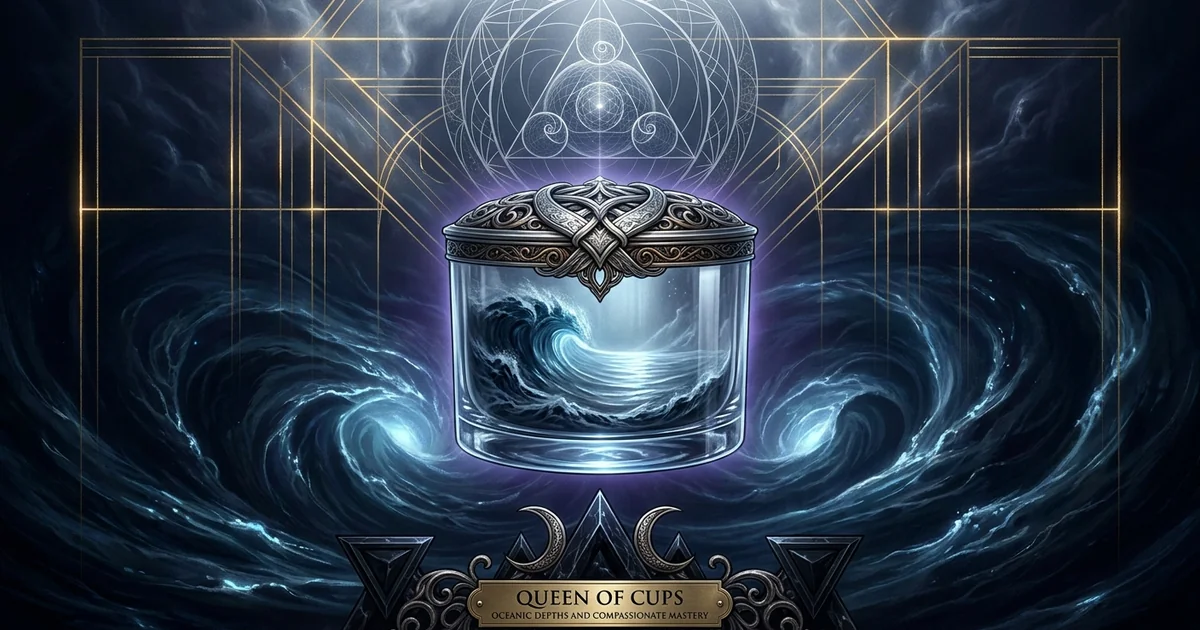
Queen of Cups: Oceanic Depths and Compassionate Mastery
Archetypal Thesis & Systemic Paradigm: The Alchemical Matrix of Water of Water
Within the symbolic cartography of the Western esoteric tradition, the Queen of Cups designates the supreme archetypal equilibrium of the elemental water continuum. Systemically categorized within Hermetic Qabalah as the personification of “Water of Water,” this court card represents not an ephemeral emotional reaction, but an architectural station of consciousness. Here, the archetypal mother-principle of Binah (Understanding) is projected into the formative, astral fabric of Briah (the World of Creation).
While the /tarot/ace-of-cups-primordial-source establishes the unconditioned, undifferentiated outflow of dynamic feeling, the Queen operates as the architectonic matrix that arrests this unbridled deluge, establishing a stable perimeter within which affective current transforms into reflective gnosis. Rather than embodying the passive, fluid indulgence often attributed to the figure in reductive exoteric interpretations, the Queen constitutes an impenetrable psychic container: an alchemical vas hermeticum operating at the threshold between subterranean unconscious drives and conscious contemplative awareness.
[ Kether: Primordial Source ]
                     |
       [ Binah: Supernal Matrix (Form) ]
                     |
         === The Veil of Paroketh ===
                     |
    [ Briah: The Creative Astral World ]
                     |
        [ Queen of Cups: Water of Water ]
        (Reflective Gnosis / Containment)
Binah in Briah: The Primal Feminine as Form-Giving Depth
To comprehend the esoteric function of the Queen of Cups, one must trace her structural lineage across the Tree of Life. In the four-fold distribution of the Tetragrammaton ($Y-H-V-H$), the Queens are assigned to the primary Heh ($\text{ה}$), aligning them irrevocably with Binah, the third Sephira situated at the summit of the Pillar of Severity. Binah represents the Great Sea (Marah), the primordial, cosmic amniotic matrix that gives finite shape, boundary, and containment to the surging, unformed force of Chokmah (Wisdom).
When Binah operates within Briah—the archangelic and astral realm of raw fluidic templates—it does not produce dry geometric abstraction. Instead, it engenders a profound, hyper-dense, reflective basin. In this station, the fluid matrix acts as a cosmic mirror.
The Queen of Cups captures the pure, self-referential essence of water: water observing itself, containing itself, and knowing itself through stillness. It is the architectonic principle of form-giving depth, ensuring that psychic contents do not dissipate into chaotic fragmentation, but instead coalesce into intelligible, relational archetypes.
The Oceanic Unconscious: Introverted Feeling as an Organ of Perception
Through the lens of analytical psychology, the Queen of Cups serves as the visual and symbolic codex for the apotheosis of introverted feeling ($Fi$), as formulated by Carl Gustav Jung. Introverted feeling does not seek to alter, guide, or colonize external circumstances through sentimental exhibitionism. Rather, it operates as a deeply internalized, discerning perceptual apparatus that continuously measures inner psychic reality against fundamental archetypal valuations.
“Introverted feeling is continually seeking an image which has no existence in reality, but of which it has had a sort of prior vision… It aims at an inner intensity, for which the objects of external reality serve at most as a stimulus. The depth of this feeling can only be guessed—it can never be clearly grasped. It makes people silent and inaccessible, for it shrinks from outer expression like an animal terrified by noise… Its true nature is concealed behind an impassive, often melancholy exterior, which resembles an impenetrable mask.” — Carl Gustav Jung, Psychological Types (Collected Works, Vol. 6, §588–§600)
The introverted feeling matrix governed by the Queen of Cups does not exhibit affective turmoil on its surface. Instead, the emotional core remains preserved at immense pressure within the depths of the psyche. This structural silence acts as an organ of non-discursive perception: by holding conscious affect in complete repose, the individual is able to perceive subtle fluctuations within the collective unconscious, apprehending the emotional and symbolic weather of their environment without surrendering ego-cohesion.
The Transmutation of Pathos: From Affective Reaction to Affective Mastery
The operational significance of the Queen of Cups tarot meaning centers on the transmutation of pathos (unconscious suffering and reactive emotionalism) into contemplative mastery. In the lower octaves of psychic development, elemental water presents as an unstable medium characterized by oceanic regression, hysteria, projections of betrayal, and emotional enmeshment.
The Queen systematically subverts this trajectory through an intentional alchemical coagula. By providing an immovable, sovereign boundary around the emotional body, the Queen demonstrates that true compassionate capacity does not stem from porous vulnerability, but from radical internal containment. Pathos is denied its chaotic external discharge; stripped of reactive egress, it is driven inward, undergoing a structural pressure-cook that distills mere sentiment into intuitive clairvoyance and self-sovereign compassion.
Classical Provenance & Textual Lineage: Historical Transmutations of the Receptive Sovereign
The iconographical lineage of the Queen of Cups illustrates a progressive esoteric refinement, transitioning from early Renaissance courtly naturalism toward a precise glyph of Hermetic interiority. In the fifteenth-century Visconti-Sforza deck, the Queen is depicted in strict adherence to contemporary royal decorum: an aristocratic matron seated upon a wooden throne, holding an open golden chalice in one hand and a scepter of temporal authority in the other.
In this early iteration, the vessel remains accessible, unsealed, and exoterically oriented toward ritualistic display, domestic piety, or liturgical devotion. The psychic mechanics of the card remained subordinated to Christian-feudal allegories of virtue, lacking the rigorous astro-Qabalistic scaffolding that would later be synthesized by nineteenth-century occult revivals.
“The Queen of the Thrones of the Waters; Queen of the Nymphs or Undines. A graceful, crowned Queen, seated upon a throne above calm waters… She holds a closed, golden cup, fashioned like a ciborium, with handles shaped like angels; in her other hand, a lotus of the Waters. She is receptive, observant, intuitive, and subtle, presiding over the dominion of moisture and receptivity, uniting the reflective stillness of Binah with the creative depths of Briah.” — S.L. MacGregor Mathers & Moina Mathers, Book T: The Tarot (1888)
From Visconti-Sforza Courtly Iconography to the Mathers Cyphers
The foundational paradigm shift occurred within the Hermetic Order of the Golden Dawn, where Samuel Liddell MacGregor Mathers and Moina Mathers translated the primitive imagery of the court cards into an exact systemic framework. Drawing upon the esoteric Cypher Manuscripts, Book T formally reclassified the card as the “Queen of the Thrones of the Waters.”
This revision integrated the card directly into the operational hierarchy of the Briatic world, removing the figure from secular domesticity and establishing her as an elemental hierarch presiding over the astral undines and the psychic moisture of the macrocosm. Under this dispensation, every iconographical detail became structurally determined: the throne was relocated to the interface of sea and shore, her garments were calibrated to elemental color scales, and her primary attribute was reconfigured into an impenetrable sacred container.
Arthur Edward Waite and Pamela Colman Smith’s Hermetic Redesign
When Arthur Edward Waite directed the production of the Rider-Waite-Smith (RWS) deck in 1909, he tasked artist Pamela Colman Smith with actualizing the doctrinal directives of the Golden Dawn while deepening its psychological resonance. Smith’s visual redesign of the Queen of Cups introduced radical, unprecedented departures from the continental Tarot de Marseille tradition.
+------------------------------------------------------+
|           PAMELA COLMAN SMITH'S 1909 DESIGN          |
+------------------------------------------------------+
|  [ Closed Ciborium ]   --> Sealed Hermetic Mystery   |
|  [ Mer-Child Throne]   --> Biological-Unconscious Tie|
|  [ Pebbled Shoreline]  --> Zero-Boundary Interface   |
|  [ Cloudless Sky ]     --> Undisturbed Astral Plane  |
+------------------------------------------------------+
Smith rendered the Queen seated upon an ornate stone throne carved with mer-children, scalloped shells, and stylized marine motifs, placed upon a pebbled shelf of land directly where the sea laps against the shore. Most significantly, Waite and Smith transformed the traditional open goblet into an elaborate, architectonic ciborium—a closed liturgical vessel crowned with a cross and flanked by winged seraphic guardians.
Waite noted in his 1888/1910 text, The Key to the Tarot, that this queen “sees visions” and is the vehicle for “the golden cup which contains that which is unrevealed.” Smith’s compositional innovation situated the vessel entirely within the queen’s contemplative field of vision: she does not look at the querent, nor does she look at her landscape. Her downward, laser-focused gaze is locked completely onto the apex of the closed chalice, illustrating the containment of vision within the /sacred-geometry/vesica-piscis-symbolism that her entire posture evokes.
The Queen of the Thrones of the Waters in Crowleyan Thelema
In Aleister Crowley’s The Book of Thoth (1944), illustrated by Lady Frieda Harris, the Thelemic stream further abstracted the archetype toward raw cosmic dynamism. Crowley aligned the Queen of Cups with the passive, hyper-fertile receptive substance of the universe—the matrix that mirrors the Sun of the King, receiving its rays and transmuting them into living tissue.
In the Harris rendering, the Queen is enveloped in continuous, semi-transparent veils of undulating light, seated upon calm water where the distinction between the figure and her medium begins to dissolve. Crowley underscored her deceptive passivity: she represents the tranquil surface of an abyss that conceals violent vortexes of creative energy.
Her cup is depicted as an oyster-like shell containing a crayfish, emphasizing the primordial, nocturnal, and lunar facets of the unconscious mind. To Crowley, the Queen is the supreme receptive gateway, embodying an astral reflectivity so absolute that it ceases to be an ego-identity, serving purely as a transpersonal lens for the light of the Supernal triad.
Structural Mechanics & Symbolic Geometry: Astrological Coordinates and Iconographical Anatomy
In the mathematical geometry of the Golden Dawn court card system, the Queens do not govern fixed, static points on the celestial sphere. Instead, they command dynamic thirty-degree bands of the tropical zodiac, specifically spanning the final decan of a mutable sign through the first two decans of a cardinal sign.
This specific deployment grants the court cards their kinetic role as transition vectors across seasonal and elemental modalities.
CELESTIAL EQUATORIAL BAND:
20° Gemini [Mutable Air] ------------ 0° Cancer ------------ 20° Cancer [Cardinal Water]
|                                     |                                       |
+--- Decan III: Sun in Gemini --------+--- Decan I: Venus in Cancer ----------+
(Intellectual Dissolution)            (Emotional Inception / Solstice Gate)
The Decanic Span: From Gemini III to Cancer II
The Queen of Cups governs the precise arc from 20° Gemini to 20° Cancer. This astrological coordination is structurally significant: it bridges the terminal mutable air of Gemini with the primordial, cardinal water of Cancer.
The initial ten degrees of her domain (20° to 30° Gemini) represent the third decan of Gemini, governed by the Sun, corresponding to the Ten of Swords. Here, the rationalizing, discursive intellect undergoes structural exhaustion and collapse, acknowledging the severe limitations of purely cerebral categorizations.
The Queen absorbs this spent, hyper-conscious mutable air and immediately submerges it into the celestial waters of the summer solstice: the first decan of Cancer (0° to 10° Cancer, governed by Venus, the Two of Cups) and the second decan of Cancer (10° to 20° Cancer, governed by Mercury, the Three of Cups).
Consequently, the Queen of Cups is not intellectually deficient; rather, she sits on a throne forged from the dissolution of pure reason, transmuting conceptual air into intuitive, cardinal oceanic depth. Her relationship to the /astrology/cancer-zodiac-archetype anchors her authority in maternal preservation, protective gestation, and somatic intuition.
| Component | Systemic / Qabalistic Value | Esoteric Signification |
|---|---|---|
| Sephirotic Attribution | Binah (Understanding) | The Supernal Mother; primal containment, architectural boundary, form. |
| Elemental Polarity | Water of Water (Briah of Heh) | Hyper-concentrated, introspective, reflective, and astral fluidity. |
| Zodiacal Sector | 20° Gemini to 20° Cancer | Decans: Gemini III (Sun), Cancer I (Venus), Cancer II (Mercury). |
| Hebrew Letter | Heh ($\text{ה}$) | The formative, structural principle of the divine name ($Y-H-V-H$). |
| Alchemical Phase | Solutio | Liquefaction of the dry, calcified ego-structure within the universal solvent. |
| Path Working Anchor | Interface of Geburah-Tiphareth | Reflective astral balance stabilizing dynamic will within emotional clarity. |
The Closed Ciborium: The Mystery of the Sealed Vas Hermeticum
The most vital diagnostic emblem within Smith’s pictorial anatomy is the closed cup. Across the seventy-eight cards of the Tarot, open vessels predominate: the Ace pours forth five streams into the water lilies; the Page contemplates a fish emerging from an open chalice; the King balances an unsealed goblet amidst turbulent seas.
The Queen of Cups alone possesses a vessel completely shielded from the elements.
THE HERMETIC CIBORIUM
      [ Cross / Supernal Axis ]
                 |
      [ Conical Dome / Ciborium Lid ]
     /-------------------------------\
    |   Hermetically Sealed Vessel    |  <-- Preserves volatile astral fluid
    | (Alchemical Vas Bene Clausum)  |      against premature dissipation.
     \-------------------------------/
         \   [ Winged Seraph ]   /
          \---------------------/
                     |
                 [ Stem ]
This closed ciborium functions as the alchemical vas bene clausum—the well-sealed vessel without which the Great Work cannot proceed. In alchemical operations, if the vessel is unsealed prematurely, the volatile spiritual principles (spiritus) evaporate into the atmosphere, destroying the operation and leaving behind only inert, dead dregs (caput mortuum).
Applied to psychic mechanics, the sealed ciborium demonstrates that the Queen does not leak emotional energy. Her feelings are not performative, nor are they bartered for social capital or validation. The closed vessel keeps the psychic contents under internal pressure, enabling the internal distillation of unvarnished instinct into lucid spiritual vision.
The seraphic figures framing the cup signify that this containment is guarded by supernal vigilance, warding off the psychic pollution of external projections.
The Shoreline Throne and Mer-Children: Structural Liminality
The topography occupied by the Queen reinforces this structural containment. She does not float within the depths of the ocean, nor does she dwell inland on dry terra firma. Her throne is erected directly upon the liminal interface: the narrow, pebbled strip where the dynamic, formless waves of the sea break upon the hard shore of physical reality.
Her ornate, stone-carved seat features the relief of an infant mer-child holding a fish, a deliberate symbolic synthesis of terrestrial humankind and marine mystery. The mer-child represents embryonic psychic life—contents arising from the collective unconscious that are beginning to assume distinct somatic and symbolic forms.
Furthermore, the Queen’s feet do not dangle carelessly into the water, nor do they sink into the mud; they rest securely on polished, smooth stones bordering the tide, with her flowing, water-patterned drapery spilling over the threshold to merge seamlessly with the surf. This anatomical precision indicates an interface characterized by zero boundary resistance: she possesses intimate somatic communion with the oceanic unconscious without suffering ego-dissolution or loss of ground.
Psychological Dynamics & Operational Praxis: Navigating Transference and Affective Intuition
In consultative tarot mechanics, the Queen of Cups does not announce an external event, a socio-political development, or an ideological conflict. She establishes an interior environmental condition. When drawn upright, the card signifies an operational demand for contemplative silence, internal psychic boundary delineation, and the conscious stabilization of the affective register.
The Empathic Observer: Containing Countertransference in Consultative Praxis
For analytical practitioners, psychoanalysts, and esoteric counselors, the Queen of Cups embodies the gold standard of therapeutic posture: the empathic, non-reactive observer. When engaged in deep clinical or divinatory work, the practitioner is consistently inundated by the projective identifications and transference mechanics of the client.
The novice or psychologically undisciplined reader instinctively responds via the dynamic of the King—seeking to fix, organize, and mentally direct the flow (see the stabilizing logic of the /tarot/king-of-cups-emotional-equilibrium)—or through an unsealed cup, absorbing the psychic pathogens of the querent until secondary traumatization occurs.
The Queen of Cups operates entirely differently. She activates what Wilhelm Reich termed “vegetative equilibrium” and what Jung conceptualized as the non-anxious container. By functioning as a polished, unruffled body of water, she holds a countertransference-free reflective field. The client gazes into the interactive dynamic and sees their own unconscious drives mirrored back with crystal clarity, stripped of moralistic distortion, judgmental reactivity, or emotional panic.
She teaches the practitioner to hold space for the most terrifying psychic monsters rising from the client’s oceanic deep without attempting to catch, kill, or domesticate them prematurely.
Upright: The Sealed Vessel of Compassionate Mastery
- Affective Containment: Holds high-intensity emotional currents without psychic leakage or defensive dissociation.
- Introverted Feeling Discernment: Possesses profound internal ethical certainty, unaffected by external consensus.
- Non-Reactive Presence: Mirrors the psychic state of the other without absorbing their pathological turbulence.
- Sovereignty Over Projection: Distinguishes between transpersonal archetypal intuition and personal neurosis.
- Alchemical State: The tranquil vas hermeticum, facilitating solutio without losing the structural integrity of the ego.
Reversed: The Ruptured Vessel of Affective Deluge
- Affective Enmeshment: Complete lack of psychological boundaries, resulting in emotional contagion and burnout.
- Histrionic Projection: Manipulates external relational fields through covert martyrdom, passive aggression, and guilt.
- Psychic Dissociation: Retreats into pathological fantasy, mistaking neurotic complexes for clairvoyant insights.
- Devouring Oceanic Ego: Smothers autonomy in others through overprotective, codependent enmeshment.
- Alchemical State: The ruptured vessel; uncontrollable flooding resulting in melancholia and psychological necrosis.
The Shadow Arc: Emotional Engulfment, Hysteria, and Covert Martyrdom
When the structural integrity of the vessel fails—signified by the card appearing reversed, ill-dignified, or afflicted by harsh aspects in an astrological spread—the Queen of Cups collapses into severe archetypal pathology. The rupture of the vas hermeticum transforms the tranquil shoreline into a catastrophic deluge.
In this shadow orientation, introverted feeling curdles into narcissistic interiority. The individual becomes incapable of separating objective reality from their subjective emotional reaction to it; if an event causes emotional pain, the event itself is perceived as inherently evil, and its instigator is cast as an intentional abuser.
The shadow Queen of Cups weaponizes her emotional fragility, employing covert martyrdom and somatic invalidism to manipulate the relational dynamic. Her empathy becomes an invasive, predatory mechanism: she reads the subtle emotional micro-signals of others not to grant them compassionate space, but to identify points of leverage, ensuring that everyone within her social ecosystem remains bound to her emotional cadence.
At its most acute clinical boundary, this shadow state aligns with borderline personality adaptations and histrionic enmeshment, where identity ceases to exist without an active, turbulent affective crisis.
Integrative Ritual and Contemplative Scrying Methodologies
To integrate the balanced current of the Queen of Cups into operational magical praxis, the practitioner utilizes active imagination and astral scrying techniques keyed to her formal Golden Dawn attributions. Rather than pursuing external theurgic invocations, the ritual mechanics require absolute sensory withdrawal (pratyahara), settling the brainwave states into the alpha-theta boundary (4–8 Hz) to approximate the quietude of the oceanic deep.
THE QUEEN'S AFFECTIVE SCRYING SEQUENCE:
[ Somatic Stillness ]
       |
[ Visualization of the Shoreline / Water-Earth Interface ]
       |
[ Formation of the Sealed Golden Ciborium in Heart Center ]
       |
[ Deposition of Affective Agitation into the Ciborium ]
       |
[ Silent Scrying of the Vessel's Surface: Emergence of Symbolic Gnosis ]- Establish the Shoreline Axis: The practitioner envisions themselves situated on the pebbled shelf where the land meets a vast, calm ocean under a twilight or pale, mist-veiled sky. The shoreline represents the waking conscious ego; the ocean represents the totality of the collective unconscious.
- Erect the Alchemical Ciborium: Within the psychic space of the heart chakra (Anahata), visualize the sealed, golden vessel. Every volatile, turbulent emotion presently agitating the nervous system—anxiety, grief, rage, unrequited desire—is mentally gathered and deposited into this golden ciborium.
- Seal the Lid: Mentally secure the lid of the chalice, crowned with the cross of equilibrium. The practitioner refuses to allow these affects to spill out as reactive speech or catastrophic ideation. The fire of attention is kept beneath the vessel.
- Contemplate the Reflective Surface: As the internal pressure builds, the practitioner shifts attention to the Queen herself, seated silently upon her throne. By scrying into the stillness of her countenance, the practitioner does not ask for answers; they await the spontaneous transmutation of the trapped emotional heat into a solitary, lucid symbolic image emerging upon the ocean’s horizon.
Philosophical Synthesis & Macrocosmic Correspondence: Solutio, Anima Mundi, and Cybernetic Affect
The wider esoteric implications of the Queen of Cups extend far beyond psychological typology or divinatory counseling. In the macrocosmic scheme, she embodies the foundational alchemical operation of solutio—the systemic liquefaction of calcified, rigid forms within the universal solvent of the cosmic sea.
The Alchemical Solutio: Liquefying Rigidity without Dissolving Identity
Alchemists continually cautioned their students: Solve et coagula (Dissolve and Coagulate). The preliminary stage of any transmutative work requires the reduction of the prima materia to its primal, undifferentiated water state.
Rigid dogmas, calcified ego defenses, intellectual obsessions, and physical armoring must undergo solutio. The Queen of Cups is the alchemical mistress of this process.
However, her genius lies in her ability to liquefy the rigidity of the self without dissolving the observer’s ontological identity. The ego does not drown; it is granted a submersible vessel.
Under her governance, the brittle, crystallizing influence of Saturn (Binah) is softened by the warm waters of the astral plane (Briah). The calcified salt dissolves, returning to the sea, yet the seed of conscious awareness remains intact inside the ciborium, ready to coalesce into a higher, more flexible state of spiritual organization.
The Queen as Node in the Anima Mundi: Intuition as Cybernetic Feedback
Within contemporary cybernetics and general systems theory, information consists of “a difference which makes a difference,” moving across relational feedback loops. When this concept is mapped onto the Hermetic paradigm of the Anima Mundi (the World Soul), intuition ceases to be an inexplicable paranormal mystery. It reveals itself as an innate cybernetic feedback mechanism operating through the fluid medium of the collective unconscious.
The Queen of Cups occupies a primary homeostatic node within this universal network. Highly chaotic systems generate destructive positive feedback loops: a minor emotional disturbance amplifies across an ecosystem, leading to systemic rupture and social panic.
The Queen serves as a negative feedback dampener—an organ of homeostatic regulation. Because her reflective basin is completely undisturbed by internal neurosis, she receives the raw, unencrypted informational signals of the Anima Mundi, dampens the chaotic noise through the high-viscosity resistance of her silence, and converts raw systemic volatility into stabilized intuitive intelligence. She knows what is occurring across the wider system because she has reduced her internal resistance to zero, allowing the wave-states of the collective sea to inform her directly.
The Non-Dual Heart: Compassion as Transpersonal Structural Architecture
Ultimately, the Queen of Cups models the transition from dualistic, moralistic empathy to non-dual, transpersonal compassion. Conventional empathy remains fundamentally fractured: it posits an “I” who feels sorrow for a separate “You,” maintaining a subtle distance that easily collapses into patronizing pity or mutual exhaustion.
The Queen’s realization of compassion rests upon the fundamental Hermetic and non-dual premise that the ocean is singular. The shoreline upon which she sits is merely the visible crust of a singular, contiguous planetary basin.
Suffering, joy, dread, and illumination are not isolated private properties owned by atomized egos; they are localized wave formations surging across a single, transpersonal body of water.
True compassionate mastery does not laboriously attempt to rescue waves from breaking upon the shore. Instead, it holds absolute, unwavering awareness of the deep oceanic continuum from which every wave arises and into which every wave must inevitably return. The Queen rests on the boundary between stone and sea, an unshakeable sovereign whose silent, compassionate vision holds the volatile cosmos in perpetual, restorative equilibrium.
Frequently Asked Questions: Resolving Advanced Symbolic Inquiries
Why is the Queen of Cups the only court figure whose vessel is completely sealed?
The ciborium held by the Queen of Cups is sealed because she presides over the occultation and distillation of the astral light within the Briatic world. In traditional esoteric theology, the vessel represents the human heart and the female reproductive matrix—both of which must remain closed and protected during the gestation of divine life.
While the other court figures manipulate or present emotional contents to the outer world (the King stabilizes relational structures, the Knight pursues affective quests, and the Page heralds newly emerging creative ideas), the Queen of Cups represents the stage of pure internal gestation.
Her vessel is sealed to prevent the evaporation of the volatile psychic spirit (spiritus) and to protect the emerging gnostic vision from being corrupted by external consensus reality or intellectual debate. It conveys that the deepest truths of the emotional unconscious are non-discursive: they cannot be articulated through spoken language, but must be experienced through direct, hermetically contained contemplative vision.
How does the Queen of Cups structurally differ from the High Priestess and The Empress?
These three archetypes correspond to distinct stations across the Tree of Life and the Arcana, representing progressive concretizations of the Supernal Feminine:
- The High Priestess (Trump II): Sits upon the Path of Gimel, spanning the vast chasm between Kether and Tiphareth. She represents the pure, unmanifest, virgin abyss—unconditioned memory, absolute potential, and the celestial root of water. She has no physical shoreline; she is the uncrossable sea itself, entirely withdrawn from human relational exchange.
- The Empress (Trump III): Sits upon the Path of Daleth, uniting Chokmah and Binah. She is dynamic, generative nature—the unbridled fecundity of the physical world, sensory life, and fertile abundance. Her element is not pure water, but the fertile earth energized by creative love.
- The Queen of Cups: Operates as a sub-principality within the world of Briah. She is the individualized human or archetypal soul containing and navigating those celestial currents. Unlike the cosmic abstraction of the Priestess or the outward biological fecundity of the Empress, the Queen represents the conscious psycho-spiritual discipline of the individual vessel: the cultivation of affective mastery, empathic boundaries, and intuitive containment on the shores of human existence.
What specific astrological transits or decanic timing does this card govern in predictive mechanics?
In traditional Golden Dawn predictive mechanics, the Queen of Cups commands the 30-degree sector spanning 20° Gemini through 20° Cancer. In the tropical calendar, this decanic progression directly governs the seasonal shift from the late northern spring into early-to-mid summer, specifically corresponding to the calendar dates between June 11 and July 11.
- 20° to 30° Gemini (June 11 – June 20): Marked by the Sun in Gemini (Ten of Swords), indicating the exhaustion of over-intellectualizing and the collapse of mental defenses.
- 0° to 10° Cancer (June 21 – July 1): Initiated at the Summer Solstice, marked by Venus in Cancer (Two of Cups), governing initial spiritual and emotional unions, receptive intimacy, and astral bonding.
- 10° to 20° Cancer (July 2 – July 11): Marked by Mercury in Cancer (Three of Cups), governing the harmonious containment of communal feeling, abundance, and intuitive articulation.
When the Queen of Cups appears as a predictive timing significator in horary or esoteric spreads, she points precisely to this early-summer Solstice window, or to moments when transiting personal planets (particularly the Moon or Venus) cross these specific degrees, precipitating deep emotional resolutions, intuitive breakthroughs, or the imperative to seal one’s psychic boundaries against external turbulence. :::