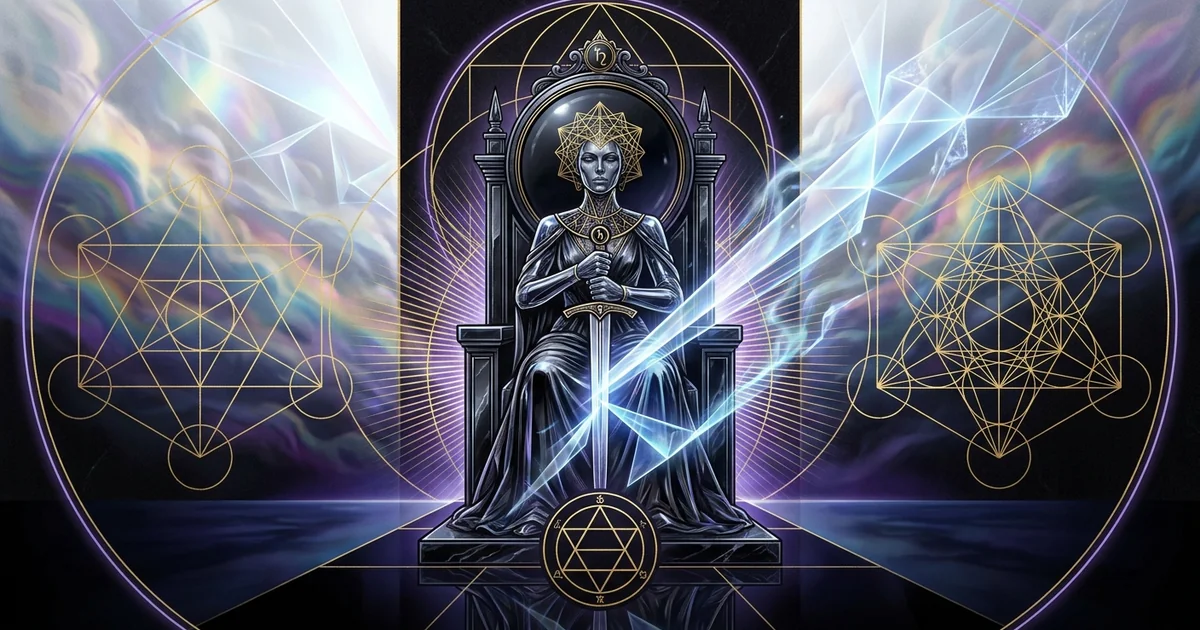
Queen of Swords: Perceptive Truth and Discerning Insight
Archetypal Thesis & Systemic Paradigm: The Epistemology of Water-of-Air
Epistemological Severance and the Scythe of Discrimination
The Queen of Swords occupies a distinct structural position within the esoteric cartography of Western hermeticism: she represents the crystallization of the “Water of Air” archetype. Far from serving as a sentimental portrait of grief or a simple personification of feminine severity, this arcanum models the precise epistemological mechanism through which the conscious mind isolates signal from noise. In the taxonomy of the suit of swords archetypal mechanics, the element of Air governs the Ruach—the rational intellect, the discursive faculty, and the communicative matrix. Water, by contrast, embodies the fluid, receptive, formative, and reflective principle associated with the systemic matrix of feeling and unconscious integration. When Water acts upon Air, the volatile turbulence of raw thought is arrested, clarified, and given bounded containment.
This synthesis generates an intellect that is fundamentally observant rather than merely speculative. The primary instrument of the Queen of Swords is not the aggressive lance of conquest, but the vertical, double-edged blade of radical discrimination. Through this weapon, she exercises what scholastic philosophy termed distinctio: the capacity to dissect composite phenomena into their constitutive components, thereby puncturing cognitive distortions, neurotic rationalizations, and emotional entanglements. Her insight does not emerge from cold apathy; rather, it arises from the deliberate suspension of affective bias. By establishing an unyielding psychic boundary between the observing subject and the dynamic object of contemplation, she inaugurates a mode of perception wherein reality is apprehended free from the flattering or terrifying projections of the ego.
Consequently, the core queen of swords tarot meaning pivots on this capacity for mental hygiene. The card represents an operative stance in which consciousness ceases to identify with the swirling contents of its own psychological theater. Where lesser cognitive states fall prey to confirmation bias and ideological possession, the epistemological blade of this queen executes an incisive severance, amputating toxic narratives and sentimental self-delusions. This is not the cold, legislative jurisprudence of external law, but the internal clarity of immediate, unfiltered apprehension.
Binah in Yetzirah: Receptive Form in the Dynamic Intellect
To trace the metaphysical architecture of this arcanum, one must consult the Qabalistic schema developed within the Hermetic Order of the Golden Dawn, wherein the four ranks of court cards are mapped directly onto the four letters of the Tetragrammaton and the four cosmological worlds. The Queen is uniformly allocated to the second letter, the primal Heh (ה), corresponding to the third Sephirah on the Tree of Life: Binah (Understanding, Contemplation, and the Supernal Mother). When the court cards manifest within the elemental suit of Swords, this primordial, architectonic Binah descends directly into the astral realm of Yetzirah (the World of Formation), which is itself ruled by the Vav (ו) and the element of Air.
Formula: Heh (Water / Binah) of Vav (Air / Yetzirah)
Elemental Attribution: Water of Air (Receptive, reflective matrix organizing volatile intellect)
Sephirotic Reflection: Binah in Yetzirah; the Great Sea refracting through the Astral Atmosphere
Divine Name Association: YHVH (specifically the first Heh operating within the matrix of the son, Vav)
Operative Mechanics: The primordial Mother of Form brings structural limit, containment, and severe structural definition to the turbulent, unstructured communicative currents of the Yetziratic realm.
Binah is the cosmic principle of limitation, structure, and severity; she is the Great Sea (Marah) that receives the luminous, unformed flash of Chokmah and coagulates it into defined form. When Binah functions through the atmospheric stratum of Yetzirah, her structural severity manifests as the analytical faculty of the human mind. The Queen of Swords is the Great Architect of clear thought. She does not produce chaotic mental ideation; rather, she receives the raw, kinetic currents of Air and binds them to strict structural syntax. Through her influence, the mind becomes an acoustic chamber capable of apprehending the Logos.
The operational consequence of “Binah in Yetzirah” is the formal termination of illusion. Air without Water is pure velocity—an erratic, ungrounded wind that generates paranoid conjecture, obsessiveness, and discursive mania. By introducing the reflective depth of Water, the Queen of Swords provides an unyielding pool in which the thoughts of Yetzirah are reflected back to consciousness with microscopic exactitude. Her severity is fundamentally identical to the severe boundary conditions required for any mathematical, philosophical, or psychological breakthrough: she establishes the axioms, defines the limits, and unhesitatingly discards whatever lies outside the bounds of structural coherence.
Classical Provenance & Textual Lineage: From Renaissance Court to Esoteric Orders
Continental Precedents: The Visconti-Sforza and Sola Busca Lineages
The iconography of the Queen of Swords is rooted in fifteenth-century Italian cartomancy, reflecting both the socio-political realities of aristocratic governance and the martial allegories of the early Renaissance. In the Visconti-Sforza deck (c. 1451), painted by Bonifacio Bembo, the Queen of Swords is depicted with classical aristocratic dignity, holding an upright blade in her right hand while her left hand gathers or gestures toward her mantle. This early depiction is devoid of the morbid, sorrowful connotations appended by later Victorian occultists; she appears as an archetype of sovereign fortitude, reflecting the actual administrative and tactical authority exercised by Italian noblewomen who maintained dynastic security during periods of siege and condottieri warfare.
Conversely, the enigmatic Sola Busca Tarot (c. 1491), engraved in Venice or Ferrara, introduces an overtly classical and militaristic undercurrent into the card’s visual lineage. Here, the court figures of the swords suit are associated with Greco-Roman historical and mythological figures, often carrying weapons with active, operational intensity. In these early continental lineages, the Queen of Swords does not mourn; she commands. The weapon she wields is a secular and metaphysical emblem of imperium—the legitimate authority to preserve civic order through the exercise of force and decisive discernment.
As playing cards and divinatory tarots diffused throughout Europe via the Tarot of Marseilles pattern (from the sixteenth to eighteenth centuries), this queen was codified in a profile posture: seated upon a massive stone throne, her body turned sharply, brandishing a massive cutlass or broadsword, while her left hand frequently extends outward in a gesture that simultaneously invites and halts approach. The Marseilles iconographers emphasized her vigilance; she is the guardian of the mental perimeter, a human checkpoint discerning between friend and foe, authentic expression and deceitful posture.
The Hermetic Order of the Golden Dawn and the ‘Queen of the Thrones of Air’
The definitive transformation of the card from a feudal portrait into a precise occult engine occurred in late nineteenth-century London through the private teachings of the Hermetic Order of the Golden Dawn. S. L. MacGregor Mathers and his collaborators systematically dismantled the exoteric, casual interpretations of the court cards, synthesizing them into a rigorous system of astrological, elemental, and Enochian correspondences. In the foundational Golden Dawn document The Book T (1888), the Queen of Swords was stripped of her bourgeois characterization and consecrated under her proper occult title: “The Queen of the Thrones of Air.”
“A graceful, seated Queen, clad in mail, with crown and crest of a winged child’s head. Her throne is placed upon clouds. Her face is severe, but beautiful. In her right hand she holds a drawn sword upright; in her left, a severed head of a man. She is the Queen of the Thrones of Air; the Water of Air; representing the subtle, observing, swift, and discriminating intellect; but inclined to cruelty and craftiness if ill-dignified.”
This Golden Dawn taxonomy assigned her governance over the celestial sphere spanning the final decan of Virgo through the first two decans of Libra (20° Virgo to 20° Libra), tying her operative power to the cosmic moment of the autumnal equinox—the exact astrological point where light and dark achieve precarious balance before descending into winter. In this formulation, Mathers married the hyper-analytical, classification-heavy nature of mutable Earth to the judicial equilibrium of cardinal Air.
The divergent developments of this archetype in the twentieth century are prominently crystallized in the split between the Arthur Edward Waite/Pamela Colman Smith deck (1909) and Aleister Crowley’s The Book of Thoth (1944, executed by Lady Frieda Harris). Waite, working through a Christian-mystical lens, presented a queen elevated upon an isolated promontory, enveloped in low-hanging stratus clouds, her features set in sorrowful resolve. He described her as a familiar figure of bereavement: “She signifies widowhood, female sadness, and embarrassment.”
Yet, Harris and Crowley rejected this sentimental reading. Crowley’s Queen of Swords is an aerial hunter seated upon a throne of condensed cloud-strata, naked to the waist, crowned with the crest of a child’s head, gazing with unblinking, ecstatic severity across the ether. Crowley insisted that her true nature was not sentimental loss, but absolute phenomenological liberation: “She represents the clear, swift, and analytical perception of the senses… She is the individualist, asserting her freedom from the gross matter of the lower planes through the ruthlessness of pure reason.”
Early Italian Tarocchi (1450s)
  └── Martial Imperium & Fortitude (Visconti-Sforza / Sola Busca)
        │
Tarot of Marseilles (16th–18th C.)
  └── Guarding the Perimeter; Vigilance & Discernment
        │
Hermetic Order of the Golden Dawn (1888)
  └── "Queen of the Thrones of Air" / Binah in Yetzirah (Book T)
        ├── Waite-Smith (1909): Elevated Solitary; Resolute Widow / Stoic Discernment
        └── Crowley-Harris (1944): Liberated Aerial Intellect; Severing Senses from Illusions
Structural Mechanics & Symbolic Geometry: Astrological Decans and Iconography
Zodiacal Transition: From Mutable Earth (Virgo III) to Cardinal Air (Libra I & II)
The operative engine of the Queen of Swords can be understood by examining her exact astronomical attribution within the Hermetic decanic system. Unlike the pip cards, which correspond to discrete ten-degree faces of the zodiac, each Golden Dawn Court Card (excluding the Princesses/Pages) governs a thirty-degree arc composed of three consecutive decans bridging two distinct signs. The Queen of Swords presides over the astral corridor extending from 20° Virgo to 20° Libra.
This cross-zodiacal placement exposes the card’s dual psychological and hermetic machinery:
- Virgo III (20° to 30° Virgo): Ruled by Mercury, this final decan of Earth is represented in the tarot by the Ten of Pentacles. It embodies hyper-refinement, radical empirical analysis, and the classification of material form. It is the capacity to notice the microscopic flaw, the systemic crack, and the structural anomaly.
- Libra I (0° to 10° Libra): Ruled by the Moon, represented by the Two of Swords. It introduces deep peace, radical neutrality, non-attachment, and the deliberate suspension of judgment while contradictory data points are weighed in dynamic balance.
- Libra II (10° to 20° Libra): Ruled by Saturn, represented by the Three of Swords. Here, the archetype touches its most profound and misunderstood dimension: sorrow, the isolation of the intellect, and the painful necessity of cutting away emotional excess to reveal the structural skeleton of truth.
The Queen of Swords is the living embodiment of the transition across the autumnal equinox threshold. She harvests the empirical, detail-oriented observations of Virgo and elevates them into the abstract, judicial arbitration of Libra. Her apparent coldness is not a personal pathology; it is an astronomical and psychological necessity. In order to arbitrate between 0° and 20° Libra, consciousness must completely abandon the subjective warmth of the summer signs, entering the cold, mathematically balanced twilight of the cosmic scales. To master her domain, one must consult the technical mechanics detailed in the analysis of Libra decans and tarot correspondences.
Iconographic Semiotics: The Vertical Blade, Severed Mask, and Cloud Mantle
The visual semiotics of the Queen of Swords, particularly in the canonical Waite-Smith and Golden Dawn configurations, constitute a deliberate diagram of awakened mental awareness. Every component of her throne, posture, and vestments functions as an ideological hieroglyph indicating the purification of consciousness:
- The Vertical Sword: Unlike other martial cards where the weapon is angled for dynamic thrusting or heavy parrying, the Queen holds her blade at an exact ninety-degree angle relative to the earth. This verticality signifies the axis mundi, the central pillar of the Tree of Life, and the yogic sushumna nadi. Her mind does not strike out in defensive paranoia; it stands perfectly upright, aligned with transcendental truth. The vertical blade acts as an intellectual lightning rod, grounding cosmic insights directly into the lucid present.
- The Bare Left Arm and Open Hand: While her right hand grips the hilt of discernment, her left arm is frequently bare of armor, extended outward with an open, receptive palm. This posture represents the fundamental synthesis of Water of Air: she does not fear reality. The extended left hand invites truth without defensive evasion, while the right hand remains perpetually prepared to sever falsity. It is the ultimate gesture of non-possessive hospitality toward phenomena.
- The Crown of Butterflies and Winged Sylph: Upon her brow rests a golden crown adorned with butterflies—the classical symbol of the soul (Psyche) undergoing radical metamorphosis through the dissolution of the chrysalis. The butterfly is ephemeral and aerial, indicating that her thoughts are no longer bound by gross material gravity. Golden Dawn variants augment this with the head of a winged child, an allusion to the purity of the higher mental faculties prior to their corruption by societal conditionings.
- The Bas-Relief of the Cherub and the Cloud-Throne: Her stone seat is carved with the image of a child-angel (the cherubic intelligence of Air) and sits perched directly above a bank of dense, rolling stratus and cumulus clouds. In esoteric psychology, the cloud canopy denotes the turbulent emotional and imaginal stratum of the lower astral plane. By seating herself above the cloud line, the Queen demonstrates mastery over the affective atmosphere. Her consciousness operates in the alpine clarity of the high troposphere, where light is unimpeded by the thermal distortions of terrestrial passions.
- The Severed Head / Dropped Mask: In the Golden Dawn and esoteric variants, the Queen occasionally holds or tramples a severed head, reminiscent of Judith bearing the head of Holofernes or Perseus slaying Medusa. In psychological cartography, this severed head is not an emblem of physical violence; it is the radical decapitation of the false ego, the termination of persona-identification, and the exposure of the deceptive masks worn by the subjective self to avoid accountability.
Psychological Dynamics & Operational Praxis: The Analytical Ego and the Anima/Animus
The Logos-Bearing Anima: Beyond Affective Defense Mechanisms
Within the analytical psychology of Carl Gustav Jung, the court cards function as pristine archetypal templates for the dynamic components of the psyche. The Queen of Swords represents a singular psychological development: the integration of the Logos by the feminine principle, or conversely, the manifestation of an Anima that has discarded seductive obscurity in favor of blinding lucidity. In classical Jungian dynamics, the Anima (the archetypal personification of the unconscious in a man) often presents as moody, emotionally diffuse, irrational, and entangled in mythological illusions. However, when the Anima undergoes individuation and assimilates the solar sword of discriminative consciousness, she transforms into the Queen of Swords—an internal guide capable of guiding the ego through the labyrinth of self-deceit.
“The discrimination of the intellect from the affective state is one of the most painful, yet necessary, achievements of psychic development. When the archetype of the feminine mind is released from the swamp of unconscious projections, she wields an intellectual scythe of terrible purity. This is not the masculine animus possessed by ideological rigidity, but the sovereign Logos of the soul, cutting clean through the false sentimentality that shelters neurotic regression.”
In feminine psychology, this card marks the emergence of the differentiated intellectual function. Marie-Louise von Franz noted that when the animus (the masculine archetype within the feminine unconscious) is unintegrated, it expresses itself as hyper-opinionated, dogmatic, and combative chatter—a destructive, ideological wind. The Queen of Swords embodies the exact opposite state: the animus has been subordinated to the sovereign, contemplative ego. She does not argue for the sake of triumph; she states what is. Her speech is economical, incisive, and unburdened by the compulsion to placate or soften the reality of the objective situation.
This transformation requires traversing what clinical psychology identifies as mourning. Discernment is inherently painful; it requires the absolute abandonment of magical thinking, childish dependencies, and the flattering delusions constructed by narcissism. For this reason, the queen of swords tarot meaning has historically carried the reputation of the “sorrowful widow.” Psychologically, the “husband” she has lost is the naive, unconscious animus-projection—the comforting fantasy of external salvation. Having endured the symbolic death of this romanticized illusion, she inherits the kingdom of her own sovereign mind. For a deeper theoretical mapping of this process, consult the anima-animus individuation framework.
Operative Divinatory Mechanics: Decoupling Diagnostic Truth from Cynical Nihilism
In clinical cartomancy and analytical consultation, the appearance of the Queen of Swords functions as a diagnostic coordinate indicating an acute epistemological imperative. The arcanum commands the querent to transition immediately out of the affective register and into the discriminative register. When an individual is engulfed in relational anxiety, career paralysis, or somaticized stress, the Queen of Swords demands the application of Occam’s razor: what is the most direct, unvarnished truth of this situation when all sentimental narratives are excised?
[ Affective Overwhelm & Cognitive Distortion ]
                 │
                 ▼  (Occam's Razor Applied)
[ Epistemological Severance: Queen of Swords Intervention ]
                 │
       ┌─────────┴─────────┐
       ▼                   ▼
[ Dignified Manifestation ] [ Ill-Dignified Shadow ]
Pristine Boundaries       Hyper-Critical Contempt
Radical Objectivity        Cynical Paralyzing Nihilism
Unflinching Candor         Vengeful Gossip & Isolation
To execute this operational shift, the investigator must guide the subject through a process analogous to Jungian active imagination, utilizing the Queen of Swords as an intrapsychic arbiter. The subject must be brought to interrogate their own defense mechanisms:
- Where is sentimentality being deployed to excuse abusive, dysfunctional, or decaying dynamics?
- Which relationships or projects survive only because the subject refuses to speak the clarifying, diagnostic word?
- What boundaries have been collapsed due to an unconscious terror of conflict or abandonment?
The primary operational danger of the Queen of Swords lies in its shadow polarity: cynical nihilism. When the discriminative faculty is detached from the foundational compassion of Binah, it deteriorates into a mechanism of preemptive emotional sadism. In this ill-dignified expression, the individual mistakes cruelty for honesty and contempt for insight. The blade is no longer wielded to excise cancer; it is used to mutilate life. The skilled practitioner must carefully determine whether the card operates as a pristine, diagnostic scalpel (upright, dignified) or as a defensive, hyper-intellectual armor designed to prevent the heart from ever feeling vulnerable again (ill-dignified, reversed).
Comparative Archetypal Polarities: The Discerning Mind Across the Court Spectrum
Queen of Swords versus King of Swords: Interior Discernment versus Exterior Jurisprudence
The structural mechanics of the tarot court cards necessitate a comparative analysis between the two senior figures of the swords suit. While both cards govern the Air element, their systemic expressions diverge based on their Qabalistic ranks: the King embodies the Chokmah-Fire polarity (Fire of Air), whereas the Queen embodies the Binah-Water polarity (Water of Air).
Queen of Swords (Water of Air)
- Operational Axis: Interior Discernment; Perceptive Filtration; Phenomenological Truth.
- Mode of Action: Receptive, observational, diagnostic, incisive, reactive-clarifying.
- Primary Metaphor: The Scalpel; The Prismatic Mirror; The Alpine Atmosphere.
- Epistemic Domain: Direct experiential perception; piercing the subjective illusions of the immediate environment.
- Shadow Pathologies: Emotional frigidity, defensive hyper-criticism, cynical isolation, bitter spite.
King of Swords (Fire of Air)
- Operational Axis: Exterior Jurisprudence; Strategic Command; Institutional Architecture.
- Mode of Action: Projective, legislative, organizing, systemic, tactical-initiating.
- Primary Metaphor: The Law Code; The Strategic Blueprint; The High Wind / Lightning.
- Epistemic Domain: Systematic structural doctrine; organizing external collective reality through authority.
- Shadow Pathologies: Authoritarian tyranny, cold intellectual brutality, dogmatic legalism.
The King of Swords is the statesman, the chief justice, the military strategist, and the logician who builds institutions. His concern is macrocosmic: he constructs legal frameworks, establishes external rules of engagement, and commands the deployment of structural power. His Air is energized by Fire; it drives outward, transforming society through deliberate tactical willpower.
Conversely, the Queen of Swords is not concerned with building empires or codifying statutory law. Her focus is phenomenological and interior. She is the auditor of reality who observes whether the Emperor has any clothes, whether the King’s laws are inherently hypocritical, and whether the language being deployed matches the underlying reality. The King rules the courtroom; the Queen embodies the sharp gaze of the witness who cannot be bribed, gaslit, or swayed by rhetorical grandiloquence. Her authority does not rest upon an institutional mandate, but upon the undeniable, self-evident clarity of her perception.
Water of Air versus Water of Water: The Queen of Swords contrasted with the Queen of Cups
The elemental dialectic between the Queen of Swords (Water of Air) and the Queen of Cups (Water of Water) illustrates the polar extremes of human perception: total objective detachment versus radical subjective immersion.
Total Detachment                                      Total Immersion
[ Queen of Swords: Water of Air ] <----------------> [ Queen of Cups: Water of Water ]
(The Frozen Lake: Pristine Reflection)               (The Deep Sea: Ocean of Feeling)
The Queen of Cups represents the unmitigated depths of the unconscious, empathy, and affective resonance. In her domain, boundaries dissolve; consciousness experiences the world by merging with it, feeling what the other feels, and translating reality into somatic, poetic, and psychic visions. Her vulnerability is her power, but her vulnerability is also her trap: without boundaries, she drowns in the emotional residue of her environment, easily mistaking visceral identification for factual reality.
The Queen of Swords functions as the ultimate antidote to this Oceanic dissolution. She freezes the water of feeling, solidifying it into the crystalline geometry of thought. Where the Queen of Cups says, “I feel you, and therefore we are one,” the Queen of Swords replies, “I see you, and therefore I recognize the boundary between your psychic material and mine.” The Queen of Cups is the warm, amniotic fluid of the womb; the Queen of Swords is the cold, clean air of the delivery room and the scissor that severs the umbilical cord. Both cards are indispensable coordinates within the human individuation process; one provides the raw material of emotional truth, while the other provides the structural discrimination necessary to prevent that truth from degenerating into a chaotic, regressive morass.
Philosophical Synthesis & Macrocosmic Correspondence: Hermetic Truth and Information Theory
Entropy, Signal, and Noise: The Queen as Cybernetic Error Correction
When transposed into the vernacular of modern systems theory, information architecture, and cybernetics, the Queen of Swords emerges as an archetypal formulation of error-correction and noise-reduction mechanics. In the mathematical theory of communication formulated by Claude Shannon, information is defined against entropy: the greater the entropy in a channel, the more the transmitted signal is degraded by white noise, static, and extraneous interference. The ultimate objective of any communicative circuit is to maximize signal fidelity while driving systemic noise toward zero.
The Queen of Swords functions as an operative low-pass and high-pass filter within the human mind. Cognitive bias, projective identification, neurotic anxieties, and sentimental attachments represent ideological white noise. They pollute the transmission of objective data across the perceptual threshold, generating an entropic, dysregulated state of consciousness. The Queen’s vertical blade executes an algorithmic operation: she truncates redundant, hallucinatory, and corrupting variables.
Originating Sephirah: Binah (Understanding / Structural Limitation)
Refracted Through: The Veil of Paroketh (The threshold separating the Astral/Personal from the Solar/Universal)
Manifesting World: Yetzirah (The realm of formative mental structures and linguistic syntax)
Systemic Function: The Queen of Swords translates the non-discursive, cosmic understanding of the Supernal Mother (Binah) into localized, syntactical, and incisive conceptual units that consciousness can wield to neutralize astral illusion.
By enforcing this cybernetic error correction, she preserves the absolute integrity of the information loop. When the human mind interfaces with the macrocosm, it is perpetually threatened by systemic drift—the slow, insidious accumulation of unexamined assumptions that eventually causes cognitive collapse. The Queen of Swords prevents this catastrophe by enforcing rigorous, ongoing calibration. She demands that every signifier point directly to an authentic signified, severing the self-referential loops of language that enable cultural and personal psychosis.
Binah’s Crucible: The Alchemical Coagulation of Pure Thought
Within Hermetic philosophy, the primary axiom of the Kybalion states: “The All is Mind; the Universe is Mental.” If reality is fundamentally mental in its primary substrate, then perception is not a passive reception of external, Newtonian objects, but an active, ontological act of world-construction. To perceive unclearly is to construct an unstable, decaying reality; to perceive with crystalline exactitude is to participate directly in the divine act of creation.
Here lies the alchemical function of the Queen of Swords: she represents the stage of Coagulatio applied to the volatile astral light. Through Binah’s cosmic crucible, she seizes the unformed, chaotic atmospheric vapors of the Yetziratic plane and coagulates them into definite geometric forms. She is the philosopher who names the demon, the logician who identifies the fallacious premise, the cartographer who marks the treacherous reef. By circumscribing the chaos of the psyche, she allows consciousness to establish real purchase upon the world.
This alchemical solidification is not a deadening of the mind, but its ultimate empowerment. The Great Mother in her form as the Queen of Swords bestows upon the initiate the capacity to endure the severe light of truth without flinching. She demonstrates that perceptive insight is the highest form of spiritual surrender: the complete abdication of who one wished the self or the world to be, in favor of an unyielding, worshipful embrace of what is.
Frequently Asked Questions: Resolving Classical and Operative Dilemmas
Does the Queen of Swords necessarily signify grief, widowhood, or emotional trauma?
The historical association between the Queen of Swords and widowhood or bereavement is an artifact of Victorian cartomancy, largely popularized by Arthur Edward Waite’s textual descriptions in The Pictorial Key to the Tarot (1910). While it is true that this card often marks an encounter with profound loss, it is a profound diagnostic error to interpret it as mere, passive grief.
The connection to bereavement originates in the Qabalistic attribution of the card to Binah (Understanding), a Sephirah that esoteric doctrine titles Marah, the Bitter Sea, and associates with Saturn, the archetype of limitation, time, and physical mortality. In classical mysticism, to enter the sphere of Binah is to witness the absolute impermanence of all created forms. When translated into the psychological domain of the swords suit, this Saturnian-Binah root indicates an individual who has encountered an undeniable limitation, a severe ending, or the painful disillusionment of a cherished fantasy.
However, the Queen of Swords does not represent the pathological depression that often follows loss; rather, she represents the sublimation of loss into radical consciousness. She is not the mourning widow paralyzed by tearful self-pity; she is the woman who, having survived the catastrophic destruction of her illusions, has been cleansed of sentimental expectations. Her grief has dried into a diamond-hard clarity. She knows that life is finite, that humans are fallible, and that sentimentality cannot alter the laws of the cosmos. Therefore, she operates with complete emotional sobriety. Where less integrated minds remain trapped in the cycle of grief, the Queen of Swords steps forward into the world as a sovereign, self-contained intelligence unburdened by false hope.
How does one distinguish an upright Queen of Swords from a reversed or ill-dignified state?
The differentiation between a well-dignified (or upright) Queen of Swords and an ill-dignified (or reversed) manifestation hinges upon the relationship between the intellect and human empathy. In both states, the mind possesses sharp analytical capacity, but their functional motives and operational impacts are diametrically opposed:
In her well-dignified or upright state, the Queen exercises discriminative intelligence in the service of truth, justice, and psychological emancipation. Her candor, though sharp, is completely devoid of malice. She speaks the truth not to wound, but to heal; her blade is the sterilized instrument of the surgeon removing a malignant tumor. She respects boundaries, preserves absolute objectivity, and holds herself to the same exacting standards of accountability that she demands of others. Her presence brings immediate relief to chaotic environments because she cuts directly to the core of complex problems, dispelling gaslighting and illuminating the path of rational action.
In her ill-dignified or reversed state, the Queen deteriorates into a destructive caricature of the analytical intellect. Here, the blade of discrimination is weaponized by an unacknowledged core of resentment, vulnerability, and bitterness. The reversed Queen of Swords utilizes her perceptiveness to locate the microscopic emotional wounds of others, targeting them with cruel, surgical mockery. This is the archetype of the hyper-critical, vengeful intellectual, the cynical gossip who manufactures drama while professing complete detachment, and the emotionally frigid individual who utilizes intellectualization as an impenetrable defense mechanism against genuine intimacy. In this distorted manifestation, she does not seek truth; she seeks an invulnerable psychological superiority, preferring to reduce everything around her to ashes rather than admit her own deep, unhealed wounds.
What is the operational difference between the Queen of Swords and Justice (Arcanum VIII/XI)?
While both the Queen of Swords and Major Arcanum Justice (traditionally Key VIII or XI depending on the deck lineage) share correspondences with the zodiacal sign of Libra, the element of Air, and the iconography of the upright blade, their operational scope within the metaphysical architecture of the Tarot operates on fundamentally different structural planes:
Queen of Swords (Court Arcanum)
- Dimensional Plane: Microcosmic, personal, subjective human intelligence.
- Systemic Role: Individualized psychological stance; execution of personal mental hygiene.
- Operational Scope: The localized application of discernment in specific situational contexts.
- Dynamic Mechanism: The human ego assimilating the Logos to navigate personal decisions.
Justice (Major Arcanum)
- Dimensional Plane: Macrocosmic, transpersonal, universal metaphysical law.
- Systemic Role: Cosmic homeostasis; the structural balance of the universe (Karma/Ma’at).
- Operational Scope: Universal equilibrium that restores cosmic balance regardless of human will.
- Dynamic Mechanism: The inexorable, self-regulating feedback loops of the universe itself.
Justice embodies the cosmic law itself—the systemic equilibrium of the universe that guarantees every action generates an equal and opposing reaction. She sits centered between the pillars of Mercy and Severity, holding the scales of universal balance. In Justice, there is no personal consciousness debating a dilemma; it is the blind, inexorable operation of cause and effect, the cosmic equilibrium that balances the books of the macrocosm across vast stretches of time.
The Queen of Swords, as a Court Card, represents the personal, micro-scale translation of this cosmic law into individual human consciousness. She is not the universal law; she is the human being striving to perceive and align with that law in the messy, immediate realities of temporal existence. While Justice weighs the totality of cosmic karma, the Queen of Swords evaluates the specific contract, the immediate dynamic, and the real-world boundary conditions of the present moment. Justice is the universe maintaining equilibrium; the Queen of Swords is the individual human consciousness maintaining its sanity within the storm.