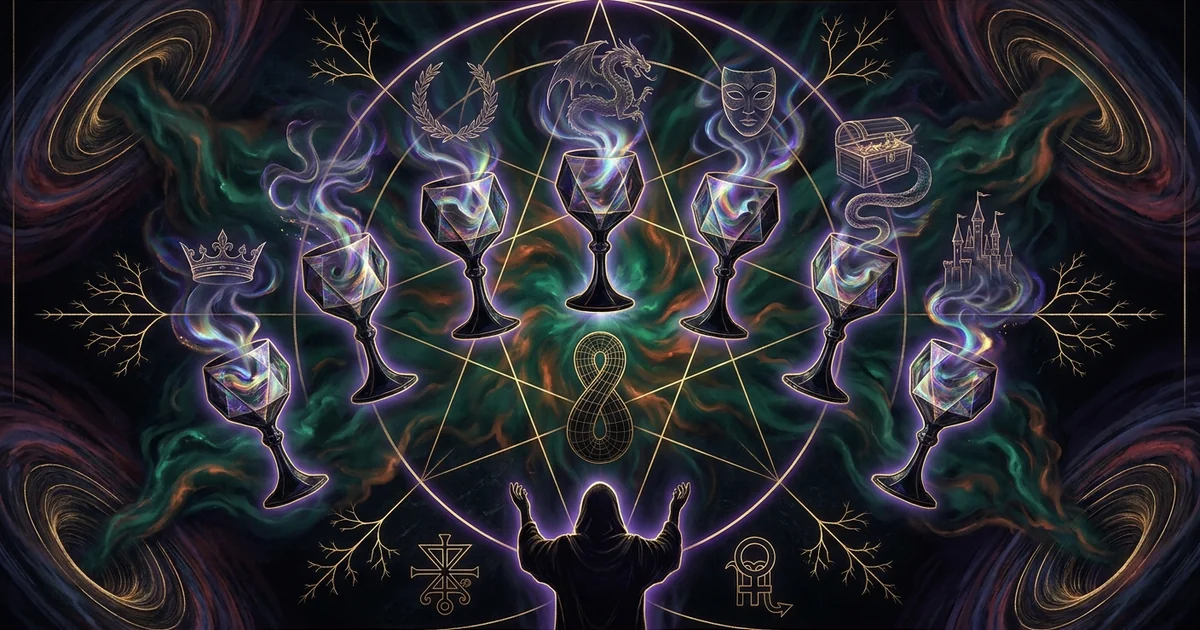
Seven of Cups: Illusions, Astral Desires and Mirage
Archetypal Thesis & Systemic Paradigm: The Phantasmagoric Nexus of Netzach in Briah
The Seven of Cups occupies an anomalous and destabilizing juncture within the architecture of the Western Mystery Tradition. Rather than modeling the tranquil confluence of intuitive wisdom commonly attributed to the suit of cups symbolism, this minor arcanum operationalizes the catastrophic threshold where uncontained feeling regresses into dynamic illusion. The structural root of this destabilization resides in the descending emanational mechanics of the Tree of Life. In Kabbalistic cosmology, the four worlds describe a progressive condensation of divine energy: Atziluth (Archetypal/Fire), Briah (Creative/Water), Yetzirah (Formative/Air), and Assiah (Material/Earth). When the fluid, receptive potencies of the water element descend into the Creative World of Briah, they require strict structural containment to sustain their coherent generative capacity.
At the level of the sixth Sephirah (Tiphereth), that containment is harmoniously established through solar equilibrium and aesthetic balance, as observed in the transition from the six of cups meaning. However, as the emanational current plunges down the Pillar of Mercy into Netzach, the sphere of victory, this Briatic cohesion fractures. Netzach is the seat of the vegetative soul, raw emotional instinct, visceral libido, and the aesthetic-erotic impulse. When the unformed waters of Briah flood the unbounded emotional vessel of Netzach without the rigorous, critical counterbalance of the intellectual Sephirah Hod (Splendor) across the central axis, form ceases to crystallize. The outcome is not organic manifestation, but an unanchored phantasmagoria: an over-saturation of the astral plane where subjective desires spontaneously project outward, manufacturing a kaleidoscopic architecture of phantom potentials.
Netzach and the Dissolution of Form in the Creative World
In this archetypal terrain, the generative faculty of Briah undergoes profound entropic dispersion. Water, by its primordial physical and metaphysical definition, lacks intrinsic structural permanence; it demands an external matrix or vessel to determine its topography. Netzach does not provide this boundary. Governed by the raw desire-nature and the uncurbed pursuit of experiential union, Netzach acts as an amplifier of emotional currents rather than an architect of form. Consequently, the seven chalices suspended in the ethers do not represent grounded physical manifestations or sustainable psychological commitments; they represent unstable astral precipitates.
The descent into Netzach causes the cups suit to mutate from an engine of mutual emotional reciprocity into a theater of isolated, speculative fantasy. Consciousness becomes untethered from the material baseline of Assiah and the ordering logic of Yetzirah. Within this zero-gravity state of awareness, possibilities bifurcate infinitely without the resistance of physical friction. The libido, denied a definitive earthly or creative outlet, bends backward upon itself, generating autonomous psychic mirages that masquerade as imminent realities. The water element here is stagnant yet turbulent, an astral swamp in which archetypal seeds ferment into distorted, alluring mutations.
Six of Cups: Tiphereth in Briah (Sol in Scorpio)
- Astrological Engine: The Sun operating within fixed water; radiance penetrating the psychic depths.
- Qabalistic Locus: The harmonic center of the Tree of Life, balancing the horizontal and vertical vectors of force.
- Phenomenological Reality: Rooted in memory, harmonic ancestral continuum, and reciprocal, balanced emotional exchange.
- Psychic Dynamic: Integration of past experiences into an authentic, centered persona without ego-fragmentation.
Seven of Cups: Netzach in Briah (Venus in Scorpio)
- Astrological Engine: Venus operating in its detriment; seductive, possessive, and obsessive astral desire.
- Qabalistic Locus: The base of the Pillar of Mercy; force expanding dynamically without the architectural restraint of Hod.
- Phenomenological Reality: Entangled within ephemeral mirages, speculative projections, and ungrounded hyper-possibility.
- Psychic Dynamic: Radical psychic inflation, projective identification, and the paralysis of executive will via sensory overload.
The Astral Screen: Projective Identification and Psychic Inflation
The phenomenological dilemma of the Seven of Cups is the dilemma of the astral screen. In classical Hermetic psychology, the astral plane acts as an ultra-sensitive, plastic reflective medium—what the post-Renaissance occultists termed the astral light. This medium instantly adopts the contours of whatever emotional charge or latent desire is directed toward it by the human psyche. When a seeker encounters this dynamic, projective identification operates at maximum potency: the internal contents of the unconscious—fears, grandiose self-images, erotic hungers, and dreads—are thrust outward into the perceptual field and perceived as external opportunities, mandates, or threats.
This dynamic initiates acute psychic inflation. The ego, mistaking the kaleidoscopic panorama of the astral screen for an inventory of actionable material choices, expands beyond its empirical boundaries. It entertains the intoxicating fantasy of omnipotence: that it may possess simultaneously the castle of social dominion, the serpent of secret gnosis, the crown of civic sovereignty, and the radiant jewel of transcendent illumination. Because none of these visions have yet been subjected to the pruning knife of physical action—which inevitably necessitates the sacrifice of all paths save one—the consciousness remains suspended in a state of suspended animation. The Seven of Cups illustrates the profound spiritual paralysis that arises when the psyche prioritizes the infinite, low-cost consumption of astral mirages over the rigorous, high-cost actualization of material reality.
Classical Provenance & Textual Lineage: From Book T to the Rider-Waite Codification
To trace the historical formulation of the Seven of Cups is to examine the systematization of Hermetic divination executed by the Hermetic Order of the Golden Dawn during the late nineteenth century. In their seminal instructional compendium, The Golden Dawn Cipher Manuscripts & The Book T, S. L. MacGregor Mathers and W. W. Westcott synthesized astrology, Kabbalah, and the Tarot into a unified divinatory grammar. Departing from the simplistic, often moralizing playing-card interpretations of the Continental tradition (such as those formulated by Etteilla), Mathers assigned the Seven of Cups the technical title of the “Lord of Illusionary Success.”
“The Seven of Cups: The Lord of Illusionary Success. Attribution: Netzach in the World of Briah; Venus in Scorpio (Third Decan: 20° to 30° Scorpio). Description: Seven Cups are arranged in two ascending triads, with one cup placed lowest and centrally. They are represented as emerging from the mist or clouds, all open and overflowing, yet no water reacheth the Earth. Divinatory Meanings: Possible victory, but of an unstable and temporary nature; deceit; illusions; promises unfulfilled; intoxication; lust; drunkenness; error of judgment; day-dreaming; violence from passion; insolence of success; reliance on that which cannot stand.” — S. L. MacGregor Mathers & W. W. Westcott, The Book T (1888)
The title Lord of Illusionary Success establishes the card’s essential operational principle: any triumph achieved under its energetic influence is illusory, fragile, or founded upon corrupted assumptions. Aleister Crowley, drawing directly from this lineage in The Book of Thoth (1944), pushed this analysis to its logical extreme. Crowley designated the card simply as “Debauch,” arguing that the combination of the number seven with the element of water represents the ultimate putrefaction of the initial, pure Briatic emanation: “The Seven of Cups is called Debauch. This card is the extreme balance of the element of water. Here, water has lost its purity; it is stagnant, foul, and full of poison… It is the balance of illusion, deceit, and false promise.”
The Golden Dawn Formula: The Lord of Illusionary Success
The architectural logic of the Golden Dawn formula depends upon the structural properties of the number seven within their cosmology. Seven represents a structural break from the self-contained harmony of the six. The six minor arcana reflect the central, harmonizing influence of Tiphereth, which mediates the upper supernal triangles down into direct awareness. The transition to the seven drops below the critical threshold of the Paroketh—the veil separating the higher self from the lower, personality-driven consciousness. Consequently, the Seven of Cups registers the shock of the Briatic water crossing this veil and spilling into the lower astral circuitry without the organizing principle of solar self-awareness.
The designation of “Illusionary Success” underscores that the card does not represent outright material catastrophe—a condition reserved for the disintegrative currents of the Five of Cups or the absolute physical exhaustion of the Ten. Rather, it models the far more insidious danger of pseudo-realization. Under its influence, the seeker experiences the somatic and neurochemical rewards of achievement entirely through the theater of the imagination. Because the internal simulation is so saturated with emotional charge, the nervous system reacts as though the objective has been won, thereby draining the practitioner of the motivational tension required to manifest that vision in the physical world of Assiah.
Decanic Heritage: Venus in the Third Decan of Scorpio
The structural underpinning of this illusionary state is derived from the Scorpio decanates. Operating within the classical system of the Chaldean order, the thirty degrees of the sign of Scorpio are dissected into three distinct decanic intervals, each governed by a specific planetary ruler:
- First Decan (0°–10° Scorpio): Mars in Scorpio (Five of Cups: Loss in Pleasure)
- Second Decan (10°–20° Scorpio): Sun in Scorpio (Six of Cups: Pleasure)
- Third Decan (20°–30° Scorpio): Venus in Scorpio (Seven of Cups: Illusionary Success)
The placement of Venus within the third decan of Scorpio introduces an acute planetary tension. Venus represents the archetypal drive toward harmony, tactile balance, connection, beauty, and systemic coherence. Scorpio, an astrological archetype under the classical rulership of Mars and the modern rulership of Pluto, governs the fixed, chthonic, underworld processes of decomposition, emotional obsession, catharsis, and instinctual regeneration.
When Venus is forced to articulate its relational, harmonious drive within the final, most extreme degrees of this fixed water sign, its native gentleness is subverted. The desire-nature does not dissipate; instead, it is subjected to the concentrated, obsessive intensity of Scorpio. Desires become all-consuming, fixated, and prone to mythologizing their targets. The third decan of Scorpio represents the culmination of this cycle: desire has exhausted its direct avenues of emotional regeneration and mutates into hyper-saturated aestheticization, leading directly to the mirage of the seven chalices.
Chaldean Decanic Sequence of the Water Element:
Cancer I (Venus)   --> Cancer II (Mercury) --> Cancer III (Moon)
Scorpio I (Mars)   --> Scorpio II (Sun)   --> Scorpio III (Venus) <-- [Seven of Cups]
Pisces I (Saturn)  --> Pisces II (Jupiter) --> Pisces III (Mars)
Smith’s Iconography: The Seven Apparitions as Astral Typologies
In 1909, artist Pamela Colman Smith, working under the direct editorial instruction of Arthur Edward Waite, radically revised the presentation of this card. In the historic Tarot of Marseilles tradition, the Seven of Cups was rendered merely as seven decorated vessels framed by symmetrical, vegetal flourishes—an abstract design revealing little of its deep psycho-spiritual perils. Waite and Smith transformed this geometric arrangement into one of the most psychologically penetrating images in Western esoteric art.
+-------------------------------------------------------------+
|               THE SEVEN VISIONS OF SMITH (1909)             |
|                                                             |
|  [Cup 1: Mask]      [Cup 2: Shroud]      [Cup 3: Serpent]   |
|  Ego / Persona      Transcendence        Chthonic Wisdom    |
|                                                             |
|  [Cup 4: Citadel]                  [Cup 5: Jewels]          |
|  Earthly Power                     Material Wealth          |
|                                                             |
|  [Cup 6: Skull-Laurel]             [Cup 7: Chimera]         |
|  Posthumous Fame                   Destructive Drive        |
+-------------------------------------------------------------+
Smith positions a dark, silhouetted human figure in the immediate foreground, observed strictly from behind. This visual choice forces the viewer to occupy the phenomenological perspective of the seeker: we cannot see the face of the figure, for the figure has surrendered all individualized facial identity to gaze upon the astral screen. The figure stands before a dense, undulating bank of gray clouds that completely obscures the horizon, severing the upper space of the card from the terrestrial plane below. Suspended within these ethereal formations are seven golden chalices, each bearing an autonomous, archetypal apparition:
- The Radiant Mask/Bust: The illusion of superficial beauty, social persona, and the idealized self-image; the seduction of narcissism.
- The Shrouded, Luminous Figure: The mirage of premature spiritual illumination, pseudo-transcendence, and the unearned attainment of divine gnosis.
- The Coiled Serpent: The chthonic archetype of hidden wisdom, instinctual dread, and toxic kundalini currents rising without balance.
- The Citadel/Castle on a Hill: The drive for territorial dominion, structural security, and secular power over the social collective.
- The Chalice Overflowing with Jewels: The seduction of boundless material wealth, luxury, and the false equation of physical opulence with spiritual worth.
- The Wreath of Laurel Framing a Skull: The mirage of worldly glory, fame, and temporal conquest, shadowed by the inevitable reality of mortality and decay.
- The Horned Chimera/Dragon: The eruption of primeval, untamed astral libido, representing uncontrolled animalistic passion and aggressive drives.
Waite himself notes in The Pictorial Key to the Tarot (1910) that these images represent “strange chalices of vision, but the images are more especially those of the fantastic spirit.” He notes that while the card appears to promise gifts of fortune, it is fundamentally an index of “fairy favours,” riches that turn to dead leaves the moment they are dragged across the threshold into waking reality.
Structural Mechanics & Symbolic Geometry: The Decanic and Qabalistic Architecture
The internal mechanics of the Seven of Cups can only be fully unlocked by synthesizing its astrological and Qabalistic coordinates into a unified systemic map. Within this structure, the card does not represent an arbitrary collection of disparate symbols, but a precise topological model of consciousness operating under the conditions of perceptual distortion.
TREE OF LIFE COORDINATES: SEVEN OF CUPS
[ KETHER ]
    |
[ CHOKMAH ] ------- [ BINAH ]
    |                   |
[ CHESED ] -------- [ GEBURAH ]
    \                 /
     [ TIPHERETH (Sol) ]  <-- Six of Cups: Sol in Scorpio
             |
    +--------+--------+
    |                 |

[ NETZACH (Venus) ]  [ HOD ]  <– Seven of Cups: Netzach in Briah
\                 /         (Venus in Scorpio)
[ YESOD (Luna) ]
|
[ MALKUTH (Earth) ]
Astrological Dynamics: The Debilitation of Venus in Scorpio
In traditional astrological dignity tables, Venus finds its detriment in Scorpio, the sign polarized against its domicile of Taurus. Where Taurus provides a calm, sensory, earthly matrix in which Venusian harmony manifests as physical stability and serene aesthetic appreciation, Scorpio subjects Venus to relentless, fixed emotional cross-currents.
In the third decan of Scorpio (20°00’ to 29°59’), this tension reaches its breaking point. As noted by the medieval Astrologer Ibn Ezra and codified into the Picatrix, the final face of Scorpio is associated with warfare, restiveness, insatiable desire, and the unearthing of hidden poisons. Venus here cannot rest; it is compelled to seduce, to dramatize, to pursue the impossible, and to extract profound emotional experiences from the ether at any cost.
The planetary ruler of the decanate (Venus) is inherently at war with the seasonal and elemental environment of Scorpio. The outcome is not organic fertility, but an aestheticized, theatrical presentation of desire. The seeker falls in love with the idea of an outcome, the aesthetic of a path, or the spectacle of an achievement, entirely severed from the grueling operational labor required to actualize it.
The Septenary Geometry: Cloud Boundaries and Vessel Suspensions
The presence of the clouds in the Seven of Cups is not merely an artistic convention to indicate floating objects; it represents an epistemological partition. In the tripartite psychology of the Kabbalah, the soul is divided into:
- Neshamah: The higher, spiritual intuition linked to the Supernal Triad.
- Ruach: The rational mind, the intellect, the faculty of moral discernment situated within the Sephiroth from Chesed to Yesod.
- Nephesh: The instinctual, animalistic, sensory soul grounded directly in the physical organism (Malkuth).
The clouds in the Seven of Cups materialize at the exact border where the Ruach fails to discipline the Nephesh. Because the rational intellect (Ruach) has relaxed its analytical vigilance, the instinctual animal soul (Nephesh) is permitted to paint its raw cravings onto the screen of the imagination. The clouds represent the vaporous, humid exhalations of this instinctual consciousness. They act as an impenetrable optical boundary: they prevent the clear light of the higher intellect (which descends from the Supernals through Tiphereth) from penetrating down to illuminate the landscape, while simultaneously shielding the human silhouette from the corrective, sobering reality of the physical earth below.
The suspension of the vessels within this vaporous medium signifies that none of the seven potentials are grounded in the Sephirah Malkuth. In physical architecture, an object must displace mass and rest upon a structural foundation; in esoteric architecture, an intention must be anchored in Malkuth through the medium of decisive physical action. The vessels of the Seven of Cups remain entirely suspended, defying the gravity of material reality. They are conceptual simulations running in an isolated cognitive loop, consuming psychic energy without producing tangible work.
Deciphering the Seven Visions: Chthonic Instinct to Transcendental Mirage
The seven apparitions detailed by Smith are not an arbitrary assembly of folkloric motifs; they constitute a systematic taxonomy of human ego-attachments. They can be divided into two primary vectors: the mundane-material attachments (the left and central registers) and the transpersonal-numinous attachments (the right and upper registers).
Taxonomy of the Seven Chalices:
---------------------------------------------------------------------
Chalice Content        Plane           Psychological Vector
---------------------------------------------------------------------
1. Radiant Mask        Mundane/Ego     Narcissism, Social Persona
2. Shrouded Figure     Transpersonal   Pseudo-Gnosis, Spiritual Inflation
3. Coiled Serpent      Chthonic        Occult Obsession, Taboo Knowledge
4. Mountain Citadel    Mundane/Power   Territorial Ambition, Temporal Dominion
5. Jeweled Chalice     Mundane/Wealth  Greed, Material Gluttony
6. Laurel with Skull   Mundane/Status  Vanity, Craving for Immortal Fame
7. Horned Chimera      Chthonic/Shadow Primal Aggression, Unchecked Libido
---------------------------------------------------------------------
The leftward apparitions—the Castle and the Jewels—appeal directly to the survival instincts of the lower ego. The Castle promises absolute invulnerability, a fortress within which the fragile self can hide from the unpredictability of existence; the Jewels promise frictionless gratification and power through the accumulation of resource tokens. Both represent the material delusions that lead individuals to squander their existential time chasing symbols of security rather than security itself.
The rightward apparitions—the Serpent and the Chimera—are chthonic, tapping into the instinctual, primordial currents of the unconscious. The serpent is the ancient initiator, promising access to subterranean currents of esoteric wisdom, but threatening the unprepared mind with venom and madness. The chimera, spitting fire, represents the untamed volcanic power of the Id, the drive to dominate, destroy, and consume without ethical restraint.
The upper tier—the Mask, the Shrouded Entity, and the Skull within the Laurel—addresses the subtler, more pernicious delusions of identity and meaning. The Mask demonstrates the trap of the social self: an individual can become so entranced by the curated face they present to the world that they dissociate entirely from their authentic internal baseline. The Skull framed by the victor’s laurel serves as a classical memento mori, reminding the observer that the pursuit of earthly legacy and public acclaim is a project doomed to dissolve into dust.
Finally, the Shrouded Figure presents the supreme hazard of the esoteric path: spiritual pride. The veil over the entity signifies that the seeker cannot see what they are worshiping; they project their own need for divinity onto an unformed phantom, falling victim to the illusion of unearned spiritual mastery.
Psychological Dynamics & Operational Praxis: Navigating the Hall of Mirrors
When viewed through the lens of modern analytical psychology, the Seven of Cups serves as a precise diagnostic blueprint for autonomous complex activation and ego-diffusion. The card captures the exact psychological condition that occurs when the ego-complex is subordinated to the contents of the collective unconscious, resulting in profound functional disequilibrium.
Active Imagination vs. Dissociative Escapism: A Jungian Dissection
Carl Gustav Jung, in his rigorous investigations into the dynamics of the psyche, established a fundamental distinction between the clinical technique of active imagination and the pathological regression into fantasy-thinking. The Seven of Cups models fantasy-thinking pushed to its pathological limits. In The Structure and Dynamics of the Psyche (Collected Works Vol. 8), Jung differentiates between “directed thinking”—an intentional, verbal, highly adapted cognitive mode that expends psychic energy to align with outer reality—and “passive thinking” or fantasy-thinking, which is non-directed, associative, and propelled by unconscious complexes.
“Directed thinking is speech for others, or rather, an internal monologue adapted to external reality… It is exhausting, exhausting because it constantly demands effort, adaptation, and adherence to objective criteria. Fantasy-thinking, on the other hand, is effortless, turns away from reality, sets free subjective wishes, and is wholly unproductive so far as outer reality is concerned… It does not adapt to the world, but adapts the world to one’s own wishes; it operates in images, drifting through memory and desire.” — C.G. Jung, The Structure and Dynamics of the Psyche, CW 8, ¶17–19
Active imagination requires an alert, grounded, and courageous ego-consciousness that enters into dialogue with the emergent images of the unconscious without being consumed by them. In active imagination, the practitioner maintains an unyielding stance, demanding accountability from the figures that arise and holding fast to ethical and empirical reality.
In the Seven of Cups, this critical ego-stance has completely collapsed. The dark silhouette in Smith’s illustration is entirely passive, transfixed by the visions. There is no active dialogue, no testing of the spirits, and no attempt to hold the images accountable to the real world. The individual is not engaging the archetypes; they are being hypnotized by them. This is the precise mechanism of dissociative escapism: using the inexhaustible imagery of the internal world to evade the friction, disappointments, and demands of physical embodiment.
Analysis Paralysis: The Entropy of Hyper-Possibility
In the operational sphere of contemporary human action, the Seven of Cups manifests as the paralyzing state of hyper-possibility, colloquially termed “analysis paralysis.” Within modern consumer and digital culture, the psyche is exposed to a continuous barrage of simulated outcomes, lifestyle options, and potential trajectories. The nervous system, unequipped for such an influx of infinite simulated alternatives, reacts with profound ambivalence.
THE ENTROPIC CYCLE OF HYPER-POSSIBILITY
[ Infinite Simulated Potentials ]
              |
              v
   [ Over-Saturation of Libido ]
              |
              v
   [ Dread of Eliminating Paths ]
              |
              v
       [ Will Paralysis ]
              |
              v

[ Psychic Entropy / Dissipation into Fantasy ]
Each cup presented by the card represents a potential timeline. To choose the Castle means abandoning the pursuit of the Serpent; to claim the Jewels demands relinquishing the Shrouded Figure of spiritual reclusion. Because the unconscious fears the grief inherent in closing off paths, the individual refuses to select any of them. By choosing none, the ego preserves the seductive, infantile fantasy that it might still have all of them.
This hesitation, however, carries a devastating energetic cost. In psychoanalytic terms, the preservation of unchosen potentials leads to psychic entropy: the libido, rather than flowing into the world to enact work and build external structures, dissipates into internal loops of daydreaming and perpetual preparation. The individual reads another treatise, draws another spread, plots another unexecuted strategy, lingering in an adolescent state of perpetual latency.
Divinatory Remediation: Diagnostic Topography within Spreads
When the Seven of Cups appears in a professional divinatory consultation, its primary functional role is not to describe an external event, but to issue a critical warning concerning the querent’s cognitive and perceptual architecture. Its presence reveals that the querent’s current assessment of their situation is fundamentally untrustworthy, tainted by wishful thinking, suppressed anxiety, or seductive misdirection.
DIAGNOSTIC VECTORING OF THE SEVEN OF CUPS

Surrounding Cards                      Operative Dynamic / Diagnostic Remediation
------------------------------------------------------------------------------------------------
Swords (Air) Dominance                 Intellectualization, rationalizing delusion;
                                       Remedy: Ruthless empirical fact-checking.

Disks/Pentacles (Earth) Dominance      Fantasy colliding with physical consequence;
                                       Remedy: Immediate logistical grounding, budgeting, physical action.

Wands (Fire) Dominance                 Scattering of creative passion across too many projects;
                                       Remedy: Strict prioritization; eliminate six to preserve one.

Cups (Water) Dominance                 Total emotional/astral flooding, severe escapism;
                                       Remedy: Psychological quarantine, therapeutic containment.
To remediate the Seven of Cups, the metaphysical cartographer must look to the cards that surround it to locate the exit vector:
- If flanked by the element of Air (Swords): The remedy lies in ruthless intellectual analysis. The querent must cut through their own poetic rationalizations using the sword of objective fact, subjecting every assumption to empirical verification.
- If flanked by the element of Earth (Pentacles): The diagnostic calls for immediate grounding in physical form. The querent must be instructed to step away from speculative planning and perform mundane, tangible, embodied tasks—auditing finances, organizing material spaces, or executing physical labor.
- If flanked by the element of Fire (Wands): The paralysis stems from scattered will. The remedy is the ruthless sacrifice of lower-priority desires: the querent must actively slay six of the cups in order to pour the entirety of their focused life force into the single remaining vessel.
- If deep within a cluster of Water (Cups): The diagnosis indicates complete emotional flooding. Here, the querent is drowning in the astral swamp, and the only viable course is to halt all external decision-making until their underlying emotional equilibrium is stabilized.
Philosophical Synthesis & Macrocosmic Correspondence: Maya, Astral Light, and Will
Beyond its personal, psychological implications, the Seven of Cups serves as a macrocosmic treatise on the ontological nature of reality. It stands as an absolute visual codification of the Hermetic doctrine of the Astral Light and its structural parallel within Eastern metaphysics: the doctrine of Maya.
The Doctrine of the Astral Light: Lévi’s Great Magical Mirror
In his foundational work Dogme et Rituel de la Haute Magie (1856), Éliphas Lévi articulated the first modern, coherent occult theory of the Astral Light. Lévi described this agency not as an intellectual abstraction, but as an all-permeating, plastic, dynamic, universal medium of fluid light that retains the energetic impression of all thoughts, words, and deeds throughout cosmic time.
- Title: The Lord of Illusionary Success
- Element: Water of Water (Briatic fluidity cascading through astral mechanics)
- Astrological Coordinates: Third Decan of Scorpio (20°00’ - 29°59’ Scorpio)
- Chaldean Decan Planetary Ruler: Venus
- Sephira: Netzach (The Seventh Sphere: Victory, Desire, Vegetative Emotion)
- Four-Color Scale Attributions:
- Atziluth: Pure, radiant Amber
- Briah: Emerald green
- Yetzirah: Brilliant greenish-yellow
- Assiah: Olive green, flecked with gold
- Primary Pitfall: Dissociative inflation, surrender to astral simulacra, analysis paralysis.
Lévi warned that this Astral Light is fundamentally amoral and mirrors precisely whatever vibration is projected into it. For the undisciplined human mind, the Astral Light acts as a dangerous seducer:
“The Astral Light is the blind force which souls must overcome if they would be liberated from the chains of earth; for if they do not, they will be absorbed by the same fatal power which created and preserved them… It is the fatal serpent, the seducer of humanity, presenting forever the fruit of illusion to our voracious appetite.” — Éliphas Lévi, Dogme et Rituel de la Haute Magie (1856)
The Seven of Cups depicts this universal mirror in its full operational display. The apparitions rising from the vessels are not entities possessing independent spiritual reality; they are astral reflections manufactured by the intersection of the collective field with the individual’s unexamined desires. The magician who does not possess ironclad mental control is swept away by these reflections, confusing the ripples in the mirror for self-existent reality. The card is an esoteric demonstration of what happens when the human will fails to master the Astral Light: instead of directing the light to coagulate into intentional form, the will is paralyzed by the light’s passive reflections.
Maya and the Dissolution of Illusion in Vedantic and Hermetic Parallelism
This Hermetic formulation intersects seamlessly with the Vedantic concept of Maya—the cosmic illusion that the world of multiplicity, individual differentiation, and transient forms possesses an ultimate, independent reality. In Advaita Vedanta, Maya operates via two distinct energetic powers:
- Avarana-Shakti (The Veiling Power): The force that obscures the fundamental non-dual substrate of reality (Brahman).
- Vikshepa-Shakti (The Projecting Power): The active force that projects the multi-layered illusion of names, forms, desires, and dualities upon that obscured background.
The Seven of Cups precisely illustrates these dual mechanisms. The cloud boundary represents Avarana-Shakti, veiling the authentic, clear light of being. The seven chalices represent Vikshepa-Shakti, vigorously projecting distinct, alluring forms onto that vaporous screen to capture and entangle the observer’s awareness.
The Western esoteric system, like the Vedantic tradition, does not view the encounter with Maya as an unmitigated error, but as an essential initiatory crucible. One cannot attain true discernment (Viveka) without first traversing the hall of mirrors. The Seven of Cups represents the necessary failure of naive desire: the soul must be allowed to taste the emptiness of phantom achievements so that it may finally abandon its fixation on external projections and turn its awareness inward toward the true source of consciousness.
Transmuting Mirage into Vision: From Netzach’s Dispersion to Tiphereth’s Focus
The resolution of the Seven of Cups requires the deliberate transmutation of its energies, shifting the center of psychic gravity from the dispersion of Netzach back up to the solar equilibrium of Tiphereth, and onward toward the rigorous, decisive transition into the eight of cups meaning. In the Eight of Cups (Saturn in Pisces: Indolence / Abandonment of Success), the seeker finally turns their back upon the vessels that once captivated their imagination, taking up the pilgrim’s staff to begin the grueling, upward ascent into the barren mountains.
THE DIALECTICAL PROGRESSION OF THE BRIATIC WATERS
[ Six of Cups: Sol in Scorpio ]
(Harmonic Balance / Tiphereth / Integrated Memory)
|
v
[ Seven of Cups: Venus in Scorpio ]
(Astral Dispersion / Netzach / Illusionary Success)
|
v
[ Eight of Cups: Saturn in Pisces ]
(Renunciation of the Mirage / Hod-Yesod Transition / Authentic Search)
To cross the threshold between the Seven and the Eight of Cups, the practitioner must execute a decisive act of will. This transmutation involves three distinct Hermetic operations:
- The Recognition of Emptiness: The seeker must step outside the field of the card and mentally declare: “These forms possess no life except the life I pour into them.” This simple act of psychological dis-identification breaks the hypnotic spell of the astral screen.
- The Severing of the Vessel Links: Rather than attempting to actualize all seven potentials simultaneously, the practitioner intentionally drops the contents of the vessels back into the raw, unformed waters of the subconscious, acknowledging that most were merely symptomatic compensations for unacknowledged emotional voids.
- The Solar Consolidation: The dispersed libido is reclaimed and drawn upward along the path of Peh or the central pillar, realigning with the single-pointed will of Tiphereth. The vision shifts from being an intoxicating theater of passive consumption to an actionable, disciplined blueprint for authentic creation.
Frequently Asked Questions: Analytical Clarifications on the Seven of Cups
How Does the Seven of Cups Diverge from Key XVIII (The Moon)?
While both cards operate within the nocturnal, watery, and perceptual domains of the psyche, they delineate radically different regions of the unconscious. Key XVIII (The Moon) is a Major Arcanum attributed to the Hebrew letter Qoph, which corresponds to the path linking the material kingdom of Malkuth directly to the astral realm of Netzach, bypassing the balance of Tiphereth. The Moon represents the primordial, archaic, and somnambulistic depths of the collective unconscious. It depicts biological evolution, visceral terror, the dark night of the soul, and the primal ancestral instincts that emerge from the pre-human memory banks of the species. Its perils are madness, deep evolutionary dread, and dissolution into the cosmic womb.
The Seven of Cups, by contrast, is a Minor Arcanum operating strictly within the personal astral matrix. It does not deal with primordial terrors, but with personal desires, daydreams, ego-rationalizations, and self-indulgent fantasies. The visions in the Seven of Cups are seductive and intoxicating rather than horrific; they represent the glamorous traps of the personal shadow and the undisciplined imagination. While The Moon is the deep ocean trench wherein primeval monsters dwell, the Seven of Cups is a shimmering mirage on the surface of an astral pond, engineered by the seeker’s own cravings.
Does the Seven of Cups Always Indicate Deception or Failure?
No card within the Hermetic system carries an exclusively negative moral designation. The Seven of Cups is a structural indicator of high imaginative bandwidth and creative potency. In artists, writers, and speculative architects, the presence of the Seven of Cups often heralds an era of extraordinary ideational abundance: it reveals that the psychic matrix is pregnant with an array of possibilities, creative narratives, and stylistic options.
The card only indicates failure when the practitioner confuses ideation with actualization. The creative person must utilize the Seven of Cups as a dynamic brainstorming chamber, an astral drafting table where multiple iterations of a design can be explored without material penalty. The catastrophe occurs only when the creator remains permanently seated at the drafting table, celebrating the preliminary sketches as if they were finished monuments, thereby falling victim to the card’s titular snare: Illusionary Success.
What Operational Techniques Ground the Astral Dispersion of This Card?
When an individual or a magical operation has been seized by the entropic dispersion of the Seven of Cups, the introduction of more spiritual, watery, or speculative practices serves only to exacerbate the pathology. To dispel this mirage, one must introduce the deliberate occult counterweights of Saturn (Structure, Boundary, Time, Limitation) and Mercury (Critical Intellect, Analytical Discrimination, Precise Communication):
+-------------------------------------------------------------------+
|               OPERATIONAL PROTOCOLS FOR REMEDIATION               |
|                                                                   |
|   1. The Rule of Single Commitment (Saturnian Elimination)        |
|      Select exactly one cup; declare the other six explicitly     |
|      dead for a cycle of ninety days.                             |
|                                                                   |
|   2. The Demanding of the Seal (Mercurial Authentication)         |
|      Subject every subjective impulse to empirical verification;  |
|      require physical evidence before allocating psychic credit.  |
|                                                                   |
|   3. Somatic Grounding in Assiah (Malkuth Anchoring)              |
|      Force the nervous system out of astral loop processing       |
|      via physical labor, heavy exercise, and material metrics.    |
+-------------------------------------------------------------------+
By imposing definitive temporal limitations, demanding measurable evidence of progress, and actively rejecting the luxury of hypothetical options, the practitioner dissolves the vaporous clouds of Netzach. The astral projections collapse, the water returns to its sacred, clear baseline, and the conscious executive will steps forward from the shadows to build what is real upon the bedrock of the physical earth. :::