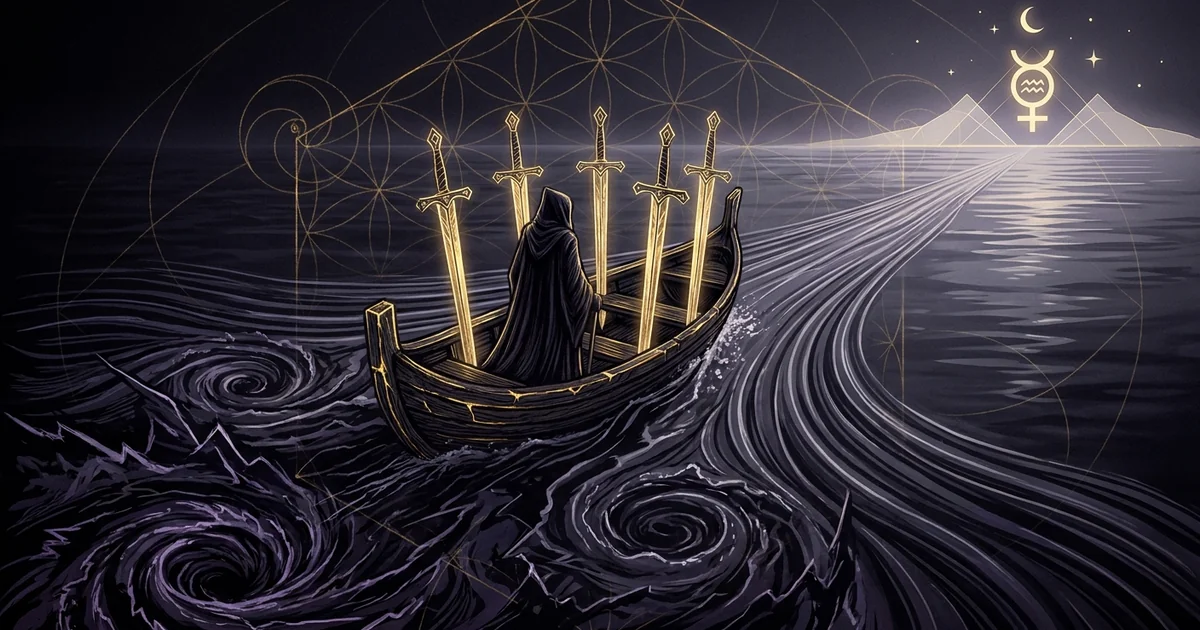
Six of Swords: Passage Across Waters to Peaceful Shores
Archetypal Thesis & Systemic Paradigm: The Liminal Mechanics of Tiphareth in Yetzirah
Thermodynamic Dissipation of Mental Entropy
The Six of Swords operationalizes the harmonic stabilization of the solar center, Tiphareth, within the turbulent psychic territory of Yetzirah, the Kabbalistic World of Formation. In classical psycho-cosmology, Yetzirah is the domain of the Ruach—the intellectual, egoic mechanism governed by conceptual differentiation, linguistic modeling, and discursive thought. When unrestrained, the volatile characteristics of the swords suit push this cognitive apparatus toward severe ideological conflict, a state formalized in the immediate precursor to this arcanum, the Five of Swords (Geburah in Yetzirah). Where the Five represents asymmetric rupture, zero-sum intellectual conquest, and severe psychic entropy (further articulated in the study of /tarot/five-of-swords-meaning), the Six intervenes as a homeostatic dampening mechanism.
It executes a thermodynamic deceleration, drawing the conscious ego away from self-reinforcing cognitive dissonance and routing it toward systemic coherence. This process does not represent triumphant ecstasy; rather, it manifests the sobering realization that psychic survival requires the immediate cessation of ideological warfare. The mental system ceases its futile expenditure of energy on insoluble conflicts, shifting its thermodynamic state from volatile friction to laminar flow.
Within the operational dynamics of the psyche, this transition models the principle of minimum entropy production. The agitated intellect, exhausted by the pyrrhic victories and bitter humiliations of the martial fifth sphere, accepts the structural gravity of Tiphareth. This sixth Sephirah acts as a gravitational anchor, drawing the disparate fragments of psychic energy back toward a central axis of meaning. The passage across waters is therefore an epistemological necessity: an orderly withdrawal from an exhausted theater of mental operations toward a cognitive landscape capable of sustaining restorative equilibrium.
                  [ SEPHIRA 5: GEBURAH ]
                (Acute Mental Entropy / Conflict)
                            │
                            ▼
              [ PSYCHIC ENERGY DISSIPATION ]
             (Withdrawal of Egoic Projections)
                            │
                            ▼
                  [ SEPHIRA 6: TIPHARETH ]
               (Harmonic Stabilization / The Six)
The Six as Equilibrium Within the Air Element
Within the elemental taxonomy of Hermetic philosophy, the air element possesses an intrinsically volatile, separating quality. Air divides, categorizes, and abstracts; left unmitigated by solar integration, its hyper-rational operations induce dissociation and severe nervous tension. In the architecture of the Decanates, the Six of Swords is positioned where this turbulent gaseous medium undergoes crystalline cooling. As detailed in the /tarot/tiphareth-minor-arcana-synthesis, the number Six represents the geometric hexagram, the union of opposing forces held in precarious balance.
Applied to the volatile nature of the swords suit, this structural equilibrium strips the intellectual faculty of its aggressive, piercing mandate. The blade ceases to function as an instrument of excision; instead, it is driven vertically into the wood of the vessel, transformed into structural ballast and an aerodynamic rudder.
The psychological apparatus reorganizes its conceptual frameworks. In place of reactive dialectics, it deploys analytical restraint. The consciousness realizes that sustained analytical hyper-arousal produces diminishing systemic returns. To maintain structural equilibrium within the air element, the intellect must adopt a posture of strategic non-engagement. This suspension of cognitive hostility allows the psychic system to stabilize its operational baseline. The six upright blades act as mutual counterweights, canceling out their individual vectors of force to produce an emergent, contemplative stillness that shields the interior consciousness from further environmental destabilization.
Liminality: The Crossing from Rupture to Reconstruction
The transitional mechanics of the Six of Swords delineate a quintessential liminal space, an interstitial zone suspended between an unviable past and an unformed future. This threshold crossing marks the conscious withdrawal of projections from a destabilized relational or ideological field. Drawing upon analytical psychology, this operational maneuver mirrors the initial phase of active-imagination, wherein the conscious ego acknowledges its inability to resolve a complex through direct confrontation and instead yields to an unconscious, compensatory current.
The individual does not arrive immediately at the opposite shore; rather, the archetypal emphasis falls entirely upon the crossing itself. The card demands tolerance for ambiguity, silence, and emotional numbness—the somatic price exacted for cognitive survival.
Qabalistic Coordinates: Tiphareth in Yetzirah (The Ruach / World of Formation).
Astrological Attribution: Second decan of Aquarius (10°00′ to 20°00′ Aquarius).
Decan Planetary Ruler: Mercury.
Hermetic Title: The Lord of Earned Success.
Elemental Matrix: Air of Air expressing through Solar/Mercurial Equilibrium.
Dynamic Modality: Fixed Air channeled through volatile, high-frequency intellectual calibration.
During this passage, the psychic tissue, lacerated by prior conflict, enters a state of convalescence. The waters upon which the vessel floats represent the threshold of the unconscious, a medium indifferent to the ideological rigidities of the waking mind. To navigate this fluid divide, the conscious ego must submit to the slow, metered cadence of the ferryman. The six of swords tarot meaning therefore refuses the fantasy of instantaneous transformation. It offers instead a sober, pragmatic methodology for psychological survival: an evacuation of a contaminated operational theater conducted with mechanical precision, emotional restraint, and acute awareness of the long recovery ahead.
Classical Provenance & Textual Lineage: From ‘Earned Success’ to the Silent Ferryman
The Golden Dawn Decan Attribution and the ‘Lord of Earned Success’
The esoteric codification of the Six of Swords achieved its foundational precision within the late-nineteenth-century curriculum of the Hermetic Order of the Golden Dawn. In the foundational documents compiled by S. L. MacGregor Mathers and W. W. Westcott, the card received the formal title “The Lord of Earned Success.” This designation is critical to understanding the epistemological parameters of the card: the peace achieved is neither a spontaneous miracle nor an unearned dispensation of divine grace. It is the calculated, hard-won outcome of intellectual labor, strategic retreat, and conscious discipline.
   [ CRISIS OF WILL ] ──> [ SYSTEMIC ANALYSIS ] ──> [ CALCULATED RETREAT ]
  (Five of Swords)         (Hermetic Intellect)        ("Earned Success")
The Golden Dawn lineage insisted that this “success” is earned precisely because the subject has survived the severe trials of the lower mental plane. The mind has recognized its structural limitations, cast off superfluous ideological dogma, and accepted the necessity of compromise. The attribution of Tiphareth—the sphere of beauty, balance, and the mediating Christ-Consciousness or Solar Logos—within the Yetziratic sphere reveals that this success is ethical and intellectual. It marks the harmonization of the fragmented Ruach under the clear, unifying light of the central Sephirah.
“Success after anxiety and trouble; self-esteem, beauty, conceit, but sometimes modesty; patience, labour, etc., according to dignity. It shows passage from one state of consciousness to another, or from one place to another; order after disorder; journey by water.” — S. L. MacGregor Mathers, Book T: The Tarot of the Golden Dawn (1888)
The Waite-Smith Iconographic Revolution: Charon and the Stygian Ferry
When Arthur Edward Waite and artist Pamela Colman Smith reformed tarot iconography in 1909, they departed decisively from the historical Marseille pattern, which had depicted merely six interlaced curved blades surrounding a central floral motif. Smith introduced a somber, narrative composition charged with mythopoetic resonance. The visual anatomy of the Smith-Waite card evokes the archetypal myth of Charon, the psychopomp of classical antiquity who ferries the souls of the departed across the rivers Styx and Acheron into the underworld.
Waite contextualized this visual shift with characteristic nuance in The Pictorial Key to the Tarot (1910). He emphasized that while the journey constitutes an escape, it is an exodus shadowed by heavy burdens. The figures in the punt—a heavily shrouded adult and a small child—are turned entirely away from the viewer, their faces concealed. This posture signifies profound mourning, psychic interiority, and the irreversible closure of a life chapter.
The ferryman stands as an impersonal functionary, a psychological psychopomp propelling the craft forward via a long pole anchored in the riverbed. Smith’s composition visually codifies the irreversible rupture from the past: there is no indication that these passengers can or will ever return to the shore they have abandoned. The card becomes an icon of necessary exile.
The Thoth Perspective: Science, Intellectual Order, and Mercurial Clarity
In Aleister Crowley’s The Book of Thoth (1944), executed artistically by Lady Frieda Harris, the Six of Swords departs from the mournful, narrative realism of Smith and returns to geometric and metaphysical abstraction. Crowley assigned to the card the title “Science,” reflecting the exaltation of intellectual balance and systemic order under the rulership of Mercury in Aquarius.
                    ┌─── Blade 1 (Chokmah)
                    ├─── Blade 2 (Binah)
   Solar Rose-Cross ┼─── Blade 3 (Chesed)   ──> United in Symmetrical Focus
   (Tiphareth Core) ├─── Blade 4 (Geburah)
                    ├─── Blade 5 (Netzach)
                    └─── Blade 6 (Hod)
Crowley conceptualized the card as the ultimate triumph of the scientific method applied to the internal mechanics of consciousness. The chaotic, discursive cross-currents of the mind are subjected to the rigorous governance of mathematics, logic, and detached analysis. In the Thoth rendering, the hilts of six swords meet at the center of an elaborate, symmetrical hexagram, their points converging upon a golden, multifaceted rose positioned at the center of a Greek cross.
Crowley emphasized that this card demonstrates the maximum balance attainable within the intellectual sphere:
- The volatile air element is held in a state of suspended animation.
- The intellect realizes its highest function not by dominating others, but by ordering its internal perceptions.
- The Mercurial intelligence operates with diagnostic clarity, illuminating the landscape of consciousness without emotional distortion.
Crowley’s interpretation underscores that this intellectual clarity comes at the expense of instinctual warmth; it is an abstract, cool, and detached peace, highly functional yet stripped of sentimental comfort.
Structural Mechanics & Symbolic Geometry: Mercurial Air and the Fluid Divide
Astrological Architecture: Mercury in Aquarius (The Second Decan)
The astronomical and astrological engine driving the Six of Swords is the placement of Mercury within the second decan of Aquarius (spanning 10° to 20° of the fixed air sign). To comprehend the operational mechanics of this decan-rulership, one must analyze the interplay between planetary nature and zodiacal matrix, an architecture explored across the /astrology/mercury-in-aquarius-decan structural framework.
Aquarius is fixed air: an intellectual modality characterized by structural cohesion, long-range theoretical modeling, broad social vision, and cool emotional detachment. It is the sign of the ideological architect and the social engineer. Mercury, the planetary ruler of the intellect, communication, and swift translation across conceptual boundaries, finds in this Aquarian decan an exceptionally lucid theater of operation.
+--------------------------------------------------------------------------+
| DECAN ARCHITECTURE: 10° - 20° AQUARIUS                                   |
+--------------------------------------------------------------------------+
| Planetary Governor: Mercury (Hermetic Translator / Analysis)             |
| Zodiacal Matrix:    Aquarius (Fixed Air / Systemic Architecture)         |
| Mode of Operation:  Dispassionate Navigation; Algorithmic Escape Vectors|
+--------------------------------------------------------------------------+
Mercury’s inherent speed and agility are tempered by the structural discipline of Saturn (the traditional ruler of Aquarius). The volatile, scattered potential of the lower mind is concentrated into a coherent beam of analytical intent. The presence of Mercury here prevents the ideological calcification common to fixed air, allowing the consciousness to formulate a rational escape vector away from bankrupt paradigms.
Under this influence, the mind does not wallow in emotional trauma; it designs a pragmatic, logistical solution to crisis. It evaluates the relational or intellectual disaster with diagnostic impartiality, mapping the exact coordinates required to navigate away from the epicenter of disruption toward a stable cognitive harbor.
Iconographic Anatomy: The Punt, the Shrouded Figures, and Asymmetric Waters
The central iconographic tension of the Smith-Waite rendering lies in the deliberate visual asymmetry of the surrounding waters. On the starboard side of the punt—the side closest to the foreground and the abandoned shore—the water is sharply rippled, agitated into short, serrated waves. This disturbance is the hydrological echo of the Five of Swords: it represents the lingering energetic turbulence of emotional conflict, resentment, and systemic injury.
Conversely, on the port bow, directly ahead of the vessel’s prow, the water transitions into a glassy, undisturbed plane. The ferryman is actively propelling the craft across this fluid boundary, crossing the literal divide between turbulence and tranquil clarity:
The structural anatomy of the craft and its inhabitants encodes a precise division of psychological labor:
- The Punt: The structural ego, a wooden vessel engineered to float atop the deep, non-rational currents of the unconscious without taking on water.
- The Ferryman: The active, executive intellect, utilizing a grounding pole that seeks the unseen riverbed. He does not use oars, which merely thrash the water’s surface; he uses a punt-pole, requiring tactile contact with the subterranean substrate beneath the fluid medium.
- The Shrouded Figures: The vulnerable, regressed, and grieving aspects of the self. Cloaked in dark fabric that completely obscures physical identity, these passengers represent the affective cargo of the psyche—the wounded feeling-values that cannot assist in the navigation, but must be safely transported out of the war zone.
The Vertical Hexagram: Structural Array of the Six Upright Blades
Erected inside the hull of the punt, six large swords stand in two parallel files of three, their points resting within the wooden floorboards. In conventional maritime architecture, placing heavy metallic blades vertically within a shallow, flat-bottomed vessel would severely destabilize its center of gravity.
Within the symbolic geometry of the Hermetic tradition, however, this vertical arrangement performs three vital psychic functions:
          [ PROW: Calm Waters Ahead ]
              │               │
         (Blade 1)         (Blade 2)   <-- Structural Ballast
              │               │
         (Blade 3)         (Blade 4)   <-- Ideological Palisade
              │               │
         (Blade 5)         (Blade 6)   <-- Prevents Retrograde Gaze
              │               │
        [ STERN: Agitated Wake / Past ]
- Ideological Ballast: The swords represent the six operational faculties of the integrated Ruach. Rather than being wielded defensively against external adversaries, their weight is turned inward, anchoring the craft and preventing it from capsizing in the choppy cross-currents of the crossing.
- Visual Palisade: The blades stand directly between the seated passengers and the horizon ahead. The wounded self is deliberately shielded from the immensity of the unknown future. The intellect shields the tender, traumatized feeling-function from existential overwhelm during the period of transit.
- Prevention of Retrograde Fixation: The vertical barrier of steel renders it impossible for the passengers to gaze backward at the shore of conflict without confronting the very instruments of their psychological wounding. The swords force an orientation toward internal contemplation, ensuring that the conscious system maintains its forward trajectory without succumbing to the destructive pull of psychological regression.
Psychological Dynamics & Operational Praxis: The Archetype of Conscious Resignation
Ego-Relocation and the Depressio as Necessary Transition
In analytical and psychodynamic clinical practice, the Six of Swords corresponds to the critical phase of depressio that inevitably follows an acute inflation-deflation catastrophe. When an individual has engaged in the destructive dialectic of the Five of Swords—whether through a catastrophic interpersonal rupture, a protracted professional dispute, or an internal civil war between competing sub-personalities—the immediate aftermath is characterized by systemic depletion. The ego-consciousness, recognizing that victory is impossible and continued struggle is fatal, must initiate an intentional relocation of its psychic investments.
This ego-relocation requires conscious resignation. The psyche must accept a suboptimal peace:
- It does not receive an apology from the perpetrator.
- It does not achieve historical vindication.
- It does not resolve the philosophical paradox that instigated the conflict.
Instead, the operational intelligence accepts the reality of the loss, bundles its remaining cognitive and emotional assets, and vacates the territory. This resignation is not pathological despair; it is the strategic acceptance of biological and psychological limits. The systemic libido drops to a low-energy state, dampening emotional reactivity so the organism can quietly metabolize its grief during transit.
Diagnostic Decoding: Upright vs. Reversed Epistemic Paralysis
In practical mantic and psychological interpretation, the distinction between the upright and reversed vectors of the Six of Swords centers on the success or failure of this epistemic relocation:
Upright: Dynamic Cognitive Relocation
- Pragmatic acceptance of ideological and relational loss.
- Willingness to inhabit the liminal void without demanding immediate resolution.
- Deployment of cool, Mercurial detachment to safely navigate away from active crises.
- Safe transit of vulnerable feeling-values (the child/passenger) shielded by functional boundaries.
- Progressive movement across the fluid divide from turbulence to nascent calm.
Reversed: Epistemic Stasis & Complex Fixation
- Refusal to abandon a toxic operational theater; ideological perseveration.
- Inability of the ego to let wounds calcify; persistent picking at psychic scar tissue.
- Leaking vessels: unconscious contents flood the ego, causing emotional overwhelm.
- Inability to tolerate the silence of the crossing, leading to reactive returns to conflict.
- The punt runs aground; the punt-pole snaps under the strain of obsessive rumination.
When the card manifests in an inverted orientation, the individual is frequently trapped in an epistemic loop. Instead of allowing the six swords to function as stabilizing ballast, the subject pulls them from the hull, transforming them once more into active weapons or self-inflicted instruments of torture. This failure of navigation frequently precedes the clandestine deceptions, rationalizations, and evasions typified by the /tarot/seven-of-swords-meaning, wherein the ego attempts to sneak back into the occupied territory to salvage its wounded pride. The reversed Six of Swords issues an urgent clinical warning: the current conceptual vessel is structurally compromised, taking on the brackish water of unresolved complexes, and threatening to drown the fragile emotional cores it was chartered to protect.
   UPRIGHT TRAJECTORY:
   [ Five: Conflict ] ──> [ Six: Orderly Exodus ] ──> [ Seven: Tactical Autonomy ]

   REVERSED LOOP:
   [ Six Inverted ] ────> [ Returns to Five ] ────> [ Severe Psychic Submersion ]
The Ferryman Complex: Transferring Affective Cargo Without Rupture
A profound psychological danger embedded within the Six of Swords dynamic is the risk of absolute emotional dissociation. In its drive to secure safe passage away from trauma, the executive intellect (the ferryman) may permanently sever its connection to the passengers it carries (the feeling-values and the somatic self). This psychological split produces the “Ferryman Complex”: an individual becomes an expert at engineering logistical escapes, moving mechanically from job to job, relationship to relationship, or ideology to ideology, while leaving the emotional self permanently shrouded, silent, and numb in the bottom of the boat.
To achieve authentic psychological integration under Tiphareth, the ferryman’s custody of the passengers must be understood as temporary and protective, not suppressive:
+--------------------------------------------------------------------------+
| THE FERRYMAN ARCHITECTURE (Integration vs. Dissociation)                 |
+--------------------------------------------------------------------------+
| PATHOLOGICAL SPLIT:                                                      |
| Ferryman (Intellect) ───[DISCONNECTED FROM]───> Passengers (Emotions)    |
| (Permanent numbness, chronic wandering, mechanical flight from trauma)   |
|                                                                          |
| INTEGRATED CONVALESCENCE:                                                |
| Ferryman (Intellect) ───[PROTECTIVE CUSTODY]───> Passengers (Emotions)   |
| (Temporary suspension of feeling to allow somatic repair during transit) |
+--------------------------------------------------------------------------+
The intellectual faculty must maintain its pole in the water, steering the craft toward the distant shore where the shrouded passengers can safely disembark, cast off their dark garments, and reintegrate into waking life. The crossing is not the destination; it is an emergency operational protocol designed to move fragile affective cargo across an existential abyss without inducing structural rupture.
Philosophical Synthesis & Macrocosmic Correspondence: Hermetic Balance in Epistemological Exile
The Law of Rhythm and Polarity in Mental Transmutation
The macrocosmic mechanics of the Six of Swords are deeply grounded in the foundational Hermetic axioms codified in the classical tradition, particularly the Law of Rhythm and the Law of Polarity as expounded in the philosophical treatises of Heinrich Cornelius Agrippa (De Occulta Philosophia Libri Tres, 1533). Agrippa established that every mental state exists on a continuous spectrum, subject to the perpetual, rhythmic swing of the cosmic pendulum:
               [ LAW OF RHYTHM: PENDULUM OSCILLATION ]

       POLAR EXTREME A                             POLAR EXTREME B
    [ Five of Swords ]                            [ Six of Swords ]
   Acute Mental Chaos    ──────► RESTORATIVE ─────► Restrained Balance
    Radical Entropy               MOMENTUM          Systemic Coherence
       (Geburah)                                       (Tiphareth)
The Six of Swords represents the precise moment the pendulum, having reached its catastrophic zenith in the violent dialectics of Geburah, reverses its trajectory and swings back toward the harmonious center of Tiphareth.
Mental transmutation within the swords suit requires this rhythmic compensation. The intellect cannot remain perpetually mobilized in martial posturing without precipitating systemic collapse. The Hermetic practitioner understands that when ideological conflict reaches peak entropy, the only path to mastery is through polarity reversal:
- Shifting the mind from expressive aggression to receptive navigation.
- Transforming conceptual friction into laminar stillness.
- Neutralizing the toxic heat of dialectical opposition through the cool, clarifying influence of Mercurial air.
The Six of Swords does not eradicate the element of conflict; rather, it transmutes its polarity, transposing the structural energy of the blades from active destruction into the architecture of self-containment.
Macrocosmic Parallels: Exodus, Katabasis, and Trans-Stygian Archetypes
The narrative core of the Six of Swords shares structural continuity with the foundational mythologems of human culture: the trans-Stygian crossing, the Biblical Exodus, and the heroic Katabasis (the deliberate descent into the underworld). In each of these narratives, the passage over water constitutes an irreversible epistemological break:
  [ EGYPT / PHARAOH ] ──► [ RED SEA CROSSING ] ──► [ WILDERNESS / SINAI ]
    (Decadent Past)        (Liminal Dissolution)      (Sober Reconstruction)
The children of Israel, fleeing the systemic bondage of Egypt, must cross the Red Sea under the mantle of night. They do not cross into a land flowing immediately with milk and honey; they cross into the stark, demanding desolation of the Sinai wilderness.
Similarly, in the Greco-Roman tradition of Katabasis, heroes such as Aeneas and Orpheus must pay the ferryman Charon to gain passage across the Stygian divide:
“The journey across the water is one of the oldest and most universal archetypal motifs of the human soul. It represents the Nekyia—the descent into the dark, maternal depths of the unconscious, a night sea journey wherein the old orientation of the conscious mind must undergo symbolic death in order that the psychic libido may be liberated, reoriented, and reborn into a wider context of individuation.” — Carl Gustav Jung, The Archetypes and the Collective Unconscious (Collected Works Vol. 9, Part I), Princeton University Press.
The Six of Swords constitutes this precise Nekyia. The travelers are not tourists admiring the maritime view; they are refugees of the spirit, crossing the threshold of the deep unconscious under the solemn realization that the world they previously inhabited has been irrevocably destroyed.
Cybernetic Feedback: Attenuation of Cognitive Noise
From the perspective of contemporary cybernetics and information theory, the Six of Swords functions as a self-regulating, homeostatic control mechanism within a dynamic psychic network. In cybernetic systems, runaway positive feedback loops lead rapidly to structural breakdown. The Five of Swords represents precisely such a runaway loop: cognitive noise, hostile signaling, and escalating ideological friction completely overwhelm the system’s operational capacity.
+--------------------------------------------------------------------------+
| CYBERNETIC NOISE ATTENUATION IN THE SIX OF SWORDS                        |
+--------------------------------------------------------------------------+
| INPUT (Five of Swords):                                                  |
| [ High-Frequency Mental Noise ] ──► Severe Cognitive Entropy             |
|                                                                          |
| FILTER (Mercury in Aquarius / Decan II):                                 |
| [ Low-Pass Attenuation Filter ]  ──► Rejection of Parasitic Signals       |
|                                                                          |
| OUTPUT (Six of Swords):                                                  |
| [ Coherent Navigational Vector]  ──► Minimal Entropy / Tiphareth Order   |
+--------------------------------------------------------------------------+
The Six of Swords acts as an optimal low-pass filter. Under the rational governance of Mercury in Aquarius, the cognitive system systematically attenuates the high-frequency parasitic signals of rage, resentment, and rhetorical defensiveness. It deliberately narrows its bandwidth, ignoring non-essential environmental data to protect its central processing core.
By dumping cognitive noise and restricting communication to the bare minimum required for physical navigation, the psychic system restores its signal-to-noise ratio. The smooth waters ahead represent this recovered systemic clarity: a purified transmission channel through which the guiding directives of the higher Self can finally be perceived and executed.
Frequently Asked Questions: Resolving Symbolic and Hermetic Inquiries
Does the Six of Swords Guarantee Absolute Resolution of Conflict?
The Six of Swords does not guarantee the definitive, holistic resolution of the underlying dispute; rather, it certifies structural survival and the successful extraction of consciousness from an unviable environment. In the objective mechanics of the tarot’s minor sequence, the root causes of the trauma encountered in the Five of Swords are not miraculously healed within the Six. Instead, the field of conflict is abandoned. The card represents an armistice engineered through physical or psychological distance, not an absolute philosophical or emotional reconciliation.
The peace depicted is inherently conditional and convalescent. The six swords are carried directly within the vessel; the psychological complexes, memory traces, and ideological vulnerabilities that produced the initial crisis remain on board as historical cargo.
True resolution and integration belong to higher spiritual coordinates within the tree of life. The Six of Swords provides only the indispensable prerequisite for such future healing: an unmolested, quiet harbor wherein the battered ego may lower its defenses without the immediate threat of annihilation.
What Is the Precise Function of the Cloaked Passenger and Child?
Within the rigorous taxonomy of Jungian archetypal psychology, the seated figures represent the traumatized feeling-values and the vulnerable puer aeternus (the child archetype) of the psyche. In situations of acute cognitive warfare, the rational, defensive apparatus of the mind often operates at the total expense of emotional vulnerability:
- The feelings are wounded, suppressed, or rendered mute by the harsh dialectics of conflict.
- The dark, obscuring shroud worn by the larger passenger signifies that these feeling-values are undergoing a period of profound mourning and psychic involution.
- They are temporarily stripped of social agency and public identity, requiring complete insulation from external stimulation.
The presence of the child denotes the fragile germ of the new life-cycle—the creative potential that has survived the catastrophe. The child is the future orientation of the self, carried tenderly across the water. The adult ferryman stands as the operational guardian, utilizing conceptual reasoning, executive boundary-setting, and practical logistics to ensure that this nascent emotional potential is not engulfed by the surrounding waters of despair. The figures do not navigate; their sole responsibility is to remain still and endure the crossing while their protective intellect steers the craft to safety.
How Does Mercury in Aquarius Overcome the Inherent Volatility of the Swords Suit?
The inherent volatility of the swords suit stems from the fast, dividing, and often destabilizing nature of the air element when it is caught in the subjective cross-currents of personal desire, pride, and reactive self-defense. Mercury in the second decan of Aquarius overcomes this instability by anchoring Mercurial cognition within the structural, impersonal architecture of fixed air:
[ Volatile / Subjective Intellect ] + [ Fixed / Transpersonal Structure ]
      (Mercury / Raw Speed)                     (Aquarius / Systemic Matrix)
                                │
                                ▼
         [ High-Level Strategic Rationality & Detached Perception ]
Aquarius elevates Mercury’s processing capacity above the narrow arena of personal grievances. It introduces systemic perspective, philosophical objectivity, and algorithmic detachment. Rather than asking, “How do I vanquish my opponent?” the Aquarian intellect asks, “What are the structural mechanics of this crisis, and what is the mathematically viable route of extraction?”
This planetary-zodiacal synthesis strips away the inflamed emotional static that typically weaponizes the swords suit. It transforms the intellectual blade from a chaotic, offensive weapon into an instrument of navigation and spatial orientation. The mind ceases to argue with reality; it accepts environmental limitations, calculates the prevailing psychic currents, and moves deliberately toward the peaceful shores of psychological coherence. :::