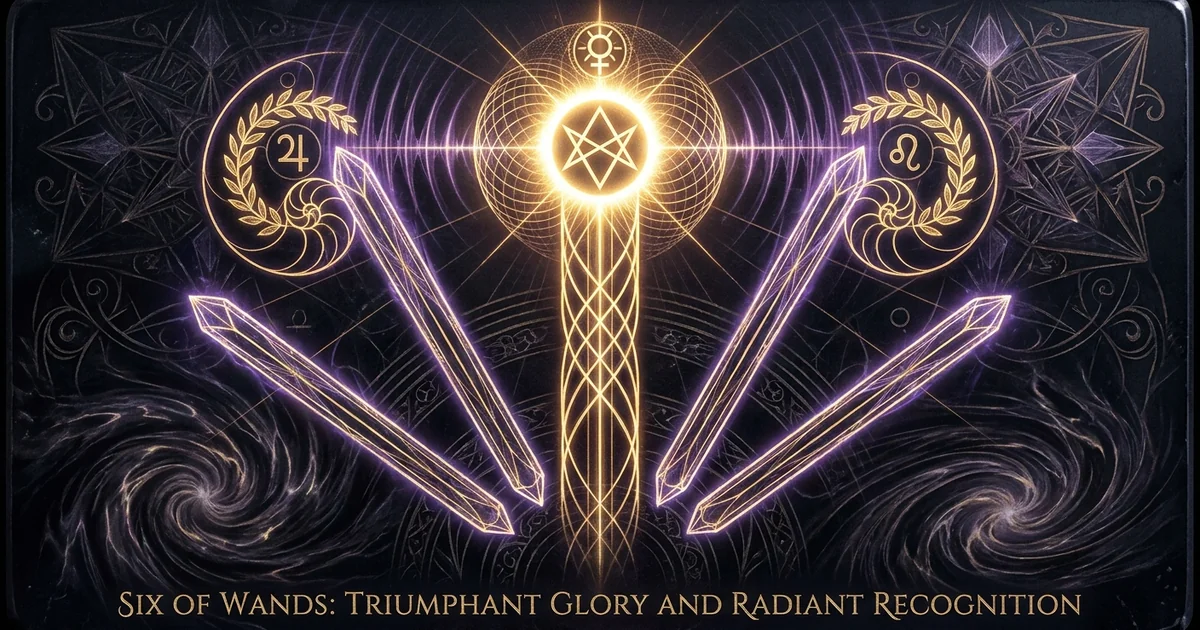
Six of Wands: Triumphant Glory and Radiant Recognition
Archetypal Thesis & Systemic Paradigm: The Solar Equilibrium of Fire
From Strife to Radiance: The Five-to-Six Structural Transition
The minor arcana of the Tarot deconstructs the cosmological progression of energy from primordial conception to physical crystallization. Within the suit of wands—governing the primordial element of Fire (Yod of the Tetragrammaton)—this sequence demonstrates the evolution of pure volition. The Six of Wands occupies a critical systemic position as the kinetic resolution of the destabilizing friction manifested in the preceding card. In the sequence of emanations, the Five of Wands (/tarot/five-of-wands-symbolism-meaning) reflects the entropic, volcanic turbulence of Geburah acting within the fiery medium: an uncalibrated collision of discordant wills, horizontal power struggles, and competitive attrition. The Six of Wands marks the structural triumph over this systemic chaos, reordering disparate thermal vectors into a singular, unified ray of teleological momentum.
This transition from Five to Six does not represent the eradication of kinetic energy, but rather its radical phase change from turbulence to laminar flow. In thermodynamics, an open system undergoing continuous thermal agitation either experiences catastrophic entropic breakdown or reorganizes itself into a higher state of dissipative order. The Six of Wands embodies this higher dissipative structure. The scattered staves of the five competitors—previously clashing without formal geometry or hierarchy—are here marshaled under the unifying axis of a singular victorious trajectory. The card documents the exact developmental threshold where individual effort transcends the horizontal dialectic of competition and ascends into the vertical hierarchy of recognized mastery.
This operational shift is essential for interpreting the six of wands tarot meaning within serious psycho-cosmological practice. Where the Five represented an undifferentiated battlefield of competing drives within the human unconscious, the Six establishes an integrated locus of authority. The chaotic expenditure of psychic libido is arrested, yielding a stable platform wherein the disparate components of the self yield precedence to a sovereign, organizing archetype. It is the emergence of cosmos out of chaos, the emergence of the sun from the nocturnal turbulence of the underworld.
Tiphareth in Atziluth: The Microprosopus Harmonized in Volition
To precisely locate the metaphysical mechanism of the Six of Wands, one must analyze its position upon the Tree of Life. The card represents Tiphareth (Beauty, Balance, and the Solar Heart) operating within the world of Atziluth, the archetypal and emanative realm of pure divine fire. Tiphareth sits at the structural center of the Qabalistic map, serving as the mediator between the supernal triad above the Abyss and the lower astral and material sephiroth below. It is the seat of the Microprosopus (the Lesser Countenance or Zeir Anpin), the harmonized, conscious spiritual ego that synthesizes the severe judgment of Geburah and the expansive mercy of Chesed into radiant equilibrium.
When the solar consciousness of Tiphareth descends into Atziluth (/qabalah/tiphareth-solar-consciousness), the raw, uncalibrated heat of the fire element is transmuted into illuminated, self-sustaining light. In the lower worlds, fire consumes its fuel, generating soot, smoke, and unstable thermal plumes; in Atziluth, fire exists as pure, radiant intelligence—the lux occultum. Tiphareth in Atziluth thus signifies the absolute moral authority of the awakened will. Ambition is purged of predatory self-assertion; volition becomes indistinguishable from cosmic law. The individual will ceases to act as an isolated ego-complex attempting to dominate external circumstances, and instead functions as a consecrated instrument through which universal harmony demonstrates its dominion.
This realization of Tiphareth transforms the operational dignities of the wands suit. The individual operating under this archetypal current acts with the sovereign poise of the solar monarch. The light projected by this center does not blindingly overpower the periphery; rather, it vitalizes everything within its orbital field. The recognition depicted in the card is not merely social approval, but an ontological acknowledgement: the environment recognizes the victor because the victor has successfully aligned personal drive with the macrocosmic order.
The Radiance Mechanism: Dynamic Homeostasis of the Solar Will
The stability demonstrated in the Six of Wands is not a static crystallization, such as one might find in the Earth element of Malkuth, but a state of dynamic homeostasis. Solar radiation maintains its spherical boundary through an exquisite equilibrium between the inward gravitational collapse of its immense mass and the outward thermal pressure generated by core thermonuclear fusion. In precisely the same manner, the Six of Wands preserves its triumphant posture through a delicate cybernetic tension: the expansive drive for external conquest is precisely countered by the interior discipline of centered solar consciousness.
If this dynamic homeostasis falters, the archetype degrades rapidly into two pathological polarities. If outward expressive force exceeds internal gravitational integration, the structure dissolves into the narcissistic mania of archetypal inflation. Conversely, if the inward gravitational pull chokes the expressive radiative capacity, the will collapses into the paralysis of unexpressed potential. The Six of Wands demonstrates the precise millisecond of archetypal perfection where these opposing vectors are in immaculate balance.
The systemic consequence of this homeostasis is the generation of a powerful coherence field. In clinical and archetypal dynamics, when an individual achieves this solar synthesis, the immediate psychic and social ecology shifts from adversarial confrontation to voluntary subordination. The external world ceases to throw up obstacles not because resistance has been violently crushed, but because the internal resistance within the operator has been dissolved. Radiance replaces force; illumination supersedes coercion.
Classical Provenance & Textual Lineage: The Lord of Victory Across Hermetic Codices
The Golden Dawn Attribution: The Lord of Victory (Netzach of Fire)
The modern theoretical architecture of the Six of Wands descends directly from the cipher manuscripts and oral teachings of the Hermetic Order of the Golden Dawn (Hermetic-Order-of-the-Golden-Dawn). Within the foundational curriculum established by S. L. MacGregor Mathers and Harriet Felkin, the card was stripped of mundane fortune-telling interpretations and codified as a precise talismanic engine titled “The Lord of Victory.”
“As a rule, it shows great success, but it is not quite so permanent as that of the Ten of Cups or the Four of Wands. It means victory after great strife; success through energy and industry; pleasure gained by labor; pride, self-consciousness, and a degree of vanity. Yet it is a very good card, representing triumph, advancement in life, and the fulfillment of hope, though warning against carelessness and the insolence of success.” — S. L. MacGregor Mathers, Book T: The Tarot of the Golden Dawn (1888)
Mathers’ formulation encapsulates the structural paradox of the card. While designating unambiguous triumph, Book T meticulously injects the caveat of impermanence and the moral hazard of hubris. The Golden Dawn recognized that the numerical six, while stable, represents a transient zenith within the cyclic decanic engine. In this Hermetic lineage, the card is mapped through the Chaldean order (Chaldean-Order) to the second decan of the fixed fire sign of Leo, assigned to the planetary lordship of Jupiter. This synthesis—Jupiter, the greater benefic, expanding the fixed, radiant, sovereign fire of the solar lion—produces the fundamental conceptual mechanics behind the title “Lord of Victory.” It is the institutionalization of victory: success that is acknowledged by law, formalized by civic or spiritual authority, and consecrated by the divine expansive principle.
The Waite-Smith Iconography: The Laurelled Equerry and the Collective Gaze
When Arthur Edward Waite collaborated with artist Pamela Colman Smith to generate the Rider-Waite-Smith (RWS) deck in 1909, they broke dramatically with the abstract geometric layouts typical of the Tarot de Marseille and early continental systems. Waite translated the abstract Hermetic formula of Book T into an explicit theatrical tableau, bringing to life the tension between individual distinction and social sanction.
[Laurel-Crowned Wand]
                              ^
                              |
    [Mounted Hero] <--------------------> [Attendant Foot Soldiers]
   (Elevated / Solar)                      (Ground Level / Collective)
In the foreground, a crowned rider sits mounted upon a white horse draped in an azure caparison. Upon the rider’s brow rests a woven laurel wreath (laurus nobilis), while a second, larger laurel garland is bound securely to the apex of the dominant wand held upright in his right hand. Flanking the horseman are foot soldiers carrying five additional wands held vertically. The visual composition hinges entirely on vertical disparity: the horseman is elevated above the pedestrian plane, his profile drawn in calm, deliberate serenity.
Waite’s critical innovation was the explicit inclusion of the retinue. The victory depicted is fundamentally non-solitary. Without the surrounding crowd of spear-bearers, the horseman would be merely an isolated traveler; it is the presence of the collective gaze that transforms personal movement into a political, social, and spiritual triumphal procession. The RWS iconography crystallizes the sociological reality that victory requires an audience: it is an intersubjective contract wherein the community willingly projects the archetype of sovereignty onto a designated surrogate, who in turn bears the burden of their shared aspiration.
Thoth and the Crowley-Harris Formulation: Architectural Symmetry of the Six Staves
In stark contrast to Waite’s narrative realism, Aleister Crowley and Lady Frieda Harris excised all human figures in The Book of Thoth (1944). Crowley viewed anthropomorphic representations of minor arcana cards as reductive compromises that distracted the initiate from pure geometric and energetic mechanics. In the Thoth deck, the Six of Wands returns to the non-dual architecture of pure forces, bearing the unadorned title “Victory.”
The visual layout of Crowley’s card displays six wands intersecting in pristine, crystalline symmetry. The background glows with an incandescent, golden-orange radiance, representing the perfected distillation of Atziluthic light. The central vertical axis is formed by two crossed wands terminating in the lotus blossoms of the Adeptus Minor and the winged globe of Ra-Hoor-Khuit, the crowned and conquering child of the New Aeon. These central wands are supported and flanked by four additional staves tipped with the phallic spear-heads and the Phoenix wands of sovereign authority.
Crowley’s formulation asserts that “Victory” is not an external societal event, but an absolute internal alignment. The wands do not clash as they did in the Five; they interlock to form an impregnable, balanced energetic scaffold. Crowley emphasizes that this victory is the exact mathematical result of Tiphareth harmonizing the previously discordant energies of Geburah. There are no cheering crowds, no ephemeral political banners, and no mutable mortal spectators. For Crowley, victory is the total, unassailable manifestation of the True Will (Thelema), operating in absolute accord with the structural laws of the macrocosm.
Structural Mechanics & Symbolic Geometry: Astrological Decans and Qabalistic Topography
The Second Decan of Leo: Jupiter’s Imperial Beneficence in the Fixed Fire Sign
The cosmological coordinates of the Six of Wands are precise: 10°00’ to 19°59’ of the zodiacal sign Leo. Within the ancient system of decans (/astrology/jupiter-in-leo-decan) organized according to the descending Chaldean Order—Saturn, Jupiter, Mars, Sun, Venus, Mercury, Moon—this ten-degree sector is governed directly by Jupiter. Leo itself is the fixed manifestation of the fire element, ruled by the Sun and situated in the height of midsummer, representing the apex of solar maturation, cardiac vitality, creative self-expression, and the archetypal seat of the monarch.
- Sephira: Tiphareth (Harmony, Beauty, Central Solar Sphere)
- World: Atziluth (Archetypal Fire, Divine Emanation)
- Astrological Coordinate: Second Decan of Leo (10°00’–19°59’ Leo)
- Decan Lord: Jupiter (Chaldean Order)
- Planetary Synergy: Jupiter operating through Fixed Solar Fire (Sun-Jupiter Synthesis)
- Geomantic Figure: Fortuna Major (Greater Fortune, Inflowing Inherent Light)
- Elemental Quality: Fire of Fire (Solar crystallization of primordial volition)
When Jupiter, the planet of expansive grace, magnanimity, civic jurisprudence, and spiritual elevation, assumes rulership over the central, fixed core of Leo, an extraordinarily favorable energetic signature emerges. Claudius Ptolemy, in his foundational astrological treatise Tetrabiblos (c. 150 CE), notes that planetary dignities operating in harmony with solar fire produce an imperial, beneficent temperament inclined toward high honors, governance, and monumental public achievements. The harsh, aggressive heat of primitive fire is tempered by Jovian broad-mindedness and philosophical benevolence.
This decanic synthesis explains why the six of wands symbolism transcends mere conquest. Mars can conquer through physical violence, but Jupiter in Leo integrates the conquest into an enduring cultural or spiritual dispensation. It represents the benevolent ruler whose legitimacy is rooted in magnanimity rather than fear. In the language of traditional geomancy, this decan corresponds to Fortuna Major—the “Greater Fortune”—a figure representing inherent, self-generating victory, vertical alignment with the light, and structural protection derived from operating within the cosmic order.
The Equine Matrix: The White Horse as Sublimated Subconscious Drive
A central esoteric glyph within the RWS iconography is the mount ridden by the laurelled victor: a pristine white stallion, draped in decorative blue fabric. In classical Hermetic psychology and the Kabbalistic tripartite division of the soul, the horse universally represents the Nephesh—the animal soul, the instinctual matrix, the visceral vegetative life-force, and the vast reservoir of the dynamic subconscious drives.
[ Spiritual Ego / Ruach ]  ===> ( Laurelled Rider )
              |
         Guided by
         Volition
              |
              v
   [ Animal Soul / Nephesh ]  ===> ( The White Horse )
Left uncalibrated, the Nephesh is wild, reactive, and driven entirely by primal biological compulsions: fear, territorial aggression, and uninhibited appetite. In the five of wands tarot meaning, these instinctual drives run riot, pulling the personality in scattered, reactive directions. In the Six of Wands, the horse is not merely broken or suppressed; it is gracefully integrated. The animal is pure white, indicating that the instinctual drives have undergone purification through the conscious will. It is cloaked in blue—the color of water, Chesed, and receptive consciousness—signifying that the subterranean emotional waters have been stilled and placed at the service of the spiritual ego (Ruach).
The posture of the rider indicates effortless command. He does not brutally saw at the reins, nor does he brandish a whip. The horse steps forward in measured, disciplined cadences. This indicates that true triumph is impossible without the complete alignment of the instinctual subterranean self with conscious teleological intent. The horse lends its colossal muscular power to the rider, while the rider provides the vision and teleological orientation that the animal lacks. It is a visual representation of sublimated libido, redirected from animal chaos into divine execution.
The Laurel Garland: Botanical Geometry of Apollonian Sovereignty
The presence of two laurel wreaths within the traditional iconography demands rigorous symbolic decodification. The laurel (Laurus nobilis) has stood since classical antiquity as the primary vegetative talisman of Apollo, the Greco-Roman solar divinity governing prophesy, structural harmony, music, healing, and the triumph of pure light over the subterranean chthonic python.
Botanically, the laurel is an evergreen, retaining its vibrant chlorophyll throughout the deadening freeze of winter. It was therefore adopted by esoteric tradition as an emblem of biological and spiritual incorruptibility: the victory over decay, death, and temporal entropy. To be crowned with laurel is to be initiated into the eternal; the temporal human being is momentarily translated into a living embodiment of the deathless solar archetype.
In the iconography of the Six of Wands, the distribution of the two garlands illustrates the dual nature of Hermetic consecration:
- The Garland of Personal Attainment: The wreath resting upon the horseman’s cap consecrates the intellect and the individual mind, signifying that the ego-consciousness has maintained its integrity under severe pressure.
- The Garland of Transpersonal Transmutation: The larger laurel wreath, bound directly around the staff of the dominant wand, consecrates the work itself. It signals that the generative phallic energy of the wand has been sanctified and brought to fruitful, immortal completion.
This Apollonian botanical geometry acts as a profound talismanic seal. It indicates that the triumph attained in the Six of Wands is not a brutal, spoils-based victory of martial carnage, but the intellectual and spiritual triumph of light, elegance, and proportion.
Psychological Dynamics & Operational Praxis: Archetypal Inflation and Collective Reflection
The Mana-Personality and the Lure of Ego Inflation
Through the analytical framework of Carl Gustav Jung’s depth psychology, the Six of Wands represents one of the most perilous junctures in the individuation process. When an individual successfully navigates the psychic shadow and the chaotic inner conflicts symbolized by the Five of Wands, a vast quantum of previously trapped libido is released into conscious awareness. This sudden influx of coherent energy produces an intense experience of psychological liberation, mastery, and charisma.
It is precisely at this moment that the ego is tempted to identify with what Jung classified as the “mana-personality” (mana-personality). The mana-personality is an archetype of the collective unconscious representing extraordinary spiritual, intellectual, or magical authority—the Inner Sovereign, the Hero, or the Magus. When the conscious ego succumbs to the delusion that the triumph, the radiant energy, and the resulting social recognition are personal attributes generated by its own small mortal agency, catastrophic archetypal inflation occurs.
Sovereign Self-Actualization (Integrated State)
- Locus of Authority: The ego serves as an aligned conduit for transpersonal teleology (the Self).
- Direction of Libido: Radiates outwardly to vitalize, protect, and empower the collective ecosystem.
- Response to Adulation: Recognizes recognition as ephemeral; remains deeply anchored in humility and service.
- Perception of the Retinue: Honors the contribution of the collective and unconscious instinctual components.
- Structural Vulnerability: Prepares proactively for inevitable cyclic shifts and ideological defense.
Narcissistic Mana-Inflation (Shadow State)
- Locus of Authority: The ego usurps the archetypal power of the mana-personality as personal property.
- Direction of Libido: Demands perpetual inward feeding to sustain an unstable, grandiose self-image.
- Response to Adulation: Becomes addicted to external validation; interprets applause as absolute proof of divine supremacy.
- Perception of the Retinue: Exploits and devalues peripheral participants as mere functional instruments of self-aggrandizement.
- Structural Vulnerability: Blind to impending resistance; precipitates catastrophic collapse into the Seven of Wands.
The laurel wreath, if gripped too tightly by the personal ego, transforms instantaneously from an Apollonian crown of light into an iron band of psychological entrapment. The individual who becomes intoxicated by the applause of the crowd loses touch with the deep instinctual base symbolized by the horse and drifts into an ungrounded, manic stratosphere of hubris.
The Sovereign and the Retinue: Psychodynamics of Collective Projection
The operational mechanics of the Six of Wands depend entirely upon the psychological contract existing between the mounted horseman and the retinue on foot. In depth psychological terms, the retinue represents the fragmented, less differentiated aspects of the psychic apparatus—the minor complexes, peripheral drives, and instinctual components of the collective unconscious that have not yet achieved conscious individualization.
These peripheral components cannot directly embody the solar archetype; instead, they project their inherent desire for sovereignty, coherence, and transcendence onto the central equestrian figure. The horseman acts as a living mirror, reflecting back to the collective their own latent nobility. This explains the profound, almost hypnotic power of charismatic leaders: the collective does not merely admire the sovereign; they fall in love with their own sublimated potential projected upon the sovereign’s form.
This dynamic imposes a severe psychodynamic responsibility upon the individual occupying the position of the Six of Wands. If the sovereign forgets that they are merely an empty screen carrying the archetypal projections of the collective, the relationship turns parasitic. The retinue will eventually withdraw their projected libido, causing the leader’s authority to evaporate overnight. The foot soldiers bearing the staves are not slaves; they are the bedrock upon which the victor’s elevation depends. If their presence is unacknowledged, their vertical staves will invert and become the hostile pikes of the mob.
Diagnostic Decoding in Consultation: Legitimate Triumph vs. Hubristic Vulnerability
When deciphering the Six of Wands within an advanced psycho-cosmological consultation, the analyst must determine the exact psychological vector of the querent relative to the archetypal architecture of the card. The card functions as an acute diagnostic instrument measuring how effectively a human consciousness processes success, visibility, and positive feedback.
In its direct, dignifying manifestation, the Six of Wands confirms that the subject has successfully aligned their conscious effort with systemic need. The recognition they receive—be it an academic accolade, professional promotion, creative breakthrough, or spiritual initiation—is structurally legitimate. The querent possesses the interior capacity to stand securely in the light, metabolizing public praise without allowing it to corrupt their ethical or psychological core. Here, the card is an augury of triumphant momentum, indicating that their chosen strategy has achieved systemic resonance.
Conversely, the card serves as an urgent diagnostic warning against hubristic vulnerability. The very condition of public triumph creates a localized blind spot. Bathed in the radiant light of their own accomplishment and deafened by the cheers of their immediate circle, the querent becomes exceptionally vulnerable to sudden shifts in the strategic landscape. The analyst must interrogate whether the querent’s current victory has engendered laziness, intellectual arrogance, or a dangerous contempt for the structural challenges that inevitably lie ahead. The card demands an immediate audit of the querent’s grounding mechanisms: is the white horse of the instinctual body being cared for, or is it being ridden to exhaustion to feed the vanity of the ego?
Philosophical Synthesis & Macrocosmic Correspondence: The Cycle of Solar Sovereignty
The Law of Rhythm: Victory as an Ephemeral Metastable Equilibrium
Within Hermetic philosophy, the cosmos is governed by absolute axioms, among which the Principle of Rhythm occupies a central station: “The measure of the swing to the right is the measure of the swing to the left; rhythm compensates.” The Six of Wands must be understood as an apex waveform within this eternal rhythmic oscillation. It does not designate an eternal paradise or an unchanging state of grace; it marks a peak—a glorious, transient, metastable equilibrium.
The structural beauty of the card lies precisely in its structural ephemerality. The Roman triumph, from which the visual motif of the laurelled horseman heavily draws, contained a built-in metaphysical safety valve. As the victorious general rode his chariot through the packed streets of the capital, receiving the ecstatic adulation of the citizenry, a public slave stood directly behind him, holding the golden crown of Jupiter above his head and whispering continuously into his ear: “Memento mori” (“Remember that you must die”) and “Respice post te; hominem te esse memento” (“Look behind you; remember that you are but a man”).
This ancient civic ritual formalizes the philosophical core of the Six of Wands. Triumph is not a static property that one can permanently possess; it is an energetic event through which one passes. To attempt to permanently freeze the momentum of the Six of Wands is to invite catastrophic systemic collapse. The tides of Atziluthic fire are perpetually moving, and the zenith of the sun at high noon is simultaneously the exact astrological moment the descent into dusk begins.
Teleological Will and the Hermetic Axiom of Accordance
The Six of Wands provides an empirical illustration of the classic Hermetic axiom: “That which is Below corresponds to that which is Above, and that which is Above corresponds to that which is Below, to accomplish the miracles of the One Thing.” In this card, victory is defined not as the aggressive subjugation of the external environment through coercive leverage, but as the achievement of profound structural accordance.
When the conscious will of the operator achieves alignment with the transcendent evolutionary trajectory of the universe—the True Will—resistance melts away. The macrocosm actively supports the microprosopic agent because the agent has become an evolutionary vanguard for the whole. This is the profound secret of the Jovian-Solar synthesis: Jupiter expands what the Sun illuminates, but only when the light is true.
The glory of the Six of Wands is therefore not subjective; it is objective cosmological resonance. The social recognition, the elevation of status, and the clearing of obstacles are merely external acoustic reverberations of an internal tuning fork that has hit the pure pitch of cosmic law. The victor is honored not for their idiosyncrasies, but because they have surrendered their small, reactive ego-desires and allowed themselves to be wielded as an instrument of divine volition.
The Precursor to Defense: The Structural Inevitability of the Seven of Wands
No minor arcana card can be thoroughly understood without analyzing the immediate necessity of its subsequent evolution. The Six of Wands transitions directly, inexorably, into the Seven of Wands (/tarot/seven-of-wands-tarot-meaning)—Netzach operating in the world of Fire, the card of defensive fortification, asymmetric combat, and sovereign resistance against overwhelming peripheral odds.
“The archetype of the mana-personality, when brought to the surface by the integration of the shadow and the encounter with the anima, easily seduces the ego into an unwarranted inflation. The individual assumes that the halo belongs to him, completely blind to the fact that elevation above the crowd instantly mobilizes the subterranean envy and compensatory aggression of the collective. The light inevitably deepens the shadow, and he who stands on the summit of public recognition must immediately prepare to defend his ground against the sudden emergence of collective resentment.” — Carl Gustav Jung, Collected Works, Vol. 9 (Part 2): Aion, p. 142
This structural progression is a fundamental sociological and spiritual law. The moment an individual achieves public elevation (the Six), they instantly alter the geopolitical and psychic equilibrium of their surrounding environment. By rising above the horizontal plane, they become a visible target. Their triumph inevitably engenders envy, ideological challenge, territorial anxiety, and structural competition from those who remain on the lower ground.
[ Six of Wands ]
                           (Elevation & Recognition)
                                      |
                           Produces Systemic Shift
                                      |
                                      v
                                [ Seven of Wands ]
                      (Asymmetrical Defense of the Summit)
The Six of Wands is thus the direct energetic engine that generates the Seven. The foot soldiers who cheer the horseman today may easily become the six adversaries who surround and besiege him tomorrow. The wise strategist, recognizing the fleeting nature of the Six of Wands, does not waste this precious window of triumph in drunken celebration. Instead, they utilize the immense cultural and social capital gained during this triumphant phase to fortify their position, assemble their defenses, and prepare for the structural trials that are guaranteed to follow.
Frequently Asked Questions: Technical and Interpretive Resolutions
How Does the Six of Wands Differ Mechanically from The Chariot (Major VII)?
While both the Six of Wands and The Chariot (Major VII) feature a triumphant warrior-equestrian figure who has achieved mastery over lower forces, their cosmological and operational mechanics belong to entirely different dimensional planes within Tarot architecture.
The Chariot represents Path 18 (Cheth) on the Tree of Life, crossing the immense gulf from Geburah to Binah, traversing the lower threshold of the Abyss. It is a Major Arcanum embodying a cardinal universal archetype: the total psychological armor of the perfected ego, sustained by the containment of contradictory polarities (represented by the opposing black and white sphinxes) through sheer, absolute focus. The Chariot’s triumph is structural, transcendent, and completely non-reliant on human observation; it is the soul conquering the astral matrix through sheer internal containment and spiritual boundary-setting.
Conversely, the Six of Wands is a Minor Arcanum—a specific, localized decanic crystallization of Tiphareth in Atziluth. Rather than resolving cosmic polarities across the Abyss, the Six of Wands documents the manifestation of solar triumph within the human, cultural, and social continuum. Its triumph is expressive, communicative, and inherently relational. The Chariot drives grimly through the wilderness, self-contained and heavily armored, paying zero attention to external appraisal; the Six of Wands rides in a public parade, unarmored, adorned in laurels, entirely integrated into the civic and psychological fabric of the community.
What Are the Structural Manifestations of the Six of Wands Reversed?
The reversal of the Six of Wands should not be reduced to simple “failure” or “defeat.” Such binary moralizing obscures the complex mechanics of the inverted solar-Jovian current. Structurally, the inverted Six of Wands operates across four precise pathological axes:
- Pathological Imposter Syndrome and Deferred Recognition: The conscious effort has succeeded, but systemic recognition is withheld, delayed, or actively suppressed by an envious hierarchy. The querent has achieved internal mastery, but the external environment refuses to formalize the triumph, producing intense psychic frustration and alienation.
- Catastrophic Archetypal Inflation and Hubris: The ego has fully succumbed to the mana-personality. The querent is addicted to applause, surrounded by sycophants, and posturing fraudulently. The appearance of success has become more important than the integrity of the work, setting up a brutal, inevitable fall from grace.
- The Fraudulent Triumph: A hollow victory achieved through political treachery, plagiarism, or coercive manipulation. Because the victory lacks the moral and cosmic accord of Tiphareth in Atziluth, it possesses zero structural stability and will instantly collapse under the slightest pressure.
- Paralysis by Public Scrutiny: The individual possesses immense potential, but is terrified of the visibility that accompanies success. They deliberately sabotage their own momentum to avoid becoming a target, shrinking back into the chaotic, safe anonymity of the Five of Wands.
In every case, the reversed Six of Wands signals a critical dysfunction in the processing of recognition, demanding an immediate structural realigning of the personal will with objective truth.
How Does Jupiter in Leo Manifest When Combust or Afflicted in a Spread?
In formal cartomantic cartography, a card’s structural dignities are radically modified by surrounding cards, mimicking the classical astrological condition of combustion (being overpowered by the harsh, burning proximity of an afflicted Sun) or severe counter-aspects from Malefics (Mars and Saturn).
When the Six of Wands is severely afflicted in a spread—for instance, flanked by the Tower (Major XVI), the Three of Swords, or Saturnian-dominated minors like the Five of Pentacles—the expansive, magnanimous synthesis of Jupiter in Leo degenerates into its lowest vibrational expressions. The Jovian benevolence vanishes, leaving behind a tyrannical, hollow authoritarianism. The querent or subject becomes desperate for external validation, demanding absolute subservience from their peers while providing zero genuine protection or generosity in return.
Furthermore, an afflicted Jupiter in Leo indicates a Pyrrhic victory: a triumph won at such a devastating structural, financial, or moral cost that the victor is functionally ruined. The parade continues, the banners wave, and the laurel wreath is placed upon the head, but the treasury is empty, the white horse is starved, and the foot soldiers are on the immediate brink of violent mutiny. When these signatures emerge, the cartomancer must strip away the dazzling surface illusions of the card and force the querent to confront the grim material reality underlying their precarious elevation. :::