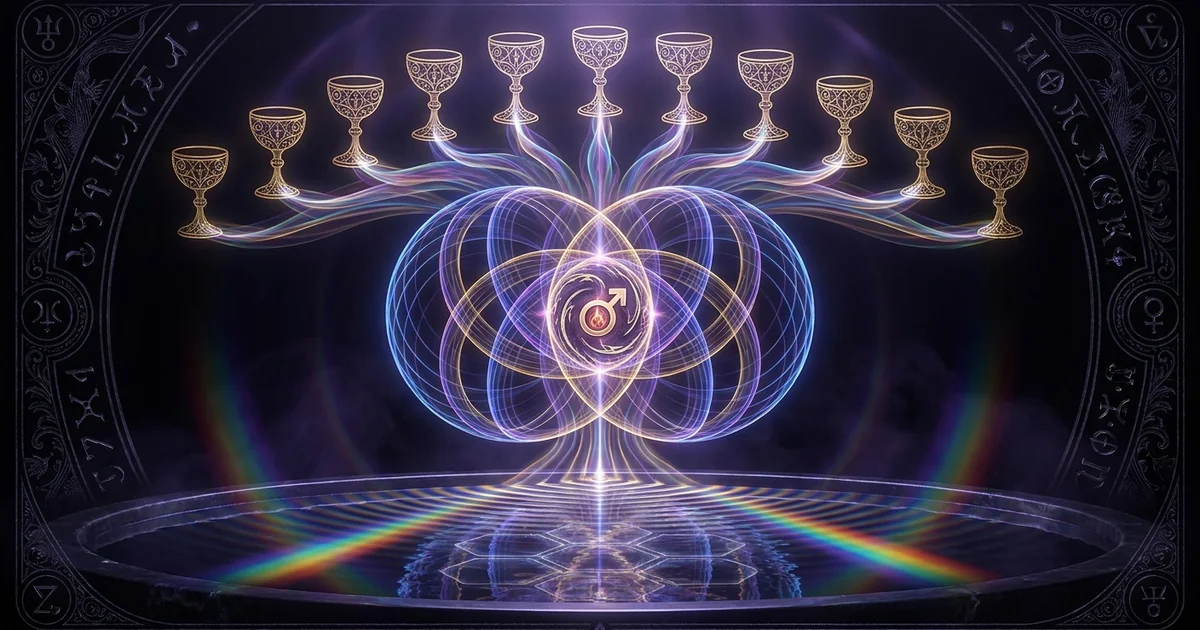
Ten of Cups: Harmonious Blessings and Radiant Wholeness
Archetypal Thesis & Systemic Paradigm: The Crystallization of Emotional Teleology
Beyond Pop Sentimentality: The Ten as Decadic Equilibrium
In modern exoteric cartomancy, the Ten of Cups is frequently reduced to a bourgeois postcard of domestic bliss—a sentimental tableau depicting suburban tranquility, nuclear family cohesion, and romantic finality. Such interpretations represent an epistemological flattening of the card’s profound psycho-cosmic mechanics. Within the structural architecture of the Hermetic Qabalah, the tens do not signify an ephemeral emotional high or the naive absence of conflict. Rather, they demarcate the decadic terminus: the complete operationalization and grounding of an elemental force into the material plane of manifestation.
The ten of cups tarot meaning represents the mathematical exhaustion and structural culmination of the water element. Water, which initiates as an undifferentiated, kinetic surge of unconditioned receptivity in the Ace of Cups, descends through the cosmological hierarchy of the Tree of Life until it achieves terminal crystallographic stability in the tenth Sephira. The Ten of Cups is not merely an emotional reward; it is an ontological milestone where the subjective fluctuations of personal desire are subsumed into a transpersonal, non-entropic matrix of relational order.
- Sephira: Malkuth (The Kingdom / Structural Manifestation)
- Qabalistic World: Briah (The World of Pure Creation / Archangelic Water)
- Elemental Sub-Attribute: Earth of Water (The structural fixation of fluid dynamics)
- Astrological Decan: Mars in Pisces (20°00’ – 29°59’ Pisces)
- Hermetic Title: The Lord of Perfected Success
- Primary Attributions: Dynamic homeostatic equilibrium, generational continuity, trans-egoic affective synthesis.
The Water Element in Assiatic Grounding: Malkuth in Briah
To comprehend the card’s interior physics, one must locate its position across the inter-dimensional descent codified as Malkuth in the Four Worlds. The Cups suit operates natively within Briah, the Kabbalistic World of Creation governed by Archangel Gabriel, where divine will is organized into specific archetypal currents of feeling, imagination, and soul-resonance. When the Briatic matrix strikes its own tenth Sephira—Malkuth—the fluid medium undergoes a thermodynamic shift comparable to fluid phase transition.
Malkuth represents the Earth aspect of any world. Consequently, the Ten of Cups embodies the “Earth of Water”—the structural containment, vesselization, and institutionalization of emotional flux. Without the stabilizing architecture of Malkuth, the Briatic water element would disperse into formless dissolution, dissolving consciousness into oceanic psychosis or boundaryless hysteria. In this decadic locus, water ceases to act as an unstable, eroding torrent; it becomes an irrigation network, a life-giving municipal cistern, an established sanctuary. Malkuth supplies the definitive boundaries within which psychic water can reside without evaporating or overwhelming the ego-structure.
Relational Homeostasis as a Complex Cybernetic System
Far from depicting a frozen utopia, the Ten of Cups models what systems theorists define as a dynamic relational homeostasis. In open cybernetic systems, homeostasis is not the cessation of movement, but the capacity of an organism or social network to absorb environmental volatility through continuous, self-correcting feedback loops. The emotional harmony of the card is systemic rather than sentimental. It maps an ecology of consciousness wherein individual subjectivities achieve a non-zero-sum coordination.
Within this cybernetic equilibrium, the psychic entropy generated by interpersonal friction is transmuted into structural coherence. The disparate agents within the collective unit—represented iconographically as parents, children, land, and water—do not dissolve their individual identities into an enmeshed monoculture. Instead, they occupy differentiated nodes within a balanced web of interdependence. The archetype models an affective field where intimacy ceases to be a volatile transaction of power and emerges instead as an unforced state of equilibrium, preserving coherence across systemic scales.
Classical Provenance & Textual Lineage: From ‘Perfected Success’ to ‘Satiety’
The Golden Dawn Hermetic Lineage and ‘The Lord of Perfected Success’
The foundational technical mechanics of the Ten of Cups were systematized in the late nineteenth century within the secret curriculum of the Hermetic Order of the Golden Dawn. In Book T: The Tarot and Its Transmutations, S.L. MacGregor Mathers and Moina Mathers synthesized astrological decanates, Qabalistic sephiroth, and geomantic figures into a unified divinatory apparatus. The Golden Dawn designated the card “The Lord of Perfected Success,” explicitly linking it to the completion of emotional labor under cosmic law.
The Golden Dawn lineage insisted that this “success” is neither arbitrary nor solely material; it is the natural consequence of emotional alignment with divine will. Mathers noted that the card’s virtue resides in its completeness: it is the total crystallization of the Cups suit’s teleology. Yet, hidden within this attribution was an esoteric caveat known to the Adepti: when an elemental current reaches its tenth Sephira, its evolutionary vector within that world is exhausted. The “perfected success” of the Ten of Cups constitutes the boundary stone of the Briatic cycle, marking the exact threshold where fulfillment must either ground itself into spiritual legacy or begin a descent toward decay.
“The 10 of Cups is the Lord of Perfected Success. It represents the permanent and enduring completion of an undertaking, the realization of hope, and the establishment of harmonious conditions. But being the Tenth, it also contains the germ of change; for perfection cannot remain stationary without lapsing into decay.” — S.L. MacGregor Mathers & Moina Mathers, Book T: The Tarot and Its Transmutations (1888)
“Appearance of Cups in a rainbow; contemplation of this vision by two figures below, evidently husband and wife. Two children dance near them; a home is seen in the distance. The figures are rejoicing in this spectacle of completed happiness… It is the fulfillment of human love, elevated to the state of divine communion.” — Arthur Edward Waite, The Pictorial Key to the Tarot (1910)
Pamela Colman Smith’s Iconographic Revolution: The Rainbow Covenant and the Choreography of Joy
When Arthur Edward Waite collaborated with artist Pamela Colman Smith to generate the Rider-Waite-Smith (RWS) deck in 1909, they executed a radical semiotic transformation of the Minor Arcana. Prior to Smith’s pictorial innovations, the pip cards of European Tarots (such as the Tarot de Marseille) depicted non-scenic arrangements of vessels. Smith transformed the abstract decadic mathematics of Malkuth-in-Briah into a staging of archetypal human experience.
Smith’s visual choreography relies heavily on theatrical blocking and the biblical archetype of the Noahic Covenant (Genesis 9:13). The composition bifurcates the visual field into terrestrial embodiment and celestial benediction. A man and a woman stand with arms raised in identical postures of trans-egoic adoration; their physical bodies face away from the viewer, directing the observer’s gaze toward the horizon and sky. Beside them, two children dance in unreflective, somatic ecstasy.
This choreography is critical: the adults do not gaze possessively at each other, nor do they look downward into the earth. They direct their physical vessels upward toward the radiant arch of ten golden cups suspended within a rainbow. Smith thereby avoids the trap of depicting isolated self-congratulation; the domestic unit is portrayed as the grounded receiver of an overarching cosmic order, reconciling the individual soul to the collective ancestral stream.
Crowley’s Dialectical Critique: The Shadow of ‘Satiety’ and Latent Inertia
In stark opposition to Waite’s idyllic staging, Aleister Crowley and Lady Frieda Harris provided a severe, dialectical deconstruction of the archetype in The Book of Thoth (1944). Crowley renamed the card simply “Satiety,” stripping away the pastoral imagery to reveal the thermodynamic danger inherent in absolute fulfillment.
In Crowley’s schema, the cups are arranged in the geometry of the Tree of Life, but the vessels are unstable, bursting, and over-brimming with an unctuous fluid that threatens to corrupt the surrounding ether. The lotus flowers of the water element, having blossomed fully, begin to droop and wither. Crowley posited that when water ceases to flow, it putrefies. Satiety, in its absolute manifestation, generates psychic stagnation, decadent complacency, and emotional inertia.
By analyzing the card through this lens, the student avoids modern pop-esoteric optimism. The Ten of Cups carries an implicit entropic shadow: the very moment emotional fulfillment becomes institutionalized and completely stabilized, the living spirit of the water element risks asphyxiation beneath the weight of its own satisfaction.
Structural Mechanics & Symbolic Geometry: Astrological Decans and Qabalistic Topography
The Decan Architecture: Mars in Pisces (Degrees 20° to 30°)
The underlying astrological engine of the Ten of Cups is the third decan of Pisces, spanning from 20°00’ to 29°59’ of the mutable water sign. In classical astrological literature, particularly the treatises of Claudius Ptolemy and Heinrich Cornelius Agrippa’s De Occulta Philosophia, this decan is ruled by Mars—an assignment that initially presents a glaring archetypal paradox. Why should Mars, the planet of severance, warfare, blood, and fiery kinetic assertion, govern the card of ultimate emotional peace and communal benediction?
The reconciliation of this apparent contradiction lies in the esoteric doctrine of sublimation. In the third decan of Pisces, Mars is immersed in the terminal, boundless waters of the zodiac. Pisces dissolves what Mars attempts to sever; the oceanic, mutable medium strips the martial force of its egoic aggression, turning its penetrating drive inward. Volition is no longer directed outward to conquer external adversaries. Instead, the martial fire is spiritualized into psychic defense, absolute devotion, and the vigorous boundary maintenance required to protect sacred space. Mars provides the essential structural tension that prevents Piscean water from collapsing into chaotic dissolution. Without this martial backbone, the harmony of the Ten of Cups would lack the strength to withstand the entropic pressures of the material world.
The Optic Refraction of the Rainbow Arch: The Septenary Reconciled in the Ten
The prominent semiotic feature of Smith’s composition is the radiant rainbow arch containing the ten vessels. Esoterically, the rainbow is not an arbitrary artistic flourish; it is an optical and metaphysical bridge linking the unitary white light of Kether to the multifaceted phenomenal diversity of Malkuth.
As explored in rainbow spectrum geometry, a rainbow represents the prismatic refraction of invisible solar unity into the seven visible frequencies of the electromagnetic spectrum. In Hermetic metaphysics, these seven rays correspond directly to the seven classical planetary governors:
- Saturn
- Jupiter
- Mars
- Sol
- Venus
- Mercury
- Luna
The Ten of Cups reconciles the septenary (the seven planets) with the decadic (the ten Sephiroth of the Tree of Life). By suspending the ten golden vessels along the trajectory of the septenary arc, the card signifies that all seven planetary drives—even the traditionally malefic influences of Saturn and Mars—have been integrated, purified, and orchestrated into an overarching harmony. The ten cups do not rest upon the earth; they form an atmospheric dome, signifying that the relational happiness experienced below is shielded by a consecrated planetary alignment.
Hydrological Vectors: River, Grove, and the Flow into the Universal Ocean
The landscape depicted beneath the celestial covenant is mathematically plotted through precise hydrological vectors. In the midground of the Smith-Waite card, a bright blue river snakes through verdant hills toward a home situated beside a grove of trees. Water, in esoteric cartography, represents the astral fluid—the perpetual current of human emotion, subconscious memory, and imaginal activity.
       [ Kether: The Primordial Source / Celestial Fountain ]
                              │
                              ▼
    [ Upper Briatic Currents: Archetypal Affect & Longing ]
                              │
                              ▼
    [ The Meandering River: Temporal Psychic Experience ]
                              │
                              ▼
[ The Estuary / Horizon: Re-absorption into Oceanic Consciousness ]
The hydrological progression within the card traces the return of differentiated water to its primordial source. The river does not pool stagnantly; it meanders through a cultivated, agricultural terrain, irrigating the soil and supporting the fruiting trees before flowing out toward the oceanic horizon in the far distance. This movement illustrates the micro-to-macrocosmic journey of individual emotional experience. The domestic sanctuary (the house) is nourished by the passing current, but the river cannot be possessed, dammed, or permanently captured by the inhabitants. It moves inevitably toward the vast, undifferentiated ocean of the universal unconscious, reiterating that human relational wholeness is sustained only when psychic currents remain fluid, flowing outward toward the transpersonal horizon.
Psychological Dynamics & Operational Praxis: Individuation and the Coniunctio
Jungian Coniunctio and Family Complex Resolution
From the perspective of analytical psychology formulated by Carl Gustav Jung, the Ten of Cups constitutes an archetypal projection of the coniunctio oppositorum—the sacred marriage of psychic polarities. The central adult figures in the card should not be read merely as an empirical biological couple, but as the internal integration of the animus and the anima within the individuation process.
The figures stand in structural symmetry, reflecting a reconciled ego-Self axis. Their identical uplifted arms demonstrate that the conscious ego has ceased its futile attempt to dominate the psyche and has instead yielded primacy to the Self.
Furthermore, the presence of the two dancing children illustrates the emergence of the divine puer and puella—the uncorrupted, creative potentials of the psyche that are liberated when the ancestral family complex is redeemed and harmonized. The choreography resolves what Jung identified as the neurosis-generating parents complex:
$$\text{Individuation Nexus} = (\text{Animus} \oplus \text{Anima}) \times \text{Integrated Shadow} \longrightarrow \text{Emergence of the Transcendent Function}$$
When the masculine and feminine operational systems within the psyche achieve mutual respect and shared teleology, the psychic energy formerly squandered on internal defense mechanisms is released, expressing itself as play, spontaneity, and creative regeneration.
Diagnostic Reading Praxis: Differentiating Actualized Wholeness from Co-Dependent Projection
In applied cartomantic diagnostics, the appearance of the Ten of Cups requires rigorous clinical discernment. The reader must evaluate whether the card signals an authentic state of dynamic emotional wholeness or functions as a defensive persona shield masking severe interpersonal pathology.
Upright Coherence
- Archetypal Reality: Organic, open-system emotional balance.
- Psychodynamic Axis: Authentic reconciliation of animus and anima.
- Relational Function: High individuation paired with deep intimacy; dynamic non-zero-sum interdependence.
- Shadow Integration: Acceptance of grief, mortality, and cyclical change without loss of faith.
- Manifestation: Generative communal anchoring, sanctuary creation, long-term emotional sustainability.
Inverted Satiety
- Archetypal Reality: Entropic decay of stagnant water; performative bliss.
- Psychodynamic Axis: Regression into the suffocating maternal or patriarchal complex.
- Relational Function: Co-dependent enmeshment; systemic denial of internal conflict; emotional tyranny.
- Shadow Integration: Repression of shadow elements to preserve an aesthetic of outward perfection.
- Manifestation: Domestic dissimulation, suburban ennui, the weaponization of harmony.
When evaluating the card within a spread, the practitioner must analyze its elemental dignities. If the Ten of Cups is flanked by discordant Swords (such as the Three or Seven of Swords), the card functions diagnostically as dissimulation: an individual or family system is aggressively projecting an image of idealized harmony to conceal internal abuse, unspoken grief, or acute psychological fracturing. Conversely, when buttressed by supportive Wands or Pentacles, it confirms the structural grounding of authentic transpersonal love.
Inversion and Shadow Diagnostics: Emotional Narcissism, Ennui, and Domestic Dissimulation
When the Ten of Cups appears inverted, or when it occupies an ill-dignified station within an esoteric consultation, it unmasks the toxic underbelly of the “happy ending.” This inversion corresponds to the Crowleyan shadow of “Satiety”—the psychic rot that occurs when an individual or system becomes intoxicated by its own comfort.
The shadow of the Ten of Cups reveals itself as an insidious form of emotional narcissism. Here, the domestic sanctuary transforms into a gated compound designed to keep the realities of suffering, mortality, and societal decay at bay. The family unit or romantic partnership becomes a totalitarian regime of enforced positivity, where authentic negative emotion, individuation, and divergence from the collective script are treated as treasonous offenses. This dynamic is observed in highly enmeshed systems where children are forbidden to differentiate from their parents’ psychic architecture, trapped within a generational mandate to perpetually reflect back an image of unbroken familial perfection.
Philosophical Synthesis & Macrocosmic Correspondence: The Teleology of the Suit of Cups
The Cycle of Water: From the Primordial Ace to the Grounded Ten
The ten cards of the minor suit of Cups map the complete thermodynamic and developmental cycle of consciousness descending through the watery plane:
[ Ace: Undifferentiated Oceanic Potentiation ]
                       │
                       ▼
[ Two: The Relational Spark / Primary Dyad ]
                       │
                       ▼
[ Three: Celebratory Communal Affinity ]
                       │
                       ▼
[ Four: Introspective Ennui / Affective Satiation ]
                       │
                       ▼
[ Five: Bereavement / The Breaking of the Vessel ]
                       │
                       ▼
[ Six: Nostalgic Recovery / Ancestral Imprints ]
                       │
                       ▼
[ Seven: Illusory Projection / Astral Dissolution ]
                       │
                       ▼
[ Eight: Voluntary Abandonment / Transcendence ]
                       │
                       ▼
[ Nine: Egocentric Wish-Fulfillment / Sensual Satiation ]
                       │
                       ▼
[ Ten: Collectivized, Non-Entropic Relational Wholeness ]
The narrative arc of the Cups suit functions as a thermodynamic cycle of consciousness: the pure potentiation of the Ace of Cups passes through relational crisis (Five), spiritual reorientation (Eight), solipsistic indulgence in the Nine of Cups, and final collective integration in the Ten.
This sequence details the slow, arduous maturation of love. In the Nine of Cups, the solitary figure sits smugly before his nine accumulated vessels, embodying a purely ego-centered state of emotional satisfaction. His back is turned to the world; he consumes his contentment in isolation. The Ten of Cups shatters this solipsism by demanding the surrender of the isolated ego to the collective good. The individual joy of the Nine is transformed into the relational communion of the Ten, demonstrating that emotional teleology is not fulfilled in the solitary gratification of appetite, but in the generative sanctification of relationship.
Hermetic Polarity and the Transcendent Function
In the philosophical corpus of Hermeticism, the Universe is understood through the immutable axioms of Rhythm, Polarity, and Gender. The Ten of Cups exemplifies the operational union of these laws. Through the polarity of the masculine and feminine figures standing in grounded receptivity, the card generates the third term: the transcendent function.
“The transcendent function does not proceed from a compromise, but from a living integration of opposites… It is an authentic manifestation of the energy that springs from the tension of polarity, establishing a new level of psychological stabilization—the quaternio of wholeness.” — Carl Gustav Jung, Aion: Researches into the Phenomenology of the Self (Collected Works, Vol. 9, Part 2, §427)
The transcendent function cannot be engineered through conscious willpower alone. It arises organically when the consciousness ceases to wage war against its contradictory currents and instead holds them in an attitude of radical openness. In the Ten of Cups, the conscious mind (the man) and the unconscious soul (the woman) unite in shared focus upon the transpersonal arc (the rainbow), allowing the biological quaternio (man, woman, two children) to emerge as a stable, four-fold psychic vessel capable of containing the numinous without psychological fragmentation.
The Return to the Source: Malkuth as the Womb of Kether
Within the esoteric metaphysics of the Tree of Life, there exists the vital Hermetic axiom: “Malkuth is in Kether, and Kether is in Malkuth, after another manner.” The tenth Sephira is not merely the mundane terminal dump of cosmological emanations; it is the cosmic womb from which the ascent back to the divine source begins.
In the Ten of Cups, Malkuth achieves its absolute purification within the World of Briah. Because water has successfully integrated its entire trajectory—surviving the melancholy of the Five, the illusions of the Seven, and the departures of the Eight—it forms a crystalline, mirror-like surface. In this fully grounded state, Malkuth ceases to act as an opaque, material obstacle and transforms into a perfect reflector of the primordial light of Kether. The family standing upon the green earth, gazing upward into the chromatic glory of the rainbow, are not merely enjoying mundane domestic fortune; they are witnessing the direct reflection of the divine countenance mirrored in the purified waters of an integrated human soul.
Frequently Asked Questions: Advanced Inquiries into the Ten of Cups
Martial Tension in Pisces: Reconciling Conflict with Perfected Success
The assignment of Mars as the planetary ruler of the third decan of Pisces in the Ten of Cups frequently causes confusion for students trained in exoteric astrology. In orthodox astrological systems, Mars is the planet of acute drive, conflict, and separation, while Pisces is the sign of absolute surrender, empathy, and dissolution. To understand why this combination yields “The Lord of Perfected Success,” one must grasp how planetary natures alter when placed in their complementary or debilitating environments.
In the third decan of Pisces (20° to 30°), the martial energy cannot operate as an unbridled conqueror. Immersed in the oceanic depths of mutable water, Mars’s external armor is melted away, and its weaponized aggression is converted into spiritual discipline and emotional courage. Mars here acts as the vital protective perimeter around the fragile core of human intimacy. It is the fierce boundary work that allows true vulnerability to exist.
Without this sublimated martial component, relational harmony degenerates into passive codependency and amorphous enmeshment. Mars provides the structural backbone that allows love to endure within the material realm. It is “perfected success” because the most volatile and dangerous planetary force in the cosmos—Mars—has been fully redeemed and recruited into the service of life, protection, and unconditional devotion.
Nine of Cups vs. Ten of Cups: Individual Solipsism vs. Relational Holism
The transition from the Nine of Cups to the Ten of Cups marks a massive ontological leap within the Minor Arcana. In the Nine of Cups, the Querent achieves the apex of individual wish-fulfillment. The card portrays a single figure, arms crossed over his chest, sitting comfortably before a curved bench holding nine golden chalices. This figure is the picture of sensual satisfaction, material comfort, and personal accomplishment. However, his state is closed, solipsistic, and self-referential. There is no other human being in his space; his satisfaction is entirely his own.
The Ten of Cups shatters this self-contained container. While the Nine represents the hedonistic culmination of the ego, the Ten signifies the trans-egoic communion of the collective. The cups in the Ten are no longer displayed on a private, wooden bench to show off personal wealth; they are raised into the sky as a shared celestial covenant. The Ten introduces the inescapable reality of the Other: partners, children, community, and generational responsibility. The Ten insists that authentic emotional wholeness cannot be experienced in a vacuum of solitary indulgence. One must risk vulnerability, open the psychic boundaries, and integrate into an interdependent relational system to move from the temporary satisfaction of the Nine to the enduring, radiant homeostasis of the Ten.
The Epistemology of Rainbow Symbolism in Esoteric Cartography
The rainbow depicted within the Ten of Cups operates as an epistemological instrument within esoteric cartography. Unlike standard artistic landscapes, esoteric Tarot designs utilize geometry, chromatic theory, and optics to encode cosmological truths. In the Smith-Waite iconography, the rainbow forms a curved bridge that spans the entire upper half of the card, acting as an ontological canopy over the terrestrial figures below.
Epistemologically, the rainbow represents the necessary interface between unmanifest unity and manifest multiplicity. Pure white light—the light of Kether or the Ain Soph—is ungraspable and blinding to the finite human intellect. To be perceived and experienced within the psychological landscape of Malkuth, this unified divine light must pass through the prism of phenomenal existence, refracting into the seven colors of the visible spectrum.
The rainbow is the absolute visual proof of this divine refraction. In esoteric traditions, it is the signature of the Demiurgic covenant: the promise that multiplicity does not represent a fall from grace, but rather the magnificent, purposeful dispersion of the divine image across the created world. The cups placed within the rainbow demonstrate that each discrete emotional station, when experienced in its proper proportion and place, contributes to the complete chromatic symphony of human and cosmic wholeness. :::