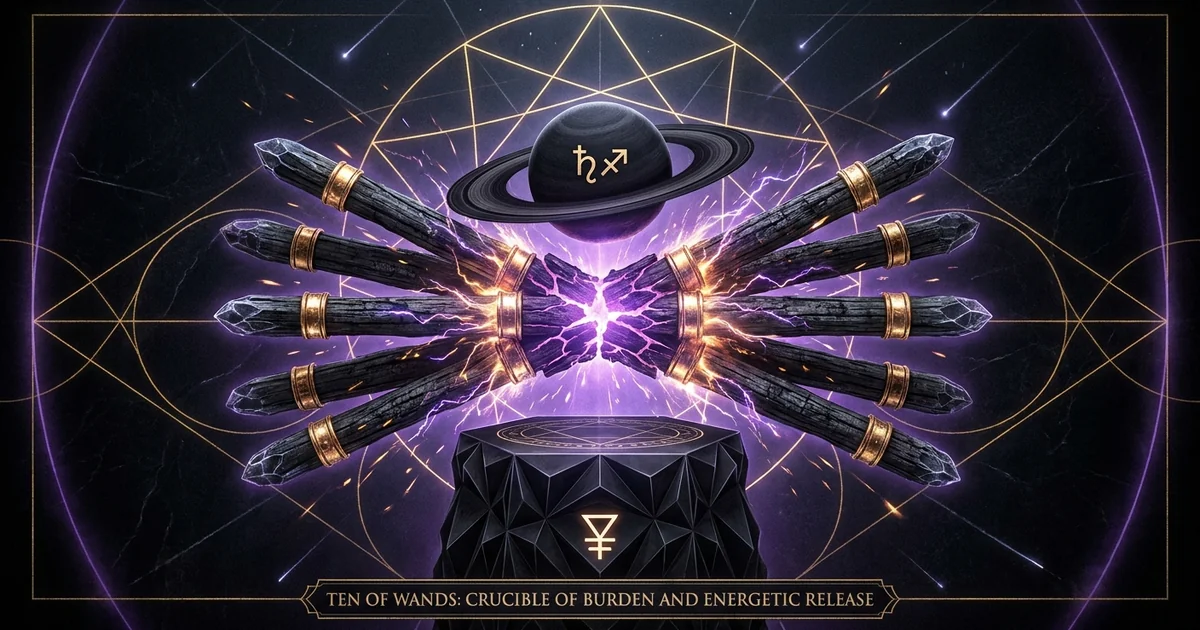
Ten of Wands: Crucible of Burden and Energetic Release
Archetypal Thesis & Systemic Paradigm: The Entropy of Primordial Will
Thermodynamic Dissipation Across the Wands Suit
In the structural geometry of the esoteric Tarot, the suit of wands operates as an energetic conduit tracing the trajectory of the fire element through successive phases of manifestation. From the undifferentiated, unconditioned flash of volition inaugurated in the Ace of Wands, this combustive force expands outward through dynamic vectorization, systemic contestation, and territorial consolidation. By the time this generative impulse arrives at the Ten of Wands, however, the thermodynamic velocity that characterized its initial movement undergoes an inexorable decay. The card marks the structural boundary condition where creative expansion exhausts its systemic carrying capacity. Rather than an accidental loss of vitality, the Ten of Wands demonstrates the absolute physical and metaphysical consequence of unmediated propulsion: when volatile energy descends through the Sephira tree without compensatory delegation, energetic offloading, or cyclic cessation, it generates friction against its own structural accumulation until kinetic velocity ceases entirely.
This mechanical breakdown exposes the core crisis of the wands suit. In thermodynamic terms, an isolated energetic system that continues to generate work without radiating entropy outward inevitably suffers catastrophic thermodynamic arrest. The creative volition that previously broke open new paradigms across the intermediate decans—ranging from the coordinated enterprise of the Three to the competitive kineticism of the Five—crystallizes in the Nine of Wands into a hyper-vigilant perimeter. In the Ten, that perimeter collapses inward. The kinetic expenditure can no longer radiate into an open environment; instead, it turns upon its own structural architecture. The individual staves, once markers of sovereign direction and focused agency, multiply to a density that crushes the vector that initiated them.
::: diagram Descent of the Fire Element from Kether to Malkuth


    Ace: Primordial Volition / Kether
    Intermediate Decans: Acceleration & Division


    Intermediate Decans: Acceleration & Division
    Nine: Defensive Crystallization / Yesod


    Nine: Defensive Crystallization / Yesod
    Ten: Systemic Saturation & Terminal Mass / Malkuth


:::
Malkuth in Atziluth: Material Densification of the Volatile
To comprehend the ten of wands tarot meaning within classical Hermetic Qabalah, one must isolate the structural tension inherent in its macrocosmic position: Malkuth in the world of Atziluth. As documented in foundational studies of Malkuth in the Four Worlds, Atziluth is the sphere of pure archetypal emanation, governed exclusively by primordial fire. It is an unformed, supersensible plane characterized by boundless radiative power and divine intention. Malkuth, conversely, is the terminal node of manifestation—the dense, inert, chthonic bedrock wherein the subtle forces of the upper Sephiroth solidify into concrete spatial-temporal reality.
When the Tenth Sephira is projected into the archetypal fire world, an acute metaphysical paradox occurs. Pure, unconfined, and weightless spiritual volition is abruptly compelled to occupy physical mass, volume, and gravitational inertia. Fire, an element defined by its refusal to be held, is forcibly bound within the absolute parameters of containment. This constitutes an ontological friction: the expansive, transcendent nature of the Atziluthic world experiences the crushing downward pull of Malkuthian physics. The result is not an organic integration of elements, but an over-densification of the volatile. Fire is forced to bear the characteristics of earth—weight, resistance, exhaustion, and physical encumbrance—generating a state of systemic over-saturation wherein the carrier is immobilized by the sheer bulk of their own spiritual creation.
The Saturation Point of Autonomous Will
This Qabalistic architecture reveals that the Ten of Wands does not merely delineate physical fatigue or occupational overwork; it documents an acute teleological failure. In this state-space representation of consciousness, autonomous will has become completely divorced from its originating vision. The subject no longer wields the staves as instruments of intentional transmutation; rather, the staves have aggregated into a self-perpetuating apparatus of obligation that demands the subject’s entire metabolic output simply to maintain positional continuity.
The original telos—the dynamic objective that justified the initial expenditure of force—is rendered entirely invisible behind the chaotic mass of its operational artifacts. The psyche enters a state of functional blindness, wherein the sheer administration of an accumulated legacy prevents the perception of any subsequent horizon. Will, having refused to observe systemic limits during its ascending phases, encounters those limits externally as an oppressive, unyielding, and mechanically non-negotiable physical impediment. The fire element, denied its cyclical dissolution back into the void, turns into an inescapable furnace of self-imposed labor.
Classical Provenance & Textual Lineage: From Mathers to the Golden Dawn
Book T and the Lord of Oppression: Original Hermetic Lineages
The formal codification of the Ten of Wands within Western esoteric cartography owes its technical parameters to Samuel Liddell MacGregor Mathers and Moina Mathers in the foundational instructional documents of the Hermetic Order of the Golden Dawn, collectively preserved as Book T. Within this curriculum, the card is designated with the technical title “The Lord of Oppression.” This title was not conceived as a subjective moral evaluation, but as an exact mechanistic diagnosis of an elemental force driven to its absolute evolutionary perimeter.
“Oppression. Cruelty, malice, pride, overweening wisdom, and unbridled ambition; which have fallen upon their own head and incurred their own overthrow… Force detached from spiritual sources, a fire burned out to dull cinders and crushing weight.”
The Golden Dawn’s attribution of this card arises from the cross-pollination of Hellenistic astrology and Qabalistic emanationism. Assigned to the final decanate of the zodiacal arc of the Centaur, the card captures the precise decanic moment where the mutable fire of Sagittarius is subjected to the rigid, binding, and crystallization-heavy governance of Saturn. Mathers recognized that when the cold, dry, melancholic mechanics of Saturn are imposed upon the fiery, warm, and expansive nature of Sagittarius, the generative enthusiasm of the sign is abruptly arrested. The “overweening wisdom” and “unbridled ambition” cited by Mathers refer precisely to the intellectual and philosophical overreach native to the Sagittarian archetype when stripped of Saturnian reality testing; when Saturn ultimately asserts its structural authority, the unanchored ambition collapses under its own accumulated gravity, converting creative passion into punitive burden.
The Waite-Smith Iconographic Shift: Agrarian Burden vs. Geometrical Density
When Arthur Edward Waite collaborated with artist Pamela Colman Smith to execute the Rider-Waite-Smith (RWS) deck in 1909, they performed a radical semiotic translation that transformed esoteric divinatory mechanics into visceral psycho-somatic imagery. In classical esoteric precursors—such as the Marseilles lineage or the internal diagrams of the Golden Dawn—the minor arcana were predominantly represented through austere geometric arrays of suit markers, relying on crossed wands and floral flourishes to indicate elemental interactions. Smith departed completely from this non-figural abstraction, transmuting the mathematical density of the ten crossed staves into a compelling tableau of human strain.
                  ┌───────────────────────────────┐
                  │      RWS VISUAL TAXONOMY      │
                  ├───────────────────────────────┤
                  │  Ten Bound Staves (Upward)    │
                  │  Aggregated Blocking Vision   │
                  │               ▲               │
                  │               │               │
                  │   Musculoskeletal Inversion   │
                  │   Convex Spine / Flexed Neck  │
                  │               ▲               │
                  │               │               │
                  │   Destination: Distant Burg   │
                  │   Civil / Municipal Sanction  │
                  └───────────────────────────────┘
Smith’s rendering exhibits a lone, heavily built figure trudging toward a walled settlement or fortified township positioned in the right background. The figure carries the totality of the ten staves gathered in an awkward, convergent sheaf, their tops splayed outward in an uneven, vision-obscuring cluster. Crucially, the carrier’s head is buried beneath the nexus of the wands; the musculoskeletal architecture of the body is contorted into an extreme forward bend, transferring the crushing mass directly across the cervicothoracic junction and the lumbar spine.
By grounding the card’s meaning in this agrarian, somatic toil, Smith anchored the abstract metaphysical crisis of Malkuth in Atziluth directly into physical embodiment. The figure does not drop the load, nor are they struck down by an external antagonist; they willfully, obsessively bear the convergent mass forward, blind to the landscape ahead, entirely consumed by the kinetic effort required to prevent the collapse of their self-assembled burden.
Crowley’s Diagnostic: The Blind Striving of Saturn in Sagittarius
In The Book of Thoth (1944), Aleister Crowley discarded Smith’s narrative personalization, returning to the formal, abstract geometry favored by the Golden Dawn while intensifying the mechanical severity of the diagnosis. Crowley titled the card simply “Oppression,” aligning its visual presentation with the catastrophic degradation of pure fiery energy. In the visual design executed by Lady Frieda Harris, eight of the staves are crossed behind two massive, dominant wands that take the form of the Dorjes—the Tibetan thunderbolts—which have hardened into immovable bars of iron.
Crowley’s diagnostic critique focuses on the total dissociation of force from its transcendent root. He posited that the Ten of Wands represents the tragedy of an energy that has become a closed circuit, an engine running at peak capacity with no intake of fresh spiritual fuel and no functional exhaust. The fire has devoured its organic sustenance and now operates as a deadweight of incandescent slag. Crowley identified this state as “the blind striving of Saturn in Sagittarius”—a condition wherein the visionary reach of the archer is trapped within the concrete dungeon of Saturnian materialism. It is the archetype of material success turned into an absolute psychic penitentiary, where the original creative volition has degenerated into an automated, unyielding compulsion to maintain a massive structural edifice that no longer serves the living spirit.
Structural Mechanics & Symbolic Geometry: Planetary and Qabalistic Coordinates
Saturn in the Third Decan of Sagittarius (20°–30°)
The diagnostic precision of the ten of wands symbolism cannot be understood apart from its exact astrological coordinates: the third decanate of Sagittarius, spanning from 20°00’ to 29°59’ of the mutable fire sign. In the classical system of decans documented by Claudius Ptolemy in the Tetrabiblos, this terminal segment of the Centaur is assigned to the planetary rulership of Saturn. This creates an irreconcilable cosmological tension between the dwelling’s resident qualities and the planetary ruler governing its terminal degrees.
- Sephira: Malkuth (The Kingdom / Structural Manifestation)
- World: Atziluth (The World of Archetypes / Pure Emanation)
- Decan: 3rd Decan of Sagittarius (20°00’ to 29°59’ Sagittarius)
- Planetary Ruler: Saturn (Cold/Dry Contraction)
- Sign Ruler: Jupiter (Hot/Moist Expansion)
- Resultant State: Severe structural friction caused by Saturnine containment applied to Jovian expansion.
Sagittarius is fundamentally a sign of diurnal fire, ruled by Jupiter, oriented toward teleological expansion, philosophical synthesis, wild trajectories, and the uninhibited pursuit of distant horizons. It is the sign of the arrow in flight. When Saturn—the cosmic principle of cold, dry limitation, boundary-setting, skeletal density, and chronological decay—takes charge of the final ten degrees of this sign, the trajectory of the arrow is terminated. Saturn acts as an atmospheric drag, converting the buoyant, aspirational velocity of Sagittarius into dense, terrestrial weight.
Ptolemy’s doctrine of essential dignities clarifies that while Saturn has operational command over this decan, it sits in an elemental environment alien to its nature; mutable fire resists the frigid immobility of the Great Malefic, yet cannot overcome it. Consequently, this decan acts as the containment zone where Jovian optimism is systematically checked by material boundaries, institutional gravity, and the unavoidable accumulation of karmic inertia.
The Sephira Malkuth: The Terminal Terminal of Atziluth
To map the card onto the Tree of Life is to locate it at the lowest point of the highest diagram: Malkuth within Atziluth. In the mechanics of emanational descent across the Tree of Life, the divine energy cascades from Kether (the Crown) through the intermediate Sephiroth, progressively differentiating, dividing, and condensing. At each stage of this descent, the archetypal energy retains a high degree of dimensional freedom until it reaches Malkuth, the tenth Sephira, known as the Kingdom.
       [ KETHER ]             <- Ace of Wands: Pure Radiance / Zero Inertia
           │
      [ CHOKMAH ]
           │
       [ BINAH ]
           │
      [ CHESED ]
           │
      [ GEBURAH ]
           │
      [ TIPHARETH ]
           │
       [ NETZACH ]
           │
        [ HOD ]
           │
       [ YESOD ]              <- Nine of Wands: Defensive Crystallization
           │
       [ MALKUTH ]            <- Ten of Wands: Terminal Structural Mass
Malkuth represents the definitive end-state of the cycle. It possesses no independent light or generative agency; its sole functional role is to serve as the passive receptacle, the terminal crystallization point, for the entire emanative process that preceded it. When the suit of wands arrives at Malkuth, the fire element finds that it has completely consumed its operational headroom. There are no remaining spatial degrees of freedom into which it can expand. The volcanic, dynamic, upward-leaping characteristics of fire are caught within the structural geometry of the physical plane. Malkuth enforces a non-negotiable rule of reality: every concept must eventually pay a toll to physical gravity. In the Ten of Wands, that toll is paid through the total loss of buoyancy, leaving the carrier to absorb the entire descending weight of the Atziluthic tree upon their mortal shoulders.
Geometric Tensility: The Crushing Architecture of Ten Convergent Rods
A formal structural analysis of the visual composition in Pamela Colman Smith’s illustration reveals how the geometry reinforces this systemic trap. The ten staves are not bundled cohesively, as in a fasces, nor are they balanced horizontally across the shoulders as a yoke. Instead, they are held in a convergent, fan-shaped formation directly against the chest and pelvis of the figure. This arrangement creates a highly unstable distribution of weight: the center of gravity of the load is located well above the bearer’s own physical center of mass.
The physical mechanics depicted in the card enforce three catastrophic structural vulnerabilities:
- Complete Occlusion of the Sensory Field: The upper cluster of the ten wands splays across the carrier’s field of vision, generating an artificial blind spot directly in their path of travel. The subject cannot see the terrain beneath their feet or the actual gate of the city they approach.
- Kinetic Lockup of the Musculoskeletal Frame: By wrapping both arms around the convergent staves to keep them from scattering, the figure eliminates their own arms as mechanisms of dynamic balance. The kinetic chain of the body is rigidly locked; every step requires an enormous expenditure of core musculature to prevent the load from tipping forward or backward.
- Tensile Collapse from Internal Separation: Because the staves are not bound by an external cord, the carrier’s grip is the only force preventing the architecture from collapsing. The staves push outward against one another in a state of chaotic divergence, forcing the bearer to exert inward compressive force while simultaneously supporting the downward vector of their collective mass.
Psychological Dynamics & Operational Praxis: The Shadow of the Atlas Complex
Ego Inflation and the Compulsion of Omnipotence
Through the diagnostic lens of Jungian analytical psychology, the ten of wands tarot meaning serves as an exact cartography of ego inflation followed by acute psychosomatic collapse. In Symbols of Transformation, Carl Gustav Jung observed that the fire element functions as an archetypal representation of psychic energy (libido) in its uninhibited, heroic form. The journey of the suit of wands charts the heroic ego’s rise: asserting identity, conquering resistance, and demonstrating mastery over the objective world. However, when the ego fails to recognize that its conscious volition is merely a localized vessel for archetypal forces rather than their divine author, it succumbs to a dangerous inflation.
“An inflated consciousness is always egocentric and conscious of nothing but its own existence. It is incapable of learning from the past, incapable of understanding contemporary events, and incapable of drawing right conclusions about the future. It is hypnotized by itself and therefore cannot be argued with.”
In this state of inflation, the ego develops an Atlas complex: an unconscious conviction that it alone must sustain the structural coherence of its world, its community, its family, or its creative enterprise. The individual operates under the delusion that delegation, systemic distribution of labor, or the release of expired commitments will cause an immediate catastrophic unraveling of reality. This is not nobility; it is omnipotent defense. The psyche hoards responsibilities, obligations, and control as a structural buffer against its underlying terror of insignificance or non-existence. The ten staves are not forced upon the carrier by an external tyrant; they are gathered, lifted, and retained through the carrier’s own refusal to yield sovereign control to collective processes or unconscious dynamics.
The Enantiodromia of Creative Passion into Servitude
The dynamic progression of the Ten of Wands illustrates Jung’s principle of enantiodromia—the regulatory psychological mechanism whereby an extreme, one-sided conscious attitude inevitably summons and transforms into its diametrical opposite. In the context of the fire element, what originated in the Ace of Wands as an ecstatic, self-liberating, and radically autonomous creative passion has, by the Ten, converted entirely into an oppressive, joyless, and automated condition of bureaucratic servitude.
       [ Primordial Volition ]
         (Creative Autonomy)
                  │
                  ▼  (Uninhibited Expansion)
       [ Structural Entrapment ]
         (Compulsive Servitude)
The individual who began as an inspired innovator, an autonomous creator, or a visionary leader becomes the exhausted caretaker of the operational machinery that their early success erected. Every wand represents a previous victory, an accepted challenge, an expanded territory, or an unvetted ambition that has successfully materialized. However, because each manifestation requires constant metabolic preservation, the creator is progressively transformed into a pack animal. The enantiodromia is total: the liberator has become the slave, the wild fire has become the ash-heavy iron furnace, and the expansion that promised infinite autonomy has resulted in complete structural paralysis.
Diagnostic Decoding in Consultation: Energetic Amputation
In the operational praxis of esoteric cartography and clinical Tarot consultation, encountering the Ten of Wands demands a decisive, diagnostic intervention rather than passive empathy. The card does not advise endurance, perseverance, or heroic stoicism; these qualities are precisely the pathological drivers keeping the subject trapped within the terminal phase of the archetype. The appearance of the Ten of Wands indicates that the systemic carrying capacity has been breached, and structural collapse is an imminent certainty if the energetic posture remains static.
The analytical protocol for this card requires a rigorous process of energetic amputation:
- The Inventory of Viability: The consultant must dispassionately differentiate between organic wands—those commitments that still possess living sap, creative vitality, and authentic teleological alignment—and dead wood, which represents expired contracts, outlived roles, and the automated maintenance of legacy projects.
- The Interruption of the Atlas Reflex: The practitioner must confront the client’s underlying secondary gains derived from overextension. Carrying the unbearable load often serves as an identity armor, allowing the individual to evade deeper emotional emptiness, relational vulnerability, or the terrifying open space of uncommitted psychic energy.
- Controlled Deposition versus Catastrophic Collapse: The client must be brought to recognize that the load will drop; the only choice remaining is whether it is deposited consciously through strategic abandonment and delegation, or scattered chaotically through cardiovascular, neurological, or emotional collapse.
Philosophical Synthesis & Macrocosmic Correspondence: Solve et Coagula
The Alchemical Nigredo of Combustive Energy
Within the classical Hermetic laboratory of Solve et Coagula (dissolve and coagulate), the Ten of Wands marks the apex of the coagulatory phase—the point where structural solidification reaches an unbearable, hyper-dense extreme that demands immediate dissolution (solve). In alchemical transmutations, when the volatile spirit is fully caught within the terrestrial matrix, it undergoes the phase of mortificatio or nigredo—the blackening. In the context of the fire element, this is the stage of calcination where organic fuel, subjected to relentless heat without replenishment, is reduced entirely to dull, inert, and immobile ash.
This ash represents the terminal state of the fire element. It can burn no further; it has no more energetic delta to surrender to the surrounding universe. This state is not an error in the work, but a mandatory stage of the Magnum Opus. The alchemist cannot attain the resurrected, spiritualized gold without first driving the base materials into the absolute exhaustion of their earthly forms. The Ten of Wands is the necessary energetic dead-end that strips the ego of its arrogant illusion of perpetual self-generation. It brings the individual down to the ground, forcing the volatile fire to experience the cold truth of terrestrial limits, thereby preparing the ground for the radical spiritual renewal that follows structural collapse.
Cross-System Parallels: I Ching Hexagram 28 (Da Guo / Critical Mass)
The structural diagnosis of the Ten of Wands finds an exact structural parallel within the binary cosmological matrix of the I Ching (The Book of Changes). The configuration corresponds directly to Hexagram 28: 大過 (Da Guo), traditionally translated as “Preponderance of the Great” or “Critical Mass.”
Ten of Wands (Tarot)
- Element: Fire collapsed into Earth (Malkuth in Atziluth).
- Mechanism: Saturnian restriction imposing mass upon Sagittarian reach.
- Pathological State: Carrying forward expired structural weight; sensory blinding.
- Resolution: Deliberate deposition of staves at the municipal threshold; conscious boundary.
Hexagram 28 - Da Guo (I Ching)
- Trigrams: Lake (Dui) above, Wind/Wood (Xun) below.
- Mechanism: Water inundating the forest; excessive interior pressure on weak foundations.
- Pathological State: The structural beam (dong) buckles under superior force.
- Resolution: Decisive, unimpeded retreat or radical load redistribution before structural fracture.
The graphic structure of Hexagram 28 features four strong, solid yang lines in the interior (lines 2, 3, 4, and 5), bounded at the top and bottom by fragile, yielding yin lines (lines 1 and 6). The traditional judgment text describes the situation with uncompromising clarity: “The ridgepole sags to the breaking point.” The hexagram illustrates a architectural structure whose central support beam is bearing a mass fundamentally disproportionate to the tensile strength of its terminal footings. The four yang lines represent excessive, aggressive, driving energetic momentum accumulated in the core, while the fragile yin lines represent the material matrix incapable of sustaining such internal pressure.
Like the Ten of Wands, Hexagram 28 diagnoses an extraordinary historical or psychological threshold where ordinary measures are futile. The structural load cannot be sustained through incremental adjustments or mere stubbornness; the central beam is on the verge of splintering. The I Ching warns that when the ridgepole buckles, catastrophic ruin ensues unless decisive, fundamental action is taken immediately to relieve the interior weight and redistribute the structural architecture.
The Precondition for Renewal: From Ten of Wands to the Fool’s Void
Within the cyclical architecture of esoteric cartography, the completion of the minor arcana at the number ten is never a permanent endpoint; it is the structural crisis that heralds the re-emergence of the zero. In the Qabalistic Tree of Life, Malkuth is not merely the bottom of one world; it is the point of contact that touches the Kether of the world below, or, in the re-ascending path of the Serpent of Wisdom, the necessary launching pad for the spiritualized consciousness to return to the source.
The Ten of Wands represents the absolute terminal phase of an entire elemental cycle. When the ten staves are finally released—whether through intentional surrender at the gates of the settlement or through absolute musculoskeletal exhaustion—the carrier undergoes an immediate, radical metamorphosis. By laying down the accumulated artifacts of the will, the hands are emptied, the spine straightens, the field of vision clears, and the center of mass drops back into alignment with the earth.
This total release of accumulated structure is the precise metaphysical precondition required to transition from the oppressive density of the tens into the absolute, weightless freedom of Arcanum 0: The Fool. The Fool can step lightly off the cliff into the void precisely because they carry nothing in their hands. They possess zero structural baggage, zero accumulated liabilities, and zero attachment to the machinery of past achievements. The Ten of Wands is the dark, heavy gateway through which the soul must pass, burning away its identification with its own creations, in order to recover the pristine, empty vessel capable of receiving the next flash of unconditioned divine inspiration.
Frequently Asked Questions on the Ten of Wands
Differentiating Systemic Burnout from Spiritual Initiation
A critical diagnostic challenge in esoteric consultation is distinguishing between the systemic, operational burnout represented by the Ten of Wands and the transformative, archetypal suffering associated with a spiritual dark night or formal initiatory ordeals. The distinction rests upon the origin and structural utility of the suffering:
- The Ten of Wands represents an entirely self-assumed, ego-generated liability. It is the systemic consequence of poor boundary regulation, unresolved omnipotent fantasies, and the compulsive hoarding of operational control. The suffering does not elevate the soul; it merely grinds down the somatic vehicle through the mechanical maintenance of expired structures. It produces dull cynicism, musculoskeletal rigidity, and cognitive fragmentation.
- True spiritual initiation involves an encounter with an objective, transpersonal power that deconstructs the ego’s defenses. In initiatory crises (such as those mediated by the Major Arcana like The Tower or Death), the suffering is transmutative, breaking open hardened psychic structures to allow the emergence of deeper archetypal awareness. The individual undergoing a Ten of Wands crisis is not being struck down by God; they are simply refusing to put down an armful of heavy sticks. The remedy for the Ten of Wands is not prayer or submission to fate, but the immediate, practical establishment of boundaries and the ruthless pruning of operational obligations.
Reversal Mechanics: Catastrophic Collapse versus Conscious Renunciation
When the Ten of Wands appears reversed or is modified by severe elemental dignities, its interpretive mechanics diverge into two diametrical systemic outcomes, depending upon the psychological maturity of the querent:
TEN OF WANDS REVERSED
                                │
        ┌───────────────────────┴───────────────────────┐
        ▼                                               ▼
[ Catastrophic Fracture ]                    [ Conscious Renunciation ]
- Unconscious resistance                     - Egoic surrender
- Musculoskeletal breakdown                  - Deliberate offloading
- Scattering of staves in crisis             - Re-establishment of boundaries
- Systemic institutional failure - Return to the Fool's void- The Path of Catastrophic Fracture (The Unconscious Reversal): If the individual continues to identify with the Atlas complex, the reversed card indicates that the physical, emotional, or institutional architecture has reached its ultimate tensile failure point. The central ridgepole snaps. This manifests as acute medical crises—such as cardiovascular events, nervous breakdowns, or adrenal collapse—or the sudden, chaotic disintegration of an enterprise where neglected systems fail simultaneously, scattering the staves into ruin.
- The Path of Conscious Renunciation (The Integrated Reversal): If the individual possesses sufficient psychological insight, the reversal indicates the breakthrough of awareness: the deliberate decision to drop the load. The figure simply unclenches their grip. The carrier acknowledges their finite carrying capacity, consciously renounces the illusion of omnipotence, delegates or abandons the non-essential staves, and walks into the municipal gates unencumbered. It signifies the profound liberation that occurs when one realizes that the majority of their burdens were self-imposed contracts that can be unilaterally terminated.
Interactions with Adjacent Elemental Suits in Consultation
The exact operational trajectory of the Ten of Wands in a reading depends heavily on the elemental dignity of adjacent cards, which reveal the medium through which the exhaustion travels:
- With the Suit of Swords (Fire and Air): When flanked by cards such as the Nine or Three of Swords, the oppression shifts from mere logistical overwork into acute psychological torment. The Saturnian friction of the Ten of Wands weaponizes the intellect; the individual is caught in hyper-vigilant cognitive loops, ruminating obsessively over catastrophic consequences should they drop their responsibilities. Air fans the dying embers of the fire into a dry, intellectual anxiety that accelerates nervous exhaustion.
- With the Suit of Cups (Fire and Water): Adjacent water cards—particularly the Four or Eight of Cups—diagnose profound emotional enervation. The carrier has expended all their vital fire on external maintenance, leaving their affective life entirely dehydrated. The relationship to the burden becomes toxic with unexpressed resentment and martyr complexes. Water cools the fire into tepid sludge, signifying that the individual is maintaining emotional commitments out of guilt long after all authentic love and passion have evaporated.
- With the Suit of Pentacles (Fire and Earth): This is the natural resting alignment of the Ten of Wands, as Malkuth is the Sephira of Earth. When flanked by cards like the Eight or Ten of Pentacles, the card indicates that the burden is fully institutionalized, bureaucratic, and somatic. Here, the energetic crisis translates into concrete material entanglement: debt maintenance, crushing corporate responsibilities, real estate encumbrances, or literal musculoskeletal disorders of the spine, shoulders, and knees. The fire has completely solidified into earth, demanding a radical restructuring of the individual’s material footprint.