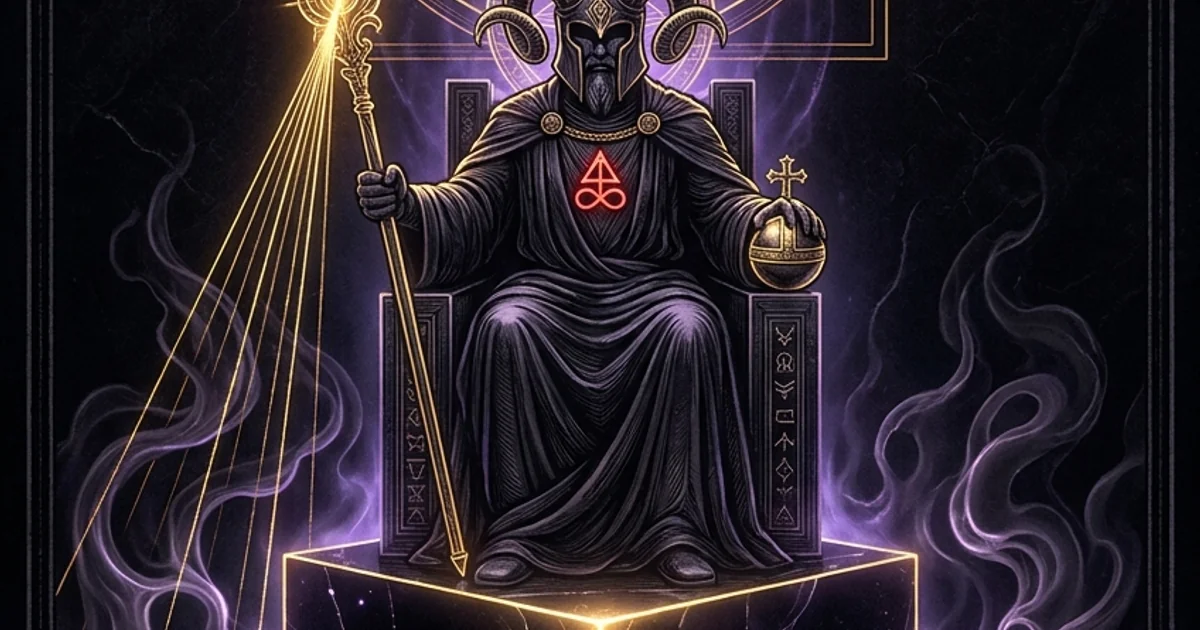
The Emperor Archetype: Sacred Order and Earthly Power
Archetypal Thesis & Systemic Paradigm: The Demarcation of Cosmos from Chaos
The Demiurgic Architect and the Principle of Coherent Form
Within the psycho-cosmological mechanics of the Western mystery traditions, the Emperor archetype—designated as Major Arcana 4—operates not merely as an anthropomorphic emblem of political hegemony, but as the foundational ontological operator responsible for the demarcation of Cosmos from Chaos. In the cosmogonic descent of light through the emanative tree, reality demands a structural crystallization point wherein raw, undifferentiated creative force ceases to expand indefinitely and submits to the constraints of limit, measure, and systemic boundary. This structural imperative constitutes the archetype of the sovereign architect: the patristic Demiurge who measures the void with a geometer’s compass, arresting the potential collapse of reality into primeval un-differentiation. The Emperor archetype sacred order is fundamentally an act of ontological architecture, projecting an unyielding geometric scaffold over the oceanic flux of the subconscious or unformed matter.
Where the unconditioned divine will initiates the impulse of being, the Emperor provides the syntactic rules through which that being can be parsed, articulated, and sustained. In this capacity, the archetype functions as the metaphysical blueprint for sovereign structure, imposing a coherent lattice upon phenomenal existence. This is not the passive reception of law, but its active, violent, and definitive inscription upon the cosmic substrate. In classical theological terms, this represents the transition from the absolute transcendence of the Godhead to the operative immanence of the demiurgic ruler—the governing agency that establishes laws of physics, biological hierarchies, and metaphysical borders. Without this architectural demarcation, subjective consciousness remains submerged in the prima materia, incapable of distinguishing subject from object, self from other, or the sanctified interior from the entropic exterior.
The Transmutation of Volatile Potential into Fixed Reality
To comprehend the dynamic mechanics of Major Arcana 4, one must contrast it directly with its antecedent, the Empress. As explored in /tarot/the-empress-archetype-generative-nature, Card 3 represents the unbounded, fecund, and volatile matrix of nature—the Dionysian surge of vegetative life that proliferates without formal boundary or teleological constraint. The Empress is the fertile matrix of pure potentiality, pregnant with all possibilities, yet structurally indiscriminate. The Emperor represents the subsequent alchemical operation of fixatio: the coagulating masculine dynamic that captures this fecund vegetative energy, channeling its generative volatility into durable, engineered forms. The wild forest of the Empress is surveyed, bounded, and transformed into the fortified civic temple and agrarian grid of the Emperor.
This dialectical tension between generative volatility and structural cohesion defines the cosmic necessity of the patristic sovereign. The Emperor does not create ex nihilo; rather, he establishes the conditions of containment through which creative life avoids self-cannibalization. The fluid syntropy of nature is captured by an externalized frame, subjecting raw organic proliferation to laws of efficiency, symmetry, and endurance. Sovereign power, from this systemic vantage point, is an obligation of cosmic conservation, an intentional expenditure of kinetic energy directed toward maintaining homeostatic-entropy against the universal slide toward dissipation. The Emperor’s throne is an anchoring stone placed upon the swirling currents of existence, a geopolitical and psychological dam that converts the rushing waters of psychic impulse into measurable, civilizational hydro-electric power.
Card 3: The Empress (Venusian Archetype)
- Cosmological Dynamic: Generative Volatility, Unbounded Gestation, Fluid Syntropy.
- Metaphysical State: Primal ocean of becoming, undifferentiated instinct, vegetative fecundity.
- Psychological Function: The Uroboric Mother; oceanic dissolution; affective immersion.
- Structural Principle: Proliferation without teleological constraint; spontaneous emergence; the wild garden.
- Energetic Polarity: Receptive, moist, centrifugal, dissolving all rigid geometric calcifications.
Card 4: The Emperor (Martial/Aries Archetype)
- Cosmological Dynamic: Delineated Structure, Rigid Orthodoxy, Fixed Boundary Preservation.
- Metaphysical State: Architectural crystallization, categorical demarcation, the establishment of law.
- Psychological Function: The Great Father; structural ego-ideal; operational reality testing.
- Structural Principle: The fortified perimeter; systemic hierarchy; civilizational engineering; the civic stone.
- Energetic Polarity: Projective, dry, centripetal, fixing volatile life-force into unyielding frameworks.
Ego Formation and the Establishment of Psychic Boundaries
In the topographical cartography of analytical psychology, the Emperor corresponds directly to the emergence and stabilization of the ego from the oceanic depths of the maternal unconscious. Carl Gustav Jung, particularly within his investigations into the paternal imago in Archetypes and the Collective Unconscious, identified the Great Father (the-great-father) archetype as the indispensable agent of psychic differentiation. For the developing human psyche, the primary danger is the regressive pull of the uroboros—the devouring, all-encompassing embrace of the unconscious mother matrix wherein identity is extinguished. The Emperor appears as the blade of logos, bisecting the psychic landscape, severing the umbilical dependence, and erecting the boundary walls of the individual ego-ideal.
Erich Neumann, tracing this developmental arc in The Origins and History of Consciousness, argued that consciousness itself is fundamentally a patriarchal creation: an intentional island of daylight won through systematic struggle against the nocturnal depths of the unconscious. The Emperor archetype provides the categorical apparatus—language, temporal awareness, ethical imperatives, and spatial orientation—that allows the fragile ego to withstand unconscious flooding. By establishing a rigid framework of internal psychic defenses, the Emperor stabilizes personal identity against psychopathic dissolution. The rules, disciplines, and taboos imposed by the paternal canon act as structural retaining walls. While these walls may risk calcification if unmoderated, their historical and psychic installation remains the absolute prerequisite for any subsequent individuated engagement with the unconscious depths.
Classical Provenance & Textual Lineage: From Renaissance Triumph to Hermetic Cipher
The Visconti-Sforza and Marseille Imperator: Temporal Imperium
The iconographic lineage of the Emperor traces its roots through the civic and political realities of fifteenth-century Northern Italy. In the hand-illuminated Visconti-Sforza tarocchi decks, commissioned for the dukes of Milan around 1450, the card depicts a recognizable European monarch seated upon an open throne, adorned with the heraldic insignia of the Holy Roman Empire, specifically the Ghibelline imperial eagle. During this Renaissance phase, the card operated largely within the framework of Petrarchan Trionfi (triumphs), representing the highest tier of temporal power, imperial legitimacy, and secular governance. The card was rooted in political theology: the emperor as dominus mundi, God’s earthly vicegerent tasked with the pacification of territories and the administration of civil justice against the chaos of warring feudal factions.
Visconti-Sforza (c. 1450)         Tarot de Marseille (c. 1650)         Golden Dawn / Waite (1909)
[ Ghibelline Imperium ]   -->    [ Chivalric Geometer ]        -->    [ Alchemical Sovereign ]
Temporal power, secular         Profile stance, crossed legs,         Enthroned on cubic stone,
justice, political pacification. martial scepter, solar eagle.        Aries rams, alchemical sulfur.
By the time the Tarot de Marseille crystallized in the seventeenth century, the imagery of L’Empereur had assumed a more defined esoteric geometry. The Marseille Emperor is famously depicted in profile, facing left toward the Empress, seated casually yet deliberately with his legs crossed in the form of a cross (forming, with his upper torso, the alchemical glyph of sulfur: a triangle over a cross). He grasps an imperial scepter with his right hand, anchored securely by a heraldic shield displaying the eagle resting at his side. This profile stance signifies operative outward vision—the externalization of the will into the temporal theater—while the crossed legs denote the fixation of spiritual energy into fourfold physical matter. The figure had moved from simple Italian civic propaganda to an allegorical representation of the human capacity to tame, organize, and govern terrestrial existence through structural authority.
Golden Dawn Syncretism: The Transition from Temporal Ruler to Astrological Sovereign
The occult revival of the late nineteenth century fundamentally reconstructed the Emperor, stripping away the transient feudal uniform to reveal the underlying cosmic engine. Under the administrative and hermetic genius of S.L. MacGregor Mathers, Dr. William Robert Woodman, and Dr. William Wynn Westcott, the Hermetic Order of the Golden Dawn synthesized the Tarot into a complete holographic system uniting Kabbalistic emanationism, Renaissance ceremonial magic, and classical astrology. Within their foundational instructional documents, specifically Book T: The Tarot of the Golden Dawn, the Emperor was stripped of merely Christian European associations and christened with his operative secret title: the Sun of the Morning, Chief Among the Mighty.
Mathers identified the Emperor with the fiery cardinal sign of Aries (/astrology/aries-cardinal-fire-archetype), the vernal initiator of the zodiacal wheel, ruled by Mars and hosting the exaltation of the Sun. This attribution radically altered the symbolic mechanics of the card: the sovereign was no longer an aging, sedentary bureaucrat managing civil accounts, but an incarnate embodiment of primordial, initiating energy. Arthur Edward Waite, collaborating with the artist Pamela Colman Smith under Golden Dawn auspices, codified this astrological attribution into the definitive modern iconography of the 1909 Rider-Waite-Smith deck. The lush vegetation of the Empress was replaced with a severe, barren landscape of red crags and granite chasms, cut through by a thin stream of water. The Emperor sits upon an austere, monolithic cubic throne carved with four stone rams’ heads—the unvarnished signature of Aries—holding the ankh of life in his right hand and an imperial orb in his left, armored for battle beneath his crimson robes.
“The Title of the Fourth Key is ‘The Sun of the Morning, Chief Among the Mighty.’ It represents a crowned monarch—majestic, seated upon a throne of stone, adorned with the emblems of Aries, the Ram. In his right hand he holdeth the Crux Ansata, the symbol of perpetual life; in his left, the orb of sovereign dominion. The nature of this Key is fiery, assertive, initiating, and stabilizing. It is the constitution of cosmic law upon the earth, governed by the cardinal fire of Aries, the exaltation of the Solar Force, and the masculine agency of the divine vision.”
The Tsaddi-Heh Transposition Debate in Modern Esotericism
The transition of the Emperor into modern occultism was complicated by the esoteric schism between the traditional Golden Dawn attributions and the magical reformulations of Aleister Crowley. In the original Golden Dawn schema, the Emperor was assigned to the Hebrew letter Heh (ה), representing the window, sight, and constitutional breath, linking the sephirah Chokmah (Wisdom) to Tiphareth (Beauty) along Path 15 on the Tree of Life. This placed the Emperor as the pure, unadulterated projection of the Father’s architectural vision descending directly into the heart of the solar ego.
However, in 1904, through the dictation of Liber AL vel Legis (The Book of the Law), Crowley claimed that the celestial hierarchy demanded a re-ordering: “All these old letters of my Book are aright; but צ is not the Star” (AL I:57). Crowley subsequently enacted the famous transposition, swapping the attributions of Major Arcana 4 and Major Arcana 17. In his Book of Thoth, Crowley assigned the Hebrew letter Tzaddi (צ, meaning the fish-hook) to the Emperor, and Heh to the Star, while retaining the astrological association of Aries for the Emperor. Crowley argued that Tzaddi symbolized the hooking, penetrating authority of the sovereign who catches and subdues reality, while Heh represented the airy, transcendent window of Nuit in the Star.
While the Golden Dawn traditionalists (including Waite and Paul Foster Case) fiercely preserved the Heh attribution—arguing that sight (Heh) is the exact sensory attribute assigned to Aries in the Sepher Yetzirah—Crowley’s diversion emphasized the Emperor not as an architectonic blueprint, but as a violent, phallic, martial force enforcing sovereign mastery over the material sphere.
Structural Mechanics & Symbolic Geometry: The Cube, the Cross, and Cardinal Fire
Geometric Hermeneutics: The Cube of Space and the Sovereign Stone
Central to the architectural mechanics of the Emperor is his absolute immobility atop a cubic stone. As Paul Foster Case demonstrates in The Tarot: A Key to the Wisdom of the Ages, the cube represents the definitive spatial crystallization of three-dimensional reality. In esoteric sacred geometry, the cube is the only regular polyhedron whose boundaries, angles, and faces yield the perfect manifestation of the primary quadrivium: four sides, six faces, eight vertices, and twelve edges. Within Case’s system of the Cube of Space—derived from the ancient cosmological treatise Sepher Yetzirah—the letter Heh is assigned to the North-East edge, the precise intersection where the initiating fire of cardinal space anchors itself into the terrestrial coordinate grid.
The cubic throne functions as the alchemical sal (salt), the principle of crystallization and fixity. By seating himself permanently upon this cubic stone, the Emperor indicates that his authority is not derived from personal caprice or subjective emotional volatility, but is co-terminus with the fundamental laws of space, form, and matter. The stone cube represents the materialization of the divine Logos—the philosophical cubic stone of the ancient freemasons, upon which the entire edifice of civil, legal, and operational reality is erected. It stands in direct antithesis to the shifting sands of unbridled unconsciousness. The Emperor cannot be moved because he is seated upon the mathematical invariants of creation; his power is structurally bound to the geometry of the physical and metaphysical universe.
Astrological Mechanics: Cardinal Fire of Aries and Planetary Dignities
The operational dynamic of the Emperor cannot be deciphered through the lens of terrestrial tyranny alone; it must be understood through the pure celestial mechanics of cardinal fire (cardinal-fire). In classical astrology, as articulated by Heinrich Cornelius Agrippa in De Occulta Philosophia Libri Tres, Aries is the initial spark of the zodiacal wheel—the dynamic, projective, and irrepressible impulse that fractures the stasis of winter to initiate the vernal equinox. Aries is characterized by an incisive, forward-thrusting vector of will that asserts existence over non-existence. This is the metaphysical engine of the Emperor: the primal assertion “I AM,” demanding the immediate organization of the surrounding environment in accordance with internal systemic vision.
+---------------------------------------------------------------------------------+
|                    ASTROLOGICAL DIGNITIES OF MAJOR ARCANA 4                     |
+--------------------------+----------------------------+-------------------------+
| Planetary Ruler: Mars    | Exaltation: The Sun        | Fall: Saturn            |
| (Dynamic projective force, | (Sovereign illumination,  | (Form must not swallow  |
| defensive boundary       | radiant authority, clarity | dynamic will; living law|
| enforcement, decisive    | of administrative vision,  | over fossilized         |
| surgical execution)      | life-giving law)           | bureaucracy)            |
+--------------------------+----------------------------+-------------------------+
Mars provides the kinetic, protective, and administrative force necessary to carve out and defend borders. It is the surgical scalpel and the fortress wall. Yet, this martial energy is elevated and sanctified by the exaltation of the Sun within Aries. The Emperor is not mindless, destructive violence; he is illuminated martial power. The Sun provides the objective clarity, the solar vision, and the commitment to life that prevents Mars from devolving into indiscriminate slaughter. Conversely, Saturn finds its fall in Aries, illustrating an essential esoteric truth: true sovereign order is not dead, fossilized bureaucratic calcification (which belongs to a decaying Saturnian regime), but a living, burning, self-renewing cardinal structure that constantly maintains structural boundaries against chaos through vigilant application of illuminated will.
Qabalistic Topography: The Path Connecting Chokmah to Tiphareth
On the Hermetic Tree of Life, within the traditional framework documented by the Golden Dawn and analyzed in /qabalah/paths-of-the-tree-of-life, the Emperor is positioned upon the 15th Path—the path of the Hebrew letter Heh. This path directly links the second Sephirah, Chokmah (Wisdom/The Primal Masculine Outpouring), to the sixth Sephirah, Tiphareth (Beauty/The Harmonious Solar Center). This placement provides an extraordinary insight into the mechanics of the archetype. Chokmah represents the unconditioned, non-conceptual, and boundless creative energy of the Divine Father (Abba). If this energy descended directly into the lower worlds unmitigated, it would annihilate all finite form through pure ontological intensity.
The 15th Path of the Emperor acts as the cosmic transformer that harnesses this terrifying, boundless Chokmah impulse and directs it downward into Tiphareth, the seat of the conscious sovereign self. The Emperor translates divine metaphysical wisdom into operative, intelligible, and actionable structural principles. He acts as the visual organ—the “Window” (Heh)—through which Tiphareth looks upward to behold the absolute transcendent will of the cosmos and translates that vision into earthly laws. Through the Path of Heh, raw cosmic potency is disciplined into solar governance, ensuring that the earthly king acts as a faithful, geometric reflection of the celestial architect.
Psychological Dynamics & Operational Praxis: Archetypal Shadow and Sovereign Integration
The Pathological Sovereign: Tyranny, Calcification, and Defensive Enclosure
When the structural imperative of the Emperor becomes uncoupled from the living flux of the unconscious and the generative wisdom of the Empress, the archetype deteriorates into its most destructive shadow: the Tyrant. This pathological manifestation is characterized by hyper-structure, severe defensiveness, emotional anesthesia, and ideological totalitarianism. In this state, the cubic stone ceases to be an anchoring altar of divine geometry and becomes the claustrophobic wall of an impenetrable prison. The sovereign becomes obsessed with control, terrified that any intrusion of spontaneity, unconscious vulnerability, or systemic novelty will shatter his fragile, rigid ego-fortifications.
“Where the paternal archetype becomes split from its generative roots, it converts the psychic vessel into a tomb of calcified defense. The ego, gripped by the shadow of the Great Father, identifies its own precarious boundaries with the eternal order of the cosmos itself. The consequence is neurosis born of psychic petrification: an absolute refusal of the living waters of the unconscious, resulting in the drying up of the soul—the creation of the mythological Waste Land.”
Psychologically, this shadow manifests as the dogmatic authoritarian who rules through intimidation, hyper-rationalization, and the systematic suppression of the anima. The feminine is denigrated as chaotic, dangerous, and irrational; emotional expression is criminalized as weakness. This pathology appears clinically in obsessional-compulsive neuroses, paranoid personality structures, and deep-seated patriarchal complexes wherein the individual cannot tolerate ambiguity, paradox, or lack of control. In societal architectures, this shadow generates the fascist state, where order is prioritized over life, surveillance replaces trust, and every citizen is reduced to a uniform, interchangeable brick in an unfeeling monolithic wall.
The Abdicated Monarch: Impotence, Nihilism, and Structural Collapse
The inverse shadow of the Emperor is not hyper-structure, but structural deficiency: the Abdicated Monarch or the Impotent Sovereign. In this psychic posture, the individual suffers from an under-developed patristic archetype, leading to an inability to establish personal boundaries, enact self-discipline, or assert legitimate authority within the world. The psychic landscape becomes a borderless, chaotic swamp where the individual is perpetually victimized by external circumstances, drifting aimlessly through life without an internal locus of control or a durable framework of personal values.
This structural collapse yields profound nihilism. Without the structural scaffolding of the Emperor, the ego cannot stabilize itself sufficiently to engage in meaningful, goal-directed teleological action. The individual suffers from chronic will-paralysis (abulia), terrified of making decisions because every decision inherently closes off alternate possibilities and demands the assumption of responsibility. The Abdicated Monarch externalizes all authority, projecting it onto predatory systems, institutional bureaucracies, or authoritarian demagogues, willingly trading their autonomy for the illusion of safety. They remain eternal adolescents—pueri aeterni—trapped in a state of suspended animation, unable to forge the internal sword and stone required to rule their own psychic territory.
              [ SHADOW: THE TYRANT ]
         (Hyper-Structure, Fascism, Calcification)
                     ▲
                     │
         [ INTEGRATED EMPEROR ] ◄── (Sovereign Order, Boundary Mastery)
                     │
                     ▼
          [ SHADOW: THE ABDICATED ]
        (Structural Collapse, Nihilism, Impotence)
Meditative and Analytical Integration of the Inner Lawgiver
The psychological maturation of the individual demands the conscious metabolization and integration of the Emperor archetype. This requires the withdrawal of externalized paternal projections. The aspirant must cease viewing authority as an external, punitive force—embodied by parents, employers, or the state—and instead install the sovereign lawgiver within their own psychic architecture. This internal sovereign functions as the mature, self-governing ego: an operational agency capable of self-discipline, long-range strategic planning, emotional containment, and absolute accountability for one’s actions.
In active meditation and operational divination, encountering Major Arcana 4 constitutes a mandate to assume immediate authority over chaotic life situations. It demands the laying down of unequivocal boundaries:
- Establishing clear personal, professional, and ethical limits;
- Purging entropic habits and unproductive emotional expenditures;
- Formulating concrete operational architectures to execute one’s will.
To successfully integrate the Emperor is to become the benevolent king of one’s own subjective domain. This internal monarch does not wage war against his own psychic constituents (the shadow, the anima, the instinctual drives); rather, he provides them with a safe, ordered, and structured environment in which they can express their energies without destroying the psychic vessel. He becomes the guardian of the kingdom, defending the interiority of the self against the psychological assaults of collective hysteria and ambient cultural chaos.
Philosophical Synthesis & Macrocosmic Correspondence: Hermetic Axioms and Societal Cybernetics
As Above, So Below: Cosmic Order as Terrestrial Law
The Hermetic axiom Quod est superius est sicut quod est inferius (That which is above is like that which is below), articulated in the Emerald Tablet of Hermes Trismegistus, serves as the metaphysical foundation of the Emperor archetype. The archetype insists that human law, civic governance, and social architecture are entirely illegitimate if they do not accurately mirror the mathematical symmetries of the macrocosmic order. True earthly power is not arbitrary coercion, but the translation of celestial geometry into terrestrial justice. In ancient Egypt, this was conceptualized as the reign of the Pharaoh under the law of Ma’at—the cosmic harmony, truth, and balance that preserved the universe from sliding backward into the primeval waters of Nun.
The Emperor serves as the living bridge between the celestial Logos and the terrestrial state. When the ancient monarch wore the solar crown, he was not engaging in mere decorative theater; he was ritually declaring himself an operational node through which the universal laws of balance, generation, and defense were channeled into the human community. As the student of the mysteries moves forward to /tarot/the-hierophant-archetype-initiatory-structures, the structural law of the Emperor is translated into religious orthodoxy and initiatory curriculum; yet the Emperor remains the foundational civic guarantor without which the temple walls could never be raised or defended.
Systemic Cybernetics: Negative Feedback Loops and Homeostatic Governance
When viewed through the lens of modern systems theory and cybernetics, the Emperor functions as the vital negative feedback loop within the human civilizational organism. A system that possesses only positive feedback loops—unrestrained expansion, continuous amplification of signals, and endless proliferation—will inevitably deplete its resources and collapse under the weight of runaway entropy. The Emperor archetype provides the stabilizing negative feedback: the corrective, homeostatic mechanism that measures current states against a systemic ideal, dampens runaway fluctuations, and restores operational equilibrium.
The Emperor is the institutional immune system of society. He establishes structural redundancy, codifies legal traditions into common memory, and preserves institutional knowledge across multi-generational time horizons. By resisting arbitrary, immediate disruptions in favor of structural continuity, the sovereign archetype ensures that civilization does not have to reinvent the wheel after every catastrophic crisis. The Emperor acts as the central processor that manages the collective metabolic expenditure of society, converting raw physical and intellectual labor into long-lasting civil infrastructure: aqueducts, legal codes, libraries, and architectural fortifications.
- Tarot Key: Major Arcana 4 (The Emperor / L’Empereur)
- Astrological Coordinates: Aries (♈), Cardinal Fire; Ruled by Mars (♂), Exaltation of the Sun (☉), Fall of Saturn (♄).
- Qabalistic Location: Path 15 (connecting Chokmah to Tiphareth); Hebrew Letter Heh (Window/Vision). Alternative Thoth schema: Path 28, Tzaddi (Fish-hook).
- Alchemical Attribution: Alchemical Sulfur (Triplicity of Fire) operating upon Salt (The Cubic Stone of Fixation).
- I Ching Resonances: Hexagram 7 (師 - Shī / The Army: Water beneath Earth—disciplined martial force organized under legitimate leadership); Hexagram 1 (乾 - Qián / The Creative: Pure, unyielding heaven-force).
- Human Design Intersection: The Heart/Ego Center; specifically Gate 21 (The Hunter / Biting Through): The gate of material control, resource allocation, and structural tribal sovereignty.
Human Design and I Ching Syntheses: The Tribal Defense Mechanisms
This systemic cybernetic function finds an exact structural resonance in the ancient Chinese philosophy of the I Ching and the modern synthetic cartography of Human Design. In the I Ching, the Emperor is mirrored in Hexagram 7 (The Army / Shih), which depicts water concealed within the earth. This hexagram analyzes how a civilized society must organize its collective potential into a disciplined, ethical martial apparatus to preserve peace and repel entropic threats. The commentary insists that the leader of the army must be a person of unshakeable moral weight—the mature sovereign—whose commands are obeyed because they represent the collective will for survival, rather than personal vanity. Furthermore, the card reflects the uncompromising creative impulse of Hexagram 1 (The Creative / Ch’ien), embodying the continuous, unyielding action of heaven’s law moving through the material sphere.
In Human Design mechanics, the Emperor archetype maps directly into the Heart/Ego Center, which governs the material dimension, willpower, and tribal survival contracts. Specifically, it illuminates the mechanics of Gate 21, the Gate of the Hunter (Biting Through). Gate 21 represents the primal tribal need for someone to control the resources, set the boundaries, distribute the food, and defend the territory against invading predators. It is the archetype of structural stewardship: the individual who steps forward to say, “I will assume the burden of control so that the collective may endure.” This is the core esoteric mystery of Major Arcana 4: earthly power is not an intoxicating privilege, but an exhausting, demanding cosmic responsibility—the voluntary assumption of the weight of the stone throne to prevent the empire of human consciousness from succumbing to the dark, indifferent sea of chaos.
Frequently Asked Questions: Advanced Inquiries in Sovereign Symbolism
Resolving the Crowley-Waite Letter Assignment Divergence
The structural dispute between Arthur Edward Waite and Aleister Crowley concerning the Hebrew letter assignment of the Emperor represents one of the most intellectually consequential divergences in modern Western esotericism. The Golden Dawn tradition, meticulously upheld by Waite and Paul Foster Case, assigns the Emperor to the Hebrew letter Heh (ה), meaning “window.” This assignment is deeply anchored in the textual authority of the Sepher Yetzirah, which systematically attributes the sense of sight, the cardinal fire of Aries, and the letter Heh to one another. Within this framework, the Emperor is primarily an archetype of architectonic vision: the sovereign rules because he sees clearly. He perceives the transcendent blueprints of Chokmah and projects them downward into the structural clarity of the solar ego in Tiphareth. The window allows the divine light to penetrate the darkness of terrestrial chaos, organizing form through illuminated comprehension.
Conversely, Aleister Crowley, influenced by his reception of Liber AL vel Legis, enacted a radical transposition, reassigning the Emperor to the Hebrew letter Tzaddi (צ), meaning “fish-hook,” while moving Heh to Major Arcana 17 (The Star). Crowley’s rationale was rooted in a dynamic, martial reconfiguration of the New Aeon. He argued that the sovereign is not a passive window through which light pours, but an active, aggressive fisherman who casts his hook into the waters of creation to snag, master, and direct reality according to his Will. By attributing Tzaddi to the Emperor, Crowley aligned the card with Path 28 on the Tree of Life (connecting Netzach to Yesod in his revised schema), fundamentally shifting the archetype from an intellectual, solar architect into a visceral, phallic force that establishes dominion directly over the instinctual and astral substructure of the material world. While both systems remain internally coherent within their respective cosmologies, the Waite/Golden Dawn attribution preserves the structural, boundary-defining intellectual clarity of the Emperor, whereas the Crowley attribution prioritizes his raw, penetrating martial agency.
Differentiating the Patriarchal Tyrant from the Sacred King
The critical distinction between the pathological Tyrant and the classical esoteric archetype of the Sacred King lies in their structural relationship to sacrifice, temporality, and the soil. In the traditional metaphysics of divine kingship—analyzed exhaustively by Sir James George Frazer in The Golden Bough and incorporated into esoteric initiatory mechanics—the Sacred King is never an absolute, self-serving autocrat. Instead, he is the primary sacrificial servant of the realm. His physical and psychological integrity is ritually consecrated to the well-being of the land (the kingdom and the king are one). The Sacred King understands that his structural authority is merely a lease held from the cosmos, conditioned upon his continuous attunement to divine law, and that his life must ultimately be surrendered when his generative potency wanes, so that the land may be renewed.
+-----------------------------------------------------------------------------------+
|                        SACRED KING vs. PATRIARCHAL TYRANT                         |
+------------------------------------+----------------------------------------------+
| THE SACRED KING                    | THE PATRIARCHAL TYRANT                       |
+------------------------------------+----------------------------------------------+
| • Temporal servant of the Logos    | • Absolutist; confuses ego with the Logos    |
| • Authority consecrated to the soil| • Parasitic; exploits the land for the ego   |
| • Embraces sacrifice for renewal   | • Clings desperately to power through terror |
| • Maintains boundaries for life    | • Fortifies boundaries to suppress life      |
| • Alchemically wed to the Empress  | • Wages war against the unconscious feminine |
+------------------------------------+----------------------------------------------+
The Patriarchal Tyrant, by contrast, suffers from an inflation of the ego that confuses personal survival with cosmic order. He severs his connection to the fertile matrix of the Empress, declaring war upon the unconscious, the feminine, and the natural cycle of death and rebirth. He hoards power mechanically, turning his laws into instruments of terror and utilizing the martial energy of Aries solely for defensive preservation. Where the Sacred King maintains the perimeter so that life within the city may flourish in safety, the Tyrant turns his weapons inward, garrisoning the city against its own citizens and transforming the civic sanctuary into an open-air prison. The rule of the Tyrant inevitably precipitates the mythic tragedy of the Waste Land: the rivers run dry, the soil becomes barren, and the people perish of spiritual starvation, precisely because the sovereign has refused to surrender his rigid ego-control to the living waters of renewal.
Synthesizing the Emperor’s Cardinal Fire with Saturnian Terrestrial Stability
The iconographic and energetic paradox of the Emperor lies in the dynamic friction between his primary astrological attribution—the blazing, volatile, cardinal fire of Aries—and his physical manifestation as an immovably seated monarch anchored upon a monolithic stone cube, a material traditionally governed by the cold, restrictive weight of Saturn. This apparent contradiction is resolved through the classical doctrine of alchemical fixation. Aries represents pure, unadulterated projection: the initial, expansive vector of the vernal equinox that thrusts itself into the void. However, if this fiery martial impulse remains entirely uncontained, it simply dissipates into the ether, leaving behind no permanent form, civilizational monument, or structural legacy.
The stone cube of the Emperor represents the necessary, intentional capture and crystallization of this cardinal fire. The sovereign deliberately seats himself upon the cube to demonstrate that he has mastered the art of fixatio: he has taken the raging, explosive Martian energy of the Ram and forged it into the permanent foundations of the state. He does not allow his fire to run wild in destructive conquest; rather, he drives it downward into the four corners of physical reality, using its heat to smelt the raw ore of nature into the unyielding iron rods of structural law. The cube does not extinguish the fire of Aries; it houses it, acting as the insulated hearth within which the sacred flame of civil order can burn continuously without consuming the temple it was designed to illuminate. :::