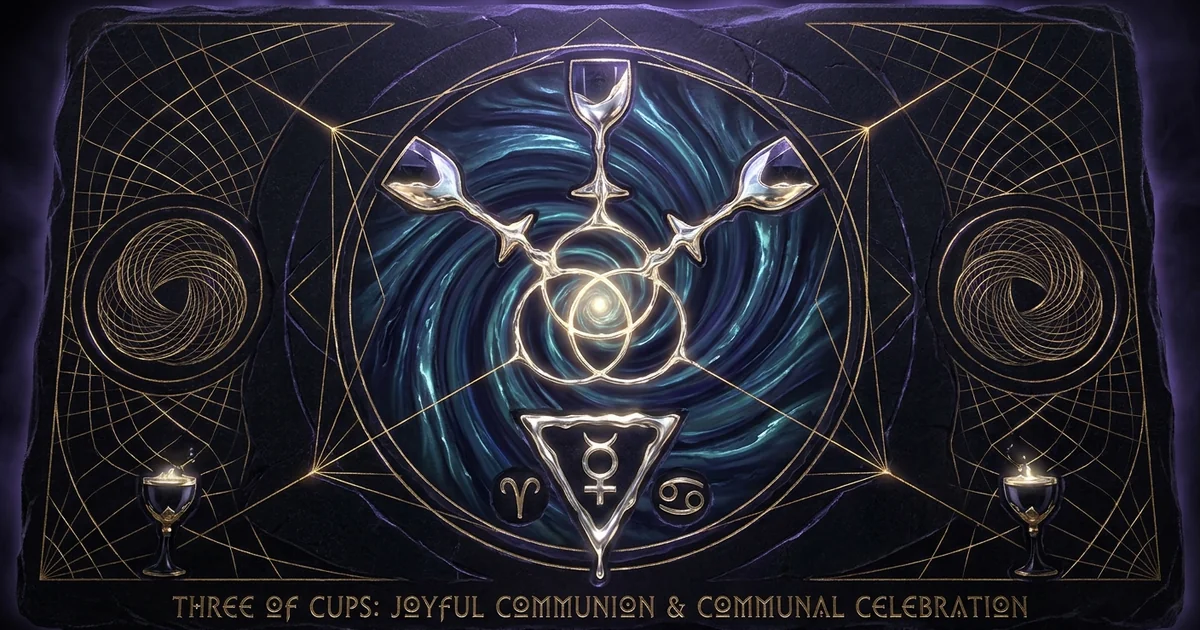
Three of Cups: Joyful Communion and Communal Celebration
Archetypal Thesis & Systemic Paradigm: The Intersubjective Geometry of Emotional Cohesion
The Three of Cups designates the operational manifestation of Binah (Understanding) within the fluidic realm of Briah, crystallizing the dynamic interplay between undifferentiated emotional communion and structured intersubjective celebration. Far from trivializing revelry as mere hedonistic indulgence, this card operates as a cybernetic feedback node within the Minor Arcana. It marks the precise alchemical point where solitary affect transmutes into collective cohesion via the second decan of Cancer (ruled by Mercury).
Within psycho-cosmological coordinate frameworks, the three of cups tarot meaning represents an archetypal pivot: it transitions the raw, bipolar attraction of the /tarot/two-of-cups-meaning into a resilient, triadic socio-emotional circuit. The water element, which in its unmodulated state risks dissipation or overwhelming oceanic dissolution, achieves its first stable socialized matrix through this triadic geometry.
Binah in Briah: The Structural Confinement of the Liquid Matrix
In Hermetic Qabalah, the Sephira Binah constitutes the cosmic archetype of form, containment, and gestational boundary. When its architectural power acts upon the World of Briah—the archangelic and creative domain characterized by pure elemental-water—it imposes structural order without arresting kinetic flow. In the suit of Cups, Binah does not freeze water into rigid dogma; rather, it crafts the receptive vessel that allows the liquid to be shared, measured, and ritually exchanged.
The title conferred upon the card by the Hermetic Order of the Golden Dawn, the “Lord of Abundance,” directly references this metaphysical operation. Binah receives the unrestricted Chokmah-force flowing through the suit and provides the functional geometry necessary for that force to become sustainable sustenance. Without the boundary conditions established by Binah, the emotional potency of Briah would flood the psychic terrain, leading to ego-submersion rather than conscious communal participation.
The operational attribution of the Three of Cups derives from the manifestation of the third Sephira, Binah (Understanding, Archetypal Mother, the Great Sea/Marah), within the second Kabbalistic world, Briah (the Creative Realm of Archangelic Water). This pairing transforms raw primordial libido into a bounded, socialized chalice.
The numerical value of Three represents the first systemic stabilization of energetic tension. In Briah, Binah’s structural rigor functions not as an inhibitor of sentiment, but as the generative, holding boundary that prevents the emotional current from evaporating into subjective fantasy or collapsing into uncontained projective identification. It creates the condition for what Aleister Crowley termed “fertility, plenty, and the realization of that which was begun by the two.”
From Dyadic Tension to Triadic Equilibrium
The transition from the Two of Cups to the Three of Cups marks an evolutionary leap in consciousness: the shift from the binary dyad to the self-stabilizing triad. While the Two of Cups embodies the intense, mirrored polarity of two sovereign psyches meeting along an axis of mutual projection and attraction, its systemic vulnerability lies in its fragility. The dyad is intrinsically volatile; it fluctuates perpetually between intimacy and defensive withdrawal.
By contrast, the introduction of a third point of reference invokes the profound laws of /sacred-geometry/triad-symbolism. A triangle cannot collapse along the single vector that perpetually threatens a pair. The third chalice acts as a witness, an altar, and a transcendent third term that balances the polar tension. In intersubjective relational theory, this triadic configuration signals the emergence of the “relational field” itself—an autonomous energetic entity that exists between and among the participants, freeing them from the suffocating pressure of bilateral enmeshment.
The Transpersonal Function of Shared Affect
Communal celebration, within this esoteric cartography, operates as an integrative psycho-spiritual mechanism. It is an intentional, boundary-holding rite wherein individual egos temporarily soften their defensive margins into an intersubjective container without suffering psychic fragmentation. The participants of the Three of Cups do not forfeit self-awareness; rather, they experience the transpersonal function of shared affect, in which emotional resonance amplifies vitality rather than draining it.
Through laughter, shared libation, and ritual synchronization, the collective psyche metabolizes individual sorrow, re-weaving isolated subjects into the wider social tapestry. It represents the structural victory of communion over alienation: the individual discovers that their interior emotional landscape is neither unique in its suffering nor destined to be borne in solitary exile.
Classical Provenance & Textual Lineage: Historical Transmissions of the Third Cups Decan
The iconography and divinatory values associated with the Three of Cups are not modern decorative inventions. They represent the synthesis of late-antique astromagical images, Renaissance occult philosophies, and Victorian esoteric reconstructions of the Eleusinian and Bacchic mysteries. To trace the genealogy of the card is to uncover how the Hellenistic decans—the thirty-six celestial gatekeepers of time and fate—became translated into psychological archetypes across millennia.
The Picatrix and Agrippan Decanic Iconography of Cancer II
The root image of the second decan of Cancer traces back through the Picatrix (the Latin translation of the Arabic Ghāyat al-Ḥakīm) and finds its definitive early modern expression in Heinrich Cornelius Agrippa’s De Occulta Philosophia Libri Tres (1533). Agrippa synthesized the earlier Hellenistic astrological texts of Teukros of Babylon with medieval Arabic astro-magic, mapping the second face of Cancer as a domain of celebratory yield, social conciliation, and organic vegetation.
“The second face [of Cancer] is of Mercury. There ascends in the second face of Cancer a woman of pleasing countenance, adorned with flowers, holding in her hand a leafy bough, and crowned with myrtle and camphor; and she sings songs of love, joy, and mirth, with companions dancing about her. The signification of this face is for pleasure, songs, merriment, games, concord, love, and the pursuit of gladness among companions and friends.” — Heinrich Cornelius Agrippa, De Occulta Philosophia Libri Tres, Book II, Chapter 37 (1533)
This Renaissance decanic matrix explicitly establishes the three themes preserved in modern decks: the vegetative yield (flowers and leafy boughs), the auditory and somatic expression of delight (songs, games, and dance), and the non-coercive, mutual affection of companions. Agrippa notes that the presence of Mercury inside the lunar domain of Cancer converts domestic or introspective oceanic feeling into exteriorized, articulated social grace.
Hermetic Order of the Golden Dawn: S. L. MacGregor Mathers and the Lord of Abundance
When the Hermetic Order of the Golden Dawn codified its curriculum in the late 19th century, S. L. MacGregor Mathers drew upon these decanic lineages to systematize the Tarot within the framework of the Western Mystery Tradition. In The Tarot: Its Occult Signification, Use in Fortune-Telling, and Method of Play (1888) and the esoteric instructions of Book T, the card was designated the “Lord of Abundance.” Mathers and his associates positioned it as the ultimate expression of material and emotional bounty generated through the synthesis of Binah and the watery element.
Aleister Crowley, drawing directly from this Golden Dawn framework in The Book of Thoth (1944), preserved the technical title while emphasizing the rhythmic equilibrium of the Sephiroth:
“The Number Three, Binah, is here realized in the element of Water. The idea of Love is realized in its natural element… This card represents the fulfillment of the Will to Love in abundance, gladness, and mutual enjoyment.”
Crowley cautioned, however, that because this card occupies a high Sephirotic position within a fluidic medium, its energy is fundamentally ephemeral. The abundance of the Three of Cups is dynamic; it represents an exuberant wave cresting at the peak of affective exchange, demanding consumption and communion rather than hoarding or possessive fixation.
Pictorial Key Innovations: Pamela Colman Smith and the Harvest Rite
Prior to the 1909 publication of the Rider-Waite-Smith deck, historical European Tarot decks—such as the Tarot of Marseilles—rendered the Three of Cups as an abstract pip arrangement: three interlocking, ornate chalices entwined with vegetative arabesques. The artist Pamela Colman Smith, working under the esoteric direction of Arthur Edward Waite, revolutionized this iconography. She converted the card’s geometric scaffolding into a narrative scene deeply evocative of ancient mystery cults.
Waite described this scene in The Pictorial Key to the Tarot (1910) with calculated simplicity: “Three maidens in a garden-ground with cups uplifted in each other’s hands to pledge one another.” Smith intentionally departed from the stoic, static posturing of typical Victorian illustration. The maidens do not sit passively; they dance in a circular clearing surrounded by heavy clusters of ripening grapes, gourds, and golden harvest sheaves.
Smith fused the decanic imagery of the Picatrix with the Eleusinian agrarian mysteries of Demeter and Persephone and the ecstatic rites of Dionysus. The three figures, intertwined by their raised chalices, do not merely raise their cups to a distant deity. They raise them to one another, sanctifying the human assembly itself as the locus of divinity.
Structural Mechanics & Symbolic Geometry: Astrological Decans and Qabalistic Architectures
The inner coherence of the Three of Cups relies upon an exacting lattice of astrological assignments, geometric ratios, and alchemical transmutations. The card operates as an intricate engine designed to circulate psychic energy throughout the cups suit without experiencing destructive resistance or emotional stagnation.
Mercury in Cancer (10°00’ to 19°59’ Cancer): Intellectualized Receptivity
The chronological and spatial domain of the card spans the second decan of Cancer, occupying the celestial coordinate arc from 10°00’ to 19°59’. Within traditional astrological dignity tables, this face is governed by the planet Mercury. The conjunction of /astrology/mercury-in-cancer produces a distinctive psycho-energetic signature: the analytical, swift, and communicative vector of Hermes intersects with the cardinal, protective, and deeply receptive water of the Crab.
Cancer is intrinsically an introverted, defensive sign, ruled by the Moon and oriented toward the preservation of somatic memory, tribal lineage, and psychic safety. When Mercury acts as decanic ruler within this aquatic sanctuary, it provides the bridge between internal feeling states and external, codified dialogue.
Mercury “mentalizes” the lunar water. It enables individuals to translate unspoken emotional currents, intuitions, and collective longings into intelligible communal expression: laughter, song, shared oaths, and verbal validation. Far from being a detached, hyper-rational placement, Mercury in Cancer functions as the poet, the celebrant, and the master of ceremonies who articulates the subconscious heartbeat of the group.
Triangular Topologies: The Chalice Triad as an Upward-Pointing Delta
The structural mechanics of the Three of Cups are governed by the geometry of the triangle. The three chalices held by the figures form an equilateral, upward-pointing delta ($\Delta$), the universal geometric glyph for the element of Fire. This structural inversion within a card ruled by elemental-water represents an esoteric paradox: the fluid water element adopts the dynamic, ascending, aspirational geometry of fire.
The upward orientation of the chalices demonstrates that communion is not merely a passive resting upon subterranean pools of sentiment; it is an active elevation of emotional libido. The cups are held aloft, defying gravity. This elevation signifies that the raw, animal drives toward social belonging and primal safety have been sublimated into high cultural artifice, conscious hospitality, and ethical affection.
The Supernal Triad of the Tree of Life—Kether, Chokmah, and Binah—is structurally mirrored in this delta, bringing the primordial architecture of divine manifestation down into the Briatic domain of human community.
       [Cup 1: Thesis / Vision]
               ▲
              / \
             /   \
            /     \
[Cup 2: Antithesis]--[Cup 3: Synthesis / Integration]
Alchemical Attributes: The Ripening of the Albedo into Shared Libation
Within Western alchemical praxis, the suit of Cups is aligned with the operations of the Albedo (the whitening), the stage of the Great Work in which the blackened, disintegrated matter of the Nigredo is purified through psychic washing (ablutio) and elevated to a state of luminous consciousness. In the Three of Cups, the Albedo achieves its harvest.
The vegetative attributes strewn across the ground of the card—pumpkins, gourds, bound sheaves of grain, and ripe hanging grapevines—signify that the invisible subterranean roots of the collective psyche have yielded dense, consumable fruit. The liquid inside the chalices is no longer the unfermented, pristine spring water of the Ace. It has undergone natural fermentation: it has become wine.
Wine embodies the alchemical marriage of the water of the earth and the fire of the sun. It is a psychoactive substance that, when consumed within ritual parameters, dissolves the calcified rigidity of the conscious persona, facilitating a sacred, controlled intoxication that bridges the personal conscious mind with the collective unconscious.
Psychological Dynamics & Operational Praxis: The Archetypal Matrix of Intersubjectivity
From the vantage point of depth psychology and operational archetypal analysis, the three of cups tarot meaning functions as a clinical diagnostic tool for examining a subject’s capacity for relational hygiene, intersubjective participation, and emotional assimilation.
Jungian Amplification: The Three Graces and the Transcendent Function
Carl Gustav Jung observed in The Archetypes and the Collective Unconscious (1959) that tripartite feminine configurations inevitably signal the operational unfolding of the anima within the male psyche, or the internal triadic structuring of the Self within the female psyche. Smith’s visual rendition of the three maidens explicitly recalls the Hellenistic Charites (the Three Graces): Aglaia (Splendor/Radiance), Euphrosyne (Mirth/Festive Joy), and Thalia (Abundant Bloom).
In Seneca’s classical treatise De Beneficiis, the Three Graces were described as dancing in an unbroken ring, hands perpetually intertwined, signifying the cybernetic recursion of relational grace: one sister gives the benefit, the second receives it, and the third returns it to the giver, maintaining an endless circulation of reciprocal energy.
[ Giver: Aglaia (Splendor) ]
               /         ▲
              /           \
             v             \
[ Receiver: Euphrosyne ] -> [ Returner: Thalia ]
Psychologically, this circular dynamic exemplifies Jung’s concept of the transcendent-function applied to interpersonal relations. When two opposing conscious positions reach an impasse, an authentic third term must emerge from the unconscious to resolve the deadlock. The Three of Cups is that emergent third term. It unifies the split fragments of the subject’s feeling function (the F-function), transmuting internalized psychic ambivalence into an outward-facing, cohesive social equilibrium.
Shadow Manifestations: Co-dependency, Hedonistic Dissipation, and Triangulation
Every archetypal coordinate possesses its corresponding shadow architecture. When the energy of the Three of Cups is corrupted, inverted, or pathologically fixated, the structured containment of Binah collapses, leaving only the toxic residues of an undisciplined water element.
The most pervasive shadow expression is psychological triangulation, a dynamic extensively mapped in systemic family therapy. In this scenario, two parties within a relational system, unable to resolve an internal dyadic conflict directly, pull a third party into the dynamic to dilute the anxiety. The triadic chalice, designed to celebrate collective abundance, becomes an instrument of insidious gossip, factionalism, and exclusionary cliques.
Furthermore, the card’s shadow can manifest as hedonistic dissipation—the compulsive pursuit of sensory distraction, superficial socializing, and chemical intoxication used as an ego defense mechanism to evade necessary solitary individuation or painful shadow confrontation.
Upright: Intersubjective Resonance
- Relational Sovereignty: Participants retain structural ego integrity while entering into conscious, mutual affective exchange.
- Transpersonal Communion: Laughter and shared celebration serve to dissolve defensive alienation, facilitating psycho-somatic rejuvenation.
- Reciprocal Benefaction: Libido circulates continuously; benefits are received, acknowledged, and returned in an unhindered circuit of social support.
- Symbolic Integration: The feeling function actively unifies internal archetypal polarities, producing authentic communal attunement.
Reversed: Dissipative Enmeshment
- Triangulation & Cliques: The third term becomes an instrument of alienation, weaponizing gossip and forming exclusive defensive alliances.
- Hedonistic Avoidance: Ritual celebration degenerates into compulsive sensory diversion, blinding the subject to urgent material or psychological decay.
- Enmeshment & Codependency: Boundary erosion leads to systemic psychic contamination, where individual identity is suffocated by groupthink.
- Emotional Exhaustion: The circuit fails to regenerate; psychic energy is siphoned off through superficial exchanges, leaving participants depleted.
Divinatory Diagnostics: Reading the Interpersonal Circuit in Consultations
In practical esoteric cartography and clinical Tarot consultation, the appearance of the Three of Cups demands a thorough audit of the querent’s social substrate and psychic ecology. It asks diagnostic questions regarding the subject’s relational support networks:
- Is the querent attempting to navigate an archetypal ordeal in pathological isolation?
- Are they capable of receiving nourishment from their peers without feeling debased or indebted?
- Have they constructed an insular echo chamber that prioritizes superficial social harmony over rigorous authentic confrontation?
When the Three of Cups emerges adjacent to challenging Major Arcana (such as The Tower or The Devil), it frequently acts as an urgent operational directive: the subject must establish an external, non-judgmental containment network before attempting deeper shadow integration. Solitary willpower alone will fail; recovery depends upon leaning into the intersubjective matrix of friends, therapeutic allies, or chosen spiritual kinship.
Philosophical Synthesis & Macrocosmic Correspondence: Cybernetic Resonance and Social Entrainment
Beyond human psychology and divinatory utility, the Three of Cups models a universal mechanical principle: the self-organizing entrainment of independent harmonic oscillators within a shared spatial medium. It is an esoteric treatise on the physics of collective cohesion.
Bio-Psychic Phase Locking: Neural Entrainment within Ritual Space
Modern chronobiology, affective neuroscience, and systems sociology provide empirical validation for what Hermetic philosophy has historically termed the “contagion of the astral light.” When individuals gather in an intentional physical assembly and engage in rhythmic speech, shared vocalization, eye contact, and collective ingestion of libation, a biological phenomenon known as neural and autonomic phase locking occurs.
“Empirical investigations into collective effervescence indicate that shared ritual actions induce rapid physiological coupling among participants. Heart-rate variability (HRV) synchronizes across interacting bodies, while autonomic nervous system tone shifts from defensive sympathetic activation to parasympathetic, socially-oriented ventral vagal dominance. The group ceases to operate as an aggregate of isolated agents; it transitions into a functionally integrated superorganism characterized by hyper-attuned bio-behavioral feedback loops.” — Systemic Neuro-Anthropology Consortium, Journal of Intersubjective Neurodynamics, 2021
This physiological synchrony is precisely what the three of cups symbolism visually maps. The maidens’ raised arms, identical strides, and circular motion portray the dissolution of biological dissonance. Within this synchronized matrix, the energy required to sustain individual psychic homeostasis is shared across the entire social collective. The cost of living is momentarily lowered; the nervous system rests, heals, and replenishes its energetic reserves within the biological safety of the tribe.
The I Ching Analogue: Hexagram 58 (Dui / The Joyous, Lake over Lake)
In the structural taxonomy of the I Ching (Book of Changes), the exact macrocosmic analogue to the Three of Cups is /iching/hexagram-58-dui (Dui / The Joyous, Lake over Lake). Dui represents the youngest daughter, the metal element acting as an open container for water, the mouth, and joyful, stimulating discussion among companions.
---  ---  Upper Trigram: Dui (The Joyous / Lake)
--------
--------
---  ---  Lower Trigram: Dui (The Joyous / Lake)
--------
--------
The commentary on the Image in Hexagram 58 presents an undeniable parallel to the Three of Cups:
“Lakes resting one on the other: The image of the Joyous. Thus the superior man joins with his friends for discussion and practice.”
The classic Chinese commentary explicates that a solitary lake dries up rapidly under the heat of the sun, and an isolated water source stagnates or evaporates. But when two or more lakes are connected, they replenish one another mutually, their moisture circulating perpetually through natural underground and atmospheric channels.
The Three of Cups operates under this precise mathematical law: true joy cannot be hoarded in a singular, closed vessel. It persists only through the continuous, reciprocal percolation of affect between open reservoirs.
Hermetic Polarities: The Hermetic Axiom of Rhythm within the Liquid Sphere
To fully understand the systemic position of the Three of Cups, it must be contextualized within the sequential rhythm of the Minor Arcana. In The Kybalion, the Hermetic Axiom of Rhythm dictates: “Everything flows, out and in; everything has its tides; all things rise and fall; the pendulum-swing manifests in everything.”
The emotional exuberance, laughter, and unrestrained social pouring of the Three of Cups represents the peak exhalation of the water suit. It is an absolute high tide of the astral waters. However, because it operates under the planetary rulership of Mercury—the archetypal traveler who refuses to settle permanently in any domestic container—this festive equilibrium cannot remain frozen in time.
The cyclical rhythm of consciousness requires that this outward communal outpouring inevitably swing inward toward its natural counterpart: the /tarot/four-of-cups-meaning. In the Four of Cups, the noise of the festival falls silent; the soul experiences the inevitable psychic satiety, emotional exhaustion, and re-establishment of solitary boundaries required after the holy madness of the communal rite.
Frequently Asked Questions: Advanced Cartographic Inquiries
How does the Three of Cups structurally differ from the Four of Wands in communal typology?
While both cards visually celebrate harmony and assembly, their underlying structural mechanics, elements, and Sephirotic positions are entirely different. The Four of Wands operates in the element of Fire and occupies the Sephira Chesed (Mercy/Abundance). It signifies civic, architectural, and structural consolidation. The Four of Wands represents the formalization of boundaries: the wedding contract, the establishment of the hearth, the raising of the civic walls, or the institutionalization of community. Its celebration is structured, public, and governed by established social conventions.
Conversely, the Three of Cups operates within the fluidic element of Water and the Sephira Binah. Its celebration is unstructured, intimate, and organic. There are no stone walls or constructed pergolas here; the setting is an open, unmanicured garden-ground.
The Three of Cups is an affective communion based purely upon emotional resonance and mutual affinity rather than civic duty, legal contract, or institutional demarcation. The Four of Wands celebrates the security of the fortress; the Three of Cups celebrates the vitality of the spring.
What is the operational consequence of Mercury ruling a water decan in this card?
The rulership of Mercury over the second decan of Cancer introduces a dynamic, communicative, and intellectual tension into an otherwise hyper-receptive, emotional sign. Water, left to its own devices, is silent, slow, and prone to non-verbal subjective impressions. Mercury acts as an electric current passing through the aquatic medium.
The operational consequence of this placement is the rapid translation of emotion into expressive form. Under Mercury in Cancer, affection does not remain latent; it demands externalization through:
- Poetry, songwriting, storytelling, and spontaneous humor
- Conscious hospitality and domestic arrangement
- The verbalization of relational contracts and mutual appreciation
Mercury prevents the water of Cancer from stagnating into sentimental brooding or defensive shell-hardening. It provides the intellectual adaptability and conversational lightness that allows multiple individuals to interlock their distinct feeling states without emotional clashing.
How should one interpret the appearance of the Three of Cups in strictly solitary, non-social consultations?
When a consultant is completely physically isolated, a hermit by circumstance, or querying a matter devoid of social relations, the Three of Cups must be interpreted through the lens of intra-psychic integration. The three figures cease to represent external human beings and instead signify the primary internal sub-personalities of the querent’s own psyche: the Persona (the social mask), the Ego (the conscious decision-maker), and the Anima/Animus (the unconscious archetypal guide).
In a solitary context, the card indicates that the internal civil war between the querent’s disparate complexes has ceased. The conscious mind, the subconscious instinctual drives, and the transpersonal aspirations have aligned in a state of harmonious self-communion. The card serves as an operational mandate for radical self-hospitality: the querent is instructed to celebrate their own survival, validate their private achievements, and provide themselves with the emotional sustenance they have historically sought from external validation. The three chalices become the three chambers of the integrated heart, resting in quiet, unassailable abundance. :::