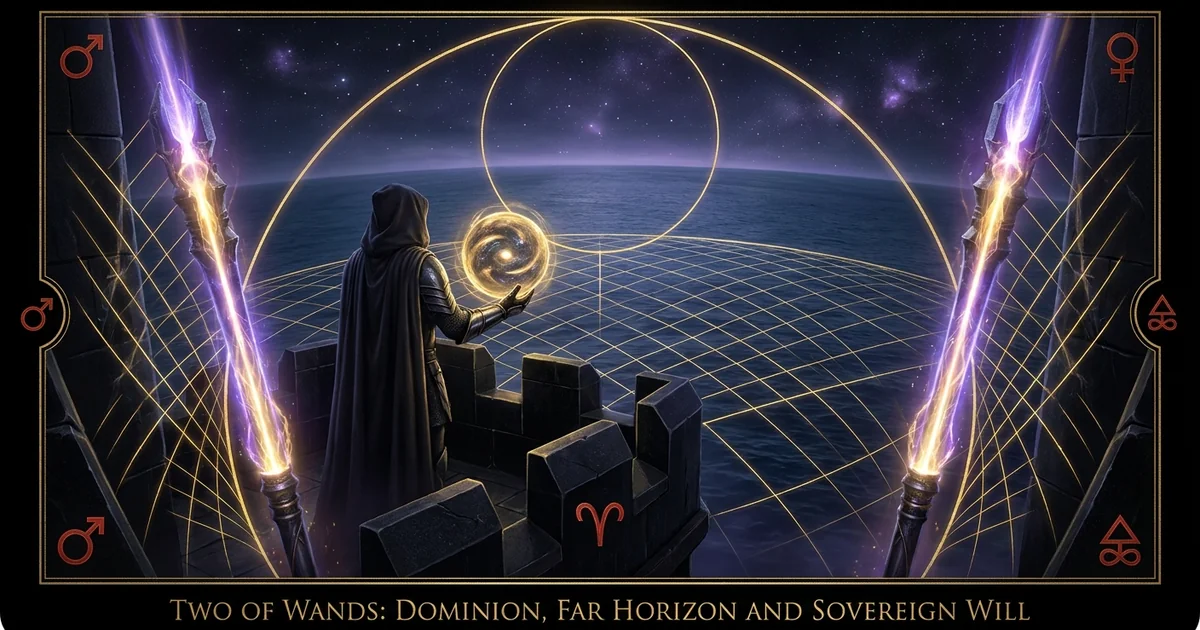
Two of Wands: Dominion, Far Horizon and Sovereign Will
Archetypal Thesis & Systemic Paradigm: The Vectorization of Primal Volition
Executive Deliberation vs. Ketheric Inception
The Two of Wands marks the primordial structural deceleration of divine volition. Where the /tarot/ace-of-wands manifests as the unconditioned, omnidirectional detonation of energetic potential—the dimensionless Ketheric point erupting through the veil of non-being—the Two of Wands introduces the fundamental principle of dualistic geometry. Here, the raw kinetic libido of the fire element ceases to be merely explosive and becomes directional.
Ace of Wands (Ketheric Ignition: 0-D Point)
  ↳ Two of Wands (Chokmah Polarization: 1-D Vector)
      ↳ Three of Wands (Binah Trajectory: 2-D Plane)
In the developmental taxonomy of consciousness, this card represents the precise psychological threshold where primary, unmediated drive meets reflective awareness. The will no longer merely exists as an energetic fact; it recognizes itself as an executive agent operating within a spatial continuum.
This transformation represents a profound psycho-cosmological crisis. Raw drive, left unconditioned, burns itself out in immediate, chaotic entropic release. To achieve efficacy, volition must submit to the boundary conditions of polarity. In the Two of Wands tarot meaning, the infinite possibility of the Ace is willingly surrendered in exchange for intentional trajectory. The energetic current is drawn taut between two poles: the origin point of secured sovereignty and the terminal point of the distant objective.
This deceleration is not a diminishment of potency, but its vectorization. By converting omnidirectional force into a focused line of deliberate intent, consciousness establishes an executive horizon across which it can project its sovereign authority.
Omnidirectional Force (Ace) ──[Polarization / Deceleration]──> Directed Vector (Two)
The Globus Cruciger and the Architectural Horizon
Central to this iconographic apparatus is the human figure poised between vertical wooden shafts, elevated upon the stone battlements of an architectural redoubt. In his right hand, the sovereign cradles a miniature terrestrial orb—the globus cruciger stripped of its overt ecclesiastical crucifix and restored to its primordial Hermetic function as an emblem of microcosmic dominion. This orb is the world held in potentia, a cognitive model of reality sustained within the palm of the magus. It signifies that before any physical territory can be conquered or transformed, it must first be rendered intellectually coherent, reduced to an operational simulation within the confines of subjective consciousness.
The stone rampart functions as an indispensable epistemic boundary. It delineates the absolute demarcation between the established, organized ego-complex (the domestic citadel) and the trans-boundary expanse of the unmapped macrocosm (the ocean and mountain ranges stretching toward the horizon). The sovereign does not stand within the wilderness; he surveys it from an entrenched redoubt of civilization and structural order.
This structural elevation converts mere biological vision into a systemic vantage. The distant ships cutting through the bay and the purple peaks on the perimeter are not merely scenic backdrops, but prospective fields of intervention. The sovereign’s gaze toward the far horizon is the phenomenological gaze of intentionality itself—a deliberate tension between the safety of the perimeter and the imperative toward outward expansion.
Chokmah in Atziluth: The Polarization of Dynamic Light
Within the architectural framework of the Qabalah, the Two of Wands occupies the exalted position of /qabalah/chokmah-wisdom-emanation within the archetypal world of Atziluth. Chokmah is the Great Father (Abba), the initial masculine, projective dynamic emerging from the primordial unity of Kether. As the Sephira of dynamic force, pure wisdom, and the cosmic phallus, Chokmah embodies the unformed rush of divine energy before it is arrested, stabilized, and cast into structural matrices by Binah (Understanding). When this Chokmic potency is channeled through Atziluth—the world of primary fire, divine emanations, and unconditioned archetypes—it yields a pure, unadulterated expression of the fire element.
Kether (Archetypal Spark)
  │
  ▼
Chokmah in Atziluth (Two of Wands: The Polarized Impulse of Will)
  │
  ▼
Binah (Formative Matrix / Three of Wands)
In this Qabalistic localization, the card does not suffer from the energetic dampening that occurs when fire descends into the dense permutations of Yetzirah (Formative Astral) or Assiah (Material Action). Instead, it reflects the primary polarization of the divine dynamic. Chokmah in Atziluth is the logos as an active, penetrating ray—the primal assertion “Let there be.” Yet, precisely because it is the Two, this flash of light encounters the concept of the “Other.”
The card models the moment the active principle recognizes the void awaiting colonization. It is the realization that will cannot exist in an operational vacuum; it requires a field of instantiation. The Two of Wands therefore represents the supreme metaphysical balance of creative force: energy poised at the very edge of manifestation, vibrating with absolute executive power, fully aware of its own capacity, yet holding its fire until the trajectory is aligned with sovereign necessity.
“The psychological mechanism of transformation consists in a channeling of energy from an instinctual, undirected form into an intentional, culturally determined vector. The libido, which otherwise expends itself in aimless discharge, is dammed up through the establishment of an archetypal surrogate or cognitive framework. This containment creates the gradient necessary for purposeful psychic work, converting raw instinct into an executive apparatus capable of projecting subjective intent onto the external world.” — Carl Gustav Jung, Symbols of Transformation (Collected Works Vol. 5, Princeton University Press), p. 142.
Classical Provenance & Textual Lineage: The Emergence of Dominion
The Golden Dawn Cipher Manuscripts and Book T Formulation
The technical identity of the Two of Wands is established in the Hermetic Order of the Golden Dawn’s curriculum, as codified by Samuel Liddell MacGregor Mathers and William Wynn Westcott from the foundational Cipher Manuscripts. In this system, the card receives the solemn title “The Lord of Dominion,” serving as the programmatic attribution for the first ten degrees of the zodiacal sphere of the Ram. In the esoteric text Book T: The Tarot, the card’s identity is constructed through a fusion of Hellenistic decanic astrology, Chaldean planetary hours, and the mathematical geometry of the Tree of Life.
“Two Wands crossed, identical with those held by the Adeptus Major. They are crossed, but do not interlock. Flames issue from the point of intersection. Above and below, two hands emerge from clouds, holding the wands. Above, the symbol of Mars; below, the sign of Aries. Title: The Lord of Dominion. Decan: First decan of Aries, governed by Mars. It represents the assertion of will, the establishment of authority, and the initial, unshakeable confidence of creative force organizing its realm.” — S. L. MacGregor Mathers, Book T: The Tarot (Golden Dawn Archival Recension), Section VII: The Thirty-Six Decanates.
In the original Golden Dawn schema, the imagery eschews human dramatization in favor of pure talismanic mechanics. The two crossed wands signify the energetic friction generated by the confrontation of twin currents of primary fire. This friction does not generate entropy; rather, it produces an apex of concentrated energetic discharge, signified by the stylized flames radiating from their nexus.
The title “Lord of Dominion” directly articulates the ontological status of the decan: the establishment of an uncontested baseline of authority. It is the energetic state wherein the operator has successfully vanquished internal resistance and stands as the unimpeachable master of his immediate ritual and psychological sphere.
The Pictorial Shift of Pamela Colman Smith and Arthur Edward Waite
When Arthur Edward Waite collaborated with artist Pamela Colman Smith to generate the Rider-Waite-Smith (RWS) deck in 1909, they initiated a profound iconographic transformation. Smith departed from the non-figurative geometry inherited from the Tarot de Marseille and maintained by the Golden Dawn’s inner circles. She transposed the abstract occult mechanics of Book T into a staged, theatrical human tableau.
Tarot de Marseille: Abstract crossed staves (Geometric Tension)
  ↳ Golden Dawn Book T: Talismanic crossed wands with planetary sigils (Elemental Force)
      ↳ Rider-Waite-Smith: Regal figure surveying horizon from battlement (Psychological Vector)
Waite’s critical intervention was the contextualization of Dominion within the human experience of space, political power, and contemplative restraint. In The Pictorial Key to the Tarot, Waite characterizes the figure as a wealthy, noble personage looking from his fortified rampart across an expansive sea toward a jagged mountainous shoreline. Waite writes that the card paradoxically carries the alternative meanings of “on the one hand, riches, fortune, magnificence; on the other, physical suffering, disease, chagrin, sadness, mortification.”
This striking ambivalence emerges directly from Smith’s staging: the sovereign possesses everything within his walls, yet his posture is not one of triumphant celebration, but of existential longing and strategic calculation. Smith illustrates the psychological cost of sovereignty. The battlements that provide structural safety simultaneously isolate the ruler, turning his dominion into an gilded enclosure unless he risks the traversal of the far horizon.
Crowley’s Martian Fire: The Pure Dynamic of the Lord of Dominion
In stark philosophical contrast to the RWS framing, Aleister Crowley, in collaboration with Lady Frieda Harris, stripped the Two of Wands of all narrative sentimentality in the design of The Book of Thoth. Crowley returned to the pristine structural mechanics of the Golden Dawn system, but radically heightened its aggressive, primordial intensity. In the Thoth deck, the card is visually constructed around two Tibetan dorjes—the ritual thunderbolts signifying diamond-like, adamantine will—crossing at a dynamic angle against a violently ignited, sulfurous background.
Crowley/Harris Dynamic:
Dorje 1 (Martian Assertion) ──X── Dorje 2 (Arian Fire)
           │
           ▼
Apex of Diamond Destruction / Re-Creation (No Narrative Hesitation)
Crowley wholly rejects the RWS reading of melancholic hesitance or domestic dissatisfaction. For Crowley, the Lord of Dominion is the cosmic emblem of pure, unhesitating assertion: Mars elevated within its own nocturnal and diurnal dignity at the vernal equinox. The dorjes represent will that is both creative and destructive, totally unconditioned by retrospective nostalgia or sentimental attachment to the parapet. Crowley notes:
“This card represents the Energy of Fire in its most exalted and active form… It is the unshakeable will, the sovereign consciousness which recognizes no impediment, because it is in perfect harmony with the fundamental nature of the Universe.”
There is no brooding over the battlements in the Thoth paradigm; dominion is not an architectural structure to be held against an encroaching sea, but an irrepressible dynamic state of continuous energetic expansion.
Structural Mechanics & Symbolic Geometry: Mars in the Decans of Aries
Astrological Decan Mechanics: Mars Governing 0°–10° Aries
The fundamental systemic engine driving the Two of Wands is the astrological placement of Mars in the first decan of Aries (/astrology/mars-in-aries-decan-1). In the Chaldean order of planetary rulerships, the 36 decans of the zodiac form a continuous descending ladder of planetary spheres. The first decan of Aries—spanning 0° to 10° of the tropical zodiac—represents the zero point of the celestial wheel: the vernal equinox. Here, the sun crosses the celestial equator, resurrecting the daylight hours and inaugurating the astrological year with the furious emergence of cardinal fire.
Zodiacal Year Zero: 0° Aries ──[Vernal Equinox]──> 10° Aries
Planetary Rulership: Mars (Domicile) in Mars Decan (Chaldean)
Energetic Signature: Cardinal Fire / Active Sulfur / Pure Initiating Drive
Because Mars serves as both the orthodox domicile ruler of the sign Aries and the decanic lord of its first ten degrees, this decan possesses an exceptional energetic concentration known as essential dignity. There is no divergence of nature between the sign and its governing intelligence. Mars in Aries represents kinetic drive in its purest, most combustible state.
Heinrich Cornelius Agrippa, in his De Occulta Philosophia, describes the image of the first decan of Aries as:
“…a man standing tall, clothed in white, holding a staff, exhibiting boldness, fortitude, high spirits, and a total absence of fear.”
This astrological profile explains the profound authority inherent to the Two of Wands. It is the unhesitating capacity to act at the absolute beginning of a cycle. However, precisely because this cardinal fire is situated within the number Two (Chokmah), this raw Martian ferocity is harnessed and stabilized by the structural architecture of cosmic wisdom. The fire is not permitted to detonate as raw violence; it is transmuted into the executive virtue of command.
Chokmah’s Reflection in the World of Archetypal Fire
The descent of divine light down the Tree of Life requires that the raw energy of each Sephira be filtered through the elemental nature of the Four Worlds:
- Atziluth (Archetypal/Fire)
- Briah (Creative/Water)
- Yetzirah (Formative/Air)
- Assiah (Material/Earth)
The /tarot/suit-of-wands-archetypes are the direct expressions of Atziluth across the numeric continuum. When Chokmah, which is itself the archetypal masculine source of dynamic projective potency, is situated within Atziluth, a condition of pure, self-reinforcing resonance is achieved.
This emanational circuit demonstrates that the Two of Wands is not an empirical, physical event, but an archetypal disposition of consciousness. The card crystallizes the exact intermediate phase between the conception of a macrocosmic enterprise and its structural formulation (which occurs in the Binah-governed Three of Wands).
The sovereign holds the orb because he operates within the realm of Archetypes (Atziluth). The physical world has not yet been physically touched; rather, the archetypal blueprint has been fully mobilized, awaiting the signal for physical descent.
Sacred Geometry: Orthogonality, the Stanchion, and the Free Wand
The spatial arrangement in Pamela Colman Smith’s composition yields deep insights through the structural mechanics of its sacred geometry. The sovereign stands framed between two massive wands, but these implements are subjected to profoundly different physical relationships with the surrounding architecture.
       [Left Hand: Unconstrained]
                    │
            (Dynamic Projective Will)
                    │
                    ▼
           [ Wand A: Free Staff ]  <─── Surveys Horizon

 vs.

           [ Wand B: Bound Staff ] <─── Anchors Foundation
                    ▲
                    │
          (Structural Memory/Law)
                    │
       [Right Side: Bolted Stanchion]
The right-hand wand is firmly bound or bolted to an iron ring anchored directly into the stone masonry of the battlement. It is immovable, vertical, and rigid. This wand represents the past: the established territory, the foundational victory, the legal and structural authority that has already been consolidated. It is the stanchion of established reality—the axis mundi of the existing empire. It cannot be wielded dynamically because its energetic function is structural stabilization; it prevents the battlement from crumbling.
Conversely, the left-hand wand is held freely within the sovereign’s left palm, its base resting lightly upon the paving stones of the terrace. This wand represents the future: mobile, unconstrained, and capable of being raised, carried forth, or repositioned at the discretion of the operator’s will. It is the instrument of prospective conquest. The geometry is decisively orthogonal: the sovereign operates as the living hypostasis bridging the immovable verticality of the past (the bolted wand) and the fluid verticality of the future (the free wand).
This architectural polarity is further qualified by the floral motif carved into the stone relief beneath the sovereign’s hand: the crossed red roses and white lilies. In the Hermetic and alchemical lexicon, the rose corresponds to active, combustive sulfur—the masculine, generative desire of the will—while the lily corresponds to philosophical mercury—the feminine purity of reflective, intentional clarity. Their cross-quarter integration upon the masonry confirms that the Lord of Dominion operates not through brute, tyrannical force, but through an internal alchemical equilibrium.
Psychological Dynamics & Operational Praxis: The Sovereign Threshold
The Dialectic of the Parapet: Safety vs. Expansion
From the perspective of Jungian archetypal psychology, the parapet of the Two of Wands constitutes the boundary line of the ego-consciousness. The castle, fortified with stone battlements, embodies the consolidated ego-complex—the structured personality that has successfully conquered its neuroses, integrated its basic survival mechanisms, and achieved a state of functional psychological coherence.
Within these walls, the individual is safe, unchallenged, and dominant. The internal psychic architecture has been pacified; the ego rules its cognitive territory without rebellion.
CITADEL OF THE EGO                                UNCONSCIOUS EXPANSE
[Consolidated Identity]                           [The Far Horizon]
┌────────────────────────┐                        ~~~~~~~~~~~~~~~~~
│ Established Mastery    │    THE PARAPET         ~ Latent Talent ~
│ Structural Security    │===================>    ~ Oceanic Risk  ~
│ Fixed Boundaries       │  (Threshold Gaze)      ~ Trans-Boundary│
└────────────────────────┘                        ~~~~~~~~~~~~~~~~~
Yet, the gaze of the sovereign is turned entirely away from the interior courtyard of the castle. He does not inspect his stores, nor does he celebrate with his subjects. He looks across the parapet toward the oceanic unconscious and the jagged, unfamiliar mountain terrain. This posture illustrates the inescapable developmental imperative of individuation. The very structure that protects the ego eventually becomes its prison.
The parapet functions as a dialectical boundary: it affords the security necessary to contemplate macrocosmic expansion, but it challenges the psyche with the terror of obsolescence. To remain behind the battlement indefinitely is to court stagnation and psychological atrophy; to leap over the battlement unprepared is to invite psychic inflation and oceanic dissolution. The Two of Wands holds this exact threshold state, demanding that the sovereign confront the anxiety of the trans-boundary horizon.
Executive Deliberation: Navigating Latent Impasse and Creative Tension
Because the card embodies a dualism (the number Two), it frequently registers in phenomenological experience as a condition of profound creative tension or strategic impasse. The individual stands between two mutually exclusive configurations of psychic energy: the maintenance of the comfortable status quo (the bolted wand) versus the high-risk gamble of externalization (the free wand).
This is not the paralyzed indecision of the Two of Swords, where mental faculties cancel each other out in an absolute cognitive stalemate. The tension within the Two of Wands is intensely combustible—it is the containment of high-pressure thermodynamic fire within an executive chamber.
Two of Swords: Air/Intellect ──> Mutual Cancellation ──> Cold Paralysis
Two of Wands:  Fire/Will      ──> High Containment   ──> Combustive Strategic Pressure
This creative tension is an indispensable phase of executive function. It is the period of strategic incubation. The sovereign is calculating vectors, assessing the logistical requirements of deployment, and measuring the depth of his internal resolve against the sheer scale of the landscape.
The impasse only becomes pathological if the sovereign mistakes the contemplative simulation (the globe in the hand) for actual instantiation. If the executive remains indefinitely on the parapet, gazing at the orb without ever deploying the ships, the Martian energy curdles, mutating into an arrogant, compensatory fantasy of omnipotence that avoids the humiliating reality of concrete limitation.
Two of Wands: Strategic Incubation
- Operational Phase: Archetypal Deliberation (Chokmah in Atziluth).
- Physical Position: Static, elevated behind the stone rampart; interior boundary.
- Instrument of Will: The Microcosmic Orb (Globus Cruciger held within the hand).
- Energetic State: Stored, high-amplitude kinetic potential; vector selection.
- Macrocosmic Focus: Scanning the distant horizon; determining theoretical trajectory.
- Vulnerability: Paralyzing megalomania, ivory-tower syndrome, agoraphobic dread.
Three of Wands: Kinetic Trajectory
- Operational Phase: Formative Launch (Binah in Atziluth).
- Physical Position: Dynamic, standing at the precipice edge; unmediated terrain.
- Instrument of Will: The Horizon Vector (Three staves anchored as a directional path).
- Energetic State: Active momentum; deployment of energetic capital across physical space.
- Macrocosmic Focus: Tracking the actual traversal of the fleets across the open sea.
- Vulnerability: Logistical overextension, supply-chain collapse, external vulnerability.
Divinatory Mechanics: Upright Sovereign Volition vs. Shadow Impotence
In divinatory praxis, the operational interpretation of the Two of Wands hinges entirely on the subject’s capacity to navigate the relationship between executive authority and boundary traversal. When the card falls in an upright orientation, it signals an uncompromised state of sovereign volition:
Upright Posture:
Secured Baseline (Wall) ──> Clear Strategic Intent (Globe) ──> Measured Trajectory (Free Wand)
The upright posture demands that the querent:
- Acknowledge the security of their current baseline;
- Cease short-term tactical operations within the domestic perimeter;
- Assume an elevated macrocosmic vantage point;
- Vectorize their long-range intent through rigorous planning.
It validates the strategic pause, indicating that deliberation is not wasted time, but the essential calibration of the arrow before the bowstring is released.
Conversely, when the Two of Wands appears in an inverted or ill-dignified posture, the structural balance collapses into its systemic shadow:
Reversed Pathology:
[Megalomaniacal Inflation] <── Split Will ──> [Agoraphobic Retreat]
(Orb divorced from reality)                    (Parapet becomes a prison cell)
The shadow of the card bifurcates into two distinct diagnostic presentations:
- The Agoraphobic Retreat: The sovereign is overwhelmed by the sheer scale of the far horizon. The ego-complex panics at the prospect of stepping beyond the ramparts, retreating into an increasingly claustrophobic, obsessive defense of the status quo. The bolted wand ceases to be a foundation and becomes the bar across the cell door.
- The Megalomaniacal Inflation: The sovereign becomes hypnotized by the orb in his hand, believing that because he holds the world conceptually, he has conquered it materially. This produces reckless, uncalculated overextension—the sudden, catastrophic discharge of raw Martian fire without the strategic infrastructure required to sustain the campaign, leading to inevitable exhaustion, structural collapse, and systemic ruin.
Philosophical Synthesis & Macrocosmic Correspondence: Hermetic Teleology
The Microcosmic Orb and the Macrocosmic Horizon
The central philosophical crux of the Two of Wands resides in the Hermetic relationship between the orb resting in the right palm and the vast landscape stretching to the limits of perception. This relationship is a direct iconographic instantiation of the primary axiom of the Tabula Smaragdina: “That which is Below corresponds to that which is Above, and that which is Above corresponds to that which is Below, to accomplish the miracles of the One Thing.”
The orb is the microcosm; the horizon is the macrocosm. The sovereign does not simply look at the world; he correlates the world outside with the world within.
       [ MACROCOSM: The Far Horizon ]
      (Unmanifest World / Oceanic Expanse)
                     ▲
                     │
            Resonant Alignment
            (Teleological Gaze)
                     │
                     ▼
       [ MICROCOSM: The Golden Orb ]
       (Subjective Will / Conceptual Model)
This operational mapping reveals the occult technology of will. Dominion is not the mechanical subjugation of an external territory through physical violence; it is the achievement of an internal psychic clarity so absolute that the outer world conforms to the projected internal matrix. The sovereign holds the globe because he has first gathered his perception of reality into a coherent unity.
The magus recognizes that external phenomena are the scattered reflections of archetypal realities. By holding the model of the territory within his hand, he exerts a non-local influence over the horizon itself. He does not rush across the sea; he allows the far horizon to be drawn toward the center of his sovereign authority through the gravitational pull of focused intentionality.
Cardinal Ignition: The Alchemical Principle of Active Sulfur
Within alchemical theory, the fire of the Two of Wands is the quintessential manifestation of active, volatilized Sulfur (Sulphur). In the tria prima—consisting of Salt (the fixed body), Mercury (the fluid spirit), and Sulfur (the combustive soul)—Sulfur is the absolute principle of generative heat, directional desire, and teleological ignition.
It is the internal fire that drives the seed to burst through the cold earth of the vernal equinox. The first decan of Aries represents the cosmological moment where this active sulfur is liberated from the inert salt of winter.
               [ ACTIVE SULFUR (Two of Wands) ]
               The Generative Fire / Projective Will
                           /          \
                          /            \
                         /              \
 [ FIXED SALT (Earth/Form) ] ────────── [ FLUID MERCURY (Water/Mind) ]
However, active sulfur is inherently hazardous; left unregulated, it manifests as the dry, destructive heat that desiccates the moist, fertile conditions necessary for sustained life. This is why the alchemy of the Two of Wands requires the structural moderation of Chokmah’s sublime wisdom.
The raw, red sulfur of instinctual desire must be purified by its confrontation with the stone battlements of reason. The card depicts this alchemical operation: the sulfurous fire is contained within the vertical axis of the staves and directed toward a remote, cool objective (the oceanic bay), preventing the fire from consuming the citadel it was generated to protect.
Cybernetic Feedback and the Vectorization of Purpose
Approaching the Two of Wands through modern systems theory and cybernetics illuminates its functional identity as a feedforward control system. In classic cybernetics, a feedback system reacts to errors and deviations after they have occurred in the environment, adjusting its outputs retrospectively.
In contrast, a feedforward system utilizes an internal, predictive model of the environment to anticipate deviations and optimize trajectory prior to the expenditure of energetic capital.
Classic Feedback:   [Action Launched] ──> [Error Detected] ──> [Adjustment Made]
Feedforward (2W):   [Internal Model]  ──> [Predictive Scan] ──> [Vectorized Will]
The sovereign on the ramparts functions as the predictive processing unit of an executive system. The globus cruciger is the internal computation: a dynamic simulation of the macrocosmic environment running within the agent’s neural architecture.
The sovereign does not release the kinetic energy of the suit (the fire element) into the landscape until the internal predictive simulation matches the operational imperatives of his sovereign teleology. The Two of Wands is the computational calibration of systemic purpose. It vectorizes will by transforming chaotic instinct into an engineered trajectory, proving that absolute dominion is not attained through violent acceleration, but through the calm, computational mastery of the far horizon.
- Sephiric Attribution: Chokmah (Wisdom / Wisdom-Force, the Second Sephira).
- Emanational World: Atziluth (The Archetypal World of Pure Divine Will).
- Zodiacal Allocation: First Decan of Aries (0°00’ – 09°59’ Aries).
- Astrological Rulers: Mars (Sign Domicile) / Mars (Chaldean Decan Governor).
- Alchemical Element: Fire of Fire (The most kinetic, volatile phase of the dynamic principle).
- Alchemical Principle: Combustive Active Sulfur (Sulphur Activum).
- Geomantic Correspondence: Puer (The Boy / Dynamic, unyielding energy of Mars).
- Angelic Rulers (Book T): Vehiel (Angelic Intelligencer) and Daniel (Sub-Angelic Governor).
- Title of Dignity: The Lord of Dominion.
Frequently Asked Questions
Distinguishing the Deliberation of the Two of Wands from the Inertia of the Four of Swords
A common analytical error in comparative tarotology is conflating the strategic pause of the Two of Wands with the static quiescence of the /tarot/four-of-swords. While both cards exhibit an apparent cessation of external movement, their underlying energetic mechanics are diametrically opposed:
Two of Wands:  Fire / Atziluth ──> High-Tension Incubation ──> Imminent Thrust
Four of Swords: Air / Yetzirah  ──> Convalescent Rest        ──> Entropy Mitigation
The Four of Swords (Jupiter in Libra) belongs to the realm of Yetzirah and represents convalescent retreat. It is the systemic necessity of mental defragmentation, horizontal recuperation, and the cessation of conflict to prevent psychic exhaustion. Its posture is supine, entombed, and guarded by the vow of silence.
The Two of Wands, conversely, belongs to the realm of Atziluth and the element of cardinal fire. Its posture is vertical, commanding, and hyper-vigilant. There is no biological or psychic exhaustion here; the silence of the Two of Wands is the silent pause of an archer drawing the string to full tension before releasing the arrow. It is not rest, but the intense, structural incubation of energetic capital preparing for explosive outward projection.
The Hermetic Meaning of the Wand Bolted to the Battlements
The wand bolted to the masonry in the Rider-Waite-Smith design is an indispensable structural signifier of the card’s esoteric mechanics. It serves as an anchor to historical precedent and secured territory. Esoterically, dynamic energy (Chokmah) cannot act effectively in the universe without an immovable fulcrum (Binah/Malkuth) to leverage against:
[Bolted Wand]  <── Firm Foundation / Grounded Authority (Past Reality)
      │
[The Sovereign] <── Axis of Agency / Equilibrium of Will
      │
[Free Wand]    <── Dynamic Trajectory / Projected Potential (Future Expansion)
The bolted wand functions as the axis mundi of the sovereign’s established domain. It symbolizes the civic, structural, or psychological infrastructure that has already been won and consolidated. It is bolted with an iron ring—the metal of Mars—proving that prior military, personal, or magical crusades have successfully materialized into permanent form.
This fixed wand provides the absolute stability required for the sovereign to turn his physical back on his castle and gaze into the perilous void of the horizon. Without the bolted wand, the sovereign would have no kingdom to return to; without the free wand, he would have no kingdom to expand.
Interpreting the Reversal: Strategic Stagnation versus Reckless Expansion
When interpreting the Two of Wands reversed, the practitioner must diagnose whether the cardinal fire of Mars in Aries has suffered from energetic hypoplasia (under-activation) or energetic hyperplasia (pathological over-activation). The reversal shatters the equilibrium between the parapet and the horizon:
                 [ BALANCED UPRIGHT: Sovereign Tension ]
                                /        \
                               /          \
                              ▼            ▼
[ REVERSED: Agoraphobic Retreat ]        [ REVERSED: Megalomaniacal Ruin ]
- Retraction of libido                   - Premature, uncalculated launch
- Terror of the uncharted                - Despisal of the domestic base
- Castle becomes an iron cage            - Supply lines cut; strategic collapse
Under the manifestation of stagnation, the fire element is choked by the heavy masonry of the castle. The querent is paralyzed by the scale of the challenge outside the gate, falling into an agoraphobic loop where planning substitutes for execution, and the security of the current base becomes a psychic prison.
Under the manifestation of reckless expansion, the Martian fire burns through the structural container entirely. The sovereign flings the free wand into the ocean and vaults the rampart without a fleet, logistics, or tactical foresight. This produces the classic catastrophe of Mars in Aries: the explosive charge that expends all its fuel before striking the target, resulting in catastrophic loss of domain, depleted vitality, and the total dispersion of creative will.