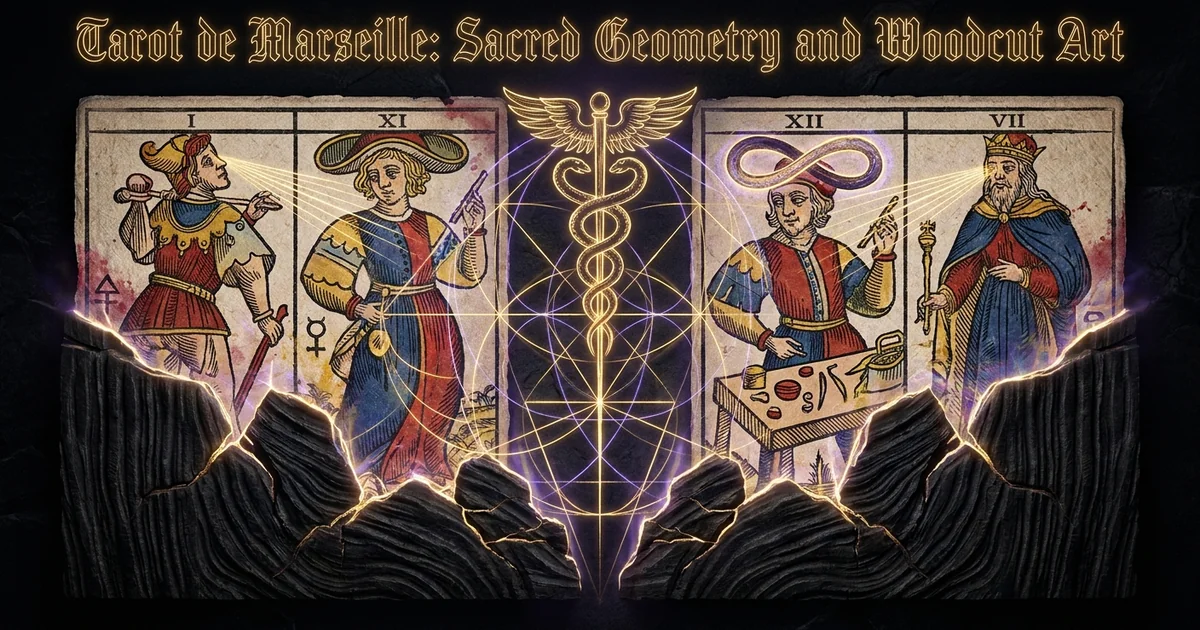
Tarot de Marseille: Sacred Geometry and Woodcut Art
Archetypal Thesis & Systemic Paradigm: The Marseille Canon as Geometrical Mandorla
The Tarot de Marseille represents an impeccably preserved canon of Renaissance sacred geometry, Pythagorean spatial mathematics, and Hermetic cosmology, transmitted under the historical guise of early modern vernacular gaming cards. Within the academic historiography of cartomancy, standard secular narratives have frequently dismissed the woodcut artifacts of seventeenth- and eighteenth-century France as rustic, artisanally crude commodities produced by illiterate printmakers for plebeian taverns. This superficial reading, thoroughly entrenched following Michael Dummett’s monumental structural work The Game of Tarot (1980), systematically misidentifies the medium for the message. In actual morphological analysis, the 1760 matrix cut into pearwood blocks by Nicolas Conver in Marseille does not present crude, naive drawings; it captures an operative, non-verbal transmission of geometric invariants, where proportional spatial divisions, chiral vectors, and vanishing points correspond to rigorous Euclidean theorems and cosmological acoustics.
Far from being an accidental byproduct of artisanal drift, the canonical Marseille deck operates as a closed topological state-space. Unlike the syncretic, nineteenth-century occult revisions initiated by Éliphas Lévi, codified by the Hermetic Order of the Golden Dawn, and popularized by the Arthur Edward Waite and Pamela Colman Smith deck, the historical French tradition requires no synthetic Hebrew alphabet overlays, Kabbalistic path-attributions, or Victorian romantic pictorialism to validate its esoteric integrity. The deck’s structural logic is native, self-referential, and fundamentally geometric. The woodcut lines themselves act as boundary conditions for psychological projections, establishing a dynamic dialectic between the viewer’s unconscious and archetypal patterns. By understanding the tarot’s lineage through the lens of Matila C. Ghyka’s The Geometry of Art and Life (1946), the imagery ceases to be arbitrary folk art and emerges instead as a deliberate matrix of dynamic symmetry, root rectangles, and harmonic subdivisions.
1.0 (Unit Width)
  +-----------------------+
  |       CIRCLE A        |
  |      (Upper Mind)     |  1.0
  |           x           |
  |=======================| --- Midpoint / Waistline (1:1)
  |       CIRCLE B        |
  |     (Lower Form)      |  1.0
  |           x           |
  +-----------------------+
       Total Height = 2.0 (Double Square)
The cards function as visual coordinates within a structural psychology that anticipates the Jungian process of individuation. When the twenty-two cards of the major-arcana are examined without the distortions of occultist revisionism, they reveal a coherent, unified system: an architectonic mandorla through which consciousness observes its own psychic operations. The structural line-weights, varying precisely between bold perimeter boundaries and micro-incisions of interior detail, delineate a field of tension where archetypal forces are calibrated into equilibrium.
Xylographic Cryptography: The Fusion of Vernacular Print and Sacred Proportion
The survival of esoteric knowledge within early modern Europe required mechanisms of radical camouflage. In an era marked by the fierce ideological surveillance of the Counter-Reformation and the strict economic monopolies of municipal guilds, metaphysical philosophy could not safely circulate in plain academic treatises without courting inquisitorial suppression or state censorship. The master woodcut cutters (maîtres cartiers) resolved this socio-political paradox through xylographic cryptography. By embedding operative geometric canons within the ubiquitous, utilitarian medium of woodcut playing cards, they assured both broad spatial dissemination and immune protection against institutional iconoclasm.
The pearwood matrix selected by master cutters like Nicolas Conver was not an incidental material choice. Pearwood (Pyrus communis) possesses an exceptionally fine, non-directional grain that allows high dimensional stability, resisting the warping and climatic expansion that would otherwise distort micro-metric geometric ratios over prolonged printing cycles. The physical cutting of the block dictated an irreducible minimum of line thickness. Because the wood between the lines was chiseled away by hand, every remaining ridge of relief had to bear the vertical pressure of the screw-driven platen press. Consequently, every line in the 1760 Conver deck represents an intentional structural decision. A line could not be introduced arbitrarily; its inclusion required the cutter to manually carve away two flanking channels of hardwood. The resulting contours are not loose, expressive sketches, but rigid, spatial boundaries engineered to survive tens of thousands of compressions without mechanical deviation.
Within these carved linear contours resides a sophisticated application of the golden-ratio-phi and root rectangles. As demonstrated in the structural analyses of Paul Marteau (Le Tarot de Marseille, 1949) and further corroborated by Alexandro Jodorowsky and Marianne Costa (The Way of Tarot, 2009), the foundational architecture of each card is established upon a strict 1:2 double-square proportion. This root-4 rectangle is mathematically and philosophically pregnant: it encapsulates the transition from the monad (unity) to the dyad (manifestation and polarity). Through simple diagonal division, the double square generates internal vesica-piscis geometry, locating points of focal emphasis at precise irrational numbers—most notably $\sqrt{2}$, $\sqrt{3}$, and the golden section $\Phi = \frac{1 + \sqrt{5}}{2} \approx 1.618$. The master cartier did not draft these lines through intuitive freehand drawing, but mechanically inscribed them into the pearwood block via scribers, compasses, and set-squares directly derived from the master mason traditions of mediaeval cathedral guilds.
The Card as State-Space Vector: Geometric Invariants vs. Illustrative Drift
When modern decks diverge from the historical woodcuts, they almost invariably commit the error of illustrative drift: exchanging geometric invariants for subjective aesthetic narration. In the historical Tarot de Marseille, a card does not depict an illustrative scene; it constitutes a state-space vector. In the mathematical sense of a state-space representation, every iconographic element—the placement of a foot, the tilt of an animal’s spine, the exact angle at which a scepter intersects a perimeter border—operates as an unchanging coordinate describing a structural condition of consciousness.
Consider the dynamic difference between the 1760 Conver edition and nineteenth-century illustrative interpretations. In illustrative systems, the artist asks: How can I dramatically render the concept of Justice or the cosmic drama of the Wheel of Fortune? The result is theatrical, idiosyncratic, and culturally bound to the visual conventions of the illustrator’s contemporary era. In contrast, the master cartier of the Marseille canon asks: Where does the balance beam of card VIII intersect the horizontal median of the double square, and how does the counterweight of the sword blade offset the gravitational center of the enthroned figure?
Conver Geometric Card (Spatial Vector):
       [Fixed Frame: 1:2 Dynamic Rectangles]
       [Point A: Anchor] <--- Vector Alpha ---> [Point B: Boundary]
                                 |
                          Platonic Median
                                 |
       [Point C: Earth]  <--- Vector Beta  ---> [Point D: Heaven]
Illustrative Drift (Romantic Revisionism):
[Arbitrary Borders: Variable Aspect Ratios]
(Subjective Dramatization / Emotional Embellishment)
(Narrative Scenery / Theatrical Stagecraft)
The Conver woodcut preserves these geometric relations under strict topological invariance. If one alters the width of the throne in Card VIII (La Justice) to make the composition more conventionally symmetrical or pleasing to Victorian taste, the invisible diagonals that connect the scales of the balance to the corners of the card’s framing border are severed. The card’s structural resonance—its capacity to function as a self-correcting psychological mirror—is tied directly to these geometric invariants. The line acts as an objective stimulus, engaging the cortical visual pathways of the observer through fundamental spatial archetypes rather than sentimental illustrations.
Chirality and Spatial Gaze: The Directional Axis of the 22 Trumps
A defining, non-arbitrary dimension of the Marseille canon is its system of strict spatial chirality—the directional orientation of figures looking left, looking right, or maintaining an orthothetic gaze directly toward the observer. Chirality in the Tarot de Marseille is not an artistic flourish; it governs the direction of energetic and psychological vectors across multi-card spreads. In the Western visual scanning matrix, which follows the sinistro-dextral (left-to-right) reading plane, the left represents the receptive, ancestral, unconscious, and introverted vector (the temporal past and ontological origin), whereas the right represents the active, projective, teleological, and extraverted vector (the temporal future and externalization of will).
The twenty-two cards of the major-arcana constitute a complex chiral engine. Cards that face leftward (such as Trump II, La Papesse, or Trump IX, L’Hermite) signify processes of internal consolidation, gestation, historical introspection, and receptive cognitive processing. Conversely, cards that face rightward (such as Trump IV, L’Empereur, or Trump VII, Le Chariot) embody external execution, structural establishment, kinetic mobilization, and projective conscious intent. Cards that present a strictly frontal orientation—most notably Trump VIII (La Justice) and Trump XXI (Le Monde)—stand as fixed, neutral axes of integration. They are the systemic stabilizers around which the kinetic, chiral currents of the deck orbit.
When cards are laid contiguously, their chiral vectors create dynamic closed circuits or irreconcilable deadlocks. If Trump II (La Papesse) is positioned to the left of Trump III (L’Impératrice), the gaze of the Papesse intersects the gaze of the Empress, establishing a visual and structural communion of receptive wisdom and expressive creation—an unbroken cognitive loop. If their positions are reversed, their gazes diverge away from one another toward the outer margins of the field, generating an optic vacuum that signifies a psychological dissociation between intuition and outward action. This vectorial grammar operates independently of textual definitions; it is built into the spatial directionality of the Conver woodcuts.
The canonical card of the Nicolas Conver 1760 deck is constructed upon a precise 1:2 double-square rectangle (canonically measuring approximately 64–65 mm in width by 121–122 mm in height within surviving uncut sheets). This frame consists of two congruent adjacent squares sharing a central horizontal axis: $$\text{Area} = s \times 2s = 2s^2$$ When diagonals are drawn across the double-square and its constituent sub-squares, the resulting harmonic intersections establish the primary structural anchors of the composition.
In Trump I (Le Bateleur), a diagnostic diagonal drawn from the upper-right corner of the card enclosure to the lower-left corner precisely tracks the inclined upper plane of the conjuror’s three-legged table. The point where this diagonal intersects the card’s primary horizontal waistline dictates the exact position of the magician’s left hand holding the golden disc. Far from being an accidental misdrawing, this geometric placement guarantees that the boundary between the upper square (intellectual, divine plane) and the lower square (physical, telluric plane) is anchored by the instrument of transformation.
Classical Provenance & Textual Lineage: The Guilds of Master Cardmakers
The origin and historical evolution of the Tarot de Marseille cannot be severed from the economic, legal, and operational structures of the French cardmakers’ guilds (corporations des cartiers). Far from being isolated, eccentric mystics working in clandestine attics, the producers of these decks were sworn craftsmen operating within heavily regulated civic bodies that governed print culture across Provence, the Lyonnais, and Paris from the sixteenth through the eighteenth centuries. The preservation of what we now classify as sacred-geometry was made possible by the legal and pedagogical conservatism of these guilds, which prioritized the reproduction of immutable master patterns over personal innovation.
Jean Noblet Matrix (Paris, c. 1650)
              |
              v
       Jean Dodal Transition (Lyon, 1701)
              |
              v
       François Chosson Stabilization (Marseille, 1736)
              |
              v
       Nicolas Conver Canonical Matrix (Marseille, 1760)
              |
              v
       Mechanical Modernity: Industrial Lithography
       (Geometric Dissolution via Stereotype Plates)
The master cartier swore an oath to preserve the canons, dimensions, paper qualities, and iconographic markers inherited from previous guild generations. Innovation was viewed with intense administrative suspicion: the municipal statutes strictly regulated the dimensions of the cards, the quality of the glue used to laminate the pasteboard layers, and the wood species permissible for the matrix blocks. This guild traditionalism functioned as an operational time capsule. Just as cathedral master masons preserved the geometry of the golden section, dynamic symmetry, and the Pythagorean quadrivium within the construction of stone vaults, the master cardmakers preserved an identical geometric language within the pearwood blocks of the tarot, transmitting it across centuries of political upheaval.
The Guild Tradition: Master Cardmakers (Cartiers) and Woodblock Cutters of 17th–18th Century Provence
In seventeenth- and eighteenth-century Provence, particularly in the Mediterranean trade hub of Marseille, the cartiers held a strategic monopoly over visual print culture. Marseille was an ideal center for esoteric preservation: it sat at the maritime crossroads of northern Italy, Spain, the Levant, and northern Europe, absorbing diverse cosmological currents while remaining fiercely protective of its municipal trade privileges. The production of a deck of cards required a triad of specialized skills: the dessinateur who drafted the original schematic lines onto the wood, the tailleur de formes (form-cutter) who carved the pearwood relief blocks, and the cartier who oversaw the paper preparation, printing, and stenciling.
In many historical workshops, the master cartier fulfilled all three roles, serving a multi-year apprenticeship that began in early adolescence. Guild apprentices were not taught abstract esoteric doctrine in written texts; they were taught through bodily, manual habituation to geometric templates. They learned to sharpen gouges and knives, to level the face of the pearwood, and to inscribe the framing lines using dividers, rulers, and proportional calipers.
The geometrical knowledge was embedded in the tools themselves. Calipers set to classical proportional divisions ensured that an apprentice could replicate the exact spatial relationships of a master block without needing a theoretical vocabulary of dynamic rectangles. This practical pedagogy safeguarded the cards’ sacred geometry from individual conceptual errors, anchoring the Hermetic patterns in wood and ink.
Transmission Nodes: From Jean Noblet (Paris, c. 1650) to Nicolas Conver (Marseille, 1760)
The historical trajectory of the canonical French Tarot de Marseille unfolds across several critical nodes of transmission, revealing an evolving standardization of geometric proportion rather than arbitrary variation. The earliest extant deck bearing the fully formed structural characteristics of the Marseille pattern is the deck produced by Jean Noblet in Paris around 1650, preserved in the Bibliothèque Nationale de France. The Noblet deck displays an intense, compact geometry, characterized by its narrower proportions and expressive, highly concentrated line work. In the Noblet matrix, one already observes the foundational double-square grid, the exact chirality of the trumps, and the distinct anatomical-mechanical gestures that define the French tradition.
+-----------------------------------------------------------------------+
| HISTORICAL TRANSMISSION OF THE MARSEILLE CANON                        |
+-------------------+--------------------+------------------------------+
| Master / Workshop | Provenance & Date  | Morphological Signature      |
+-------------------+--------------------+------------------------------+
| Jean Noblet       | Paris, c. 1650     | Compact frame, proto-Type I, |
|                   |                    | intense artisanal lines      |
| Jean Dodal        | Lyon, 1701         | Flamboyant Gothic line-work, |
|                   |                    | broad strokes, transitional  |
| François Chosson  | Marseille, 1736    | Geometric consolidation,     |
|                   |                    | immediate Conver precursor   |
| Nicolas Conver    | Marseille, 1760    | Definitive Type II canon,    |
|                   |                    | harmonic mathematical cuts   |
+-------------------+--------------------+------------------------------+
Following Noblet, the work of Jean Dodal (Lyon, 1701) marks a pivotal transitional stage between what tarot historians classify as Type I (characterized by archaic iconographic details such as the uncovered breasts of Trump XVII and unblindfolded Cupid in Trump VI) and Type II (the mature, stabilized Marseille system). The deck of François Chosson (Marseille, 1736) immediately anticipated Conver, presenting an almost identical geometric layout. When Nicolas Conver carved his blocks in 1760, he integrated these ancestral prototypes into a definitive master matrix.
Textual and morphological comparisons between Noblet, Dodal, Chosson, and Conver confirm that Conver did not invent a new pictorial language; he clarified and regularized the existing geometry. Conver removed extraneous decorative flourish, refined the straightness and curvature of lines, and balanced the harmonic ratios, cementing his deck as the gold standard of Type II Tarot de Marseille morphology.
“Item, no master cartier shall alter, diminish, or artificially innovate upon the established patterns, measures, marks, or traditional forms of the cards of Marseille, under penalty of confiscation of the forms, blocks, and paper, and an arbitrary fine… The borders, crowns, visages, and attributes must conform entirely to the ancient approved blocks kept within the guild chest…” — Règlemens et Statuts des Maîtres Cartiers de la Ville et Communauté de Marseille, Archives Municipales de Marseille, Série HH (Corporations d’Arts et Métiers).
Iconoclasm and Conservation: Survival of Esoteric Woodcuts Across the Industrial Revolution
The survival of this woodcut canon was fundamentally threatened by the technological shifts of the Industrial Revolution. In the late eighteenth and early nineteenth centuries, the invention of mechanical papermaking, the implementation of lithography by Alois Senefelder, and the subsequent emergence of high-speed steam printing destroyed the guild-based craft system. The woodblock fell out of commercial viability. Industrial lithographic stones and copperplate engravings offered finer lines, subtle tonal gradations, and cheap mass replication, but completely lacked the structural necessity of relief carving that had preserved the geometric invariants.
As the French card market industrialized, printers smoothed out the ancient woodcut contours to suit Victorian bourgeois sensibilities. The robust, archetypal figures of the Conver deck were replaced by elegant, neoclassical, or romantic illustrations devoid of sacred geometry. The original pearwood blocks cut by Nicolas Conver in 1760 were fortunately preserved through the industrial succession of the Conver workshop into the hands of the Camoin printing house in Marseille.
While the actual commercial market was saturated with debased lithographic cards, Conver’s physical blocks were carefully preserved in the Camoin archives, eventually rediscovered and analyzed by mid-twentieth-century scholars such as Paul Marteau. This physical survival ensured that the uncorrupted geometric matrix survived into the modern era, retaining the Hermetic and Pythagorean geometry that had vanished from mainstream print culture.
Structural Mechanics & Symbolic Geometry: The Dynamic Geometry of the Woodcuts
The underlying scaffolding of the Tarot de Marseille does not depend upon arbitrary human composition; it is governed by dynamic symmetry, a system of proportion explored by Jay Hambidge and formalized in esoteric philosophy by Matila C. Ghyka. Dynamic symmetry utilizes root rectangles—rectangles whose ratios of width to length correspond to the square roots of integers: $\sqrt{2}, \sqrt{3}, \sqrt{4}, \sqrt{5}$. Within these spatial frameworks, any diagonal, perpendicular, or harmonic subdivision generates a continuous field of geometric resonance. When an initiate gazes upon a canonical card from the Nicolas Conver matrix, the visual cortex does not register an isolated drawing of an archetype; it encounters an orthothetic machine where every angle, line weight, and color boundary is structurally bound to the geometry of the perimeter.
+-----------------------+  <- (0, 1)
       |           |           |
       |     *     |     *     |  <- Quadrant Subdivisions
       |           |           |
       |-----------+-----------|  <- Exact Card Center (1/2, 1/2)
       |           |           |
       |     *     |     *     |
       |           |           |
       +-----------------------+  <- (1, 0)
     1:2 Dynamic Root-4 Aspect Ratio
This structural discipline is fundamentally distinct from the pictorial logic of standard painting. In conventional easel art, space is organized via an illusionistic vanishing point that draws the viewer’s perspective deep into an artificial horizon. In the woodcuts of the Marseille canon, the perspective is flat, projective, and immediate. There is no atmospheric depth; the space is an architectonic plane. The figures exist simultaneously in profile, three-quarter view, and frontal projection, echoing the canonical sacred art of ancient Egypt and the master glass-painters of Gothic cathedrals. The geometric scaffolding is never explicitly drawn as an external grid; it is internalized, disguised within the folds of a cloak, the tilt of an emperor’s scepter, or the horizon line of a landscape.
The Root Rectangles and Dynamic Symmetry: Card Enclosures and Inner Mandorlas
The macro-boundary of every card in the Marseille deck is established by the root-4 rectangle, the 1:2 double square. This spatial container is formed by stacking two equal squares vertically. The dividing line between these two squares constitutes the primary horizontal waistline of the card. In human archetypal anatomy, this line marks the division between the upper world (the cranial and cardiovascular centers, representing the spiritual and intellectual realms) and the lower world (the pelvic, digestive, and locomotor systems, representing the telluric, instinctual, and physical realms).
Within this double-square container, the master woodcut artists projected inner mandorlas—the almond-shaped spatial intersecting zones created by two overlapping circles, historically known as the vesica-piscis. By placing the point of a compass at the center of the lower square and extending the pencil to the perimeter, a circle is inscribed that governs physical manifestation. By repeating this operation from the center of the upper square, a second, identical circle is inscribed representing the spiritual sphere.
The intersection of these two circles yields the sacred mandorla: the zone of dynamic mediation where spirit clothes itself in matter, and where matter awakens into spirit. In cards such as Trump II (La Papesse) and Trump V (Le Pape), the focal points of spiritual instruction—the open book resting on the lap or the three-tiered papal cross—are located at the precise geometric intersections of this inner mandorla.
The Five-Color Alchemical Palette: Chromatic Resonance and Printing Boundaries
The chromatic architecture of the Tarot de Marseille is just as strictly regulated as its linear geometry. The historical woodcut decks were colored not with modern CMYK printing process inks, but with a highly restricted, symbolic palette applied via cut brass or cardboard stencils (au pochoir). The canonical palette comprises five fundamental colors, supplemented by the black of the woodcut line and the unprinted white/cream of the rag paper:
- Red (Rouge): Active, kinetic force; arterial blood; sulfur; conscious will; outward materialization.
- Blue (Bleu): Receptive, introverted depth; venous blood; alchemical mercury; the contemplative unconscious; the cosmic firmament.
- Yellow (Jaune): Luminous solar intelligence; gold; divine clarity; intellectual discrimination; transcendent light.
- Green (Vert): Vegetative vitality; organic nature; copper/Venus; continuous regeneration; the psychoid bridge between matter and spirit.
- Flesh (Chair): The human condition; vulnerable transience; incarnation; the mortal body as the vessel of transformation.
In the Nicolas Conver deck, these colors do not simply decorate or fill illustrative spaces; they define geometric boundaries. The colors never blend, shade, or form atmospheric gradients. They are printed as flat, unmodulated zones of pure chromatic frequency. Noticeably, the stenciled pigments often intentionally slip slightly off the black woodcut registration lines. While modern observers often misread this registration shift as primitive print quality, in esoteric mechanics it generates a subtle visual vibration—a structural parallax between the unchangeable, rigid boundary of the black line (the archetypal skeleton) and the dynamic, fluid application of color (the living soul animating the form).
Architectonic Centers: The Compass Point Analysis of Le Chariot, La Justice, and Le Monde
A rigorous compass-point and straightedge analysis of the mature Conver cards reveals how structural geometry determines symbolic meaning. In Trump VII (Le Chariot), the composition is dominated by a strict triangulation. The square chariot body occupies the lower half of the card, anchoring the structure in the telluric fourfold plane. Emerging from this cube is a perfect equilateral triangle formed by the canopy poles and the crown of the young prince. The apex of this triangle touches the precise midpoint of the upper framing line. This geometric configuration mathematically demonstrates the Pythagorean formulation of the quaternary (the carriage of the body) being directed and steered by the ternary (the transcendent spirit).
CANOPY APEX (Spirit / Ternary)
                     /\
                    /  \
                   /    \
                  /      \
                 /________\
                |          |
                |  CUBIC   |
                | CHARIOT  | (Body / Quaternary)
                |__________|
In Trump VIII (La Justice), the geometry switches from dynamic kinetics to absolute, motionless equilibrium. The focal point of the card is not the face of the woman, but the pivot of the balance scales held in her left hand. If diagonal lines are drawn from the four corners of the card frame, their intersection precisely pinpoints the central heart-space of the figure, while the scale’s crossbeam rests upon a secondary horizontal harmonic line. The sword in her right hand does not tilt; it forms a rigid vertical axis perpendicular to the lower border, parallel to the side of the card frame, embodying the absolute, unwavering orthothetic axis of divine law.
In Trump XXI (Le Monde), the geometrical culmination of the major-arcana is achieved. The composition is built around an explicit, fully realized mandorla framed by an elliptic wreath of leaves. This mandorla is mathematically generated by two interpenetrating circles whose radii are equal to the card’s width. The four corners of the card frame outside the mandorla are anchored by the four Kerubic figures: the Human/Angel, the Eagle, the Lion, and the Bull. These four points form a harmonic 3:4:5 right-triangle distribution across the card’s spatial field, binding the four classical elements to the central, contrapposto axis of the androgynous dancer. The dancer holds two wands—one passive, one active—mediating between the eternal quaternary of the cosmos and the dynamic unity of the center.
Psychological Dynamics & Operational Praxis: The Decoded Optic Grid
When deployed within traditional operational praxis, the Tarot de Marseille functions as a visual apparatus for mapping unconscious processes. Rejecting the fortune-telling methods of nineteenth-century cartomancy, serious practitioners understand that the cards operate as dynamic mirrors of the human psyche. The operational mechanics of a Marseille spread depend not on memorized textual divinations found in fortune-telling manuals, but on the real-time optic interaction between the cards’ structural vectors. The gaze of the figures, the extension of their limbs, the inclination of their tools, and the geometric axes of their garments create an open-circuit diagram across the reading table.
Card A [Active Vector]       Card B [Receptive Field]
       +--------------------+       +--------------------+
       |              (===>)| ----> |(<===)              |
       |     FIGURE A       | Gaze  |     FIGURE B       |
       |  Projective Force  | Vector|  Receptive Dynamic |
       +--------------------+       +--------------------+
         Result: Unbroken Circuit of Dynamic Psychological Transfer
The cards do not speak in isolated semantic sentences; they generate visual voltages. A reader trained in the pure French tradition observes the layout as a structural engineer analyzes a load-bearing blueprint. Where is the energetic flow blocked? Where does a gaze run off the edge of the spread into empty space, indicating an unintegrated psychological projection? Where do two swords intersect, creating an agonizing focal point of mental tension? The geometric matrix carved into the pearwood by Nicolas Conver provides an objective psychological diagnostic tool, removing the subjective bias of the reader and allowing the structural realities of the querent’s unconscious to reveal themselves through spatial vectors.
The Gaze Trajectory: Vector Mechanics in Multi-Card Arrays
The primary vector in any Marseille spread is the gaze trajectory. The human eye naturally follows the line of sight of any depicted face. The master woodcut artists exploited this neuro-cognitive reflex by carving eyes that do not merely look forward, but look along sharp, angular diagonals.
When three cards are placed side by side—for example, Trump IX (L’Hermite), Trump X (La Roue de Fortune), and Trump XI (La Force)—the visual vectors dictate the psychological movement:
- L’Hermite faces to the left (the past, the internal realm), turning his back entirely upon the Wheel of Fortune. His lantern illuminates the historical origins of the psyche, holding light for what came before.
- La Roue de Fortune features three beasts: one descending on the left, one ascending on the right, and a sphinx crowned at the top looking forward. The left-facing beast looks back toward the Hermit, indicating a cyclical entrapment in past psychological patterns.
- La Force, positioned to the right of the Wheel, looks sharply downward and to the left, gazing directly at the mouth of the lion she gently holds open. Her gaze vector does not meet the gaze of the Sphinx, indicating that the conscious mastery of instinctual energy (La Force) requires an intimate, internal optic focus that detaches from the external cycles of fate (La Roue).
If the reader were to rearrange these cards, the vector mechanics would radically alter. By placing La Force on the left, looking right, and L’Hermite on the right, looking left, their gaze trajectories would directly confront each other across the central card. The spread ceases to be a progressive, chronological narrative; it instantly becomes an intense mirror chamber wherein conscious willpower (La Force) and unconscious introspection (L’Hermite) compress the intervening card between two high-pressure optic vectors.
Gestural Polarity and Spatial Receptive-Active Fields
Beneath the gaze of the figures lies a dense network of gestural polarities. In the anatomy of the Conver woodcuts, the hands are consistently carved with deliberate, unnatural sizing: one hand is almost invariably drawn larger, more muscular, or more active than the other. This deliberate asymmetry establishes the fundamental polarity between the active hand (which holds, cuts, commands, and projects) and the receptive hand (which receives, cradles, touches, and senses).
+--------------------------------------------------------------------------+
| GESTURAL POLARITY & SPATIAL FIELDS IN THE CONVER MATRIX                  |
+-------------------+----------------------------+-------------------------+
| Trump Archetype   | Left Hand (Spatial/Visual) | Right Hand (Visual)     |
+-------------------+----------------------------+-------------------------+
| I. Le Bateleur    | Holds golden coin (Earth)  | Grasps magic wand (Fire)|
| VII. Le Chariot   | Rests on hip (Containment) | Holds scepter (Command) |
| VIII. La Justice  | Balances scales (Sense)    | Holds sword upright     |
| XI. La Force      | Stabilizes lower jaw       | Manipulates upper jaw   |
+-------------------+----------------------------+-------------------------+
This bodily syntax extends into the minor-arcana. Unlike the narrative, scenic illustrations introduced by Arthur Edward Waite and Pamela Colman Smith, the Marseille pip cards—the Bâtons (Wands), Coupes (Cups), Épées (Swords), and Deniers (Coins)—are non-figurative, vegetative mandalas. The dynamic vegetative flourishes of the Swords and Wands grow, curve, and interlace across the card frames in strict accordance with the laws of natural plant morphogenesis and dynamic symmetry.
The curved scimitars of the Épées intersect to form protective mandorlas that encase central flowers, illustrating how the intellectual faculty (the blade) can either slice through reality in violent analysis or create a protected, interior space wherein the spiritual heart (the flower) can blossom. The straight shafts of the Bâtons cross at rigid perpendiculars, tracking the direct, assertive assertion of vital and creative will across the physical plane.
French Tarot Tradition (Nicolas Conver, 1760)
- Spatial Geometry: Absolute double-square frame (1:2); dynamic root rectangles; internal Vesica Piscis; flat planar projection.
- Visual Narrative: Non-scenic, archetypal woodcut matrices; non-figurative vegetative pip progressions; self-contained Euclidean spatial language.
- Chirality & Vectoring: Strict gaze and gestural vectors that create continuous, energetic circuits across multi-card spreads.
- Esoteric Premise: Operative Platonic-Pythagorean geometry, Hermetic axio-geometry, and craft guild transmission without imported alphabets.
Anglo-Occult Tradition (Waite-Smith, 1909)
- Spatial Geometry: Variable, arbitrary border aspect ratios; illustrative depth with vanishing points; theatrical stage-set framing.
- Visual Narrative: Scenic, theatrical, dramatic vignettes on all minor pips; heavy reliance on Victorian and Edwardian narrative symbolism.
- Chirality & Vectoring: Figurative illustrations prioritize narrative drama over strict spatial gaze vectors or geometric balance.
- Esoteric Premise: Synthetic Kabbalistic overlays (Golden Dawn paths on the Tree of Life), explicit astrological sigils, and Christian mysticism.
The Mirror Spread: Operative Individuation through Geometric Symmetry
In the operational praxis of the Mirror Spread (Le Tirage en Miroir), the geometric architecture of the Conver deck becomes an instrument of applied archetypal psychology. The cards are arranged in an architectonic cross or square, ensuring that every active card on the right is balanced by an opposing card on the left, with an anchoring median card at the center.
When the querent’s psychic conflicts are placed within this mirror, the resulting geometric symmetries bypass the defense mechanisms of the rational ego. Because the cards do not provide an easy, sentimental narrative (as scenic decks do), the querent cannot project a facile, heroic fantasy onto the images. The raw, woodcut figures confront the unconscious directly.
The querent is forced to answer the structural demands of the image: Why does your conscious ambition (Trump VII, Le Chariot) face away from the central axis, while your unconscious dread (Trump XIII, L’Arcane sans Nom) cuts straight toward the roots of your foundation? The reading becomes an active meditation, a kinetic individuation process wherein the fragmented pieces of the psyche are organized back into an integrated mandala.
Philosophical Synthesis & Macrocosmic Correspondence: The Octave and the Cosmic Spheres
The ultimate architecture of the Tarot de Marseille reveals itself when the twenty-two cards of the major-arcana are viewed not as a simple linear progression from 1 to 21, but as an architectonic cosmological matrix. By separating the unnumbered card, Le Mat (The Fool), as the zero-point catalyst—the roving singularity or unmanifest quantum potential—the remaining twenty-one cards spontaneously organize into a Platonic-Pythagorean matrix of three septenaries: three distinct tiers of seven cards each.
[ LE MAT ] (The Unnumbered Transcendent Singularity / 0)
                          |
  ====================================================================
  TIER 1 (Cards I - VII):   THE TERRESTRIAL QUATERNARY & HUMAN MIND
  [ I ]  --> [ II ] --> [ III ] --> [ IV ] --> [ V ] --> [ VI ] --> [ VII ]
  ====================================================================
  TIER 2 (Cards VIII - XIV): THE PSYCHIC LAWS & THE MORAL SOUL
  [ VIII ] -> [ IX ] -> [ X ]   --> [ XI ] -> [ XII ] -> [ XIII ] -> [ XIV ]
  ====================================================================
  TIER 3 (Cards XV - XXI):  THE CELESTIAL REALMS & COSMIC EQUILIBRIUM
  [ XV ] --> [ XVI ] -> [ XVII ] -> [ XVIII ] -> [ XIX ] -> [ XX ] -> [ XXI ]
  ====================================================================
This 3x7 matrix directly reflects the classical Platonic octave and the Pythagorean tetraktys. Each of the three horizontal tiers represents a distinct ontological realm through which the soul descends into matter and re-ascends into cosmic unity:
- The First Septenary (Cards I through VII): The Earthly Plane. The consolidation of personal identity, the formation of the ego, social and institutional integration, and outward mastery over the terrestrial environment, culminating in the moving vehicle of Trump VII (Le Chariot).
- The Second Septenary (Cards VIII through XIV): The Psychological/Soul Plane. The confrontation with transpersonal law, internal balance (La Justice), the initiation of solitude (L’Hermite), the crisis of destiny (La Roue), the confrontation with instinct (La Force), the ultimate ego-sacrifice (Le Pendu), and the absolute, stripping transformation of mortality (Trump XIII), ending in the psychic equilibrium of Trump XIV (Tempérance).
- The Third Septenary (Cards XV through XXI): The Cosmic/Celestial Plane. The confrontation with the chthonic shadow (Le Diable), the dissolution of false structures (La Maison Dieu), the restoration of sidereal grace (L’Étoile), the perilous crossing of the subconscious ocean (La Lune), the illumination of solar consciousness (Le Soleil), the awakening of eternal spirit (Le Jugement), and the final, ecstatic integration of the cosmic androgyny within the mandorla (Trump XXI, Le Monde).
The 3x7 + 1 Matrix: The Platonic Octave and Septenary Cycles of the Soul
The septenary structure is not an arbitrary cultural preference for the number seven; it is a direct mathematical consequence of cosmic acoustics. In the Platonic musical scale formalized in the Timaeus, an octave contains seven distinct scale steps before resolving into the harmonic return of the eighth note. The major-arcana functions according to identical musical acoustics: each tier represents a complete octave of experience.
When the cards are arranged in this 3x7 grid, profound vertical correspondences emerge between the cards across the octaves:
- Column 1: Trump I (Le Bateleur), Trump VIII (La Justice), and Trump XV (Le Diable). The initial conscious manipulation of physical tools (I) finds its transpersonal moral balance (VIII) and its instinctual, shadow reflection in the raw terrestrial forge of the underworld (XV).
- Column 2: Trump II (La Papesse), Trump IX (L’Hermite), and Trump XVI (La Maison Dieu). The silent, veiled cloister of theoretical wisdom (II) matures into the experiential, slow walking journey of the Hermit (IX), which is violently shattered by the direct lightning bolt of divine revelation tearing down the tower of pride (XVI).
- Column 7: Trump VII (Le Chariot), Trump XIV (Tempérance), and Trump XXI (Le Monde). The kinetic, outward mastery of the material vehicle (VII) is transformed into the angelic, internal circulation of spiritual waters (XIV), which ultimately opens into the cosmic realization of the soul dancing at the center of the universe (XXI).
Throughout this rigid, mathematical architecture, Le Mat moves freely as the uncontained, non-local principle. Bearing no Roman numeral, Le Mat is the pure zero ($0$), the nomadic spark of consciousness that enters any card, catalyzes its transformation, and moves onward, ensuring that the system never stagnates into a closed, dogmatic trap.
Hermetic Axio-Geometry: ‘As Above, So Below’ Inscribed in Woodcut Vectors
The foundational Hermetic axiom—Quod est superius est sicut quod est inferius (“That which is above is like that which is below”)—is translated in the Tarot de Marseille into an operative spatial grammar. It is not an abstract philosophical proposition; it is geometrically inscribed into the vectors of the woodcut blocks.
Notice, for instance, the posture of Trump I (Le Bateleur). His left hand is raised toward the heavens, holding a golden coin or wand, while his right hand points downward toward the tools on his table. This identical posture is mirrored, inverted, and transfigured in Trump XII (Le Pendu), where the figure is suspended upside down by one foot between two living trees, his limbs forming a cross and a downward-pointing triangle, demonstrating the inverted perspective of the initiate who views the material world as secondary and the spiritual world as primary.
       Trump I (Le Bateleur): Hand to Heaven, Hand to Earth
       Trump XII (Le Pendu):   Inverted Human Rooted in the Divine
       Trump XV (Le Diable):   Upward Torch of Ignorance, Downward Claw
       Trump XXI (Le Monde):   Twin Wands Mediating Heaven and Earth
This axio-geometry demonstrates that the Marseille cards do not require an imported Kabbalistic tree-of-life overlay to validate their Hermetic structure. The cards are self-sufficient geometric emanations of the same European Hermetic tradition that shaped Gothic stonemasonry, Renaissance alchemy, and Euclidean mathematics. The deck does not copy the Hermetic worldview; it is an organic, visual embodiment of that worldview, captured in the immutable grain of pearwood.
Convergence with the I Ching and Astrological Decans: Topological Invariants
When the Tarot de Marseille is studied alongside other sacred coordinate systems—such as the sixty-four hexagrams of the I Ching or the thirty-six decanic-tarot-correspondences of Hellenistic astrology—a striking structural convergence appears. These systems do not necessarily share a historical genealogical origin; rather, they share a topological invariance. They are all complete, mathematical state-space representations of archetypal reality.
In the I Ching, transitions between hexagrams occur through the systematic changing of broken (Yin) and solid (Yang) lines, tracking the flux of cosmic energy across dynamic states. In the Tarot de Marseille, an identical cybernetic mechanism governs the progression of the minor-arcana pips. The four suits correspond precisely to the four elemental states of matter and spirit:
- Deniers (Coins): Earth, solid state, condensed matter, maximum Yin stability.
- Coupes (Cups): Water, liquid state, psychic fluidity, receptive Yin-Yang mediation.
- Épées (Swords): Air, gaseous state, intellectual discrimination, active Yang-Yin penetration.
- Bâtons (Wands): Fire, radiant plasma, creative vitality, absolute Yang dynamic force.
The progression of numbers 1 through 10 in each suit reflects an unfolding cybernetic cycle: from the unmanifest monad of the Ace, through the polar tension of the Two, the dynamic stabilization of the Three, the cubic consolidation of the Four, the crisis of the Five, the harmonic equilibrium of the Six, the kinetic projection of the Seven, the crystalline perfection of the Eight, the gestational threshold of the Nine, and the inevitable systemic return and transmutation of the Ten. The Ten of any suit completes its cycle only to touch the seed of the next, mirroring the ancient cosmic serpent, the ouroboros, which consumes its own tail to sustain the continuous life of the cosmos.
“The cards of the Tarot de Marseille present a pure typological series of archetypal images, acting as an intuitive coordinate system. Like the mandala of Tibetan Buddhism or the hexagram matrix of the I Ching, the woodcut figures operate as synchronistic catalysts: they externalize the self-regulating functions of the collective unconscious, ordering the random events of the temporal world into a coherent, mathematically balanced psychological cosmos.” — Marie-Louise von Franz, Number and Time: Reflections Leading toward a Unification of Depth Psychology and Physics (1974), citing Carl G. Jung’s Seminar on Archetypal Symbolism.
Frequently Asked Questions
Did early modern French woodcut artists consciously intend this sacred geometry?
The master cardmakers (maîtres cartiers) did not conceptualize sacred geometry through modern academic or esoteric vocabularies, but their conscious intention was thoroughly bound to their craft pedagogy. In the guild system of early modern France, practical geometry, spatial balance, and strict proportional rules were not taught as abstract philosophy; they were transmitted through direct bodily apprenticeship and workshop cutting templates.
A form-cutter learned to position lines using compasses, dividers, set-squares, and plumb-lines directly inherited from ancestral workshop patterns. Just as medieval stone-carvers applied the golden ratio and the Vesica Piscis without necessarily articulating a theoretical treatise on Euclidean geometry, the woodcut cutters preserved these spatial invariants because any deviation from the guild-approved templates constituted a violation of municipal craft statutes and produced visually unstable, rejected blocks.
Why does the Nicolas Conver 1760 deck hold primacy over earlier decks like Noblet or Dodal?
While the decks of Jean Noblet (Paris, c. 1650) and Jean Dodal (Lyon, 1701) are chronologically earlier and hold immense historical value, the 1760 deck carved by Nicolas Conver in Marseille represents the definitive stabilization of the “Type II” Tarot de Marseille morphology. Noblet’s deck is compact, highly idiosyncratic, and exhibits a proto-Marseille spatial density, while Dodal’s deck displays expansive, Gothic-inflected lines.
The Nicolas Conver matrix represents the moment of optimal geometrical equilibrium: his lines are exceptionally clean, mathematically balanced, and carved into durable pearwood with rigorous dynamic symmetry. The Conver blocks were preserved physically within the historical Camoin workshop archives, providing modern researchers with direct, uncorrupted access to the original eighteenth-century relief-cut printing surfaces.
How does the Marseille system function without the astrological and Hebrew attributions of the Golden Dawn?
The historical Tarot de Marseille is an entirely autonomous, self-contained symbolic engine that predates the syncretic systems of nineteenth-century Anglo-French occultism. The Hermetic Order of the Golden Dawn, building upon the speculative work of Éliphas Lévi, intentionally altered card names, spatial orientations, and numerical sequences (such as swapping Trump VIII Justice with Trump XI Strength) to force the tarot into alignment with the twenty-two letters of the Hebrew alphabet and the thirty-two Paths of Wisdom on the Kabbalistic Tree of Life.
The Tarot de Marseille requires none of these imported overlays. Its syntax is native, spatial, and geometric. It communicates directly through visual vectoring, gaze trajectories, dynamic symmetry, chromatic frequencies, and the natural musical octaves of its 3x7+1 architecture. Overlying secondary systems onto the Marseille woodcuts obscures the native Euclidean and Hermetic language already encoded in its cuts.
What distinguishes the woodcut printing technique from modern photographic reproductions?
The historical woodcut printing technique relied on relief blocks chiseled by hand from the dense, fine-grained wood of fruit trees, predominantly pearwood. In relief printing, every line that appears on the finished page corresponds to an actual ridge of physical wood left standing after the artist carved away the surrounding negative space. This method imparts an architectural firmness to the line-work; the pressure of the screw press creates a physical debossment in the damp rag paper, integrating the carbon-black ink into the paper’s linen fibers.
Modern photographic and digital reproductions, by contrast, smooth out these tactile, structural realities into flat, micro-thin layers of CMYK process inks or digital pixels. In doing so, modern reprints frequently distort the exact framing ratios, erase subtle linear intersections, or artificially normalize the dynamic stencil-color slips (au pochoir) that give the original Conver woodcuts their spatial resonance. Direct engagement with the original relief cuts reveals that the medium of the woodcut is structurally inseparable from the esoteric content it preserves.