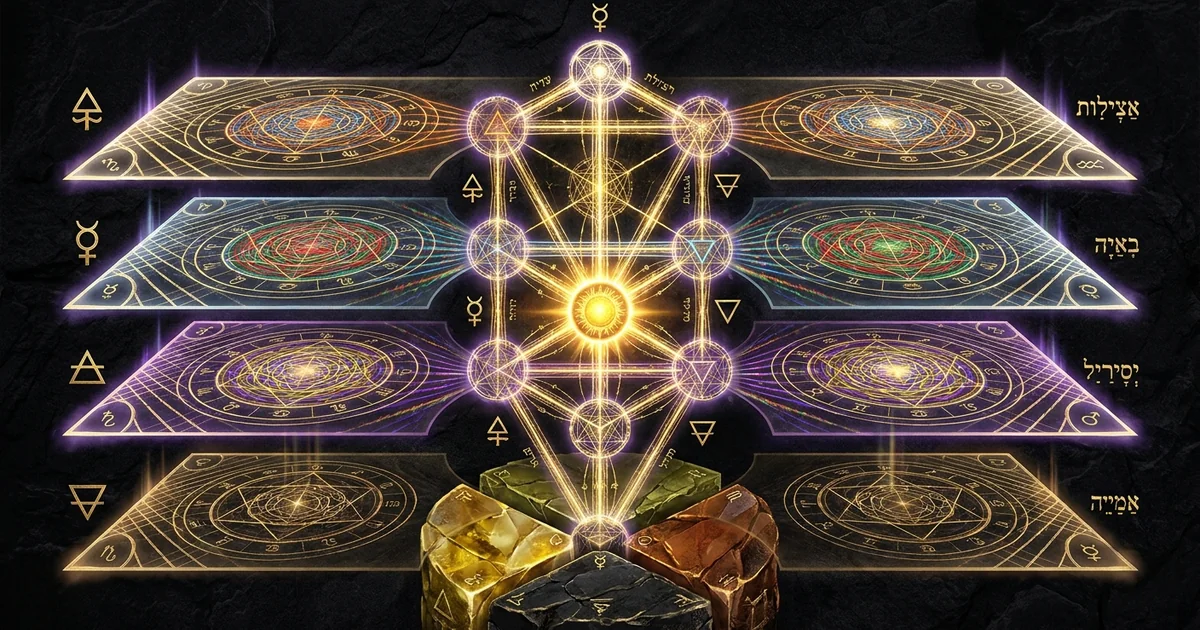
Golden Dawn Color Scales: Four Worlds in Esoteric Tarot
Archetypal Thesis & Systemic Paradigm: Chromatic Coordinates of Consciousness
Chromatic Emanationism and the Fourfold State-Space
In the initiatory framework of the Hermetic Order of the Golden Dawn, color does not serve as an aesthetic ornamentation or an arbitrary allegorical cipher. Rather, within occult color theory, chromatic value functions as an exact vibratory index of metaphysical density. It designates the precise stage of energetic deceleration whereby undifferentiated divine light precipitates into tangible substance.
The Western esoteric tradition posits that the universe does not emerge ex nihilo in a single instantaneous event. It crystallizes through an emanationist descent across four distinct cosmic strata known in Qabalistic cartography as the four-worlds: Atziluth (the Archetypal World), Briah (the Creative World), Yetzirah (the Formative World), and Assiah (the Material World). Each of these four realms represents a discrete state-space of consciousness, governed by an escalating degree of formal limitation and structural condensation.
Pure Divine Luminosity (Ain Soph Aur)
  │
  ▼
[Atziluth: Archetypal]  --> King Scale      (Primordial radiation, radical primaries)
  │
  ▼
[Briah: Creative]       --> Queen Scale     (Architectural matrix, deep pigments)
  │
  ▼
[Yetzirah: Formative]   --> Prince Scale    (Luminescent composites, astral currents)
  │
  ▼
[Assiah: Material]      --> Princess Scale  (Crystalline grounding, earth-tints, flecks)
The Golden Dawn mapped this quadripartite cosmic descent onto the thirty-two paths-of-wisdom—comprising the ten emanations or sephiroth and the twenty-two connecting channels of the Tree of Life—by establishing four exhaustive, interlocking chromatic palettes: the King, Queen, Prince, and Princess scales.
These four scales act as a rigorous coordinate matrix. The King Scale, attributed to Atziluth, articulates the primary luminous impulse: pure, unrefracted, and radical brilliance. The Queen Scale, attributed to Briah, provides the structural womb or architectural housing: rich, saturated, and reflective hues that capture and contain the initial Atziluthic flash.
The Prince Scale, attributed to Yetzirah, manifests dynamic mixtures, fluid spectral gradients, and astral permutations representing the movement of active mind. The Princess Scale, attributed to Assiah, grounds the current into the deep, composite, mineral-dense, and flecked tones of material manifestation. Far from being decorative, the golden dawn color scales four worlds tarot structure operates as a cosmological map, calibrating human sensory perception directly to metaphysical realities.
The Optical Mechanics of Tetragrammaton
The quadripartite architecture of these color scales is fundamentally derived from the fourfold formula of the Tetragrammaton ($Y-H-V-H$). The divine name operates not as a static moniker, but as the master equation of universal generation and decay.
The letter Yod corresponds to the Father, the element of Fire, the world of Atziluth, and the King Scale. Heh corresponds to the Mother, the element of Water, the world of Briah, and the Queen Scale. Vau corresponds to the Son, the element of Air, the world of Yetzirah, and the Prince Scale. The final Heh corresponds to the Daughter, the element of Earth, the world of Assiah, and the Princess Scale.
This systematic distribution dictates that every node within the Qabalistic cosmos exists simultaneously across four dimensional densities. For example, the path of the Tarot trump The Magus (attributed to the Hebrew letter Beth and the planet Mercury) cannot be adequately understood through a single color. It must be apprehended through its Atziluthic source of brilliant yellow (King Scale), its Briatic condensation into royal purple (Queen Scale), its Yetziratic astral oscillation as gray-violet (Prince Scale), and its Assiatic material anchor as rayed amber flecked with indigo (Princess Scale).
Through this mechanical integration, the Tetragrammaton ceases to be an abstract theological tenet. It transforms into an operational chromatic engine, mapping the continuous conversion of archetypal energy into neurosensory reality.
Tarot as a Spectral Interface for Archetypal Cartography
Within this Hermetic paradigm, the seventy-eight cards of the Tarot form a mobile, pictorial synthesis of the Tree of Life. They serve as visual transducers designed to recalibrate the neural and cognitive architecture of the practitioner to specific archetypal coordinates.
The Minor Arcana cards, divided into four suits, represent the operations of the ten Sephiroth through the lens of the elements and worlds:
- Wands mediate Atziluth (King Scale),
- Cups mediate Briah (Queen Scale),
- Swords mediate Yetzirah (Prince Scale), and
- Pentacles ground Assiah (Princess Scale).
Concurrently, the twenty-two Major Arcana trumps synthesize the planetary, zodiacal, and elemental currents bridging these Sephiric nodes.
When an initiate views an authentic Hermetic Tarot card constructed according to these canons, the ocular apparatus is exposed to precise spectral values designed to bypass rational discursive cognition. The interaction of the King Scale’s pure hue with the Queen Scale’s structural complement creates an immediate cognitive dissonance—a destabilization of mundane visual perception.
The card ceases to be a static two-dimensional painting. It becomes a functional psycho-cosmological interface. By engaging the eye with exact chromatic wavelengths, the Tarot card activates unconscious archetypal complexes, systematically tuning the internal theater of the psyche to the universal patterns embodied by the 32 Paths of Wisdom.
Classical Provenance & Textual Lineage: From Cypher Manuscripts to Book T
The Cipher Manuscripts and the Formulation of Book T
The technical codification of the four color scales represents one of the crowning achievements of late nineteenth-century British occultism. Prior to the founding of the Hermetic Order of the Golden Dawn in 1888, Western esoteric systems utilized fragmented, often contradictory planetary and elemental color systems derived from Agrippa, Pietro d’Abano, and seventeenth-century astrological manuals. These older associations rarely accounted for systemic dimensional descent, usually presenting a single static color per celestial body or element.
The foundation for a unified, four-world chromatic doctrine was laid within the enigmatic Golden Dawn Cipher Manuscripts, an encrypted text discovered by William Wynn Westcott and decoded with the assistance of Samuel Liddell MacGregor Mathers. Building upon the skeletal attributions outlined in these folios, Mathers synthesized the Order’s internal instructional curricula.
The primary transmission of the chromatic system appeared in the secret instruction designated as Book T: The Tarot, Comprising the Secret Instruction in the Knowledge of the Tarot and its Use in Divination (circulated among Second Order initiates from circa 1888 to 1893). In Book T, Mathers codified the relationship between the decanates, the elements, and the planetary rulers, formulating the exact pigments required to render both the Major Trumps and the Minutum Mundum (“Little World”) diagram.
“The Adept who desires to make progress in our Science must construct his own pack of Tarot cards, and draw and paint his own Minutum Mundum diagram. For it is not the mere handling of curious symbols which elevates the mind, but the deliberate, manual transcription of the Celestial Colors onto the plastic ether of the subconscious through the labor of the brush and the focused ray of the Will.”
Goethean Polarity vs. Newtonian Optics in Hermetic Theory
The theoretical mechanics underlying the Golden Dawn’s chromatic doctrines cannot be adequately understood through the prism of standard Newtonian mechanics. Sir Isaac Newton’s 1704 Opticks reduced color to a passive, mechanical phenomenon: white light is broken down through differential refraction into a linear spectrum of quantitative wavelengths.
In sharp contrast, the Golden Dawn’s esoteric framework embraced the qualitative, phenomenological perspective articulated by Johann Wolfgang von Goethe in his 1810 Zur Farbenlehre (Theory of Colours). Goethe rejected the notion that white light is a composite of preexisting colors; rather, he posited that color arises through the active, dialectical tension between light (Lux) and darkness (Tenebrae).
Newtonian Optical Model (Mechanical / Reductive):
White Light ===[ Prism ]===> Linear Refracted Spectrum (Continuous Wave-Frequencies)
Goethean-Hermetic Model (Dialectical / Qualitative):
Lux (Archetypal Light) <— Polar Boundary (Tension) —> Tenebrae (Absorptive Void)
│
▼
Chromatic Manifestation
(Color as Living Energy)
In the Goethean view, color is not a dead, physical constant, but an energetic boundary condition. Yellow is light attenuated by darkness; blue is darkness illuminated by light.
The founders of the Golden Dawn identified this dialectical tension as an optical reflection of the Qabalistic cosmos. Light corresponds to the unmanifest radiance of Kether, while darkness represents the primordial, receptive void of the Supernal Abyss. The intersection of these forces produces the spectral phenomena of the Paths.
Color in Hermeticism is thus treated as a living, dynamic field of polarity. The King Scale reflects the forward thrust of light entering the boundary of manifestation, while the Queen Scale represents the absorptive, stabilizing resistance of the dark feminine matrix, providing form to the incoming ray.
Lineage Transmission: Mathers, Crowley, and the Preserved Tables of Liber 777
The internal secret instructions of the Golden Dawn were meticulously protected under strict oaths of secrecy within the Rosae Rubeae et Aureae Crucis (R.R. et A.C.), the Second Order governed by Mathers. Every Adeptus Minor was required to hand-copy the four scales into their personal notebooks, manually mixing tempera pigments to execute their own ritual implements, including the Lotus Wand, the Rose Cross Lamen, and the Vault of the Adepti. This manual transcription was intended to impress the energetic signature of each world upon the practitioner’s psychological architecture.
This private lineage entered the public domain through the radical disclosures of Aleister Crowley. Following his rupture with the Golden Dawn, Crowley recognized that the chromatic system constituted an objective mathematical language for mystical operations.
In 1909, Crowley published Liber 777: Vel Prolegomena Symbolica Ad Systemam Sceptico-Mysticae Viae Explicandae in The Equinox. In Columns XV, XVI, XVII, and XVIII of this master reference work, Crowley codified the King, Queen, Prince, and Princess scales for all 32 Paths of the Tree of Life.
This preservation ensured that the chromatic correspondences survived the historical dissolution of the original Order. It went on to inform both the visual execution of the Rider-Waite-Smith deck (conceived by A. E. Waite and executed by Pamela Colman Smith, both former Golden Dawn initiates) and the radical, high-vibrational execution of the Thoth Tarot, painted by Lady Frieda Harris under Crowley’s direct supervision.
Structural Mechanics & Symbolic Geometry: The Quadripartite Matrix of the 32 Paths
    [ KETHER ]        Pure White Radiance (King) / White (Queen)
         │
         │ (Path 11: The Fool / Aleph)
         │ King: Bright Pale Yellow | Queen: Sky Blue
         ▼
   [ CHOKMAH ]        Pure Blue (King) / Gray (Queen)
         │
         │ (Path 14: The Empress / Daleth)
         │ King: Emerald Green | Queen: Sky Blue
         ▼
    [ BINAH ]         Crimson (King) / Black (Queen)
The King Scale (Atziluth): Archetypal Primaries and Transcendent Radiance
The King Scale functions as the chromatic benchmark for the highest metaphysical realm, Atziluth. Here, the energetic force operates in its most undiluted, proactive, and unconditioned state. Consequently, the colors assigned to the ten Sephiroth and twenty-two Paths in the King Scale consist of radical primaries, intense radiances, and unclouded spectral absolutes.
For the Sephiroth, Kether manifests not as an opaque pigment, but as Brilliance—a pure, self-luminous white. Chokmah assumes a deep, pure Ultramarine Blue, the archetype of masculine dynamic projection. Binah takes on a saturated, primordial Crimson, reflecting the vitalizing root of cosmic blood before its condensation into material form.
When applied to the twenty-two Paths, the King Scale reflects the pristine elemental, planetary, and zodiacal essences. The three Mother Letters are assigned archetypal primaries:
- Aleph (Air) is assigned Bright Pale Yellow, the radiance of the morning sun;
- Mem (Water) assumes a deep Sea Green; and
- Shin (Fire) is depicted as a glowing, incandescent Vermilion.
The planetary paths in this scale assume bright, transparent colors reflecting direct celestial rays: Mercury (Beth) is Yellow, Venus (Daleth) is Emerald, Mars (Peh) is Scarlet, and the Sun (Resh) is Orange.
These are not the colors of material objects seen by the physical eye. They are the ideal, transcendental spectra of archetypal ideas as they exist within the mind of the Logos, untainted by atmospheric attenuation or terrestrial absorption.
The Queen Scale (Briah): Reflective Hues and Architectural Formation
Upon descending across the Supernal Abyss into the Creative World of Briah, the energetic ray encounters the maternal principle of form and condensation. The Queen Scale, tied to the letter Heh of the Tetragrammaton, introduces a reflective, complementary, and housing dynamic to the chromatic matrix.
Where the King Scale radiates, the Queen Scale absorbs, limits, and defines. The architectural necessity of this scale is demonstrated in the color transitions of the Supernal triad: Kether in the Queen Scale becomes Pure White (opaque and defined rather than uncontained brilliance); Chokmah descends from pure blue into Gray, the dynamic balance of light and dark; and Binah transitions from crimson into impenetrable Black.
King Scale (Atziluth)
- Primary Emission: Radiant, out-pouring, transcendental light-frequencies.
- Archetypal Polarity: Active, masculine, seminal (Chokmah/Father/Yod).
- Reflective Index: Zero absorption; total, unbounded electromagnetic emission.
- Hermetic Utility: Divine invocation, opening of elemental portals, initial projection of the will.
- Card Application: The underlying divine current within the Suit of Wands and the initial creative spark of the Major Trumps.
Queen Scale (Briah)
- Primary Emission: Saturated, reflective, stabilizing boundary hues.
- Archetypal Polarity: Receptive, feminine, gestating (Binah/Mother/Heh).
- Reflective Index: High selective absorption; structural containment of light into definite form.
- Hermetic Utility: Divinatory meditation, pathworking receptivity, scrying, creating talismanic bases.
- Card Application: The foundational color palette utilized across the Major Arcana of the Golden Dawn, Rider-Waite-Smith, and Thoth systems.
Because the Queen Scale serves as the reflective container for the divine ray, the Golden Dawn designated it as the foundational palette for constructing the visual imagery of the Tarot trumps. When an Adept meditates upon the Path of the Empress (Daleth), the Queen Scale provides the field of Sky Blue, reflecting the celestial waters of Binah, which frames and holds the King Scale’s emerald radiance.
The Queen Scale is the great cosmic matrix: it is the receptive canvas without which the radiant King Scale would remain blinding, formless, and inaccessible to mortal consciousness.
The Prince (Yetzirah) and Princess (Assiah) Scales: Dynamic Synthesis and Earthly Grounding
The Prince Scale operates within the Formative World of Yetzirah, attributed to the letter Vau, the Son, and the cognitive matrix of formative thought. In this dimension, the raw archetypal light (King) contained within its maternal architecture (Queen) begins to interact, producing fluid, multi-spectral combinations and luminous intermediaries.
The colors of the Prince Scale are rarely single, primary hues; they manifest as compound, shifting, and iridescent gradations. For example, Kether in the Prince Scale is White Brilliance, yet Chokmah transitions to a White-dipped Blue, and Binah becomes a rich Dark Brown.
On the Paths, the Prince Scale expresses the turbulence of the astral currents: the Path of Aleph shifts from the sky-blue of Briah into an Intense Pale Yellow, while the Path of Shin becomes a Glowing Flame containing inner gradations of gold and violet. The Prince Scale represents the realm of the astral traveler—the dynamic, imaginal space where thoughts coalesce into forms before taking on physical mass.
Finally, the Princess Scale grounds the entire emanation within the World of Assiah, governed by the final Heh of the Tetragrammaton and the Daughter. Here, energy reaches thermodynamic equilibrium, precipitating into dense matter, chemical compounds, and terrestrial pigments.
The Princess Scale is characterized by deep, composite, flecked, and rayed pigments. Malkuth, the tenth Sephira, does not have a single color in the lower scales; in the Princess Scale, it is definitively divided into four quarters: Citrine, Olive, Russet, and Black, representing the mineral and organic crystallization of the elements.
            [ Citrine: Air of Earth ]
                        │
 [ Olive: Water of Earth ] ──┼── [ Russet: Fire of Earth ]
                        │
             [ Black: Earth of Earth ]
On the Paths of the Princess Scale, pigments are often “spotted” or “flecked” with complementary colors:
- Path 11 (The Fool) becomes White flecked with Gold;
- Path 13 (The High Priestess) transitions into Dark Gray flecked with White; and
- Path 24 (Death, Scorpio) manifests as a deep Dull Brown flecked with Blue-Black.
These flecked configurations reflect the micro-crystalline structure of the physical world. The Princess Scale serves as the physical body of the cosmic archetype, anchoring the higher vibrations into the stability of terrestrial matter.
Optical Mechanics & Praxis: Flashing Colors and Talismanic Transmutation
Complementary Antagonism: Physiological Afterimages and Visual Chiasmus
The operational apex of the Golden Dawn’s chromatic curriculum is found in the doctrine of “Flashing Colors.” This technique is an exact, optical-talismanic method for producing an artificial, energetic vibration within the visual and etheric fields of the practitioner.
The mechanics rely upon the juxtaposition of strictly complementary colors of equal saturation and luminosity. When complementary pigments—such as an intense cadmium red and a luminous emerald green—are set against each other along an exact geometric boundary, the human ocular system undergoes a specific physiological disruption.
According to the secret instructions of the R.R. et A.C., the primary complementary pairings required to induce the flashing phenomenon must adhere to strict visual axes:
- Red ($\sim 700\text{ nm}$) $\longleftrightarrow$ Emerald Green ($\sim 520\text{ nm}$)
- Blue ($\sim 470\text{ nm}$) $\longleftrightarrow$ Orange ($\sim 600\text{ nm}$)
- Yellow ($\sim 580\text{ nm}$) $\longleftrightarrow$ Royal Purple/Violet ($\sim 400\text{ nm}$)
- Citrine (Tertiary Green-Yellow) $\longleftrightarrow$ Plum/Red-Violet
- Olive (Tertiary Green-Brown) $\longleftrightarrow$ Russet (Tertiary Orange-Brown)
- White (Universal Pure Reflector) $\longleftrightarrow$ Black (Universal Total Absorber) Purity of pigment is paramount: dirty or unsaturated pigments fail to achieve the required opponent-process retinal exhaustion.
From the perspective of contemporary neuroscience and modern optical physics, this phenomenon is rooted in the opponent-process theory of color vision, first formulated by Ewald Hering. The human retina utilizes three types of cone photoreceptors, which transmit information through three antagonistic neural channels: red versus green, blue versus yellow, and black versus white.
When the eye is focused upon a red surface, the red-sensitive cones and their associated retinal ganglion cells fire intensely, gradually depleting their available photopigments.
Physical Stimulus:       [ Pure Red Surface ]
                               │ (Prolonged Gaze)
Retinal Exhaustion:      Red Cones Depleted / Green Pathways Disinhibited
                               │ (Transference to Neutral Matrix)
Neural Phantasm:         [ Flashing "Emerald" Aura / Spectral Mirage ]
When the gaze abruptly shifts to an adjacent neutral surface or a green boundary, the fatigued red-channel receptors drop below their baseline firing rate. This causes the uninhibited green-channel ganglion cells to fire vigorously.
The resulting complementary afterimage is not a passive artifact. It is an endogenous, subjective emission of light generated entirely within the visual cortex.
The Construction of Flashing Tablets and Active Tarot Talismans
The Golden Dawn translated this physiological vulnerability into an occult instrument. In the Second Order, Adepts constructed Enochian Watchtower tablets, elemental weapons, and personalized Tarot talismans using the King Scale for the background field and the Queen Scale (or strict complementary opponent) for the sigils, Hebrew characters, and geomantic figures drawn upon that field.
When an Adept gazes steadily at a talisman constructed under these optical parameters, the boundary between the two complementary colors begins to break down. Due to micro-saccadic eye movements, the retinal afterimage of the sigil continually overlaps with the background field.
The sigil appears to detach from the substrate, vibrating and emitting a pulsing, incandescent aura of complementary light. This shimmering halo is the “flashing” phenomenon described in Order manuscripts.
Rather than interpreting this merely as retinal fatigue, the Hermetic practitioner understands the optical breakdown as the thinning of the sensory veil. The mechanical exhaustion of the physical apparatus forces the opening of the astral chiasmus—the inner eye of the imagination—allowing the spiritual intelligence governing that specific path or Sephira to imprint its presence directly upon the Adept’s consciousness.
Psycho-Sensory Feedback: Inducing Theta Hypnagogia via Chromatic Tension
The prolonged contemplation of flashing colors produces measurable alterations in neurocognitive state-space. The sustained visual struggle to reconcile two complementary wavelengths of identical luminosity prevents the mind from settling into its standard default mode network (DMN) patterns.
The continuous optical oscillation generates a state of sensory overload, functioning analogously to acoustic binaural beats or rhythmic visual stroboscopic driving.
As the physical eye is exhausted by the complementary antagonism, the practitioner’s brainwave activity shifts from high-frequency beta states (associated with analytical, waking consciousness) down into the alpha ($8\text{–}12\text{ Hz}$) and theta ($4\text{–}7\text{ Hz}$) bands. This shift marks the onset of hypnagogia—a liminal psychic threshold characterized by heightened suggestibility, spontaneous visual hypnagogic imagery, and the direct perception of internal archetypal contents.
In this state, the Tarot card ceases to be an external object. The boundaries between the subject and the painted symbol dissolve into a cybernetic feedback loop. The practitioner does not simply look at the card; the card projects its chromatic tension into the practitioner, opening an operative doorway through which deeper pathworking and interior transformation take place.
Psychological Dynamics & Operational Praxis: The Archetypal Scaffolding of the Self
Chromatic Active Imagination: Jungian Integration of Yetziratic Spectra
When analyzed through the analytical psychology of Carl Gustav Jung, the four Qabalistic worlds directly map onto the structural stratification of the human psyche.
- Assiah corresponds to the somatic, physical body and sensory-motor processing.
- Yetzirah mirrors the personal unconscious, the astral theater of dreams, fantasies, and emotional-affective complexes.
- Briah represents the objective psyche, the collective unconscious structured by universal, cognitive-intellectual archetypes.
- Atziluth equates to the central Archetype of Order: the transcendent, unconditioned Self, the unified source-field of psychic energy (libido).
“The chromatic stages through which the alchemical work proceeds—from the initial nigredo (blackness) through the albedo (whiteness) and citrinitas (yellowing) to the ultimate rubedo (redness)—are not the chemical misinterpretations of archaic metallurgy. They are the psychic cartography of individuation. The soul cannot lay claim to its wholeness without submitting itself to the spectrum of its internal contraries, transmuting the base darkness of unintegrated instinct into the solar gold of conscious realization.” — C.G. Jung, Mysterium Coniunctionis (CW 14, paras. 31–33)
Within this psychological frame, the practice of Hermetic scrying—using a Tarot trump painted in the four scales—serves as an operational methodology for Active Imagination. By concentrating upon the Yetziratic (Prince) and Briatic (Queen) colors of a card, the ego consciously enters the intermediate realm of the unconscious.
The fluid, shifting tones of the Prince Scale allow the archetypal contents of the unconscious to emerge in dynamic forms. The practitioner does not remain a passive spectator to these emerging visual fantasies.
Instead, they actively hold ego-consciousness stable against the rising tides of unconscious material. This containment is facilitated by the strict structural borders and complementary harmonies of the Queen Scale, preventing the psychic inflation or ego-dissolution that might otherwise occur when confronting deep collective archetypes.
Analytical Unfolding: Ascending the Tree via Princess to King Scales
In practical pathworking, the operational methodology of the Hermetic Adept reverses the macrocosmic order of emanation. While creation descends from the King Scale through to the Princess Scale, initiatory interior ascent must begin from the bottom and climb upward:
[ Princess Scale: Assiah ]   --> Sensation: Somatic Grounding, Physical Tarot Card
             │
             ▼
[ Prince Scale: Yetzirah ]   --> Affect & Imagination: Dream-State, Astral Visions
             │
             ▼
[ Queen Scale: Briah ]       --> Intellect & Archetype: Pure Structural Meaning
             │
             ▼
[ King Scale: Atziluth ]     --> Transcendent Self: Pure Radiant Undifferentiated Will
The process begins in Assiah, within the Princess Scale. The practitioner sits physically before the material card, anchoring somatic awareness in the heavy, flecked, and deep earth-tones of the terrestrial sphere.
Through focused gaze and controlled pranic respiration, the practitioner initiates the reverse alchemical distillation. The heavy pigments of the Princess Scale are visually and mentally distilled into the dynamic, astral color-fields of the Prince Scale (Yetzirah). In this phase, the imagery of the card comes alive: figures move, landscapes expand, and the personal unconscious projects its emotional affect into the scene.
From this Yetziratic dreamscape, the Adept must push through the psychic imagery to reach the underlying structural geometry of the Queen Scale (Briah). Here, personal narratives fall away, revealing the archetype in its pure, universal form. The practitioner no longer experiences a personal dream of power or struggle, but directly encounters the cosmic principle of that Path (e.g., Justice, Death, or The Hierophant) as a geometric, architectural constant of the human mind.
Finally, if the ascent is sustained, this architectural container collapses into the King Scale (Atziluth)—a blinding, unified flash of archetypal will. In this instant, subject and object merge into the radiant, undifferentiated ground of the Self before consciousness descends back down the scales, transformed and integrated.
Pathworking and State-Space Induction Through Card Contemplation
This ascending pathworking operates as an empirical method of state-space induction. In contemporary cognitive science, consciousness can be modeled as a trajectory moving through a high-dimensional state-space of neural attractor basins. Mundane, daily consciousness remains trapped in a small, conservative basin dominated by sensory inputs and immediate survival goals.
The precise chromatic system of the Golden Dawn serves as an attractor destabilizer. By methodically guiding consciousness across the four color scales of a specific path, the practitioner shifts the neural landscape.
The Princess Scale anchors the sensory apparatus; the Prince Scale activates right-hemisphere, metaphorical processing; the Queen Scale coordinates left-hemisphere, structural integration; and the King Scale drives the system toward a global, synchronized coherence across both hemispheres. The Tarot card, viewed through this lens, functions as a psycho-cybernetic navigational compass. It allows the Hermetic practitioner to reliably leave ordinary consciousness, explore complex archetypal landscapes, and return to waking reality without psychological fragmentation.
Philosophical Synthesis & Macrocosmic Correspondence: Hermetic Axioms and Cosmic Order
As Above, So Below: The Spectral Holography of the Minutum Mundum
The foundational axiom of the Western Esoteric Tradition—attributed to Hermes Trismegistus in the Emerald Tablet—states: “That which is Below corresponds to that which is Above, and that which is Above corresponds to that which is Below, to accomplish the miracles of the One Thing.”
The Golden Dawn color scales demonstrate this axiom through structural fractal self-similarity. The Minutum Mundum diagram is an optical hologram. The entire cosmic order is not simply divided into four flat slices; rather, the principle of the four worlds resides within every single node of the system.
       MACROCOSM: Four Worlds Across the Entire Tree
Atziluth (Tree 1) ──> Briah (Tree 2) ──> Yetzirah (Tree 3) ──> Assiah (Tree 4)

                              ║ (Fractal Reflection)
                              ▼

       MICROCOSM: Four Scales Inside Every Single Path
[ Path 25 (Samekh / Art) ]
├── King: Radiant Sunburst Gold
├── Queen: Deep Cerulean Blue
├── Prince: Shifting Luminescent Violet
└── Princess: Earth-Grounded Indigo flecked with Gold
Every Sephira and every Path contains its own internal fourfold hierarchy. Within the single Sephira of Tiphareth, the King Scale radiates radiant pink-gold; the Queen Scale encloses this in deep amber; the Prince Scale permutes it into a shimmering, rich salmon-orange; and the Princess Scale grounds it into bright golden-yellow flecked with emerald.
This fractal architecture means that any path contains the whole cosmic equation within its own local parameters. The Adept working with a single Tarot trump is not interacting with a severed fragment of the cosmos, but with an optical aperture into the entirety of the universe.
Thermodynamics, Entropic Dissipation, and Chromatic Crystallization
The descent of the chromatic scales from Atziluth to Assiah mirrors the fundamental laws of classical thermodynamics and information theory:
[ Atziluth / King Scale ]
  High Coherence | Single-Wavelength Purity | Low Entropy
       │
       ▼ (Radiative Dissipation / Energetic Cooling)
[ Assiah / Princess Scale ]
  Particulate Dispersion | Multi-Spectral Complexity | High Entropy
In the King Scale, we observe absolute energetic coherence: the colors are single-ray wavelengths of high intensity, representing an informational state of minimal entropy and maximum potentiality. As the current descends into Briah and Yetzirah, the initial coherence undergoes radiative dissipation. The energetic stream experiences resistance, encountering the cooling constraints of form, leading to the complex mixtures, modulations, and gradients of the Prince Scale.
By the time the wave reaches Assiah, the system has cooled into particulate manifestation. The Princess Scale represents the maximum entropy of the system: colors are broken, flecked, and mixed with terrestrial earth pigments.
The pure white light of Kether has transformed into the quadrated muds of Malkuth—citrine, olive, russet, and black. Yet, this high-entropy crystallization is not a descent into ruin; it is the ultimate stabilization of form.
The divine energy precipitates into matter so that it can achieve stability, creating a concrete canvas upon which consciousness can awaken to its own nature.
The Telos of the Great Work: Re-integrating the Fourfold Palette
The final aim of Hermetic initiation—the Magnum Opus or Great Work—is the conscious re-integration of the fragmented palette back into the unified light of the Archetype. Uninitiated consciousness perceives the world as an incoherent, overwhelming collage of disjointed, conflicting colors. The mundane mind is tossed between the opposing forces of attraction and repulsion, overwhelmed by the sensory bombardment of Assiah.
The Adept’s task is to achieve visual and psychic synthesis: to take the scattered, flecked pigments of the Princess Scale, unify them through the astral dynamism of the Prince Scale, hold them within the receptive matrix of the Queen Scale, and illuminate them with the radiant focus of the King Scale.
This accomplishment is symbolized by the Minutum Mundum drawn and painted by the Adept’s own hand. When the initiate can perceive all four scales simultaneously within every Tarot card and every life experience, the illusion of separation dissolves.
Visual fragmentation collapses into unified solar consciousness. The four colors of the Tetragrammaton are brought into equilibrium within the heart of the initiate, completing the Great Work and actualizing the divine light within the temple of the manifest world.
Frequently Asked Questions: Advanced Inquiries into Hermetic Chromatics
Resolving Discrepancies Between Rider-Waite-Smith and Thoth Palettes
A frequent source of confusion among contemporary esoteric scholars is the visual discrepancy between the two most prominent descendants of the Golden Dawn system: the Rider-Waite-Smith (RWS) deck (1909) and the Crowley-Harris Thoth Tarot (1944).
The RWS deck, executed by Pamela Colman Smith under the direction of Arthur Edward Waite, deliberately obscures the strict four-scale system. Waite was bound by the solemn oaths of secrecy of the R.R. et A.C. and intentionally avoided publishing the complete chromatic keys of the Second Order.
Furthermore, Smith was granted wide artistic license to interpret the cards through her own intuitive lens. She prioritized accessible narrative compositions, theatrical costume drama, and intuitive scenic backdrops over rigorous adherence to the tables of Book T. Consequently, while the RWS deck contains flashes of Golden Dawn color theory (such as the red and green balance in the Justice card, or the yellow sky of the Magician), it does not systematically map the four worlds.
Rider-Waite-Smith (RWS) Paradigm:
[ Book T Canons ] ──> [ Waite's Oaths of Secrecy ] ──> [ Smith's Intuitive Artistry ] ──> Narrative Focus

Crowley-Harris Thoth Paradigm:
[ Liber 777 Tables ] ──> [ Total Secret Disclosure ] ──> [ Synthetic Flashing Geometry ] ──> High-Vibrational Dynamic
Conversely, Aleister Crowley and Lady Frieda Harris approached the Thoth Tarot with the explicit intent of rendering the four scales fully accessible. Crowley disregarded the Victorian secrecy oaths, utilizing the mathematical formulations he had already made public in Liber 777.
Harris spent over five years systematically applying the King, Queen, Prince, and Princess scales directly onto the canvases. She utilized dynamic projective geometry and synthetic cubist techniques to weave the complementary flashing colors into the very fabric of the imagery.
In the Thoth deck, a trump rarely relies on a single background tone. Harris layers the King Scale’s archetypal hue through the Queen Scale’s structural complement, causing the trumps to vibrate with the precise optical-astral current demanded by the original Golden Dawn curriculum.
The Physical Nature of ‘Flashing Colors’ vs. Subjective Hallucination
A foundational inquiry regarding the Golden Dawn’s chromatic technology is whether the phenomenon of “flashing colors” is an objective, external physical reality or an internal, subjective hallucination.
The answer lies within the biophysics of perception: flashing colors are neither purely external physical entities nor arbitrary mental hallucinations. They are phenomenological objective illusions rooted in the physiological architecture of the human nervous system.
The physical reality consists of precise electromagnetic wavelengths reflected from pigment molecules (such as vermilion, lapis lazuli, or viridian) and striking the rhodopsin and iodopsin photopigments in the rods and cones of the human retina.
The “flash”—the aura of complementary radiance that seems to hover over the image—is the physiological response of the visual cortex adjusting to local cone fatigue and the disinhibition of the antagonistic neural channel (opponent-process mechanics).
Physical Realm (Objective Stimulus):
  Electromagnetic Reflection (Wavelengths $\lambda_1$ and $\lambda_2$)
                 │
                 ▼
Biophysical Interface (Physiological Bridge):
  Photopigment Depletion + Antagonistic Retinal Ganglion Firing
                 │
                 ▼
Phenomenological Space ("The Flash"):
  Cortical Afterimage / Subjective Perception of Vibratory Field
                 │
                 ▼
Astrosophic Realization (Operative Reality):
  The Mind Perceives the Archetypal Force via the Neural Mechanism
This physiological reaction is completely predictable and mathematically replicable across subjects with normal trichromatic vision.
In the Hermetic paradigm, the physical nervous system is the ultimate sensory terminal through which the astral and archetypal worlds are experienced. The physiological afterimage is not a “false” hallucination, but the biophysical bridge.
By pushing the physical retina to its operational limit, the practitioner disengages mundane visual processing. The resulting optical instability clears the psychic space, allowing subtle astral forces to register upon the sensorium.
The flash is real: it is an empirical phenomenon occurring at the precise interface where matter, nervous system, and archetypal consciousness intersect.
Operational Rules for Selecting Color Scales in Practical Divination
In operational praxis, confusing which scale governs a specific ceremonial, meditative, or divinatory operation leads to energetic misdirection. The Golden Dawn established clear functional boundaries for the application of each scale, ensuring that the Adept does not attempt to invoke an archetypal force using an inappropriate density.
To apply the Golden Dawn chromatic doctrine to Tarot operations, the practitioner must align the operational objective with the correct emanationist world:
- The Queen Scale (Briah / Divination & Scrying): The Queen Scale is the primary palette for all divinatory analysis, passive contemplation, and reflective pathworking. Because Briah is the world of forms and receptive containment, it allows the symbols to manifest safely within the practitioner’s intuitive theater without burning out the nervous system.
- The King Scale (Atziluth / Divine Invocation): Utilized exclusively for the primary invocation of higher celestial intelligences, divine names, and the initial consecration of sacred space. It is the scale of the pure, focused Will.
- The Prince Scale (Yetzirah / Astral Projection & Evocation): Governs operations involving the direct manipulation of astral currents, psychological integration, and dream work. It provides the fluid imagery necessary for active journeying along the paths.
- The Princess Scale (Assiah / Material Talismans & Grounding): Reserved for the final construction of physical talismans, planetary seals, and materialization rituals designed to produce tangible, terrestrial results in the physical world.
When a practitioner reads the Tarot for divinatory purposes, they should mentally view the cards through the lens of the Queen Scale. The Queen Scale provides the stable, reflective pool within which the querent’s future possibilities and archetypal patterns can be accurately discerned without subjective projection.
If the practitioner transitions from passive divination to the active, magical projection of intention—such as charging a specific Tarot card to act as a catalyst for creative transformation—they must leave the Queen Scale behind.
They must construct the sigils in the radiant hues of the King Scale and anchor them into the heavy, grounded tones of the Princess Scale. Mastery of the golden dawn color scales four worlds tarot structure requires knowing precisely where one stands upon the ladder of the Four Worlds, employing the corresponding chromatic wavelength to realize the Work. :::