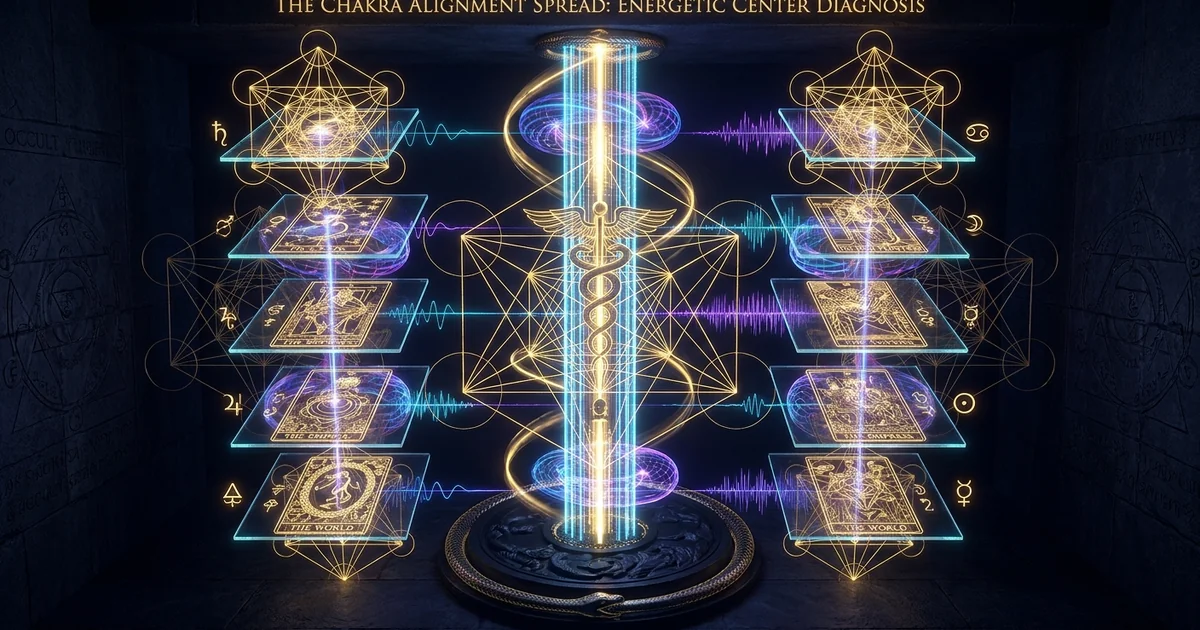
The Chakra Alignment Spread: Energetic Center Diagnosis
Archetypal Thesis & Systemic Paradigm: The Pranic-Archetypal Interface
Somatic Projection and State-Space Topography
Subtle energy functions within esoteric cartography as an intermediary ontological stratum, bridging the gulf between unquantifiable somatic physiology and the transcendent archetypal dynamics of the collective unconscious. Cartesian dualism bifurcated human existence into res cogitans and res extensa, creating an artificial epistemological schism that historically rendered physical sensation alienated from symbolic meaning. In contrast, Tantric subtle anatomy and Western Hermeticism posit an intermediate realm—the imaginal body, or the subtle pranic vehicle (prāṇamaya-kośa)—wherein somatic tensions, affective disturbances, and instinctual drives register as localized energetic vector fields. When operationalized through divination, the physical organism ceases to be merely biochemical machinery and is recognized as a living canvas of archetypal inscription.
The chakra alignment tarot spread diagnosis formalizes this bridge by translating subtle energetic fluctuations into an exteriorized, spatial state-space. Rather than treating the human body as an opaque biomechanical apparatus, this cartographic protocol projects the subject’s internal energetic topography onto a disciplined, two-dimensional matrix of seventy-eight symbolic keys. Each positional node within the spread functions as a discrete phase-space coordinate. Within this framework, psychic complexes that elude conscious verbalization undergo projective-identification upon the imagery of the Arcanum assigned to that locus. The diagnostic tarot spread thus provides a somatic mirror: a concrete, semiotic topology wherein neurovegetative tone, autonomic arousal, and instinctual fixation are converted into an intelligible grammar of elemental, astrological, and archetypal interactions.
[ Unconscious Affect / Somatic Tension ]
                   │
                   ▼  (Subtle Transduction)
        [ Prāṇamaya-Kośa / Nāḍī Matrix ]
                   │
                   ▼  (Hermetic Cartography)
      [ Seven-Node Tarot State-Space ]
                   │
                   ▼  (Conscious Integration)
       [ Homeostatic Biofeedback Loop ]
The Suṣumṇā Axis as a Projective Cybernetic Circuit
Within Tantric metaphysics, the central conduit of the subtle organism is the suṣumṇā nāḍī—the non-physical vertical axis running from the perineum to the coronal aperture of the skull. Flanked by the solar (piṅgalā) and lunar (iḍā) channels, the suṣumṇā represents the unconditioned channel through which the evolutionary potentiality of consciousness, personified as kuṇḍalinī-śakti, ascends. When this verticality is replicated through the diagnostic subtle energy spread, the vertical layout of cards ceases to be an arbitrary line of cardboard; it becomes an active cybernetic circuit. Each card dealt along the central column functions as an attractor state, capturing the prevailing thermodynamic and psychological tension operative within that specific developmental stage of consciousness.
By applying divinatory methodology directly to this energetic axis, the practitioner systematically de-fatalizes the reading process. Classical predictive fortune-telling relies upon a passive epistemological posture, trapping the querent in a deterministic timeline dictated by external agency. Conversely, diagnosing energetic centers via Tarot establishes an interactive biofeedback loop aimed at restoring systemic homeostasis. The spread does not ask what will occur, but rather how the psycho-somatic organism is currently processing, distributing, or constricting the life-force.
Through this recalibration, divination shifts from fatalistic augury to an operational navigational instrument. The cards reveal where consciousness has calcified into chronic muscular and psychic armoring, allowing the querent to mobilize conscious awareness—the foundational catalyst of psychological alchemy—toward systemic re-equilibration.
“The chakras, therefore, are symbols of consciousness. They represent the stages of consciousness through which man ascends from the purely instinctual life to the highest level of spiritual integration… If you turn to the chakras, you are turning to a system that describes the development of impersonal, archetypal consciousness through its localization in the physical body. In our Western psychology, we have completely forgotten that the body is also mind; we have localized the mind entirely in the head, whereas the Tantric system recognizes that the instincts, the passions, and the spiritual intuitions reside as distinct centers of awareness throughout the somatic column.” — Carl Gustav Jung, The Psychology of Kundalini Yoga: Notes of the Seminar Given in 1932 (ed. Sonu Shamdasani, 1996)
Classical Provenance & Textual Lineage: Tantric Shastra Meets Hermetic Cartography
Textual Genesis: The Ṣaṭ-Cakra-Nirūpaṇa and Tantric Subtle Body Anatomy
The foundational architectural blueprint for contemporary subtle body diagnostics derives from the sixteenth-century Bengali treatise Ṣaṭ-Cakra-Nirūpaṇa (“Description of the Six Centers”), penned by the Tantric adept Pūrṇānanda Svāmī as the sixth chapter of his extensive compendium, the Śrī-tattva-cintāmaṇī. Prior to its translation into English by Sir John Woodroffe (writing under the pseudonym Arthur Avalon) in the 1919 classic The Serpent Power, Western occultism possessed only fragmentary, highly distorted notions of the Eastern energetic loci. Pūrṇānanda systematically codified the six primary intra-corporeal lotuses (padmas)—ranging from Mūlādhāra at the pelvic floor to Ājñā between the eyebrows—crowned by the extra-corporeal locus of the Sahasrāra padma at the cranium.
[ Sahasrāra: Coronal Splendor (Trans-Elemental Consciousness) ]
                               │
[ Ājñā: Two-Petaled Lotus (Manas / Supreme Mind) ]
                               │
[ Viśuddha: Sixteen-Petaled Lotus (Ākāśa / Ether) ]
                               │
[ Anāhata: Twelve-Petaled Lotus (Vāyu / Air) ]
                               │
[ Maṇipūra: Ten-Petaled Lotus (Tejas / Fire) ]
                               │
[ Svādhiṣṭhāna: Six-Petaled Lotus (Apas / Water) ]
                               │
[ Mūlādhāra: Four-Petaled Lotus (Pṛthvī / Earth) ]
Pūrṇānanda’s formulation was fundamentally phenomenological and meditative rather than anatomical in the modern medical sense. Each cakra was characterized by a specific petal count, an inscribed Sanskrit phoneme (mātṛkā), a presiding deity, an animal vehicle (vāhana), and, critically, an elemental tattva. This classical anatomy was never conceived as an inert collection of anatomical organs; it mapped a living, vibrating continuum of psycho-spiritual power stations through which the macrocosm reflects within the microcosm (kṣudrabrahmāṇḍa). Physical ailments and psychological fixations were understood within this lineage not as isolated somatic breakdowns, but as disruptions in the rhythmic flow of the primary vital airs (prāṇa-vāyus) navigating through these focal points.
“The Chakras are centers of consciousness, which are the subtle aspects of the physical nerve-plexuses, but they are not the plexuses themselves. The Sukshma Sharira, or subtle body, is a real material continuum, though composed of matter far finer than that which is perceived by the physical senses. In the Sushumna Nadi, which is the central channel of this subtle system, the six Chakras are strung like lotuses on a stalk. He who contemplates these lotuses, with their respective Tattvas, deities, and seeds of power, acquires the mastery over the elements and frees the mind from the bondage of the gross flesh.” — Pūrṇānanda Svāmī, Ṣaṭ-Cakra-Nirūpaṇa, trans. Arthur Avalon, The Serpent Power (London: Luzac & Co., 1919)
The Western Occult Synthesis: Theosophical and Golden Dawn Transmutations
The translation of Tantric shastric literature precipitated an unprecedented convergence with Western esotericism during the late nineteenth and early twentieth centuries. Promoted by the early Theosophical Society under Helena Blavatsky, and later radically reconfigured by C.W. Leadbeater in his 1927 volume The Chakras, the subtle body was reinterpreted through an occult-physio-psychological lens. Concurrently, the founders of the Hermetic Order of the Golden Dawn—most notably S.L. MacGregor Mathers and William Wynn Westcott—synthesized Western Qabalah, Hermetic astrology, and the Tarot, laying the foundations for what would emerge as systemic energetic cartography.
Within the Golden Dawn’s private instructional curricula, documented in Book T: The Tarot, the cards were anchored to the Hebrew alphabet, the paths and Sephiroth of the Tree of Life, and the classical astrological decans. While the Golden Dawn officially focused its energetic work on the Western Middle Pillar exercise rather than the Indian cakra system, their meticulous synchronization of elemental affinities created the exact symbolic apparatus required to interface with Eastern pranic models. When modern esotericists mapped the seventy-eight cards of the Tarot onto the seven chakras tarot layout, they were not committing arbitrary cultural appropriation, but executing a logical synthesis of two parallel systems of psycho-cosmology.
Rigorous scholarship demands philological and historical hygiene: the Tantric cakra is an interior meditative locus activated by mantra and breath, whereas the Western Qabalistic sephira is an objective emanation of the divine pleroma. Nevertheless, within operational divination, both serve as archetypal nodes representing specific vibrational layers of being. The modern chakra alignment spread synthesizes these lineages by deploying the Tarot’s symbolic lexicon—governed by the strict elemental affinities articulated in /tarot/elemental-dignities-interpretive-framework—to evaluate the functional health of these Tantric power centers.
Structural Mechanics & Symbolic Geometry: The Seven-Node Vertical Spread Architecture
Node Geometry: The Ascending Basal-to-Coronal Vector
The structural mechanics of the chakra alignment spread reflect the morphology of the human spine and the vertical trajectory of the suṣumṇā nāḍī. The diagnostic procedure requires an ascending linear deployment of seven cards, extracted from the randomized deck and laid out from bottom to top. This bottom-to-top ordination is critical: it respects the evolutionary and developmental imperative of consciousness, which must establish grounding in physical survival before proceeding to affective, expressive, and noetic integration.
The diagnostic sequence acknowledges two simultaneous energetic currents detailed in both classical yoga and Western Hermeticism:
- The Muktimarga (the path of liberation), an ascending current whereby somatic energy is refined and sublimated into spiritual awareness.
- The Bhuktimarga (the path of manifestation), a descending current whereby cosmic inspiration and cognitive intent are crystallized into tangible form.
The seven-card column acts as an open register. It evaluates not only the internal balance of each discrete center, but also the systemic transit of prāṇa between adjacent nodes. A blockage at Node 3 necessarily distorts the expressive capacity of Node 5, just as an inflation at Node 6 devoid of stability at Node 1 invites clinical dissociation or ungrounded spiritual bypass.
Elemental, Planetary, and Sephiric Attributions per Locus
To execute a precise pranic diagnosis, each of the seven positions must be evaluated through its correspondence to classical Indian Tattva theory, Western planetary rulers, and Qabalistic architecture. The diagnostic matrix integrates these cross-traditional parameters:
| Positional Node | Sanskrit Cakra | Tattva / Element | Classical Planet | Qabalistic Sephira | Primary Psycho-Energetic Function |
|---|---|---|---|---|---|
| Node 1: Base | Mūlādhāra | Pṛthvī (Earth) | Saturn | Malkuth | Somatic security, survival instincts, physical stability. |
| Node 2: Sacral | Svādhiṣṭhāna | Apas (Water) | Jupiter / Moon | Yesod | Erotic desire, fluid emotionality, instinctual creativity. |
| Node 3: Solar | Maṇipūra | Tejas (Fire) | Mars / Sun | Hod & Netzach | Volition, dynamic ego agency, digestive and metabolic force. |
| Node 4: Heart | Anāhata | Vāyu (Air) | Venus / Sun | Tiphareth | Relational coherence, unconditional compassion, integration. |
| Node 5: Throat | Viśuddha | Ākāśa (Ether) | Mercury | Da’at (Abyss) | Semantic articulation, authentic voice, systemic truth. |
| Node 6: Brow | Ājñā | Mahat / Mind | Moon / Jupiter | Binah & Chokmah | Intuitive synthesis, metacognition, trans-rational vision. |
| Node 7: Crown | Sahasrāra | Trans-Elemental | Sun / Trans-Saturnian | Kether | Transcendence, unitive consciousness, non-dual realization. |
The spatial allocation of these correspondences provides the baseline against which the drawn cards are measured. When an Arcanum occupies a node, its internal symbolic composition (suit, element, planetary association, and numerological value) interfaces directly with the baseline matrix of that specific chakra.
Diagnostic Vectors: Evaluating Stasis, Depletion, and Hyper-Activation
Analyzing the spread requires isolating the functional status of each locus into one of three primary clinical categories: homeostasis (dynamic equilibrium), depletion (hypo-activation), or stasis/excess (hyper-activation).
Homeostasis is indicated when the intrinsic elemental nature of the card harmonizes with the native tattva of the chakra. For instance, receiving the Queen of Pentacles at Node 1 (Mūlādhāra/Earth) or the Ace of Cups at Node 2 (Svādhiṣṭhāna/Water) signifies that the energetic center is functioning smoothly. Vital force flows uninhibited, the psychological defense mechanisms associated with that developmental stage are flexible, and the querent maintains somatic resilience in that domain.
Depletion (hypo-activation) manifests when the card occupying a center displays profound structural deficiency, severe exhaustion, or elemental irrelevance that saps the center’s potency. Cards such as the Four of Swords, Five of Pentacles, or Eight of Cups residing in physical or affective centers denote an absence of available prāṇa. The center is running on energetic reserves; the individual may experience emotional alienation, chronic fatigue, an inability to assert boundaries, or a collapse of motivation relative to that center’s domain.
Stasis or Hyper-Activation occurs when dense, turbulent, or excessively combustible cards overwhelm a center’s regulatory capacity. The Tower, Five of Wands, Nine of Swords, or Devil landing in an energetic center indicate severe friction. Stasis reflects trapped, coagulated energy that cannot find constructive release, resulting in inflammation, hyper-vigilance, psychological fixations, and obsessive somatic tension.
[ DEPLETION / HYPO-ACTIVE ] <─── [ BALANCED HOMEOSTASIS ] ───> [ STASIS / HYPER-ACTIVE ]
- Under-vitalized                - Dynamic equilibrium            - Congested pranic flow
- Collapsed boundaries           - Elementally resonant           - Inflammatory resistance
- Apathy / Somatic deficit       - Fluid autoregulation           - Obsessive fixation
Psychological Dynamics & Operational Praxis: Pranic Diagnosis and Shadow Integration
Diagnostic Stratification: Reading Elemental Dissonance vs. Resonance
The diagnostic core of the chakra alignment tarot spread diagnosis rests upon evaluating elemental dignities between the drawn card and the recipient node. In the Golden Dawn system articulated in Book T, elemental interactions are classified as either harmonious, inimical, or neutral. When applied to subtle body diagnosis, elemental dissonance exposes the etiology of psychological neurosis and somatic disquiet.
Consider an elemental clash: a highly combustive, aggressive Fire card—such as the Knight of Wands or the Seven of Wands—falling into Node 2 (Svādhiṣṭhāna), the seat of the Water element (Apas). Water and Fire are mutually inimical; Fire boils and evaporates Water, while Water extinguishes Fire. Diagnostically, this placement identifies an acute somatic conflict: the fluid, receptive, and intuitive processing required by the sacral basin is being hijacked by urgent, impatient, and perhaps combative instinctual energy.
Psychologically, the querent is not experiencing organic emotional flow; rather, their feelings are inflamed, volatile, and prone to histrionic reaction or sexual burnout. The diagnostic spread exposes this friction not as a deterministic prophecy, but as an acute energetic state requiring conscious temperance.
Conversely, consider an excessively humid or aqueous card—such as the Eight of Cups or the Moon—occupying Node 3 (Maṇipūra), the furnace of the internal fire (Tejas). The metabolic fire necessary for decisive volition and healthy boundaries is submerged by oceanic affect, unaddressed grief, or unconscious projections. The individual cannot mobilize willpower because their solar center is literally drowned in emotional ambiguity. Resolving this tension demands deliberate behavioral interventions that re-ignite the digestive and psychic fire, clearing the swamp of emotional inertia.
Pranic Depletion (Hypo-Activation / Deficient Qi)
- Earth Centers (Nodes 1 & 2): Somatic ungroundedness, chronic derealization, structural fatigue, inability to hold financial or spatial boundaries; feeling untethered from the physical vehicle.
- Fire Centers (Node 3): Paralyzing abulia, profound lack of self-assertion, fear of visibility, passivity in the face of boundary violations, low digestive fire (mandāgni).
- Air Centers (Node 4 & 5): Respiratory constriction, emotional coldness, systemic mutism, total suppression of creative or dissenting expression, passive-aggressive submission.
- Water Centers (Node 2 & 4): Affective numbness, anhedonia, dry intellectualization of trauma, incapacity for relational empathy, isolationist defense mechanisms.
Pranic Stasis / Excess (Hyper-Activation / Inflammatory Qi)
- Earth Centers (Nodes 1 & 2): Severe behavioral rigidity, calcified resistance to psychological change, somatic hoarding, compulsive acquisition, stubborn entrapment in material structures.
- Fire Centers (Node 3): Narcissistic aggression, manic workaholism, tyrannical control dynamics, stress-induced somatic ulcers, severe autonomic hyper-arousal.
- Air Centers (Node 4 & 5): Hyper-verbalization, manic logorrhea, intellectualization shielding against felt emotion, obsessive rumination, discursive dissociation.
- Water Centers (Node 2 & 4): Histrionic flooding, boundary-less enmeshment, codependency, chronic somatization of emotional volatility, drowning in the personal unconscious.
Decoupling Somatization from Pathologization in Interpretation
A critical imperative within the operational praxis of the subtle energy spread is maintaining a rigorous phenomenological boundary between psycho-spiritual diagnosis and empirical medical nosology. A reader who observes the Three of Swords at Node 4 (Anāhata) or the Ten of Swords at Node 1 (Mūlādhāra) must never pronounce the existence of cardiovascular pathology or spinal disease. To do so is not merely ethically reprehensible; it represents a category error that conflates the imaginal subtle body with the gross physical organism (sthūla-śarīra).
Gross Somatic Layer (Sthūla-Śarīra)  <─── DO NOT DIAGNOSE (Pathology/Medicine)
                 ▲
                 │ (Interface of Somatization)
Subtle Pranic Layer (Sūkṣma-Śarīra)   <─── TARGET DOMAIN (Chakra Alignment Spread)
                 ▲
                 │ (Archetypal Transduction)
Causal Dynamic Layer (Kāraṇa-Śarīra) <─── DIVINATORY ACCESS (Hermetic Tarot Matrix)
The process of somatization involves the unconscious mind translating unresolved moral, psychological, or existential crises into physical sensations—a phenomenon extensively documented by psychoanalysis and modern trauma theory. When a difficult card occupies an energetic center, it indicates that an archetypal complex is actively somatizing: it is generating felt tension, muscular constriction, and neuro-energetic blockage.
The practitioner’s role is to illuminate the archetypal drama generating the somatic knot, decoupling the psychological complex from the physical vehicle. By liberating the symptom from unconscious physical confinement and restoring it to conscious symbolic awareness, the querent can process the emotional knot psychically rather than discharging it pathologically through somatic suffering.
The Triadic Sub-Spread for Acute Blockage Deconstruction
When a primary seven-node reading reveals a site of catastrophic stasis—signified by cards of profound structural disruption (such as The Tower, Death, Ten of Swords, or Three of Swords) or heavily degraded elemental dignities—the practitioner must not leave the site unexamined. The diagnostic inquiry shifts from global cartography to focal deconstruction through the deployment of an auxiliary Triadic Sub-Spread applied directly to the afflicted node.
       [ Sub-Card B: Upādhi ]
     (Present Defense Mechanism)
            ▲          ▲
           ╱            ╲
          ╱              ╲
[ Sub-Card A: Adhiṣṭhāna ]  [ Sub-Card C: Mokṣa/Kriyā ]
     (Root Psychic Cause)       (Liberating Action Vector)
The practitioner extracts three additional cards placed in a triad over the problematic cakra:
-
Card A: Adhiṣṭhāna (The Root Psychic Cause): This card anchors the etiology of the blockage. It reveals the historical, archetypal, or karmic root that initially generated the pranic constriction. It exposes what the psyche experienced as intolerable, driving the energy out of dynamic circulation and into defensive calcification.
-
Card B: Upādhi (The Present Defense Mechanism): This card depicts the active armor, compensation strategy, or secondary gain that maintains the blockage in the contemporary field. It illustrates the mask, behavioral pathology, or protective inflation the ego employs to avoid feeling the vulnerability exposed at the root.
-
Card C: Mokṣa/Kriyā (The Liberating Action Vector): This card provides the prescriptive therapeutic intervention. It indicates the exact elemental quality, psychological posture, or ritualized behavioral action required to break the stagnation and restore the uninhibited circulation of prāṇa through the afflicted cakra.
Philosophical Synthesis & Macrocosmic Correspondence: Hermetic Axioms and Microcosmic Coherence
As Above, So Below: Aligning the Middle Pillar with the Suṣumṇā
The theoretical validation of the chakra alignment spread rests upon the primary axiom of Western Hermeticism: Quod est superius est sicut quod est inferius—“That which is above is like that which is below.” The human subtle body does not exist in isolation from cosmic architecture; it is the macrocosm miniaturized and phenomenologically interiorized. This structural identity enables an operative bridge between the Eastern suṣumṇā nāḍī and the Western Kabbalistic Middle Pillar.
In the Hermetic Kabbalah, the central pillar of the Otz Chiim (the Tree of Life) represents the Pillar of Mildness or Equilibrium, harmonizing the energetic polarities of the Pillar of Mercy (Force) and the Pillar of Severity (Form). As explored extensively in /tarot/middle-pillar-tarot-mapping, this axis links Malkuth (the physical kingdom) directly through Yesod (the astral foundation) and Tiphareth (the solar center of beauty and consciousness) to Kether (the crown of divine unity).
When the tarot deck is deployed across the seven chakras, it simultaneously traces this Sephiric architecture. The cards illuminate the precise degree to which the querent’s personal vertical axis mirrors the cosmic order. When the energetic centers are aligned, the individual functions as a coherent conduit through which macrocosmic archetypes descend into material instantiation without neurosis, distortion, or energetic leakage.
The structural convergence of the seven subtle centers with the Western planetary heptarchy and Qabalistic architecture establishes an absolute coordinate system for advanced diagnosis:
- Sahasrāra (Crown): Corresponds to Kether (The Crown). Planetary Ruler: Primum Mobile / Neptune. Primary Major Arcanum: The Fool (Key 0) / The World (Key XXI) as cosmic completion. Trans-elemental unconditioned awareness.
- Ājñā (Third Eye): Corresponds to the supernal threshold bridging Binah and Chokmah across the Abyss. Planetary Ruler: Classical Moon / Jupiter in exaltation. Primary Major Arcanum: The High Priestess (Key II). Metacognitive vision and intuitive synthesis.
- Viśuddha (Throat): Corresponds to the sphere of Da’at (Invisible Sephira of Knowledge). Planetary Ruler: Mercury. Primary Major Arcanum: The Magician (Key I). Semiotic mastery, the spoken Logos, and communicative formulation.
- Anāhata (Heart): Corresponds precisely to Tiphareth (Solar Harmony). Planetary Ruler: Sol. Primary Major Arcanum: The Sun (Key XIX) or The Empress (Key III) as universal eros. Relational coherence and systemic integration.
- Maṇipūra (Solar Plexus): Corresponds to the dynamic junction of Netzach and Hod, reflecting Geburic force. Planetary Ruler: Mars. Primary Major Arcanum: The Tower (Key XVI) / The Chariot (Key VII). Ego agency, dynamic will, metabolic drive.
- Svādhiṣṭhāna (Sacral): Corresponds directly to Yesod (The Astral/Vital Foundation). Planetary Ruler: Luna. Primary Major Arcanum: The Moon (Key XVIII) / The Star (Key XVII). Fluid emotionality, instinctual libido, and subconscious imagery.
- Mūlādhāra (Root): Corresponds to Malkuth (The Material Kingdom). Planetary Ruler: Saturn. Primary Major Arcanum: The Universe / The World (Key XXI) or The Emperor (Key IV) for grounding form. Somatic structure, survival instinct, physical manifestation.
Non-Dual Homeostasis and Cybernetic Self-Correction
Within vulgar occultism, energetic centers are routinely subjected to a mechanistic fallacy: chakras are spoken of as valves that must be violently “blasted open” or defensively “shut down.” Classical Tantra, particularly the Non-Dual Śaiva-Śākta traditions of Kashmir, rejects this crude hydraulic framework. The cakra is not an aperture of physical plumbing, but a dynamic, oscillatory whirlpool (āvarta) of living consciousness (saṃvit).
True health within the subtle organism is never a permanent, static state of total exposure or impenetrable closure. It is dynamic homeostasis—the fluid capacity of an energetic center to open, receive, assimilate, express, and return to resting equilibrium in proportion to the demands of the environmental and psychological field.
The chakra alignment spread operates precisely as a cybernetic steering mechanism within this non-dual framework. Cybernetics, as defined by Norbert Wiener, is the science of communication and control in the animal and the machine, predicated upon feedback loops that continually inform a system of its deviation from an optimal operational state.
When a querent observes the cards arrayed along their suṣumṇā axis, the Tarot serves as an exteriorized consciousness-mirroring device. By visually registering elemental dissonances, depletion states, and instinctual congestions, the ego-consciousness receives the critical feedback required to modify its psychic posture.
The symbolic apprehension of the spread immediately induces somatic self-regulation: breathing patterns shift, unconscious muscular armoring softens, and cognitive fixation releases. In this moment, the Cartesian split dissolves entirely. Divination fulfills its highest metaphysical trajectory—not as an instrument of superstitious prophecy, but as a sophisticated psycho-cosmological protocol for systemic self-correction, homeostatic integration, and the purposeful realization of the Great Work.
Frequently Asked Questions: Analytical and Operational Inquiries
Interpreting Reversals in Subtle Body Diagnostics
The presence of reversed cards within a subtle energy spread introduces critical nuances that must not be reduced to simplistic negative omens. In the context of energetic center diagnosis, a reversed card fundamentally denotes an inverted vector of pranic circulation—the energy has turned inward, become internalized, or is trapped beneath the threshold of conscious realization.
When an inherently constructive card—such as the Three of Cups or the Six of Wands—appears reversed at Node 4 (Anāhata), it does not indicate the destruction of love or public disgrace. Instead, it diagnoses that the relational and expressive attributes of that card are currently blocked from outward interpersonal manifestation.
The individual may possess abundant affection, but an internalized inhibition prevents them from communicating it to the social environment. The vital force turns back upon the subject, often generating internal melancholy or silent self-criticism.
Conversely, when inherently disruptive cards appear reversed—such as The Devil (reversed) at Node 2 or the Five of Swords (reversed) at Node 5—the reversal frequently indicates an emerging emergence from bondage. The acute, toxic crystallization of the complex is beginning to fracture; the individual is actively discharging the somatic knot, even if the process is accompanied by the disorientation of psychological convalescence.
The reader must interpret reversals not as structural catastrophes, but as indicators of the flow direction of the vital airs: an upright card signifies externalized, manifest operational energy, whereas a reversed card signifies internalized, subterranean, or shadow-bound processes that demand introspection before they can be harmoniously integrated into the macrocosmic field.
Resolving Elemental Contradictions between Eastern and Western Systems
A recurring technical dilemma in subtle body diagnostics arises from the apparent divergence between classical Indian Tattva attributions and Western Hermetic-astrological associations. A prominent example lies in the rulership of the Heart Center (Anāhata): Indian shastric texts assign this lotus strictly to the Air element (Vāyu Tattva), governed by the visual symbol of the six-pointed hexagram and the sense of touch.
Conversely, the Western Hermetic tradition routinely maps the cardiac locus to the Sun, aligning it with Tiphareth on the Tree of Life, which embodies Solar Fire and spiritual equilibrium, or to Venus in post-Theosophical health models.
Resolving this discrepancy requires adopting the Hermetic principle of functional equivalence rather than enforcing a rigid, literalist syncretism. Both systems are describing the same energetic reality from different observational postures.
The Tantric assignment of Vāyu (Air) to Anāhata highlights its expansive, mobile, unifying, and relational essence: like the atmosphere, the heart permeates all things, knows no rigid boundaries, and provides the vital breath of communion across the organism.
The Western attribution of the Solar Fire emphasizes the heart as the central pump, the radiant monarch of the somatic kingdom, and the point of harmonious balance through which all peripheral forces are reconciled.
When evaluating a tarot spread at Node 4, the practitioner resolves this tension by treating Air as the medium of relation and Fire as the radiant source of integration. If an Air card (such as the Knight of Swords) falls here, it diagnoses the communicative, intellectual, and relational currents of the heart; if a Fire card (such as the Sun) appears, it diagnoses the vitality, sovereign self-worth, and radiant core of the querent’s identity.
The reader navigates these twin frameworks through a stereoscopic vision that honors both Eastern shastric phenomenology and Western Hermetic grammar, synthesizing them into a coherent diagnostic whole.
Ethical and Clinical Boundaries of Pranic Tarot Readings
The practice of subtle body diagnosis through symbolic systems carries profound ethical liabilities that require strict operational boundaries. Under no circumstances should an esoteric practitioner, regardless of their proficiency in divination or subtle anatomy, utilize the chakra alignment tarot spread diagnosis to diagnose, prognosticate, or treat physical or psychological diseases recognized by conventional medicine and psychiatry.
The subtle body is a phenomenological and imaginal construct. While imbalances in the prāṇamaya-kośa often correlate with somatic distress, conflating an energetic reading with clinical diagnostics generates acute iatrogenic anxiety.
Telling a querent that a Swords card at the heart center indicates coronary disease, or that a corrupted Pentacles card at the root indicates uterine or prostate pathology, is professional malpractice that fractures the ethical integrity of esoteric scholarship. Such conduct violates the baseline boundary of the therapeutic alliance and exploits the suggestible state induced during divinatory consultations.
The practitioner must maintain a clear framework:
- The spread maps phenomenological consciousness, archetypal tensions, and subjective states of energetic distribution.
- The reading explores how the querent experiences their vital force, where their emotional attention is concentrated or constricted, and how their instinctual complexes interface with conscious intent.
- If a querent presents with physical pain, chronic somatic symptoms, or severe psychiatric distress, the practitioner’s ethical obligation is to mandate immediate consultation with licensed medical or psychological professionals.
By operating strictly within the domain of psycho-spiritual navigation and archetypal integration, the practitioner maintains the sacredness of the work, serving not as an unqualified medical technician, but as a cartographer of the soul assisting the querent in navigating the evolving terrain of their own consciousness.