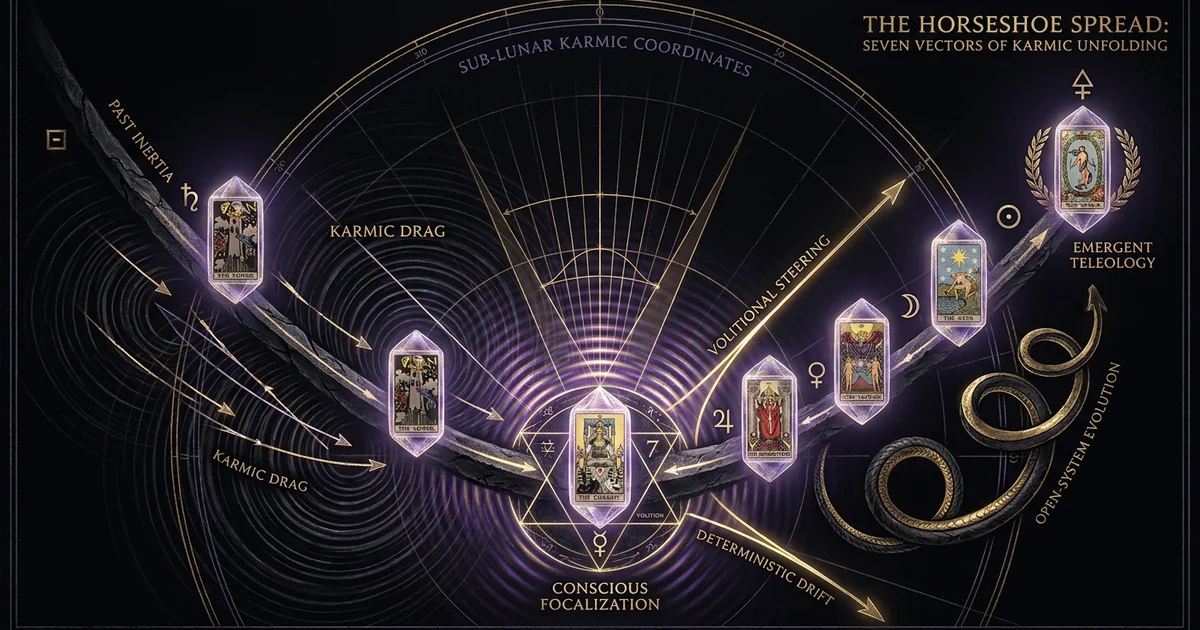
The Horseshoe Spread: Seven Vectors of Karmic Unfolding
Archetypal Thesis & Systemic Paradigm: The Heptadic Arc of Karmic Entelechy
The Parabolic Geometry of Consequence
The cartomantic deployment of the horseshoe spread constitutes a radical break from the static, concentric mechanics characteristic of closed cruciform designs. Whereas the traditional cruciform array models an immediate, cross-sectional anatomy of the psyche, the horseshoe architecture organizes cards along an open parabolic curve. This geometric arrangement mirrors the Hamiltonian mechanics of a physical system traversing a continuous potential energy landscape. The querent does not occupy a passive coordinate at the center of intersecting pressures; rather, volition is mapped as a discrete phase-space trajectory that ascends to an energetic apex and descends into empirical manifestation.
The parabolic trajectory inherently accounts for momentum, gravitational drag, and systemic thresholds. By structuring the consultation along an ascending limb (Vectors I through III), a culmination vertex (Vector IV), and a descending limb (Vectors V through VII), the spread models temporal unfolding not as a flat sequence of chronological occurrences, but as a non-linear curvature of consequence. Past actions generate kinetic debt; this debt curves upward through conscious and unconscious thresholds, confronts the fulcrum of present volitional agency, and cascades through macrocosmic constraints toward an emergent realization. The horseshoe spread thereby operationalizes the concept of karma away from vulgar retributive fatalism, reframing it as the conservative dynamics of an open energetic circuit.
                  [ Vector IV: Conscious Pivot ]
                     /                      \
        [ Vector III: Unconscious ]    [ Vector V: Environmental Field ]
               /                                  \
    [ Vector II: Immediate Axis ]        [ Vector VI: Subjective Shadow ]
           /                                          \
[ Vector I: Root Momentum ]              [ Vector VII: Emergent Teleology ]
State-Space Modeling of Volitional Trajectories
Within this analytical framework, the horseshoe tarot spread karmic vectors function as mathematical state variables. A reading does not generate a deterministic prophecy; it maps a state-space manifold where human volition interacts continuously with macrocosmic boundary conditions. Each vector represents a directional force operating within the querent’s psychic economy. When a card is placed into one of the seven positions, it instantiates an archetypal operator that modifies the entire systemic equation.
The predictive capacity of this model rests upon tracing the conserved quantities across the spread. Just as physical dynamics track the exchange between kinetic and potential energy, the practitioner must monitor how psychic energy—what Carl Gustav Jung termed libido—converts from latent unconscious pressure into overt behavioral praxis. The querent’s conscious intentionality rarely accounts for more than a single variable within this field. By externalizing the broader phase space across seven distinct loci, the consultation illuminates the hidden parameters governing the system, allowing the individual to recalibrate their trajectory prior to entering systemic lock-in at Vector VII.
The Septenary Nexus: Transcending Linear Determinism
The adoption of a seven-fold arrangement is neither arbitrary nor purely aesthetic; it draws directly upon the archaic archetype of the septenary cycle as the fundamental metric of sublunary evolution. A seven card spread engages an epistemological threshold where quantitative accumulation yields qualitative mutation. In classical metaphysics, the number seven marks the completion of an organic cycle—the heptad mediates between the unmanifest triad of divine archetypes and the manifest quaternary of material elements.
By distributing the inquiry across seven coordinates, the spread transcends simple linear determinism through a process of archetypal cybernetics. Each position provides a cybernetic feedback signal that modifies the meaning of adjacent nodes. The querent is confronted with a dynamic topology where causes do not merely produce uniform effects; instead, past actions (Vector I) are refracted through covert drives (Vector III), filtered through extrinsic pressures (Vector V), and polarized by internal complexes (Vector VI). The reading functions as an instrument of psychological individuation, dislodging the subject from repetitive behavioral scripts and restoring authentic moral agency within the deterministic stream of cause and consequence.
Classical Provenance & Textual Lineage: From Folk Heptagrams to Hermetic Geometry
The Heptadic Legacy within the Hermetic Order of the Golden Dawn
The historical morphology of the horseshoe spread traces a continuous developmental arc from informal European cartomantic methods to the systematic occult orders of the late nineteenth century. In the late Victorian era, the Hermetic Order of the Golden Dawn undertook a comprehensive synthesis of Western esotericism, reconciling continental ceremonial magic with Qabalistic emanational cosmology and classical astrology. Within the foundational instructional documents codified by S. L. MacGregor Mathers and Moina Mathers, designated collectively as Book T - The Tarot, the septenary planetary structure served as the foundational grid for analytical discernment.
“The seven planets correspond unto the seven double letters of the Sepher Yetzirah, and likewise unto the seven operational degrees of the lesser methods of opening the key. When the cards are arranged in the form of an arch or crescent, they set forth the ascension of the natural forces toward the sphere of the Sun, and their subsequent precipitation into the sublunary realm of elemental mixed forms.” — S. L. MacGregor Mathers, The Golden Dawn Manuscripts: Book T - The Tarot (1889)
Although the Golden Dawn popularized the elaborate fifteen-card spreading method and preserved the structural architecture of the /tarot/celtic-cross-spread-geometry, their internal papers reveal a continuous operational reliance upon seven-card configurations. These lesser spreads were designated for targeted strategic diagnostics where the extensive elemental counting of the Opening of the Key was computationally excessive. The Golden Dawn recognized that the planetary heptad, mapped onto the double letters of the Hebrew alphabet, provided an ideal symbolic apparatus for isolating the specific cosmic ray or planetary friction governing an immediate psychological conflict.
Transmission via Continental Occultism and Arthur Edward Waite
Prior to its formalization within British esoteric orders, the seven-card arch existed as an enduring staple of regional European cartomancy, particularly within French and Italian popular divination. In these early continental folk practices, seven cards were typically distributed in a semi-circle or open arch to read the unfolding of a discrete endeavor across time. However, these vernacular deployments lacked philosophical rigor, operating largely as fatalistic narrative strips tracking superficial encounters, fortunes, and perils.
The structural transformation of this folk method into a sophisticated tool for esoteric analysis occurred largely through the work of Arthur Edward Waite. In The Pictorial Key to the Tarot (1910), Waite sought to rescue cartomancy from what he characterized as the degraded, superstitious trivialities of fortune-telling. While Waite explicitly documented the Celtic Cross as the primary modern spread, his esoteric circles routinely utilized the seven-fold parabolic layout to trace the internal, moral evolution of the soul. By pairing the visual symbolism of the Major Arcana—which maps the /tarot/major-arcana-archetypal-journey—with the rigorous heptadic geometry of the horseshoe, post-Golden Dawn occultists converted a rudimentary peasant layout into an operational diagram of psychic transmutation.
Evolution from Cartomantic Folk Spreads to Formal Archetypal Diagrams
The transition from folk cartomancy to contemporary karmic divination marks a major paradigm shift. In traditional cartomancy, time was conceived as a uniform, unyielding corridor through which the querent marched toward preordained events. The folk horseshoe layout simply registered these events as sequential mile-markers.
With the twentieth-century convergence of Depth Psychology and Hermetic Philosophy, the seven-card spread was re-conceptualized as a projective psychological diagram. The seven positions ceased to denote reified external encounters and were instead recognized as nodes of internal and systemic tension. The parabolic curve came to represent the dialectical movement of consciousness: the ego’s immersion in historical conditioning, its ascent to a moment of decisive moral and psychological crisis, and its necessary descent into the empirical field to integrate the archetypal shadow. The modern horseshoe spread stands as an enduring synthesis of historical occult geometry and post-Jungian psychological cartography.
Structural Mechanics & Symbolic Geometry: Decoding the Seven Karmic Vectors
The structural integrity of the Horseshoe Spread is anchored in the descending Chaldean planetary order, tracing the manifestation of systemic force from the primordial boundary to sublunary reception:
- Vector I (Root Momentum): Attributed to Saturn (Binah/Shabbathai). Form, ancestral residue, chronos, structural constraint.
- Vector II (Immediate Axis): Attributed to Jupiter (Chesed/Tzedek). Expansion, current structural tension, focalized agency.
- Vector III (Unconscious Substrate): Attributed to Mars (Geburah/Madim). Severance, repressed instinct, covert subterranean drive.
- Vector IV (Conscious Pivot): Attributed to the Sun (Tiphareth/Shemesh). The fulcrum of self-awareness, illumination, moral bifurcation.
- Vector V (Environmental Field): Attributed to Venus (Netzach/Nogah). Extrinsic desire matrices, interpersonal resonance, social vectors.
- Vector VI (Subjective Shadow): Attributed to Mercury (Hod/Kokab). Rationalized anxiety, cognitive dissonance, projection of the complex.
- Vector VII (Emergent Teleology): Attributed to the Moon (Yesod/Levanah). The matrix of materialization, energetic precipitation, final karmic resolution.
Vectors I–III: The Infrasonic Baseline (Past Inertia, Present Axis, Covert Pressures)
The ascending limb of the horseshoe spread establishes the foundational parameters of the querent’s field of inquiry. It comprises three sequential vectors that map the transition of latent psychic momentum into acute, active consciousness.
                  [ Vector IV ]
                     /     \
        [ Vector III ]     [ Vector V ]
               /                 \
    [ Vector II ]               [ Vector VI ]
           /                         \
[ Vector I ]                         [ Vector VII ]
Vector I: Root Momentum (Past Inertia). This locus registers the systemic point of departure—the archetypal and historical inertia underpinning the query. It does not merely signify historical events that occurred in linear time; rather, it identifies the foundational karmic pattern that continues to exert gravitational pull upon the present. Operating under the planetary frequency of Saturn, Vector I exposes the structural calcifications, generational patterns, and unconscious commitments that restrict the current field of movement. It is the initial condition of the phase space: the unyielding causal ground from which the current inquiry emerges.
Vector II: Immediate Axis (Present Friction). Moving upward along the parabolic curve, Vector II establishes the acute conscious axis of the situation. Attributed to the expansive and governing current of Jupiter, this vector identifies where the structural weight of the past directly impacts the present moment. It marks the visible, conscious manifestation of the dilemma: the explicit conflict, project, or existential crossroads commanding the querent’s cognitive resources. Vector II measures immediate velocity and environmental friction; it reveals how effectively the subject’s conscious ego is navigating the incoming momentum of Vector I.
Vector III: Unconscious Substrate (Covert Pressures). Located directly beneath the summit of the parabolic arc, Vector III exposes the submerged instinctual, biological, and archetypal drives operating beneath the ego’s threshold of awareness. Governing this station is the dynamic, destabilizing influence of Mars. Here lie the repressed complexes, shadow volitions, and energetic compensations that secretly drive the overt behavior observed at Vector II. If a Major Arcana key manifests at Vector III, it indicates that the querent is gripped by a transpersonal dynamic that will actively sabotage conscious intent unless brought into analytical clarity before the culmination of Vector IV.
Vector IV: The Culmination Point and the Pivot of Praxis
Occupying the geometric apex of the spread, Vector IV represents the Conscious Pivot and the Fulcrum of Praxis. This station corresponds archetypally to the Solar sphere (Tiphareth), the seat of the mediating ego-Self axis on the Tree of Life. Vector IV constitutes the single most critical interpretive node in the entire horseshoe spread karmic vectors framework. It is not an indicator of an inevitable event; it marks the exact mathematical coordinate of highest potential energy, where the system possesses its greatest degree of volitional freedom.
At this vertex, the ascending trajectory of cause, conscious focus, and covert instinct reaches critical saturation. The card occupying Vector IV reveals the strategic imperative—the decisive psychological posture or behavioral intervention required to redirect the downstream outcome. It is the locus of genuine decision making tarot praxis. If the querent acts with archetypal lucidity at this juncture, they effectively alter the boundary conditions of the downward descent. Conversely, if Vector IV is bypassed through psychological evasion or unconscious reactivity, the trajectory enters a ballistic, deterministic descent through Vectors V, VI, and VII, leaving the outcome entirely to the mercy of environmental forces and unintegrated complexes.
Vectors V–VII: The Extrinsic Field, Subjective Polarization, and Karmic Synthesis
The descending limb of the horseshoe models the manifestation of the volitional decision into the external world. It captures the complex interplay between environmental context, subjective distortion, and systemic resolution.
Vector V: The Extrinsic Field (Macrocosmic Drag and Other). As the parabolic trajectory begins its descent toward materialization, it collides directly with the external environment. Vector V, operating under the magnetic and relational polarity of Venus, maps the extrinsic systemic field. This includes the agency, reactions, agendas, and systemic constraints imposed by other individuals, institutional systems, or macrocosmic conditions. Vector V answers the question of how the world receives the momentum directed through Vector IV. It acts as an energetic filter: it may present syntropic support and alignment, or it may assert severe environmental drag, showing precisely where individual volition confronts social, economic, or relational realities.
Vector VI: Subjective Shadow (Hopes, Fears, and Distortions). Positioned opposite to Vector II, Vector VI diagnoses the micro-agent’s internal, psychological digestion of the situation. Assigned to the quicksilver, cognitive sphere of Mercury, this vector isolates the querent’s internal neuroses, catastrophic projections, and idealized illusions. In traditional nomenclature, this position is often trivially titled “Hopes and Fears.” Analytically, however, it represents the specific cognitive biases and archetypal-shadow distortions that threaten to warp the subject’s perception. Vector VI exposes how the querent may internalize environmental friction (Vector V) as personal failure, or how unintegrated anxieties from the past (Vector I) resurface as self-fulfilling prophecies.
Vector VII: Emergent Teleology (Synthesized Resolution). The final grounding of the parabolic arc rests at Vector VII, assigned to the lunar realm of Yesod—the foundation and matrix of material precipitation. This vector does not depict a fatalistic, immovable future carved into stone. Rather, it represents the emergent teleology of the total system: the inevitable consequence that precipitates if the velocity, environmental resistance, and shadow complexes identified in the preceding six vectors remain unmodified. Vector VII demonstrates the law of entelechy: the realization of potential into actuality. It serves as an ontological mirror, reflecting the exact degree of consciousness or unconsciousness integrated throughout the preceding parabolic cycle.
Psychological Dynamics & Operational Praxis: Strategic Decision-Making and Shadow Integration
The Spread as an Iterative Cybernetic Feedback Loop
When deployed within advanced analytical contexts, the seven card spread ceases to be a static descriptive exercise and operates as an iterative cybernetic-feedback loop. In classic systems theory, a cybernetic mechanism requires a sensor to register system trajectory, a comparator to measure this trajectory against a homeostatic ideal, and an effector to execute corrective adjustments. The horseshoe spread integrates all three operations within a singular semiotic field.
Fatalistic Cartomancy (Passive Linear Model)
- Vector IV (Apex): Interpreted as an unavoidable crisis or predetermined event imposed by external forces.
- Vector VI (Shadow): Dismissed as simple emotional sentimentality (“what you are wishing for or dreading”).
- Vector VII (Telos): Read as a rigid, unalterable terminal fate that the client must passively accept.
- Operational Result: Entrenches psychological fatalism, reinforces victim complexes, and paralyzes moral volition.
Karmic Vector Modeling (Cybernetic Systems Model)
- Vector IV (Apex): Identified as the critical fulcrum of praxis and the exact locus of systemic volitional freedom.
- Vector VI (Shadow): Diagnosed as cognitive bias, projective identification, and active shadow sabotage.
- Vector VII (Telos): Modeled as an emergent, phase-space attractor that shifts dynamically based on adjustments at Vector IV.
- Operational Result: Stimulates conscious individuation, clarifies strategic choice-points, and restores active agency.
The practitioner approaches the spread by treating Vector IV as the system’s effector. The reading diagnoses the systemic drift: Vector I reveals the historical feedback loop, Vector III monitors subterranean signal noise, and Vector V measures external system perturbation. By visualizing the systemic direction, the querent receives a high-fidelity diagnostic readout of their psychological trajectory. Divination within this framework becomes an exercise in applied metacognition. The consultant uses the cards to elevate unconscious compensatory mechanisms into deliberate, calibrated strategies, arresting entropy before behavioral manifestation occurs at Vector VII.
Bifurcation Analysis: Resolving Decisional Impasses at Vector IV
In strategic decision making tarot operations, the apex card at Vector IV must be analyzed through the lens of bifurcation theory. In dynamic systems, a bifurcation point occurs when a small, continuous change in an input parameter produces a sudden, radical reorganization of the entire system’s topological structure. When a querent presents an acute decisional impasse—a profound crisis of personal, corporate, or ethical direction—Vector IV marks the exact threshold of systemic instability.
                              [ Vector IV: Bifurcation Point ]
                                     /                 \
                                    /                   \
        Branch A: Integrated Praxis                     Branch B: Ballistic Descent
                   |                                                |
      [ Systemic Equilibrium ]                         [ Pathological Entropy ]
To resolve this impasse, the analyst evaluates how the archetypal energy at Vector IV modifies the energetic flow between the ascending and descending limbs. If Vector IV contains an active, assertive arcanum (such as The Chariot or The Emperor), the decisional strategy mandates crisp boundary formation, structural imposition, and conscious command over incoming instinctual pressures.
Conversely, if a receptive or disintegrative arcanum appears (such as The Hanged Man or The Tower), the strategic imperative demands the systematic dissolution of obsolete ego defenses, conscious non-action, or the radical surrender of illusory control. By interpreting Vector IV not as an event that happens to the querent, but as a deliberate methodological stance that must be adopted by the querent, the spread functions as a compass for navigating complex, high-stakes life transitions.
Shadow Projection and Epistemic Distortion in Vectors V and VI
The interplay between the descending stations of Vector V (the Environmental Field) and Vector VI (the Subjective Shadow) exposes the primary psychological mechanism of suffering: projective identification and epistemic distortion. Carl Gustav Jung repeatedly demonstrated that elements of the personal and collective unconscious that remain unintegrated are invariably projected outward onto the macrocosmic environment. The subject then experiences their own disowned contents as hostile actions or insurmountable obstacles engineered by the external world.
The structural relationship between Vectors V and VI provides an unsparing diagnostic of this dynamic. The practitioner must conduct a rigorous cross-vector examination:
- Diagnostic Disentanglement: Is the card present in Vector V truly an external structural barrier, or is it merely the objective screen upon which the neuroses of Vector VI are being cast?
- Cross-Chatter Analysis: Examine the causal vector running from Vector I directly across to Vector VI. Frequently, unresolved ancestral trauma, past betrayal, or unacknowledged failures located in Vector I bypass conscious reflection, manifest subconsciously as repressed rage in Vector III, and resurface as acute paranoia or neurotic attachment in Vector VI.
- Epistemic Realignment: When the querent can visually perceive the structural divergence between what the world is presenting (Vector V) and the subjective cognitive distortion through which they interpret that presentation (Vector VI), the projective field collapses. The practitioner assists the querent in withdrawing these projections, transforming debilitating anxiety into clear, strategic engagement with real-world parameters.
Philosophical Synthesis & Macrocosmic Correspondence: Hermetic Polarity and Macrocosmic Recurrence
The Law of Septenaries in Hermetic Axiomatics and Agrippan Cosmology
The architectural integrity of the horseshoe spread derives directly from the classical doctrine of the septenary as codified in Renaissance Hermeticism. In the foundational cosmology of Heinrich Cornelius Agrippa’s De Occulta Philosophia (Book II, Chapter X), the “Scale of the Number Seven” is established as the supreme organizational matrix of the manifest universe. Agrippa systematized the Alexandrian and medieval concept that the cosmos is governed by the Seven Governors—the planetary spheres spanning from the remote, icy boundary of Saturn down to the immediate, reflective presence of the sublunary Moon.
“Number is not merely an invention of the human intellect; it is the most primitive archetypal expression of order in the human unconscious. The number seven, in particular, represents an organic, qualitative closure of a time-bound developmental process. When cards or divinatory lots fall into a septenary pattern, synchronicity operates to align the qualitative nature of that moment with the macrocosmic rhythms of sublunary change. Divination does not read causal chains; it registers the acausal clustering of archetypal meaning within an ordered, qualitative field.” — Marie-Louise von Franz, On Divination and Synchronicity: The Psychology of Meaningful Chance (1980)
This septenary cosmological framework bridges the celestial order directly to sublunary psychological transformation. Just as the soul was held to descend through the planetary spheres—gathering specific energetic coats, virtues, and vices at each celestial sphere—the querent’s volitional inquiry traces an identical descent through the seven cards of the spread.
The parabolic horseshoe acts as a microcosmic mirror of this ancient Ptolemaic journey. By mapping the inquiry across seven points, the spread attunes the individual’s temporal dilemma to the timeless planetary hours and cosmic cycles detailed in the /astrology/chaldean-order-planetary-hours. The divinatory session is transformed from a consultation about transient ego concerns into an operational alignment with the universal principles of Hermetic polarity, rhythm, and mental transmutation.
Entropy, Syntropy, and Karmic Dissipation across Dimensional Planes
The mechanics of karmic unfolding mapped by the spread can be rigorously conceptualized through the thermodynamic principles of entropy and syntropy. A closed system naturally moves toward entropy: dissipation of energy, loss of structure, and chaotic breakdown. When an individual operates entirely under the deterministic momentum of their past (Vector I) and the blind compulsions of their unconscious complexes (Vector III), their life trajectory behaves as a closed, entropic loop. Karma, within this operational context, is simply the accumulation of systemic entropy resulting from unexamined, mechanical behavior.
The horseshoe spread introduces syntropy into this energetic economy. By confronting the conscious mind with the totality of its causal trajectory, the consultation transforms a closed, entropic loop into an open, dissipative system. As formulated by Ilya Prigogine, dissipative structures import energy and order from their environment, allowing them to reorganize into higher, more complex states of equilibrium when subjected to structural fluctuations.
The fulcrum of praxis at Vector IV is precisely this structural fluctuation. When intentional consciousness intervenes at the culmination point, the systemic momentum of the past is not destroyed—it is integrated, metabolized, and redirected. Karmic dissipation occurs not through ascetic mortification or passive suffering, but through the syntropic application of archetypal insight, which breaks the repetitive cycle of mechanical recurrence.
The Parabolic Arch as the Microcosmic Journey Through the Seven Planetary Gates
To master the interpretation of the horseshoe spread is to perceive it as an initiatory passage through the planetary gates. The ascending limb requires the practitioner to lead the querent through the ordeal of Saturnian confrontation (Vector I), where past illusions and structural decay must be acknowledged without mitigation. It demands the expansion of perspective through Jupiterian vision (Vector II), followed immediately by the courageous descent into the Martian subterranean furnace (Vector III), where the querent’s hidden instincts and repressed aggressive libido reside.
Only when these three lower thresholds have been navigated can the querent stand beneath the unsparing, blinding clarity of the Solar apex (Vector IV). Here, at the station of Tiphareth, the ego undergoes a temporary death and realignment with the transpersonal Self. The descending arc marks the necessary re-entry into the world. The initiate must wear the social and relational garments of Venus (Vector V), withstand the mental trickery and cognitive shadows of Mercury (Vector VI), and ultimately anchor their transformed will into the sublunary lunar soil of Yesod (Vector VII).
Through this parabolic transit, the querent does not merely resolve a transient, tactical problem; they accomplish a discrete stage of the Great Work. Divination, practiced at this elevation, operates as applied theurgy—a systematic technology for aligning mortal volition with the supreme harmonic order of the cosmos.
Frequently Asked Questions
Structural Comparison: Horseshoe Spread versus the Celtic Cross
The essential distinction between the Horseshoe Spread and the ten-card Celtic Cross lies in their underlying spatial and temporal geometries. The Celtic Cross, detailed extensively in its classical framework (/tarot/celtic-cross-spread-geometry), is an intensive, concentric mandala. Its central axis—comprising the significator, the crossing obstacle, the root, the past, the crown, and the immediate future—is surrounded by a vertical staff of four contextual cards. This architecture is essentially static and spatial, offering a high-resolution, structural cross-section of the psyche frozen at a single moment in time.
The Horseshoe Spread, by contrast, is dynamic, vector-driven, and intrinsically temporal. Rather than examining a cross-sectional snapshot, it charts a ballistic trajectory through a continuous phase space. While the Celtic Cross excels at diagnosing the multi-layered architecture of a deeply entrenched internal neurosis or a dense, multi-faceted systemic crisis, the Horseshoe Spread is structurally superior for analyzing dynamic momentum, tactical decision-making, and forward-looking operational trajectories. It traces the continuous flow of consequence from root cause to emergent teleology without the static encumbrance of concentric radial stations.
Navigating Reversals and Blocked Karmic Vectors
Within the rigorous dynamics of the seven-vector framework, a reversed card is never interpreted as a simplistic, fatalistic inversion of its upright meaning, nor is it dismissed as an intrinsically malevolent omen. Reversals must be diagnosed as systemic vector inversions—instances where the archetypal current of the card has retroflexed inward or encountered extreme structural friction.
When a reversal occurs on the ascending limb (Vectors I–III), it typically indicates energy that has become pathologically internalized:
- A reversed card at Vector I reveals ancestral or past trauma that is being actively suppressed, leading to systemic calcification.
- At Vector III, a reversed card signifies that the subterranean instinctual drive is operating completely dissociated from the ego, threatening severe compensatory sabotage.
- When a reversal appears at the pivot point of Vector IV, it exposes acute decisional paralysis—the querent possesses the necessary conscious awareness to act, but is actively refusing the responsibility of their volitional agency.
- On the descending limb, a reversal at Vector V indicates profound environmental dissonance, where the outside world actively rejects the querent’s initiative.
- At Vector VI, a reversal signals severe, active epistemic distortion, where the subject’s cognitive shadow has completely detached from external reality, generating phantom fears or ungrounded delusions.
- Finally, a reversal at Vector VII indicates an outcome that fails to manifest physically, dissolving into latent, unresolved potential that will inevitably circle back into a subsequent karmic cycle.
Iterative Spreading for Complex, Multi-Tiered Strategic Decisions
The Horseshoe Spread accommodates fractal recursion. When an analytical reading uncovers an exceptionally dense, high-stakes decisional juncture at Vector IV, or when the emergent teleology at Vector VII points to a complex systemic bifurcation, the analyst does not terminate the consultation. Instead, the specific vector of interest is extracted and deployed as the seed coordinate for a secondary, subordinate seven-card horseshoe spread.
Initial Spread: [ I ] -> [ II ] -> [ III ] -> [ IV ] -> [ V ] -> [ VI ] -> [ VII ]
                                                |
                                      (Extracted as Seed)
                                                |
Secondary Spread:             [ I ] -> [ II ] -> [ IV ] -> [ V ] -> [ VII ]
                                          (Fractal Unfolding)
In this recursive operation, the card sitting at Vector IV of the primary spread is placed into the Vector I (Root Momentum) position of the secondary array. The practitioner then draws six additional cards to populate the remaining vectors of the new parabolic arch. This secondary reading provides an expanded, microscopic analysis of the internal mechanics governing that specific decision-making threshold.
Similarly, if Vector VII reveals an emergent teleology that requires multi-tiered strategic scaffolding over several months or years, that outcome card can be treated as the Vector I baseline for a subsequent phase-space projection. This fractal deployment allows the practitioner to navigate vast, complex matrices of corporate, spiritual, or psychological evolution, maintaining complete structural coherence across macroscopic and microscopic fields of inquiry. Through such operational mastery, the Horseshoe Spread confirms its status as one of the most mathematically sophisticated and archetypally complete instruments in the Western divinatory tradition. :::