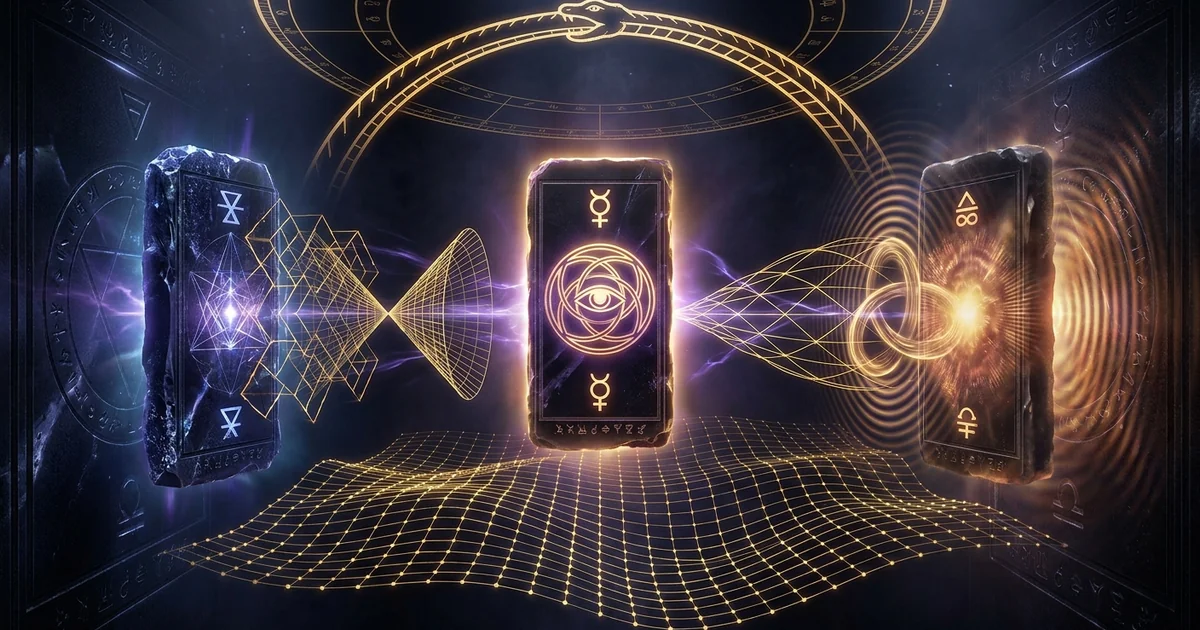
The Three-Card Spread: Past, Present and Future Vectors
Archetypal Thesis & Systemic Paradigm: The Triad as a Spatiotemporal Vector Engine
The cartomantic encounter is frequently misunderstood as an instrument of vulgar fortune-telling—a simplistic mechanism designed to extract predetermined chronological outcomes from a randomized deck. Within an advanced hermeneutic framework, however, the three card tarot spread past present future operates as an intricate, triadic state-space engine. It projects the phenomenological continuum of human consciousness across a three-node spatial matrix. Rather than freezing existence into a linear sequence of static coordinates, the layout establishes an energetic circuit where mnemonic trace, immediate observation, and probabilistic potential continuously inform and condition one another.
       [ VECTOR 1 ]                 [ VECTOR 2 ]                 [ VECTOR 3 ]
       Past: Mnemonic              Present: Conscious           Future: Probabilistic
       Trace & Inertia                  Fulcrum                       Horizon
To reduce this geometric architecture to a mere “quick tarot spread” for casual inquiry is to misunderstand its mathematical and psychological utility. The triadic layout functions as a minimum viable model of consciousness. Just as three non-collinear points establish a geometric plane, three positional archetypes capture the multidimensional topology of human experience. The observer does not simply look backward and forward along an unyielding, mechanical timeline; instead, the practitioner witnesses how active psychic residue shapes the present perceptive fulcrum, which simultaneously projects a prospective horizon.
Chronos vs. Kairos in Divinatory Cartography
Traditional temporal analysis relies on the concept of chronos—quantitative, uniform, divisible, and strictly sequential time. In the classical chronometric worldview, the past is an extinct repository of causes, the present is an infinitesimal and vanishing point, and the future is an unwritten destination waiting to be struck by the falling dominoes of deterministic causality. Cartomancy, by contrast, operates entirely within the domain of kairos: the qualitative, non-linear, archetypally charged moment of opportunity and crisis. The three-card array disrupts quantitative time by externalizing internal psychological vectors onto physical space, transforming chronos into a living, interconnected field.
When the practitioner engages in triadic divination, the temporal vector designated as “Past” does not represent a fixed historical datum buried in the chronological registry. Instead, it signifies the querent’s active mnemonic trace—the unassimilated psychic debt, emotional fixation, or structural inertia currently pressing upon the field of awareness. The “Future” position does not denote an unalterable, pre-scripted fate. Rather, it represents an unfolding teleological trajectory, an emergent probability wave generated by the collision of past momentum with present behavioral paradigms.
“Synchronicity does not denote causality in a temporal sequence, but rather an acausal connecting principle wherein internal psychic states and external objective events correspond meaningfully. In prospective analysis, the unconscious projects an anticipatory blueprint—a teleological orientation toward future individuation rather than a mechanical reaction to past trauma.” — C. G. Jung, Synchronicity: An Acausal Connecting Principle (Collected Works, Vol. 8, §840)
Within this kairological framework, time is treated not as a passive medium through which the individual travels, but as an active matrix of archetypal forces. The layout maps how these forces concentrate within the experiential present. For a broader analysis of how complex spatial spreads handle temporal architecture, see the systemic breakdown in the /tarot/celtic-cross-deep-structure monograph.
The Dynamic Triad: Thesis, Antithesis, and Synthesis
The operational architecture of the three-card layout reflects the dialectical engine governing Western esoteric philosophy and Hegelian logic. In this layout, the three positions do not merely sit side by side as isolated portraits; they engage in an active dialectical exchange. The first card (Position 1: The Past) functions as the thesis—the established condition, the foundational premise, or the initial energetic momentum introduced into the querent’s system.
Position 2 (The Present) emerges as the antithesis or the fulcrum of confrontation. It introduces the immediate conflict, the observational friction, or the counter-force that challenges the inertia of the initial thesis. It is the locus where the individual’s conscious ego-awareness directly encounters the resistance of material reality or psychic contradiction. The interaction between thesis and antithesis generates an intolerable structural tension that demands resolution, which cannot be achieved by remaining within the parameters that created it.
Position 3 (The Future) therefore manifests as the synthesis. It does not merely arrive after the present; it emerges out of the dynamic friction between the first two cards. The third card models the teleological resolution of the dialectic. It demonstrates how the thesis and antithesis are subsumed, integrated, and transformed into an entirely new operational state. If the conscious fulcrum (Present) fails to assimilate the structural inertia of the initial condition (Past), the synthesis manifests as systemic collapse or involuntary symptomology. Conversely, if the conscious fulcrum successfully integrates this historical momentum, the third card reveals a coherent leap forward in conscious individuation.
State-Space Reductions and the Observational Frame
In cybernetic terms, a divination system operates as a state-space reduction mechanism. The human psyche is submerged in an overwhelming sea of internal and external stimuli, cognitive biases, affective feedback loops, and probabilistic horizons. Attempting to interpret this total psychological matrix simultaneously results in cognitive noise and analytical paralysis. The three-card spread reduces this infinite-dimensional psychological state-space to a discrete, three-node observational frame.
By limiting the spread to three points of contact, the practitioner filters out non-essential systemic interference, maximizing signal clarity. This radical constraint does not diminish the interpretive depth of the consultation; it enhances it. The triad isolates the primary variables driving the querent’s current systemic trajectory:
- The primary generative source (Input)
- The current transmutative process (Throughput)
- The emerging systemic output (Feedback/Output)
When the reading is framed this way, the three-card spread past present future ceases to be a rudimentary parlor trick. It becomes an advanced heuristic tool. It mirrors the fundamental feedback loops that govern self-regulating organisms. The querent is confronted with a compressed, externalized blueprint of their internal trajectory, enabling targeted interventions within their psychological and behavioral framework.
Classical Provenance & Textual Lineage: From Cartomantic Truncation to Modern Geometry
The spatial arrangement of cartomantic symbols along a horizontal, three-node timeline is not an arbitrary modern convention. It is the historical product of late eighteenth-century French occultism, nineteenth-century British esoteric syntheses, and early twentieth-century psychological codifications. By examining how this format evolved from expansive, table-length spreads down to the minimal geometric triad, we uncover the deliberate engineering that underpins its widespread use today.
Etteilla’s Linear Syntheses and 18th-Century Cartomancy
The formalization of cards as structural instruments of temporal analysis originated primarily with Jean-Baptiste Alliette (writing under the pseudonym Etteilla) in late eighteenth-century Paris. Prior to Etteilla’s seminal 1785 treatise, Manière de se récréer avec le jeu de cartes nommées Tarots, cartomancy was largely an informal folk practice characterized by fluid, unregulated tableau distributions. Drawing on speculative Egyptian historiography and French esoteric Freemasonry, Etteilla introduced rigorous positional mechanics to card layouts.
Etteilla pioneered the practice of arranging cards in strict horizontal lines, assigning specific contextual valences to the directional movement of the consultation. His methodological treatises instructed the reader to read cards in linked linear sequences—frequently utilizing three-card groupings or “triplets” to unpack specific events, conditions, and outcomes. In Etteilla’s operational schema, a single card was considered semantically unstable; its latent meaning could only be locked into place when flanked by an antecedent and a subsequent card. This laid the empirical groundwork for what modern practitioners term the timeline reading, anchoring interpretive meaning within a sequential chain of cause, condition, and consequence.
The Golden Dawn’s ‘Opening of the Key’ Reductions
During the late Victorian occult revival, the Hermetic Order of the Golden Dawn absorbed and radically revised these continental cartomantic methods. S. L. MacGregor Mathers and his circle rejected vulgar, fatalistic fortune-telling in favor of an elaborate Hermetic-Qabalistic framework. Within their formal curriculum, divination was treated as an operational science governed by precise astrological, elemental, and Qabalistic attributions.
The primary cartomantic methodology of the Golden Dawn was the formidable “Opening of the Key” (OOK) operation. This system involved multiple operations across the table, utilizing the entire seventy-eight-card deck to track astrological decans, elemental affinities, and Hebrew letter associations. However, within this massive operation, Mathers recognized that the human mind processes narrative and archetypal tension most effectively through the fundamental functional unit of the “story-triad.”
In the OOK, once cards were dealt into their respective directional heaps, the adept read them by counting across the tableau according to systematic numerical values, consistently pairing the card landed upon with the two cards flanking it. These three-card groupings were analyzed using strict rules of elemental dignities. The Golden Dawn established that the triad is the foundational quantum of cartomantic meaning; larger spreads are simply composite networks built from these integrated, three-node building blocks. For an exhaustive analysis of the Golden Dawn’s counting techniques, consult /tarot/elemental-dignities-hermetic-mechanics.
A.E. Waite’s Geometric Codification in the Pictorial Key
When Arthur Edward Waite published The Pictorial Key to the Tarot in 1910, he set out to strip away what he viewed as the superstitious accretions and needlessly convoluted obscurities of earlier occultists, while preserving the structural integrity of the symbolic system. While Waite popularized the ten-card Celtic Cross spread as the primary layout for general inquiries, he simultaneously validated the concise, three-node configuration as an elite instrument of clean, concentrated divination.
“The presence of many cards often serves only to confuse the intuition of the operator, multiplying ambiguities rather than resolving them. In the hands of an adept who has mastered the interior correspondences, three cards are sufficient to extract the heart of any mystery, mirroring in their balance the three worlds of human and divine operation.” — A. E. Waite, The Pictorial Key to the Tarot (1910), Part III, Section 2
Waite recognized that an excess of positional variables often encourages an undisciplined reader to drown in contradictory symbols. By standardizing the clean, linear triad—which was later codified across the twentieth century into the classic Past-Present-Future model—Waite provided a framework that bridges the conscious intellect and the transpersonal imagination. In doing so, he established that geometric economy, rather than sprawling positional complexity, yields the highest degree of interpretive signal fidelity.
Structural Mechanics & Symbolic Geometry: Directionality, Dignities, and Vector Tension
A rigorous reading of the three card tarot spread past present future requires moving beyond interpreting each card in isolation. The spread functions as an interconnected semantic field where positional geography, elemental interactions, and visual dynamics actively qualify, amplify, or mute the individual archetypes.
Spatial Semiotics: Left-to-Right Vectoring vs. Cultural Scripts
The spatial arrangement of the triad carries implicit psychological meaning. In Western cultures, where written language and historical timelines are inscribed from left to right, the cartomantic layout naturally absorbs this cognitive conditioning. The left-hand card is positioned as the origin point, carrying a systemic drag that represents retrospective momentum. The center card provides a stabilizing, observational anchor. The right-hand card serves as the open probabilistic horizon, functioning as the directional emission point of the system’s kinetic energy.
This arrangement relies on deep-seated cognitive metaphors:
- The Left: The unconscious, the maternal, the receptive, the ancestral background, and accumulated historical entropy.
- The Center: The conscious ego-interface, the active locus of crisis, sensory immediacy, and the fulcrum of choice.
- The Right: The realm of projection, teleological becoming, external action, and prospective manifestation.
If an operator works within a cultural script that reads right-to-left (such as Hebrew or Arabic), the semiotic polarities naturally invert. What remains invariant across all cultural applications is the triadic topology itself: an origin point, an observational fulcrum, and a vector of emission. The central card remains structurally dependent on the card behind it, while exerting immense pressure on the card ahead.
Elemental Dignities and Inter-Card Polarities
The interaction between the three cards is governed by the Hermetic doctrine of elemental dignities, derived from classical physics and astrological theory. Each card in the deck is governed by one of the four esoteric elements: Fire (Wands), Water (Cups), Air (Swords), or Earth (Pentacles). In the three-card configuration, the elemental identity of the central card dictates how effectively energy flows from the Past into the Future.
The system relies on fundamental dynamic relationships:
- Friendly and Active: Fire and Air fuel and stimulate one another (Air feeds the flame; Fire rarefies the atmosphere).
- Friendly and Passive: Water and Earth nourish and stabilize one another (Water irrigates the soil; Earth contains and channels the waters).
- Inimical and Antagonistic: Fire and Water neutralize one another through violent steam and extinction; Air and Earth wear one another down through abrasion and stagnation.
Consider a scenario where the Past card is the Knight of Wands (Fire), the Present card is the Three of Cups (Water), and the Future card is the Ace of Swords (Air):
       [ KNIGHT OF WANDS ]   ──X──   [ THREE OF CUPS ]   ─────>   [ ACE OF SWORDS ]
             (Fire)                       (Water)                      (Air)
       *Antagonistic Interface*      *Structural Blockage*       *Laminar Transition*
Here, the energetic, kinetic drive of the Past vector is directly quenched by the emotional, communal water of the Present. The Present card is severely compromised or “ill-dignified” by the historical inertia pressing into it. The system experiences internal friction, boiling off its kinetic momentum into emotional confusion. Consequently, the transition into the Future card (Air) will not emerge as a smooth, organic development. Instead, it will arrive through intellectual crisis or severing detachment, as the system struggles to liberate itself from the steam produced by the clash between Fire and Water.
Conversely, if the triad displays a sequence of King of Cups (Water), Queen of Pentacles (Earth), and Eight of Pentacles (Earth), the dignities operate in harmonious mutual reception. The emotional depth and intuitive insights of the past are grounded by the practical, stabilizing present, allowing the future trajectory to unfold through focused, disciplined craft and material stability. The cards do not clash; they flow together in laminar alignment.
Card Gaze Dynamics and Directional Flow
Beyond elemental dignities, the spatial mechanics of the triad are shaped by the visual anatomy, ocular gaze, and physical posture of the figures depicted across the cards. This visual dynamic dictates whether the energetic vector flows smoothly forward, collapses in reverse, or deadlocks in internal conflict.
When analyzing the three-card spread, the practitioner must map the line of sight for each illustrated figure:
[ PAST CARD ]                 [ PRESENT CARD ]                 [ FUTURE CARD ]
Figure gazes RIGHT (---->)    Figure gazes LEFT (<----)        Figure gazes FORWARD (O-O)
            \                      /
             \                    /
*Somatic Collision & Fixation*- Averting the Future: If the figure in the Present card turns their back to the Future card and fixes their ocular gaze directly onto the Past card, the layout indicates psychological regression. Despite any conscious desire to advance, the querent’s active attention is captured by historical trauma or past accomplishments. The prospective vector is systematically starved of conscious energy.
- Refusal of History: If the figure in the Present card faces firmly toward the Future, but the figure in the Past card faces completely away from the spread (off to the far left), the individual is attempting to make a forward leap while repressing their foundational conditions. The unintegrated past becomes a shadow-vector, covertly undermining the emergent future.
- Harmonious Forward Vectoring: When the figure in the Past gazes toward the Present, and the figure in the Present gazes directly into the Future, an unbroken circuit of consciousness is established. Mnemonic energy is processed, integrated at the central fulcrum, and channeled into the teleological horizon.
Psychological Dynamics & Operational Praxis: Deploying the Spread in Real-Time Analysis
When deployed with psychological rigor, the three-card spread operates as an active biofeedback loop, not a passive exercise in fatalism. Divination only descends into superstition when the observer treats the symbolic sequence as an unalterable narrative carved into the fabric of a predetermined universe. By applying Jungian archetypal psychology and cybernetic systems theory, the practitioner transforms the consultation into a dynamic intervention.
Deterministic / Fatalistic Divination
- Ontology: Reality is a closed, pre-scripted chronological timeline (chronos).
- Agency: The querent is a passive recipient of external events and fixed outcomes.
- Future Node: An immutable, prophetic verdict; an inevitable circumstance waiting to happen.
- Mechanics: Treats symbols as literal, linear predictions of material fortune.
- Intervention: Remediation through passive submission, superstitious evasion, or fatalistic acceptance.
Cybernetic / Archetypal Vector Analysis
- Ontology: Reality is an open, probabilistic field of archetypal meaning (kairos).
- Agency: The querent is an active observer and co-creative agent in an ongoing feedback loop.
- Future Node: A quantum superposition representing the path of least systemic resistance.
- Mechanics: Decodes symbols as reflections of unconscious complexes and dynamic field pressures.
- Intervention: Psycho-spiritual transformation; altering the present fulcrum changes the teleological trajectory.
Decoupling Fatalism: The Future Position as a Quantum Superposition
In professional practice, the third position—the Future—must be presented to the querent as a high-probability trajectory rather than an inescapable destiny. Drawing on the language of quantum mechanics and systems analysis, this position represents a superposition of potential outcomes, collapsed into a specific archetype by the unconscious momentum documented in positions one and two.
The Future card answers a specific systemic question: Given the psychic debt active in the Past, and assuming the ego continues its current patterns in the Present, what is the path of least resistance for this system?
If the card revealed in the future position is catastrophic or disruptive—such as the Tower (Key XVI) or the Three of Swords—it does not indicate an unavoidable appointment with fate. Instead, it issues a diagnostic alert: the system is traveling along an unsustainable trajectory. The prospective collapse can be interrupted if the querent consciously alters the structural dynamics of the Present card. The spread reveals the emergent trajectory specifically so the querent can participate in its conscious revision. For more on the acausal mechanisms driving this work, explore /esoteric-philosophy/jungian-synchronicity-divination.
The Mechanics of Timeline Reading and Cognitive Calibration
A clinical timeline reading requires tracing how cognitive complexes migrate through the spread. During the reading, the practitioner acts as an analytical mirror, tracking how the querent’s cognitive biases manifest across the triadic layout:
- Phase 1: Excavation of the Mnemonic Complex (Position 1): The practitioner isolates the core belief, unresolved conflict, or structural pattern driving the situation. The question here is not simply “What happened?”, but “What historical narrative is the querent’s psyche actively maintaining?”
- Phase 2: Identification of Present Defense Mechanisms (Position 2): The practitioner examines how the central card responds to this past momentum. Does the present archetype represent an overcompensation, an avoidance strategy, or an active confrontation? This card reveals the querent’s current psychological equilibrium, exposing where conscious intent conflicts with unconscious habit.
- Phase 3: Extrapolation of the Horizon (Position 3): The practitioner maps the prospective vector, synthesizing the previous two positions into their natural systemic outcome. The client is asked to evaluate this trajectory: Does this projected horizon align with your conscious will, or does it merely perpetuate the unresolved conflicts of the past?
This triadic calibration shifts the querent from a posture of passive anxiety to one of conscious agency. The reading illuminates the hidden mechanics of their situation, returning responsibility for the outcome to the conscious ego.
Symptomatic Diagnostics: Resolving Past-Present Cognitive Loops
A common phenomenon in cartomantic diagnostics is the “stalled loop,” where the dynamic tension between the Past and the Present creates an energetic impasse, freezing the entire system in place.
┌────────────────────────────────────────────────────────┐
       │                                                        │
       v                                                        │
[ PAST CARD ] <========================================> [ PRESENT CARD ]
(Unresolved Complex)    *Endless Compensatory Oscillation*     (Rigid Defense)
This dynamic occurs when the Present card functions entirely as a psychological defense mechanism against the Past card, rather than serving as an evolutionary bridge into the Future. For example, if the Five of Pentacles (material lack, abandonment) appears in the Past position, and the Four of Pentacles (rigid control, hoarding, emotional containment) appears in the Present, the system is caught in a closed, trauma-driven feedback loop:
The individual is so consumed by the fear of historical deprivation that they lock their psychic energy behind rigid defenses. This stance chokes off the organic circulation of energy required to manifest a balanced future. As a result, the Future card will inevitably display stagnation or violent disruption, reflecting the system’s inability to adapt.
The practitioner’s task is to point out this defensive loop directly to the querent. By naming the dynamic, the reader helps dissolve the compulsive lock between the first two cards, allowing the central fulcrum to finally release its energy into a conscious, creative future vector.
Philosophical Synthesis & Macrocosmic Correspondence: Hermetic Axioms and Systemic Feedback
The structural elegance of the three-card spread past present future is not a product of chance or convenience. It is an expression of fundamental metaphysical laws that govern both macrocosmic processes and individual human consciousness. From the emanations of the Hermetic Qabalah to the alchemical transmutations of early modern philosophy, the triad has always served as the primary blueprint for the manifestation of spirit into form.
The table below establishes the direct structural correspondences between the three-card spread vectors, the Hermetic Tria Prima, the Hegelian dialectic, and the Supernal emanations of the Qabalistic Tree of Life:
| Spatiotemporal Vector | Alchemical Principle (Tria Prima) | Hegelian Dialectic | Qabalistic Sephirah (Supernal) | Psychological Function |
|---|---|---|---|---|
| Position 1: Past | Salt (Sal): Fixity, structural crystallization, material residue | Thesis: The established condition or primary assertion | Binah (Understanding / Form): The Great Mother, structural constraint, time | Unconscious memory, somatic habit, karmic inertia |
| Position 2: Present | Mercury (Argentum Vivum): Volatility, mediation, consciousness | Antithesis: The internal contradiction or counter-force | Kether / Tiphareth: The conscious mediator and spiritual pivot | Ego-awareness, active perception, choice fulcrum |
| Position 3: Future | Sulfur (Sulphur): Combustion, teleological drive, dynamic will | Synthesis: The resolution and emergence of a new state | Chokmah (Wisdom / Force): The primordial dynamic thrust, expansive will | Emergent probability, teleological trajectory, potential |
The Triad on the Tree of Life: Kether, Chokmah, Binah / Supernal Reflections
Within the Hermetic Qabalah, the universe emerges through the interaction of three primordial Supernal emanations atop the Tree of Life: Kether (the Crown, the singular source), Chokmah (Wisdom, dynamic masculine force), and Binah (Understanding, receptive feminine form). These three Sephiroth comprise the Supernal Triad, the divine engine from which all manifest reality cascades downward into the physical world of Malkuth.
[ KETHER ]
                   (Source / Fulcrum)
                       /        \
                      /          \
                     /            \
          [ CHOKMAH ] <----------> [ BINAH ]
      (Force / Teleology)       (Form / Mnemonic Past)
The three-card spread functions as a micro-cosmic reflection of this Supernal architecture:
- Binah governs form, restriction, karma, and the fabric of historical time itself. It is the cosmic reservoir of memory, directly corresponding to Position 1 (The Past).
- Chokmah is the boundless, undifferentiated kinetic thrust toward becoming. It represents raw teleological drive, corresponding directly to Position 3 (The Future).
- Kether—reflected downward across the central Abyss into the solar beauty of Tiphareth (the Sephirah of conscious integration)—serves as the balanced mediator holding these two opposing polarities in equilibrium. This pivot corresponds directly to Position 2 (The Present).
When an adept lays down three cards, they are not merely engaging in a mundane reading. They are tracing the primordial descent of light across the Tree of Life. The spread recapitulates the ongoing cosmic dance between Form (Past) and Force (Future), mediated by the central spark of Awakened Consciousness (Present). For a deeper analysis of these dynamics, refer to /qabalah/tree-of-life-triads.
Alchemical Triplicities: Sulfur, Mercury, and Salt
In the alchemical tradition codified by Paracelsus, all manifest phenomena are composed of three interior principles known as the Tria Prima: Salt, Sulfur, and Mercury. These principles are not merely physical chemical substances; they are universal psycho-spiritual dynamics.
- Salt (Sal): Represents the principle of fixation, crystallization, physical corporeality, and dense historical weight. In the three-card spread, Salt rules the Past. It is the ash left behind by the alchemical fire—the durable, immovable record of choices already made and experiences already crystallized into character.
- Sulfur (Sulphur): Represents the principle of combustion, desire, active teleology, and the spiritual will toward transmutation. Sulfur rules the Future. It is the volatile, unquenched desire within the human soul that drives the system forward into new experiences, compelling the individual to transform potential into actual reality.
- Mercury (Argentum Vivum): Represents the fluid, volatile principle of mediation, transformation, consciousness, and communication between worlds. Mercury rules the Present. It is the only force capable of dissolving the rigid crystallization of Salt without being consumed by the fiery hunger of Sulfur.
The present moment is an inherently Mercurial space. If the central card operates with healthy alchemical fluidity, it dissolves the rigid, dead weight of past habit (Salt) and channels the volatile, creative impulses of the future (Sulfur) into a stable, conscious life. If the alchemical Mercury is contaminated, the system fractures: the individual is either crushed by the weight of their past or incinerated by erratic, anxious impulses about what is to come.
Systemic Cybernetics and the Holographic Monad
The Hermetic axiom “As above, so below; as within, so without” is fundamentally a description of fractal, holographic systems. In a hologram, every individual part contains the structural information of the entire image. Similarly, in cybernetics, any viable self-regulating system must possess a mechanism that mirrors the environment it interacts with.
The three card tarot spread past present future operates as a holographic monad. Contained within this minimal three-node footprint is the essential narrative structure of the universe: Origin, Crisis, and Destination. It reflects the cybernetic loop of an organism navigating an uncertain world:
- Sensory input from past experience (Mnemonic Memory)
- Central computational processing (Present Integration)
- Motor action guided by anticipation (Prospective Behavior)
When the practitioner masters the dynamics of this simple triad, they possess the structural key to every layout in cartomancy. A ten-card Celtic Cross, an astrological wheel, or a full tableau are simply complex networks woven from these fundamental three-card vectors. By learning to read the quiet conversation between the past, the present, and the emergent future, the adept reads the human soul as it learns to navigate time itself.
Frequently Asked Questions: Technical Clarifications in Positional Triads
Resolving Stalled Vector Trajectories
How should a practitioner interpret catastrophic Major Arcana cards (e.g., The Tower, Death, Ten of Swords) when they appear in the Future position?
A catastrophic or disruptive archetype appearing in the future position must never be interpreted as an immutable, fatalistic decree of personal doom. In archetypal psychology and cybernetic vector analysis, cards like The Tower (Key XVI) or the Ten of Swords signify the necessary structural collapse of unsustainable cognitive assumptions, ego-defenses, or life situations.
The future card illustrates the logical systemic terminus of the momentum documented in the Past and Present positions. When a collapse archetype appears, it indicates that the querent’s current trajectory cannot continue without triggering an inevitable systemic correction. The practitioner’s objective is to unpack the underlying mechanism:
[ PAST: EGO-INFLATION ]  ──>  [ PRESENT: COMPULSIVE DEFENSE ]  ──>  [ FUTURE: THE TOWER ]
 (Unconscious Hubris)               (Rigid Denial)                  (Systemic Correction)
The Tower does not announce an arbitrary strike from an angry universe; it reveals that the conscious ego has constructed a rigid, brittle psychological architecture (Position 2) to compensate for historical vulnerabilities (Position 1). The appearance of the Tower is an evolutionary intervention designed to liberate consciousness from a psychological prison. The querent is invited to consciously deconstruct their rigid defense mechanisms in the present, allowing the psychic energy bound up in the structure to be released safely, without requiring a destructive external crisis.
Major vs. Minor Arcana Hierarchies in Positional Dominance
How does the distribution of Major and Minor Arcana across the three positions affect the dynamic weight of the reading?
The balance between the Major Arcana (the twenty-two transpersonal, archetypal keys) and the Minor Arcana (the fifty-six contextual, tactical cards) indicates whether the querent is navigating broad transpersonal forces or routine, everyday dynamics.
       [ MAJOR IN PAST ]             ──>             [ MINORS IN PRESENT & FUTURE ]
(Macrocosmic Archetypal Root)                     (Mundane Tactical Adaptations)
- Major Arcana in the Past, Minors in Present and Future: This configuration demonstrates that the root cause of the current situation is transpersonal, archetypal, or karmic. The querent is dealing with the lingering aftershocks of an initiation, an existential shift, or a deep structural transition that occurred in the past. The Minor Arcana in the present and future show that the current work is tactical, mundane, and practical: the individual is simply learning how to integrate and live out the consequences of that fundamental archetypal shift.
- Minors in the Past and Present, Major Arcana in the Future: This dynamic indicates that ordinary daily choices, tactical decisions, and mundane habits are converging toward an archetypal crisis or transformation. The querent may feel they are managing ordinary, low-stakes matters, but the system’s kinetic energy is reaching a critical threshold that will soon initiate a profound, transpersonal reorganization.
- Major Arcana exclusively across all Three Positions: The querent is suspended in an existential crisis or spiritual initiation. Immediate mundane considerations are completely overshadowed by transpersonal imperatives; the conscious ego must surrender its tactical calculations and align with the deep demands of psychological individuation.
Alternative Triadic Layout Configurations
How do non-temporal triadic variants (e.g., Mind-Body-Spirit or Situation-Obstacle-Advice) relate to the Past-Present-Future baseline?
Alternative three-card layouts are simply coordinate rotations of the exact same underlying geometric and alchemical engine. They do not depart from the fundamental mechanics of the triad; they merely map its structural axes to different dimensions of experience.
- Situation – Obstacle – Advice: This popular operational layout directly mirrors the Hegelian dialectic:
- Situation represents the Thesis (the established reality or Past vector).
- Obstacle represents the Antithesis (the friction, confrontation, or Present locus of crisis).
- Advice represents the Synthesis (the prospective vector of conscious integration or Future resolution).
- Mind – Body – Spirit: This layout maps the triad vertically through the subtle and material bodies, directly paralleling the alchemical Tria Prima:
- Body aligns with Salt (the material, crystallized residue).
- Mind aligns with Mercury (the fluid, perceptive, mediating consciousness).
- Spirit aligns with Sulfur (the dynamic, teleological divine spark driving the soul forward).
Regardless of the semantic labels applied to the positions, the functional geometry of the three-card layout remains identical. It balances two opposing forces through a central mediating fulcrum, mapping the structural coordinates of consciousness as it moves through the manifest world.